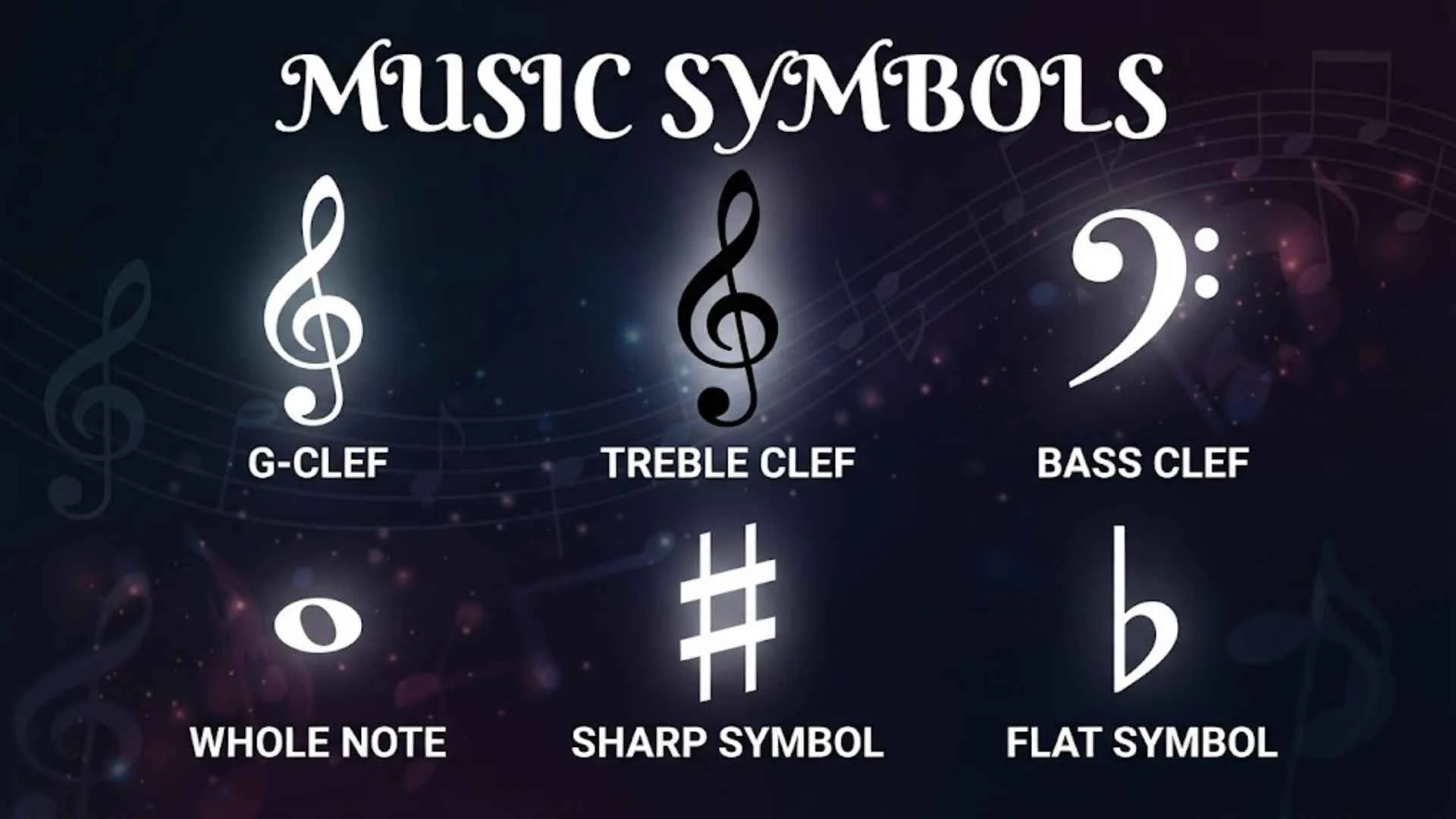
Music symbols are the visual language used to write, read, and communicate music. They tell musicians what notes to play, how long to hold them, when to remain silent, how loudly or softly to perform, how fast to play, and how a musical passage should be expressed.
You may recognize familiar symbols such as the treble clef 𝄞, sharp ♯, flat ♭, quarter note ♩, or eighth note ♪. However, written music contains many other symbols that provide detailed instructions about pitch, rhythm, dynamics, articulation, tempo, repetition, and musical expression.
Understanding music symbols and their meanings is useful for beginners learning sheet music as well as experienced musicians who want a convenient notation reference. This guide explains the most important musical symbols in simple language, with examples and practical explanations.
Music Symbols and Meanings at a Glance
The following table provides a quick reference to some of the most commonly encountered music symbols.
| Symbol | Name | Meaning |
| 𝄞 | Treble clef | Establishes the pitch positions for a higher register |
| 𝄢 | Bass clef | Establishes the pitch positions for a lower register |
| ♯ | Sharp | Raises a note by one semitone |
| ♭ | Flat | Lowers a note by one semitone |
| ♮ | Natural | Cancels a previous sharp or flat |
| 𝄪 | Double sharp | Raises a note by two semitones |
| 𝄫 | Double flat | Lowers a note by two semitones |
| 𝅝 | Whole note | Long note value |
| 𝅗𝅥 | Half note | Half the duration of a whole note |
| ♩ | Quarter note | Common rhythmic value |
| ♪ | Eighth note | Shorter rhythmic value |
| 𝅘𝅥𝅮 | Sixteenth note | Short rhythmic value |
| 𝄻 | Whole rest | Silence corresponding to a whole-note value |
| 𝄼 | Half rest | Silence corresponding to a half-note value |
| 𝄽 | Quarter rest | Silence corresponding to a quarter-note value |
| . | Augmentation dot | Adds half of the original duration |
| 𝄐 | Fermata | Holds a note or rest longer than its written value |
| = | Equal sign | Indicates equality in musical or theoretical notation |
| p | Piano | Play softly |
| f | Forte | Play loudly |
| mf | Mezzo-forte | Moderately loud |
| mp | Mezzo-piano | Moderately soft |
| < | Crescendo hairpin | Gradually become louder |
| > | Diminuendo hairpin | Gradually become softer |
| 𝄆 | Repeat sign | Repeat a designated section |
| 𝄌 | Coda | Indicates a concluding section |
| ° | Degree symbol | Commonly used for degrees or certain chord notation |
| ∞ | Infinity | Represents an unbounded concept in music-related mathematics/theory |
The exact appearance of some symbols can vary between fonts, notation software, and musical traditions.
What Are Music Symbols?
Music symbols are written signs that communicate instructions or information about a musical composition.
A single piece of sheet music can use symbols to communicate several different types of information.
Pitch
Pitch symbols tell a musician which notes to play or sing.
Clefs, note positions, key signatures, and accidentals all contribute to pitch information.
Rhythm
Rhythmic symbols tell the performer how long sounds should last and when silence should occur.
Notes, rests, dots, ties, beams, and time signatures are important parts of rhythmic notation.
Dynamics
Dynamic markings tell musicians how loudly or softly to perform.
Examples include:
- pp — very soft
- p — soft
- mp — moderately soft
- mf — moderately loud
- f — loud
- ff — very loud
Expression
Expression markings provide instructions about musical character and performance.
They may tell a musician to play smoothly, sharply, lightly, heavily, or with another particular character.
Structure
Barlines, repeat signs, D.C., D.S., Coda, and Fine help performers understand how different sections of a composition are organized.
Music Note Symbols
Music notes are among the most recognizable music symbols. They communicate pitch and rhythmic duration.
The visual appearance of a note can change according to its duration.
Whole Note
A whole note has an open notehead and normally does not have a stem.
In 4/4 time, it normally occupies four quarter-note beats.
Its exact duration should always be understood in relation to the meter and surrounding notation.
Half Note
A half note has an open notehead with a stem.
In 4/4 time, it normally lasts for two quarter-note beats.
Two half notes can therefore fill one standard 4/4 measure.
Quarter Note
The quarter note ♩ has a filled notehead and a stem.
In 4/4 time, it normally represents one quarter-note beat.
Quarter notes are among the most frequently encountered note values in beginner music.
Eighth Note
The eighth note ♪ has a filled notehead, a stem, and a flag when it appears by itself.
Two or more eighth notes can be connected with a beam.
In 4/4 time, an individual eighth note normally represents half of a quarter-note beat.
Sixteenth Note
A sixteenth note has a filled notehead and a stem with two flags when written individually.
Multiple sixteenth notes are often connected with two beams.
They allow composers to represent faster rhythmic subdivisions.
Thirty-Second Notes and Smaller Values
Music can use thirty-second, sixty-fourth, and even smaller note values.
These symbols are particularly useful for passages containing rapid rhythmic movement.
The shorter the note value, the more notes can fit within the same overall rhythmic space.
Music Rest Symbols
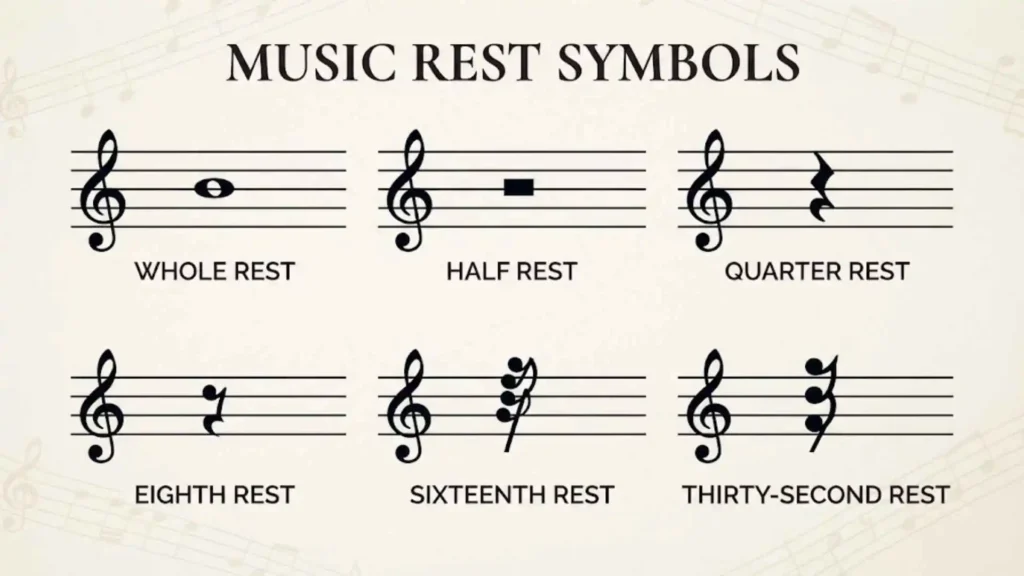
Rests are just as important as notes because music contains both sound and silence.
A rest tells the musician not to produce a sound for a specified rhythmic duration.
Whole Rest
A whole rest represents a duration equivalent to a whole note in many contexts.
In common 4/4 usage, it can also indicate that the performer remains silent for an entire measure.
Half Rest
A half rest represents the duration of a half note.
In 4/4 time, it normally represents two quarter-note beats of silence.
Quarter Rest
A quarter rest represents the same rhythmic duration as a quarter note.
It is commonly encountered in melodies and rhythmic patterns.
Eighth Rest
An eighth rest represents the silent equivalent of an eighth note.
It allows short gaps to be written precisely within a rhythm.
Sixteenth Rest
A sixteenth rest represents the duration of a sixteenth note without producing a sound.
Multiple short rests can create complex rhythmic patterns.
Why Rests Matter
Beginners sometimes focus only on notes and overlook rests.
This can cause rhythmic mistakes because silence is part of the composition. A rest is not simply an absence of information; it is an intentional rhythmic instruction.
Clef Symbols
Clefs appear at the beginning of a staff and establish how the lines and spaces should be interpreted as pitches.
Treble Clef
The treble clef 𝄞 is also known as the G clef.
It is commonly used for higher musical registers.
You may encounter it in:
- Violin music
- Flute music
- Trumpet music
- Guitar music
- Many vocal parts
- The right hand of piano music
The treble clef identifies the position of G above middle C.
Bass Clef
The bass clef 𝄢 is also called the F clef.
It is commonly used for lower musical registers.
You may see it in:
- Bass guitar music
- Cello music
- Double bass music
- Trombone music
- Tuba music
- The left hand of piano music
The bass clef identifies the position of F below middle C.
Alto Clef
The alto clef is a C clef that places middle C on the middle line of the staff.
It is strongly associated with viola music.
Tenor Clef
The tenor clef is another type of C clef.
It is used for certain higher passages of instruments that commonly read bass clef, including some cello, bassoon, and trombone music.
Staff and Barline Symbols
The staff provides the framework on which musical notes and other markings are written.
Musical Staff
A standard staff contains five horizontal lines and four spaces.
The clef determines how these lines and spaces correspond to pitches.
Notes placed higher or lower on the staff generally represent different pitches.
Ledger Lines
Ledger lines are short horizontal lines used above or below the staff.
They allow musicians to notate pitches that fall outside the normal five-line staff.
Barline
A barline is a vertical line separating measures.
It helps organize musical rhythms into manageable groups.
Double Barline
A double barline contains two vertical lines.
It can indicate the end of a section or another important structural point.
Final Barline
A final barline commonly marks the end of a composition or movement.
It is often visually heavier than an ordinary barline.
Accidentals and Pitch Symbols
Accidentals change the pitch of individual notes.
Sharp Symbol
The sharp symbol ♯ raises a note by one semitone.
For example:
F♯
is one semitone higher than F.
A sharp can occur as part of a key signature or as an accidental applied to a particular note.
Flat Symbol
The flat symbol ♭ lowers a note by one semitone.
For example:
B♭
is one semitone lower than B.
Like sharps, flats can occur in key signatures or as individual accidentals.
Natural Symbol
The natural symbol ♮ cancels a previous sharp or flat according to the rules of the notation in which it appears.
For example, if an F has been raised to F♯ and a natural sign is subsequently applied, the pitch returns to F natural.
Double Sharp
The double-sharp symbol 𝄪 raises a note by two semitones.
It is less common for beginners but appears in some key signatures and advanced harmonic contexts.
Double Flat
The double-flat symbol 𝄫 lowers a note by two semitones.
It is another advanced accidental that may appear in more complex musical passages.
Key Signature Symbols
A key signature appears near the beginning of a staff, usually after the clef.
It establishes the default sharps or flats for a passage.
Sharp Key Signatures
A key signature may contain one or more sharps.
These sharps apply to the relevant notes throughout the passage unless another marking changes a particular note.
For example, a key signature containing F♯ means F is normally treated as sharp within that key context.
Flat Key Signatures
A key signature can also contain flats.
A key signature with B♭ means B is normally treated as flat throughout the relevant passage.
Key Signature vs. Accidental
The difference is useful for beginners.
A key signature establishes a recurring pitch pattern for a passage.
An accidental changes a particular note in the written music.
Understanding this distinction makes sheet music much easier to read.
Time Signature Symbols
A time signature tells musicians how beats are organized into measures.
It usually appears after the clef and key signature.
4/4 Time
The time signature 4/4 is one of the most commonly encountered meters.
The top number indicates four beats or metric units in each measure, while the bottom number identifies the quarter note as the notational unit represented by 4.
In ordinary 4/4 notation, four quarter-note beats fill a measure.
3/4 Time
The time signature 3/4 normally contains three quarter-note beats per measure.
It is strongly associated with waltz-like rhythmic patterns, although it is used in many other types of music.
2/4 Time
The time signature 2/4 normally contains two quarter-note beats per measure.
It is frequently used in music with a clear two-beat pulse.
6/8 Time
The time signature 6/8 contains six eighth-note units per measure.
These are often felt as two larger beats, each divided into three eighth notes.
Common Time
The symbol C is commonly used to represent 4/4, also called common time.
It is a traditional notation shortcut rather than a separate meter.
Cut Time
The symbol ¢ is commonly associated with 2/2, called cut time.
It indicates two half-note beats per measure.
Dynamic Music Symbols
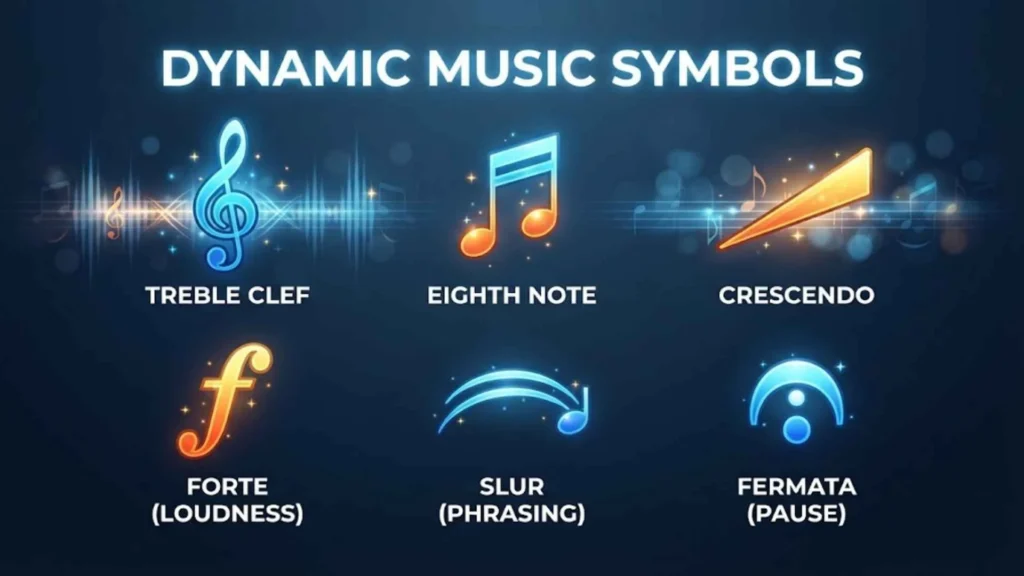
Dynamics tell performers about volume and changes in intensity.
Pianissimo
pp means pianissimo.
It instructs the performer to play or sing very softly.
Piano
p means piano.
It means softly.
The word “piano” here refers to volume rather than the piano instrument.
Mezzo-Piano
mp means mezzo-piano.
It indicates a moderately soft dynamic.
Mezzo-Forte
mf means mezzo-forte.
It indicates a moderately loud dynamic.
Forte
f means forte.
It instructs the performer to play or sing loudly.
Fortissimo
ff means fortissimo.
It indicates a very loud dynamic.
Additional markings such as ppp and fff can indicate even softer or louder levels.
Crescendo and Diminuendo Symbols
Dynamics can change gradually rather than staying at one level.
Crescendo
A crescendo means to gradually become louder.
It can be written as cresc. or represented by an expanding hairpin:
<
The marking tells the performer to increase the musical intensity over the indicated passage.
Diminuendo
A diminuendo means to gradually become softer.
It can be written as dim. or represented by a closing hairpin:
>
It is also sometimes described using the term decrescendo.
Articulation Music Symbols
Articulation markings tell musicians how individual notes should be attacked, sustained, separated, or emphasized.
Staccato
A small dot placed above or below a note indicates staccato.
The note is performed in a short, detached manner rather than being sustained in the same way as a fully connected note.
Accent
The accent symbol > indicates emphasis.
An accented note receives more prominence than surrounding notes.
Tenuto
A horizontal line placed above or below a note commonly indicates tenuto.
It generally tells the performer to give the note its full written value and to emphasize its sustained character.
Marcato
Marcato indicates strong emphasis.
It generally asks the performer to give a note a pronounced, marked attack.
Fermata
The fermata symbol 𝄐 indicates that a note, chord, or rest should be held longer than its written duration.
The exact amount of extra time depends on musical context and performance practice.
Tie and Slur Symbols
Ties and slurs can look similar, but they communicate different instructions.
Tie
A tie connects two notes of the same pitch.
The durations are combined so that the sound continues for the total value.
For example, tying a quarter note to another quarter note produces a continuous duration equivalent to two quarter notes.
Slur
A slur connects notes that generally have different pitches.
It indicates smooth, connected phrasing rather than combining their rhythmic values.
Tie vs. Slur
The easiest way to distinguish them is:
Tie = same pitch + combined duration
Slur = connected notes + smooth phrasing
This distinction is especially important for beginners learning to read sheet music.
Tempo Symbols
Tempo tells musicians how quickly a composition should be performed.
Traditional tempo terms are often derived from Italian.
Largo
Largo generally indicates a very slow, broad tempo.
Adagio
Adagio generally indicates a slow and expressive tempo.
Andante
Andante suggests a moderate pace traditionally associated with a walking character.
Moderato
Moderato indicates a moderate tempo.
Allegro
Allegro generally indicates a fast and lively tempo.
Presto
Presto indicates a very fast tempo.
BPM
Tempo can also be specified precisely using beats per minute, or BPM.
For example:
♩ = 120
means that the quarter-note beat occurs at a rate of 120 beats per minute.
Traditional tempo words are useful descriptions, while BPM provides a more precise numerical reference.
Repetition and Navigation Symbols
Composers often need to tell performers when to repeat a section or jump to another part of a score.
Repeat Sign
The repeat sign 𝄆 or its paired form indicates that a section should be repeated.
The performer follows the repeat instructions shown in the score.
Da Capo
D.C. stands for Da Capo, meaning “from the beginning.”
It tells the performer to return to the beginning of the indicated musical section.
Dal Segno
D.S. stands for Dal Segno, meaning “from the sign.”
It directs the performer back to a designated sign in the score.
Coda
The coda symbol 𝄌 indicates a concluding section.
An instruction such as To Coda tells the performer when to jump to that section.
Fine
Fine means “end.”
It identifies the point where the performance finishes when used with a navigation instruction such as D.C. al Fine.
Ornament Music Symbols
Ornaments decorate melodies and add expressive or technical detail.
Trill
A trill involves rapid alternation between a principal note and a neighboring pitch.
It adds movement and ornamentation to the melody.
Mordent
A mordent is a short ornament involving rapid movement between a principal note and an adjacent note.
The exact performance can vary according to musical style and historical practice.
Turn
A turn is an ornament that moves around a principal note using neighboring pitches.
It can add a decorative melodic figure to a passage.
Grace Note
Grace notes are small notes placed before a main note.
They are generally performed quickly as ornaments rather than receiving the same rhythmic emphasis as ordinary notes.
Octave and Register Symbols
Some markings tell performers to play written notes in another register.
8va
8va indicates that the music should generally be performed one octave higher than written.
This avoids the need to place many ledger lines above the staff.
8vb
8vb indicates that the music should generally be performed one octave lower than written.
It is useful for passages that would otherwise require numerous ledger lines below the staff.
15ma and 15mb
These markings can indicate that music should be performed two octaves above or below the written notes.
They are useful for extreme registers.
Chord Symbols
Chord symbols are common in lead sheets, popular music, jazz, and contemporary music.
Major Chord
A simple letter such as:
C
normally indicates a C major chord.
Minor Chord
A symbol such as:
Cm
indicates C minor.
Seventh Chord
A symbol such as:
C7
usually indicates a C dominant seventh chord.
Major Seventh Chord
A symbol such as:
Cmaj7
indicates a C major seventh chord.
Diminished Chord
A symbol such as:
Cdim
indicates a diminished chord.
Chord notation can vary between styles, so the surrounding musical context is important.
Instrument-Specific Music Symbols
Not every music symbol is used by every instrument. Some markings are designed for particular playing techniques.
Piano Symbols
Piano notation may include pedal instructions such as:
- Ped.
- Una corda
- Tre corde
- Release markings
These markings tell the pianist how to use the instrument’s pedals or change pedal technique.
Guitar Symbols
Guitar notation and tablature can include markings for:
- Bends
- Slides
- Hammer-ons
- Pull-offs
- Vibrato
- Harmonics
- Palm muting
These symbols communicate techniques that ordinary pitch notation may not fully describe.
String Instrument Symbols
String players may encounter markings for bow direction and techniques such as:
- Down-bow
- Up-bow
- Pizzicato
- Arco
- Tremolo
These instructions affect how the sound is produced.
Vocal Music Symbols
Singers may encounter:
- Breath marks
- Caesuras
- Phrase markings
- Lyric extensions
- Slurs
These markings help communicate breathing, phrasing, pronunciation, and musical expression.
How to Read Music Symbols in Sheet Music
Knowing individual symbols is useful, but the real skill is understanding how multiple symbols work together.
Start With the Clef
Look at the clef first.
The clef establishes how the staff’s lines and spaces represent pitches.
Check the Key Signature
Next, identify the key signature.
It tells you which pitches are normally sharpened or flattened throughout the relevant passage.
Check the Time Signature
Look at the time signature to understand how the beats are organized.
This helps you determine how notes and rests fit within each measure.
Identify the Tempo
Look for a tempo word or BPM marking.
This tells you how quickly the piece should be performed.
Read the Notes and Rests
Identify the pitches and rhythmic values.
Pay attention to stems, flags, beams, dots, and rests.
Look for Accidentals
Check whether individual notes have sharps, flats, naturals, double sharps, or double flats.
These can modify pitches established by the key signature.
Follow Dynamics and Articulation
Finally, pay attention to dynamic and articulation markings.
A passage is not fully interpreted by pitch and rhythm alone. The composer may also specify volume, emphasis, smoothness, separation, and other expressive details.
How Music Symbols Work Together
A musical score should be read as a complete system rather than as a collection of unrelated symbols.
Consider a simplified example:
𝄞 + 4/4 + ♯ + ♩ + f
These symbols provide different kinds of information.
The Clef Establishes Pitch
𝄞 tells the performer how to interpret the staff’s pitch positions.
The Time Signature Organizes Rhythm
4/4 tells the performer how beats are grouped into measures.
The Sharp Changes Pitch
♯ raises the affected note by one semitone.
The Quarter Note Provides Rhythmic Value
♩ tells the performer the note’s written duration.
Forte Controls Volume
f tells the performer to play loudly.
Together, these markings can communicate far more information than any one symbol could provide by itself.
Music Symbols for Beginners
Beginners do not need to memorize every musical marking at once.
Learning the most frequently used symbols first makes the process easier.
Start With Pitch Symbols
Learn:
- Treble clef
- Bass clef
- Sharp
- Flat
- Natural
- Staff
- Ledger lines
These provide the foundation for understanding pitch.
Learn Basic Rhythm Symbols
Next, learn:
- Whole note
- Half note
- Quarter note
- Eighth note
- Sixteenth note
- Whole rest
- Half rest
- Quarter rest
- Eighth rest
- Sixteenth rest
Then practice counting them.
Learn Basic Dynamics
Start with:
- pp
- p
- mp
- mf
- f
- ff
- Crescendo
- Diminuendo
Learn Common Articulations
Focus on:
- Staccato
- Accent
- Tenuto
- Fermata
- Tie
- Slur
Once these are familiar, more advanced symbols become easier to understand.
Music Symbols You Can Copy and Paste
Some readers search for music symbols because they want characters to use in messages, documents, social media posts, or other digital content.
Here are several commonly used musical Unicode characters:
♪ ♫ ♩ ♬ ♭ ♯ ♮ 𝄞 𝄢 𝄐
Music Note Characters
♪ — Eighth note character
♫ — Beamed eighth notes character
♩ — Quarter note character
♬ — Beamed musical notes character
Pitch Characters
♯ — Sharp
♭ — Flat
♮ — Natural
Clef and Expression Characters
𝄞 — Treble clef character
𝄢 — Bass clef character
𝄐 — Fermata
Not every symbol used in professional sheet music has a convenient plain-text Unicode equivalent. Music notation software is normally better suited for creating complete scores.
Music Symbols vs. Music Emojis
Music symbols and music emojis are related but serve different purposes.
Musical Notation Symbols
Examples include:
- ♩
- ♪
- ♯
- ♭
- ♮
- 𝄞
These can represent actual musical notation or notation-related concepts.
Music Emojis
Examples include:
- 🎵
- 🎶
- 🎼
- 🎹
- 🎸
- 🎤
These are primarily used in digital communication and visual expression.
A music emoji can suggest the idea of music, while a notation symbol can communicate specific musical information.
American and British Music Note Names
Musical terminology can differ depending on the country.
| American Term | British Term |
| Whole note | Semibreve |
| Half note | Minim |
| Quarter note | Crotchet |
| Eighth note | Quaver |
| Sixteenth note | Semiquaver |
| Thirty-second note | Demisemiquaver |
Knowing both naming systems can help when reading music books, lessons, tutorials, or educational material from different countries.
Commonly Confused Music Symbols
Some symbols are easy to confuse, especially when you are learning to read music.
Sharp vs. Flat
A sharp raises a note by one semitone.
A flat lowers a note by one semitone.
They therefore change pitch in opposite directions, although enharmonic relationships can make the same sounding pitch have different written names.
Tie vs. Slur
A tie combines the durations of notes with the same pitch.
A slur generally indicates smooth connection or phrasing between different notes.
Note vs. Rest
A note represents sound.
A rest represents silence.
Both have rhythmic duration.
Crescendo vs. Diminuendo
A crescendo gradually increases volume.
A diminuendo gradually decreases volume.
The two hairpins point in opposite directions.
Key Signature vs. Accidental
A key signature establishes recurring pitch alterations for a passage.
An accidental modifies an individual note according to the notation’s rules.
Why Are Music Symbols Important?
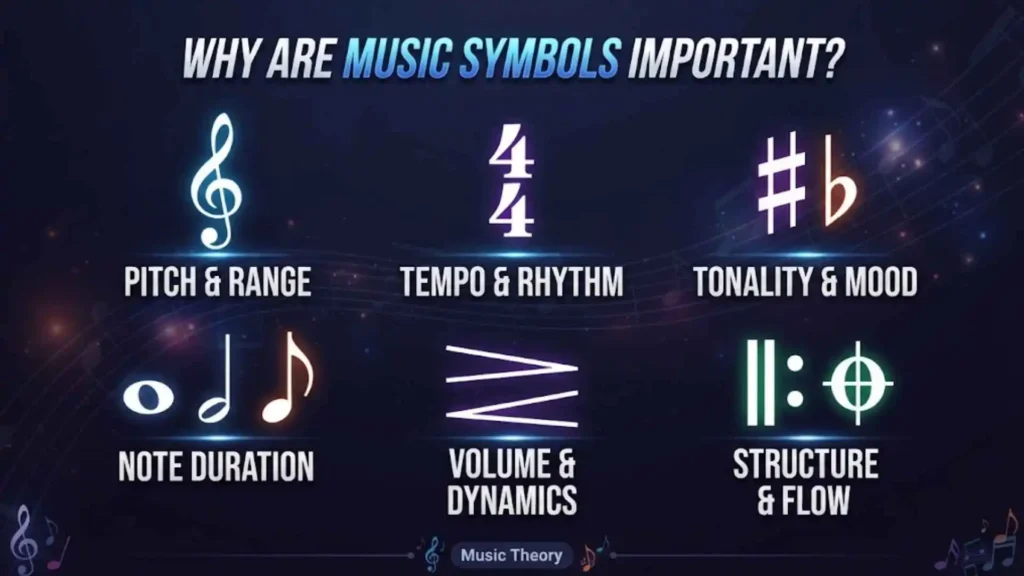
Music symbols make it possible to preserve and communicate musical ideas in written form.
They help musicians understand:
- Pitch
- Rhythm
- Tempo
- Dynamics
- Articulation
- Expression
- Repetition
- Musical structure
- Instrumental techniques
A written score can therefore contain instructions about much more than which notes to play.
The combination of notation symbols allows a composer to communicate a detailed musical performance without having to explain every instruction in words.
Common Mistakes Beginners Make With Music Symbols
Learning musical notation takes practice, and certain mistakes appear frequently.
Ignoring the Key Signature
A beginner may read the notes correctly but forget that the key signature changes the default pitch of particular notes.
Always check the key signature before reading a passage.
Confusing the Clefs
Treble and bass clefs use different pitch references.
A note placed on the same physical line can represent a different pitch depending on the clef.
Treating Every Note as One Beat
Note values are not all the same.
A whole note, half note, quarter note, and eighth note have different rhythmic values.
Forgetting Rests
Rests are part of the rhythm.
Skipping a rest or playing during it can change the entire musical phrase.
Ignoring Dynamics
Playing every note at the same volume can remove much of the intended musical expression.
Dynamics are performance instructions, not optional decorations.
Confusing Staccato With a Rest
A staccato note is still played.
It is simply performed in a short, detached manner.
A rest, on the other hand, indicates silence.
Assuming Tempo Words Have One Exact BPM
Terms such as Allegro or Adagio provide general tempo character rather than universally fixed numerical speeds.
When exact speed matters, a composer can provide a BPM marking.
Frequently Asked Questions
What are music symbols?
Music symbols are signs used in written music to communicate pitch, rhythm, duration, dynamics, tempo, articulation, expression, repetition, and other performance instructions.
What are the most common music symbols?
Some of the most common include the treble clef, bass clef, sharp, flat, natural, whole note, half note, quarter note, eighth note, rests, time signatures, dynamic markings, staccato, slurs, ties, and repeat signs.
What does the treble clef symbol mean?
The treble clef 𝄞 establishes the pitch positions for a higher register and identifies the position of G above middle C.
What does the bass clef symbol mean?
The bass clef 𝄢 establishes the pitch positions for a lower register and identifies the position of F below middle C.
What does ♯ mean in music?
The sharp symbol ♯ raises a note by one semitone.
What does ♭ mean in music?
The flat symbol ♭ lowers a note by one semitone.
What does ♮ mean in music?
The natural symbol ♮ cancels a previous sharp or flat according to the notation context.
What does ♩ mean in music?
The symbol ♩ represents a quarter note. In 4/4 time, a quarter note normally receives one beat.
What does ♪ mean in music?
The symbol ♪ represents an eighth note. In 4/4 time, it normally represents half of a quarter-note beat.
What does a dot after a music note mean?
An augmentation dot increases a note’s duration by half of its original value. For example, a dotted quarter note has a duration equal to one quarter note plus half of a quarter note.
What does a fermata mean?
A fermata 𝄐 indicates that a note, chord, or rest should be held longer than its written duration.
What does p mean in music?
p stands for piano and means to perform softly.
What does f mean in music?
f stands for forte and means to perform loudly.
What does a crescendo mean?
A crescendo means that the music should gradually become louder.
What does a diminuendo mean?
A diminuendo means that the music should gradually become softer.
What is the difference between a tie and a slur?
A tie connects notes of the same pitch and combines their durations. A slur connects notes to indicate smooth or connected phrasing.
What does D.C. mean in music?
D.C. stands for Da Capo, meaning “from the beginning.” It instructs the performer to return to the beginning of the indicated section.
What does D.S. mean in music?
D.S. stands for Dal Segno, meaning “from the sign.” It directs the performer to return to a designated sign in the score.
What does Coda mean in music?
A coda is a concluding section of a musical composition. The coda symbol 𝄌 indicates where that section begins.
What are the seven basic music notes?
The seven basic note names in the common Western system are A, B, C, D, E, F, and G. These note names repeat across different octaves.
How many music symbols are there?
There is no single fixed number of music symbols. Musical notation contains a large collection of symbols and markings, and different instruments, musical traditions, notation systems, and historical periods use different signs.
Conclusion
Music symbols form the visual language of written music. They allow musicians to understand pitch, rhythm, silence, tempo, dynamics, articulation, expression, repetition, and performance techniques from a musical score.
For beginners, the best approach is to learn the symbols in groups. Start with the staff and clefs, then learn notes and rests, accidentals, key signatures, time signatures, dynamics, articulation, and tempo markings. After these basics become familiar, more advanced symbols such as ornaments, navigation signs, and instrument-specific techniques become easier to understand.

Hi, I’m Asher Monroe, a writer who believes that meaningful words have the power to inspire change and bring people closer to their dreams. I have always been fascinated by the beauty of quotes and the way a simple message can provide motivation, hope, and comfort.
I enjoy creating content around inspirational quotes, life lessons, success stories, and positive thoughts that help readers find encouragement in their everyday lives. My goal is to share words that connect with people and remind them of their inner strength.
Through my writing, I explore the ideas of personal growth, confidence, and the importance of staying inspired through every chapter of life.
I am the author of Words That Move the Soul and The Path of Endless Inspiration, two books focused on the power of wisdom, positivity, and meaningful thoughts.
 Sienna Brooks
 Rowan Sinclair Rowan Sinclair