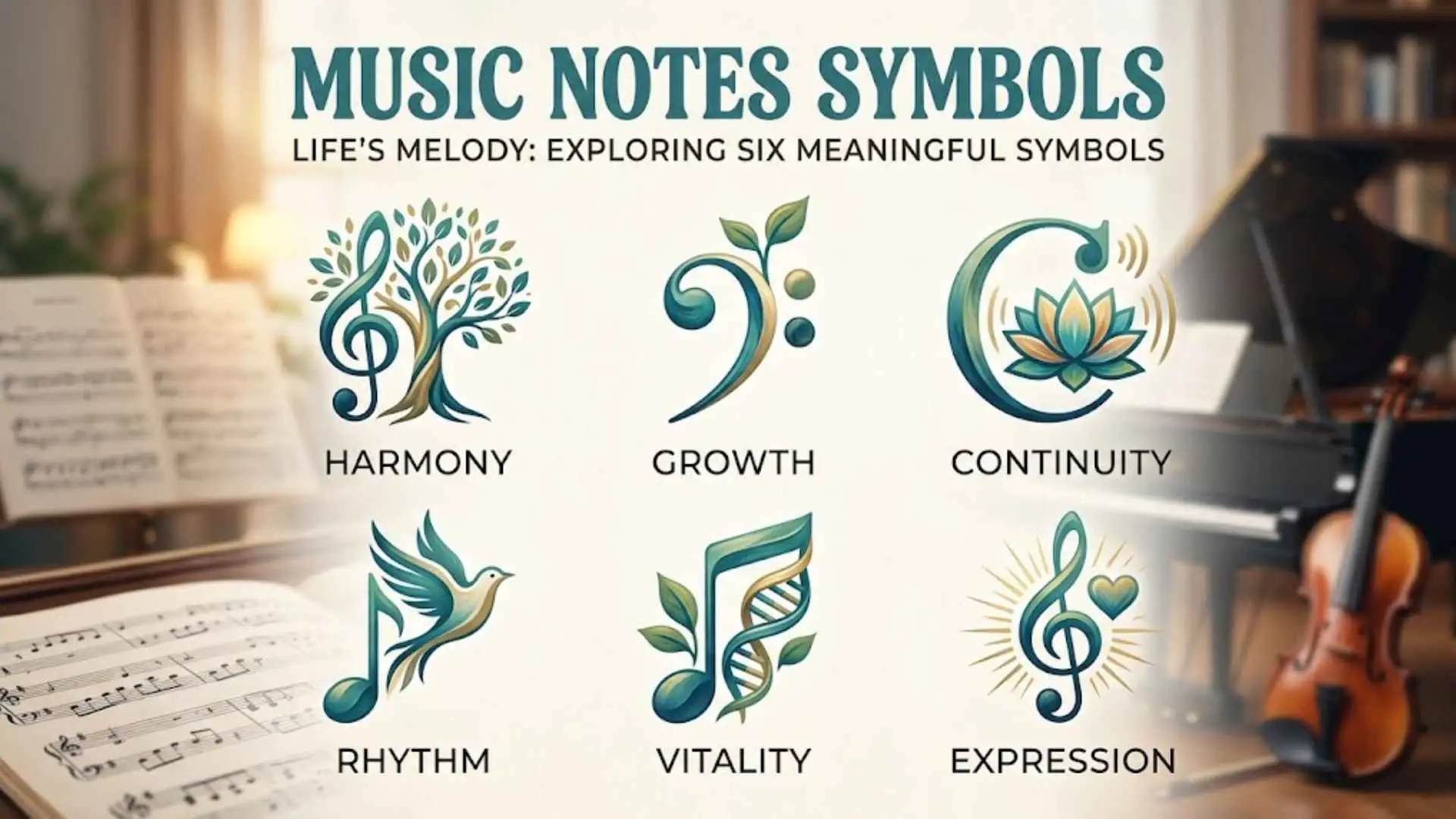
Music notes are the visual language musicians use to understand rhythm, pitch, and timing. From the familiar quarter note ♩ to the elegant treble clef 𝄞, each musical symbol has a specific role in written music. Learning these symbols makes it easier to read sheet music, understand musical patterns, and recognize how notes fit together.
This guide covers music notes symbols with names, meanings, beats, and examples. You will also learn about note values, rests, symbols on the musical staff, piano notation, and the difference between musical notes and letter names such as A, B, C, D, E, F, and G.
If you want music symbols for texting, social media, artwork, or tattoos, you will find useful copy-and-paste characters too. The guide separates standard music notation from decorative Unicode characters so you can understand both their musical purpose and their practical uses.
Music notes symbols with names
Music notation uses different symbols to show pitch, rhythm, silence, and musical expression. The following table introduces common symbols used in written music.
| Symbol | Name | Main Purpose |
| 𝄞 | Treble clef | Identifies the pitches on a treble staff |
| 𝄢 | Bass clef | Identifies the pitches on a bass staff |
| ♩ | Quarter note | Represents one beat in common simple meters when the quarter note receives the beat |
| ♪ | Eighth note | Represents half the duration of a quarter note |
| ♬ | Beamed eighth notes character | Decorative representation of connected notes |
| 𝅝 | Whole note | Represents four quarter-note beats in common time |
| 𝅗𝅥 | Half note | Represents two quarter-note beats in common time |
| 𝅘𝅥 | Quarter note character | Musical notation character |
| 𝅘𝅥𝅮 | Eighth note character | Musical notation character |
| 𝅘𝅥𝅯 | Sixteenth note character | Musical notation character |
| 𝄽 | Quarter rest | Represents silence for a quarter-note duration |
| 𝄾 | Eighth rest | Represents silence for an eighth-note duration |
| ♯ | Sharp | Raises a note by one semitone in standard notation |
| ♭ | Flat | Lowers a note by one semitone in standard notation |
| ♮ | Natural | Cancels a sharp or flat under the applicable notation rules |
| 𝄐 | Fermata | Indicates that a note or rest should be held longer at the performer’s discretion |
Some musical notation characters may display differently across fonts and applications. For actual sheet music, a notation editor is usually more reliable than a plain-text character because it positions notes, stems, beams, and rests correctly on a staff.
Music notes symbols letters
Musical note letters identify pitches. In standard Western music notation, the seven basic letter names are A, B, C, D, E, F, and G. After G, the sequence begins again at A in the next octave.
| Letter | Note Name | Example On Piano |
| A | A note | A white key |
| B | B note | B white key |
| C | C note | C white key |
| D | D note | D white key |
| E | E note | E white key |
| F | F note | F white key |
| G | G note | G white key |
Notes can also be modified with accidentals:
- C♯: C sharp, one semitone above C.
- D♭: D flat, one semitone below D.
- F♮: F natural, indicating F without a previously applied sharp or flat in the relevant context.
On many instruments, C♯ and D♭ sound the same in equal temperament, although their written names and musical roles can differ.
Do not confuse note letters with note symbols. The letter C tells you the pitch name, while ♩ or ♪ describes a rhythmic value. A C written as a quarter note combines both types of information.
Music notes symbols pictures
Pictures of musical symbols help beginners identify notation quickly. The most useful visual references show the symbol in its correct position on a five-line staff rather than displaying it as an isolated character.
Note Values
Noteheads, stems, and flags distinguish whole, half, quarter, eighth, and sixteenth notes. These features help readers understand duration.
Notes On The Staff
The vertical position of a notehead identifies its pitch. The clef determines how the staff’s lines and spaces are interpreted.
Accidentals
Sharp, flat, and natural signs modify pitches according to musical notation rules. They can appear beside individual notes or in a key signature.
When studying a picture, look at the notehead first, then the stem, flag, beam, and staff position. This helps you identify both the pitch and the duration without relying on the shape alone.
Music notes symbols chart
A music notes chart makes it easier to compare note values and understand how they relate to each other. The following chart assumes a simple meter in which the quarter note receives one beat.
| Note Value | Common Symbol | Equivalent Quarter-Note Beats |
| Double whole note | 𝅜 | 8 |
| Whole note | 𝅝 | 4 |
| Half note | 𝅗𝅥 | 2 |
| Quarter note | ♩ | 1 |
| Eighth note | ♪ | 1/2 |
| Sixteenth note | 𝅘𝅥𝅯 | 1/4 |
| Thirty-second note | 𝅘𝅥𝅰 | 1/8 |
A dot placed after a note increases its duration by half of its original value. For example, a dotted half note lasts three quarter-note beats in this context.
A tie connects two notes of the same pitch and combines their durations. A beam groups certain shorter notes visually, making rhythms easier to read.
Remember that the number of beats a note receives depends on the time signature and the rhythmic context. The chart provides common equivalents, not a universal rule for every meter.
Music notes symbols and meanings
Musical symbols communicate more than pitch and duration. They also tell performers when to pause, how loudly to play, how to change the sound, and how to shape a musical phrase.
| Symbol | Name | Meaning |
| ♩ | Quarter Note | A rhythmic value commonly equal to one beat |
| ♪ | Eighth Note | Half a quarter note’s duration |
| ♯ | Sharp | Raises a pitch by one semitone |
| ♭ | Flat | Lowers a pitch by one semitone |
| ♮ | Natural | Cancels an applicable sharp or flat |
| 𝄐 | Fermata | Hold longer than the written duration, as directed |
| 𝄑 | Breve | A historical or specialized note value |
| p | Piano | Play softly |
| f | Forte | Play loudly |
| mf | Mezzo Forte | Play moderately loudly |
| pp | Pianissimo | Play very softly |
| ff | Fortissimo | Play very loudly |
| cresc. | Crescendo | Gradually increase volume |
| dim. | Diminuendo | Gradually decrease volume |
The letters p and f are standard musical instructions rather than decorative note characters. They are typically printed above or below the staff.
Musical symbols can also vary by historical period and notation style. Always consider the score’s context when interpreting an unfamiliar mark.
Music notes symbols on lines
Written music uses a staff made of five horizontal lines and four spaces. Notes placed on these lines and spaces represent different pitches, and the clef determines their names.
Treble clef notes
In treble clef, the lines from bottom to top are:
- E
- G
- B
- D
- F
The spaces from bottom to top are F, A, C, and E. A common memory aid for the lines is “Every Good Boy Does Fine,” while the spaces spell the word FACE.
Bass clef notes
In bass clef, the lines from bottom to top are G, B, D, F, and A. The spaces are A, C, E, and G.
Notes that extend beyond the five staff lines can be written using small additional lines called ledger lines. For example, middle C commonly sits on a ledger line below the treble staff.
A note’s vertical position tells you its pitch, while its shape and attached markings tell you its duration or performance instructions.
Types of music notes symbols
Music notes are grouped by their rhythmic value. Each note type represents a duration relative to the others, although the actual length in seconds depends on the tempo.
- Double Whole Note: Also called a breve, it is twice the duration of a whole note in systems that use it.
- Whole Note: An open notehead without a stem.
- Half Note: An open notehead with a stem.
- Quarter Note: A filled notehead with a stem.
- Eighth Note: A filled notehead with a stem and one flag, or a beam when grouped.
- Sixteenth Note: A filled notehead with two flags, or two beams when grouped.
- Thirty-Second Note: A filled notehead with three flags, or three beams when grouped.
These symbols can appear with dots, ties, and beams to create more complex rhythms. For example, two eighth notes commonly fit into the duration of one quarter note, while four sixteenth notes fit into the same duration.
Rests have corresponding rhythmic values and indicate silence rather than a played note.
Free printable music notes symbols
Printable music note references are useful for beginners, students, teachers, and musicians who want a quick reference beside their practice space. A clear one-page chart can show note names, note values, rests, clefs, and staff positions.
For a useful printable reference, include:
- The five-line treble and bass staves.
- The seven note letters from A to G.
- Whole, half, quarter, eighth, and sixteenth notes.
- Common rests and their durations.
- Sharp, flat, and natural signs.
- A short example showing how notes fit into a measure.
For best results, create or print a chart from a music notation application or a trusted music education resource. Check that symbols are sharp and readable at the intended paper size. If you are making a worksheet for children, use larger symbols and leave room for students to label notes.
All music notes symbols
Music notation contains a broad range of symbols, but they can be organized into several practical groups. Learning these categories is more useful than trying to memorize every symbol at once.
| Category | Examples | Purpose |
| Clefs | Treble clef, bass clef | Establish pitch reference |
| Notes | Whole, half, quarter, eighth | Show sound duration |
| Rests | Whole rest, quarter rest, eighth rest | Show silence |
| Accidentals | ♯, ♭, ♮ | Change written pitch |
| Time signatures | 4/4, 3/4, 6/8 | Organize beats into measures |
| Dynamics | p, mf, f, ff | Indicate loudness |
| Articulation | Staccato dot, accent mark | Shape individual notes |
| Expression | Fermata, trill, slur | Guide performance |
| Repetition | Repeat signs, D.C., D.S. | Indicate repeated sections or navigation |
This list covers common families rather than every mark used in orchestral, contemporary, or historical scores. Advanced music can also use specialized symbols for extended techniques, percussion, electronic instruments, and unusual rhythmic patterns.
Music notes symbols and names and beats
Understanding note names alongside their beats helps you read rhythm more confidently. In a simple 4/4 measure, four quarter-note beats fill one bar.
| Note | Name | Beats In 4/4 Context |
| 𝅝 | Whole Note | 4 |
| 𝅗𝅥 | Half Note | 2 |
| ♩ | Quarter Note | 1 |
| ♪ | Eighth Note | 1/2 |
| 𝅘𝅥𝅯 | Sixteenth Note | 1/4 |
Here are a few examples:
- One half note plus two quarter notes equals four quarter-note beats.
- Four quarter notes equal one whole note in duration.
- Two eighth notes equal one quarter note in duration.
- Four sixteenth notes equal one quarter note in duration.
A rest takes up time in the measure just like a note does, but no pitched sound is played during it. Dots and ties can extend a note’s duration, so count the complete rhythmic value rather than just the basic note shape.
Music notes symbols meaning
The meaning of a musical symbol depends on where and how it is written. A quarter note identifies a rhythmic duration, but the staff position determines which pitch is played. A sharp sign changes pitch, while a dynamic marking changes the intended loudness.
Consider the note C♩. The letter C identifies the pitch, and the quarter-note shape indicates its rhythmic value. If a sharp sign appears before it, C♯ is played instead, subject to the score’s notation rules.
Similarly, a rest does not mean that the music has stopped altogether. It indicates silence for a particular part or instrument while the rest of the music may continue.
The most reliable way to interpret a symbol is to read it together with the clef, key signature, time signature, surrounding notes, and any performance instructions.
Music notes symbols text
Music symbols in text can be useful for social media bios, messages, captions, usernames, music-themed posts, and simple digital designs. Some characters are standard Unicode musical symbols, while others are emoji or ordinary letters used in a musical context.
Here are a few examples you can use:
- ♩ — Quarter note
- ♪ — Eighth note
- ♫ — Beamed eighth notes
- ♬ — Beamed sixteenth-note character
- ♯ — Sharp sign
- ♭ — Flat sign
- ♮ — Natural sign
- 𝄞 — Treble clef
- 𝄢 — Bass clef
The appearance of these characters depends on the font and application. Some specialized musical notation characters may be missing from older fonts or certain devices. If you are writing actual music, use a notation editor instead of relying on plain text to arrange the symbols.
Music Notes Symbols and Names
This section provides another useful way to learn music notation by matching each symbol family with its purpose.
| Symbol Family | Examples | What It Tells You |
| Clefs | 𝄞, 𝄢 | Which pitches correspond to staff positions |
| Note Values | ♩, ♪, 𝅗𝅥 | How long notes last relative to one another |
| Accidentals | ♯, ♭, ♮ | How pitches are altered |
| Rests | 𝄽, 𝄾 | How long to remain silent |
| Dynamics | p, f, mf | How softly or loudly to play |
| Expression | 𝄐 | How to sustain or shape a passage |
When reading a score, do not identify a note from its appearance alone. Check its position on the staff, the clef, and any accidentals that apply. This is especially important when distinguishing the pitch of a note from its duration.
Music Notes Symbols Tattoos
Music note tattoos are popular among musicians, singers, composers, music students, and people who simply feel connected to music. A small note can represent a favorite song, a meaningful memory, creativity, or a lifelong interest.
Popular designs include:
- Single Eighth Note (♪): A simple choice for a small tattoo.
- Treble Clef (𝄞): Often chosen by singers and musicians who work with treble-clef notation.
- Musical Staff: A few notes written on a staff can represent a favorite melody.
- Sound Wave Design: A recording’s waveform can connect a tattoo with a particular voice or memory.
- Notes With a Heart: Combines music with love, relationships, or personal meaning.
- Bass Clef (𝄢): May appeal to bass players, pianists, and musicians who read bass notation.
Before getting a tattoo, check the design carefully. A Unicode character may look different from a professionally drawn musical symbol, and a real staff needs correctly placed notes to represent an actual melody. If you want a specific song, ask a knowledgeable musician to verify the notation.
Name of Music Notes Symbols
The names of music note symbols often refer to their shapes and rhythmic values. Understanding the names helps you communicate with music teachers, read lessons, and search for accurate notation references.
- Whole Note: An open notehead with no stem in common modern notation.
- Half Note: An open notehead with a stem.
- Quarter Note: A filled notehead with a stem.
- Eighth Note: A filled notehead with a stem and one flag.
- Sixteenth Note: A filled notehead with two flags.
- Thirty-Second Note: A filled notehead with three flags.
- Treble Clef: A clef commonly used for higher-pitched parts.
- Bass Clef: A clef commonly used for lower-pitched parts.
- Sharp: Raises a note by a semitone.
- Flat: Lowers a note by a semitone.
- Natural: Cancels an applicable sharp or flat.
In handwritten and printed scores, several shorter notes may be connected with beams instead of individual flags. Their rhythmic values remain the same.
Images of Music Notes Symbols
Images are particularly useful when a symbol needs to appear exactly as it does in printed notation. Unlike plain-text characters, musical images can preserve the spacing, proportions, and details of a complete score.
7
Choose the format according to your project:
- PNG: Useful for transparent-background graphics and digital worksheets.
- SVG: Suitable for scalable vector artwork when the file is supported.
- JPEG: Useful for photographs and sheet-music images without transparency.
- Music notation files: Best when you need to edit individual notes, rhythms, and staff positions.
For educational articles, add descriptive captions and alternative text. For example, “Quarter note on a treble staff” is more useful than a generic image label. Use images that you own or have permission to reproduce.
Music Notes Symbols Keyboard
You can enter music symbols using a keyboard, character picker, or copy-and-paste method. The exact steps depend on your operating system, keyboard layout, and application.
On Windows, the Character Map utility can help you locate characters supported by installed fonts. On macOS, the Character Viewer provides access to many symbols and emoji. In applications with symbol menus, search for musical characters if the font supports them.
For quick use, copying a symbol from a reliable source is often easiest. Characters such as ♪, ♫, ♯, and ♭ are convenient for short messages and simple designs.
A standard computer keyboard does not provide a dedicated key for every music notation character. Also, typing a character is different from entering fully formatted sheet music. If you need stems, beams, noteheads, rests, and staff placement to follow music notation conventions, use a music notation application.
Music Notes Symbols Piano
Piano music commonly uses a grand staff made of two connected staves: a treble staff for the right hand and a bass staff for the left hand. A brace usually connects them, showing that the two staves belong to the same instrument.
Here is how piano notation works:
- Treble Clef (𝄞): Usually used for notes played by the right hand.
- Bass Clef (𝄢): Usually used for notes played by the left hand.
- Middle C: A useful reference pitch located between the two staves on a ledger line.
- Accidentals: Sharp, flat, and natural signs show pitch changes.
- Time Signature: Indicates how beats are organized into measures.
- Rests: Show when a hand or musical part remains silent.
These are common conventions, not strict rules that every piano score must follow. Some passages cross between staves, and either hand can play notes written on either staff.
Music Notes Symbols and Beats
Beats are the regular pulses that help organize music. Note values show how long sounds last relative to the beat, while the tempo determines how quickly those beats occur.
For example, in 4/4 time, a measure commonly contains four quarter-note beats. In 3/4 time, it commonly contains three quarter-note beats. In 6/8 time, the meter is usually felt as two main beats, each divided into three eighth notes, depending on the tempo and musical style.
A metronome can help you practise counting. If the tempo is 60 quarter-note beats per minute, each quarter-note beat lasts one second. At 120 beats per minute, each lasts half a second.
Remember that a note’s duration is relative to the rhythmic unit used in the meter. Always read the time signature before calculating how notes fit into a measure.
Different Music Notes Symbols
Different musical symbols serve different jobs, even when they look similar. Recognizing these differences helps prevent common reading mistakes.
- Quarter Note vs. Eighth Note: An eighth note has one flag or is connected by one beam; a quarter note does not.
- Half Note vs. Whole Note: Both have open noteheads, but the half note has a stem.
- Sharp vs. Flat: A sharp raises a pitch by a semitone; a flat lowers it by a semitone.
- Note vs. Rest: A note represents a sound, while a rest represents silence.
- Tie vs. Slur: A tie connects notes of the same pitch to extend their duration; a slur groups different or repeated pitches for connected performance, depending on the instrument and context.
- Clef vs. Note: A clef establishes the pitch reference for a staff; a note shows a specific pitch and rhythmic value.
Learning these distinctions is often more useful than memorizing symbols without context. Practise by identifying one feature at a time: staff position, notehead, stem, flags, and any additional marks.
Music Notes Symbols Copy and Paste
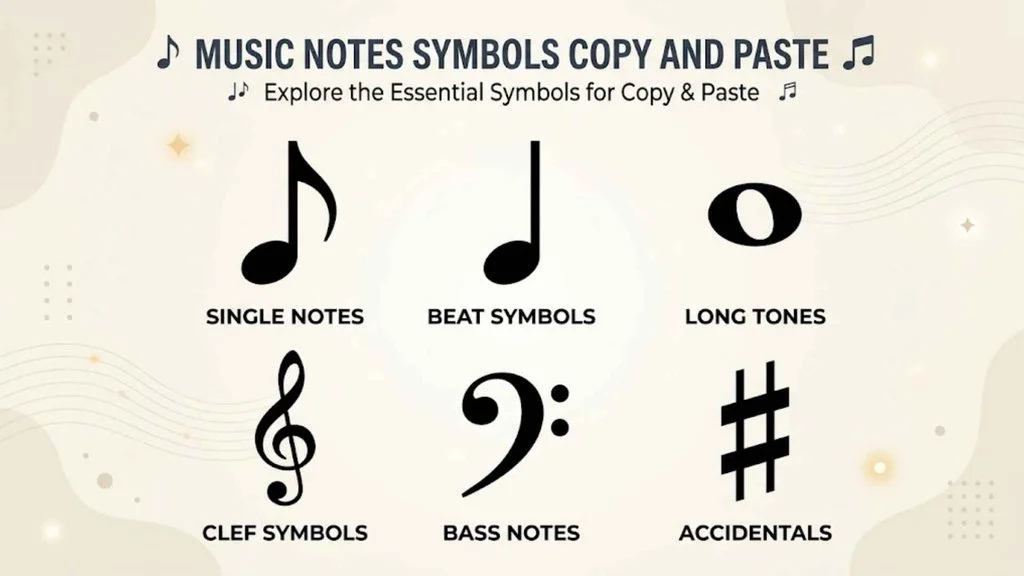
Use these music symbols in messages, captions, bios, music-themed usernames, and decorative text. Select the Copy button beside a character to copy it.
♪
Eighth Note
♪
Copy
♫
Beamed Eighth Notes
♫
Copy
♬
Beamed Sixteenth Notes Character
♬
Copy
♩
Quarter Note
♩
Copy
♯
Sharp Sign
♯
Copy
♭
Flat Sign
♭
Copy
♮
Natural Sign
♮
Copy
𝄞
Treble Clef
𝄞
Copy
𝄢
Bass Clef
𝄢
Copy
𝄐
Fermata
𝄐
Copy
🎵
Musical Note Emoji
🎵
Copy
🎶
Musical Notes Emoji
🎶
Copy
🎼
Musical Score Emoji
🎼
Copy
🎹
Musical Keyboard Emoji
🎹
Copy
Example captions:
- Music is my language ♪♫
- Follow your rhythm 🎶
- Life sounds better with music 🎵
- Lost in the melody ♩
- Every note tells a story 🎼
Some characters are notation symbols, while others are emoji. Their appearance can change between platforms, so check the result before using them in a design or published post.
Frequently Asked Questions
What are the most common music note symbols?
The most common note values are whole notes, half notes, quarter notes, eighth notes, and sixteenth notes. Clefs, rests, and accidentals are also essential for reading written music.
How do I copy and paste music symbols?
Choose a symbol from the copy-and-paste collection, select its Copy button, and paste it into your preferred application. If the character does not display correctly, try a compatible font.
What are the seven musical note letters?
The seven basic note letters in standard Western notation are A, B, C, D, E, F, and G. The sequence repeats across different octaves.
How many beats does a quarter note receive?
In common simple meters such as 4/4, a quarter note usually receives one beat. Its duration in seconds depends on the tempo.
What is the difference between a music note and a music symbol?
A music note represents a pitch and rhythmic duration when written in notation. Music symbols also include clefs, rests, accidentals, dynamics, and other instructions that guide a performance.
Conclusion
Music note symbols help musicians understand pitch, rhythm, timing, silence, and expression. Learning the names and meanings of common notes makes reading sheet music easier and provides a foundation for playing instruments or studying music theory.
For quick reference, remember the relationship between whole, half, quarter, eighth, and sixteenth notes. Learn the treble and bass clefs, practise identifying notes on the staff, and pay attention to time signatures when counting beats.
If you need musical characters for social media, messages, or creative projects, the copy-and-paste collection provides a convenient starting point. For accurate sheet music, use proper notation software so every note appears in the correct position.

Hello, I’m Rowan Sinclair, a passionate writer and lifelong admirer of the wisdom found in great quotes. I believe that words have the ability to inspire change, spark creativity, and connect people across cultures and generations.
I enjoy writing about motivational quotes, famous sayings, and lessons from history’s most influential thinkers. Every article I create is driven by my desire to help readers discover meaningful insights that they can apply to their own lives.
When I’m not writing, I spend my time reading biographies, exploring classic literature, and collecting memorable quotes that deserve to be shared with the world.
I am the author of Voices That Inspire and A Collection of Timeless Thoughts, two books that celebrate the enduring power of words and the stories behind them.
 Asher Monroe
 Sienna Brooks