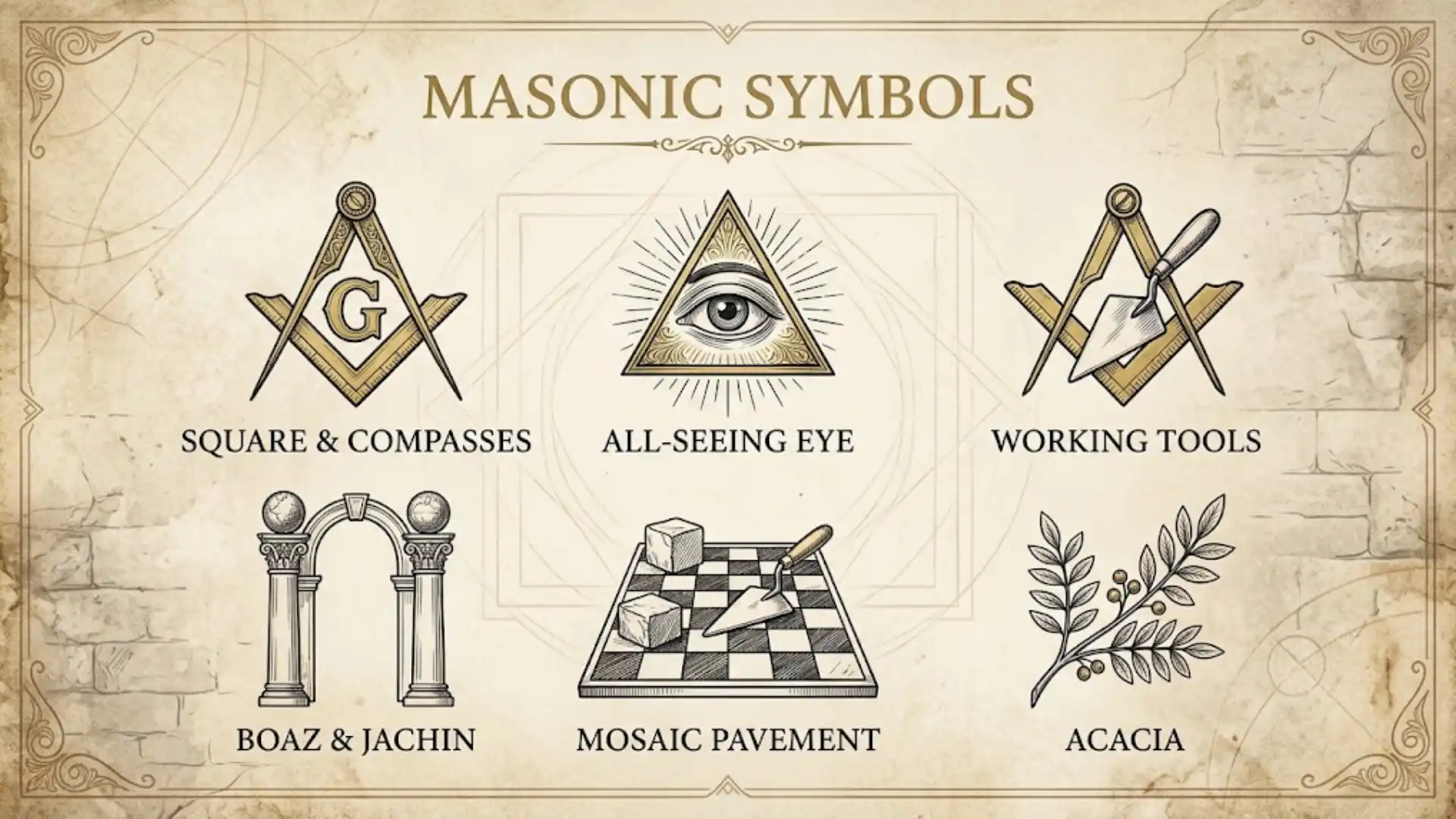
Masonic symbols have fascinated people for centuries because they combine geometric shapes, traditional tools, historical references, and moral lessons. From the famous square and compass to the letter G, these symbols appear in Masonic buildings, artwork, jewelry, books, and other historical settings. Some are easy to recognize, while others require an understanding of Freemasonry and its traditions.
If you are searching for Masonic symbols and their meanings, you may also want to know why certain designs appear on American money, what the number 33 represents, and whether Masonic symbols can be found in Washington, DC, or Mormon temples. These topics attract curiosity because Masonic imagery is often associated with history, philosophy, architecture, and secret societies.
This guide explores common Masonic symbols, their traditional interpretations, historical background, and appearances in different settings. You will also find explanations of the square and compass, collections of symbols, tattoo ideas, and answers to questions about Freemasonry and Mormonism. Where interpretations differ, the article distinguishes documented history from speculation.
What are Masonic symbols?
Masonic symbols are images, shapes, tools, and emblems used in Freemasonry, a fraternal organization whose traditions developed from the practices of stonemasons and later social and philosophical groups. These symbols help communicate ideas about personal conduct, knowledge, responsibility, and moral improvement.
Many Masonic emblems come from the tools of traditional builders. A square can represent fairness and upright behavior, while a compass can symbolize self-control and appropriate limits. Other symbols draw on geometry, architecture, light, or traditional religious and philosophical imagery.
Not every symbol associated with Freemasonry has one universal meaning. Interpretations can differ among Masonic jurisdictions, historical periods, and individual members. A symbol appearing on a building or document is not automatically proof of a Masonic connection; its origin and context matter.
Masonic Symbols Meaning
The meaning of a Masonic symbol often relates to a moral principle, a philosophical idea, or a lesson taught within Freemasonry. Understanding the basic symbolism makes it easier to recognize these emblems in historical artwork and architecture.
| Symbol | Common Interpretation |
| □ Square | Honesty, fairness, and upright conduct |
| ◯ Circle | Unity, continuity, or wholeness in broader symbolic traditions |
| △ Triangle | A three-part idea or a spiritual concept in some traditions |
| ☀ Sun | Light, knowledge, and enlightenment in various symbolic contexts |
| ✦ Star | Guidance, aspiration, or other meanings depending on the design |
| ⚓ Anchor | Hope and stability in broader symbolic traditions |
| Pillars | Strength, establishment, and balance in Masonic symbolism |
| All-seeing eye | Divine watchfulness or providence in some contexts |
These examples need context. The circle, triangle, sun, star, and anchor are not exclusively Masonic symbols. Their meaning depends on how they are presented and whether they appear alongside recognizable Masonic imagery.
Masonic Symbols and Their Meanings
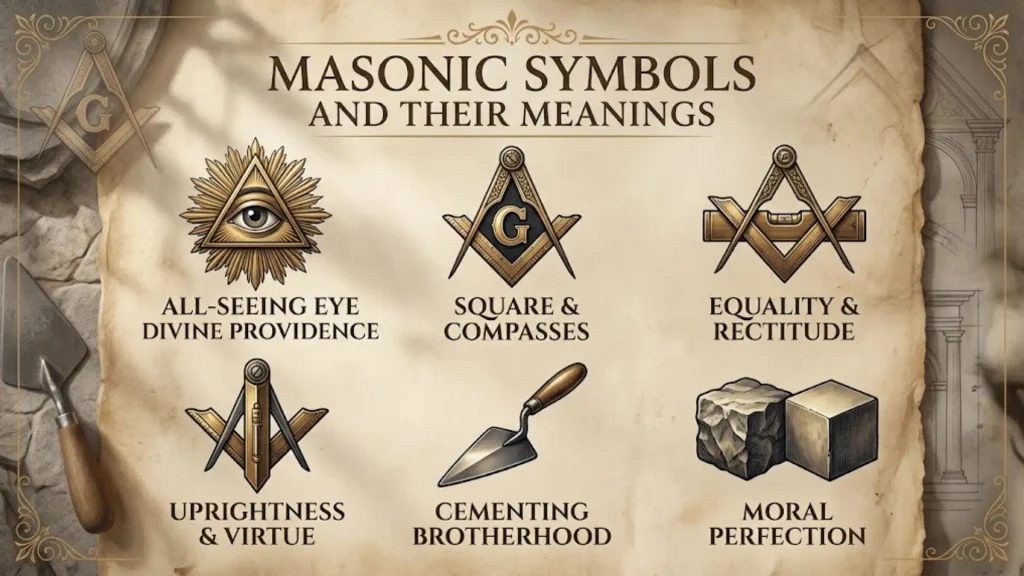
Several well-known Masonic symbols have traditional explanations that help illustrate the organization’s emphasis on ethical behavior and self-improvement.
- Square and compass: Associated with moral conduct and self-restraint.
- Letter G: Often interpreted as referring to God or geometry, depending on the tradition.
- Rough and perfect ashlars: The rough stone can represent a person developing their character, while the finished stone suggests refinement.
- Level: Commonly associated with equality among members.
- Plumb rule: Represents upright conduct and integrity.
- Trowel: Associated with spreading brotherly love and strengthening relationships.
- Pillars: Often linked with strength and establishment, particularly in traditional Masonic imagery.
- All-seeing eye: May symbolize divine watchfulness, although the eye is also found outside Freemasonry.
The central lesson is that these emblems are generally interpreted as reminders of principles rather than as a universal code with one fixed explanation for every design.
Masonic Symbols Square and Compass
The square and compass is the best-known emblem of Freemasonry. It combines two tools traditionally used by builders, giving the design both a practical origin and a moral interpretation.
The square is commonly associated with fairness, honesty, and acting correctly toward others. The compass is often understood as a reminder to exercise self-control and keep personal behavior within appropriate limits.
In some versions, the letter G appears between the tools. It is commonly associated with geometry, a fundamental subject in building, and may also refer to God in particular Masonic traditions.
The arrangement, letter, and decorative details can vary. A square and compass on a ring, lodge sign, gravestone, or historic building may therefore look slightly different while retaining its recognizable identity.
Masonic Symbols Square and Compasses
The phrase “square and compasses” is another common name for the same emblem. The difference is mainly grammatical: compass can refer to a single instrument, while compasses is the traditional name for the two-legged drawing instrument.
In Masonic writing, both forms are understandable. The emblem usually shows the square and the pointed, hinged compasses arranged together.
You may see the design engraved on jewelry, printed on lodge materials, carved into stone, or displayed on ceremonial objects. Some versions include a letter G, while others show only the two tools.
When identifying the emblem, look at the overall arrangement rather than relying on one decorative detail. Similar geometric designs can appear in engineering, architecture, education, and other traditions without being Masonic.
Ancient Masonic Symbols
The phrase “ancient Masonic symbols” often refers to emblems that draw on old building practices, biblical narratives, classical geometry, and traditions preserved by Freemasonry. However, the age of a symbol and the age of its Masonic use are not necessarily the same.
The square, compass, level, and plumb rule are tools with histories that extend far beyond modern Freemasonry. Builders used such instruments long before the development of organized speculative Freemasonry.
Other imagery, including pillars, the sun, the moon, and the all-seeing eye, has appeared in different cultures and religious or philosophical traditions. Their presence alone does not establish a Masonic origin.
Modern Freemasonry developed from earlier stonemason traditions and became organized in its familiar form in the early eighteenth century. Claims that every Masonic emblem originated in an ancient secret civilization require historical evidence rather than resemblance alone.
Masonic Symbols Images and Meanings
Visual examples can help you identify Masonic emblems more easily. The following reference list describes recognizable designs and their commonly associated meanings.
⚒
Working tools
Traditional tools such as the square, compass, level, and plumb rule are used symbolically to explain personal discipline and ethical behavior.
G
The letter G
Often interpreted as geometry or, in some traditions, God. Its interpretation depends on the Masonic context.
△
Triangle
A geometric shape used in many traditions. It can have spiritual or philosophical associations, but it is not exclusively Masonic.
◉
Eye imagery
An eye within a triangle is sometimes associated with divine providence. Similar eye imagery also appears in non-Masonic settings.
These are simplified visual references, not exact reproductions of every traditional Masonic emblem. If you need an accurate historical image, examine the complete design, its date, and its documented source.
Masonic Symbols on Money
The United States one-dollar bill is frequently discussed in articles about Masonic symbolism because its reverse features an unfinished pyramid topped by an eye within a triangle. The design belongs to the Great Seal of the United States, which is printed on the bill.
The pyramid symbolizes strength and endurance in the official explanation of the Great Seal. The eye above it represents providence, while the Latin inscriptions Annuit Coeptis and Novus Ordo Seclorum express ideas associated with providence and a new era.
These elements are sometimes described online as proof of a Masonic influence over American currency. However, the presence of an eye, a pyramid, or geometric imagery does not independently establish that a design is Masonic. The eye of providence also existed in broader European religious and artistic traditions.
The Great Seal was adopted in 1782, and the eye-and-pyramid design appeared on the reverse of the one-dollar bill in 1935. The historical record of the seal’s design is a better starting point than unsupported claims about hidden meanings.
33 Masonic Symbols
The number 33 is especially associated with the Scottish Rite, a Masonic appendant body. In the Southern Jurisdiction of the United States, the 33rd degree is an honorary degree conferred on selected members in recognition of service. Details differ among Scottish Rite jurisdictions.
There is no single universally accepted collection called “33 Masonic symbols.” Searchers using this phrase may be looking for a list of emblems connected with Masonic traditions or the degrees of the Scottish Rite.
Here are 33 symbols and symbolic elements commonly discussed in Masonic or related historical contexts. Their associations are not all exclusive to Freemasonry.
| No. | Symbol | Common Association |
| 1 | Square | Fairness |
| 2 | Compasses | Self-control |
| 3 | Letter G | Geometry or God in some traditions |
| 4 | Level | Equality |
| 5 | Plumb rule | Upright conduct |
| 6 | Trowel | Brotherhood |
| 7 | Gavel | Discipline and improvement |
| 8 | Rough ashlar | Character in development |
| 9 | Perfect ashlar | Refined character |
| 10 | Two pillars | Strength and establishment |
| 11 | All-seeing eye | Providence |
| 12 | Triangle | Three-part symbolism |
| 13 | Sun | Light and knowledge |
| 14 | Moon | A complementary celestial symbol |
| 15 | Stars | Guidance or aspiration |
| 16 | Apron | Masonic identity and labor |
| 17 | Acacia | Immortality and remembrance in Masonic tradition |
| 18 | Beehive | Industry and cooperation |
| 19 | Anchor | Hope in broader symbolism |
| 20 | Ark | Preservation in certain traditions |
| 21 | Hourglass | Passing time |
| 22 | Scythe | Mortality in some emblematic imagery |
| 23 | Book | Knowledge or sacred law |
| 24 | Sword | Duty or justice in certain contexts |
| 25 | Lamb | Innocence in broader symbolism |
| 26 | Dove | Peace in broader symbolism |
| 27 | Winged hourglass | Time and mortality |
| 28 | Chain | Connection or unity |
| 29 | Circle | Continuity |
| 30 | Square pavement | Contrasting experiences or moral lessons |
| 31 | Three steps | Progress in some Masonic interpretations |
| 32 | Five-pointed star | A symbol with multiple historical meanings |
| 33 | Seven-pointed star | A symbol used in several unrelated traditions |
This is a reference list, not an official universal Masonic inventory. Some entries are established Masonic emblems, while others are broader symbols that may appear in particular Masonic artwork or in unrelated contexts.
Masonic Symbols Images Tattoos
Masonic tattoos appeal to people who value Freemasonry, geometric artwork, personal symbolism, or family connections to a Masonic lodge. The square and compass is one of the most recognizable choices, but other designs can offer a more personal meaning.
Popular ideas include:
- Square and compass tattoo: Represents traditional Masonic principles of fairness and self-restraint.
- Letter G tattoo: Can refer to geometry or God, depending on the wearer’s beliefs and Masonic tradition.
- Pillar tattoo: Draws on architectural imagery associated with strength and establishment.
- All-seeing eye tattoo: May represent providence or spiritual awareness, although it is not exclusively Masonic.
- Geometric Masonic tattoo: Combines lines, circles, and drafting-tool imagery for a minimalist design.
- Masonic apron tattoo: References an important emblem of Masonic identity and labor.
Before choosing a tattoo, verify the design’s meaning and consider whether it represents a specific degree, jurisdiction, or organization. Some emblems have ceremonial associations that a general tattoo design may not communicate accurately.
For a copyable text version, the characters below can be used as simple references:
- △ — Triangle
- ◯ — Circle
- ✦ — Star
- G — Letter G
- □ — Square
These are ordinary text characters or letters, not official Unicode versions of the full square-and-compass emblem. Detailed Masonic logos usually require an image or custom artwork.
Masonic Symbols G
The letter G is commonly displayed in the center of the square and compass emblem in some Masonic traditions. Two frequently cited interpretations are geometry and God.
Geometry fits the historical connection between Freemasonry and the craft of building. Traditional stonemasons relied on measurement, proportion, angles, and geometric principles to construct buildings.
The religious interpretation relates to the importance of a Supreme Being in many forms of Freemasonry. Requirements and beliefs differ among Masonic bodies, so the letter should not be treated as having exactly the same significance everywhere.
A standalone letter G is not automatically a Masonic symbol. Its meaning depends on the design surrounding it, the location where it appears, and any available historical documentation.
32 Masonic Symbols and Their Meanings
The phrase “32 Masonic symbols” is often used by people looking for an organized visual reference. It is useful to distinguish such a list from the 32nd degree of the Scottish Rite, which is a specific degree rather than a catalog of 32 separate symbols.
The following 32 entries summarize common Masonic emblems and related imagery without claiming that every item belongs to one official system.
| No. | Symbol | Meaning or Association |
| 1 | Square | Fairness |
| 2 | Compasses | Self-restraint |
| 3 | Letter G | Geometry or God |
| 4 | Level | Equality |
| 5 | Plumb rule | Integrity |
| 6 | Gavel | Self-improvement |
| 7 | Trowel | Brotherhood |
| 8 | Rough ashlar | Unrefined character |
| 9 | Perfect ashlar | Developed character |
| 10 | Pillars | Strength and establishment |
| 11 | Eye of providence | Divine watchfulness |
| 12 | Apron | Labor and Masonic identity |
| 13 | Acacia | Remembrance and immortality |
| 14 | Beehive | Industry |
| 15 | Sun | Light |
| 16 | Moon | Celestial imagery |
| 17 | Stars | Guidance |
| 18 | Triangle | Three-part concepts |
| 19 | Circle | Wholeness |
| 20 | Hourglass | Time |
| 21 | Scythe | Mortality |
| 22 | Book | Knowledge |
| 23 | Sword | Duty or justice |
| 24 | Anchor | Hope |
| 25 | Chain | Unity |
| 26 | Dove | Peace |
| 27 | Lamb | Innocence |
| 28 | Ark | Preservation |
| 29 | Square pavement | Contrasting experiences |
| 30 | Three steps | Progress |
| 31 | Five-pointed star | Multiple historical associations |
| 32 | Seven-pointed star | Multiple traditional associations |
The exact interpretation of each emblem may vary. For reliable identification, use the name of the lodge, the Masonic body, or the historical object as additional context rather than assuming all symbols belong to the same ritual tradition.
Masonic Symbols on Mormon Temple
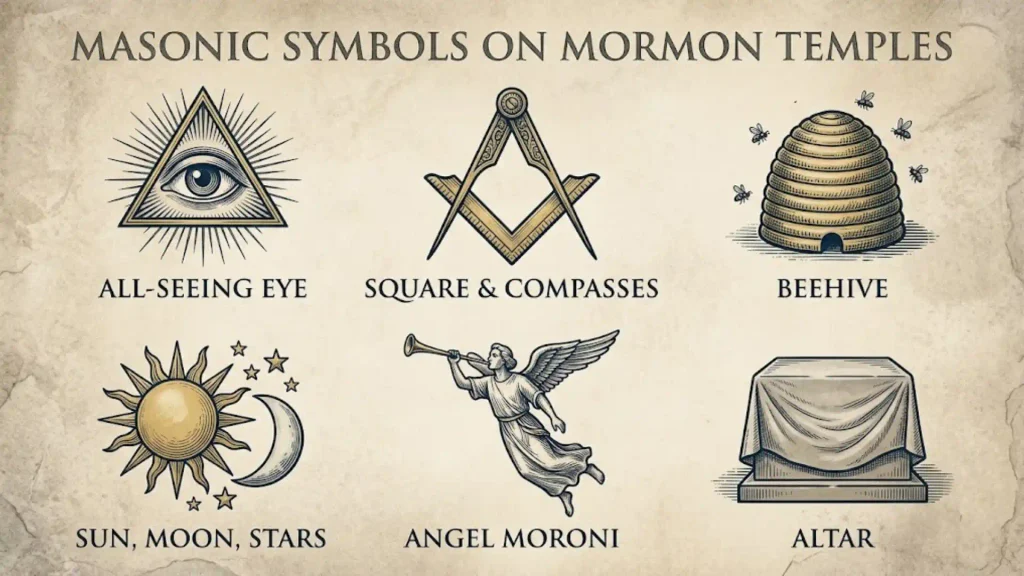
Questions about Masonic symbols on Mormon temples often arise because early Latter-day Saint history has a documented connection with Freemasonry. Joseph Smith, the founder of the Latter-day Saint movement, became a Freemason in Nauvoo, Illinois, in 1842. Several other early church leaders were also Masons.
Some researchers have discussed similarities between Masonic ceremonial practices and certain Latter-day Saint temple practices introduced during the same historical period. However, similarities do not mean that every temple design or religious ceremony is Masonic.
Latter-day Saint temples are religious buildings used for sacred ordinances. Their architecture and decoration vary by building, location, and period. Claims that a particular symbol is Masonic should be evaluated by examining the actual design, historical records, and the context in which it appears.
It is also helpful to distinguish a documented historical relationship from a claim that modern temples secretly belong to Freemasonry. The two organizations have distinct identities, purposes, and religious frameworks.
Masonic Symbols in Mormonism
The relationship between Freemasonry and Mormonism is a historical topic that attracts interest from religious scholars, historians, and members of both communities.
Joseph Smith joined Freemasonry in March 1842, when a lodge was operating in Nauvoo. The timing has led scholars to examine similarities between Masonic ritual forms and the temple endowment introduced among Latter-day Saints during that period.
Some researchers identify parallels in ceremonial clothing, gestures, symbolic instruction, and the use of ritual settings. Interpretations differ over how these similarities developed and what they reveal about religious history.
A few important distinctions help keep the subject clear:
- Historical connection: Early Latter-day Saint leaders had documented involvement in Freemasonry.
- Symbolic similarities: Some researchers identify parallels between certain ceremonial elements.
- Different purposes: Freemasonry is a fraternal organization, while Latter-day Saint temples serve religious purposes within the church.
- Individual symbols: A geometric design or an eye motif alone does not establish a direct connection.
Religious symbolism can overlap across different cultures and institutions. A careful explanation considers historical dates, primary documents, and the meaning each community gives its own practices.
Masonic Symbols in Washington DC
Washington, DC, and the surrounding region contain several landmarks associated with American Freemasonry, national history, and monumental architecture. Their visual designs sometimes encourage questions about Masonic symbolism.
One notable landmark is the George Washington Masonic National Memorial in Alexandria, Virginia, just outside Washington, DC. It honors George Washington and his association with Freemasonry. Its monumental architecture and Masonic identity make it a direct example of a building created for a Masonic purpose.
Washington, DC, also contains buildings and memorials with classical architectural features, including columns, obelisks, eagles, and geometric forms. These elements are used across many architectural and civic traditions. Their presence does not automatically indicate a Masonic origin.
When researching a specific landmark, consider its architect, construction date, original plans, and institutional history. These sources are more reliable than interpreting a building’s appearance in isolation.
Washington DC Masonic Symbols
If you are looking for Masonic symbols in Washington, DC, it helps to separate buildings that explicitly belong to Masonic organizations from public monuments that merely use similar visual elements.
The George Washington Masonic National Memorial in Alexandria is a clear starting point for exploring American Masonic heritage. It was designed as a memorial associated with Freemasonry, so its historical connection is direct rather than speculative.
Other buildings may feature columns, stars, pyramidal forms, or classical symmetry. Such features are common in architecture and can have meanings unrelated to Freemasonry. Even when a famous historical figure was a Mason, that fact alone does not prove that every building associated with the person contains intentional Masonic symbolism.
For a useful historical investigation, look for official landmark descriptions, architectural records, inscriptions, and information from the organization responsible for the site. This approach helps distinguish documented symbols from theories based on visual resemblance.
32 Masonic Symbols
The search for “32 Masonic symbols” can mean two different things: a collection of 32 emblems or a question about the 32nd degree of the Scottish Rite. The distinction matters because the degree is part of a structured Masonic system, while a symbol list is simply a reference collection.
The Scottish Rite builds on the first three degrees of Freemasonry and includes additional degrees. In its Southern Jurisdiction in the United States, the 32nd degree is a recognized part of that system. Its teachings and ceremonial content should not be reduced to a list of 32 icons.
For general symbol identification, common examples include the square, compasses, level, plumb rule, apron, rough ashlar, perfect ashlar, pillars, and letter G. Their interpretations relate to Masonic traditions and may vary by jurisdiction.
If a website presents a numbered list as the official “32 Masonic symbols,” check whether it identifies a particular Masonic body and provides historical sources. Numbered online lists are often editorial collections rather than standardized official catalogs.
Masonic Symbols Images
People often search for Masonic symbols images to identify a logo, study historical artwork, find a reference for a project, or understand an emblem they have seen on a building or personal object.
The most useful images show the complete design rather than a cropped portion. For example, a letter G becomes easier to identify as part of a Masonic emblem when the square and compass are also visible.
Common visual categories include:
- Geometric emblems: Square, compasses, circles, and triangles.
- Building tools: Gavel, level, plumb rule, and trowel.
- Lodge symbols: Aprons, pillars, and other ceremonial imagery.
- Historical artwork: Engravings, lodge seals, and architectural carvings.
- Related symbolic designs: Eyes, stars, and other motifs that also occur outside Freemasonry.
For schoolwork, publishing, or historical research, use images with clear provenance and check their usage rights. An image labeled “Masonic” online may be a modern interpretation rather than a historically verified design.
Masonic Symbols and Meanings
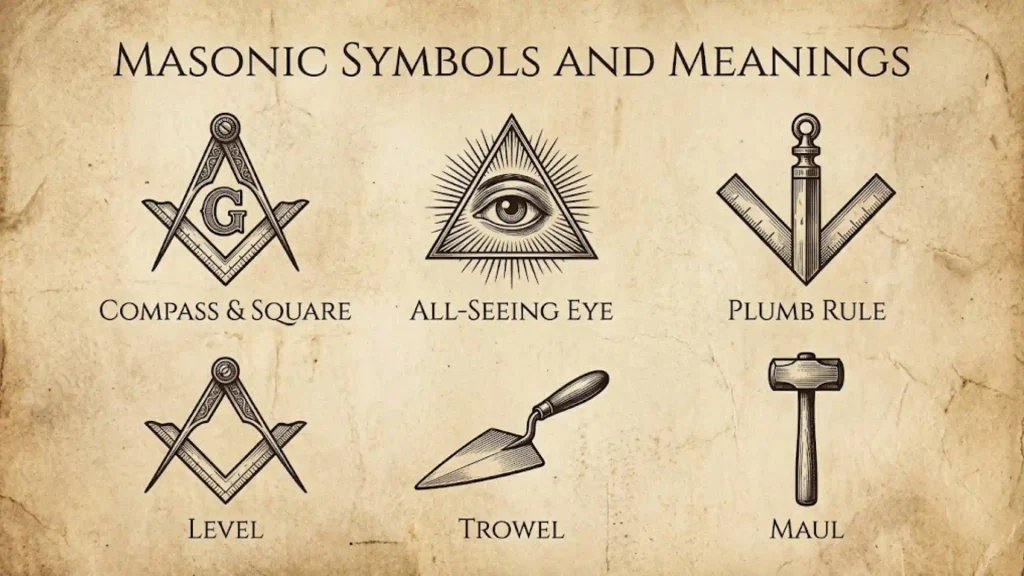
Masonic symbolism becomes easier to understand when symbols are grouped by their purpose instead of treated as a collection of mysterious signs.
Symbols of moral conduct: The square, level, and plumb rule are commonly associated with fairness, equality, and integrity.
Symbols of personal development: The rough and perfect ashlars illustrate the idea of improving one’s character. The gavel can also be interpreted as a reminder to correct personal faults.
Symbols of fellowship: The trowel and beehive are associated with brotherhood, cooperation, or industry in Masonic explanations.
Symbols of knowledge: The letter G and geometric tools connect to geometry and, in some traditions, spiritual ideas about God.
Symbols of mortality and remembrance: Acacia and certain emblematic images remind members of mortality, memory, and the continuation of moral influence.
These categories provide a helpful starting point, but they are not a universal dictionary. The meaning of a particular emblem should be checked against the relevant Masonic tradition and historical setting.
Masonic Symbols Images and Meanings
For readers who want a quick visual reference, the following table combines recognizable Masonic emblems with concise explanations. It is designed to help identify symbols without suggesting that every design has a single fixed meaning.
| Symbol or Design | Common Meaning | Where You May Encounter It |
| Square and compass | Moral conduct and self-restraint | Lodge emblems, jewelry, signs |
| Letter G | Geometry or God in some traditions | Certain square-and-compass designs |
| Level | Equality | Masonic teaching and artwork |
| Plumb rule | Integrity | Lodge symbolism |
| Gavel | Personal improvement | Masonic ceremonial imagery |
| Rough ashlar | Character being developed | Masonic illustrations |
| Perfect ashlar | Refined character | Masonic illustrations |
| Trowel | Brotherhood | Traditional Masonic symbolism |
| Pillars | Strength and establishment | Lodge imagery and architecture |
| All-seeing eye | Providence in some contexts | Masonic and non-Masonic artwork |
| Acacia | Remembrance and immortality | Certain Masonic traditions |
| Beehive | Industry and cooperation | Masonic emblem collections |
If you want a symbol for a presentation, tattoo reference, or personal research, compare several well-documented examples before choosing one. Small changes in the design can affect how it is identified, and not every decorative version has an established traditional meaning.
The most reliable interpretation combines three things: the visible shape, the setting where it appears, and the historical or organizational source that explains it. This prevents ordinary geometric artwork from being mistaken for a specifically Masonic emblem.
FAQs About Masonic Symbols
What is the most famous Masonic symbol?
The square and compass is the most widely recognized Masonic emblem. It is commonly associated with fairness, ethical conduct, and self-control. Some versions also include the letter G.
What does the letter G mean in Masonic symbols?
The letter G is commonly interpreted as geometry or God in certain Masonic traditions. The intended meaning depends on the context and the tradition in which the emblem is used.
Are the symbols on the dollar bill Masonic?
The eye and pyramid on the US one-dollar bill are part of the Great Seal of the United States. Although these elements are sometimes associated with Freemasonry, their presence does not prove that the design is exclusively Masonic.
What does the number 33 mean in Freemasonry?
The 33rd degree is associated with the Scottish Rite, including its Southern Jurisdiction in the United States. It is an honorary degree awarded to selected members for service. It does not represent a universal list of 33 Masonic symbols.
Are Masonic symbols connected to Mormon temples?
There is a documented historical connection between early Latter-day Saint leaders and Freemasonry. Researchers have discussed similarities between certain ceremonial practices, but individual symbols and architectural designs need to be examined in their historical context.
Conclusion
Masonic symbols offer a way to explore the history, philosophy, and traditions of Freemasonry. The square and compass, letter G, working tools, pillars, and other emblems are commonly associated with moral conduct, personal development, knowledge, and fellowship.
Their appearance on money, buildings, tattoos, and religious sites can raise interesting questions, but context matters. A symbol that resembles a Masonic emblem may have a different origin or meaning, so historical evidence is essential when investigating claims about hidden connections.
If you want to identify a Masonic symbol, begin with its shape, location, and documented history. Comparing reliable references will help you understand its traditional meaning without confusing established facts with speculation.

Hi, I’m Asher Monroe, a writer who believes that meaningful words have the power to inspire change and bring people closer to their dreams. I have always been fascinated by the beauty of quotes and the way a simple message can provide motivation, hope, and comfort.
I enjoy creating content around inspirational quotes, life lessons, success stories, and positive thoughts that help readers find encouragement in their everyday lives. My goal is to share words that connect with people and remind them of their inner strength.
Through my writing, I explore the ideas of personal growth, confidence, and the importance of staying inspired through every chapter of life.
I am the author of Words That Move the Soul and The Path of Endless Inspiration, two books focused on the power of wisdom, positivity, and meaningful thoughts.
 Sienna Brooks
 Rowan Sinclair Rowan Sinclair