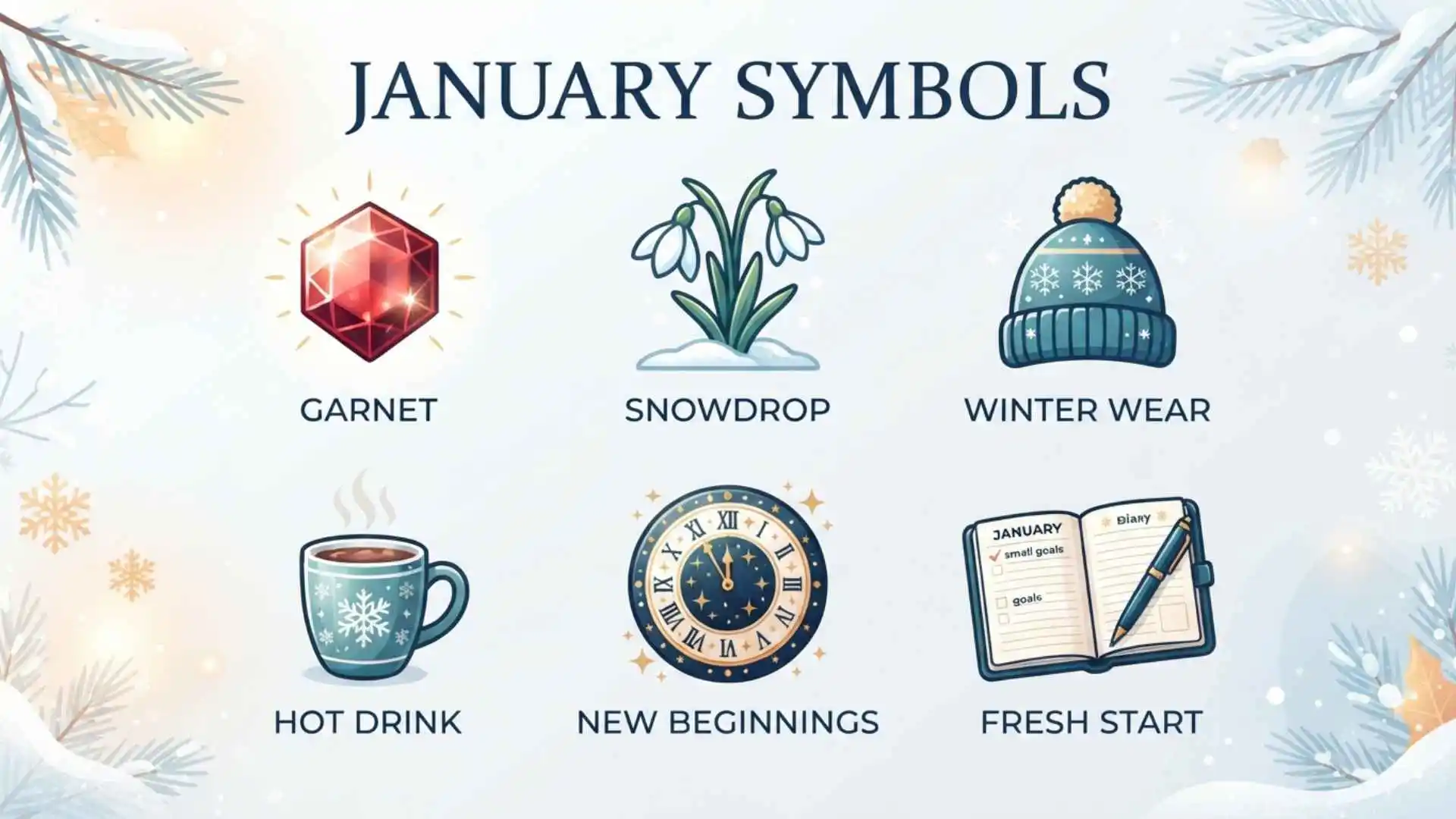
January is the first month of the year and is widely associated with new beginnings, renewal, hope, reflection, strength, and fresh opportunities. Its symbols come from several different traditions, including birth-month customs, astrology, Roman history, nature, winter folklore, and modern symbolism.
The most widely recognized January symbols include garnet, the traditional January birthstone; carnation and snowdrop, the commonly associated birth flowers; Capricorn and Aquarius, the two Western zodiac signs that occur during January; and Janus, the Roman deity whose name is connected with the month.
Other traditions also associate January with symbols such as the fir tree, owl, Wolf Moon, winter landscapes, evergreen plants, and colors such as red, white, and blue. However, not all of these associations are universal or officially standardized.
This guide explores the major January symbols and their meanings, explains their historical and cultural connections, and shows which symbols are best for birthdays, gifts, tattoos, jewelry, artwork, and celebrations.
January Symbols at a Glance
If you are looking for a quick list of January symbols, the table below brings the most common associations together.
| January Symbol | Category | Common Meaning or Association |
| Garnet | Birthstone | Protection, commitment, strength, friendship |
| Carnation | Birth flower | Love, admiration, affection |
| Snowdrop | Birth flower | Hope, renewal, purity |
| Janus | Roman symbolism | Beginnings, transitions, reflection |
| Capricorn | Zodiac sign | Discipline, ambition, determination |
| Sea-Goat | Capricorn symbol | Capricorn’s traditional zodiac imagery |
| Aquarius | Zodiac sign | Independence, innovation, progress |
| Water Bearer | Aquarius symbol | Knowledge, ideas, sharing |
| Fir tree | Traditional plant | Endurance, resilience, continuity |
| Wolf Moon | January lunar tradition | Winter, reflection, nature |
| Evergreen | Winter symbolism | Life, endurance, persistence |
| Red | Modern color association | Energy, passion, strength |
| White | Winter symbolism | Purity, peace, fresh starts |
| Blue | Winter symbolism | Calmness, reflection, serenity |
Some of these are strongly established January associations, while others come from particular birth-month, folklore, or modern symbolic traditions.
What Does January Symbolize?
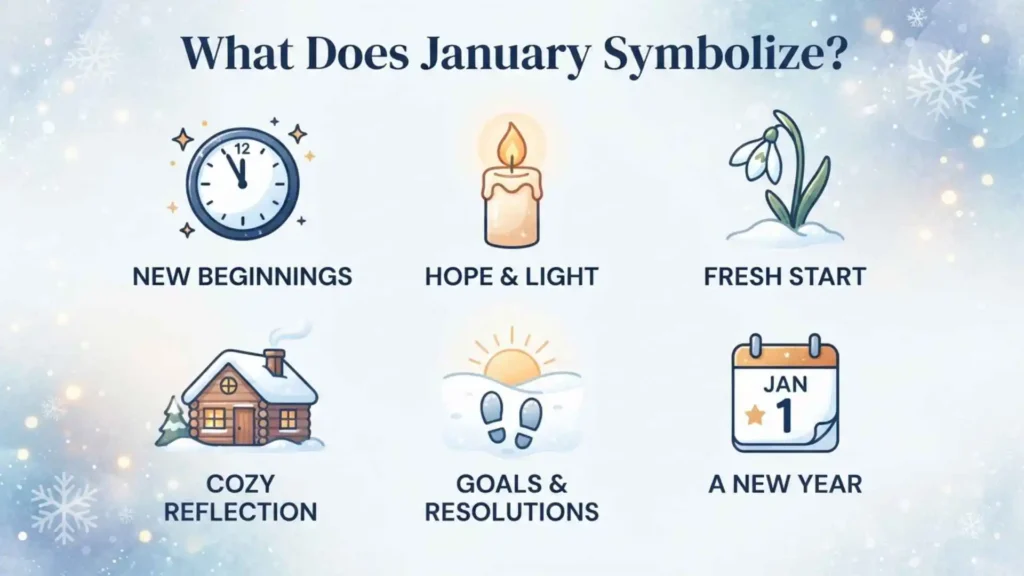
January’s strongest symbolic meaning comes from its position at the beginning of the calendar year.
It marks a transition from one year to another, making it naturally connected with fresh starts and looking toward the future.
New Beginnings
January is perhaps most strongly associated with new beginnings.
People often use the start of the year to establish goals, begin projects, change habits, or make plans for the future.
This makes January a useful symbol for:
- Starting over
- Personal growth
- New opportunities
- Goal setting
- Change
- Moving forward
Renewal and Hope
January can also represent renewal and hope.
The beginning of a new year creates a sense that the future is still unwritten. This symbolism becomes especially powerful when combined with the snowdrop, which is associated with emerging from winter and approaching spring.
Strength and Resilience
January occurs during winter in the Northern Hemisphere.
The cold, dormant landscape can symbolize endurance and resilience. Evergreen plants are particularly suitable for this interpretation because they remain green even during winter.
Reflection and Looking Forward
January is also a month of reflection.
People often look back at what happened during the previous year while deciding what they want to accomplish in the next one.
This combination of past reflection and future planning is one reason Janus is such an appropriate historical symbol for January.
January’s Main Symbols and Their Meanings
January has several important symbols, but they come from different traditions.
Garnet
Garnet is the traditional birthstone associated with January.
It is best known for deep red varieties, although garnets occur in a range of colors.
As a symbolic stone, garnet is commonly associated with:
- Strength
- Protection
- Commitment
- Friendship
- Passion
- Constancy
Its long history and attractive appearance have made garnet a popular choice for January birthday jewelry.
Carnation
The carnation is one of January’s commonly recognized birth flowers.
Traditional flower symbolism associates carnations with meanings such as love, admiration, affection, fascination, and remembrance.
The meaning can change according to the color of the flower.
Snowdrop
The snowdrop is another flower traditionally associated with January.
Because snowdrops can appear during cold periods and are associated with the transition toward spring, they are commonly connected with:
- Hope
- Renewal
- Rebirth
- Purity
- Resilience
The snowdrop is therefore particularly appropriate as a symbol of January’s fresh-start theme.
Janus
Janus is the Roman deity traditionally associated with beginnings, transitions, passages, doorways, and endings.
The English word “January” ultimately comes from the Latin name associated with Janus.
His traditional two-faced representation is especially appropriate for the month because it can be interpreted as looking backward toward the past and forward toward the future.
Capricorn
Capricorn is one of the two Western zodiac signs that occur during January.
Its symbol is the Sea-Goat, a mythical creature combining goat and fish imagery.
Capricorn is commonly associated in astrology with:
- Ambition
- Discipline
- Responsibility
- Patience
- Determination
Aquarius
Aquarius is the other Western zodiac sign associated with January.
Its symbol is the Water Bearer.
Although its imagery involves water, Aquarius is traditionally classified as an air sign in Western astrology.
Aquarius is commonly associated with:
- Independence
- Innovation
- Originality
- Ideas
- Humanitarian themes
January Birthstone
Garnet is the traditional birthstone for January and is one of the month’s most recognizable symbols.
Why Is Garnet January’s Birthstone?
Birthstone traditions developed over time through a mixture of religious, cultural, historical, and commercial traditions.
Garnet became associated with January in modern birthstone systems and is now widely recognized as the month’s birthstone.
What Does Garnet Symbolize?
Garnet has traditionally been connected with qualities such as:
Protection: Historical traditions have sometimes treated garnet as a protective stone.
Strength: Its durability and rich appearance have contributed to associations with strength and endurance.
Commitment: Garnet is sometimes connected with loyalty and lasting relationships.
Passion: Its deep red color contributes to associations with energy and romantic passion.
These are symbolic and cultural associations rather than scientifically established effects.
What Colors Can Garnet Be?
Garnet is not always red.
Although red garnet is the variety most people associate with January, garnets can occur in several colors, including:
- Red
- Orange
- Green
- Yellow
- Brown
- Pink
- Purple
- Black
The exact color depends on the mineral composition and variety.
Is Garnet Always Red?
No.
Red is the most familiar garnet color, but the garnet mineral group includes multiple varieties with different colors and characteristics.
For January jewelry, however, deep red garnet remains the most traditional and recognizable choice.
January Birth Flowers
January is commonly associated with carnation and snowdrop.
These flowers offer two different but complementary symbolic interpretations of the month.
Carnation Meaning
Carnations are commonly associated with:
- Love
- Admiration
- Affection
- Fascination
- Remembrance
Their symbolism can change depending on the cultural tradition and flower color.
Carnation Color Meanings
Traditional flower-language systems often assign different meanings to different carnation colors.
| Carnation Color | Common Traditional Association |
| Red | Love and admiration |
| Pink | Affection and appreciation |
| White | Purity and remembrance |
| Yellow | Disappointment or rejection in some traditions |
These meanings are part of traditional flower symbolism and can vary between cultures.
Snowdrop Meaning
The snowdrop has a particularly strong connection with hope and renewal.
Its appearance during cold weather has made it a natural symbol of persistence and the expectation of spring.
For this reason, snowdrop symbolism can represent:
- Hope after hardship
- New beginnings
- Renewal
- Purity
- Resilience
January Zodiac Symbols
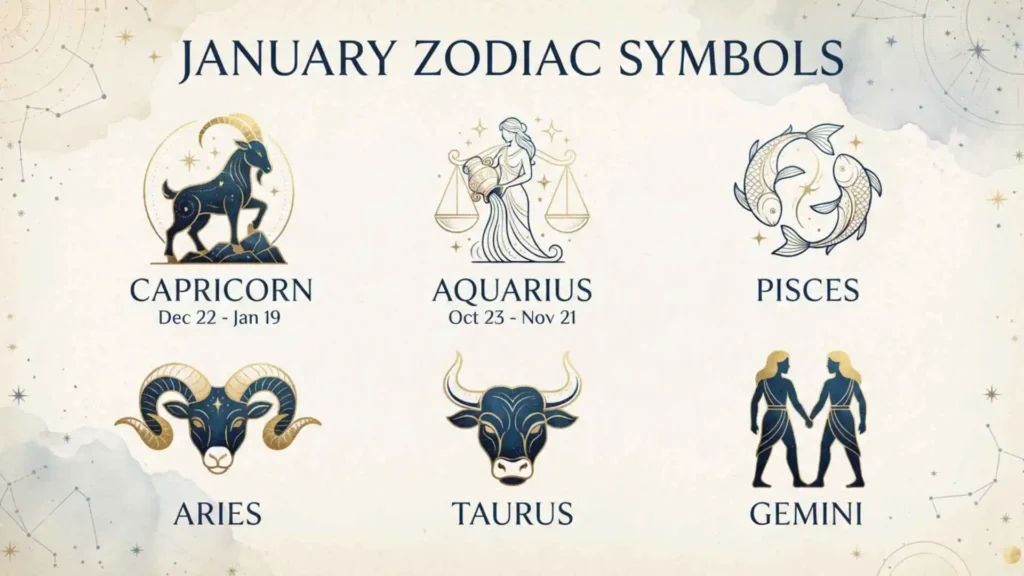
January contains two Western zodiac signs: Capricorn and Aquarius.
The exact transition date can vary slightly depending on the year and source, but Capricorn generally covers the beginning of January, while Aquarius begins around the latter part of the month.
Capricorn and the Sea-Goat
Capricorn’s symbol is the Sea-Goat, a mythical creature with the front portion of a goat and the tail of a fish.
The unusual combination gives Capricorn one of the most distinctive symbols in astrology.
In traditional astrological interpretation, Capricorn is associated with qualities such as discipline, responsibility, ambition, patience, and persistence.
Aquarius and the Water Bearer
Aquarius is represented by the Water Bearer.
The Water Bearer is usually depicted as a person pouring water from a vessel.
Despite this water imagery, Aquarius is an air sign in Western astrology.
Its symbolism is often connected with ideas, innovation, independence, social progress, and humanitarian concerns.
Capricorn vs. Aquarius
| Feature | Capricorn | Aquarius |
| Symbol | Sea-Goat | Water Bearer |
| Element | Earth | Air |
| January association | Earlier January | Later January |
| Common themes | Discipline, ambition | Independence, innovation |
| Symbolic creature/figure | Mythical Sea-Goat | Human Water Bearer |
These are astrological traditions rather than scientific personality classifications.
January Colors and Their Meanings
There is no single universally recognized official January color.
However, several colors are frequently used in January-themed designs and symbolism.
Red
Red connects naturally with January because of garnet, the month’s traditional birthstone.
It can symbolize:
- Energy
- Passion
- Courage
- Strength
- Love
White
White is strongly associated with winter and snow in regions experiencing winter during January.
It can symbolize:
- Purity
- Peace
- Simplicity
- Fresh starts
- A blank slate
Blue
Blue is another common winter color.
It can represent:
- Calmness
- Reflection
- Serenity
- Cold winter landscapes
- Stability
These color associations are mostly symbolic and decorative rather than official January standards.
January Birth Tree and Plant Symbols
Birth-tree traditions are less standardized than January’s birthstone or commonly recognized birth flowers.
Fir Tree
In some birth-tree and seasonal traditions, the fir tree is associated with January.
Because fir trees remain evergreen during winter, they can symbolize:
- Endurance
- Longevity
- Resilience
- Protection
- Continuity
However, different birth-tree systems assign different trees to months, so the fir should be described as a traditional association rather than a universally official January birth tree.
Evergreen Symbolism
Evergreen plants provide a broader January symbol.
While many other plants become dormant during winter, evergreens retain their foliage.
This makes them natural symbols of:
Persistence, life, endurance, and continuity.
January Birth Animal and Bird
Unlike the birthstone and birth flowers, January does not have one universally accepted birth animal or bird.
Different symbolic systems use different animals.
Owl and Other Traditional Associations
Some modern birth-month traditions associate January with animals or birds such as the owl, often connecting it with wisdom, observation, or intuition.
However, these associations vary considerably between sources.
There is no single official January birth animal recognized across all cultures.
Why January Animal Traditions Differ
Animal symbolism often comes from folklore, modern birth-month calendars, astrology, regional traditions, or symbolic systems created for particular purposes.
Therefore, if you use an animal as a January symbol, it is best to identify the tradition behind the association rather than presenting it as universal.
January’s Wolf Moon
The first full moon traditionally associated with January is commonly called the Wolf Moon.
The name comes from traditional North American and European seasonal naming practices and is connected with observations of wolves and the winter landscape.
Why Is It Called the Wolf Moon?
The Wolf Moon name is traditionally associated with the time of year when winter conditions were severe and wolves were commonly heard or observed around settlements.
Different cultures have used different names for January’s full moon, so Wolf Moon is best understood as a traditional lunar name rather than an official scientific designation.
What Does the Wolf Moon Symbolize?
In modern symbolism, the Wolf Moon can represent:
- Winter
- Reflection
- Solitude
- Instinct
- Strength
- Survival
- Connection with nature
This makes it an attractive symbol for people looking for a January image with a stronger and more mysterious character.
Is the Wolf Moon Always in January?
The traditional name is associated with January’s full moon, but the exact date of the full moon changes every year.
The astronomical event is determined by the lunar cycle, not by a fixed calendar date.
Why Is January Named After Janus?
The historical origin of the word January is one of the most interesting aspects of January symbolism.
Who Was Janus?
Janus was a Roman deity associated with beginnings, transitions, entrances, exits, passages, and changes.
Unlike many Roman gods, Janus is traditionally represented with two faces.
What Do the Two Faces of Janus Mean?
The two faces are commonly interpreted as looking in opposite directions.
Symbolically, this can represent:
- Past and future
- Endings and beginnings
- Reflection and planning
- Leaving and entering
- Change and transition
This imagery makes Janus particularly appropriate for January.
Why Is Janus a Symbol of New Beginnings?
January begins a new calendar year while immediately following the conclusion of the previous one.
Janus’s connection with transitions therefore mirrors the experience of entering a new year while still reflecting on the year that has ended.
January Symbols for Tattoos and Jewelry
January symbols can be combined to create personalized designs.
January Tattoo Ideas
Popular symbolic combinations can include:
- Garnet with a carnation
- Snowdrop with a January birth date
- Capricorn with garnet
- Aquarius with a snowdrop
- Janus-inspired imagery
- Wolf Moon with a wolf
- Evergreen branches with a January date
A tattoo can combine several January symbols to represent both the person’s birth month and a personal meaning.
January Jewelry Ideas
Garnet is the most traditional choice for January birthstone jewelry.
Possible designs include:
- Garnet rings
- Garnet necklaces
- Garnet earrings
- Garnet bracelets
- Carnation pendants
- Snowdrop charms
- Capricorn jewelry
- Aquarius jewelry
Combining January Symbols
Combining symbols can create a more personal piece.
For example:
Garnet + Carnation: January birthday, love, and admiration.
Garnet + Capricorn: January birthstone with Capricorn identity.
Snowdrop + Janus: Hope combined with transition and new beginnings.
Wolf Moon + Evergreen: Winter strength and resilience.
Which January Symbol Should You Choose?
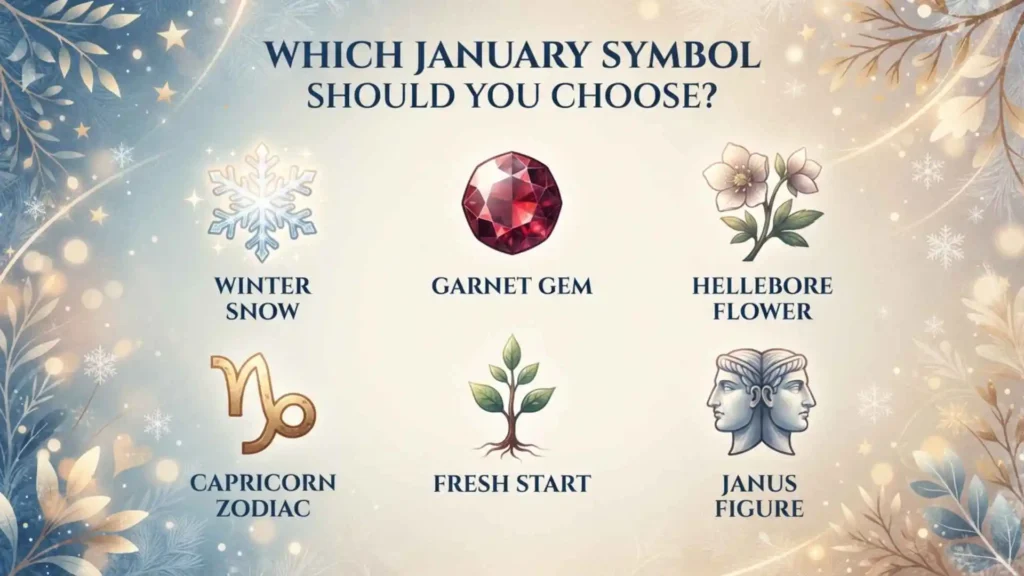
The best January symbol depends on the meaning you want to communicate.
Best Symbol for New Beginnings
Janus is one of the strongest historical choices because of his connection with transitions and beginnings.
The snowdrop is another excellent option because of its association with hope and renewal.
Best Symbol for Love
The carnation, particularly a red carnation in traditional flower symbolism, is a natural choice for love and admiration.
Best Symbol for Hope
The snowdrop is especially suitable for hope, renewal, and looking toward better times.
Best Symbol for Strength
Garnet and evergreen imagery can work well when you want to represent strength, endurance, and persistence.
Best Symbol for a January Birthday
For a traditional January birthday symbol, choose garnet, carnation, snowdrop, Capricorn, or Aquarius, depending on the person’s interests and birth date.
January Symbols in Different Traditions
Not every January symbol comes from the same cultural background.
Understanding where a symbol comes from helps prevent different traditions from being incorrectly presented as one universal system.
Historical Symbols
Janus is primarily a historical Roman association.
His connection to January comes from the Roman calendar and the meaning of his name and religious role.
Birth-Month Traditions
Garnet, carnation, and snowdrop are commonly used as January birth-month symbols.
These traditions are especially popular for birthdays, jewelry, gifts, and personalized artwork.
Modern Symbolism
Colors, tattoos, animals, and some January personality interpretations are often modern or popular symbolic associations.
They can be meaningful without necessarily being ancient or universally recognized traditions.
January Symbols and New Year’s Resolutions
January’s symbolism is closely connected with New Year’s resolutions.
The beginning of the year creates a natural opportunity to evaluate the past and plan for the future.
Why January Represents Change
People commonly use January to:
- Set personal goals
- Begin new habits
- Start new projects
- Organize their lives
- Learn new skills
- Change routines
- Focus on personal development
This is another reason why words such as renewal, transformation, hope, and fresh start are strongly associated with January.
January Symbols Cheat Sheet
Here is a simple reference for the most useful January symbols and their meanings.
| Symbol | Meaning |
| Garnet | Strength, protection, commitment |
| Carnation | Love, admiration, affection |
| Snowdrop | Hope, renewal, purity |
| Janus | Beginnings, endings, transitions |
| Capricorn | Discipline, ambition, persistence |
| Sea-Goat | Capricorn |
| Aquarius | Independence, innovation, originality |
| Water Bearer | Aquarius |
| Fir | Endurance and continuity in some traditions |
| Evergreen | Resilience and lasting life |
| Wolf Moon | Winter, reflection, nature |
| Red | Passion, energy, strength |
| White | Purity, peace, fresh beginnings |
| Blue | Calmness and winter reflection |
Frequently Asked Questions
What are the main symbols of January?
The most widely recognized January symbols include garnet, carnation, snowdrop, Capricorn, Aquarius, and Janus. Other traditions also associate January with the fir tree, evergreen plants, Wolf Moon, winter, and various colors.
What is January’s birthstone?
Garnet is the traditional birthstone associated with January.
What are January’s birth flowers?
The carnation and snowdrop are commonly recognized as January birth flowers.
What does garnet symbolize?
Garnet is traditionally associated with strength, protection, commitment, friendship, passion, and constancy. These are cultural and symbolic associations rather than scientifically proven effects.
What does the carnation symbolize?
Carnations are commonly associated with love, admiration, affection, fascination, and remembrance. The meaning can vary according to flower color and cultural tradition.
What does the snowdrop symbolize?
The snowdrop is commonly associated with hope, renewal, purity, rebirth, and resilience, partly because of its connection with the transition from winter toward spring.
What zodiac signs are in January?
January includes Capricorn and Aquarius in the Western zodiac.
What is Capricorn’s symbol?
Capricorn is represented by the Sea-Goat, a mythical creature combining goat and fish imagery.
What is Aquarius’s symbol?
Aquarius is represented by the Water Bearer, usually depicted as a person carrying or pouring water.
Is Aquarius a water sign because it has a Water Bearer?
No. Despite its water-related imagery and name, Aquarius is traditionally classified as an air sign in Western astrology.
Why is January named after Janus?
January’s name comes from Janus, the Roman deity associated with beginnings, transitions, passages, and doorways.
What does Janus symbolize?
Janus can symbolize transition, beginnings and endings, reflection, and looking toward the future. His two-faced imagery is especially appropriate for the transition from one year to another.
What color represents January?
There is no single universally official January color. Red, white, and blue are commonly used in January symbolism because of garnet and winter associations.
What animal represents January?
There is no universally accepted official January animal. Some birth-month traditions associate January with animals such as the owl, but these associations vary by tradition.
What is January’s birth tree?
Some birth-tree traditions associate January with the fir tree, but birth-tree systems differ. The fir is commonly used symbolically to represent endurance, resilience, and continuity.
What is the January Wolf Moon?
The Wolf Moon is a traditional name commonly given to January’s full moon. It is associated with winter and has become a popular symbol of nature, reflection, strength, and survival.
What is the best January symbol for a tattoo?
There is no single best choice. Garnet, carnation, snowdrop, Capricorn, Aquarius, Janus, evergreen branches, and the Wolf Moon can all work well depending on the intended meaning.
What is the best January symbol for a birthday gift?
Garnet is the most traditional choice because it is January’s birthstone. Carnation or snowdrop designs are also meaningful options for someone who prefers floral symbolism.
Does January have an official symbol?
January does not have one single symbol that represents every tradition. Instead, it has several widely recognized associations, including its birthstone, birth flowers, zodiac signs, and historical connection with Janus.
What does January symbolize spiritually?
In modern spiritual and symbolic interpretations, January is often associated with renewal, reflection, transformation, hope, fresh beginnings, and setting intentions for the future. These interpretations vary between individuals and traditions.
Conclusion
January symbols bring together history, nature, birth-month traditions, astrology, winter imagery, and modern symbolism.
The month’s most recognizable associations are garnet, carnation, snowdrop, Capricorn, Aquarius, and Janus. Garnet represents January as a birthstone, while the carnation and snowdrop provide floral symbolism connected with love, admiration, hope, and renewal. Capricorn and Aquarius represent the two Western zodiac signs found during January, while Janus provides the month’s strongest historical connection with beginnings and transitions.
Other symbols, including the fir tree, evergreen plants, Wolf Moon, winter colors, and traditional animals, can add additional meaning, but these should be understood as particular cultural or modern associations rather than universal January symbols.

Hi, I’m Asher Monroe, a writer who believes that meaningful words have the power to inspire change and bring people closer to their dreams. I have always been fascinated by the beauty of quotes and the way a simple message can provide motivation, hope, and comfort.
I enjoy creating content around inspirational quotes, life lessons, success stories, and positive thoughts that help readers find encouragement in their everyday lives. My goal is to share words that connect with people and remind them of their inner strength.
Through my writing, I explore the ideas of personal growth, confidence, and the importance of staying inspired through every chapter of life.
I am the author of Words That Move the Soul and The Path of Endless Inspiration, two books focused on the power of wisdom, positivity, and meaningful thoughts.