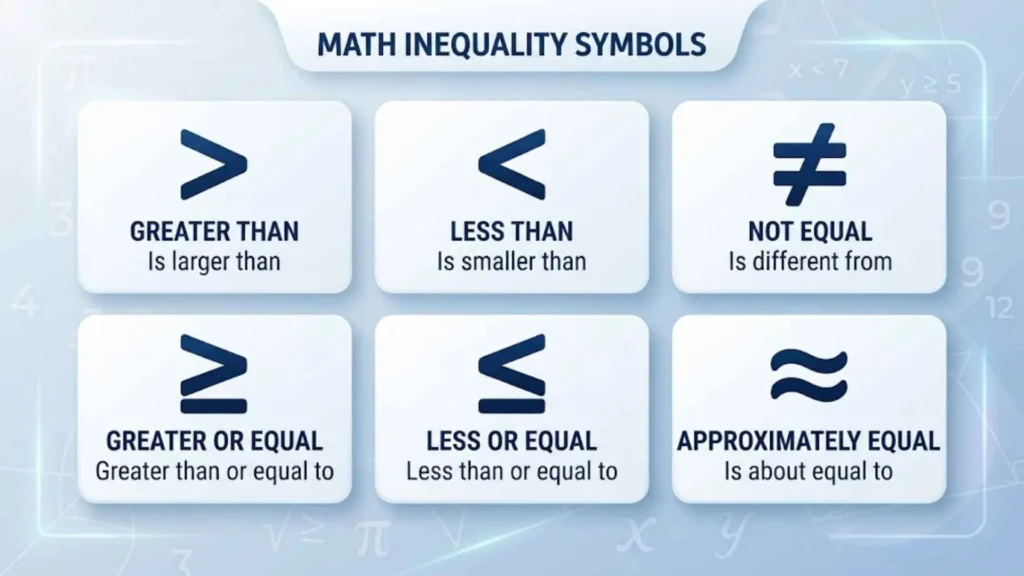
Inequality symbols are mathematical signs used to compare two values, expressions, or quantities. Common examples include <, >, ≤, and ≥, and each one tells you whether one value is smaller, larger, or equal to another.
Understanding these symbols becomes much easier when you see them with numbers, words, number lines, and graphs. This guide explains their meanings, shows practical examples, and explains how open and closed circles and shading work.
You will also find inequality symbols that you can copy and paste, along with keyboard methods, verbal forms, and useful examples for schoolwork, worksheets, messages, and digital documents.
Inequality symbols with examples
The most commonly used inequality symbols compare two quantities.
| Symbol | Meaning | Example | Meaning in words |
| < | Less than | 3 < 8 | 3 is less than 8 |
| > | Greater than | 9 > 4 | 9 is greater than 4 |
| ≤ | Less than or equal to | x ≤ 6 | x is less than or equal to 6 |
| ≥ | Greater than or equal to | x ≥ 2 | x is greater than or equal to 2 |
| = | Equal to | 5 = 5 | 5 is equal to 5 |
| ≠ | Not equal to | 7 ≠ 3 | 7 is not equal to 3 |
For example, 4 < 10 is true because 4 is smaller than 10. Similarly, 12 > 7 is true because 12 is larger than 7.
The symbols ≤ and ≥ include equality. Therefore, x ≤ 5 allows x to be 5 as well as any value smaller than 5.
Inequality symbols and meanings
Here is a quick reference for the main inequality symbols:
- < — less than
- > — greater than
- ≤ — less than or equal to
- ≥ — greater than or equal to
- ≠ — not equal to
- = — equal to
The first four are especially common when solving mathematical inequalities. The equal sign is used for exact equality rather than an inequality, while the not-equal sign states that two quantities are different.
A useful way to remember < and > is to think of the wider side as pointing toward the larger number. In 2 < 9, the open side faces 9 because 9 is larger.
Inequality symbols words
Inequalities can also be written using words. Knowing these word forms helps when converting a word problem into a mathematical expression.
| Words | Symbol | Example |
| Less than | < | x < 10 |
| Greater than | > | x > 10 |
| Less than or equal to | ≤ | x ≤ 10 |
| Greater than or equal to | ≥ | x ≥ 10 |
| Not equal to | ≠ | x ≠ 10 |
| Equal to | = | x = 10 |
Some word problems use phrases that imply inequalities without directly saying “less than” or “greater than.”
For example:
- “At least 20” means x ≥ 20.
- “At most 20” means x ≤ 20.
- “More than 20” means x > 20.
- “Fewer than 20” means x < 20.
- “No more than 20” means x ≤ 20.
- “No fewer than 20” means x ≥ 20.
Pay close attention to phrases such as at least and at most, because they include the boundary value.
Inequality symbols number line
A number line provides a visual way to show the solution to an inequality.
For x > 3, place an open circle at 3 and shade or draw the line toward numbers greater than 3.
For x ≥ 3, use a closed circle at 3 because 3 itself is included.
For x < 3, use an open circle at 3 and shade toward smaller numbers.
For x ≤ 3, use a closed circle at 3 and shade toward smaller numbers.
The basic rule is:
- Open circle = boundary value is not included.
- Closed circle = boundary value is included.
- Shade right = values greater than the boundary.
- Shade left = values less than the boundary.
This makes number lines particularly useful when checking whether a solution includes its endpoint.
Inequality symbols graph
Inequalities can be represented on graphs, especially when working with two variables.
For a simple one-variable inequality, a number line is usually the clearest graph. For an inequality involving x and y, the solution may appear as a shaded region on a coordinate plane.
For example:
y > x + 2
The boundary is the line y = x + 2. Because the inequality uses > rather than ≥, the boundary line is normally drawn dashed, and the region satisfying the inequality is shaded.
For:
y ≥ x + 2
the boundary is included, so the line is drawn solid and the appropriate region is shaded.
The distinction is:
- < or > → boundary usually not included → dashed boundary
- ≤ or ≥ → boundary included → solid boundary
Inequality symbols at most
The phrase at most means “less than or equal to.”
For example:
x ≤ 15
means x can be 15 or any number below 15.
Possible values include:
15, 14, 10, 5, 0, -2
The number 15 is included because “at most” allows the maximum value itself.
Compare this with less than 15, which is written:
x < 15
Here, 15 is not included.
Other examples include:
- At most 50 → x ≤ 50
- At most 100 people → x ≤ 100
- A temperature of at most 30°C → T ≤ 30°C
- A score of at most 75 → s ≤ 75
What are the inequality symbols
Inequality symbols are mathematical characters used to show relationships between quantities that are not necessarily equal.
The basic comparison symbols are:
< > ≤ ≥ ≠
They communicate relationships such as smaller than, larger than, smaller than or equal to, larger than or equal to, and not equal to.
For example:
6 < 11
states that 6 is smaller than 11.
11 > 6
states the same numerical relationship from the opposite direction.
Inequality symbols are widely used in arithmetic, algebra, statistics, science, economics, programming-related notation, and everyday quantitative descriptions.
All inequality symbols
There is no single short list that contains every mathematical relation ever used, because different areas of mathematics use additional specialized notation. However, the following symbols cover many common comparison relationships.
| Symbol | Common name or meaning |
| < | Less than |
| > | Greater than |
| ≤ | Less than or equal to |
| ≥ | Greater than or equal to |
| ≠ | Not equal to |
| ≈ | Approximately equal to |
| ≡ | Identically equal to / equivalent, depending on context |
| ≪ | Much less than |
| ≫ | Much greater than |
| ≤ | Less than or equal to |
| ≥ | Greater than or equal to |
Some of these are not strictly inequality operators in every context. For example, ≈ commonly means approximately equal to rather than an inequality in the usual algebraic sense.
For most school-level inequality problems, the core symbols to learn are <, >, ≤, ≥, and ≠.
Inequality symbols in math
In mathematics, inequality symbols are used to describe relationships between numbers, variables, expressions, and quantities.
Consider:
x + 4 > 10
To solve it, subtract 4 from both sides:
x > 6
The solution is every value greater than 6.
Another example is:
2x ≤ 12
Divide both sides by 2:
x ≤ 6
When multiplying or dividing an inequality by a negative number, the inequality sign reverses. For example:
-2x > 8
Dividing by -2 gives:
x < -4
This sign reversal is one of the most important rules to remember when solving inequalities.
How to type inequality symbols
You can insert inequality symbols in several ways depending on the device or application.
The easiest option is often to copy and paste the character directly:
< > ≤ ≥ ≠
On a standard keyboard, the < and > characters are commonly available using the comma and period keys with Shift.
The symbols ≤, ≥, and ≠ may require a symbol menu, character viewer, Unicode input method, or an application-specific shortcut.
In Microsoft Word and similar applications, you can also use the application’s symbol or equation tools. In mathematical editors, typing an expression such as \le or \ge may produce the corresponding symbol when that editor supports LaTeX-style commands.
For ordinary text, copying the actual character is often the simplest method.
Inequality symbols graph
When an inequality is shown on a coordinate graph, the boundary and shading communicate different parts of the solution.
Suppose you have:
y < 2x + 1
First draw the boundary represented by:
y = 2x + 1
Because the original inequality uses <, the boundary is not part of the solution, so it is represented with a dashed line. The area below the line is then shaded.
For:
y ≤ 2x + 1
the boundary is included. The line is therefore solid, and the appropriate side of the graph is shaded.
A useful test point, often (0, 0), can help determine which side of the boundary should be shaded when the direction is not immediately obvious.
Inequality symbols examples
Here are several examples showing how the symbols work in practical situations.
Basic comparisons
- 2 < 7 — 2 is less than 7.
- 9 > 4 — 9 is greater than 4.
- 5 ≤ 5 — 5 is less than or equal to 5.
- 8 ≥ 3 — 8 is greater than or equal to 3.
- 6 ≠ 10 — 6 is not equal to 10.
Variable examples
- x < 20
- x > -5
- x ≤ 12
- x ≥ 100
- x ≠ 0
Everyday examples
If a box can hold no more than 10 kilograms:
weight ≤ 10 kg
If a student must score at least 60 points:
score ≥ 60
If a product costs less than $50:
price < $50
These examples show why understanding the exact wording is important.
Inequality symbols words
When an inequality is written as words, identify the comparison phrase before choosing a symbol.
For example:
x is less than 9
becomes:
x < 9
“y is greater than or equal to 12” becomes:
y ≥ 12
“n is not equal to 4” becomes:
n ≠ 4
Be especially careful with phrases such as “greater than 5.” The statement x > 5 does not include 5.
Likewise, “at least 5” means x ≥ 5, so 5 is included.
Inequality symbols number line
A number line can show both the direction and endpoint of an inequality.
| Inequality | Circle | Direction |
| x < 4 | Open at 4 | Left |
| x ≤ 4 | Closed at 4 | Left |
| x > 4 | Open at 4 | Right |
| x ≥ 4 | Closed at 4 | Right |
For example, the solution to x ≥ 4 begins at 4 and continues toward larger numbers.
The solution to x < 4 extends toward smaller numbers but stops before including 4.
For compound inequalities such as:
2 < x ≤ 7
use an open circle at 2 and a closed circle at 7, with the section between them highlighted.
What are inequality symbols
Inequality symbols provide a compact way to express comparison. Instead of writing “12 is greater than 7,” mathematics can simply use:
12 > 7
This makes equations and mathematical statements shorter and easier to analyze.
They are especially useful when the exact value of a variable is unknown. For instance:
x > 25
does not identify one value of x. It describes a whole range of possible values.
That range-based quality is what makes inequalities different from equations that specify an exact value.
Inequality symbols definition
An inequality symbol is a mathematical notation used to express that one quantity has a particular relationship to another quantity.
Common relationships include:
- Less than: <
- Greater than: >
- Less than or equal to: ≤
- Greater than or equal to: ≥
- Not equal to: ≠
An inequality can contain numbers, variables, algebraic expressions, or functions.
For example:
3x + 2 ≥ 14
is an inequality because it states that the expression on the left is greater than or equal to the value on the right.
Inequality symbols chart
The following chart gives a quick reference for common inequality and comparison symbols.
| Symbol | Meaning | Example |
| < | Less than | 3 < 8 |
| > | Greater than | 8 > 3 |
| ≤ | Less than or equal to | x ≤ 8 |
| ≥ | Greater than or equal to | x ≥ 3 |
| ≠ | Not equal to | x ≠ 8 |
| ≈ | Approximately equal to | π ≈ 3.14 |
| ≪ | Much less than | 2 ≪ 100 |
| ≫ | Much greater than | 100 ≫ 2 |
Remember that symbols such as ≈, ≪, and ≫ have meanings that depend on mathematical context. They should not automatically be treated as interchangeable with < or >.
Mathematical inequality symbols meaning
Mathematical inequality symbols describe comparison rather than exact equality.
The most important meanings are:
< means the value on the left is smaller.
> means the value on the left is larger.
≤ means the value on the left is smaller or exactly the same.
≥ means the value on the left is larger or exactly the same.
≠ means the two sides do not have the same value.
For example:
x ≤ 10
allows values such as 10, 9, 0, and -5.
By contrast:
x < 10
does not allow 10 itself.
Inequality symbols keywords
People search for inequality information using many different phrases. Common search terms and related concepts include:
- inequality symbols
- inequality symbols and meanings
- math inequality symbols
- inequality symbols chart
- inequality symbols examples
- less than symbol
- greater than symbol
- less than or equal symbol
- greater than or equal symbol
- inequality symbols number line
- inequality symbols graph
- inequality symbols copy and paste
- how to type inequality symbols
- inequality symbols words
- at most inequality
- at least inequality
- open and closed circles
- inequality shading
These phrases reflect different search intents. Some readers want a quick symbol to copy, while others need an explanation of how to solve or graph inequalities.
Inequality symbols shading
Shading is commonly used to show the solution area of an inequality.
On a number line:
- x > 3 → shade to the right.
- x ≥ 3 → shade to the right.
- x < 3 → shade to the left.
- x ≤ 3 → shade to the left.
On a coordinate graph, shading identifies the region where the inequality is true.
For example:
y > x
means the solution lies above the line y = x.
y < x
means the solution lies below the line.
The boundary itself depends on whether equality is included.
Inequality symbols open or closed circle
Open and closed circles are important when graphing inequalities on a number line.
An open circle means the endpoint is excluded.
Example:
x > 5
Use an open circle at 5 because x can be greater than 5, but it cannot equal 5.
A closed circle means the endpoint is included.
Example:
x ≥ 5
Use a closed circle at 5 because x can equal 5 or be greater than 5.
A simple memory rule is:
- < or > → open circle
- ≤ or ≥ → closed circle
Inequality symbols and meanings
The symbols can be understood by looking at the relationship between the two sides.
Take:
4 < 9
The smaller value is on the left.
Reverse the comparison:
9 > 4
The statement remains true because the larger value is now on the left.
For symbols containing the horizontal line, the line represents inclusion of equality:
≤ means less than or equal to.
≥ means greater than or equal to.
This small line is therefore meaningful and should not be omitted when equality is part of the statement.
Inequality symbols meaning
The simplest meanings to remember are:
< — smaller than
> — larger than
≤ — smaller than or equal to
≥ — larger than or equal to
≠ — different from or not equal to
For example, x ≥ 25 means that x can be 25 or any value greater than 25.
The context can affect how an inequality is interpreted. A statement about the number of people in a room usually concerns whole numbers, while an inequality involving measurements may allow decimals or fractions.
Inequality symbols copy and paste
Here are common inequality symbols ready to copy:
<
>
≤
≥
≠
≈
≪
≫
For quick mathematical writing, you can copy the exact character you need and paste it into a document, website, message, worksheet, presentation, or other text field.
Quick Copy List
- < — Less than
- > — Greater than
- ≤ — Less than or equal to
- ≥ — Greater than or equal to
- ≠ — Not equal to
- ≈ — Approximately equal to
- ≪ — Much less than
- ≫ — Much greater than
If a particular application does not display a specialized character correctly, its equation or symbol insertion feature may provide another way to enter it.
Math inequality symbols
Math inequality symbols are useful for comparing quantities and describing ranges of possible values.
The core set is:
< > ≤ ≥ ≠
You will encounter these signs in basic arithmetic, algebra, geometry, statistics, science, and many other quantitative subjects.
When solving an inequality, remember that multiplying or dividing both sides by a negative number reverses the inequality sign. For example:
-3x < 12
Dividing by -3 changes the direction:
x > -4
That rule is essential when working with algebraic inequalities.
Frequently Asked Questions
What are the four main inequality symbols?
The four main comparison symbols are <, >, ≤, and ≥. They mean less than, greater than, less than or equal to, and greater than or equal to.
What does ≤ mean in math?
The symbol ≤ means “less than or equal to.” It allows the value on the left to be either smaller than or exactly equal to the value on the right.
What is the difference between < and ≤?
The symbol < excludes equality, while ≤ includes equality. For example, x < 5 excludes 5, whereas x ≤ 5 includes 5.
How do I remember which way the inequality sign goes?
Think of the wider, open side as facing the larger value. In 3 < 8, the wide side faces 8, while the pointed end faces 3.
How do you graph an inequality on a number line?
Place an open circle when the endpoint is excluded and a closed circle when it is included. Then shade left for values smaller than the endpoint and right for values greater than it.
Conclusion
Inequality symbols make it easy to compare numbers and describe ranges of possible values. The most important signs are <, >, ≤, ≥, and ≠, each of which communicates a specific mathematical relationship.
Number lines and graphs make inequalities easier to understand visually. Open and closed circles show whether an endpoint is excluded or included, while shading shows the direction or region containing the solutions.
For everyday writing and digital work, the symbols can also be copied and pasted directly. Once you understand their meanings and how they relate to words such as “at least,” “at most,” “less than,” and “greater than,” inequality problems become much easier to read and solve.

Hello, I’m Rowan Sinclair, a passionate writer and lifelong admirer of the wisdom found in great quotes. I believe that words have the ability to inspire change, spark creativity, and connect people across cultures and generations.
I enjoy writing about motivational quotes, famous sayings, and lessons from history’s most influential thinkers. Every article I create is driven by my desire to help readers discover meaningful insights that they can apply to their own lives.
When I’m not writing, I spend my time reading biographies, exploring classic literature, and collecting memorable quotes that deserve to be shared with the world.
I am the author of Voices That Inspire and A Collection of Timeless Thoughts, two books that celebrate the enduring power of words and the stories behind them.
 Sienna Brooks