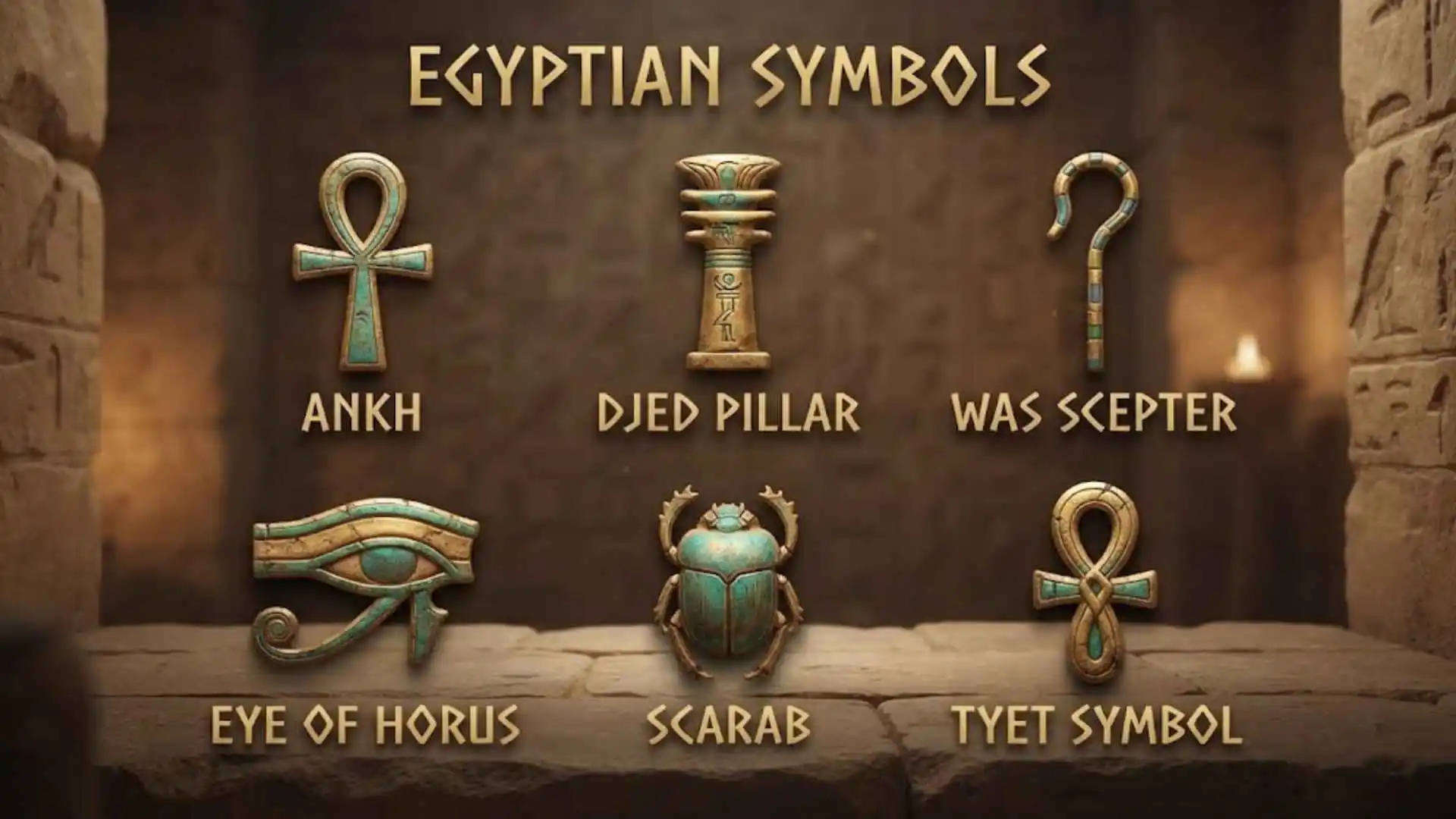
Egyptian symbols have fascinated people for thousands of years because they combine art, writing, religion, mythology, and everyday ideas into recognizable shapes. Symbols such as the Ankh, Eye of Horus, scarab, and Was scepter are still widely recognized today.
This guide explores Egyptian symbols and meanings from several angles, including ancient Egyptian symbols, hieroglyphics, symbols of life and protection, famous names, tattoo ideas, and symbols that can be copied into text. It also explains an important distinction between ancient Egyptian signs and modern Unicode characters.
If you are looking for a meaningful Egyptian symbol, trying to understand a hieroglyph, or simply want a character you can copy and paste, you will find practical information here. Meanings can vary by historical period and context, so each symbol is explained with that distinction in mind.
Egyptian Symbols And Meanings
Ancient Egyptians used symbols in temples, tombs, jewelry, statues, religious objects, documents, and artwork. Some symbols represented ideas such as life, protection, power, rebirth, kingship, or health, while others functioned as parts of the hieroglyphic writing system.
Here are some of the best-known Egyptian symbols:
| Symbol | Common name | Commonly associated meaning |
| ☥ | Ankh | Life, vitality, living |
| 𓂀 | Eye of Horus | Protection, healing, restoration |
| 𓆣 | Scarab | Rebirth, regeneration, transformation |
| 𓇳 | Sun disk | Sun, solar power, divine association |
| 𓋹 | Ankh-related hieroglyphic form | Life |
| 𓉐 | House sign | House, dwelling, place |
| 𓏏 | Bread loaf sign | Bread or the sound/value associated with it in writing |
| 𓂋 | Mouth sign | Mouth and related phonetic value |
| 𓆑 | Horned viper sign | A consonantal sound in hieroglyphic writing |
The meanings of these signs should not all be treated as simple modern symbols with one fixed definition. Hieroglyphs could represent sounds, words, concepts, or grammatical information depending on how they were used.
The most familiar religious symbols are often more useful for understanding Egyptian culture than for translating individual words. For example, the Ankh is strongly associated with life, while the Eye of Horus has connections with protection and restoration.
Ancient Egyptian Symbols
Ancient Egyptian symbols developed over a very long period, so there was no single universal collection used unchanged throughout Egyptian history. Different symbols became important in different periods and contexts.
Some of the most recognizable examples include the Ankh, Djed pillar, Was scepter, Eye of Horus, Eye of Ra, scarab, lotus, crook and flail, and Shen ring.
These objects and signs appeared in religious scenes, royal imagery, funerary art, amulets, inscriptions, and architecture. Their meanings were often connected to Egyptian ideas about kingship, the gods, death, rebirth, order, and protection.
A useful way to understand ancient Egyptian symbols is to group them by theme:
- Life: Ankh
- Protection and restoration: Eye of Horus
- Stability: Djed
- Power and authority: Was scepter
- Rebirth: Scarab
- Royal authority: Crook and flail
- Eternity or protection: Shen ring
- Rebirth and regeneration: Lotus
The same image could also carry more than one association. Egyptian religious symbolism was complex, and modern one-word definitions can simplify that complexity.
Ancient Egyptian Symbols And Meanings
Ankh
The Ankh, ☥, is probably the most recognizable Egyptian symbol associated with life. It has a loop above a cross-like form and appears frequently in Egyptian art.
Egyptian deities are often shown holding an Ankh or presenting it toward a king. The sign is commonly understood as representing life or living.
Djed
The Djed is a pillar-like symbol associated with stability and endurance. It became particularly important in funerary and religious contexts and was connected with Osiris.
Was Scepter
The Was scepter represents a long staff with a distinctive animal-like head and forked base. It is associated with power, dominion, and authority.
Scarab
The scarab beetle had an important place in Egyptian religious thought. Its association with the sun and regeneration helped make the scarab a popular symbol of renewal and protection.
Shen Ring
The Shen ring is a circular or looped symbol associated with protection and the idea of eternity or something that is encircled. It appears in many forms of Egyptian art.
Egyptian Symbols And Their Meanings
Egyptian symbols can be easier to understand when separated according to the idea they represent.
| Idea | Symbol often associated with it |
| Life | Ankh |
| Protection | Eye of Horus |
| Restoration | Eye of Horus |
| Stability | Djed |
| Rebirth | Scarab |
| Power | Was scepter |
| Royal authority | Crook and flail |
| Eternity | Shen ring |
| Renewal | Lotus |
| Solar power | Sun disk |
These associations are useful for modern readers, but they should not be treated as exact translations for every appearance of a symbol. Egyptian religion changed over time, and symbols could have religious, artistic, royal, funerary, or linguistic functions.
Egyptian Symbols And Meanings With Pictures
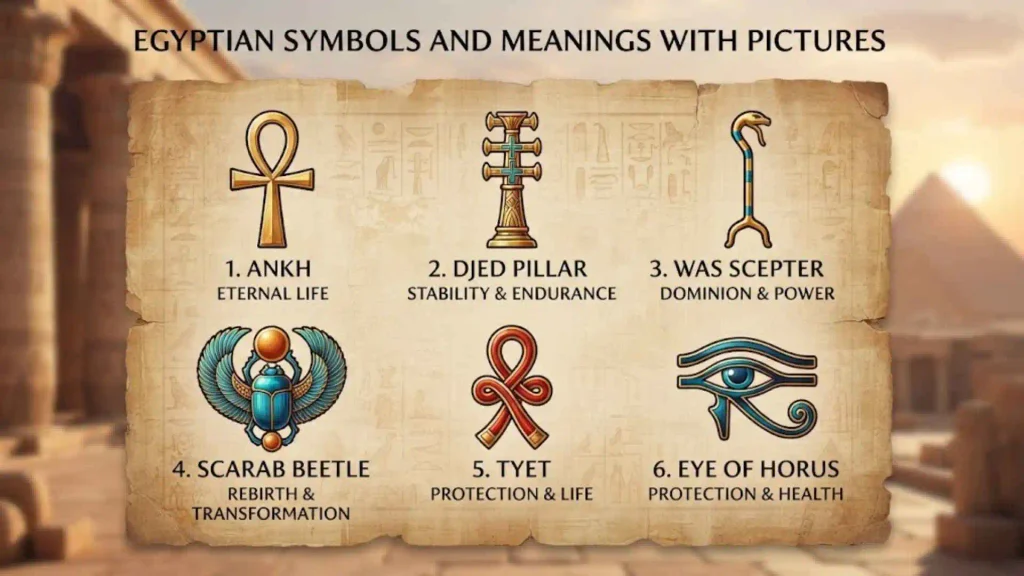
Pictures are especially helpful when studying Egyptian symbols because many signs are recognizable by their visual form. The Ankh has a looped top, the Djed resembles a column with horizontal bars, and the scarab represents a beetle.
When identifying an Egyptian symbol from a picture, pay attention to the surrounding artwork. A symbol carved on a temple wall may have a different function from a sign appearing inside a written word.
For example:
- ☥ Ankh: recognizable by its loop and cross-like lower section.
- Eye of Horus: recognizable as a stylized human or falcon eye with distinctive markings.
- Scarab: represented by a beetle, often with its wings or body shown in a stylized form.
- Djed: a column-like sign with several horizontal elements near the top.
- Lotus: commonly shown as a flowering plant, especially in scenes involving water, nature, and renewal.
A picture alone is not always enough to identify a hieroglyph accurately. Similar artistic forms can appear in different contexts, and some hieroglyphs are primarily writing signs rather than standalone symbolic emblems.
Egyptian Symbols Name
Knowing the name of an Egyptian symbol makes it easier to research its history and meaning. Here are several names commonly encountered in books, museums, and Egyptian art:
- Ankh — associated with life.
- Eye of Horus — associated with protection, healing, and restoration.
- Eye of Ra — connected with the solar deity Ra and protective or destructive divine power depending on context.
- Djed — associated with stability and Osiris.
- Was scepter — associated with authority and power.
- Scarab — associated with regeneration and rebirth.
- Shen ring — associated with protection and eternity.
- Lotus — associated with renewal and regeneration.
- Crook and flail — strongly associated with Egyptian kingship.
- Atef crown — a distinctive crown associated especially with Osiris.
Some names describe objects, while others identify signs that became part of religious or artistic symbolism. This distinction is useful when researching an Egyptian symbol because not every famous Egyptian image is a hieroglyph in the strict sense.
Egyptian Symbols Of Life
The Ankh is the Egyptian symbol most strongly associated with life. Its importance can be seen throughout Egyptian religious art.
The Ankh appears in scenes involving gods and kings, where it can be shown being held, offered, or presented near the face of a ruler. Its connection with life also explains why it became popular in funerary and religious imagery.
Other Egyptian imagery can also relate to life, renewal, or regeneration. The lotus flower, for example, was associated with rebirth and renewal, while the scarab was linked to regeneration.
For a simple modern design representing life, the Ankh ☥ is generally the clearest choice. However, the exact historical significance of any Egyptian image depends on its context.
Egyptian Symbols Meaning
The meaning of an Egyptian symbol can depend on whether it is being used as a religious emblem, an artistic image, or a hieroglyphic writing sign.
For example, the Ankh is commonly explained as “life,” but an Ankh appearing in a temple scene is part of a larger religious composition. Similarly, the Eye of Horus is widely associated with protection, but it also has connections with the myth of Horus and the restoration of his injured eye.
This is why a good interpretation should consider:
- The symbol itself.
- The historical period.
- The surrounding symbols.
- The object or inscription where it appears.
- Whether the sign is being used as writing or as imagery.
This approach helps prevent modern meanings from being incorrectly presented as complete translations of ancient Egyptian culture.
Ankh Egyptian Symbols
The Ankh, ☥, is one of the most recognizable symbols from ancient Egypt. It consists of a loop above a cross-like shape and is frequently seen in Egyptian art.
The symbol is strongly associated with life and vitality. It was used in religious and funerary scenes and was frequently connected with gods and divine power.
The Ankh is also popular in modern jewelry, artwork, tattoos, clothing, logos, decorative designs, and digital content.
Ankh Symbol To Copy
☥
You can copy the character above when your device and font support it. It is commonly known as the ANKH symbol in Unicode and is represented by U+2625.
It is worth remembering that the Unicode character is a modern digital character. Unicode encoding does not mean that ancient Egyptians used digital text or that every modern digital rendering exactly reproduces an archaeological artifact.
Egyptian Symbols Copy Paste
If your goal is simply to copy an Egyptian-looking symbol, the following characters can be useful:
| Symbol | Name or description | Common modern use |
| ☥ | Ankh | Life, Egyptian-themed designs |
| 𓂀 | Egyptian hieroglyphic eye sign | Decorative or historical-themed text |
| 𓆣 | Egyptian hieroglyphic scarab sign | Egyptian-themed decoration |
| 𓇳 | Egyptian hieroglyphic sun disk sign | Solar or Egyptian-themed designs |
| 𓉐 | Egyptian hieroglyphic house sign | Decorative text |
| 𓂋 | Egyptian hieroglyphic mouth sign | Hieroglyphic writing displays |
Some hieroglyphic characters are available in Unicode, while others may require a font that supports the Egyptian Hieroglyphs Unicode block. Their appearance can vary between fonts.
For everyday copy-and-paste use, ☥ is generally the easiest Egyptian-related character because it is a standard Unicode character found outside the specialized Egyptian Hieroglyphs block.
Egyptian Symbols Copy And Paste
Here is a compact copy-and-paste collection:
Life: ☥
Egyptian hieroglyphic examples: 𓂀 𓆣 𓇳 𓉐 𓂋
You can use these in social media posts, notes, usernames where supported, decorative headings, messages, artwork concepts, or educational projects.
Keep in mind that a hieroglyphic character may not display correctly on every device. If you see an empty box, question mark, or missing character, the problem is usually related to font or software support rather than the symbol itself.
Egyptian Symbols Text
Egyptian symbols can be used as decorative text, but there is an important difference between Egyptian-themed Unicode characters and ancient Egyptian writing.
The Ankh character ☥ can function like an ordinary text character. You can place it in a message or heading without needing to reproduce an entire ancient inscription.
Hieroglyphic characters such as 𓂀 and 𓆣 are different. They belong to the Unicode Egyptian Hieroglyphs repertoire and are intended to represent individual hieroglyphic signs. A complete ancient Egyptian inscription requires knowledge of the writing system, not simply a sequence of attractive-looking symbols.
For decorative text, you might use:
- ☥ Egyptian Life ☥
- 𓂀 Protection 𓂀
- 𓆣 Rebirth 𓆣
- 𓇳 Sun 𓇳
These are modern text-design examples rather than ancient Egyptian sentences.
Egyptian Symbols And Meanings Pdf
People often search for Egyptian symbols and meanings in PDF form because a printable reference can be useful for study, classroom work, crafts, or personal research.
A useful Egyptian symbols PDF should ideally include the symbol, its historical name, its common interpretation, and enough context to prevent misleading one-word definitions.
For example, a reference table might include:
| Symbol | Main association | Useful note |
| Ankh | Life | One of the most recognizable Egyptian symbols |
| Djed | Stability | Closely associated with Osiris |
| Scarab | Rebirth | Connected with regeneration and solar imagery |
| Eye of Horus | Protection and restoration | Related to the myth of Horus |
| Was | Authority | Often associated with divine or royal power |
| Shen | Protection and eternity | A loop or ring motif |
When using a PDF for academic work, check whether it identifies the original source and distinguishes historical evidence from modern interpretations.
Hieroglyphics Egyptian Symbols
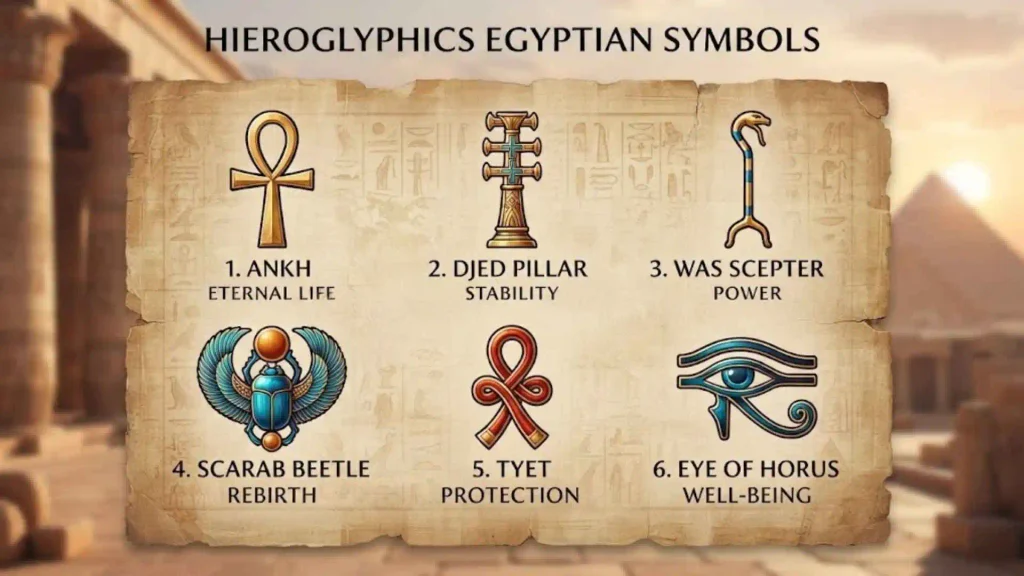
Egyptian hieroglyphs were part of a complex writing system used for the ancient Egyptian language. They were not simply a collection of decorative symbols with one fixed meaning each.
A hieroglyph could represent a sound, a word, or an idea. Some signs functioned as phonograms, while others could serve as logographic or determinative signs.
For example, the 𓂋 sign represents a mouth and has a phonetic value associated with the Egyptian consonant conventionally transliterated as r. The exact role of a sign becomes clearer when it is studied within an inscription.
This is why translating an Egyptian name by randomly selecting attractive hieroglyphs can produce an inaccurate result. A proper transliteration requires understanding the ancient Egyptian writing system and the conventions used to represent its sounds.
Egyptian Symbols And Meanings Pdf
A second PDF-focused search may have a different purpose from the earlier reference section. Readers may want a printable chart specifically organized around meanings rather than names.
For a personal reference sheet, the following categories are useful:
Life And Renewal
- Ankh ☥ — life
- Scarab 𓆣 — regeneration and rebirth
- Lotus imagery — renewal and regeneration
Protection
- Eye of Horus 𓂀 — protection and restoration
- Shen ring — protection and eternity
- Certain amulets — protective functions depending on the object and period
Power And Stability
- Was scepter — authority and power
- Djed — stability and endurance
- Crook and flail — kingship and royal authority
A printable chart is most useful when it clearly labels these as common associations rather than claiming that each symbol has only one meaning.
Protection Egyptian Symbols And Meanings Pdf
Protection is one of the most common reasons modern readers search for Egyptian symbols. Ancient Egyptians used many amulets and images for protective purposes, and some famous symbols became strongly associated with protection.
The Eye of Horus is one of the best-known examples. It is connected to the myth of Horus, whose eye was injured and restored. This helped give the symbol associations with healing, restoration, and protection.
The Shen ring is another protective motif. Its closed circular form was associated with ideas of eternity and protection.
Other protective amulets existed as well. Their purposes could include safeguarding the wearer, supporting health, assisting the dead, or invoking a deity’s power.
For a printable protection reference, focus on historically attested symbols rather than modern designs that are merely described as “Egyptian.”
Meaningful Egyptian Symbols And Meanings
Some Egyptian symbols remain popular because their associations are easy to connect with modern ideas.
Symbols Connected With Positive Ideas
- ☥ Ankh: life and vitality
- Eye of Horus: protection, restoration, and healing
- Scarab: renewal and rebirth
- Djed: stability and endurance
- Lotus: renewal and regeneration
- Shen ring: eternity and protection
The word “meaningful” is subjective, so the best symbol depends on the idea someone wants to express. A person interested in life may prefer the Ankh, while someone interested in stability may find the Djed more appropriate.
Egyptian Symbols Of Protection
Protection appears frequently in Egyptian religious and funerary symbolism. Amulets were an important part of Egyptian material culture, and protective objects were used for both the living and the dead.
The Eye of Horus is especially familiar because of its strong connection with protection and restoration. It is sometimes called the wedjat or udjat eye in discussions of ancient Egyptian religion.
The scarab was also used extensively as an amulet. Scarab amulets could carry names, designs, inscriptions, or religious associations, and their significance varied according to their use.
Protection should therefore be understood as a broad category rather than a single symbol. Different amulets served different purposes, and their significance depended on historical and religious context.
What Does Each Egyptian Symbols Mean?
There is no single meaning for every Egyptian symbol because “Egyptian symbols” includes several different categories. Some are religious emblems, some are objects, some are hieroglyphic writing signs, and some are modern representations.
Here is a practical overview:
| Symbol | Common meaning or function |
| ☥ Ankh | Life |
| 𓂀 Eye of Horus | Protection, restoration |
| 𓆣 Scarab | Rebirth, regeneration |
| Djed | Stability |
| Was scepter | Authority and power |
| Shen ring | Protection, eternity |
| Lotus | Renewal, regeneration |
| Crook and flail | Kingship |
| Sun disk | Solar imagery and divine association |
These descriptions are starting points rather than complete translations. Context matters greatly when interpreting ancient Egyptian imagery.
Egyptian Symbols Ankh
The Ankh deserves special attention because it has become one of the most recognizable symbols of ancient Egypt.
Its looped top and cross-like lower portion make it visually distinctive. In ancient Egyptian art, gods and kings are frequently shown holding the Ankh.
The symbol’s primary modern association is life. It is also commonly connected with vitality, existence, and the continuation of life.
Ankh In Modern Designs
Today, the Ankh appears in:
- Jewelry
- Tattoos
- Graphic design
- Clothing
- Posters
- Educational materials
- Egyptian-themed decorations
- Social media posts
The character ☥ is especially convenient for digital use because it is a Unicode character rather than an image.
Egyptian Symbols Tattoos
Egyptian symbols are popular tattoo subjects because many have recognizable shapes and established cultural associations.
Common choices include:
- Ankh: life and vitality
- Eye of Horus: protection and restoration
- Scarab: rebirth and regeneration
- Djed: stability
- Lotus: renewal
- Shen ring: eternity or protection
Before choosing a tattoo, it is worth checking the historical meaning of the exact symbol and its spelling or transliteration. A decorative design marketed online as an “Egyptian symbol” may not be an authentic ancient sign.
For a tattoo based on hieroglyphs, accuracy matters even more. A sequence of signs that looks attractive does not automatically spell the intended name or word.
Famous Egyptian Symbols
Several Egyptian symbols have become internationally recognizable.
The Ankh
The Ankh is perhaps the most widely recognized Egyptian symbol and is associated with life.
The Eye Of Horus
The Eye of Horus is strongly associated with protection, healing, and restoration.
The Scarab
The scarab became an important symbol of regeneration and was widely used in amulets and decorative objects.
The Djed
The Djed represents stability and has important associations with Osiris.
The Was Scepter
The Was scepter is connected with authority and power.
The Crook And Flail
These objects are closely associated with Egyptian kingship and royal imagery.
The Lotus
Lotus imagery has associations with renewal, regeneration, and the natural world.
These symbols are famous partly because they survived through monumental art, funerary objects, jewelry, and modern popular culture.
Ancient Egyptian Symbols And Their Meanings
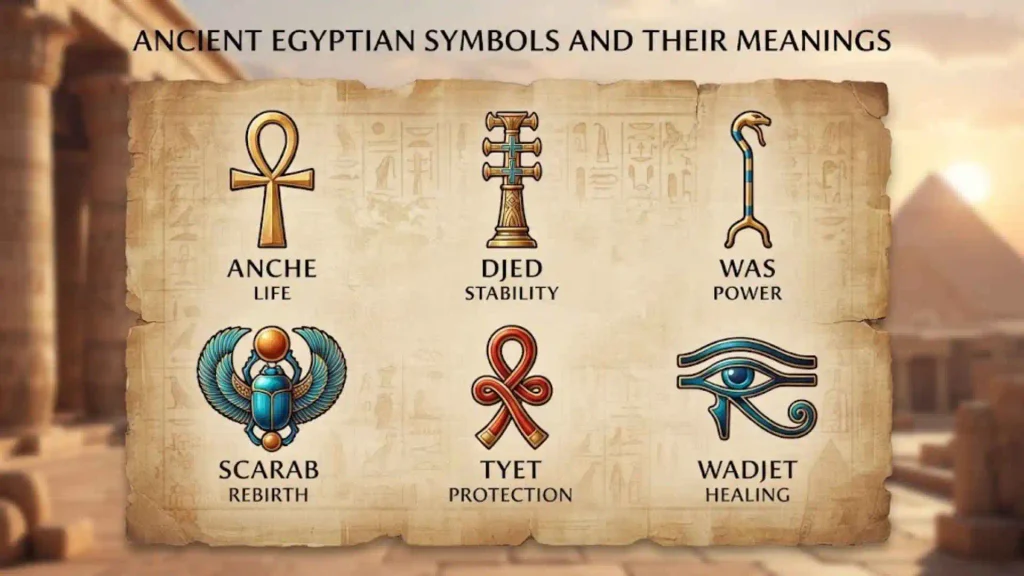
Ancient Egyptian symbolism cannot be reduced to a simple dictionary because religion, writing, art, and political imagery overlapped.
For instance, a scarab could be an actual amulet, a decorative object, a symbol of regeneration, or part of a personal name. An Eye of Horus could appear as an amulet or as part of a larger religious composition.
The strongest interpretations come from studying the symbol together with its archaeological and textual context. Museum collections, scholarly publications, inscriptions, and archaeological records are generally more reliable than modern symbol lists when historical accuracy matters.
For casual use, however, the common associations in this guide provide a practical starting point for understanding and using Egyptian-inspired symbols.
Ancient Egyptian Symbols And Meanings
A final way to organize the subject is by the ideas modern readers most often want to express.
| Theme | Egyptian symbol | Common association |
| Life | Ankh ☥ | Life and vitality |
| Protection | Eye of Horus | Protection and restoration |
| Rebirth | Scarab | Regeneration and renewal |
| Stability | Djed | Stability and endurance |
| Authority | Was scepter | Power and dominion |
| Kingship | Crook and flail | Royal authority |
| Eternity | Shen ring | Protection and eternity |
| Renewal | Lotus | Regeneration and renewal |
The important distinction is between common symbolic associations and literal translations. A symbol may communicate an idea in artwork without functioning as a word in the Egyptian language.
If you are researching a specific inscription, name, or hieroglyphic phrase, it is better to study the complete inscription rather than translating isolated decorative signs.
Frequently Asked Questions
What Is The Most Famous Egyptian Symbol?
The Ankh is one of the most famous Egyptian symbols. It is widely associated with life and appears frequently in ancient Egyptian religious and artistic scenes.
What Is The Egyptian Symbol For Protection?
The Eye of Horus is one of the Egyptian symbols most strongly associated with protection. It is also connected with restoration and healing through the mythology surrounding Horus.
Can I Copy And Paste Egyptian Symbols?
Yes. The Ankh ☥ can be copied and pasted as a Unicode character. Several Egyptian hieroglyphic characters, such as 𓂀 and 𓆣, are also encoded in Unicode, although display support depends on fonts and software.
Are Egyptian Hieroglyphs The Same As Egyptian Symbols?
Not exactly. Hieroglyphs are part of an ancient Egyptian writing system, while the broader category of Egyptian symbols can include religious emblems, objects, amulets, crowns, and artistic motifs.
What Does The Ankh Symbol Mean?
The Ankh is commonly associated with life, vitality, and living. It is one of the most recognizable symbols in ancient Egyptian art and remains popular in modern jewelry, tattoos, and digital designs.
Conclusion
Egyptian symbols bring together writing, religion, art, mythology, and ideas about life, death, protection, power, and renewal. The Ankh, Eye of Horus, scarab, Djed, Was scepter, and other symbols each have their own historical associations and visual characteristics.
For simple copy-and-paste use, ☥ is one of the easiest Egyptian-related Unicode characters to use, while characters such as 𓂀 and 𓆣 can provide a more distinctly hieroglyphic appearance when supported by the device and font.
The best way to use these symbols is to understand the difference between historical meaning and modern decoration. Whether you are researching ancient Egypt, choosing a tattoo concept, creating educational material, or adding an Egyptian-style character to text, knowing the context makes the symbol far more meaningful.

Hi, I’m Sienna Brooks, and I believe that the right words can inspire, comfort, and empower people at every stage of life. For as long as I can remember, I’ve been drawn to meaningful quotes and the stories behind them. I love curating collections of inspirational, motivational, and heartfelt quotes that resonate with readers around the world.
Through my writing, I strive to help others find encouragement, whether they’re celebrating life’s happiest moments or navigating its biggest challenges. I believe that wisdom is timeless, and I’m passionate about sharing words that leave a lasting impact.
I am the author of Reflections in Words and The Journey of Inspiration, two books dedicated to exploring the beauty and power of timeless quotes.
 Rowan Sinclair Rowan Sinclair