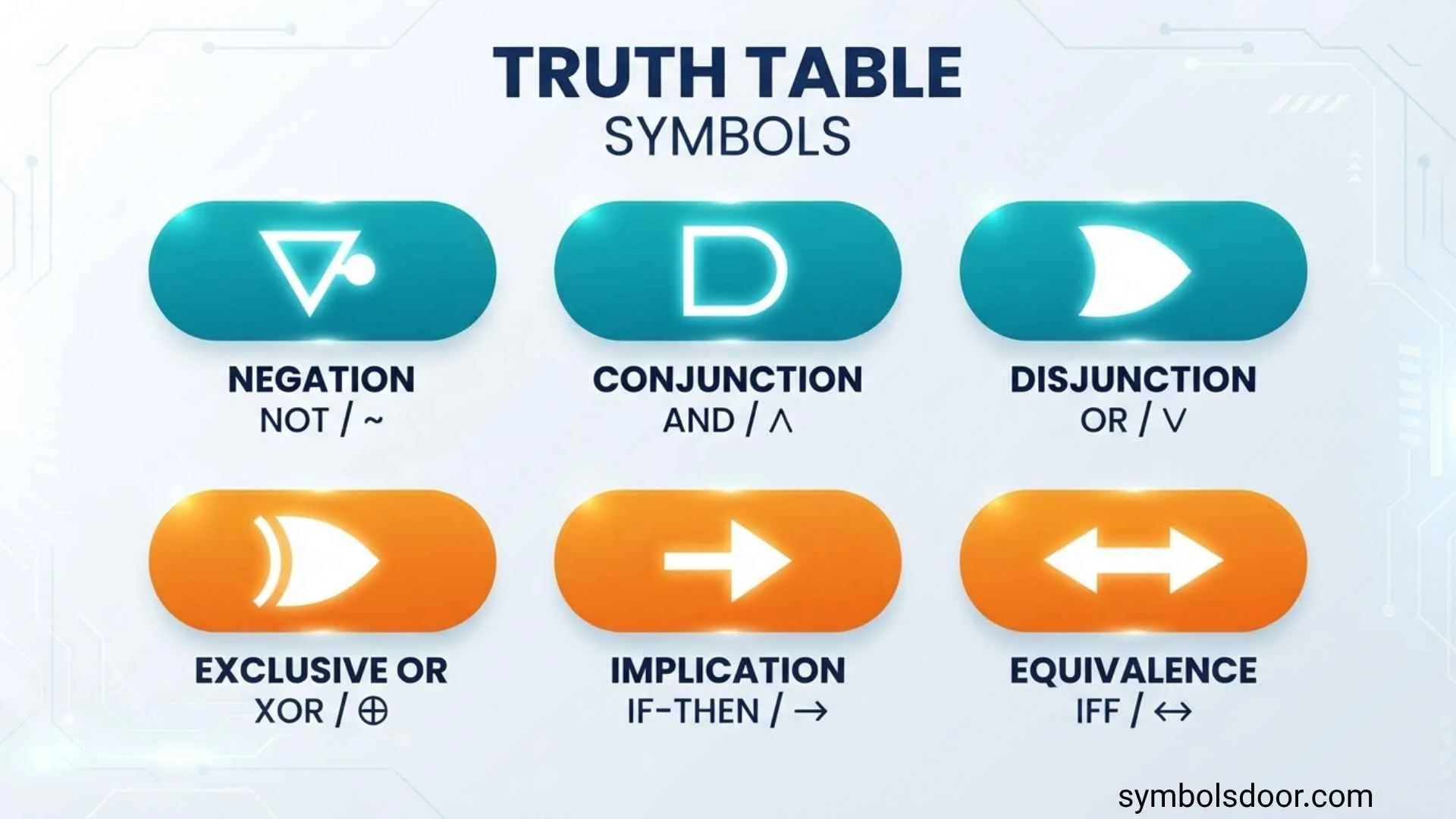
Truth table symbols are used to represent logical operations and show how the truth value of an expression changes based on its inputs. They are commonly used in mathematics, propositional logic, Boolean algebra, computer science, programming, and digital electronics.
The most common symbols include ¬ for NOT, ∧ for AND, ∨ for OR, ⊕ for XOR, → for implication, and ↔ for biconditional. Other symbols such as ≡, ⊤, and ⊥ are also useful when studying logical equivalence, tautologies, and contradictions.
Whether you are learning how to create a truth table, studying logic gates, or trying to understand Boolean expressions, knowing what each symbol means is essential.
Truth Table Symbols at a Glance
Here is a quick reference for the most common symbols used in truth tables.
| Symbol | Name | Read As | Basic Meaning |
| ¬P | NOT | Not P | Opposite of P |
| P ∧ Q | AND | P and Q | Both must be true |
| P ∨ Q | OR | P or Q | At least one must be true |
| P ⊕ Q | XOR | P exclusive-or Q | Exactly one must be true |
| P → Q | Implication | If P, then Q | Conditional relationship |
| P ↔ Q | Biconditional | P if and only if Q | Both have the same truth value |
| P ≡ Q | Logical equivalence | P is equivalent to Q | Same result in every case |
| ⊤ | True | True | Always true |
| ⊥ | False | False | Always false |
| T | True | True | Truth value |
| F | False | False | Truth value |
Different textbooks and fields can use alternative notation for some operations. The underlying logical concepts, however, remain the same.
What Is a Truth Table?

A truth table is a systematic way of listing all possible truth-value combinations of logical variables and showing the resulting value of a logical expression.
In basic propositional logic, a statement is either:
- T = True
- F = False
For example, let:
P = It is raining.
P can either be true or false.
If there are two propositions, P and Q, there are four possible combinations:
| P | Q |
| T | T |
| T | F |
| F | T |
| F | F |
A truth table allows you to calculate what happens for every possible combination.
Why Truth Tables Are Important
Truth tables are useful for:
- Understanding logical operators
- Testing logical arguments
- Evaluating propositions
- Proving logical equivalence
- Finding tautologies and contradictions
- Simplifying Boolean expressions
- Designing digital circuits
- Understanding logic gates
- Studying computer science
- Analyzing conditional statements
T and F Versus 1 and 0
Truth tables commonly use either T and F or 1 and 0.
| Logical Value | Truth Table | Boolean/Digital Logic |
| True | T | 1 |
| False | F | 0 |
Therefore:
T = 1
and
F = 0
The notation depends on the subject.
Mathematical logic often uses T/F, while Boolean algebra and digital electronics frequently use 1/0.
NOT Symbol (¬)
The NOT symbol is:
¬
An expression such as:
¬P
is read as “not P.”
NOT is called a negation operator because it reverses the truth value of a proposition.
| P | ¬P |
| T | F |
| F | T |
When P is true, ¬P is false.
When P is false, ¬P is true.
Other NOT Notations
Depending on the subject, NOT can also be written as:
- ~P
- P̅
- !P
For example, in some programming languages:
!P
means the logical NOT of P.
The exact notation depends on the system being used.
AND Symbol (∧)
The AND symbol is:
∧
The expression:
P ∧ Q
is read as “P and Q.”
The result is true only when both P and Q are true.
| P | Q | P ∧ Q |
| T | T | T |
| T | F | F |
| F | T | F |
| F | F | F |
Example of AND
Suppose:
P = I have a ticket.
Q = I have identification.
Then:
P ∧ Q
means:
I have a ticket and I have identification.
The statement is true only when both conditions are true.
AND in Boolean Algebra
AND is often represented using multiplication or a centered dot:
A · B
So:
A ∧ B = A · B
in common Boolean notation.
OR Symbol (∨)
The standard logical OR symbol is:
∨
The expression:
P ∨ Q
means “P or Q.”
In standard propositional logic, OR is inclusive, meaning it is true when:
- P is true
- Q is true
- Both P and Q are true
| P | Q | P ∨ Q |
| T | T | T |
| T | F | T |
| F | T | T |
| F | F | F |
Why OR Can Be True When Both Are True
A common beginner mistake is assuming that OR means exactly one.
In standard logical OR:
T ∨ T = T
Both propositions can be true.
This is different from XOR.
XOR Symbol (⊕)
The XOR symbol is:
⊕
XOR means exclusive OR.
The expression:
P ⊕ Q
is true when exactly one of P and Q is true.
| P | Q | P ⊕ Q |
| T | T | F |
| T | F | T |
| F | T | T |
| F | F | F |
OR vs. XOR
The easiest way to remember the difference is:
OR: One or both are true.
XOR: Exactly one is true.
| P | Q | OR | XOR |
| T | T | T | F |
| T | F | T | T |
| F | T | T | T |
| F | F | F | F |
The T/T row is the important difference.
XOR in Digital Logic
XOR is widely used in digital circuits.
Using 1 and 0:
| A | B | A ⊕ B |
| 0 | 0 | 0 |
| 0 | 1 | 1 |
| 1 | 0 | 1 |
| 1 | 1 | 0 |
The output is 1 when the inputs are different.
Implication Symbol (→)
The implication symbol is:
→
The expression:
P → Q
is read as:
If P, then Q.
It is also called a conditional statement.
| P | Q | P → Q |
| T | T | T |
| T | F | F |
| F | T | T |
| F | F | T |
When Is P → Q False?
The conditional is false in only one situation:
P = True and Q = False
In other words, P happens but the promised result Q does not happen.
This is one of the most important rules to remember when working with truth tables.
Antecedent and Consequent
In:
P → Q
P is called the antecedent.
Q is called the consequent.
You can think of it as:
P = condition
Q = result
So:
If P, then Q.
Biconditional Symbol (↔)
The biconditional symbol is:
↔
The expression:
P ↔ Q
means:
P if and only if Q.
It is true when P and Q have the same truth value.
| P | Q | P ↔ Q |
| T | T | T |
| T | F | F |
| F | T | F |
| F | F | T |
Therefore, the biconditional is true when:
- Both are true, or
- Both are false.
“If and Only If” Meaning
The phrase if and only if is often abbreviated as iff.
A biconditional can also be represented as:
(P → Q) ∧ (Q → P)
Both directions must be true.
Logical Equivalence Symbol (≡)
The symbol:
≡
is often used to indicate logical equivalence.
Two logical expressions are equivalent if they produce the same truth value for every possible input combination.
For example:
P → Q
is logically equivalent to:
¬P ∨ Q
Their truth tables are:
| P | Q | P → Q | ¬P ∨ Q |
| T | T | T | T |
| T | F | F | F |
| F | T | T | T |
| F | F | T | T |
Because the final columns are identical:
P → Q ≡ ¬P ∨ Q
Why Logical Equivalence Matters
Truth tables can be used to prove that two expressions are logically equivalent.
If the final columns match for every possible combination of inputs, the expressions have the same logical behavior.
True Symbol (⊤)
The symbol:
⊤
can represent logical truth.
An expression that is always true is called a tautology.
For example:
P ∨ ¬P
is always true.
| P | ¬P | P ∨ ¬P |
| T | F | T |
| F | T | T |
Therefore:
P ∨ ¬P ≡ ⊤
False Symbol (⊥)
The symbol:
⊥
can represent logical falsehood.
An expression that is always false is called a contradiction.
For example:
P ∧ ¬P
can never be true.
| P | ¬P | P ∧ ¬P |
| T | F | F |
| F | T | F |
Therefore:
P ∧ ¬P ≡ ⊥
Truth Table Symbols for Logic Gates
Truth tables are closely connected to digital logic gates.
| Logical Operation | Symbol | Logic Gate |
| NOT | ¬A | NOT gate |
| AND | A ∧ B | AND gate |
| OR | A ∨ B | OR gate |
| NAND | ¬(A ∧ B) | NAND gate |
| NOR | ¬(A ∨ B) | NOR gate |
| XOR | A ⊕ B | XOR gate |
| XNOR | ¬(A ⊕ B) | XNOR gate |
These gates are fundamental components of digital electronics and computing systems.
NAND Truth Table
NAND means NOT AND.
It is the opposite of AND.
| A | B | A ∧ B | NAND |
| 0 | 0 | 0 | 1 |
| 0 | 1 | 0 | 1 |
| 1 | 0 | 0 | 1 |
| 1 | 1 | 1 | 0 |
A NAND output is 0 only when both inputs are 1.
NOR Truth Table
NOR means NOT OR.
| A | B | A ∨ B | NOR |
| 0 | 0 | 0 | 1 |
| 0 | 1 | 1 | 0 |
| 1 | 0 | 1 | 0 |
| 1 | 1 | 1 | 0 |
NOR is true only when both inputs are false.
XNOR Truth Table
XNOR is the opposite of XOR.
It can be written:
¬(A ⊕ B)
| A | B | A ⊕ B | XNOR |
| 0 | 0 | 0 | 1 |
| 0 | 1 | 1 | 0 |
| 1 | 0 | 1 | 0 |
| 1 | 1 | 0 | 1 |
XNOR is true when both inputs are the same.
Boolean Algebra Symbols
Truth tables are also used extensively with Boolean algebra.
Common Boolean notation includes:
| Operation | Logic Symbol | Common Boolean Notation |
| NOT | ¬A | A̅ or A’ |
| AND | A ∧ B | A · B or AB |
| OR | A ∨ B | A + B |
| XOR | A ⊕ B | A ⊕ B |
Boolean algebra normally uses:
1 = True
0 = False
For example:
1 · 1 = 1
for Boolean AND.
And:
1 + 0 = 1
for Boolean OR.
Boolean operators should not be confused with ordinary arithmetic because Boolean operations follow different rules.
Truth Table Symbols in Programming
Programming languages often use different characters for logical operators.
| Logical Operation | Mathematical Logic | Common Programming Notation | ||
| NOT | ¬ | ! | ||
| AND | ∧ | && | ||
| OR | ∨ | ` | ` | |
| XOR | ⊕ | ^ in many languages | ||
| Equality | Depends on context | == in many languages |
Programming syntax varies by language, so these symbols are not universal.
For example, ! commonly means logical NOT, while && and || commonly represent logical AND and OR in languages such as C-style programming languages.
How Many Rows Does a Truth Table Have?
The number of rows in a complete truth table depends on the number of independent variables.
The formula is:
2ⁿ
where n is the number of variables.
| Variables | Number of Rows |
| 1 | 2 |
| 2 | 4 |
| 3 | 8 |
| 4 | 16 |
| 5 | 32 |
| 6 | 64 |
| 7 | 128 |
| 8 | 256 |
For example, a truth table with three variables has:
2³ = 8 rows
A table with four variables has:
2⁴ = 16 rows
This formula is important when constructing truth tables manually.
How to Create a Truth Table
Creating a truth table becomes easier when you follow the same process every time.
Step 1: Identify the Variables
First, identify all independent propositions.
For:
(P ∨ Q) ∧ R
the variables are:
- P
- Q
- R
There are three variables.
Step 2: Calculate the Number of Rows
Use:
2ⁿ
With three variables:
2³ = 8
So you need eight rows.
Step 3: List Every Combination
Create all possible T/F combinations.
| P | Q | R |
| T | T | T |
| T | T | F |
| T | F | T |
| T | F | F |
| F | T | T |
| F | T | F |
| F | F | T |
| F | F | F |
Step 4: Calculate Intermediate Operations
For:
(P ∨ Q) ∧ R
first calculate:
P ∨ Q
Then combine that result with R.
| P | Q | R | P ∨ Q | (P ∨ Q) ∧ R |
| T | T | T | T | T |
| T | T | F | T | F |
| T | F | T | T | T |
| T | F | F | T | F |
| F | T | T | T | T |
| F | T | F | T | F |
| F | F | T | F | F |
| F | F | F | F | F |
The final column is the result of the complete expression.
Truth Table for a Negated Expression
Consider:
¬(P ∧ Q)
First calculate P ∧ Q and then negate it.
| P | Q | P ∧ Q | ¬(P ∧ Q) |
| T | T | T | F |
| T | F | F | T |
| F | T | F | T |
| F | F | F | T |
This is equivalent to a NAND operation.
Truth Table for a Complex Expression
Consider:
(P ∨ Q) ∧ ¬R
There are three variables, so eight rows are required.
| P | Q | R | P ∨ Q | ¬R | (P ∨ Q) ∧ ¬R |
| T | T | T | T | F | F |
| T | T | F | T | T | T |
| T | F | T | T | F | F |
| T | F | F | T | T | T |
| F | T | T | T | F | F |
| F | T | F | T | T | T |
| F | F | T | F | F | F |
| F | F | F | F | T | F |
Using intermediate columns makes complicated expressions much easier to solve.
Operator Precedence in Truth Tables
When several logical operators appear in the same expression, the order in which they are evaluated matters.
A commonly used precedence order is:
- Parentheses
- NOT
- AND
- OR
- Implication
- Biconditional
For example:
¬P ∨ Q ∧ R
is generally interpreted with NOT first and AND before OR.
To avoid confusion, use parentheses:
¬P ∨ (Q ∧ R)
If you mean something different, write it explicitly.
Why Parentheses Matter
Compare:
¬(P ∧ Q)
with:
¬P ∧ Q
They are different expressions and can produce different truth-table results.
Parentheses make the intended grouping clear.
Tautology, Contradiction, and Contingency
Truth tables can classify logical expressions into three major categories.
Tautology
A tautology is always true.
Example:
P ∨ ¬P
| P | P ∨ ¬P |
| T | T |
| F | T |
Every final result is true.
Contradiction
A contradiction is always false.
Example:
P ∧ ¬P
| P | P ∧ ¬P |
| T | F |
| F | F |
Every final result is false.
Contingency
A contingency is true in some cases and false in others.
For example:
P ∧ Q
| P | Q | P ∧ Q |
| T | T | T |
| T | F | F |
| F | T | F |
| F | F | F |
Because the final column contains both T and F, it is a contingency.
Common Truth Table Symbols Cheat Sheet
Use this quick reference when you need to remember the most important operators.
| Symbol | Meaning | Remember It As |
| ¬P | NOT P | Opposite of P |
| P ∧ Q | P AND Q | Both true |
| P ∨ Q | P OR Q | One or both true |
| P ⊕ Q | P XOR Q | Exactly one true |
| P → Q | If P, then Q | False only T → F |
| P ↔ Q | P iff Q | Same truth value |
| P ≡ Q | Logically equivalent | Same results |
| ⊤ | True | Always true |
| ⊥ | False | Always false |
| 0 | False | Boolean false |
| 1 | True | Boolean true |
Common Mistakes With Truth Table Symbols
Confusing OR and XOR
Remember:
OR: T when at least one input is true.
XOR: T when exactly one input is true.
The difference occurs when both inputs are true.
Misunderstanding Implication
The expression:
P → Q
is false only when:
P = T
and:
Q = F
This rule is essential when creating conditional truth tables.
Forgetting to Negate the Entire Expression
There is a significant difference between:
¬(P ∨ Q)
and:
¬P ∨ Q
The parentheses determine what the NOT operator applies to.
Using the Wrong Number of Rows
If you have four independent variables, you need:
2⁴ = 16 rows
not eight.
Mixing Boolean Algebra With Normal Arithmetic
Boolean operators may use symbols such as + and ·, but they do not follow ordinary arithmetic rules.
For example, in Boolean algebra:
1 + 1 = 1
because OR of true and true is true.
Truth Table Symbols and Logical Equivalence
One of the most useful applications of truth tables is checking whether two expressions are logically equivalent.
Consider:
P → Q
and:
¬P ∨ Q
Create columns for both.
| P | Q | P → Q | ¬P | ¬P ∨ Q |
| T | T | T | F | T |
| T | F | F | F | F |
| F | T | T | T | T |
| F | F | T | T | T |
The final results of P → Q and ¬P ∨ Q are identical.
Therefore:
P → Q ≡ ¬P ∨ Q
This demonstrates how truth tables can be used as a formal method for checking logical equivalence.
Frequently Asked Questions
What are the main truth table symbols?
The main truth table symbols are ¬ for NOT, ∧ for AND, ∨ for OR, ⊕ for XOR, → for implication, and ↔ for biconditional. Symbols such as ≡, ⊤, and ⊥ are also commonly used in formal logic.
What does ¬ mean in a truth table?
The symbol ¬ means NOT or negation. It reverses a proposition’s truth value. If P is true, ¬P is false; if P is false, ¬P is true.
What does ∧ mean in logic?
The symbol ∧ means logical AND. P ∧ Q is true only when both P and Q are true.
What does ∨ mean in a truth table?
The symbol ∨ means logical OR. In standard propositional logic, P ∨ Q is true when at least one proposition is true, including when both are true.
What does ⊕ mean?
The symbol ⊕ means exclusive OR, or XOR. It is true when exactly one of the inputs is true.
What is the difference between OR and XOR?
OR is true when one or both inputs are true. XOR is true only when exactly one input is true.
For example:
T ∨ T = T
but:
T ⊕ T = F
What does → mean in a truth table?
The symbol → represents implication or a conditional statement. P → Q means “if P, then Q.” It is false only when P is true and Q is false.
What does ↔ mean?
The symbol ↔ represents a biconditional. P ↔ Q means “P if and only if Q.” It is true when P and Q have the same truth value.
What does ≡ mean in logic?
The symbol ≡ commonly represents logical equivalence. Two expressions are logically equivalent when they have the same truth value for every possible combination of inputs.
What do 0 and 1 mean in a truth table?
In Boolean logic, 0 normally represents false and 1 represents true. This notation is particularly common in Boolean algebra, computer science, and digital electronics.
How many rows does a truth table have?
A complete truth table with n independent variables has 2ⁿ rows. For example, two variables require four rows, three require eight, and four require sixteen.
What is a tautology?
A tautology is a logical expression that is true for every possible combination of truth values.
For example:
P ∨ ¬P
is a tautology.
What is a contradiction?
A contradiction is an expression that is false for every possible combination of truth values.
For example:
P ∧ ¬P
is a contradiction.
What is a contingency?
A contingency is an expression that is true in some cases and false in others.
What symbols are used in Boolean algebra?
Common Boolean symbols include 0, 1, +, ·, complement notation, and ⊕. Boolean algebra often uses 0 for false and 1 for true.
Are truth table symbols the same in programming?
Not always. Programming languages often use different characters. For example, ! commonly represents NOT, && represents AND, and || represents OR in many languages. Exact syntax depends on the programming language.
Why are truth tables important in digital electronics?
Truth tables show how the outputs of logic gates depend on their inputs. They are fundamental to analyzing AND, OR, NOT, NAND, NOR, XOR, and XNOR gates and are widely used when designing and understanding digital circuits.
How do I create a truth table?
Identify the variables, calculate the number of rows using 2ⁿ, list every possible combination of truth values, evaluate intermediate operations, and then calculate the final expression.
Why are parentheses important in truth tables?
Parentheses determine which part of a logical expression is evaluated together. They can change the result of an expression, so they are especially important when several operators are used together.
Conclusion
Understanding truth table symbols is the foundation for working with propositional logic, Boolean algebra, digital electronics, mathematics, and computer science.
The most important symbols to remember are:
- ¬ = NOT
- ∧ = AND
- ∨ = OR
- ⊕ = XOR
- → = implication
- ↔ = biconditional
- ≡ = logical equivalence
- ⊤ = true
- ⊥ = false
Remember that OR allows both inputs to be true, while XOR requires exactly one to be true. Also remember that P → Q is false only when P is true and Q is false.
Once these basic rules are understood, you can use truth tables to evaluate complex logical expressions, prove equivalence, identify tautologies and contradictions, and understand how digital logic gates work.

Hi, I’m Asher Monroe, a writer who believes that meaningful words have the power to inspire change and bring people closer to their dreams. I have always been fascinated by the beauty of quotes and the way a simple message can provide motivation, hope, and comfort.
I enjoy creating content around inspirational quotes, life lessons, success stories, and positive thoughts that help readers find encouragement in their everyday lives. My goal is to share words that connect with people and remind them of their inner strength.
Through my writing, I explore the ideas of personal growth, confidence, and the importance of staying inspired through every chapter of life.
I am the author of Words That Move the Soul and The Path of Endless Inspiration, two books focused on the power of wisdom, positivity, and meaningful thoughts.