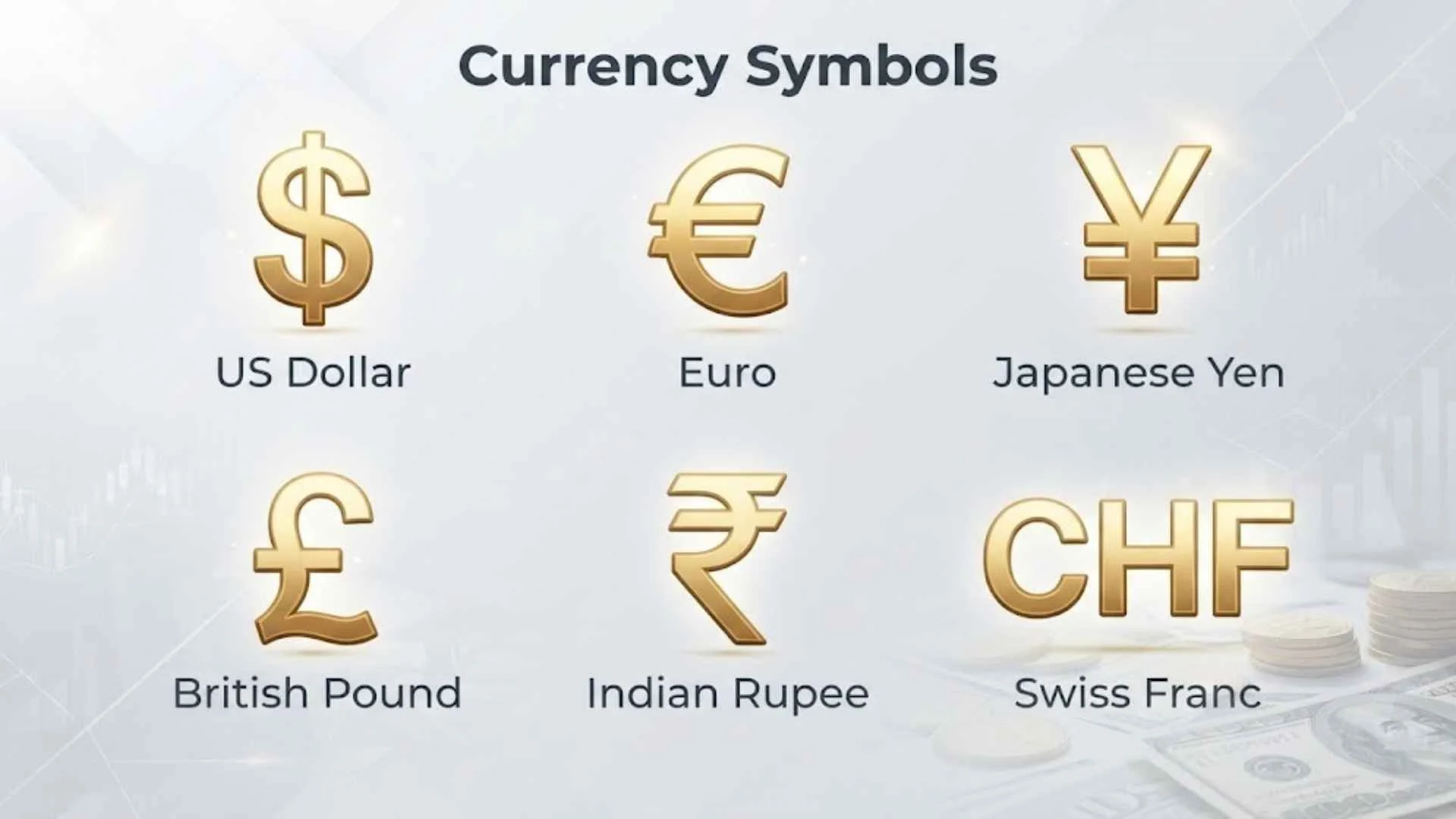
Currency symbols are short visual marks used to identify money and make prices easier to recognize. Symbols such as $, €, £, ¥, ₹, and ₩ appear on price tags, invoices, websites, financial documents, and everyday messages.
This guide brings together currency symbols from different countries and regions, along with their names, meanings, Unicode characters, and practical examples. You can also find symbols in copy-and-paste form when you need to use them in text.
From familiar money signs to less common international currency symbols, the sections below organize the information by region and purpose. This makes it easier to find a particular symbol without searching through unrelated lists.
Currency Symbol Means
A currency symbol is a graphical character that represents a particular currency or monetary unit. It is commonly placed before or after an amount to show which currency is being used.
For example:
- $100 — dollar amount
- €100 — euro amount
- £100 — pound sterling amount
- ₹100 — Indian rupee amount
- ₩100 — South Korean won amount
The same symbol can sometimes represent more than one currency. The dollar sign $, for example, is associated with several dollar-based currencies. In those cases, a country or currency code may be added for clarity, such as USD, CAD, AUD, or NZD.
Currency symbols are different from three-letter ISO 4217 currency codes. A symbol is a visual character, while a code such as USD or EUR is a standardized alphabetic identifier.
Currency Symbols With Name
Here are some widely used currency symbols with their common currency names:
| Symbol | Currency name |
| $ | Dollar |
| € | Euro |
| £ | Pound sterling |
| ¥ | Yen / Yuan |
| ₹ | Indian rupee |
| ₽ | Russian ruble |
| ₩ | South Korean won |
| ₺ | Turkish lira |
| ₪ | Israeli new shekel |
| ₴ | Ukrainian hryvnia |
| ₫ | Vietnamese dong |
| ฿ | Thai baht |
| ₱ | Philippine peso |
| ₦ | Nigerian naira |
| ₡ | Colon |
| ₲ | Paraguayan guarani |
| ₵ | Ghanaian cedi |
| ₭ | Lao kip |
| ₮ | Mongolian tögrög |
| ₸ | Kazakhstani tenge |
| ₾ | Georgian lari |
| ₼ | Azerbaijani manat |
| ₺ | Turkish lira |
| ₻ | Nordic mark |
Some currencies do not have a dedicated symbol commonly used in ordinary text. In those cases, currency codes, abbreviations, or localized forms are often used instead.
Currency Symbols Copy Paste
If you need currency characters for a document, website, spreadsheet, social media post, or message, you can copy them directly from this list:
$ — Dollar
€ — Euro
£ — Pound
¥ — Yen / Yuan
₹ — Indian rupee
₽ — Russian ruble
₩ — South Korean won
₺ — Turkish lira
₪ — Israeli new shekel
₴ — Ukrainian hryvnia
₫ — Vietnamese dong
฿ — Thai baht
₱ — Philippine peso
₦ — Nigerian naira
₡ — Colon
₲ — Guarani
₵ — Cedi
₭ — Kip
₮ — Tögrög
₸ — Tenge
₾ — Lari
₼ — Manat
You can select the character itself and copy it without copying the description.
Currency Symbols D
The heading “Currency Symbols D” can cover currency symbols and monetary abbreviations associated with currencies whose names or common abbreviations begin with D. There is no single official currency symbol category called “D currency symbols.”
Examples of currencies beginning with D include:
- Djiboutian franc — commonly represented by Fdj or the ISO code DJF
- Danish krone — commonly represented by kr
- Dominican peso — commonly represented by $ or RD$
- Dalasi — the currency of The Gambia, commonly written as D
This is a useful reminder that not every currency has a unique Unicode symbol. Many currencies rely on abbreviations, currency codes, or regional conventions instead.
Currency Symbols Unicode
Unicode includes many dedicated currency-related characters. Unicode makes it possible for compatible digital systems to represent these characters consistently.
Some useful currency characters include:
| Symbol | Unicode code point | Common name |
| ¤ | U+00A4 | Currency Sign |
| $ | U+0024 | Dollar Sign |
| £ | U+00A3 | Pound Sign |
| ¥ | U+00A5 | Yen Sign |
| € | U+20AC | Euro Sign |
| ₹ | U+20B9 | Indian Rupee Sign |
| ₽ | U+20BD | Ruble Sign |
| ₩ | U+20A9 | Won Sign |
| ₪ | U+20AA | New Sheqel Sign |
| ₫ | U+20AB | Dong Sign |
| ₭ | U+20AD | Kip Sign |
| ₮ | U+20AE | Tugrik Sign |
| ₯ | U+20AF | Drachma Sign |
| ₱ | U+20B1 | Peso Sign |
| ₵ | U+20B5 | Cedi Sign |
| ₸ | U+20B8 | Tenge Sign |
| ₺ | U+20BA | Turkish Lira Sign |
| ₼ | U+20BC | Manat Sign |
| ₾ | U+20BE | Lari Sign |
The Unicode code point identifies the character, while the displayed glyph can vary depending on the font, operating system, browser, or application.
Currency Symbols With Country Name Pdf
A country-based currency reference can be useful when studying currencies, preparing financial documents, or creating printable reference material. A simple country-and-currency list can include the following:
| Country | Currency | Common symbol or notation |
| United States | United States dollar | $ |
| Canada | Canadian dollar | $ / C$ |
| United Kingdom | Pound sterling | £ |
| Germany | Euro | € |
| France | Euro | € |
| India | Indian rupee | ₹ |
| Japan | Japanese yen | ¥ |
| China | Chinese yuan | ¥ / CN¥ |
| South Korea | South Korean won | ₩ |
| Thailand | Thai baht | ฿ |
| Vietnam | Vietnamese dong | ₫ |
| Turkey | Turkish lira | ₺ |
| Russia | Russian ruble | ₽ |
| Ukraine | Ukrainian hryvnia | ₴ |
| Nigeria | Nigerian naira | ₦ |
| Ghana | Ghanaian cedi | ₵ |
| Philippines | Philippine peso | ₱ |
| Israel | Israeli new shekel | ₪ |
| Kazakhstan | Kazakhstani tenge | ₸ |
| Georgia | Georgian lari | ₾ |
For a printable PDF, this table can be copied into a word processor or spreadsheet and exported as a PDF. A PDF is particularly useful when you want a static currency reference for offline use.
Foreign Currency Symbols
Foreign currency symbols are symbols used to identify currencies outside the country where the reader lives. Their meaning depends on the surrounding country, currency name, or financial context.
Common examples include:
- € — euro
- £ — pound sterling
- ¥ — Japanese yen or Chinese yuan in appropriate contexts
- ₹ — Indian rupee
- ₩ — Korean won
- ₽ — Russian ruble
- ₺ — Turkish lira
- ₴ — Ukrainian hryvnia
- ₪ — Israeli new shekel
- ₦ — Nigerian naira
When dealing with international prices, it is safer to include the currency code when a symbol could be ambiguous. For example, US$50 is clearer internationally than simply $50.
European Currency Symbols
The euro is the most recognizable currency symbol associated with many European countries:
€ — Euro
Several European countries that do not use the euro have their own currency notation. Examples include:
- £ — Pound sterling, United Kingdom
- kr — Krone or krona used in several European countries
- ₽ — Russian ruble
- ₴ — Ukrainian hryvnia
- ₾ — Georgian lari
- ₺ — Turkish lira
- ₣ — Historical franc sign, associated with former currencies rather than current European national currencies
A symbol such as kr is particularly context-dependent because it can refer to currencies in more than one Nordic country.
Currency Symbols Around The World
Currency symbols vary considerably across regions. Some are dedicated Unicode characters, while others are abbreviations or combinations of letters and symbols.
Examples from around the world include:
- North America: $, C$, MX$
- South America: $, ₲, ₡
- Europe: €, £, ₽, ₴, ₺
- Asia: ₹, ¥, ₩, ฿, ₫, ₱
- Africa: ₦, ₵, R, E
- Oceania: $, A$, NZ$
The same basic symbol may appear in several countries. For that reason, a currency symbol should always be interpreted together with the currency name or country when there is any possibility of confusion.
World Currency Symbols
A world currency symbol list is useful for recognizing monetary characters in international websites, travel information, e-commerce stores, and financial content.
Some of the most recognizable examples are:
| Region | Symbol | Currency |
| North America | $ | Dollar |
| Europe | € | Euro |
| Europe | £ | Pound sterling |
| Asia | ¥ | Yen / yuan |
| Asia | ₹ | Indian rupee |
| Asia | ₩ | Won |
| Asia | ฿ | Baht |
| Asia | ₫ | Dong |
| Europe/Asia | ₽ | Ruble |
| Europe/Asia | ₺ | Turkish lira |
| Africa | ₦ | Naira |
| Africa | ₵ | Cedi |
| Asia | ₱ | Philippine peso |
| Asia | ₪ | Israeli new shekel |
| Asia | ₸ | Tenge |
This list is a starting point rather than a complete list of every monetary notation used worldwide.
Asian Currency Symbols
Asia contains a large number of currencies and monetary systems, including several currencies with dedicated symbols.
| Symbol | Currency | Country or region |
| ₹ | Indian rupee | India |
| ¥ | Japanese yen | Japan |
| ¥ / CN¥ | Chinese yuan | China |
| ₩ | South Korean won | South Korea |
| ฿ | Thai baht | Thailand |
| ₫ | Vietnamese dong | Vietnam |
| ₱ | Philippine peso | Philippines |
| ₪ | Israeli new shekel | Israel |
| ₺ | Turkish lira | Turkey |
| ₸ | Kazakhstani tenge | Kazakhstan |
| ₾ | Georgian lari | Georgia |
| ₼ | Azerbaijani manat | Azerbaijan |
| ₭ | Lao kip | Laos |
| ₮ | Mongolian tögrög | Mongolia |
Some Asian currencies are usually written with abbreviations or codes rather than a dedicated Unicode currency character.
Currency Symbols With Name
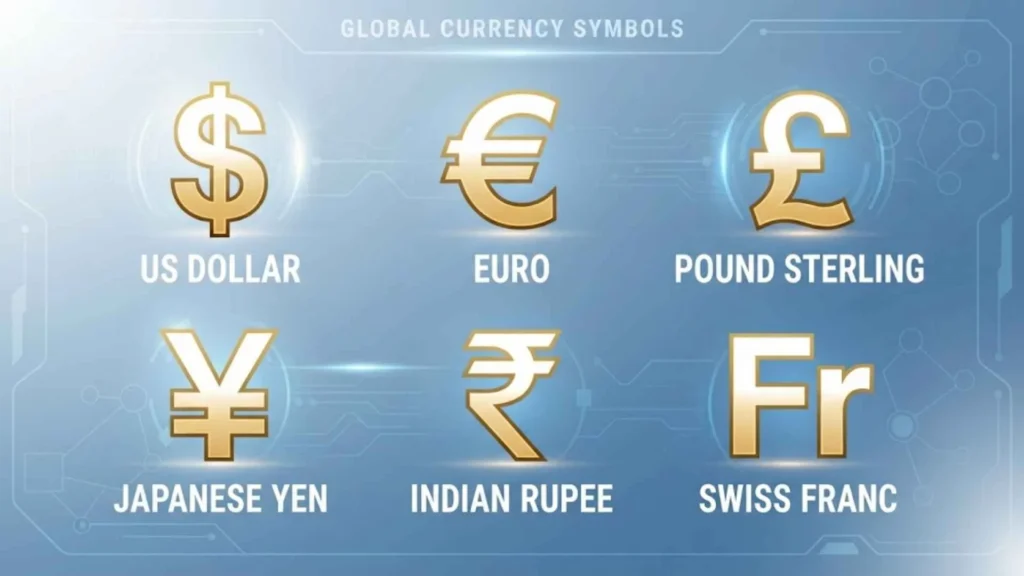
The name attached to a currency symbol helps clarify exactly what the character represents. This is especially important when the same symbol is shared by multiple currencies.
For example, $ may refer to several dollar currencies, while ¥ can be used for both the Japanese yen and Chinese yuan in different contexts. A symbol by itself does not always identify a country.
Here are additional examples:
- $ — Dollar
- € — Euro
- £ — Pound sterling
- ₹ — Indian rupee
- ¥ — Yen / yuan
- ₩ — Won
- ₽ — Ruble
- ₺ — Turkish lira
- ₴ — Hryvnia
- ₦ — Naira
- ₵ — Cedi
- ₱ — Peso
- ₸ — Tenge
- ₾ — Lari
For professional financial writing, pair the symbol with the full currency name or ISO code when there is a chance of ambiguity.
Currency Symbols And Meanings
Currency symbols primarily indicate monetary value, but their exact meaning depends on the currency and context.
$ generally indicates a dollar- or peso-based currency, depending on the country and surrounding information.
€ identifies the euro.
£ identifies pound sterling in modern British usage and is also associated historically with other pound currencies.
¥ is commonly used for the Japanese yen and Chinese yuan.
₹ specifically represents the Indian rupee.
₩ represents the won, particularly the South Korean won in modern usage.
₽ represents the Russian ruble.
₺ represents the Turkish lira.
₦ represents the Nigerian naira.
A symbol’s meaning should therefore be interpreted with its location, currency name, or three-letter currency code when needed.
List Of Currency Symbols
Here is a compact list of commonly encountered currency symbols:
| Symbol | Currency |
| $ | Dollar |
| ¢ | Cent |
| £ | Pound sterling |
| ¥ | Yen / yuan |
| € | Euro |
| ₹ | Indian rupee |
| ₽ | Russian ruble |
| ₩ | Won |
| ₪ | Israeli new shekel |
| ₫ | Vietnamese dong |
| ₭ | Lao kip |
| ₮ | Mongolian tögrög |
| ₱ | Peso |
| ₵ | Cedi |
| ₸ | Tenge |
| ₺ | Turkish lira |
| ₼ | Azerbaijani manat |
| ₾ | Georgian lari |
| ₦ | Nigerian naira |
| ₲ | Guarani |
| ₡ | Colon |
| ¤ | Generic currency sign |
The generic currency sign ¤ is useful when a specific currency cannot or should not be identified.
International Currency Symbols
International currency symbols are used to communicate monetary values across borders. A symbol can make a price quickly recognizable, but international financial communication often benefits from a currency code as well.
For example:
- $100 USD — United States dollars
- $100 CAD — Canadian dollars
- €100 EUR — euros
- £100 GBP — pounds sterling
- ¥100 JPY — Japanese yen
- ₹100 INR — Indian rupees
In international e-commerce, travel, banking, and financial reporting, combining a symbol with a three-letter code can reduce ambiguity.
Various Currency Symbols
Currency notation can take several forms. Some currencies have unique Unicode symbols, while others use ordinary letters, abbreviations, or combinations of characters.
Examples include:
- € — dedicated euro symbol
- ₹ — dedicated Indian rupee sign
- ₽ — dedicated ruble sign
- ₦ — dedicated naira sign
- kr — abbreviation used for several krone or krona currencies
- R — used in contexts involving certain rand or real currencies
- A$ — Australian dollar notation
- C$ — Canadian dollar notation
- NZ$ — New Zealand dollar notation
- US$ — United States dollar notation
These variations show why currency identification should consider more than the visual symbol alone.
Worldwide Currency Symbols
Worldwide currency symbols appear in many places, including online stores, financial applications, international menus, travel websites, invoices, and product catalogs.
Some especially recognizable symbols are:
$ € £ ¥ ₹ ₽ ₩ ₺ ₪ ₴ ₫ ฿ ₱ ₦ ₵ ₸ ₾ ₼
When using these characters online, remember that the displayed design may change according to the selected font. The underlying character remains the same when the correct Unicode character is used.
Currency Symbols Europe
European currencies include both euro and non-euro currencies. The euro symbol is:
€
Other European currency notations include:
- £ — Pound sterling
- kr — Krone or krona
- ₽ — Russian ruble
- ₴ — Ukrainian hryvnia
- ₺ — Turkish lira
- ₾ — Georgian lari
The euro is used by multiple countries, so € identifies the currency rather than a single country. For prices that need country-level clarity, adding the country or currency code is helpful.
Different Currency Symbols Of Different Countries
Different countries may use different symbols for their currencies, while some countries share similar symbols.
| Country | Currency | Symbol or notation |
| United States | US dollar | $ |
| United Kingdom | Pound sterling | £ |
| India | Indian rupee | ₹ |
| Japan | Yen | ¥ |
| China | Yuan | ¥ / CN¥ |
| South Korea | Won | ₩ |
| Russia | Ruble | ₽ |
| Turkey | Turkish lira | ₺ |
| Ukraine | Hryvnia | ₴ |
| Thailand | Baht | ฿ |
| Vietnam | Dong | ₫ |
| Philippines | Philippine peso | ₱ |
| Nigeria | Naira | ₦ |
| Ghana | Cedi | ₵ |
| Kazakhstan | Tenge | ₸ |
| Georgia | Lari | ₾ |
| Azerbaijan | Manat | ₼ |
| Israel | New shekel | ₪ |
| Laos | Kip | ₭ |
| Mongolia | Tögrög | ₮ |
The table demonstrates why country names are useful when a symbol is shared or ambiguous.
Types Of Currency Symbols
Currency symbols can be grouped into several practical types.
Dedicated Currency Signs
These are characters specifically associated with a currency, such as:
- € — Euro sign
- ₹ — Indian rupee sign
- ₽ — Ruble sign
- ₺ — Turkish lira sign
- ₦ — Naira sign
Shared Symbols
Some symbols are used by multiple currencies:
- $ — various dollar and peso currencies
- ¥ — Japanese yen and Chinese yuan in different contexts
Currency Abbreviations
Some currencies are commonly identified using letters:
- kr — several Nordic currencies
- R — used in some regional currency contexts
- A$ — Australian dollar
- C$ — Canadian dollar
Generic Currency Character
¤ is the Unicode Currency Sign. It can be used when a generic monetary symbol is needed without specifying a particular currency.
Other Country Currency Symbols
Many countries use currency notation that may be unfamiliar to readers elsewhere. Some examples include:
- ₾ — Georgian lari
- ₼ — Azerbaijani manat
- ₸ — Kazakhstani tenge
- ₭ — Lao kip
- ₮ — Mongolian tögrög
- ₵ — Ghanaian cedi
- ₦ — Nigerian naira
- ₲ — Paraguayan guarani
- ₡ — currencies using the colon symbol, especially Central American contexts
- ₫ — Vietnamese dong
Not every country has a unique single-character currency symbol. Where no dedicated symbol is commonly used, abbreviations and ISO codes provide a practical alternative.
Different Currency Symbols
Currency symbols can differ in shape, placement, and regional usage. The most familiar characters include $, €, £, ¥, and ₹, but the Unicode currency block contains many additional signs.
The placement of a currency symbol also varies. In English-language contexts, symbols such as $, £, and € are often placed before the amount, while some currencies and language conventions place monetary signs or abbreviations after the number.
For example:
- $50
- £50
- €50
- ₹50
Always follow the normal convention for the language and currency you are writing about.
Currency Symbols List
For quick reference, here is another practical collection:
$ — Dollar sign
¢ — Cent sign
£ — Pound sign
¥ — Yen sign
¤ — Currency sign
€ — Euro sign
₩ — Won sign
₪ — New sheqel sign
₫ — Dong sign
₭ — Kip sign
₮ — Tugrik sign
₱ — Peso sign
₲ — Guarani sign
₴ — Hryvnia sign
₵ — Cedi sign
₸ — Tenge sign
₺ — Turkish lira sign
₼ — Manat sign
₽ — Ruble sign
₾ — Lari sign
₹ — Indian rupee sign
₦ — Naira sign
All Currency Symbols
There is no single short list that captures every way currencies are represented worldwide because many currencies use abbreviations rather than dedicated Unicode characters. Historical currencies also have symbols that are no longer used as current national currencies.
For modern Unicode currency characters, some useful examples include:
| Symbol | Unicode | Name |
| ¤ | U+00A4 | Currency Sign |
| $ | U+0024 | Dollar Sign |
| £ | U+00A3 | Pound Sign |
| ¥ | U+00A5 | Yen Sign |
| € | U+20AC | Euro Sign |
| ₡ | U+20A1 | Colon Sign |
| ₢ | U+20A2 | Cruzeiro Sign |
| ₣ | U+20A3 | French Franc Sign |
| ₤ | U+20A4 | Lira Sign |
| ₥ | U+20A5 | Mill Sign |
| ₦ | U+20A6 | Naira Sign |
| ₧ | U+20A7 | Peseta Sign |
| ₨ | U+20A8 | Rupee Sign |
| ₩ | U+20A9 | Won Sign |
| ₪ | U+20AA | New Sheqel Sign |
| ₫ | U+20AB | Dong Sign |
| € | U+20AC | Euro Sign |
| ₭ | U+20AD | Kip Sign |
| ₮ | U+20AE | Tugrik Sign |
| ₯ | U+20AF | Drachma Sign |
| ₰ | U+20B0 | German Penny Sign |
| ₱ | U+20B1 | Peso Sign |
| ₲ | U+20B2 | Guarani Sign |
| ₳ | U+20B3 | Austral Sign |
| ₴ | U+20B4 | Hryvnia Sign |
| ₵ | U+20B5 | Cedi Sign |
| ₶ | U+20B6 | Livre Tournois Sign |
| ₷ | U+20B7 | Spesmilo Sign |
| ₸ | U+20B8 | Tenge Sign |
| ₹ | U+20B9 | Indian Rupee Sign |
| ₺ | U+20BA | Turkish Lira Sign |
| ₽ | U+20BD | Ruble Sign |
| ₾ | U+20BE | Lari Sign |
| ₼ | U+20BC | Manat Sign |
Some entries in Unicode are historical or specialized rather than current everyday currency symbols. Therefore, a Unicode list should not automatically be treated as a list of currently active national currencies.
Money Currency Symbols
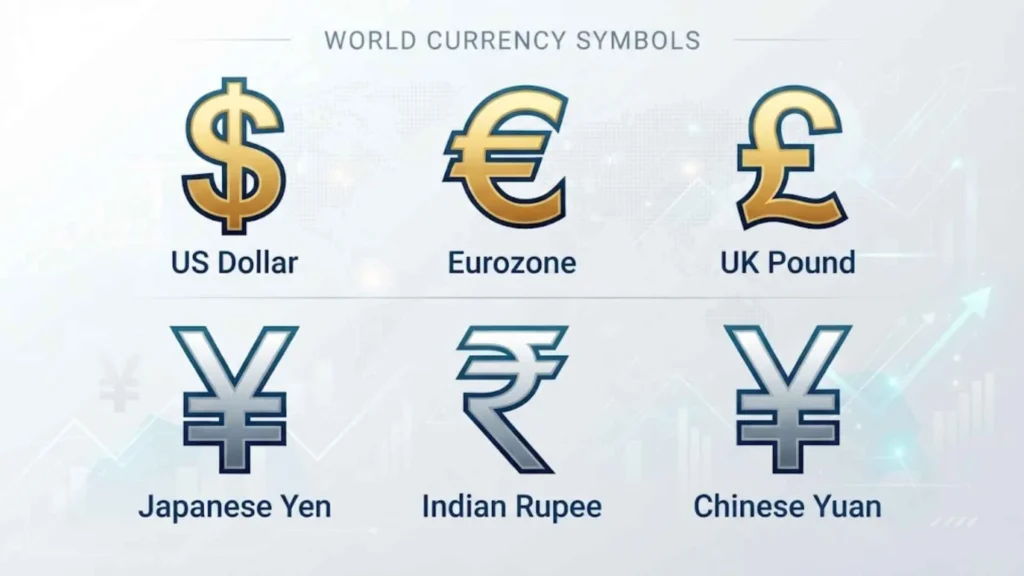
Money currency symbols make monetary amounts recognizable at a glance. They are widely used in prices, receipts, financial documents, advertisements, menus, apps, and online stores.
Popular examples include:
- $ — dollar
- € — euro
- £ — pound sterling
- ¥ — yen or yuan
- ₹ — Indian rupee
- ₽ — Russian ruble
- ₩ — won
- ₺ — Turkish lira
- ₦ — Nigerian naira
- ₱ — peso
- ฿ — baht
- ₫ — dong
When writing for an international audience, the safest approach is to combine the symbol with the currency name or ISO code whenever the symbol could have more than one interpretation.
Frequently Asked Questions
What Is The Most Common Currency Symbol?
The dollar sign $ is one of the most widely recognized currency symbols. It is used for multiple currencies, so the country or currency code may be needed to identify the exact currency.
What Is The Currency Symbol For The Euro?
The currency symbol for the euro is €. Its Unicode code point is U+20AC, and its official Unicode name is EURO SIGN.
What Is The Unicode Symbol For The Indian Rupee?
The Indian rupee sign is ₹. Its Unicode code point is U+20B9, and its Unicode name is INDIAN RUPEE SIGN.
Why Do Some Countries Share The Same Currency Symbol?
Currency symbols are often based on historical abbreviations, monetary traditions, or similar currency names. As a result, different currencies can use the same or similar symbols.
Can I Copy And Paste Currency Symbols?
Yes. Characters such as $, €, £, ¥, ₹, ₽, ₩, and ₺ can generally be copied and pasted like ordinary text. Their appearance may vary depending on the font and application.
Conclusion
Currency symbols provide a quick visual way to identify monetary amounts. Familiar characters such as $, €, £, ¥, and ₹ are joined by many less familiar symbols used across Asia, Europe, Africa, and other regions.
For everyday writing, copying a symbol is usually enough, but international financial content may require additional context. Adding a currency name or ISO code helps distinguish symbols that are shared by multiple currencies.
This collection can also serve as a handy reference for Unicode characters, country-based currency information, and copy-and-paste needs. When accuracy matters, check the currency name and code rather than relying on the symbol alone.

Hi, I’m Sienna Brooks, and I believe that the right words can inspire, comfort, and empower people at every stage of life. For as long as I can remember, I’ve been drawn to meaningful quotes and the stories behind them. I love curating collections of inspirational, motivational, and heartfelt quotes that resonate with readers around the world.
Through my writing, I strive to help others find encouragement, whether they’re celebrating life’s happiest moments or navigating its biggest challenges. I believe that wisdom is timeless, and I’m passionate about sharing words that leave a lasting impact.
I am the author of Reflections in Words and The Journey of Inspiration, two books dedicated to exploring the beauty and power of timeless quotes.
 Rowan Sinclair Rowan Sinclair