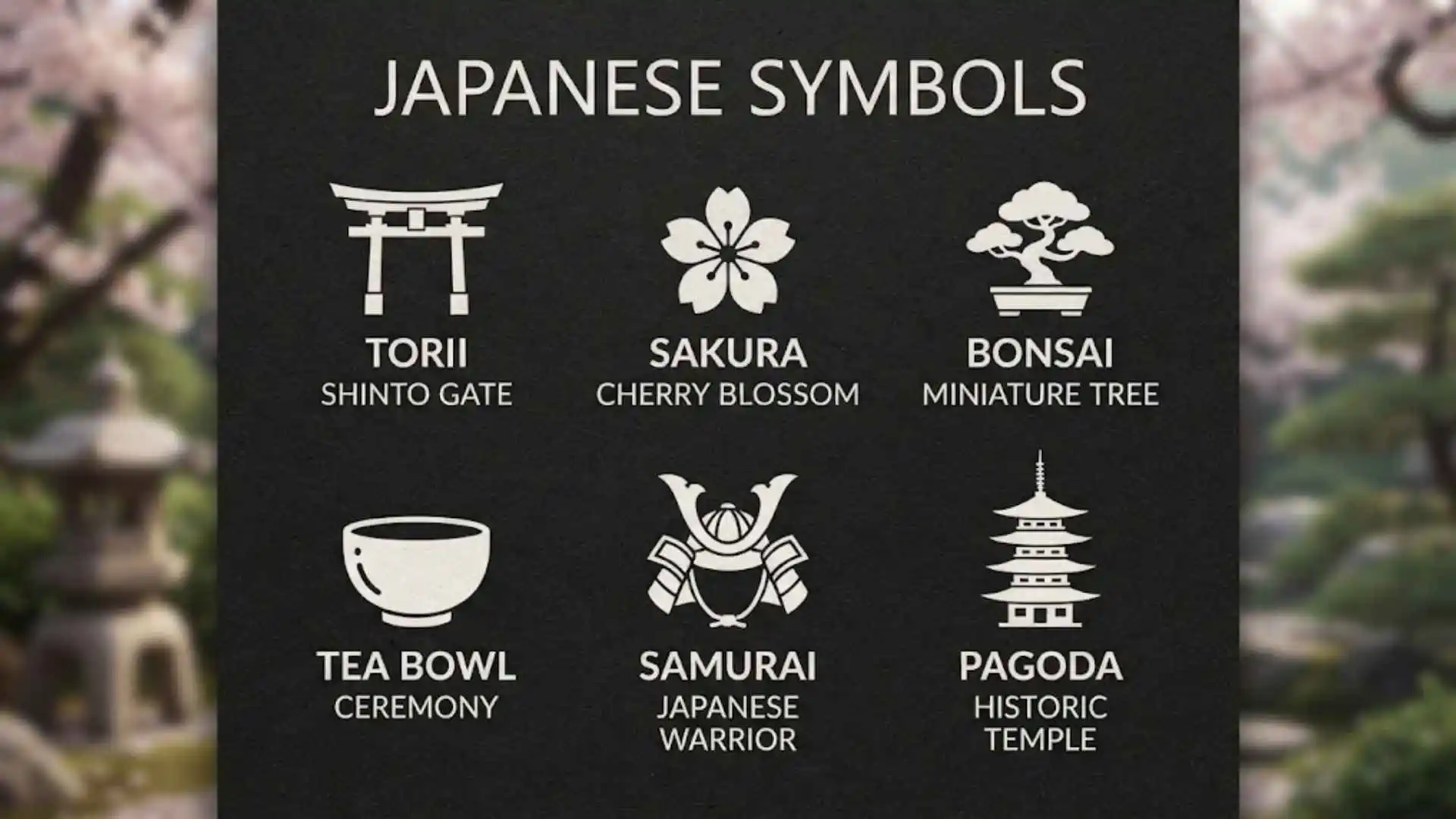
Japanese symbols can be beautiful, meaningful, and useful in text, usernames, artwork, tattoos, and social media. The phrase “Japanese symbols” can refer to several things, including kanji, hiragana, katakana, punctuation, traditional patterns, and cultural motifs.
This guide covers Japanese symbols and meanings, easy characters to copy and paste, aesthetic text, traditional and ancient symbols, and popular choices connected with love, peace, good luck, and personal qualities. You will also find useful information about Japanese names and tattoo ideas.
Because Japanese characters have specific meanings and readings, appearance alone should not be used to determine what a character means. The lists below separate common characters from broader cultural symbols so you can choose them more accurately.
What Are Japanese Symbols Called
“Japanese symbols” is a broad informal phrase rather than the name of one specific writing system. Japanese writing mainly uses kanji, hiragana, and katakana, along with punctuation and other written marks.
Kanji (漢字) are characters historically derived from Chinese writing and used in Japanese. Hiragana (ひらがな) and katakana (カタカナ) are kana syllabaries used to represent Japanese sounds.
For symbols or signs in a broader sense, the Japanese word 記号 (kigō) can be used. Cultural motifs such as a torii, daruma, or maneki-neko are better described as cultural symbols or objects rather than individual writing characters.
Common Japanese Symbols
Some Japanese characters are especially useful for beginners because their basic meanings are relatively easy to understand.
| Character | Common meaning |
| 愛 | Love |
| 夢 | Dream |
| 心 | Heart, mind, feelings |
| 力 | Strength, power |
| 美 | Beauty |
| 和 | Harmony, peace |
| 幸 | Happiness, good fortune |
| 光 | Light |
| 花 | Flower |
| 月 | Moon, month |
| 星 | Star |
| 山 | Mountain |
| 海 | Sea |
| 空 | Sky |
| 雪 | Snow |
The meaning of a kanji can change when it appears in a compound word, so a dictionary definition for one character does not always describe its meaning in every sentence.
Japanese Symbols And Meanings
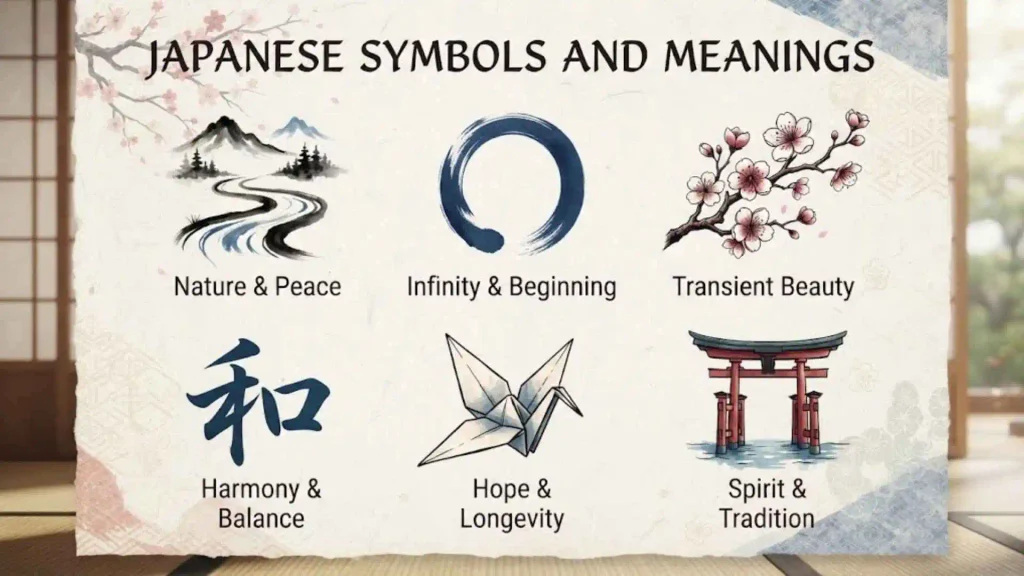
Japanese characters can represent simple ideas such as love, beauty, strength, nature, emotions, and personal qualities.
Some popular examples are:
- 愛 — love
- 夢 — dream
- 希望 — hope
- 自由 — freedom
- 平和 — peace
- 勇気 — courage
- 感謝 — gratitude
- 友情 — friendship
- 幸福 — happiness
- 家族 — family
- 成功 — success
- 健康 — health
Full words can sometimes communicate an idea more clearly than a single kanji. For example, 平和 directly means peace, while 和 has a wider meaning related to harmony and peacefulness.
Japanese Symbols Meaning
When looking for the meaning of a Japanese symbol, first identify whether it is kanji, kana, punctuation, or a cultural motif.
For example:
- 愛 — love or affection
- 恋 — romantic love or longing
- 夢 — dream
- 心 — heart, mind, or feelings
- 道 — road, path, or way
- 和 — harmony or peace
- 忍 — endurance or perseverance in appropriate words and contexts
- 絆 — bond or connection
- 誠 — sincerity
- 真 — truth or something genuine
A character can have several English translations because Japanese meaning depends on the word and context in which it appears.
Japanese Symbols And Their Meanings
A useful way to explore Japanese characters is by grouping them according to common themes.
| Theme | Character or word | Meaning |
| Love | 愛 | Love |
| Romance | 恋 | Romantic love |
| Peace | 平和 | Peace |
| Hope | 希望 | Hope |
| Freedom | 自由 | Freedom |
| Friendship | 友情 | Friendship |
| Gratitude | 感謝 | Gratitude |
| Courage | 勇気 | Courage |
| Happiness | 幸福 | Happiness |
| Family | 家族 | Family |
| Strength | 力 | Strength |
| Beauty | 美 | Beauty |
This approach is particularly helpful when choosing a character for a design because it lets you compare a single kanji with a more specific Japanese word.
Japanese Symbols Names
Japanese names can be written using kanji, hiragana, or katakana. Which writing system is appropriate depends on the name and how it is normally represented.
Some kanji commonly found in Japanese names include:
- 美 — beauty
- 子 — child
- 花 — flower
- 愛 — love
- 優 — gentle, kind, or excellent depending on usage
- 明 — bright
- 直 — straight or honest
- 健 — healthy or strong
- 翔 — soar or fly
A single pronunciation can sometimes have multiple possible kanji spellings. The chosen characters can therefore change the meaning and appearance of a name.
Japanese Symbols Text
Japanese text is created mainly with kanji, hiragana, and katakana.
Here are simple examples:
- あ — hiragana
- か — hiragana
- ん — hiragana
- ア — katakana
- カ — katakana
- ン — katakana
- 日 — kanji
- 山 — kanji
- 水 — kanji
- 火 — kanji
Japanese also uses distinctive punctuation, including 「 」 for quotation marks, 『 』 for another style of quotation brackets, ・ as a middle dot, and 々 as an iteration mark.
Japanese Symbols Aesthetic
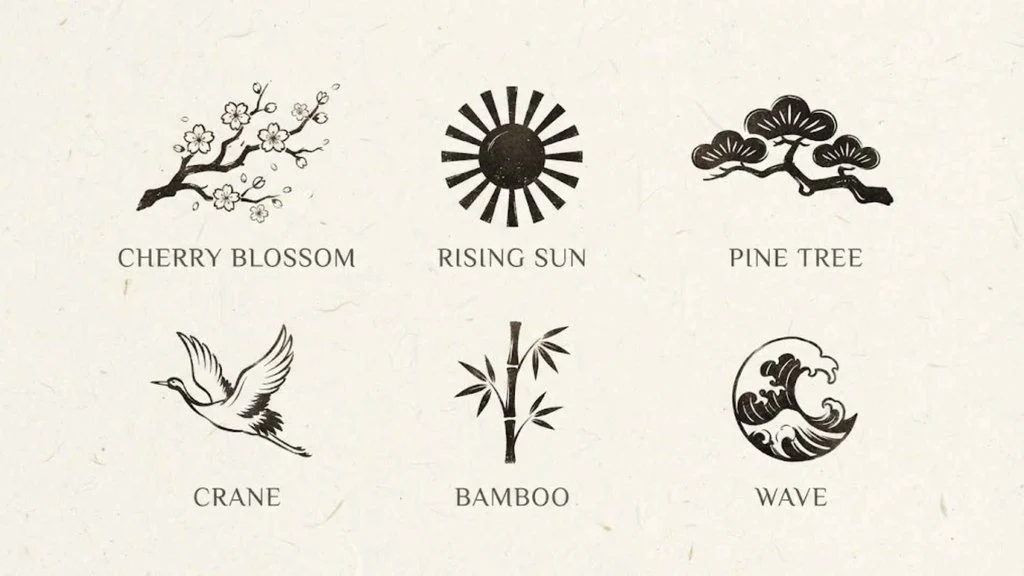
Japanese characters can create an attractive visual style because many kanji have compact, balanced shapes.
Popular characters for decorative designs include:
- 月 — moon
- 星 — star
- 桜 — cherry blossom
- 花 — flower
- 雪 — snow
- 風 — wind
- 海 — sea
- 空 — sky
- 光 — light
- 夢 — dream
- 美 — beauty
Japanese punctuation can also add visual interest:
「 」
『 』
・
〜
々
These characters can work well in usernames, captions, digital artwork, and decorative layouts. However, decorative use does not automatically make a phrase grammatically correct Japanese.
Japanese Symbols With Deep Meaning
Some Japanese characters are popular because they can represent broad personal ideas.
- 愛 — love and affection
- 夢 — dream
- 希望 — hope
- 勇気 — courage
- 自由 — freedom
- 平和 — peace
- 誠 — sincerity
- 忍 — endurance or perseverance
- 絆 — a meaningful bond
- 心 — heart, mind, or inner feelings
- 和 — harmony
- 道 — way or path
The phrase “deep meaning” is subjective. A character can become personally meaningful through a person’s experiences, relationships, beliefs, or goals even when its ordinary dictionary meaning is simple.
Japanese Symbols For Love
Several Japanese characters and words are connected with love.
愛 — Love
愛 is one of the most recognizable kanji associated with love, affection, and care.
恋 — Romantic Love
恋 is commonly connected with romantic love, longing, or being in love.
恋愛 — Romantic Love
恋愛 is a Japanese word referring to romantic love or romantic relationships.
愛情 — Affection
愛情 means affection or love and can describe emotional care or attachment.
For a simple design, 愛 is easy to recognize. If you want natural Japanese writing, however, the correct word depends on exactly what you want to say.
Japanese Symbols For Peace
The standard Japanese word for peace is:
平和
It is made from two kanji:
- 平 — can convey ideas such as flat, even, or peaceful depending on the word
- 和 — harmony, peace, or related concepts
和 can therefore be associated with peacefulness and harmony, although it does not always mean “peace” by itself.
For a precise translation of the English word “peace,” 平和 is generally more direct.
Japanese Symbols For Good Luck
Japanese culture has many characters, objects, and traditions associated with good fortune.
Useful written examples include:
- 福 — good fortune or blessings
- 幸 — happiness or good fortune
- 幸福 — happiness
- 幸運 — good luck
- 招福 — inviting good fortune
Cultural symbols associated with luck include maneki-neko (beckoning cat) and daruma dolls. These are cultural objects rather than individual Unicode characters.
Traditional Japanese Symbols
Traditional Japanese symbolism includes patterns, flowers, animals, objects, and architectural elements.
Seigaiha (青海波) is a repeating wave pattern commonly used in Japanese design. Its visual associations include calmness, continuity, and an enduring peaceful life.
Asanoha (麻の葉) is a geometric pattern based on hemp leaves. It has traditionally been associated with growth and vitality.
Kikkō (亀甲) uses hexagonal shapes inspired by the shell pattern of a tortoise. The tortoise has long been associated with longevity.
Sakura (桜) represents cherry blossoms and is deeply connected with Japanese seasonal culture.
These motifs are visual traditions rather than simple one-character Unicode symbols.
Ancient Japanese Symbols
The history of Japanese writing stretches back many centuries, and ancient Japanese symbols can refer to several different forms of writing and imagery.
Kanji became an important part of Japanese writing through historical contact with Chinese writing. Before modern Japanese was standardized, characters and writing practices changed over time.
Historical writing systems and forms include:
- Early kanji usage in Japan
- Man’yōgana, an older method of using kanji for their sounds
- Early forms of hiragana
- Early forms of katakana
- Historical inscriptions and seals
- Traditional religious and decorative motifs
Some websites present unusual shapes as “ancient Japanese symbols” without reliable historical evidence. A mysterious-looking character should not automatically be considered an authentic ancient Japanese symbol.
Japanese Symbols Tattoo
Japanese characters are frequently chosen for tattoos because a short character or phrase can represent a larger concept.
Popular examples include:
- 愛 — love
- 夢 — dream
- 勇 — courage
- 力 — strength
- 自由 — freedom
- 平和 — peace
- 忍 — endurance
- 希望 — hope
- 絆 — bond
- 家族 — family
Before getting a Japanese tattoo, check the complete expression with a fluent Japanese speaker. A literal online translation can miss differences in nuance, natural usage, or the meaning created by combining characters.
It is also better to verify the exact characters visually before giving them to a tattoo artist. A small character difference can produce a completely different word.
Easy Japanese Symbols
If you are new to Japanese writing, these characters are relatively simple to recognize and copy:
- 愛 — love
- 夢 — dream
- 心 — heart or mind
- 花 — flower
- 月 — moon
- 星 — star
- 海 — sea
- 山 — mountain
- 空 — sky
- 光 — light
- 和 — harmony
- 力 — strength
They can be used in decorative text, captions, profile names, artwork, or personal notes.
Japanese Symbols Copy Paste
Here is a quick collection for direct copying:
Love and emotions
- 愛
- 恋
- 心
- 夢
- 幸
- 喜
Nature
- 桜
- 花
- 月
- 星
- 空
- 海
- 山
- 雪
- 雨
- 風
Personal qualities
- 力
- 勇
- 忍
- 誠
- 真
- 智
- 美
Ideas
- 和
- 平和
- 希望
- 自由
- 絆
- 道
You can copy the characters directly from the list. Keep in mind that combining several characters randomly does not necessarily create a meaningful Japanese phrase.
Famous Japanese Symbols
Japan has many recognizable symbols that are not part of its writing system.
- Mount Fuji — a famous Japanese mountain and cultural image
- Sakura — cherry blossom
- Torii — gate associated with Shinto shrine spaces
- Daruma — traditional doll associated with perseverance and goals
- Maneki-neko — beckoning cat associated with good fortune
- Koi — ornamental carp frequently represented in Japanese art
- Koinobori — carp-shaped streamers associated with Children’s Day
- Chrysanthemum — an important flower in Japanese culture
- Seigaiha — traditional wave pattern
The meaning of these symbols can vary by historical period and context, so they should not all be treated as having one fixed interpretation.
Japanese Symbols Text
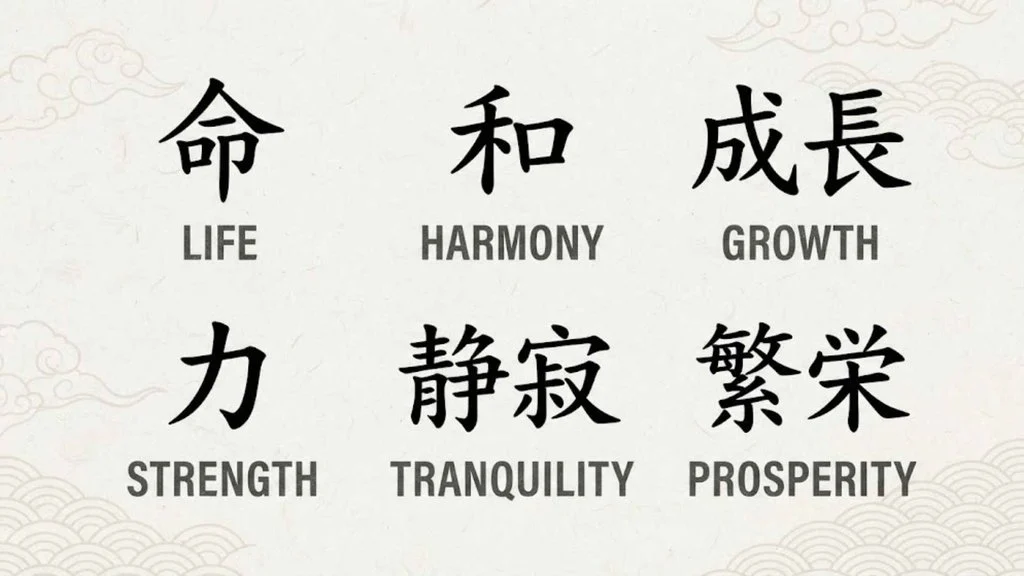
Japanese characters can be combined with English text for decorative usernames, captions, and social media posts.
Examples include:
Dream 夢
Love 愛
Peace 平和
Moon 月
Star 星
Harmony 和
Sakura 桜
Japanese punctuation can create additional visual styles:
「愛」
『夢』
月・星・空
桜〜夢〜愛
These are useful as decorative combinations. If you want to write a genuine Japanese sentence, use normal Japanese grammar rather than arranging characters only for appearance.
Japanese Symbols And Meanings
Different Japanese characters can express similar ideas while carrying different shades of meaning.
For example:
- 愛 — love or affection
- 恋 — romantic love or longing
- 和 — harmony
- 平和 — peace
- 幸 — happiness or good fortune
- 幸福 — happiness
- 希望 — hope
- 勇気 — courage
- 友情 — friendship
- 感謝 — gratitude
This is why choosing a Japanese character based only on an English keyword can sometimes produce an awkward result. The complete Japanese word should be considered when accuracy matters.
What Is My Name In Japanese Symbols
An English name does not normally have one special Japanese symbol that represents it.
Foreign names are often written phonetically in katakana. For example:
- Michael → マイケル
- Sarah → サラ
- Daniel → ダニエル
The exact katakana spelling depends on how the name is pronounced.
Kanji can sometimes be selected creatively to represent a foreign name’s sound or desired meaning, but this is different from the normal Japanese spelling of that name. If you want an accurate personal-name conversion, pronunciation is more important than simply translating the English meaning of the name.
Japanese Symbols Copy And Paste
For a smaller collection of attractive characters, try these:
愛 恋 夢 心 和 幸 美 力
桜 花 月 星 空 海 山 雪
光 風 雨 龍 虎 炎 雷 影
希望 平和 自由 絆 勇気 感謝
These can be copied into usernames, captions, messages, artwork, and other text fields that support the characters.
Japanese Symbols With Deep Meaning
A few Japanese words are especially useful when you want a phrase with a strong personal theme.
| Japanese | Meaning |
| 絆 | Bond or connection |
| 希望 | Hope |
| 自由 | Freedom |
| 平和 | Peace |
| 勇気 | Courage |
| 感謝 | Gratitude |
| 幸福 | Happiness |
| 家族 | Family |
| 誠実 | Sincerity/integrity |
| 挑戦 | Challenge |
Using a complete word instead of a single character can reduce ambiguity. For example, 感謝 clearly expresses gratitude, while choosing one character from that word without understanding its role can change the intended meaning.
Cool Japanese Symbols
For a bold or dramatic visual style, these characters are often appealing:
- 龍 — dragon
- 虎 — tiger
- 雷 — thunder
- 炎 — flame
- 影 — shadow
- 闇 — darkness
- 光 — light
- 風 — wind
- 月 — moon
- 星 — star
- 夢 — dream
- 道 — way or path
- 空 — sky
- 海 — sea
A character can look “cool” because of its shape, meaning, cultural association, or use in popular media. Its actual Japanese meaning remains more important than the visual impression.
Japanese Symbols Copy And Paste
For a final quick-copy collection, these groups cover several common themes.
Romantic: 愛 恋 心 絆
Peaceful: 平和 和 穏
Positive: 幸 福 希望 光
Strong: 力 勇 忍 誠
Nature: 桜 花 月 星 海 山
Mystical: 龍 影 闇 雷 炎
Dreamy: 夢 空 月 星 風
Some characters may have broader meanings than the short English labels shown here. For important uses, check the complete Japanese word and context.
FAQ
What Is The Most Popular Japanese Symbol For Love?
愛 is one of the most recognizable Japanese kanji associated with love and affection. 恋 is more closely connected with romantic love and longing.
Can I Copy And Paste Japanese Symbols?
Yes. Japanese Unicode characters can be copied and pasted into many text fields, websites, messages, and social platforms. Their appearance can vary depending on the font and device.
What Japanese Symbol Means Peace?
平和 is the standard Japanese word for peace. 和 can also express harmony and peacefulness, depending on the context.
Are Japanese Symbols The Same As Kanji?
No. Kanji are one part of Japanese writing. Hiragana, katakana, punctuation, and cultural motifs are different categories, although all may be informally called Japanese symbols.
Should I Verify A Japanese Symbol Before Getting A Tattoo?
Yes. For a permanent tattoo, verify the exact character or phrase with a fluent Japanese speaker. This helps avoid incorrect meanings, unnatural combinations, and translation mistakes.
Conclusion
Japanese symbols include much more than decorative characters. Kanji, hiragana, katakana, punctuation, traditional patterns, and cultural motifs all contribute to the rich visual world associated with Japanese writing and design.
For simple copy-and-paste use, characters such as 愛, 夢, 心, 和, 桜, 月, and 力 are easy starting points. More specific words such as 平和, 希望, 自由, and 感謝 can express complete ideas with greater precision.
The best character is the one whose actual Japanese meaning matches your intended message. If the symbol will be used for a tattoo, name, business design, or other permanent purpose, take a little extra time to verify its meaning and natural usage.

Hi, I’m Sienna Brooks, and I believe that the right words can inspire, comfort, and empower people at every stage of life. For as long as I can remember, I’ve been drawn to meaningful quotes and the stories behind them. I love curating collections of inspirational, motivational, and heartfelt quotes that resonate with readers around the world.
Through my writing, I strive to help others find encouragement, whether they’re celebrating life’s happiest moments or navigating its biggest challenges. I believe that wisdom is timeless, and I’m passionate about sharing words that leave a lasting impact.
I am the author of Reflections in Words and The Journey of Inspiration, two books dedicated to exploring the beauty and power of timeless quotes.
 Rowan Sinclair Rowan Sinclair