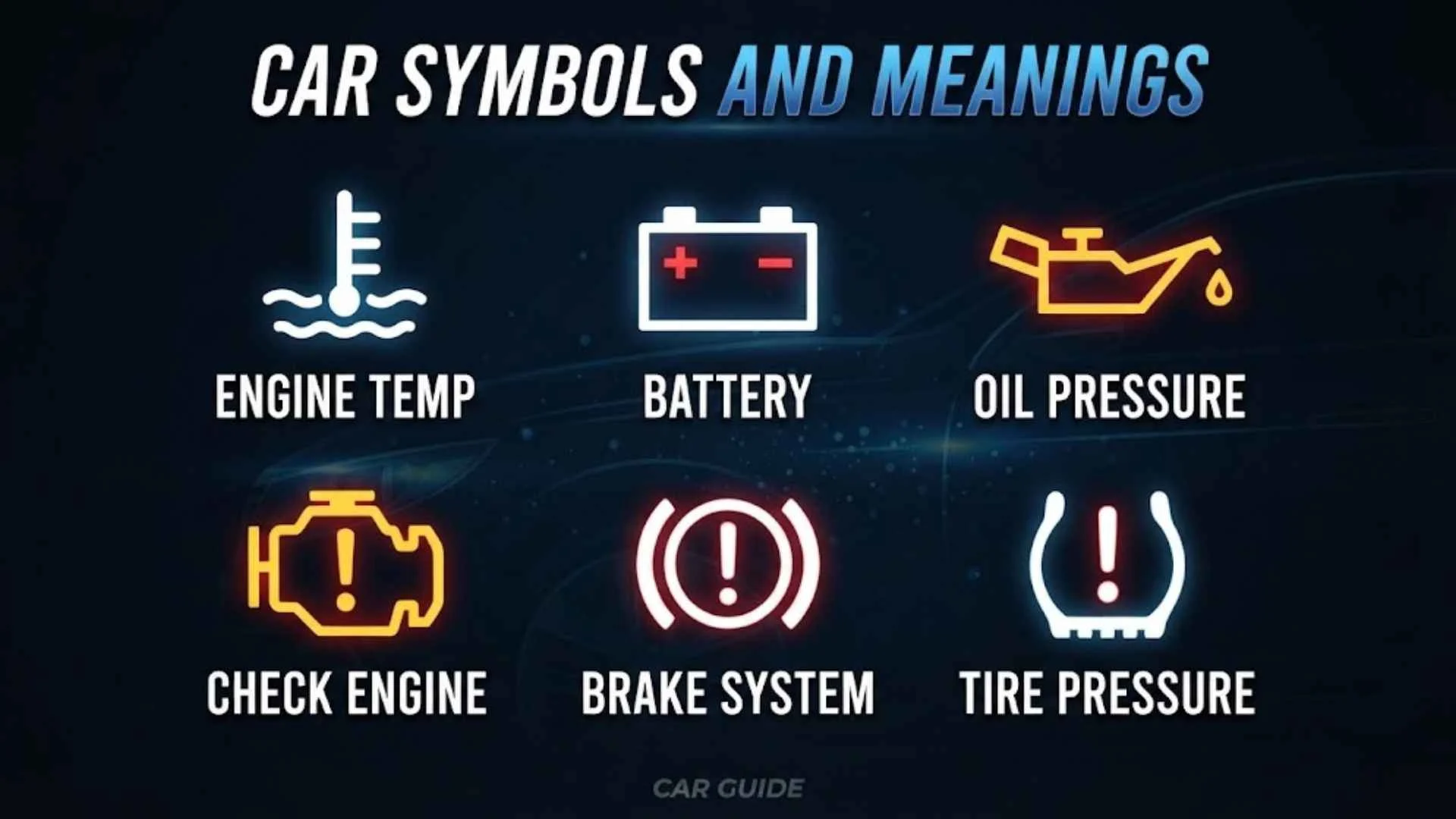
If a strange symbol suddenly appears on your car’s dashboard, it can be difficult to know whether it is simply telling you that a feature is active or warning you about a problem. Understanding car symbols and their meanings can help you recognize important dashboard information and decide what to check next.
Modern vehicles can have dozens of dashboard symbols for the engine, brakes, tires, lighting, airbags, steering, traction control, driver-assistance systems, fuel, electrical systems, and more. Some symbols are informational, while others can indicate a condition that needs prompt attention.
This guide explains common car symbols, dashboard warning lights, indicator lights, their meanings, colors, shapes, flashing behavior, and recommended next steps. Because symbols can differ between manufacturers and models, always use your vehicle’s owner’s manual as the final reference for a specific warning.
Quick Car Symbols and Meanings Chart
The following table provides a quick reference for some of the most common car symbols.
| Car Symbol | Common Meaning | Typical Color | What to Do |
| Engine-shaped icon | Check engine or malfunction indicator | Amber/Yellow | Investigate the cause |
| Oil can | Oil pressure or oil-related warning | Red/Amber | Check promptly; stop if instructed |
| Battery | Charging system warning | Red | Check the charging system |
| Thermometer over waves | Engine coolant temperature | Red | Stop safely if overheating |
| Tire with exclamation mark | Low tire pressure/TPMS | Amber | Check tire pressure |
| ABS | Anti-lock braking system warning | Amber | Have the system checked |
| Circle with exclamation mark | Brake-system warning | Red/Amber | Check the brake system |
| Person with airbag | Airbag/SRS warning | Amber | Arrange inspection |
| Car with wavy lines | Traction/stability control | Amber | Check system status |
| Gas pump | Low fuel or fuel information | Amber | Refuel when necessary |
| Seat belt icon | Seat belt not fastened | Red | Fasten the seat belt |
| Blue headlight | High beams active | Blue | Switch off when inappropriate |
| Green headlight | Low beams or lighting active | Green | Usually informational |
| Windshield with spray | Washer fluid or washer system | Amber | Check/refill fluid |
| Steering wheel with warning | Power steering or steering system | Red/Amber | Check promptly |
| Door-open icon | Door, trunk, or hood open | Red/Amber | Close and secure it |
The exact symbol, color, and behavior can vary by vehicle.
What Do Car Symbol Colors Mean?
Color is one of the quickest ways to understand the general purpose of a dashboard symbol. However, color should never be considered a universal diagnosis because manufacturers can use different warning strategies.
Red Car Symbols
Red generally indicates a warning that deserves prompt attention. Depending on the symbol, it can relate to an important safety, engine, braking, temperature, or electrical condition.
Examples include:
- Brake warnings
- Engine temperature warnings
- Oil pressure warnings
- Charging-system warnings
- Some steering-system warnings
- Seat belt warnings
A red light should not automatically be interpreted as proof that the vehicle has suffered catastrophic damage. Instead, identify the symbol and follow the instructions for your specific vehicle.
If the warning indicates a potentially dangerous condition, stop somewhere safe and follow the manufacturer’s recommendations.
Yellow or Amber Car Symbols
Yellow or amber symbols commonly indicate a fault, caution condition, or system that needs attention.
Examples include:
- Check engine
- ABS
- Tire pressure
- Airbag/SRS
- Traction control
- Stability control
- Some driver-assistance warnings
An amber warning does not necessarily mean you must stop immediately. The appropriate response depends on the symbol, whether it is flashing, the vehicle’s behavior, and any message displayed on the instrument panel.
Green Car Symbols
Green symbols are commonly used to show that a feature is active or operating.
Common examples include:
- Turn signals
- Low-beam headlights
- Cruise-control status
- Certain driving-assistance functions
Green generally serves as an information or status indication rather than a fault warning.
Blue Car Symbols
Blue is also commonly used for information.
One of the best-known examples is the high-beam indicator. When it is illuminated, it generally tells the driver that the vehicle’s high-beam headlights are active.
Some manufacturers may use blue for other vehicle functions, so the owner’s manual remains the best reference.
Why Color Alone Is Not Enough
It is tempting to memorize a simple rule such as “red is bad and green is good.” While this can be useful as a general starting point, it isn’t enough to identify a dashboard problem.
For accurate interpretation, consider:
- The symbol’s shape
- Its color
- Whether it is flashing or steady
- Any message on the display
- Whether the vehicle feels or sounds different
- Your vehicle’s make, model, and year
- The owner’s manual
Find Car Symbols by Their Shape
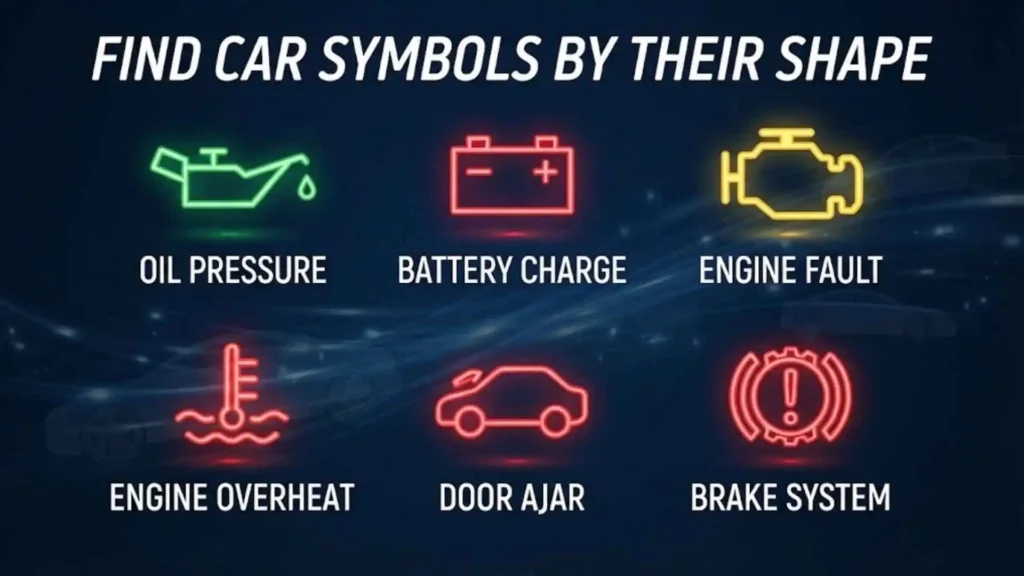
Many drivers don’t know the official name of a dashboard icon. Instead, they search based on what the symbol looks like.
For that reason, identifying symbols by shape can be extremely useful.
Oil Can Symbol
The oil can symbol generally looks like a small oil container with a drop coming from it.
It is commonly associated with engine oil pressure, although some vehicles can display separate oil-level information.
If an oil-pressure warning appears while the engine is running, treat it seriously. Low oil pressure can cause severe engine damage if the vehicle continues operating under the wrong conditions.
Engine-Shaped Symbol
The engine-shaped icon is commonly known as the check engine light or malfunction indicator light.
It can be triggered by many different conditions involving engine management, emissions, sensors, or related systems.
A steady check engine light and a flashing check engine light can require different levels of attention, depending on the vehicle.
Horseshoe-Shaped Symbol With an Exclamation Mark
This symbol looks somewhat like a horseshoe or partially open tire with an exclamation mark in the center.
It is commonly associated with the tire-pressure monitoring system.
When it appears, check the tire pressures using the manufacturer’s recommended specifications.
Car With Squiggly Lines
This symbol commonly shows a vehicle above curved or wavy lines.
It is associated with traction control, electronic stability control, or a related stability system.
If the symbol flashes while driving, it may indicate that the system is actively responding to wheel slip. If it stays illuminated, the system may be switched off or may have detected a fault, depending on the vehicle.
Circle With an Exclamation Mark
A circle containing an exclamation mark is commonly associated with the braking system.
Depending on the vehicle, it may indicate that the parking brake is engaged, brake fluid is low, or a brake-system issue has been detected.
If the warning remains on after releasing the parking brake, check the owner’s manual and have the system inspected.
Battery-Shaped Symbol
The battery icon normally looks like a rectangular battery with positive and negative terminals.
It generally relates to the vehicle’s charging system rather than simply telling you that the battery needs replacing.
Possible causes can involve the alternator, charging circuit, battery, wiring, or related electrical components.
Thermometer Symbol
The temperature warning symbol often resembles a thermometer positioned above liquid or waves.
It is associated with engine coolant temperature.
If the vehicle is overheating, continuing to drive can cause serious engine damage. Follow the manufacturer’s instructions and never open a hot pressurized cooling system.
Steering Wheel Symbol
A steering-wheel icon can be associated with the power-steering or electronic steering system.
The meaning can vary significantly between vehicles.
If a steering warning appears together with noticeably heavier steering or unusual steering behavior, take the warning seriously and follow the vehicle’s recommended procedure.
Common Car Dashboard Symbols and Meanings
The dashboard combines warning lights, indicators, and information symbols to communicate the vehicle’s operating condition.
Check Engine Symbol
The check engine symbol usually resembles the outline of an engine.
It means the vehicle’s diagnostic system has detected a condition that requires attention.
Possible causes are numerous and can include:
- Engine-management faults
- Emissions-related problems
- Sensor problems
- Fuel-system issues
- Ignition-related faults
- Other electronic or mechanical conditions
A diagnostic scan may be needed to determine the actual cause.
If the light is flashing, consult the vehicle’s instructions promptly because some vehicles use a flashing check-engine light to indicate a condition that can potentially cause damage if operation continues.
Oil Pressure Warning Symbol
The oil-pressure warning normally resembles an oil can.
Oil is essential for lubricating internal engine components. A warning related to oil pressure can indicate that the engine is not receiving adequate lubrication under the detected conditions.
If the warning appears while driving, safely stop when appropriate and follow the vehicle manufacturer’s instructions.
Do not assume that adding oil automatically fixes an oil-pressure warning. Oil level and oil pressure are different issues.
Battery or Charging System Symbol
The battery symbol usually indicates a problem with the vehicle’s charging system.
The vehicle may continue running temporarily if electrical energy remains available, but the charging problem can eventually leave the vehicle unable to operate.
Possible causes include:
- Alternator problems
- Battery problems
- Loose or damaged connections
- Charging-circuit faults
- Drive-belt-related issues on some vehicles
The exact cause requires diagnosis.
Engine Temperature Symbol
The engine-temperature warning can indicate that the engine coolant temperature is too high.
Possible contributing factors can include:
- Low coolant
- Cooling-system problems
- Radiator issues
- Cooling-fan problems
- Thermostat problems
- Other engine cooling faults
If the temperature warning appears, avoid continuing to drive an overheating vehicle.
Brake Warning Symbol
Brake warnings can have several meanings.
Depending on the vehicle, the symbol can indicate:
- Parking brake engaged
- Low brake fluid
- Brake-system fault
- Electronic brake-system problem
If the warning stays illuminated after checking that the parking brake is released, consult the owner’s manual and arrange an inspection.
ABS Symbol
The ABS symbol usually contains the letters ABS inside a circle or a similar outline.
ABS stands for Anti-lock Braking System.
An illuminated ABS warning can mean that the anti-lock braking function has detected a fault. Conventional braking may continue to operate in some vehicles, but the ABS function may not work as intended.
Have the system checked according to the manufacturer’s recommendations.
Airbag Symbol
The airbag warning commonly depicts a seated person with an airbag in front of them.
It is associated with the supplemental restraint system, often called SRS.
If this warning remains illuminated, the vehicle may have detected a problem with an airbag or related safety-system component.
Because airbags are important safety equipment, do not treat a persistent airbag warning as an ordinary convenience indicator.
Seat Belt Symbol
The seat-belt warning commonly shows a person wearing a seat belt.
It indicates that a seat belt may not be fastened.
Many vehicles also use an audible warning and can detect occupancy in particular seating positions.
The safest response is straightforward: fasten the seat belt properly.
Tire and Wheel Car Symbols
Tire-related dashboard symbols can provide important information about tire pressure and monitoring systems.
Tire Pressure Warning Symbol
The TPMS warning usually resembles a tire cross-section with an exclamation mark.
It commonly indicates that one or more tires have pressure outside the expected range.
When this light appears:
- Check all tires.
- Measure their pressures.
- Compare them with the manufacturer’s recommended pressures.
- Inflate or adjust as appropriate.
- Follow the vehicle’s reset or relearn procedure if required.
Do not rely only on visual inspection because a tire can be significantly underinflated without looking obviously flat.
Tire Pressure System Fault
Some vehicles distinguish between low tire pressure and a fault within the tire-pressure monitoring system.
A system fault can mean that the monitoring equipment itself needs attention.
If the warning does not behave as expected after correcting tire pressures, consult the owner’s manual.
Brake and Safety Car Symbols
Parking Brake Symbol
A parking-brake symbol can appear as a P or an exclamation mark inside a circle, depending on the vehicle.
It may illuminate when the parking brake is engaged.
If your vehicle uses an electronic parking brake, the symbol may have additional indicators showing its operating status.
Brake Pad Warning
Some vehicles have a separate indicator for worn brake pads.
The symbol and warning behavior vary by manufacturer.
If a brake-pad warning appears, arrange an inspection rather than assuming the problem will disappear on its own.
Electronic Brake System Symbols
Modern vehicles may use additional symbols for electronic parking brakes, brake-hold systems, regenerative braking, and other braking functions.
Because these systems vary considerably, consult the vehicle-specific documentation when an unfamiliar brake symbol appears.
Car Lighting Symbols
Lighting indicators tell you which exterior lighting functions are active or whether a lighting-related issue has been detected.
Low Beam Headlight Symbol
The low-beam symbol generally resembles a headlamp with several lines pointing downward.
It is often green when the low-beam headlights are switched on.
High Beam Symbol
The high-beam indicator commonly appears blue.
It normally confirms that the high-beam headlights are active.
High beams should be used responsibly so they do not interfere with the vision of approaching or nearby drivers.
Front Fog Light Symbol
The front fog-light symbol usually resembles a headlamp with horizontal lines and a curved or vertical marking.
Its exact appearance can vary between manufacturers.
Rear Fog Light Symbol
Rear fog lights often use a different symbol from front fog lights.
Because rear fog lamps are intended for specific visibility conditions, drivers should use them according to local regulations and the vehicle’s instructions.
Turn Signal Symbols
Turn signals generally appear as left- and right-pointing arrows.
They flash when the corresponding indicator is activated.
An unusually fast flashing turn signal can indicate a problem with an exterior indicator bulb or circuit on some vehicles.
Fuel and Maintenance Symbols
Fuel Pump Symbol
The fuel-pump icon indicates the vehicle’s fuel system or fuel level.
When a low-fuel warning appears, refuel according to the vehicle’s requirements.
Many fuel-pump symbols also include a small arrow that indicates which side of the vehicle contains the fuel filler door.
Windshield Washer Symbol
The windshield-washer symbol usually resembles a windshield with fluid spraying across it.
It can indicate low washer fluid or a washer-system status.
If the reservoir is low, refill it with appropriate windshield washer fluid.
Service or Maintenance Symbol
Some vehicles use a wrench, spanner, service, or maintenance symbol.
This can indicate that scheduled maintenance is due or that the vehicle has detected a service-related condition.
The exact maintenance schedule should be determined from the manufacturer’s service information.
Steering and Stability Symbols
Power Steering Warning
A steering wheel combined with an exclamation mark can indicate a power-steering or steering-system issue.
The warning can be particularly important if steering becomes unusually heavy or behaves differently.
Follow the vehicle’s instructions and avoid continuing to operate an unsafe vehicle.
Traction Control Symbol
The traction-control symbol often looks like a car with curved lines underneath it.
When it flashes, it may indicate that the traction-control system is actively responding to wheel slip.
When it stays illuminated, it can mean that the system has been switched off or has detected a fault.
Electronic Stability Control Symbol
Electronic stability control symbols commonly show a vehicle with wavy lines.
The system helps maintain vehicle stability under certain driving conditions.
A flashing indicator can represent active intervention, while a continuously illuminated symbol can have a different meaning depending on the vehicle.
Driver Assistance Car Symbols
Modern vehicles increasingly use symbols for systems that assist drivers with speed, lane position, distance, and collision awareness.
Cruise Control Symbol
The cruise-control symbol indicates the status of the cruise-control system.
Some vehicles distinguish between cruise control being switched on, ready, and actively maintaining a selected speed.
Adaptive Cruise Control Symbol
Adaptive cruise control can use a car icon, speed indicator, distance bars, or other graphics.
The display can tell you whether the system is ready, active, temporarily unavailable, or detecting a vehicle ahead.
Lane Departure Warning Symbol
Lane-related symbols may depict a car positioned between two lane markings.
They can be associated with lane-departure warning or lane-keeping assistance.
Blind Spot Monitoring Symbol
Blind-spot monitoring systems can display warning indicators in side mirrors or on the dashboard.
A warning usually indicates that the system has detected another vehicle or object in an area the driver may not easily see.
Forward Collision Warning Symbol
Some vehicles use a car or collision-related icon when their forward-sensing system detects a potential hazard.
The system may provide visual or audible alerts.
Drivers should continue paying attention to the road because assistance systems have limitations and should not replace attentive driving.
Electric and Hybrid Car Symbols
Electric and hybrid vehicles can have dashboard symbols that do not appear in conventional gasoline-powered cars.
EV Ready Symbol
Some electric and hybrid vehicles display a symbol showing that the vehicle is ready to move even when the engine is not running.
This is important because an electric motor can operate quietly.
Charging Symbol
Electric vehicles may display a plug, battery, or charging indicator.
Depending on the model, the display may communicate:
- Charging in progress
- Charging complete
- Charging scheduled
- Charging interrupted
- Charging-system fault
Regenerative Braking Symbol
Hybrid and electric vehicles can display information related to regenerative braking.
Regenerative braking can recover some energy during deceleration and send it back to the vehicle’s battery system.
The symbols and displays differ by manufacturer.
Hybrid System Warning
Hybrid vehicles may display a warning if the hybrid powertrain or high-voltage system detects a problem.
Because high-voltage systems require specialized procedures, follow the manufacturer’s instructions rather than attempting repairs without the necessary knowledge and equipment.
Diesel Car Symbols
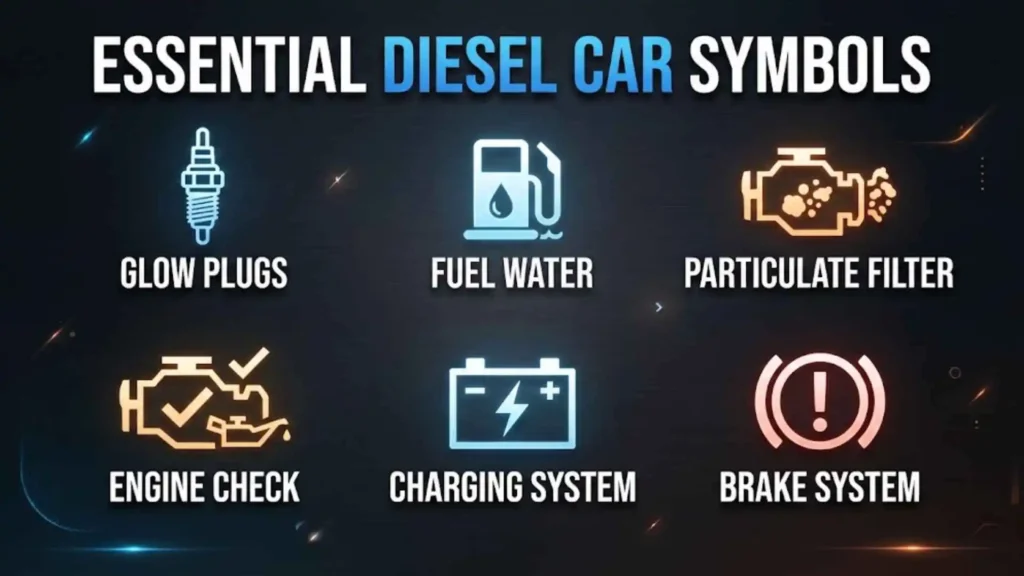
Diesel vehicles can have additional dashboard indicators.
Glow Plug Symbol
The glow-plug indicator commonly resembles a small coil.
It is associated with the diesel engine’s glow-plug system.
On many diesel vehicles, it appears briefly during startup and then turns off when the system is ready.
A persistent or unusual warning should be investigated using the vehicle’s documentation.
Diesel Particulate Filter Symbol
Some diesel vehicles display a DPF-related symbol.
The diesel particulate filter captures certain particles from exhaust gases.
If a DPF warning appears, follow the vehicle manufacturer’s instructions because the appropriate response can vary between vehicles.
DEF or AdBlue Symbol
Some diesel vehicles equipped with selective catalytic reduction systems use a DEF or AdBlue-related warning.
The warning can indicate that the fluid level is low or that a related system needs attention.
The exact meaning and required action vary by vehicle.
What Does It Mean When a Car Symbol Is Flashing?
A flashing dashboard symbol can mean something different from a steady symbol.
The difference depends on the vehicle and the system involved.
Solid Warning Light
A solid light may indicate that a condition has been detected and remains active.
For some systems, it means the vehicle can continue operating while the issue is investigated. For others, it can indicate a condition requiring immediate attention.
Flashing Warning Light
A flashing light can indicate active system intervention or a more urgent fault.
For example, some vehicles use a flashing check-engine light to indicate a potentially damaging engine condition.
Never assume that a flashing light is equivalent to a steady light.
Symbols That Appear During Startup
Many vehicles illuminate several dashboard indicators briefly when the ignition is switched on or the vehicle starts.
This can be part of a system or bulb check.
If the symbol disappears after startup, it may simply have been part of the normal check. If it remains illuminated, investigate its meaning.
What Does It Mean When Multiple Car Symbols Come On?
Sometimes several dashboard lights appear simultaneously.
This can happen for different reasons and does not necessarily mean that every illuminated system has developed an independent fault.
Low Battery or Charging Problems
An electrical or charging problem can affect multiple vehicle systems.
If the battery or charging warning appears together with several other warnings, the underlying issue may be electrical.
One Fault Affecting Several Systems
Modern vehicles share sensors, control modules, and communication networks.
A single fault can therefore cause several systems to report warnings.
Startup Self-Check
If multiple symbols appear briefly and then disappear after startup, this can be normal.
What Should You Do?
When several symbols remain illuminated:
- Read any warning message on the dashboard.
- Identify red or safety-related warnings first.
- Check whether the vehicle behaves differently.
- Consult the owner’s manual.
- Avoid unnecessary driving if the vehicle appears unsafe.
- Arrange professional diagnosis when required.
Why Do Car Symbols Appear When Starting the Car?
It is normal for many dashboard symbols to appear briefly during startup.
The vehicle may use this period to verify that warning indicators and electronic systems are operating.
A typical sequence may look like this:
Ignition on → several symbols illuminate → engine starts → many symbols turn off.
This does not automatically mean the vehicle has multiple problems.
The important distinction is whether a warning remains illuminated after startup.
If a symbol stays on, consult the owner’s manual to determine what it represents.
Can You Drive With a Car Warning Symbol On?
There is no single answer for every dashboard symbol.
Some warnings are informational, while others can indicate conditions that make continued driving unsafe.
When You Should Stop Safely
Warnings related to potentially serious conditions such as overheating, oil pressure, or certain brake or steering problems may require the vehicle to be stopped safely.
Follow the manufacturer’s instructions for the specific warning.
When You May Need Service Soon
Some amber warnings may allow limited continued driving, but the underlying issue should still be investigated.
Examples can include:
- ABS warning
- Airbag warning
- Persistent check-engine light
- Tire-pressure warning
- Traction or stability-system warning
The exact response depends on the vehicle.
When the Symbol Is Usually Informational
Green or blue indicators commonly tell you that a feature is operating.
Examples include:
- Turn signals
- Low beams
- High beams
- Some cruise-control indicators
Even then, the owner’s manual is the final reference for your specific vehicle.
What to Do When an Unknown Car Symbol Appears
Seeing an unfamiliar symbol does not mean you should immediately panic, but you should identify it before ignoring it.
Check the Color
Start by determining whether the symbol is red, amber, yellow, green, blue, or another color.
Look for a Message
Modern dashboards often display a written explanation beside the icon.
Read the entire message.
Check Whether It Is Flashing
A flashing warning can have a different significance from a steady warning.
Notice Any Changes in Vehicle Behavior
Pay attention to:
- Unusual noises
- Loss of power
- Overheating
- Heavy steering
- Poor braking
- Shaking
- Strange smells
- Reduced acceleration
- Unusual shifting
A warning combined with a noticeable change in vehicle behavior deserves more attention than an isolated informational indicator.
Consult the Owner’s Manual
The owner’s manual is the best source for interpreting symbols on a particular vehicle.
Search the dashboard-warning section using the symbol’s appearance or name.
Don’t Reset a Warning Without Understanding It
Clearing a warning does not necessarily repair the problem that caused it.
A warning may return if the underlying fault remains.
Do Car Symbols Mean the Same Thing in Every Car?
No. Many common symbols are widely recognizable, but manufacturers can use different designs, colors, messages, and warning strategies.
The same general-looking icon can have slightly different meanings between:
- Car manufacturers
- Model years
- Vehicle trims
- Gasoline and diesel vehicles
- Hybrid vehicles
- Electric vehicles
- Different markets
For that reason, an online general guide can help you identify a symbol, but your vehicle’s owner’s manual should take priority when determining the exact meaning and recommended response.
Car Symbols vs. Warning Lights vs. Indicator Lights
These terms are often used interchangeably, but they can describe different functions.
Warning Lights
Warning lights alert you to a condition that may require attention.
Examples include:
- Oil pressure
- Brake system
- Engine temperature
- ABS
- Airbag
Indicator Lights
Indicator lights tell you that a feature is active.
Examples include:
- Turn signals
- Headlights
- High beams
- Cruise control
Information Symbols
Some symbols simply communicate vehicle status.
Examples can include:
- Fuel level information
- Drive mode
- Charging status
- Eco-driving information
Understanding this difference can prevent unnecessary concern when a normal operating indicator appears.
What You Should Not Do When a Car Symbol Appears
Knowing what not to do can be just as important as knowing what a symbol means.
Don’t Ignore Serious Warnings
A warning that relates to oil pressure, overheating, braking, or another important vehicle system should not simply be ignored because the vehicle still moves.
Don’t Assume Every Red Light Means the Same Thing
Red is generally associated with higher-priority warnings, but the actual meaning comes from the symbol and vehicle.
Don’t Assume Every Yellow Light Is Harmless
Amber warnings can indicate faults that require diagnosis.
Don’t Open a Hot Cooling System
If the temperature warning indicates overheating, do not open a hot radiator or pressurized coolant reservoir unless the manufacturer specifically provides a safe procedure for doing so.
Don’t Guess at an Unfamiliar Symbol
Use the owner’s manual or another reliable vehicle-specific reference.
Don’t Rely Only on Resetting the Dashboard
A warning disappearing after a reset does not necessarily mean that the underlying issue has been fixed.
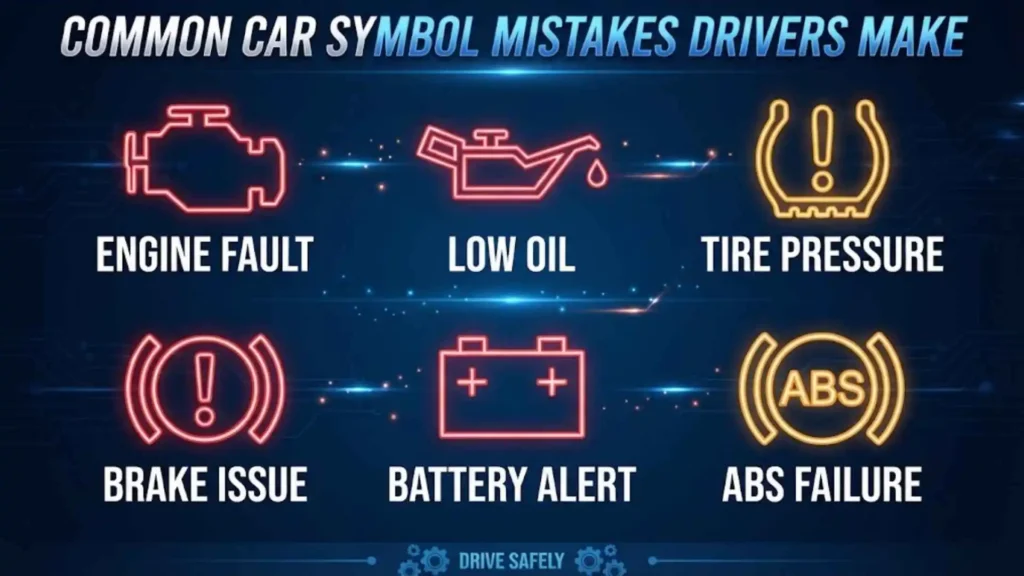
Common Car Symbol Mistakes Drivers Make
Confusing Oil Pressure With Oil Level
The oil-pressure warning and oil-level information are not necessarily the same.
A vehicle can have an adequate oil level while still experiencing an oil-pressure problem.
Ignoring Tire Pressure Because the Tire Looks Normal
A tire can be underinflated without looking obviously flat.
Use an accurate pressure gauge.
Assuming a Check Engine Light Means the Engine Is About to Fail
The check engine light can have many causes.
The symbol alone does not identify the exact fault.
Treating Every Dashboard Symbol as a Warning
Some symbols simply indicate that a feature is active.
Assuming Symbols Are Identical Across Cars
Always verify unfamiliar symbols against the vehicle’s own documentation.
How to Remember the Most Important Car Symbols
You do not need to memorize every symbol in your vehicle.
Start with the symbols associated with major safety and mechanical systems:
- Oil pressure
- Engine temperature
- Brakes
- ABS
- Tire pressure
- Battery/charging
- Check engine
- Airbag
- Steering
- Traction/stability control
- Seat belt
Once you recognize these, you can quickly determine when a dashboard symbol deserves closer attention.
Frequently Asked Questions
What do the symbols on a car dashboard mean?
Car dashboard symbols communicate information about vehicle systems and features. Some indicate normal operation, while others warn about conditions that may require attention. Their exact meanings vary by vehicle.
What are the most important car symbols to know?
Important symbols include oil pressure, engine temperature, brake, ABS, battery, tire pressure, check engine, airbag, steering, and stability-control warnings. Drivers should also understand their vehicle’s seat-belt and lighting indicators.
What does a red car symbol mean?
A red symbol generally indicates a higher-priority warning or safety-related condition. The exact meaning depends on the icon and vehicle. Check the owner’s manual and follow any instructions displayed on the dashboard.
What does a yellow or amber car symbol mean?
Yellow or amber commonly indicates a fault, caution condition, or system that needs attention. Some amber warnings allow continued driving, while others require prompt service.
What does the car with squiggly lines symbol mean?
It is commonly associated with traction control or electronic stability control. A flashing symbol can indicate active system intervention, while a continuously illuminated symbol may indicate that the system is disabled or has detected a fault.
What does the horseshoe symbol with an exclamation mark mean?
It commonly represents the tire-pressure monitoring system. Check the pressure of all tires against the manufacturer’s recommended specifications.
What does the red oil can symbol mean?
The oil-can warning is commonly associated with engine oil pressure. If it illuminates while the engine is running, follow the manufacturer’s instructions and safely stop when necessary.
What does the battery symbol mean on a car?
The battery-shaped warning commonly indicates a charging-system problem. The cause may involve the battery, alternator, wiring, charging circuit, or another related component.
What does the thermometer symbol mean?
A thermometer symbol is commonly associated with engine coolant temperature. If it indicates overheating, safely stop the vehicle and follow the manufacturer’s instructions.
What does the ABS symbol mean?
The ABS symbol indicates the Anti-lock Braking System. If it remains illuminated, the vehicle may have detected an ABS fault and the system should be inspected.
Why are several car symbols showing at once?
Several warnings can appear because of a startup system check, low battery voltage, a charging-system problem, a sensor issue, or one underlying fault affecting multiple systems.
Why do dashboard symbols appear when I start my car?
Many vehicles briefly illuminate dashboard symbols during startup as part of a system check. If a symbol stays illuminated after the vehicle starts, check its meaning in the owner’s manual.
Can I drive with a warning light on?
It depends on the symbol, color, whether it is flashing, any accompanying message, and how the vehicle is behaving. Some indicators are informational, while certain warnings require the vehicle to be stopped safely.
Why are car symbols different between manufacturers?
Manufacturers can use different dashboard designs, symbols, colors, warning messages, and electronic systems. Hybrid, electric, diesel, and gasoline vehicles can also have different indicators.
What should I do if I don’t recognize a car symbol?
Check its color and shape, see whether it is flashing, read any dashboard message, and consult your vehicle’s owner’s manual. If the vehicle is behaving unusually or a serious warning appears, take appropriate safety precautions.
Conclusion
Car symbols are a simple but important way for a vehicle to communicate with its driver. They can tell you that a light or assistance feature is active, warn you about low tire pressure, or alert you to a problem involving the engine, brakes, electrical system, steering, or another major component.
The best way to interpret a dashboard symbol is to look at its shape, color, flashing behavior, accompanying message, and the vehicle’s current behavior. Do not assume that every symbol has exactly the same meaning across all makes and models.
If a symbol is unfamiliar, use this guide to narrow down its meaning and then check the owner’s manual for your specific vehicle. For serious warnings involving brakes, oil pressure, overheating, steering, or other safety-critical systems, follow the manufacturer’s instructions and avoid unnecessary driving until the condition has been properly addressed.

Hi, I’m Asher Monroe, a writer who believes that meaningful words have the power to inspire change and bring people closer to their dreams. I have always been fascinated by the beauty of quotes and the way a simple message can provide motivation, hope, and comfort.
I enjoy creating content around inspirational quotes, life lessons, success stories, and positive thoughts that help readers find encouragement in their everyday lives. My goal is to share words that connect with people and remind them of their inner strength.
Through my writing, I explore the ideas of personal growth, confidence, and the importance of staying inspired through every chapter of life.
I am the author of Words That Move the Soul and The Path of Endless Inspiration, two books focused on the power of wisdom, positivity, and meaningful thoughts.
 Sienna Brooks
 Rowan Sinclair Rowan Sinclair