Car light symbols can appear suddenly on the dashboard, and knowing what they mean can help you understand what your vehicle is telling you. Some lights are simple reminders, while others can indicate a problem that needs immediate attention.
The meaning of a car light symbol can vary by vehicle, but many dashboard icons are widely standardized. Red lights generally indicate a serious warning, amber or yellow lights usually signal a fault or caution, and green or blue lights often show that a feature is operating.
This guide explains common car light symbols, their names and meanings, headlight indicators, dashboard warning lights, and symbols used by Toyota, Hyundai, Kia, Lexus, BMW, Nissan, and Mazda. Use your owner’s manual for the exact meaning of a symbol on your particular vehicle.
Car Dashboard Symbols And Meanings
Car dashboard symbols are visual indicators that communicate information about your vehicle. They can tell you that a system is active, remind you about a feature, or warn you about a mechanical or safety problem.
The most important thing to check is the color of the light as well as the symbol itself.
| Light color | General indication |
| Red | Serious warning or condition requiring prompt attention |
| Yellow/Amber | Caution, malfunction, or service may be needed |
| Green | System or function is operating |
| Blue | Usually an active lighting function, such as high beams |
| White | Information or system status on some vehicles |
These colors are general conventions, not universal rules. Vehicle manufacturers can use different colors and symbol designs.
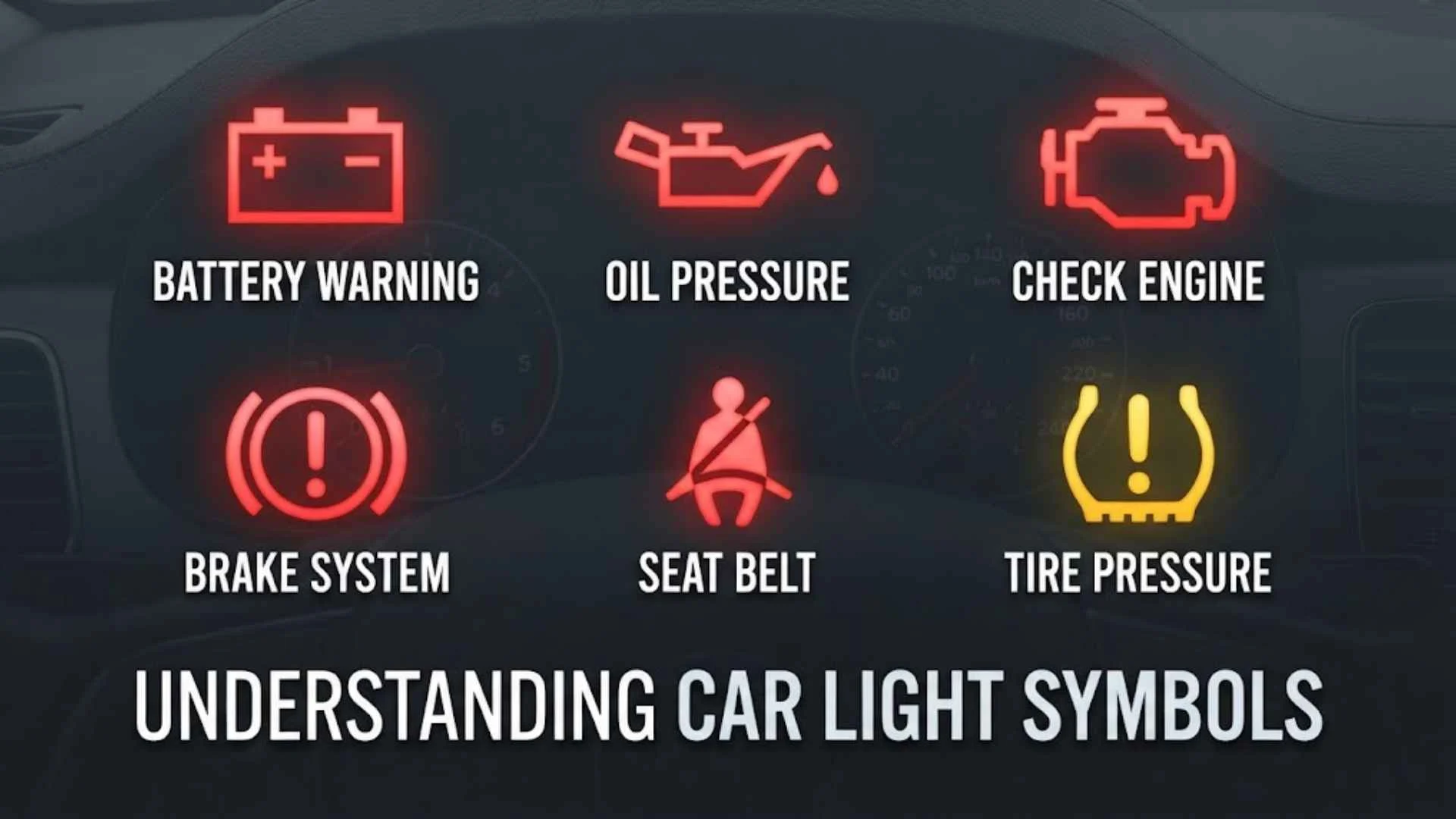
Common dashboard warning symbols include:
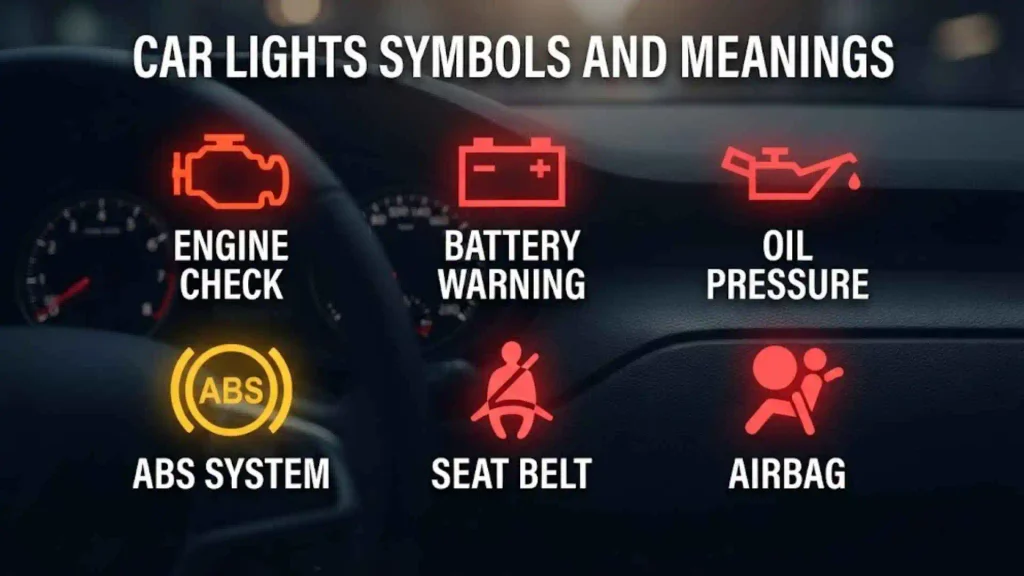
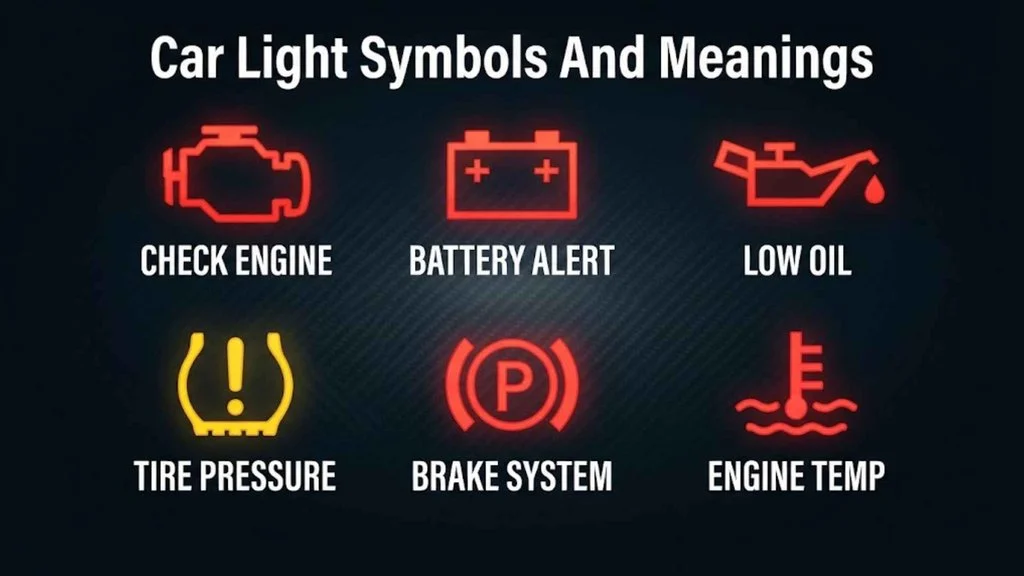
- Engine-shaped light — Engine or emissions-related fault
- Oil can — Engine oil pressure warning
- Battery — Charging system warning
- Thermometer over liquid — Engine coolant temperature warning
- Circle with an exclamation mark — Brake system or related warning, depending on vehicle
- ABS — Anti-lock braking system warning
- Tire-shaped symbol with an exclamation mark — Tire pressure warning
- Seat belt figure — Seat belt reminder
- Airbag figure — Airbag or supplemental restraint system warning
- Steering wheel with exclamation mark — Steering system warning on applicable vehicles
A warning light should never be ignored simply because the car continues to drive normally.
Car Dashboard Symbols With Names
Knowing the name of a dashboard symbol makes it easier to look up its exact meaning in an owner’s manual or vehicle guide.
Here are some of the most common symbols:
| Symbol or icon description | Name | Typical meaning |
| Engine outline | Check engine light | Engine, emissions, or related system fault |
| Oil can | Oil pressure warning | Low engine oil pressure or related fault |
| Battery rectangle | Charging system warning | Charging system problem |
| Thermometer | Engine temperature warning | Engine coolant temperature is too high or system issue |
| Tire with ! | Tire pressure warning | Low tire pressure or TPMS fault |
| ABS | ABS warning | Anti-lock braking system fault |
| Person with circle | Airbag/SRS warning | Airbag or restraint system fault |
| Person with belt | Seat belt reminder | Seat belt needs to be fastened |
| Steering wheel + ! | Steering warning | Steering assistance/system issue |
| Skidding car | Traction/stability control | System active or malfunction, depending on display |
| Brake symbol | Brake warning | Parking brake, brake fluid, or brake-system issue depending on vehicle |
The exact appearance can change between model years and manufacturers.
Car Lights Symbols And Meanings
Car lights symbols generally fall into two groups: exterior-light indicators and warning or information indicators.
Common lighting symbols include:
- Low-beam headlight indicator — Low-beam headlights are on.
- High-beam indicator — High beams are active.
- Fog-light indicator — Front or rear fog lights are switched on, depending on the symbol.
- Parking-light indicator — Parking or position lights are active.
- Turn signal arrows — Left or right turn indicator is operating.
- Auto-light indicator — Automatic lighting function may be active on some vehicles.
- Adaptive-lighting indicator — An adaptive lighting system may be operating or require attention, depending on the vehicle.
A blue headlight indicator commonly identifies high beams, while green indicators are often used for ordinary exterior lighting. However, always check the vehicle manual because manufacturers can vary their dashboard layouts.
Car Light Symbols Hyundai
Hyundai vehicles use a range of dashboard and exterior-light indicators. The exact design depends on the model and model year.
Common Hyundai lighting indicators can include:
- Low-beam headlight indicator
- High-beam indicator
- Turn signal indicators
- Front fog-light indicator
- Rear fog-light indicator on applicable models
- Auto-light or lighting-system indicators
- High Beam Assist indicators
Hyundai dashboards also display warning symbols for systems such as the engine, braking system, tire pressure, charging system, and electronic stability control.
Some Hyundai models use a blue high-beam indicator, while ordinary lighting functions may use green indicators. The owner’s manual should be used for model-specific interpretations.
Car Dashboard Warning Lights
Dashboard warning lights are designed to alert the driver when a vehicle system needs attention. The urgency depends on the symbol, its color, whether it is flashing, and what the vehicle is doing.
Red Warning Lights
A red warning generally deserves immediate attention.
Examples include:
- Engine overheating warning
- Low engine oil pressure
- Brake system warning
- Charging system warning
- Certain steering system warnings
- Seat belt warning
If a critical red warning appears while driving, safely stop when appropriate and consult the owner’s manual. Some conditions require the engine to be switched off to prevent further damage.
Yellow Or Amber Warning Lights
Yellow or amber lights usually indicate a fault, caution, or condition that should be checked.
Examples include:
- Check engine light
- ABS warning
- Tire pressure warning
- Traction-control warning
- Maintenance-related warnings
- Driver-assistance system warnings
An amber light does not always mean the vehicle must stop immediately, but it should not automatically be ignored.
Green And Blue Indicators
Green and blue lights generally provide information rather than indicate a fault.
Examples include:
- Turn signals
- Low-beam headlights
- Cruise control status
- High-beam headlights
- Certain active driving-assistance functions
A blue high-beam indicator is particularly useful because it confirms that the vehicle’s high beams are switched on.
Car Dashboard Symbols And Meanings With Pictures
Pictures are useful because many dashboard symbols are easier to recognize visually than by name. However, the actual icon can differ slightly between manufacturers.
Some of the most recognizable dashboard icons are:
Engine icon:
Usually indicates a check-engine or malfunction indicator.
Oil can icon:
Usually relates to engine oil pressure. If this warning appears red while the engine is running, it should be taken seriously.
Battery icon:
Usually indicates a charging-system issue rather than simply a weak battery.
Tire with exclamation mark:
Usually indicates low tire pressure or a tire-pressure monitoring system issue.
Thermometer icon:
Usually relates to engine coolant temperature.
Brake warning symbol:
Can indicate that the parking brake is applied or that a brake-system issue has been detected, depending on the vehicle.
ABS lettering:
Indicates a possible anti-lock braking system fault.
For an exact picture and interpretation, the owner’s manual is the most reliable source because it shows the symbols used specifically on your vehicle.
What Do The Car Light Symbols Mean
Car light symbols tell you about lighting functions, vehicle systems, or warnings. Their meaning depends on the symbol, color, and vehicle.
For example, if you see a blue headlight symbol, it commonly means the high beams are active. A green turn-arrow symbol usually indicates that a turn signal is operating.
A warning symbol is different. A red oil-pressure symbol is not simply telling you that a light is on; it can indicate a condition that could damage the engine if ignored.
When a new symbol appears, check:
- What color is the symbol?
- Is it steady or flashing?
- What does the owner’s manual call it?
- Did it appear after starting the vehicle or while driving?
- Are there other warning messages?
- Does the vehicle feel or sound different?
These details can help determine how urgently the problem should be investigated.
All Car Light Symbols
There is no single universal collection containing every car light symbol because manufacturers add their own icons and systems. Modern vehicles can have indicators for lighting, engine systems, driver assistance, hybrid systems, electric powertrains, and many other functions.
A useful general collection includes:
| Symbol type | Common purpose |
| Turn arrows | Turn signal operation |
| Low-beam icon | Low-beam headlights active |
| High-beam icon | High beams active |
| Fog-light icon | Fog lights active |
| Engine icon | Engine/emissions fault |
| Oil can | Oil pressure warning |
| Battery | Charging system warning |
| Thermometer | Coolant temperature warning |
| Tire + ! | Tire pressure warning |
| ABS | Anti-lock brake warning |
| Brake symbol | Brake-related warning |
| Airbag symbol | Restraint-system warning |
| Skidding car | Stability/traction-control status |
| Steering wheel + ! | Steering-system warning |
| Seat belt symbol | Seat belt reminder |
For a complete list for a specific vehicle, use the manual for that exact model and year.
What Do Car Light Symbols Mean
Car light symbols can mean anything from a normal operating status to a serious mechanical warning.
For example:
- A green headlight symbol usually indicates a lighting function is active.
- A blue high-beam symbol indicates high beams are active.
- A yellow engine symbol usually indicates a detected engine or emissions-related fault.
- A red oil symbol can indicate low oil pressure.
- A red temperature warning can indicate overheating.
- A tire-pressure symbol can indicate low pressure or a TPMS issue.
The symbol alone is not always enough. The owner’s manual may specify conditions under which a warning requires immediate action.
Toyota Car Light Symbols
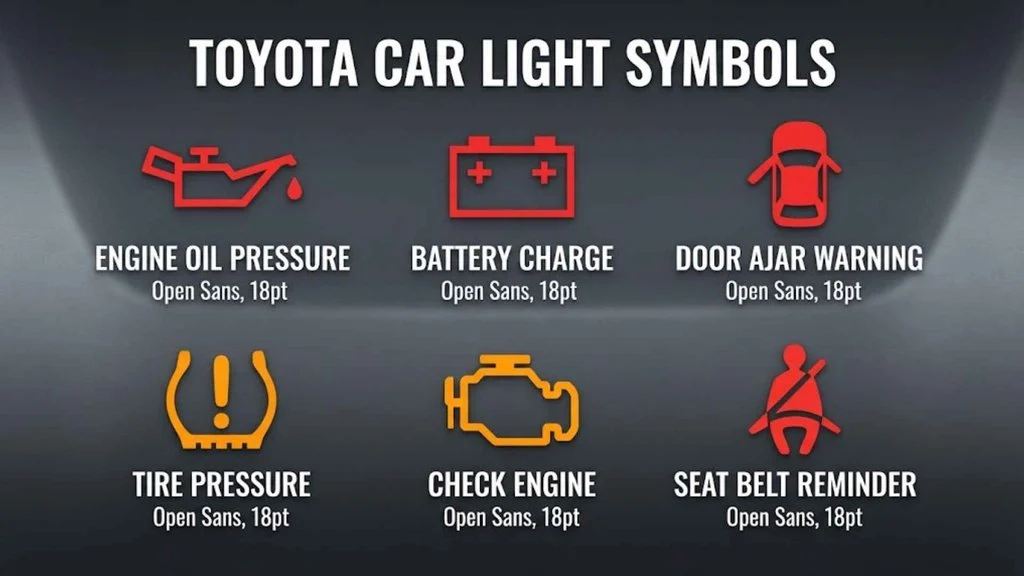
Toyota vehicles use many familiar dashboard and lighting symbols, although the exact design varies by model and year.
Common Toyota indicators include:
- Low-beam headlight indicator
- High-beam indicator
- Turn-signal arrows
- Fog-light indicators
- Automatic high-beam indicator on equipped vehicles
- Check engine warning
- Oil-pressure warning
- Charging-system warning
- Tire-pressure warning
- ABS warning
- Brake warning
- Airbag warning
- Dynamic stability or traction-control indicators
Toyota vehicles may also display indicators for Toyota Safety Sense features and other driver-assistance systems.
If a Toyota warning light appears, check the message or symbol against the owner’s manual for the specific model. A symbol used on a Corolla may not have exactly the same function as one displayed on a different Toyota model.
Car Light Symbols And What They Mean
Understanding a car light symbol starts with identifying whether it is a lighting indicator or warning indicator.
For lighting symbols:
Green or blue often means a lighting function is active.
For warning symbols:
Yellow or amber commonly means the system has detected a condition that should be checked.
Red generally indicates a more urgent warning.
A flashing light can also have a different meaning from a steady light. For example, turn-signal arrows normally flash as the indicators operate, while some warning systems use flashing to signal a more urgent condition.
Car Light Symbols Meaning Headlights
Headlight symbols are designed to show which exterior lighting functions are operating.
Low-Beam Headlights
The low-beam symbol generally looks like a headlamp with several lines pointing downward and outward. It indicates that the vehicle’s normal headlights are switched on.
High-Beam Headlights
The high-beam indicator commonly appears as a blue headlamp symbol with horizontal light rays. It confirms that high beams are active.
Drivers should switch from high beams when approaching or following other road users where required by traffic rules.
Fog Lights
Fog-light symbols vary depending on whether they represent front or rear fog lamps. The icon typically resembles a headlamp with a distinctive set of light rays.
Because fog-light symbols differ among manufacturers, the owner’s manual remains the best reference.
Kia Car Light Symbols
Kia vehicles use dashboard symbols for headlights, fog lights, turn signals, high beams, warning systems, and driver-assistance features.
Common Kia lighting indicators include:
- Low-beam headlights
- High beams
- Turn signals
- Front fog lights
- Rear fog lights on equipped models
- Automatic lighting
- High Beam Assist
Kia dashboards can also show warning lights for engine problems, brakes, tire pressure, airbags, charging systems, and electronic stability control.
The exact symbol can vary according to the vehicle’s trim, equipment, and model year.
Car Light Symbols Toyota
Toyota car light symbols can be divided into several practical categories.
Exterior-light indicators: headlights, high beams, fog lights, and turn signals.
Warning indicators: engine, oil pressure, brakes, charging system, tire pressure, and restraint systems.
Driver-assistance indicators: adaptive cruise control, lane-related functions, pre-collision systems, and automatic high-beam features on equipped models.
A Toyota symbol should always be interpreted in combination with its color and any accompanying message.
Lexus Car Light Symbols
Lexus uses many lighting and warning indicators similar to those found in Toyota vehicles, while some models include additional symbols for advanced driver-assistance and vehicle systems.
Common Lexus lighting symbols include:
- Headlight indicator
- High-beam indicator
- Turn signals
- Fog-light indicator
- Automatic high-beam indicator
- Adaptive lighting indicators on equipped vehicles
Lexus dashboards can also display warning lights for braking, engine operation, tire pressure, charging, airbags, steering, and stability-control systems.
Since Lexus models differ significantly by year and equipment, the exact owner’s manual should be used when identifying an unfamiliar symbol.
BMW Car Light Symbols
BMW dashboards can display both traditional warning lights and more detailed electronic messages.
Lighting-related indicators may include:
- Low-beam headlights
- High beams
- Automatic headlight control
- Fog lights
- Turn signals
- Adaptive lighting
- High Beam Assistant
BMW vehicles can also show warning symbols for engine systems, brakes, tire pressure, stability control, steering, driver assistance, and other electronic systems.
Modern BMW models may display a symbol together with a written message. When that happens, the message can provide more specific information than the icon alone.
Car Light Symbols And Names
A symbol’s name is useful when searching for its meaning or discussing it with a mechanic.
Here is a quick reference:
| Symbol | Common name |
| Headlamp with downward rays | Low-beam indicator |
| Blue headlamp | High-beam indicator |
| Headlamp with fog-style rays | Fog-light indicator |
| Left/right arrows | Turn-signal indicators |
| Engine outline | Check engine light |
| Oil can | Oil pressure warning |
| Battery | Charging system warning |
| Tire with ! | Tire pressure warning |
| ABS | ABS warning light |
| Person with circle | Airbag/SRS warning |
| Thermometer | Engine temperature warning |
| Steering wheel + ! | Steering warning |
These are descriptive names rather than a single universal naming system. Your manufacturer may use a slightly different name in its manual.
All Car Light Symbols Meaning
The phrase “all car light symbols” can refer to both exterior-light indicators and dashboard warning symbols. Since there is no universal dashboard design, a complete list must be vehicle-specific.
For general reference, the major groups are:
- Headlight indicators — Low beams, high beams, automatic lights, and adaptive lighting.
- Fog-light indicators — Front or rear fog lamps.
- Turn indicators — Left and right direction signals.
- Engine warnings — Engine or emissions-related problems.
- Brake warnings — Parking brake or braking-system issues.
- Tire warnings — Tire pressure or TPMS problems.
- Safety-system warnings — Airbags, seat belts, and related systems.
- Stability warnings — Traction and electronic stability systems.
- Electrical warnings — Battery and charging-system problems.
- Temperature warnings — Engine coolant temperature problems.
The owner’s manual is the authoritative source for the complete set used by a particular car.
Car Light Symbols Meaning
A car light symbol should be interpreted according to three things: the icon, its color, and the vehicle system involved.
A green or blue symbol often confirms that a feature is operating. An amber warning generally means that a system needs attention. A red warning can indicate a condition that requires immediate action.
For example, a blue high-beam icon is normally a status indicator, while a red oil-pressure warning is a potential mechanical warning. Treating every dashboard light the same way can lead to confusion.
Different Car Light Symbols
Different car manufacturers can use different visual designs for similar functions. Even within the same brand, symbols may change between generations.
For example, a high-beam indicator is commonly blue, but the surrounding design can vary. Fog-light indicators can also differ depending on whether they represent front or rear lamps.
Modern vehicles may add symbols for:
- Automatic emergency braking
- Lane departure warning
- Lane keeping assistance
- Blind-spot monitoring
- Adaptive cruise control
- Automatic high beams
- Electric vehicle charging
- Hybrid system operation
- Regenerative braking
- Driver attention systems
This is why a symbol found online should not automatically be assumed to have the same meaning on every car.
Car Light Symbols Headlights
Headlight symbols are among the most frequently used car light indicators.
The low-beam indicator generally confirms that the standard headlights are operating.
The high-beam indicator is normally blue and shows that high beams are switched on.
The fog-light indicator identifies fog lamps when fitted.
The turn-signal arrows flash to indicate left or right direction signals.
Some vehicles also have indicators for automatic headlights, adaptive headlights, or automatic high-beam systems. These advanced symbols are especially common on newer vehicles.
Nissan Car Light Symbols
Nissan vehicles use dashboard and lighting indicators for both conventional equipment and modern driver-assistance systems.
Common Nissan symbols can include:
- Headlight indicator
- High-beam indicator
- Fog-light indicator
- Turn-signal indicators
- Automatic high-beam indicator
- Check engine warning
- Oil-pressure warning
- Brake warning
- ABS warning
- Tire-pressure warning
- Airbag warning
- Charging-system warning
- Vehicle dynamic control indicators
Nissan models can differ considerably in their dashboard displays. A symbol on a newer Rogue, for example, may not appear on an older Sentra or Altima.
Always match the symbol with the model year and owner’s manual.
Mazda Car Light Symbols
Mazda dashboards use symbols for headlights, high beams, fog lamps, turn signals, safety systems, and vehicle warnings.
Common Mazda lighting indicators include:
- Headlight indicator
- High-beam indicator
- Fog-light indicator
- Turn-signal arrows
- Automatic lighting indicators
- High Beam Control indicators on equipped vehicles
Mazda also uses warning indicators for systems such as engine operation, tire pressure, brakes, charging, airbags, and stability control.
Some newer Mazda models display additional information through a multi-information display, making it useful to read the accompanying message rather than relying only on the dashboard icon.
Car Light Symbols And Meanings
Car light symbols are much easier to understand when they are separated into status indicators, caution indicators, and warning indicators.
Status indicators tell you what the vehicle is doing. Headlights, high beams, turn signals, and certain assistance systems fall into this category.
Caution indicators tell you that a condition has been detected and should be checked. Tire-pressure and some driver-assistance warnings can fall into this category.
Warning indicators can signal a potentially serious problem. Oil pressure, engine temperature, braking, and certain electrical warnings may require prompt action.
If a warning appears unexpectedly, do not rely only on a generic online symbol chart. The exact vehicle manual can tell you what that particular symbol means and what action the manufacturer recommends.
Frequently Asked Questions
What Is The Most Important Car Light Symbol To Know?
There is no single most important symbol for every driver. Red oil-pressure, brake, overheating, and certain charging or steering warnings can indicate serious conditions and deserve prompt attention.
What Does A Blue Car Light Symbol Mean?
A blue dashboard light commonly indicates that the high-beam headlights are active. Some vehicles may use blue for other information functions, so the owner’s manual should be checked for an exact interpretation.
What Does A Yellow Car Light Symbol Mean?
A yellow or amber light generally indicates caution, a detected fault, or a condition that should be checked. The urgency depends on the specific symbol and vehicle.
Why Do Car Light Symbols Differ Between Brands?
Manufacturers can use different designs and add brand-specific indicators for their own systems. Model year, trim level, safety technology, and powertrain can also affect which symbols appear.
Can I Drive With A Dashboard Warning Light On?
It depends on the warning. Some indicators simply show that a feature is active, while others indicate a fault that may require immediate attention. Red or flashing warnings should be treated seriously, and the owner’s manual should guide the appropriate response.
Conclusion
Car light symbols provide a quick visual language for understanding what your vehicle is doing and when it needs attention. Headlight, high-beam, fog-light, and turn-signal indicators usually describe active lighting functions, while warning symbols can point to problems involving the engine, brakes, tires, temperature, electrical system, or safety equipment.
Toyota, Hyundai, Kia, Lexus, BMW, Nissan, and Mazda all use many familiar symbols, but their exact designs and meanings can vary by model and year. Modern cars can also add symbols for advanced driver-assistance, hybrid, electric, and other vehicle-specific systems.
The safest approach is to identify the symbol, check its color and whether it is flashing, and then consult the owner’s manual for your exact vehicle. A general car light symbols chart is useful for recognition, but the manufacturer’s instructions should take priority when a warning appears.

Hi, I’m Sienna Brooks, and I believe that the right words can inspire, comfort, and empower people at every stage of life. For as long as I can remember, I’ve been drawn to meaningful quotes and the stories behind them. I love curating collections of inspirational, motivational, and heartfelt quotes that resonate with readers around the world.
Through my writing, I strive to help others find encouragement, whether they’re celebrating life’s happiest moments or navigating its biggest challenges. I believe that wisdom is timeless, and I’m passionate about sharing words that leave a lasting impact.
I am the author of Reflections in Words and The Journey of Inspiration, two books dedicated to exploring the beauty and power of timeless quotes.
 Rowan Sinclair Rowan Sinclair