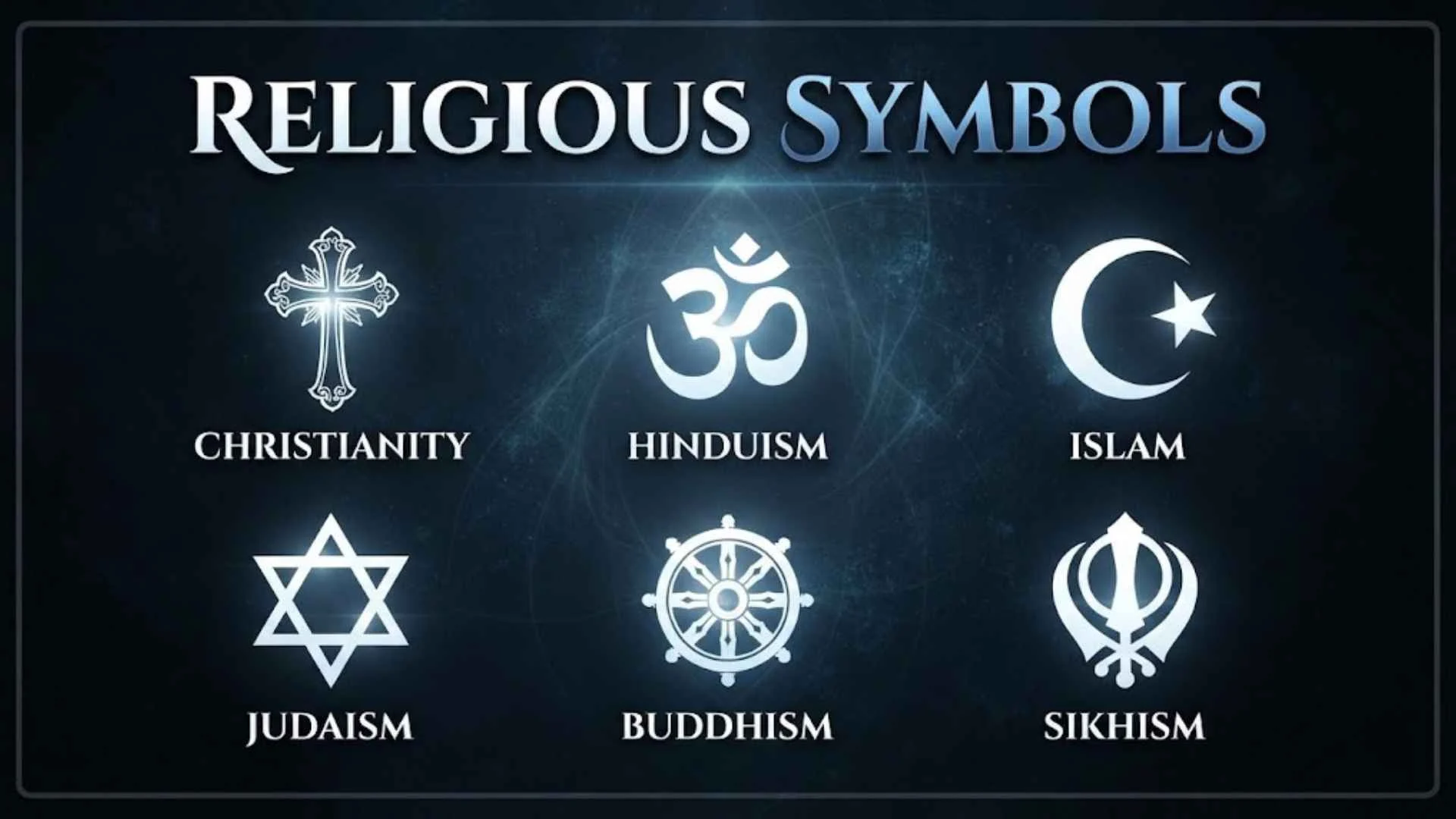
Religious symbols have been used for centuries to represent faith, beliefs, traditions, sacred ideas, and communities. From the Christian cross to the Hindu Om, these symbols can carry deep meanings and are often seen in places of worship, artwork, books, jewelry, clothing, and digital content.
This guide brings together common religious symbols, their names, meanings, and useful copy-and-paste characters where appropriate. It also covers Christian and Catholic symbols separately so you can quickly understand how related symbols may differ in meaning or use.
The provided search topics also include many common questions about “lay down or lie down.” Because this is a different language topic, the final part of the article explains the grammar clearly, with examples involving beds, resting, and everyday conversation.
7 main religions symbols
The world’s major religions use many different symbols to communicate important ideas. There is no single official symbol for every religion, and some traditions use several symbols depending on culture and denomination.
Here are seven widely recognized religious traditions and symbols associated with them:
| Religion | Common symbol | Common meaning |
| Christianity | ✝ | The cross represents the crucifixion of Jesus and is a central Christian symbol. |
| Islam | ☪ | The crescent and star are widely associated with Islam, although they are not a universal religious symbol. |
| Hinduism | ॐ | Om represents a sacred sound and spiritual concept in Hindu traditions. |
| Buddhism | ☸ | The Dharma wheel represents the Buddha’s teachings and the path of Dharma. |
| Judaism | ✡ | The Star of David is a widely recognized symbol of Jewish identity and tradition. |
| Sikhism | ☬ | The Khanda is a prominent symbol associated with Sikhism. |
| Baháʼí Faith | ✦ | The nine-pointed star is commonly associated with the Baháʼí Faith. |
Some symbols are strongly associated with a religion but may not be considered official by every follower. Their meanings can also vary according to historical period, denomination, culture, or context.
Religious symbols and meanings
Religious symbols can represent beliefs, sacred teachings, important events, spiritual concepts, or community identity. Here are some well-known examples.
- ✝ — Cross: A central Christian symbol associated with Jesus Christ, his crucifixion, and Christian faith.
- ☪ — Crescent and star: Commonly associated with Islam, although the symbol itself has historical and cultural associations beyond Islamic theology.
- ॐ — Om: A sacred symbol and sound associated particularly with Hindu traditions.
- ☸ — Dharma wheel: Represents Buddhist teachings and the path toward liberation.
- ✡ — Star of David: A six-pointed star strongly associated with Jewish identity and tradition.
- ☬ — Khanda: A major Sikh symbol representing important principles and aspects of Sikh belief.
- ☯ — Yin-yang: A Chinese philosophical symbol representing complementary forces. It is associated with Taoist thought but is not simply a universal symbol for all Chinese religion.
- ☮ — Peace symbol: A modern peace symbol rather than a symbol belonging exclusively to one religion.
- ☦ — Orthodox cross: A cross form associated with Eastern Orthodox Christianity.
- ☥ — Ankh: An ancient Egyptian symbol associated with life. It belongs to ancient Egyptian religious culture rather than a modern major world religion.
The meaning of a symbol should always be considered in context. A character that appears in religious artwork may have a more specific meaning than it does when used casually online.
Religious symbols pictures
Pictures can make religious symbols much easier to recognize because many symbols have distinctive shapes, lines, or arrangements.
When comparing pictures of religious symbols, pay attention to details such as the number of points, the shape of a cross, surrounding decorations, and whether the symbol belongs to a particular denomination or cultural tradition.
For example, a simple cross and a crucifix are related Christian symbols but are visually different. A crucifix normally includes a representation of Jesus on the cross, while a plain cross does not.
Pictures are especially useful when you are trying to identify a symbol seen on jewelry, architecture, artwork, clothing, tattoos, books, or religious objects.
All religious symbols with names
There are thousands of religious symbols across world religions, denominations, historical traditions, and cultures. The following list includes recognizable examples rather than claiming to be a complete list of every religious symbol.
| Symbol | Name | Associated tradition | Common association |
| ✝ | Latin cross | Christianity | Jesus, crucifixion, Christian faith |
| ☦ | Orthodox cross | Eastern Christianity | Orthodox Christian tradition |
| ✡ | Star of David | Judaism | Jewish identity and tradition |
| ☪ | Crescent and star | Islam | Common cultural association with Islam |
| ॐ | Om | Hinduism | Sacred sound and spiritual reality |
| ☸ | Dharma wheel | Buddhism | Buddha’s teachings and Dharma |
| ☬ | Khanda | Sikhism | Sikh faith and identity |
| ☯ | Yin-yang | Taoist philosophy | Complementary forces |
| ☥ | Ankh | Ancient Egyptian religion | Life and vitality |
| 🔱 | Trident | Hindu traditions | Often associated with Shiva |
| 🪯 | Khanda-related Sikh imagery | Sikhism | Sikh religious identity |
| ✦ | Nine-pointed star | Baháʼí Faith | Baháʼí symbolism |
| ☮ | Peace symbol | Modern secular culture | Peace and anti-war movements |
Not every symbol in this table is a Unicode character originally created for religious use. Some Unicode symbols have broader meanings and are used religiously only in particular contexts.
Religious symbols Christian
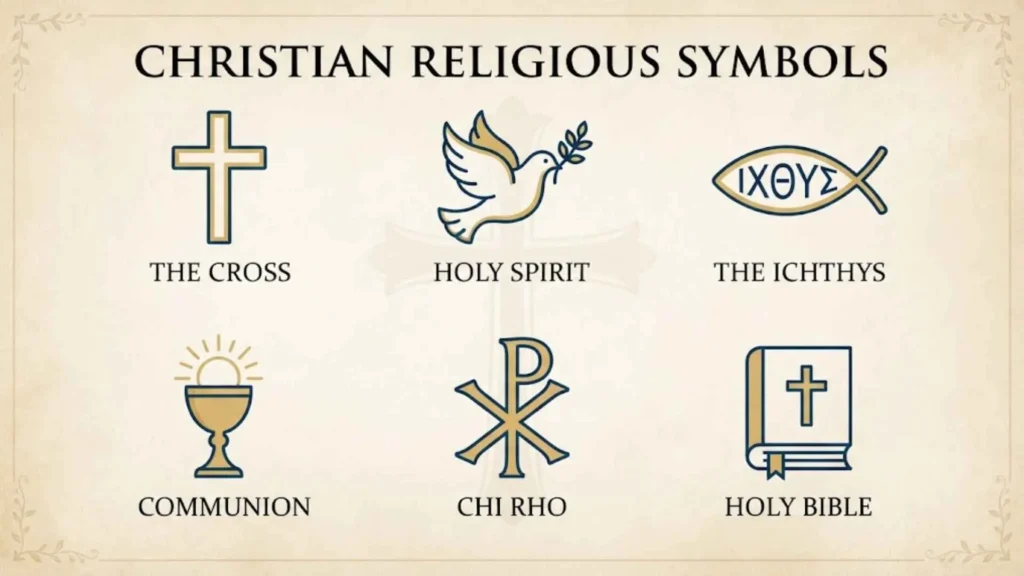
Christianity contains a large variety of symbols used across denominations and historical periods.
The cross (✝) is the most recognizable Christian symbol. It refers to the crucifixion of Jesus and is used in churches, artwork, jewelry, books, clothing, and digital designs.
The crucifix is a cross that includes a representation of Jesus. It is particularly prominent in Catholic and some other Christian traditions.
Other Christian-associated symbols include:
- ☦ — Orthodox cross: Associated with Eastern Orthodox Christianity.
- ✝ — Latin cross: Commonly used throughout Western Christianity.
- ☧ — Chi-Rho: An early Christian Christogram formed from Greek letters associated with the name of Christ.
- Α Ω — Alpha and Omega: Greek letters used in Christian symbolism to represent the beginning and the end.
- 🐟 — Fish: The fish or ichthys became an important early Christian symbol.
- ✝️ — Cross emoji: A colorful emoji presentation of the cross that can be used in digital communication.
Christian symbols can have different designs depending on denomination and historical tradition. A symbol should therefore be identified by its specific form rather than assuming that every cross-shaped design has exactly the same meaning.
Religious symbols Catholic
Catholic tradition uses many symbols in churches, liturgy, artwork, religious objects, and devotional practices.
The crucifix is especially significant in Catholic visual tradition because it depicts Jesus on the cross. The cross itself is also widely used.
Other Catholic-associated symbols include:
- ✝ — Cross: Represents Christ’s crucifixion and Christian faith.
- Crucifix — Cross with the figure of Jesus: A particularly important Catholic devotional image.
- IHS — Christogram: A traditional Christian monogram associated with the name of Jesus and frequently seen in Catholic contexts.
- Α Ω — Alpha and Omega: Used in Christian liturgical and artistic symbolism.
- ✝️ — Cross emoji: Useful for digital religious messages, although its emoji appearance can vary by platform.
- Chi-Rho — ☧: An early Christian Christogram that can also appear in Catholic art and historical Christian contexts.
Catholic symbols are not necessarily exclusive to Catholicism. Many originated in wider Christian traditions and are shared by different denominations.
Go lay down or lie down
The correct choice depends on whether the person is putting something somewhere or resting themselves.
Lay normally takes an object. Lie means to recline or rest.
For example:
- I am going to lie down. — Correct when you mean that you are going to rest.
- I am going to lay the book down. — Correct because “the book” is the object being placed somewhere.
- Please lay the baby down carefully. — Correct because “the baby” is the object.
For everyday statements about yourself resting, lie down is normally the correct expression.
Do people lay down or lie down
When a person is resting their own body, the standard present-tense verb is lie.
Correct: “People lie down when they are tired.”
Lay requires an object in standard English:
Correct: “People lay their clothes down.”
The confusion happens because the past tense of lie is lay. That creates this pattern:
- Present: I lie down.
- Past: I lay down.
- Past participle: I have lain down.
By contrast:
- Present: I lay the book down.
- Past: I laid the book down.
- Past participle: I have laid the book down.
Going to lay down or lie down
If you are talking about going somewhere to rest, use going to lie down.
Example: “I am going to lie down for a while.”
If you are putting an object somewhere, use going to lay down with an object.
Example: “I am going to lay the blanket down.”
The easiest test is to ask whether an object comes after the verb. If you are reclining yourself, lie down is the usual choice.
Is it lay down or lie down in bed
When you mean getting into a resting position in bed, lie down in bed is the standard form.
Example: “I am going to lie down in bed.”
You can also say:
- “I need to lie down.”
- “She went to lie down.”
- “He is lying down in bed.”
If you are placing something on the bed, use lay:
Example: “Lay the clothes down on the bed.”
Do I lay down or lie down
If you are asking whether you should rest yourself, say:
“Do I lie down?”
For example:
“I feel tired. Should I lie down?”
Use lay when you have an object:
“Do I lay the pillow down?”
The key distinction is simple: lie = recline yourself; lay = put something down.
Lay down or lie down?
For the common instruction telling someone to rest their body, lie down is the standard form.
Correct: “Please lie down.”
However, lay down can be correct when it has an object:
Correct: “Please lay the blanket down.”
There is also a common reason people hear “lay down” so often: the past tense of “lie” is lay. For example, “Yesterday, I lay down for an hour” is grammatically different from “I lay the blanket down.”
Is lay down or lie down
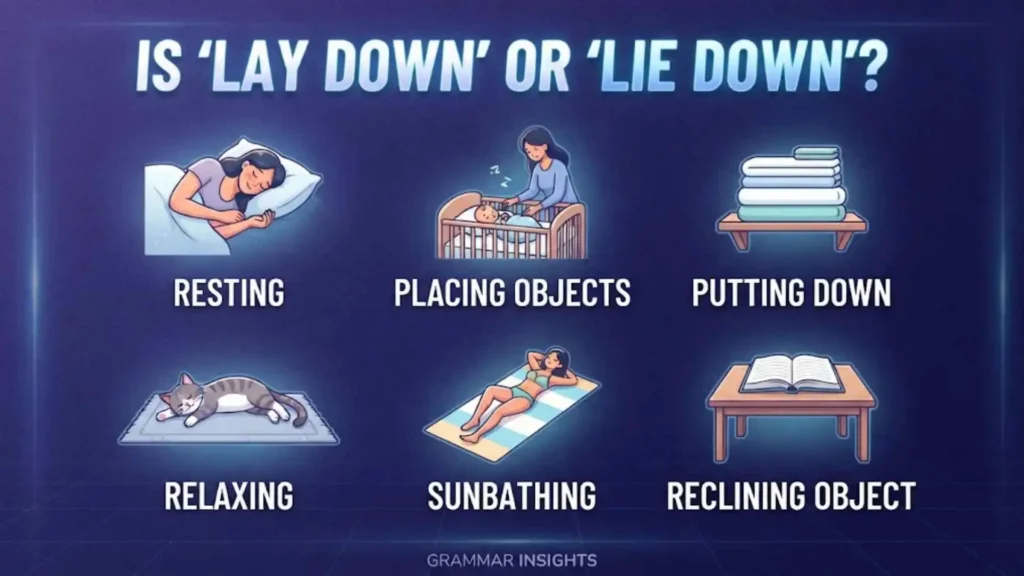
Both forms can be correct, but they perform different grammatical jobs.
Lie down means to recline:
“I need to lie down.”
Lay down means to place something down:
“Lay the keys down on the table.”
In informal speech, “lay down” is sometimes used where standard English would use “lie down,” but the distinction above is useful when you want the conventional grammatical form.
I want to lay down or lie down
When you mean that you want to rest, say:
“I want to lie down.”
For example:
“I am exhausted, and I want to lie down.”
If you are placing an object somewhere, lay is appropriate:
“I want to lay the blanket down.”
The presence of an object after lay is a useful clue.
To lay down or lie down
The infinitive depends on the meaning.
Use to lie down for reclining:
“I need to lie down.”
Use to lay down when something is being placed:
“I need to lay the package down.”
This difference remains important even when the phrase begins with to.
Do you say lay down or lie down
For telling someone to rest their body, say lie down.
Examples:
- “You should lie down.”
- “Go lie down and get some rest.”
- “The doctor told him to lie down.”
For placing something somewhere:
- “Lay the phone down.”
- “Lay the book down.”
- “Lay the cards down on the table.”
Lay down or lie down which is correct
There is no single answer without knowing the sentence.
| Meaning | Correct form | Example |
| Recline or rest | Lie down | “I need to lie down.” |
| Reclined in the past | Lay down | “I lay down earlier.” |
| Place something | Lay down | “Lay the bag down.” |
| Placed something in the past | Laid down | “I laid the bag down.” |
A quick way to remember it is lie = yourself and lay = something else.
Does a person lay down or lie down
A person normally lies down when the person is reclining.
Example: “The person decided to lie down.”
If the sentence describes what the person does with another object, lay can be used:
Example: “The person laid the baby down.”
The past-tense form creates an important distinction:
Present: “The person lies down.”
Past: “The person lay down.”
Is lay down or lie down correct
Both can be correct depending on the sentence.
Use lie down when the subject reclines:
“She wants to lie down.”
Use lay down when the subject places something:
“She wants to lay the towel down.”
For past tense, the pattern changes:
“She lay down yesterday.”
“She laid the towel down yesterday.”
Lay down or lie down on bed
When you mean resting on a bed, the usual expression is lie down on the bed.
Examples:
- “I want to lie down on the bed.”
- “He went to lie down on the bed.”
- “She is lying down on the bed.”
If you are placing something on the bed, use lay:
“Lay the jacket down on the bed.”
The word bed does not determine the verb by itself. The intended action does.
Need to lay down or lie down
If you need to rest, the standard expression is:
“I need to lie down.”
For example:
“I have been working all morning, and I need to lie down.”
If you need to place an object somewhere, use lay:
“I need to lay the documents down.”
This is one of the most common situations where choosing between lay and lie becomes confusing.
Is it lay down or lie down
For the meaning “recline” or “rest,” use lie down.
For the meaning “place something down,” use lay down.
Compare:
- “I will lie down after lunch.”
- “I will lay the book down after lunch.”
The first sentence describes your position. The second describes what you do with an object.
Lay down or lie down in bed
If you are talking about getting into a resting position in bed, lie down in bed is the standard expression.
Examples:
- “I am going to lie down in bed.”
- “She likes to lie down in bed and read.”
- “He lay down in bed after dinner.” — past tense
If you are placing an item on the bed, use lay:
“Lay the pillow down in bed.”
The tense also matters. Lie becomes lay in the simple past, which is why sentences such as “I lay down in bed last night” are correct.
Do you lay down or lie down
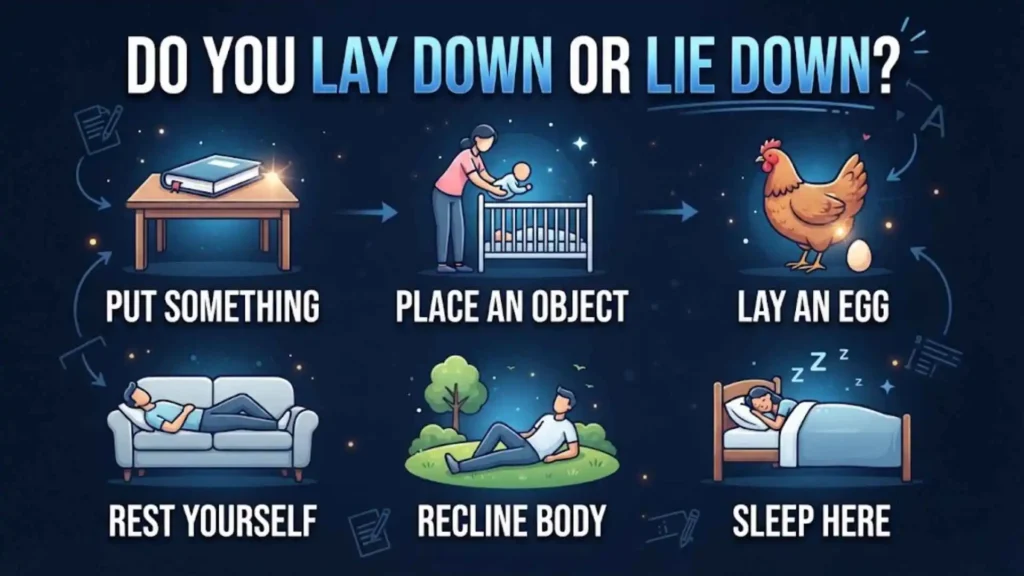
When you are the person resting, you lie down.
“I lie down when I am tired.”
When you put an object somewhere, you lay it down.
“I lay my phone down.”
Remember that lay is also the simple past of lie:
“I lie down every afternoon.”
“Yesterday, I lay down for an hour.”
I need to lay down or lie down
If you mean that you need to rest, the standard form is:
“I need to lie down.”
You might say this when you are tired or simply want to rest for a short time.
If you are talking about putting something down, use lay:
“I need to lay the book down before I leave.”
The easiest rule is to identify the action first. If your own body is reclining, choose lie in the present tense. If you are putting an object somewhere, choose lay.
Frequently Asked Questions
What are the most recognizable religious symbols?
Some widely recognized examples include the Christian cross, Star of David, Om, Dharma wheel, Khanda, and crescent and star. Their meanings and religious significance can vary by tradition and context.
What is the difference between a cross and a crucifix?
A cross is a Christian cross-shaped symbol, while a crucifix specifically depicts Jesus on the cross. The crucifix is especially prominent in Catholic tradition.
Can I copy and paste religious symbols?
Yes. Characters such as ✝, ☦, ✡, ☪, ॐ, ☸, and ☬ can be copied when your device and application support those Unicode characters. Their visual appearance can vary between fonts and platforms.
Is “I want to lie down” grammatically correct?
Yes. “I want to lie down” is the standard expression when you mean that you want to recline or rest.
Why is “I lay down” sometimes correct?
“I lay down” can be correct as the simple past of lie. For example, “I lay down for an hour yesterday.” However, “I lay the book down” uses lay as a different verb meaning to place something somewhere.
Conclusion
Religious symbols provide a visual way to represent faith, identity, history, teachings, and spiritual ideas. Symbols such as ✝, ✡, ☪, ॐ, ☸, and ☬ are widely recognized, but their exact meanings and importance can depend on the religious and cultural context in which they are used.
For copy-and-paste purposes, Unicode characters can make religious symbols convenient to use in messages, profiles, documents, artwork, and other digital spaces. Always check the context of a symbol before assuming that its meaning is universal or that it belongs exclusively to one tradition.
The grammar section follows a similarly simple principle: use lie down when a person reclines and lay down when something is being placed down. Remember that lay is also the past tense of lie, which explains many of the confusing examples people encounter in everyday English.

Hi, I’m Asher Monroe, a writer who believes that meaningful words have the power to inspire change and bring people closer to their dreams. I have always been fascinated by the beauty of quotes and the way a simple message can provide motivation, hope, and comfort.
I enjoy creating content around inspirational quotes, life lessons, success stories, and positive thoughts that help readers find encouragement in their everyday lives. My goal is to share words that connect with people and remind them of their inner strength.
Through my writing, I explore the ideas of personal growth, confidence, and the importance of staying inspired through every chapter of life.
I am the author of Words That Move the Soul and The Path of Endless Inspiration, two books focused on the power of wisdom, positivity, and meaningful thoughts.
 Sienna Brooks
 Rowan Sinclair Rowan Sinclair