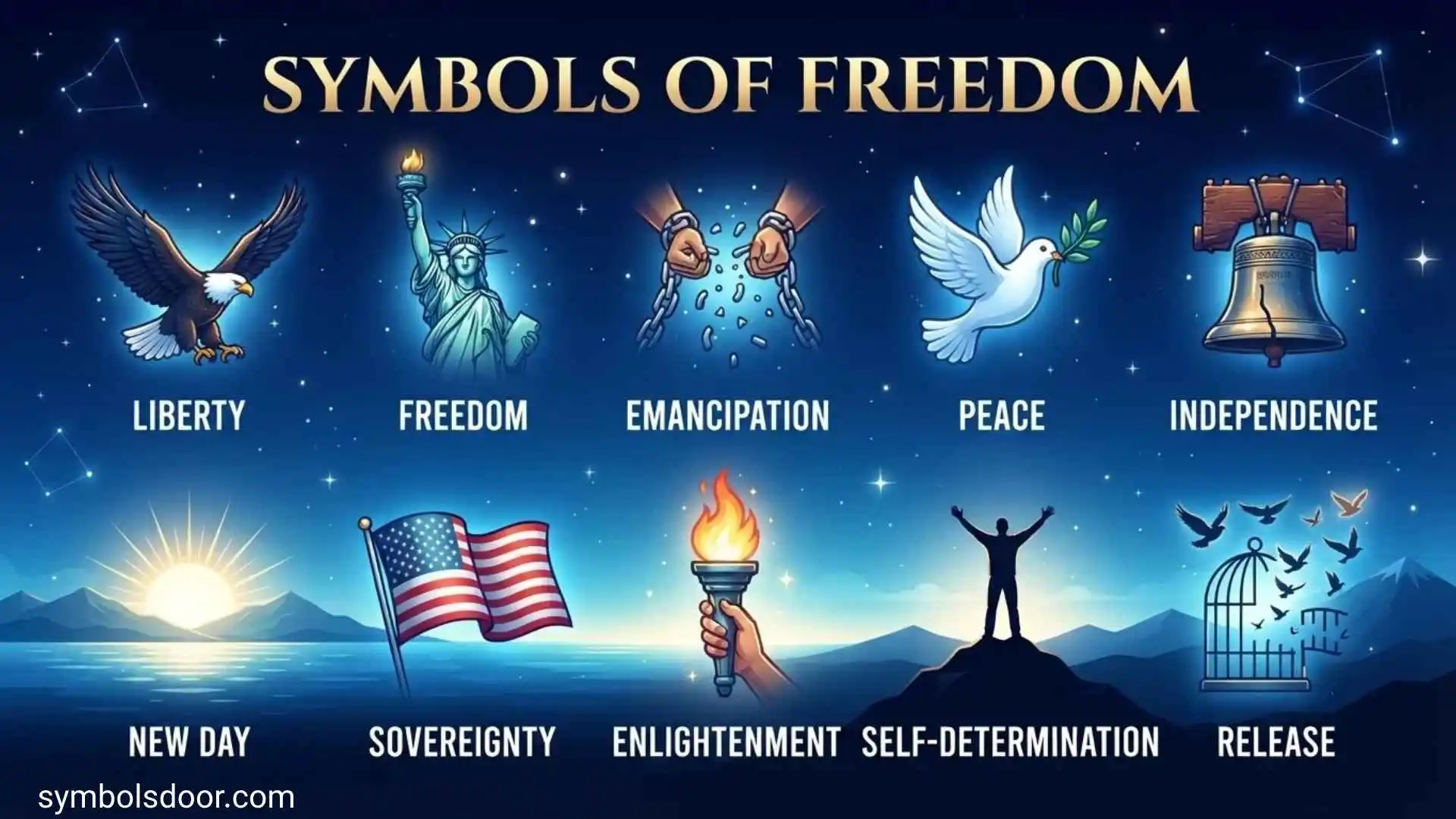
Freedom is one of the most important ideas in human history. It represents the ability to make choices, express yourself, follow your beliefs, and live without unfair control. Across different societies, people have used animals, monuments, colors, natural elements, and everyday objects to express this powerful idea.
Some symbols of freedom have deep historical roots. The Statue of Liberty, for example, represents liberty, democracy, and hope. The broken chains have a direct connection to emancipation and the struggle against oppression. Other symbols, such as butterflies, birds, open roads, and wings, express personal independence and the desire to live without limitations.
These images don’t always carry the same meaning. A symbol that represents political independence in one culture may represent spiritual awakening or personal growth in another.
This guide explores 29 symbols of freedom and their meanings, including their historical backgrounds, cultural significance, and modern uses. You’ll also discover American freedom symbols, spiritual symbols of liberation, freedom imagery in art, and popular freedom tattoo designs.
What Do Symbols of Freedom Represent?
Symbols of freedom are images, objects, gestures, or signs that represent liberty, independence, liberation, and the ability to make personal choices. They help people communicate ideas that can be difficult to explain through words alone.
A broken chain can represent the end of oppression. A bird flying across an open sky can suggest independence. A torch can represent knowledge and enlightenment, while an open road may symbolize the freedom to choose your own direction.
The meanings behind these images generally fall into several categories.
- Political freedom: The right to participate in government, express opinions, and live under fair laws.
- Personal independence: The ability to make your own decisions and shape your future.
- Social liberation: Freedom from discrimination, slavery, oppression, and unfair treatment.
- Spiritual freedom: The search for enlightenment, inner peace, and release from suffering.
- Emotional freedom: The ability to move beyond fear, guilt, unhealthy relationships, and emotional restrictions.
- Creative freedom: The opportunity to express your ideas, imagination, and identity without unnecessary limitations.
Freedom, Liberty, Independence, and Liberation
These terms are closely related, but they don’t mean exactly the same thing.
| Concept | Meaning | Example |
| Freedom | The ability to act, choose, or live without certain restrictions | Freedom of expression |
| Liberty | Freedom recognized or protected through rights and laws | Constitutional liberty |
| Independence | Freedom from another authority or controlling power | A country’s independence |
| Liberation | The process of becoming free from oppression or control | Emancipation from slavery |
| Autonomy | The ability to govern yourself or make independent decisions | Personal autonomy |
Understanding these differences makes freedom symbolism easier to interpret. For example, the Statue of Liberty primarily represents liberty and political ideals, while a butterfly often represents personal transformation and emotional freedom.
Symbols of Freedom and Their Meanings
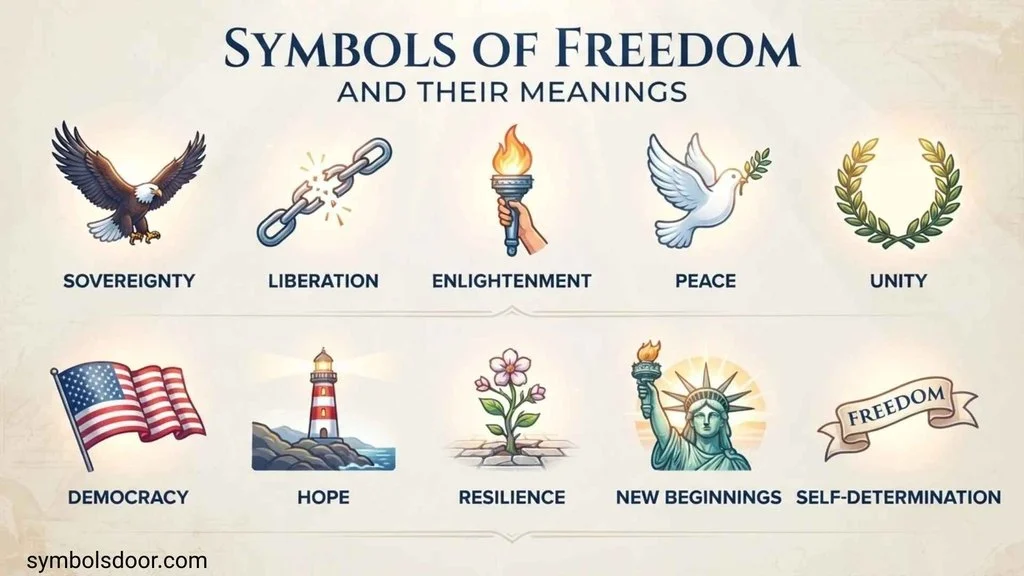
The following symbols represent different forms of freedom, from national independence and political resistance to spiritual liberation and personal growth.
Some have well-documented historical connections to liberty. Others are common visual expressions that people use to communicate independence, hope, and self-determination.
Statue of Liberty – A Symbol of Liberty and Hope
<AsyncImage query=”Statue of Liberty New York Harbor torch full monument clear daylight” aspectRatio=”16:9″ width=”100%”/>
The <Entity value=”Statue of Liberty” category=”point_of_interest” location=”Liberty Island, New York, USA”/> is one of the world’s most recognizable symbols of freedom. It represents liberty, democracy, opportunity, and the belief that people should live without oppression.
France gave the monument to the United States as a gift. Designed by sculptor Frédéric Auguste Bartholdi, it was dedicated on October 28, 1886. Its formal name is Liberty Enlightening the World.
Every major feature carries symbolic meaning:
- Torch: Enlightenment, knowledge, and guidance.
- Tablet: Law and the principles of independence.
- Broken chains: Freedom from tyranny and oppression.
- Crown: Its seven rays are commonly associated with the seven seas and seven continents.
The monument also became closely connected with immigration. For generations, people arriving in the United States viewed it as a welcoming image of opportunity and a new beginning.
Today, the Statue of Liberty represents both American national identity and a broader aspiration for human liberty.
Bald Eagle – Freedom, Strength, and Independence
<AsyncImage query=”American bald eagle flying with wings spread in natural sky” aspectRatio=”16:9″ width=”100%”/>
The bald eagle represents freedom, strength, courage, and independence, particularly in American culture.
The United States adopted the bald eagle as its national bird in 1782. Its image appears on the Great Seal of the United States, government emblems, currency, and official documents.
Its ability to soar high above the landscape makes it a natural image of independence. Its powerful wings and sharp eyesight also contribute to its associations with strength and confidence.
The bald eagle is especially meaningful in American patriotic imagery. However, it is important to recognize that the eagle has different meanings in other cultures and traditions.
American Flag – Liberty, Unity, and National Identity
<AsyncImage query=”United States American flag waving outdoors blue sky” aspectRatio=”16:9″ width=”100%”/>
The American flag, also known as the Stars and Stripes, represents national identity, independence, and the ideals associated with the United States.
The Continental Congress adopted the first official national flag design on June 14, 1777. Its original design included 13 stripes and 13 stars, representing the original colonies.
The flag’s main elements carry familiar meanings:
- Stars: Represent the states of the United States.
- Stripes: Represent the original 13 colonies.
- Red, white, and blue: Have traditional patriotic interpretations, although the original 1777 flag resolution did not assign official meanings to each color.
The flag appears during Independence Day celebrations, military ceremonies, public events, and national commemorations.
It also represents freedom of expression. People may display it to express patriotism, while others may use it in protests to highlight disagreements between national ideals and real experiences.
Liberty Bell – Independence and the Fight for Freedom
<AsyncImage query=”Liberty Bell Philadelphia close up historic bell crack” aspectRatio=”16:9″ width=”100%”/>
The <Entity value=”Liberty Bell” category=”point_of_interest” location=”Philadelphia, Pennsylvania, USA”/> represents American independence, freedom, and the continuing struggle for equal rights.
The bell was commissioned in 1752 for the Pennsylvania State House, now known as Independence Hall. Its famous inscription reads:
Proclaim LIBERTY Throughout All the Land Unto All the Inhabitants Thereof.
The words come from Leviticus 25:10 in the Bible.
Although people often connect the bell with the Declaration of Independence in 1776, there is no conclusive evidence that it rang during the declaration’s public reading.
Its symbolic importance grew during the 19th century. Abolitionists adopted the bell’s inscription as a message against slavery, helping establish its reputation as an important symbol of liberty.
Its famous crack also became part of its identity. Today, the bell represents the idea that freedom must extend beyond political independence to include the rights of all people.
Broken Chains – Freedom From Oppression
<AsyncImage query=”broken iron chains links symbolic liberation freedom dark background” aspectRatio=”16:9″ width=”100%”/>
Broken chains are among the clearest visual symbols of liberation.
A chain can represent slavery, imprisonment, domination, or restrictions on personal choice. When the chain breaks, it suggests that those restrictions have ended.
Historically, broken chains have appeared in abolitionist imagery and representations of emancipation. They also appear near the feet of the Statue of Liberty, connecting the monument with freedom from tyranny.
Today, broken chains can represent:
- Freedom from slavery and forced control.
- Resistance against injustice.
- Breaking unhealthy personal patterns.
- Escaping oppressive relationships.
- Reclaiming identity and independence.
A broken chain tattoo often expresses survival, strength, or the decision to move forward after a difficult experience.
Dove of Peace – Peace, Freedom, and Reconciliation
<AsyncImage query=”white dove flying with wings spread peaceful blue sky” aspectRatio=”16:9″ width=”100%”/>
The dove of peace represents peace, hope, reconciliation, and the desire to live without violence.
Its religious history includes the biblical story of Noah’s Ark. In that account, a dove returns carrying an olive leaf, signaling that the floodwaters are receding.
The dove later became a widely recognized image of peace. Artists, religious communities, and peace movements have used it to express reconciliation and hope.
Its connection to freedom comes from the relationship between peace and human dignity. People cannot fully enjoy freedom when they live under constant violence, war, or intimidation.
The dove therefore represents a peaceful environment in which individuals and communities can live with greater security and independence.
Open Road – Freedom of Choice and Adventure
<AsyncImage query=”long empty open highway stretching toward distant mountains scenic landscape” aspectRatio=”16:9″ width=”100%”/>
An open road is a modern symbol of personal freedom, adventure, and independence.
Unlike monuments or historical emblems, it doesn’t have one fixed cultural origin. Its meaning comes from the idea that an open road offers choices. You can decide where to go, which direction to take, and when to change your plans.
The open road appears frequently in travel photography, literature, movies, and music.
It can represent:
- Leaving a restrictive situation.
- Exploring unfamiliar places.
- Starting a new chapter.
- Making independent decisions.
- Pursuing opportunities without a fixed destination.
In American popular culture, highways and long-distance road trips often express individual freedom and self-discovery.
Torch – Enlightenment, Knowledge, and Liberty
<AsyncImage query=”classical liberty torch flame held upward symbolic freedom dark background” aspectRatio=”16:9″ width=”100%”/>
A torch represents light, knowledge, guidance, and enlightenment. It can also symbolize the courage to challenge ignorance and injustice.
The torch is an important feature of the Statue of Liberty. It represents the idea that knowledge and liberty can guide people toward a better future.
Torches also appear in the Olympic tradition. The modern Olympic flame ceremony connects the Games with continuity, shared values, and international participation.
In freedom imagery, a burning torch can suggest:
- Freedom through education.
- Awareness of human rights.
- Hope during difficult times.
- Enlightenment and personal growth.
- The courage to stand against oppression.
The torch is therefore a powerful symbol of freedom through knowledge rather than physical escape.
Butterfly – Transformation and Personal Freedom
<AsyncImage query=”monarch butterfly flying in open meadow wildflowers natural sunlight” aspectRatio=”16:9″ width=”100%”/>
The butterfly is a popular symbol of transformation, personal growth, and emotional freedom.
Its life cycle makes it especially meaningful. A butterfly begins as an egg, becomes a caterpillar, enters a chrysalis, and eventually emerges with wings.
This natural process provides a powerful image of change. It can represent leaving behind an old identity and discovering new possibilities.
People often connect butterflies with:
- Emotional healing.
- Personal independence.
- Self-discovery.
- New beginnings.
- Freedom from past limitations.
Butterfly imagery is also popular in jewelry, paintings, clothing, and freedom tattoo designs.
Its meaning is usually personal or contemporary rather than a universal historical emblem of political liberty.
Wings – Independence and the Freedom to Rise
<AsyncImage query=”large bird wings spread in flight against open blue sky” aspectRatio=”16:9″ width=”100%”/>
Wings represent flight, independence, ambition, and the desire to move beyond limitations.
Across mythology, religious imagery, and literature, wings often suggest the ability to rise above ordinary restrictions. They can represent physical movement as well as emotional or spiritual growth.
For example, angel wings are commonly associated with protection and spirituality. Bird wings usually suggest independence and freedom of movement.
In modern designs, wings can communicate:
- Confidence and personal strength.
- Freedom from restrictive circumstances.
- Ambition and new opportunities.
- Spiritual growth.
- The ability to choose your own direction.
Wing tattoos are particularly popular among people who want to express independence, courage, or a fresh start.
Phoenix – Rebirth and Freedom After Hardship
<AsyncImage query=”mythological phoenix rising with glowing wings flames fantasy illustration” aspectRatio=”16:9″ width=”100%”/>
The phoenix is a mythical bird associated with fire, renewal, death, and rebirth.
Ancient Greek and Roman writers described versions of a remarkable bird connected with cycles of renewal. Related traditions and stories also developed in other cultures, although their details and meanings are not identical.
In modern freedom symbolism, the phoenix represents the ability to rise after difficult experiences.
Its image can communicate:
- Overcoming hardship.
- Rebuilding after loss.
- Freedom from an old identity.
- Strength after oppression.
- Hope and personal transformation.
A phoenix tattoo often represents a new beginning after a major life challenge. Its flames suggest that change can involve difficulty, but they also create an image of renewal.
Horse – Freedom, Strength, and Movement
<AsyncImage query=”wild horse galloping freely across open grassland” aspectRatio=”16:9″ width=”100%”/>
The horse often represents freedom, power, movement, and independence.
For thousands of years, horses have helped people travel, work, trade, and explore distant places. Their speed and strength made them important in transportation, agriculture, and warfare.
A wild horse running across an open landscape creates a particularly strong image of freedom. It suggests movement without restraint and the ability to follow a natural path.
In art and modern symbolism, horses can represent:
- Personal independence.
- Strength and determination.
- Adventure and exploration.
- Connection with nature.
- The desire to escape limitations.
Horse symbolism varies across cultures. In some traditions, horses also carry meanings connected with wealth, status, spiritual power, or military strength.
Feather – Spiritual Freedom and Connection
<AsyncImage query=”single white feather floating in soft natural light peaceful background” aspectRatio=”16:9″ width=”100%”/>
A feather can symbolize lightness, flight, spirituality, and a connection with nature.
Because feathers allow birds to fly, they are often associated with independence and freedom of movement. In personal symbolism, a feather may represent the desire to let go of emotional burdens and move forward.
Feathers also have important meanings in specific Indigenous cultures. Their significance can depend on the bird, community, ceremony, and individual tradition.
It’s important not to treat all Indigenous feather symbolism as identical. Some feathers have cultural or spiritual significance that should be understood within the community that uses them.
In contemporary designs, feathers often appear in jewelry, artwork, and tattoos to express freedom, spirituality, and personal identity.
Key – Unlocking Freedom and Opportunity
<AsyncImage query=”antique brass key isolated on rustic wooden surface warm natural light” aspectRatio=”16:9″ width=”100%”/>
A key represents access, opportunity, independence, and the ability to unlock something previously unavailable.
In freedom symbolism, a key can represent gaining control over your own life. It may suggest that you have found a way out of a restrictive situation or discovered a new opportunity.
Keys also appear in religious, literary, and cultural imagery. Depending on the tradition, they can represent authority, knowledge, protection, or responsibility.
A key may symbolize:
- Freedom of choice.
- Access to education and opportunities.
- Personal independence.
- Discovering your identity.
- Taking control of your future.
An unlocked door or a key breaking through a lock can strengthen the message of liberation.
Sunrise – Hope and a New Beginning
<AsyncImage query=”golden sunrise over open horizon mountains peaceful landscape” aspectRatio=”16:9″ width=”100%”/>
The sunrise represents hope, renewal, possibility, and the beginning of a new chapter.
Its daily appearance creates a natural connection with fresh starts. After darkness, the rising sun brings light and visibility.
In freedom symbolism, sunrise can represent moving beyond oppression, recovering from hardship, or finding the confidence to make independent decisions.
It may also express:
- Hope after a difficult period.
- Emotional healing.
- Spiritual awakening.
- Personal transformation.
- A brighter future.
The sunrise is not a universal historical emblem of political liberty. Its connection with freedom is mainly symbolic and emotional.
Open Sky – Unlimited Possibilities
<AsyncImage query=”wide open blue sky above green landscape distant horizon clouds” aspectRatio=”16:9″ width=”100%”/>
An open sky represents possibility, space, imagination, and freedom from limitations.
Unlike walls, fences, or closed spaces, the sky appears endless. This makes it a natural image of unrestricted movement and personal ambition.
Artists often use open skies to create a feeling of breathing space. A wide horizon can make a person appear free to explore and choose a new direction.
Open-sky imagery can represent:
- Freedom of thought.
- Personal independence.
- Unlimited possibilities.
- Hope and optimism.
- Emotional release.
It is especially common in landscape paintings, photography, inspirational artwork, and travel imagery.
Mountain Peak – Achievement and Independence
<AsyncImage query=”mountain climber standing on summit overlooking vast mountain landscape” aspectRatio=”16:9″ width=”100%”/>
A mountain peak represents achievement, courage, perseverance, and the freedom to reach beyond ordinary limitations.
Climbing a mountain requires effort, patience, and determination. Reaching the summit can symbolize overcoming challenges and taking control of your journey.
In personal freedom symbolism, mountains often communicate independence and self-reliance.
They may represent:
- Breaking through personal barriers.
- Achieving a difficult goal.
- Finding strength through struggle.
- Discovering a new perspective.
- Choosing your own path.
Mountain imagery appears in motivational art, outdoor culture, literature, and tattoo designs.
Open Door – Opportunity and Personal Choice
<AsyncImage query=”open wooden door leading to bright sunlit green garden peaceful scene” aspectRatio=”16:9″ width=”100%”/>
An open door represents opportunity, new beginnings, access, and freedom of choice.
A closed door can suggest separation or restriction. An open door creates the possibility of moving forward.
This image is common in literature, painting, photography, and motivational designs.
An open door may symbolize leaving a difficult situation, starting a new career, entering a new stage of life, or choosing a different future.
Its message is simple: you have options, and you can decide which direction to take.
Sailboat – Independence and Freedom of Movement
<AsyncImage query=”single sailboat sailing across open ocean under blue sky” aspectRatio=”16:9″ width=”100%”/>
A sailboat represents exploration, independence, adventure, and the freedom to travel.
For centuries, sailing vessels allowed people to cross oceans, discover new places, establish trade routes, and connect distant communities.
In symbolic imagery, a sailboat moving across open water suggests independence and the ability to navigate life’s challenges.
It can represent:
- Freedom of movement.
- Adventure and discovery.
- Self-reliance.
- Exploration of new opportunities.
- Confidence in uncertain situations.
A sailboat also reminds us that freedom involves responsibility. A sailor must understand the wind, water, weather, and direction rather than simply drift without a plan.
Olive Branch – Peace and Reconciliation
<AsyncImage query=”green olive branch with olives isolated on light neutral background” aspectRatio=”16:9″ width=”100%”/>
The olive branch is an ancient symbol of peace, reconciliation, and the end of conflict.
Its history includes ancient Greek traditions, where olive branches were associated with peace and victory. The branch also appears in biblical imagery and later diplomatic and political designs.
In the Great Seal of the United States, an olive branch appears in the eagle’s right talon, while arrows appear in its left. The olive branch represents the power to make peace, while the arrows represent the power to make war.
The olive branch connects with freedom because peaceful societies provide better conditions for people to enjoy their rights and independence.
White Color – Peace, Purity, and New Beginnings
<AsyncImage query=”white fabric flowing freely in bright natural sunlight minimalist background” aspectRatio=”16:9″ width=”100%”/>
The color white often represents peace, purity, openness, and new beginnings.
In freedom-related imagery, white can communicate a desire for nonviolence, reconciliation, and a fresh start.
White flags have a recognized meaning in armed conflict: they are traditionally used to signal a request for a truce, negotiation, or surrender, depending on the circumstances.
However, color meanings vary widely. White is associated with mourning in some cultures, while other societies connect it with celebration, purity, or spiritual life.
For this reason, white should not be described as a universal freedom color. Its meaning depends on the cultural and visual context.
Raised Fist – Resistance and Solidarity
<AsyncImage query=”raised clenched fist silhouette against bright sky protest solidarity” aspectRatio=”16:9″ width=”100%”/>
The raised fist is a powerful symbol of resistance, solidarity, and collective action.
It has appeared in labor movements, anti-fascist movements, civil rights campaigns, and struggles for social equality.
One of its most recognized modern uses is its connection with the Black Power movement in the United States during the 1960s.
The raised fist communicates strength and determination. It can represent people standing together against oppression and demanding equal treatment.
Its meaning depends on the movement and context. Different groups have used the gesture to express different political goals.
Today, it remains common in protest posters, murals, social campaigns, and freedom artwork.
Peace Sign – Peace, Protest, and Social Freedom
<AsyncImage query=”classic circular peace symbol black graphic on white background” aspectRatio=”16:9″ width=”100%”/>
The modern peace sign originated in the British Campaign for Nuclear Disarmament in 1958. Designer Gerald Holtom created it for protests against nuclear weapons.
Its design combines the semaphore signals for the letters N and D, representing nuclear disarmament.
The symbol later spread through anti-war movements, peace campaigns, and popular culture.
Although it is primarily a symbol of peace, it is also associated with freedom from violence, political oppression, and war.
It became especially familiar during the anti-Vietnam War movement and the wider protest culture of the 1960s.
The peace sign is therefore a modern historical symbol, not an ancient emblem used by every culture.
Released Anchor – Letting Go and Moving Forward
<AsyncImage query=”rustic ship anchor resting beside open sea coastline sunrise” aspectRatio=”16:9″ width=”100%”/>
An anchor traditionally represents stability, security, and hope. However, an anchor being released or lifted can suggest movement and freedom from restriction.
In personal symbolism, a released anchor may represent leaving behind something that once held you in place.
It can express:
- Moving beyond a difficult past.
- Freedom from emotional burdens.
- Starting a new journey.
- Taking control of personal decisions.
- Accepting change and uncertainty.
The released anchor is a modern interpretive image rather than a universally established historical freedom emblem.
Its meaning is strongest when the design clearly shows the anchor being lifted, released, or left behind.
Bird in Flight – Freedom Through Flight
<AsyncImage query=”flock of wild birds flying freely across open sunset sky” aspectRatio=”16:9″ width=”100%”/>
A bird in flight is one of the most common visual representations of freedom.
Birds can travel through the air, move across long distances, and explore environments without roads or borders. Their flight makes them natural symbols of independence and unrestricted movement.
Different birds carry additional meanings. Eagles may represent strength, doves peace, and swallows travel or return.
In general, a flying bird can represent:
- Freedom of movement.
- Independence.
- Hope and possibility.
- Escape from restrictions.
- The desire to explore new places.
Bird imagery is popular in paintings, poems, jewelry, and freedom tattoo designs.
Dragonfly – Change and Emotional Freedom
<AsyncImage query=”blue dragonfly hovering above pond reeds natural photography” aspectRatio=”16:9″ width=”100%”/>
The dragonfly often represents transformation, adaptability, and change.
Its life cycle includes an aquatic stage before it emerges as a flying adult. This transition makes it a meaningful image of personal development.
In modern symbolic interpretations, dragonflies can represent emotional freedom, self-discovery, and the ability to adapt when life changes.
They may communicate:
- Moving beyond old limitations.
- Personal growth.
- Emotional release.
- Flexibility and resilience.
- Living with greater awareness.
Dragonfly meanings differ across cultures, so it’s better to describe freedom as one possible interpretation rather than a universal traditional meaning.
Fire – Transformation and Freedom From the Past
<AsyncImage query=”bright orange campfire flames at night symbolic transformation” aspectRatio=”16:9″ width=”100%”/>
Fire represents energy, transformation, purification, destruction, and renewal.
Its meaning is complex. Fire can destroy homes and forests, but it can also provide warmth, light, and the energy needed for human life.
In freedom imagery, fire can represent the strength to challenge restrictions and transform an old situation.
It may symbolize:
- Courage and determination.
- Resistance against oppression.
- Freedom through change.
- Renewal after hardship.
- The power to create a new beginning.
A flame can also represent knowledge and enlightenment, especially when artists use it as an image of light overcoming darkness.
Rainbow – Hope, Diversity, and Equality
<AsyncImage query=”bright rainbow arching over green landscape after rain” aspectRatio=”16:9″ width=”100%”/>
The rainbow represents hope, renewal, diversity, and the possibility of a brighter future.
Its appearance after rain makes it a natural symbol of hope following difficult conditions.
In modern culture, the rainbow flag is widely associated with LGBTQ+ pride, visibility, inclusion, and equal rights. It communicates the idea that people should be able to express their identities without discrimination.
The rainbow also has older religious and cultural meanings. For example, it appears in the biblical story of Noah as a sign of a covenant.
Today, it can represent freedom of expression, acceptance, and the right to live openly.
Tree Growing Freely – Growth, Strength, and Independence
<AsyncImage query=”large old tree growing freely in open green meadow spreading branches blue sky” aspectRatio=”16:9″ width=”100%”/>
A tree growing freely represents natural growth, resilience, independence, and the freedom to develop without unnecessary restrictions.
Trees begin as small plants and gradually expand their roots, trunks, and branches. Their growth provides a useful comparison for personal development.
In freedom symbolism, an unrestricted tree can represent:
- Personal growth.
- Strong roots and cultural identity.
- Independence.
- Connection with nature.
- Freedom to develop your own beliefs and values.
Trees also have specific meanings in many cultures and spiritual traditions. However, a tree growing freely should not be confused with a single ancient symbol shared by all civilizations.
Quick Reference: All Freedom Symbols and Their Meanings
The table below summarizes the main freedom signs and symbols discussed in this guide.
| Symbol | Main meaning | Type of freedom |
| Statue of Liberty | Liberty, hope, opportunity | Political and social |
| Bald eagle | Strength and independence | National |
| American flag | Independence and unity | Political and national |
| Liberty Bell | Liberty and equal rights | Historical and political |
| Broken chains | Release from oppression | Social and personal |
| Dove | Peace and reconciliation | Social |
| Open road | Choice and adventure | Personal |
| Torch | Knowledge and enlightenment | Intellectual |
| Butterfly | Transformation and growth | Emotional and personal |
| Wings | Independence and possibility | Personal |
| Phoenix | Rebirth after hardship | Personal and spiritual |
| Horse | Strength and movement | Personal |
| Feather | Spiritual connection and flight | Spiritual |
| Key | Access and opportunity | Personal |
| Sunrise | Hope and new beginnings | Emotional |
| Open sky | Unlimited possibilities | Personal |
| Mountain peak | Achievement and perseverance | Personal |
| Open door | Opportunity and choice | Personal |
| Sailboat | Exploration and independence | Personal |
| Olive branch | Peace and reconciliation | Social |
| White color | Peace and new beginnings | Cultural and symbolic |
| Raised fist | Resistance and solidarity | Political and social |
| Peace sign | Peace and anti-war activism | Political and social |
| Released anchor | Letting go and moving forward | Emotional |
| Bird in flight | Freedom of movement | Personal |
| Dragonfly | Adaptability and transformation | Emotional |
| Fire | Change and renewal | Personal and spiritual |
| Rainbow | Diversity and equality | Social |
| Freely growing tree | Growth and resilience | Personal and cultural |
Historical Symbols of Freedom Across Different Periods
Freedom symbolism didn’t appear all at once. Different societies developed images of liberty in response to their political systems, religious beliefs, social struggles, and ideas about human dignity.
Some symbols were created to represent freedom from slavery. Others represented independence from foreign rule or the right to participate in government.
Ancient Roman Symbols of Freedom
<AsyncImage query=”ancient Roman liberty goddess Libertas classical sculpture with liberty cap” aspectRatio=”16:9″ width=”100%”/>
Ancient Rome developed several important visual traditions associated with liberty.
One of the most significant was the pileus, a cap associated with people who had been formally freed from slavery. During Roman manumission ceremonies, a freed person could receive this cap as a sign of their new legal status.
The pileus later became connected with the broader idea of liberty. Roman representations of Libertas, the goddess of freedom, sometimes showed her holding a liberty cap on a staff.
This tradition influenced later European and American freedom imagery.
However, Roman freedom was not equal for everyone. Slavery remained a major part of Roman society, and political rights depended heavily on citizenship, gender, and social position.
Ancient Greek Ideas About Liberty
Ancient Greek societies developed important ideas about citizenship, public participation, and political freedom.
In some Greek city-states, particularly Athens, eligible male citizens could participate directly in political decisions. However, women, enslaved people, and many foreign residents were excluded from these rights.
Greek mythology also included figures and stories associated with liberation, courage, and the struggle against control.
The historical lesson is important: ancient ideas of freedom helped shape later political thought, but they did not provide equal liberty to everyone.
The Phrygian Cap and the Pileus
<AsyncImage query=”classical red Phrygian liberty cap historical illustration” aspectRatio=”16:9″ width=”100%”/>
The Phrygian cap became one of the most recognizable historical symbols of political liberty.
Its name comes from Phrygia, an ancient region in Asia Minor. Although the Phrygian cap and Roman pileus were historically distinct forms of headwear, later artists and political movements connected their shapes and meanings.
The liberty cap became especially important during the American and French revolutionary eras.
During the French Revolution, revolutionaries adopted the red cap as an image of popular liberty. It later became closely associated with Marianne, the personification of the French Republic.
In early America, liberty caps appeared on flags, seals, liberty poles, and revolutionary artwork.
Freedom Symbols in Persian and Celtic Traditions
Persian and Celtic traditions include rich imagery connected with kingship, protection, nature, spiritual beliefs, and cultural identity.
However, it’s important not to label every traditional emblem as a symbol of freedom.
For example, Persian historical art often used winged figures, royal imagery, and symbols of divine authority. Modern interpretations may connect some of these images with spiritual freedom or national identity, but their original meanings require careful historical context.
Celtic art includes interlacing patterns, spirals, and the triskele. Modern audiences sometimes interpret these designs as symbols of movement, continuity, and personal transformation.
These interpretations should be distinguished from what historical evidence can establish about their original use.
Freedom Symbols During the American Revolution
<AsyncImage query=”American Revolution historical Liberty Tree liberty pole colonial flag illustration” aspectRatio=”16:9″ width=”100%”/>
During the American Revolution, symbols helped colonists communicate resistance to British rule and support for political independence.
Important imagery included:
- The American flag.
- Liberty trees and liberty poles.
- Liberty caps.
- Revolutionary banners.
- Personifications of Liberty and Columbia.
The Liberty Tree became associated with colonial protest, particularly in Boston. Liberty poles also appeared in communities as public expressions of resistance.
These images helped turn political ideas into recognizable signs of collective identity.
Freedom Symbols During the French Revolution
<AsyncImage query=”French Revolution Marianne Phrygian cap Liberty Equality Fraternity historical painting” aspectRatio=”16:9″ width=”100%”/>
The French Revolution beginning in 1789 introduced powerful imagery associated with liberty, equality, and republican government.
Two important symbols were the Phrygian cap and Marianne.
Marianne became the personification of the French Republic. Artists often depicted her wearing a Phrygian cap, connecting her with revolutionary liberty.
The French national motto, Liberty, Equality, Fraternity, also expresses the political values associated with the revolutionary period.
The Phrygian cap remains an important symbol of the French Republic.
Symbols of Freedom in Abolition Movements
<AsyncImage query=”historical abolitionist broken chains emancipation freedom engraving illustration” aspectRatio=”16:9″ width=”100%”/>
Abolition movements used freedom imagery to challenge slavery and demand human dignity.
Broken chains, freed people, liberty caps, and images of emancipation appeared in printed materials, speeches, and public campaigns.
The Liberty Bell became particularly important to American abolitionists because of its inscription about proclaiming liberty to all inhabitants.
This history demonstrates how symbols can gain new meanings through social movements. A bell originally commissioned for a colonial government building became an internationally recognized emblem of liberty and emancipation.
Freedom Symbols in the Civil Rights Movement
The American civil rights movement used powerful images to demand equal treatment, voting rights, and freedom from racial discrimination.
The raised fist became an important symbol of resistance and solidarity. Protest signs, banners, religious imagery, and freedom songs also helped communicate the movement’s goals.
These symbols represented more than national independence. They expressed the demand that the rights promised by American democratic ideals should apply equally to everyone.
American Freedom Symbols and Their Meanings
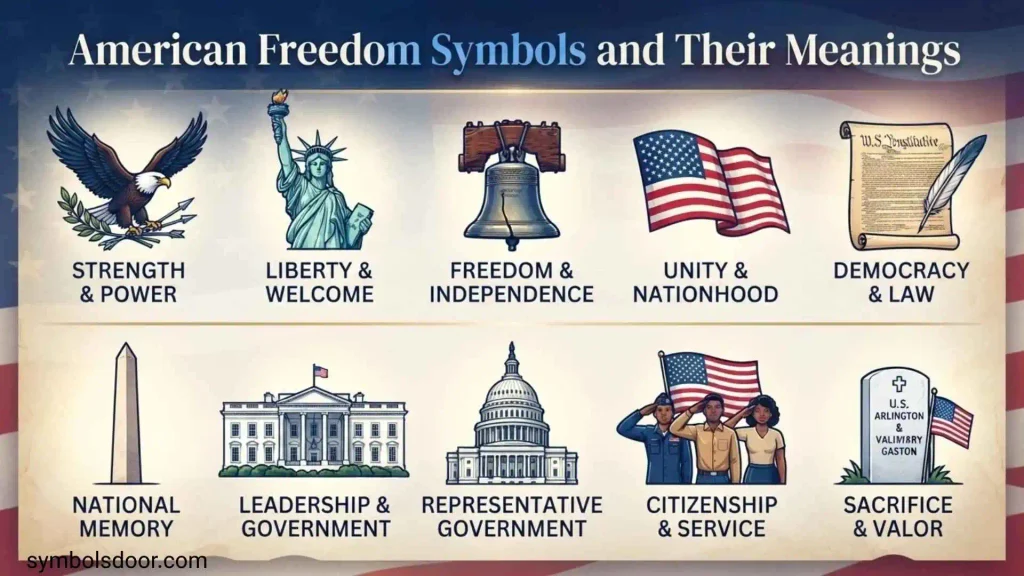
American freedom symbols have a strong connection to the country’s founding, constitutional traditions, national identity, and continuing debates about equality.
They appear during public ceremonies, Independence Day celebrations, military commemorations, and political movements.
| American symbol | Historical or cultural association |
| Statue of Liberty | Liberty, immigration, and opportunity |
| Bald eagle | National strength and independence |
| American flag | National identity and independence |
| Liberty Bell | Liberty and abolition |
| Liberty Tree | Colonial resistance |
| Liberty cap | Revolutionary liberty |
| Olive branch | Peace and diplomacy |
| Torch | Enlightenment and guidance |
Immigration and the American Dream
The Statue of Liberty became an important image of immigration and opportunity.
For many newcomers, it represented the possibility of building a life through work, education, and personal effort.
This connection helped establish the monument as a symbol of the American Dream.
However, the experience of immigration has never been identical for everyone. Laws, economic conditions, discrimination, and social barriers have shaped who could access these opportunities.
Constitutional Rights and Democracy
American freedom symbolism also connects with constitutional rights.
The First Amendment protects several fundamental freedoms, including speech, religion, the press, peaceful assembly, and petitioning the government.
These rights are essential to democratic participation.
Symbols such as the American flag and Liberty Bell can therefore represent both national independence and the continuing responsibility to protect individual rights.
Military Sacrifice and National Freedom
Military memorials and national ceremonies often use flags, eagles, torches, and other patriotic imagery to recognize those who served or died in military conflicts.
These symbols connect freedom with sacrifice, national defense, and collective responsibility.
However, military symbolism can carry different meanings depending on the historical event and the people affected by it.
Spiritual Symbols of Freedom and Liberation
Political freedom and spiritual freedom are related ideas, but they are not identical.
Political freedom concerns rights, laws, and independence from external control. Spiritual freedom often concerns inner peace, self-understanding, enlightenment, and release from suffering or attachment.
Different religious traditions express these ideas through distinct symbols.
Lotus Flower – Spiritual Awakening and Liberation
<AsyncImage query=”pink lotus flower blooming above water serene pond” aspectRatio=”16:9″ width=”100%”/>
The lotus flower holds important spiritual meaning in Hinduism and Buddhism.
It grows from muddy water and rises above the surface to bloom. This natural process has become an image of purity, spiritual development, and awakening.
In Buddhist traditions, the lotus can represent the possibility of moving beyond ignorance and suffering. In Hindu traditions, it appears in imagery connected with deities, creation, and spiritual purity.
Its meaning is not simply political freedom. It represents a deeper form of spiritual liberation and the possibility of developing wisdom despite difficult conditions.
Dharma Wheel – Freedom From Suffering
<AsyncImage query=”Buddhist Dharma wheel eight spokes traditional golden symbol” aspectRatio=”16:9″ width=”100%”/>
The Dharma Wheel, or Dharmachakra, is an important Buddhist symbol.
Its eight spokes are commonly associated with the Noble Eightfold Path, which includes right understanding, intention, speech, action, livelihood, effort, mindfulness, and concentration.
The wheel represents the Buddha’s teachings and the path toward liberation from suffering.
In this context, freedom involves changing how a person understands and responds to life. It is a spiritual process rather than independence from a government.
Ankh – Life and Spiritual Continuity
<AsyncImage query=”ancient Egyptian ankh hieroglyph symbol carved stone museum” aspectRatio=”16:9″ width=”100%”/>
The ankh is an ancient Egyptian symbol associated with life and divine power.
It frequently appears in Egyptian religious art, where gods are shown holding or offering the ankh.
Modern interpretations sometimes connect it with spiritual freedom, eternal life, and personal empowerment.
However, its established historical meaning is primarily associated with life. Its connection with freedom is a later or broader symbolic interpretation.
Flowing Water – Renewal and Release
<AsyncImage query=”clear flowing river moving through green natural landscape” aspectRatio=”16:9″ width=”100%”/>
Flowing water can represent renewal, movement, cleansing, and the ability to adapt.
Its connection with freedom comes from its movement. Water follows its course, changes direction, and continues flowing around obstacles.
In spiritual and artistic imagery, flowing water can represent emotional release and letting go of past difficulties.
Different religious and cultural traditions assign their own meanings to rivers, springs, and sacred water. These meanings should be understood within their individual contexts.
Symbols of Freedom in Art and Visual Expression
Artists use freedom symbols in art to communicate political ideas, personal emotions, and cultural values.
They may use recognizable objects such as broken chains and birds, or more abstract elements such as open spaces, flowing lines, and light.
The goal is to express freedom through visual language rather than explain it through lengthy text.
Freedom in Paintings and Drawings
<AsyncImage query=”symbolic fine art painting bird flying out of open cage bright sky freedom” aspectRatio=”16:9″ width=”100%”/>
Paintings about freedom often include:
- Birds flying across open skies.
- Broken chains and unlocked doors.
- People standing against powerful structures.
- Sunlight entering dark spaces.
- Trees growing without barriers.
- Open landscapes and distant horizons.
Artists may use light and shadows to create a contrast between oppression and liberation.
For example, a dark room with an open door leading into sunlight can communicate the transition from restriction to opportunity.
Artistic Expression and Creative Freedom
Creative freedom means having the ability to explore ideas and express yourself through art, music, writing, design, or performance.
Artists often use untamed lines, open forms, expressive gestures, and natural growth to represent individuality.
A painting doesn’t always need a recognizable freedom emblem. Its movement, composition, and use of space can communicate independence.
For example:
- Open forms can suggest possibility.
- Flowing lines can communicate movement.
- Expansive backgrounds can create a sense of openness.
- Natural shapes can represent growth and change.
- Light and shadows can suggest the movement from uncertainty toward understanding.
This is why freedom in art can be both political and deeply personal.
Psychological and Emotional Meanings of Freedom Symbols
Freedom is not limited to national independence or political rights. It also affects how people understand themselves and manage their lives.
Modern freedom symbolism often represents the desire to overcome emotional pressure, establish healthy boundaries, and develop a stronger sense of identity.
Personal Independence and Autonomy
Personal independence means having the ability to make decisions about your own life.
Symbols such as open doors, keys, open roads, and flying birds can represent this ability.
They communicate the idea that you have choices and can take responsibility for your decisions.
Emotional Freedom and Healing
Emotional freedom refers to moving beyond feelings or circumstances that limit your well-being.
A butterfly may represent emotional transformation. A sunrise can suggest hope after hardship, while broken chains can express release from a difficult past.
These images can help people communicate experiences that are personal or difficult to describe.
Confidence, Courage, and Self-Expression
The raised fist, mountain peak, phoenix, and eagle can represent courage and confidence.
They may express a person’s determination to challenge unfair expectations, protect personal boundaries, and follow individual goals.
Freedom also involves responsibility. Making independent choices means recognizing how your actions affect other people.
Freedom Tattoo Symbols and Their Meanings
<AsyncImageGroup query={[“minimalist flying bird freedom tattoo forearm black ink”,”butterfly transformation tattoo fine line”,”broken chain tattoo wrist black ink”,”phoenix rising tattoo detailed black and grey”,”feather wings freedom tattoo design”]} aspectRatio=”5:4″ layout=”carousel”/>
Freedom tattoos are popular because they allow people to express personal experiences through meaningful images.
Some designs represent independence, while others communicate survival, transformation, emotional healing, or a desire to move forward.
Bird Tattoo Symbolism
A flying bird tattoo commonly represents independence and freedom of movement.
It may express a desire to travel, explore new opportunities, or escape restrictive circumstances.
Butterfly Tattoo Meaning
A butterfly tattoo often represents transformation and personal growth.
People may choose it to mark a major life change, emotional recovery, or a new beginning.
Eagle Tattoo
An eagle tattoo can represent strength, courage, confidence, and independence.
In American-inspired designs, it may also communicate patriotism and national identity.
Feather Tattoo
A feather tattoo may represent spirituality, freedom, and a connection with nature.
If the design draws from an Indigenous tradition, research its specific cultural meaning rather than assuming that every feather design has the same significance.
Broken Chain Tattoo
A broken chain tattoo represents freedom from restrictions, oppression, or difficult experiences.
It can also communicate the decision to break unhealthy patterns and reclaim personal control.
Wings Tattoo
Wing tattoos commonly represent independence, ambition, and the ability to rise above limitations.
Some people choose them to express spiritual beliefs, while others use them as a reminder to keep moving forward.
Open Road Tattoo
An open road tattoo represents adventure, personal choice, and the freedom to create your own journey.
It may appeal to people who value travel, exploration, and independence.
Freedom Symbols in Fashion, Decor, and Popular Culture
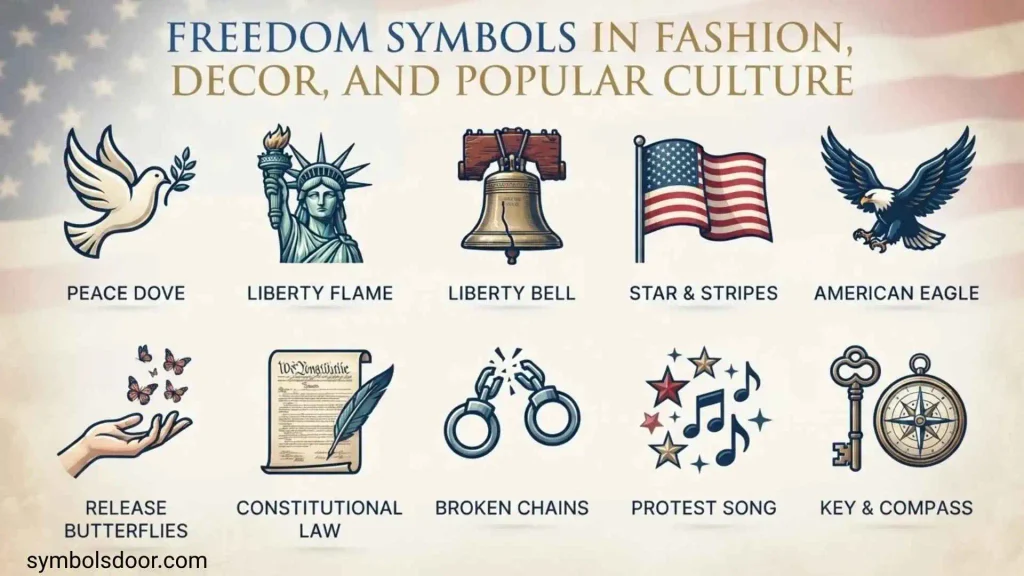
Freedom symbolism extends beyond historical monuments and political movements. It also appears in everyday objects, clothing, jewelry, home decor, music, and entertainment.
Freedom Jewelry and Fashion
Jewelry featuring feathers, wings, keys, birds, or broken chains can express personal identity.
Some people choose minimalist designs because they prefer subtle symbolism. Others select bold patriotic or artistic images.
Freedom-themed clothing may use flags, raised fists, peace signs, or inspirational messages.
However, symbols can have political or cultural associations that go beyond fashion. It’s worth understanding their background before using them.
Freedom in Home Decor
Freedom-inspired home decor often uses open landscapes, birds, natural textures, and peaceful colors.
Common choices include:
- Bird and butterfly wall art.
- Open-sky landscape paintings.
- Rustic Americana decorations.
- Olive branch illustrations.
- Inspirational artwork featuring roads and mountains.
- Minimalist designs with keys or feathers.
These elements can create a sense of openness, individuality, and connection with nature.
Freedom in Movies and Music
Movies and music often explore freedom through stories of resistance, escape, identity, and self-discovery.
Protest music has played an important role in movements demanding civil rights and political change. Folk, rock, and country music have also explored themes of independence, travel, and personal choice.
In films, open highways, motorcycles, birds, and wide landscapes often represent a character’s desire to escape restrictions.
These images have become familiar parts of modern freedom symbolism.
Olympic Torch and Freedom
The Olympic torch is associated with the Olympic Games and the continuity of the Olympic flame tradition.
It represents sporting ideals, international participation, and the connection between different generations of athletes.
It is sometimes included in broader freedom imagery because sport can bring people together across national and cultural boundaries.
However, its official symbolism is not identical to that of the Statue of Liberty’s torch.
How Freedom Symbols Can Be Misused or Misunderstood
Symbols can carry powerful meanings, but their interpretation is not always positive or straightforward.
A symbol associated with freedom in one historical period may later be adopted by a political group with a very different message.
Some extremist organizations also misuse national, religious, or historical imagery to promote exclusion, hatred, or violence.
Before using a symbol, consider these questions:
- What was its original historical purpose?
- Which communities have used it?
- Does it have a recognized political or extremist association?
- Has its meaning changed over time?
- Could its use disrespect a cultural or religious tradition?
- Does the design communicate the message you intend?
Why Cultural Context Matters
A feather, eagle, cross, flag, or ancient pattern can mean different things to different communities.
For example, a feather may be a decorative element in one design but a culturally significant object in a particular Indigenous tradition.
Similarly, a national flag may represent independence to one person and a painful historical experience to another.
Understanding cultural context helps prevent misleading interpretations and encourages respectful use of symbolic imagery.
How to Choose a Symbol That Represents Freedom
The right freedom symbol depends on the kind of independence or liberation you want to express.
Start by identifying what freedom means to you.
| Your intended message | Symbols to consider |
| Political liberty | Statue of Liberty, liberty cap, Liberty Bell |
| National independence | American flag, bald eagle |
| Freedom from oppression | Broken chains, raised fist |
| Peace and reconciliation | Dove, olive branch, peace sign |
| Personal independence | Open road, open door, key |
| Emotional healing | Butterfly, sunrise, dragonfly |
| Strength after hardship | Phoenix, mountain peak, horse |
| Spiritual liberation | Lotus, Dharma Wheel |
| Freedom of movement | Bird in flight, wings, sailboat |
| Equality and inclusion | Rainbow, raised fist |
Before choosing a symbol for a tattoo, artwork, clothing design, or public message, consider its history and cultural associations.
A symbol becomes more meaningful when you understand what it represents rather than choosing it simply because it looks attractive.
Why Symbols of Freedom Still Matter Today
Symbols of freedom remain important because they help people communicate shared values, remember historical struggles, and express hopes for the future.
A monument can preserve the memory of independence. A raised fist can communicate resistance. A broken chain can remind people of the struggle against slavery, while a dove can express the hope for peace.
These images also help connect different generations. People may inherit a symbol from earlier movements and use it to express new demands for equality, justice, and human rights.
Modern freedom symbolism appears in several important areas:
- Human rights campaigns: Images communicate demands for dignity, equality, and protection.
- Political movements: Flags, raised fists, and liberty imagery express collective goals.
- Personal identity: Tattoos and jewelry communicate independence and self-expression.
- Art and entertainment: Visual symbols explore freedom, resistance, and personal choice.
- Digital culture: Emojis, illustrations, profile images, and social media graphics spread symbolic messages quickly.
Freedom also involves responsibility. The ability to express your beliefs and make personal choices should exist alongside respect for the rights and dignity of others.
Frequently Asked Questions About Symbols of Freedom
What Are the Most Common Symbols of Freedom?
Some of the most common symbols include the Statue of Liberty, bald eagle, American flag, Liberty Bell, broken chains, dove, butterfly, wings, phoenix, and bird in flight.
The Statue of Liberty is especially recognized internationally, while the bald eagle and American flag have strong connections to American national identity.
What Is the Most Recognized Symbol of Freedom?
The Statue of Liberty is one of the most widely recognized symbols of freedom.
It represents liberty, opportunity, democracy, and hope. Its torch, tablet, and broken chains each contribute to its message.
Why Is the Bald Eagle a Symbol of Freedom?
The bald eagle represents strength, independence, and national identity in the United States.
Its ability to soar high and its powerful appearance make it a natural symbol of freedom in American patriotic imagery.
Why Are Broken Chains a Symbol of Freedom?
Broken chains represent release from slavery, imprisonment, oppression, and restrictive control.
They communicate the idea that something once holding a person or community back has been overcome.
Why Does a Dove Represent Peace and Freedom?
The dove has long been associated with peace, hope, and reconciliation.
Its connection with freedom comes from the idea that people need safety and peace to enjoy their rights and live independently.
What Animals Symbolize Freedom?
Several animals commonly represent freedom:
- Birds: Independence and freedom of movement.
- Bald eagles: Strength and American liberty.
- Horses: Movement, power, and independence.
- Butterflies: Transformation and personal growth.
- Phoenixes: Rebirth and renewal.
- Dragonflies: Adaptability and change.
Their meanings depend on the cultural and artistic context.
What Flower Symbolizes Spiritual Freedom?
The lotus flower is strongly associated with spiritual awakening and liberation in Hindu and Buddhist traditions.
Its growth from muddy water into a beautiful flower makes it an image of purity, wisdom, and development.
However, no single flower represents freedom in every culture.
What Does a Butterfly Symbolize in Freedom?
A butterfly often represents personal transformation, emotional healing, and the ability to move beyond past limitations.
Its life cycle makes it a powerful image of change and new beginnings.
What Does a Phoenix Represent After Struggle?
A phoenix represents rebirth, resilience, and renewal after hardship.
It is commonly used to express the ability to rebuild your life and move forward after difficult experiences.
What Does the Torch Symbolize in Liberty?
The torch represents enlightenment, knowledge, guidance, and hope.
On the Statue of Liberty, it communicates the idea that liberty can guide people toward a brighter future.
What Are Ancient Symbols of Freedom?
The Roman pileus and the later liberty cap are important historical examples.
The pileus was associated with freed people in ancient Rome. Later, liberty-cap imagery became connected with political liberty during the American and French revolutionary periods.
What Are Spiritual Symbols of Liberation?
Important examples include:
- Lotus flower.
- Dharma Wheel.
- Ankh.
- Flowing water in some spiritual interpretations.
Their meanings differ by religious and cultural tradition. The lotus and Dharma Wheel, for example, have particular significance in Hindu and Buddhist contexts.
What Symbols Represent Freedom From Oppression?
Broken chains, the raised fist, liberty caps, and revolutionary liberty imagery are common symbols of resistance against oppression.
Their historical meanings are especially important in abolition movements, political revolutions, and civil rights campaigns.
What Are Popular Freedom Tattoo Symbols?
Popular freedom tattoo designs include flying birds, butterflies, eagles, feathers, wings, broken chains, phoenixes, and open roads.
People often choose these images to express independence, courage, emotional healing, and personal transformation.
How Have Freedom Symbols Changed Over Time?
Freedom symbols have evolved as societies and political movements have changed.
The Roman pileus was connected with the status of freed people. The liberty cap later became a symbol of revolutionary politics. The raised fist became associated with modern resistance movements, while the rainbow flag became an important image of LGBTQ+ pride and equality.
Modern symbols also include open roads, butterflies, and birds as expressions of personal independence.
What Can We Learn From Symbols of Freedom?
Symbols of freedom show how people express their desire for dignity, independence, equality, and self-determination.
They also remind us that freedom has many dimensions. It includes political rights, social equality, personal choice, cultural identity, and the ability to live without oppression.
Conclusion: The Lasting Meaning of Symbols of Freedom
The symbols of freedom found throughout history communicate powerful ideas about independence, liberty, peace, equality, and personal growth.
Some, such as the Statue of Liberty, Liberty Bell, Phrygian cap, and broken chains, have well-documented historical connections to political freedom and emancipation. Others, including butterflies, birds, open roads, mountains, and sunrise imagery, express more personal ideas about transformation and independence.
Spiritual symbols such as the lotus and Dharma Wheel offer another perspective. They connect freedom with enlightenment, inner peace, and release from suffering.
Ultimately, no single image can represent every meaning of freedom. The symbols people choose reflect their histories, beliefs, cultures, and personal experiences. Understanding those meanings helps you appreciate not only the images themselves but also the human struggles and hopes behind them.

Hi, I’m Asher Monroe, a writer who believes that meaningful words have the power to inspire change and bring people closer to their dreams. I have always been fascinated by the beauty of quotes and the way a simple message can provide motivation, hope, and comfort.
I enjoy creating content around inspirational quotes, life lessons, success stories, and positive thoughts that help readers find encouragement in their everyday lives. My goal is to share words that connect with people and remind them of their inner strength.
Through my writing, I explore the ideas of personal growth, confidence, and the importance of staying inspired through every chapter of life.
I am the author of Words That Move the Soul and The Path of Endless Inspiration, two books focused on the power of wisdom, positivity, and meaningful thoughts.
 Sienna Brooks
 Rowan Sinclair Rowan Sinclair