In Greek mythology, few gods have as many recognizable symbols as Apollo. Ancient artists often portrayed him carrying a bow, playing a lyre, or wearing a laurel wreath. Other images connect him with a raven, a tripod, a sacred serpent, and radiant light. Each object tells part of his story and represents a different aspect of his divine identity.
The Apollo symbols are more than decorative objects. They reflect his powers over music, prophecy, healing, archery, poetry, and purification. They also connect him to important myths, including his victory over Python, his relationship with Daphne, and the story of Coronis and the raven.
Apollo’s connection with the sun deserves special attention. Although people often call him the Greek god of the sun, the ancient Greeks originally recognized Helios as the sun’s personification. Apollo became increasingly associated with solar imagery in later Greek and Roman traditions.
Understanding these differences helps you recognize Apollo’s symbols accurately. This guide explains the main symbols of Apollo, their meanings, and the mythology behind each one.
Who Is Apollo in Greek Mythology?
Apollo is one of the major Olympian gods in ancient Greek religion. He is the son of Zeus, king of the gods, and Leto, a daughter of the Titans. His twin sister is Artemis, the goddess associated with hunting, wilderness, and, in later traditions, the moon.
According to Greek mythology, Apollo and Artemis were born on the island of Delos. Their mother, Leto, struggled to find a place where she could give birth because Hera, Zeus’s wife, was angry about Zeus’s relationship with her. Delos eventually offered her shelter.
Apollo became an important figure in Greek religious life. His sanctuary at Delphi was home to one of the ancient world’s most influential oracles. People traveled there to seek prophetic guidance about personal decisions, political matters, wars, and religious questions.
Apollo’s Main Powers and Divine Domains
Apollo had several roles, which explains why his sacred symbols represent different ideas.
| Divine role | Meaning and association |
| God of music | Music, instruments, song, and harmony |
| God of prophecy | Oracles, divine knowledge, and predictions |
| God of healing | Health, purification, and medicine |
| God of archery | The bow, arrows, and distant attacks |
| God associated with poetry | Song, poetic expression, and inspiration |
| God of light | Brightness, clarity, and illumination |
| God associated with plague | Disease, divine anger, and punishment |
| God of youth | Idealized youthful beauty and physical excellence |
Apollo’s powers could have opposite effects. He could bring disease with his arrows, yet he could also protect people from illness and help restore health. This combination makes him more complex than a god who represents only healing or goodness.
His association with music and prophecy also connects him with order, knowledge, and divine inspiration. These different responsibilities appear throughout his mythology and explain the variety of Apollo’s attributes.
Apollo’s Appearance and Characteristics
Ancient Greek artists commonly represented Apollo as a handsome, youthful, and athletic man. He usually appeared without a beard, with carefully arranged hair and an idealized body.
This appearance reflected Greek ideas about youth, beauty, athleticism, and physical balance. Apollo’s image often expressed strength without the heavy appearance associated with some other male gods.
Artists used recognizable objects to show his identity. For example:
- A lyre identified him with music and poetry.
- A bow and arrows represented his archery skills and divine power.
- A laurel wreath connected him with Daphne and victory.
- A tripod represented his prophetic sanctuary at Delphi.
- A raven or swan could identify him through sacred animal associations.
These attributes helped ancient viewers recognize Apollo in paintings, sculptures, pottery, and other forms of Greek religious art.
What Are the Main Symbols of Apollo?
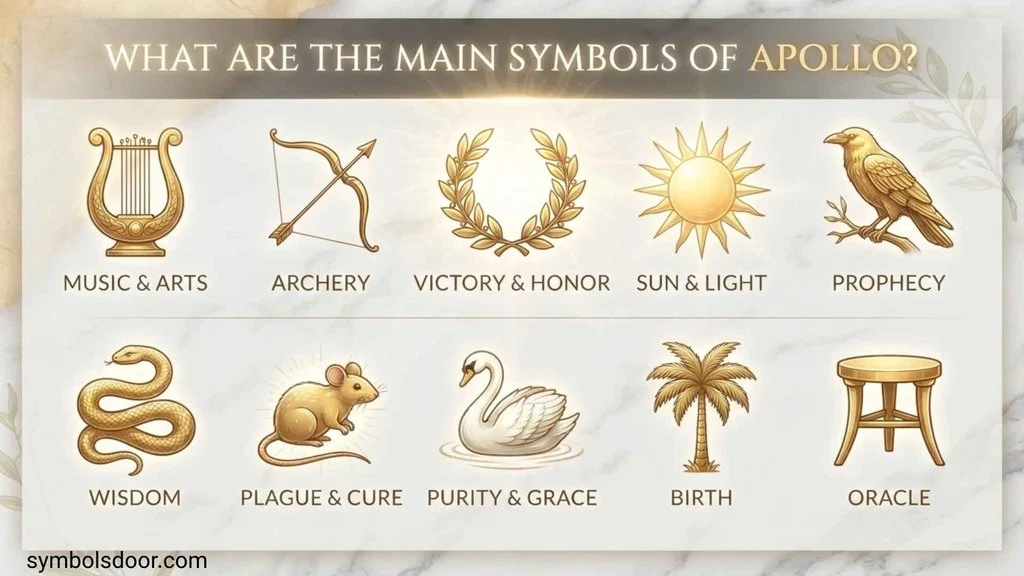
The most familiar Apollo symbols include the bow and arrows, lyre, raven, laurel branch, and laurel wreath. Light and solar imagery also became strongly connected with him in later traditions.
Here is a quick guide to their meanings.
| Apollo symbol | Symbolic meaning | Mythological connection |
| Bow and arrows | Archery, divine power, plague, and punishment | Apollo’s role in the Trojan War and his defeat of Python |
| Lyre | Music, harmony, poetry, and creativity | Hermes gives Apollo the lyre |
| Raven | Divine messages and the consequences of betrayal | Apollo, Coronis, and Ischys |
| Laurel branch | Sacred transformation and Apollo’s connection with Daphne | Daphne becomes a laurel tree |
| Laurel wreath | Victory, honor, and achievement | Apollo’s sacred laurel and the Pythian Games |
| Sun rays | Light, brightness, and illumination | Apollo’s later solar associations |
| Golden chariot | The sun’s movement across the sky | Solar traditions associated with Helios and later Apollo |
| Tripod | Prophecy and divine communication | The Oracle of Delphi |
| Omphalos stone | Delphi as the symbolic center of the world | Apollo’s famous sanctuary |
Not every object has the same historical status. The bow and lyre are especially well-established attributes of Apollo in ancient literature and art. The sun chariot, for example, needs more historical context because it was traditionally associated with Helios before Apollo became closely identified with the sun.
Bow and Arrows: Apollo’s Symbols of Archery and Divine Power
<PRIVATE_PERSON>
The bow and arrows are among Apollo’s most recognizable attributes. Ancient Greek literature frequently describes him as an exceptionally skilled archer who could strike targets from a great distance.
His bow represents more than physical skill. It also expresses his divine authority, ability to punish wrongdoing, and power to send disease. Apollo’s arrows could bring sudden death or widespread illness, making the weapon a symbol of both destruction and supernatural control.
What Do Apollo’s Bow and Arrows Symbolize?
Apollo’s bow and arrows represent several connected ideas:
- Archery: Apollo’s exceptional skill with a bow.
- Divine punishment: His ability to punish people who offend him or disrespect his sacred authority.
- Plague and disease: His arrows could spread illness among humans.
- Protection: His power could also defend people and support divine order.
- Victory: His defeat of dangerous enemies, including Python, demonstrates his strength.
The bow also appears in stories involving Apollo’s family and other gods. His sister Artemis shares his association with archery, although her hunting role gives her bow a somewhat different meaning.
Apollo’s Silver Bow and Silver Arrows
Ancient literature often describes Apollo as the god with the silver bow. Homer’s Iliad, for example, calls attention to his silver bow when describing the plague he sends against the Greek army.
The silver weapon reinforces his divine identity and makes him visually recognizable in ancient storytelling and artwork.
However, not every artistic depiction uses the same material or color. The silver bow is a traditional literary attribute, while artists could represent the weapon differently depending on the period and medium.
Apollo and the Python Serpent
One of Apollo’s most important victories involves Python, a monstrous serpent associated with the area of Delphi.
According to a well-known version of the myth, Apollo killed the serpent and established his sanctuary at Delphi. This victory helped explain his connection with the oracle and the title Pythian Apollo.
The story represents the god’s power to overcome a dangerous force and establish sacred authority.
The sanctuary at Delphi later became one of the most important religious centers in ancient Greece. Its oracle, known as the Pythia, delivered prophetic responses in Apollo’s name.
Apollo’s bow therefore connects two important parts of his identity: his skill as an archer and his authority as a god of prophecy.
Apollo’s Plague Arrows in the Trojan War
Apollo’s arrows play a major role in Book One of Homer’s Iliad.
During the Trojan War, Agamemnon dishonors Chryses, a priest of Apollo, by refusing to return his daughter Chryseis. Chryses prays to Apollo for help.
Apollo responds by sending a plague through the Greek camp. His arrows strike animals and soldiers, causing widespread suffering.
The episode shows why Apollo was both a god of healing and a god of plagues. He could bring disease when angered, but his divine power also included the ability to relieve suffering.
This myth gives the bow and arrows a deeper meaning. They represent the consequences of disrespecting divine authority, not simply the ability to win a battle.
Lyre: Apollo’s Symbol of Music and Harmony
The lyre is another major symbol of Apollo. This ancient stringed instrument connects him with music, poetry, song, and artistic expression.
In Greek art, Apollo frequently appears holding or playing a lyre. Sometimes artists depict him with a larger instrument called a kithara, which belongs to the same family of stringed instruments.
The lyre represents the musical side of Apollo’s identity. It also reflects the ancient Greek belief that music could create order, harmony, and balance.
What Does Apollo’s Lyre Symbolize?
Apollo’s lyre has several meanings:
- Music and song: It represents his skill as a divine musician.
- Harmony: Its musical sounds symbolize order and balance.
- Poetry: Ancient poetry was often performed with musical accompaniment.
- Creativity: The instrument represents artistic expression and inspiration.
- Cultural achievement: Music played an important role in Greek education, festivals, and public life.
Apollo’s musical identity also connects him with the Muses, the divine figures associated with different forms of artistic and intellectual inspiration. He is often portrayed as their leader or musical companion.
How Did Apollo Get His Lyre?
A famous myth about Apollo’s lyre involves Hermes, the messenger god.
According to the Homeric Hymn to Hermes, Hermes created the first lyre using a tortoise shell and strings. He later stole cattle belonging to Apollo, leading to a disagreement between the two gods.
Apollo eventually discovered Hermes’ actions. Their conflict ended through negotiation and an exchange of gifts.
Hermes gave Apollo the lyre, and Apollo accepted the instrument. The gift became one of the defining parts of Apollo’s identity.
The story is important because it explains why the lyre is associated with Apollo even though Hermes is credited with inventing it in this tradition.
Apollo as the God of Music and Poetry
Apollo’s musical role extended beyond playing an instrument. He represented the connection between music, poetry, education, and cultural life.
In ancient Greece, musicians often accompanied poetry with instruments. Performers sang stories about gods, heroes, battles, and historical events.
Apollo’s lyre therefore represents both entertainment and a respected form of artistic knowledge.
His musical abilities also appear in stories involving musical competitions. In the myth of Marsyas, a satyr challenges Apollo to a musical contest. Apollo wins, and the story demonstrates his superior musical authority, although its violent ending also reveals the dangerous side of divine pride and competition.
Raven: Apollo’s Sacred Bird and Its Mythological Meaning
The raven is a bird associated with Apollo through several mythological traditions. Its most famous connection involves the story of Coronis, a woman loved by the god.
In this story, the raven acts as a messenger. Its report brings Apollo troubling news and leads to a tragic series of events.
What Does the Raven Symbolize for Apollo?
The raven’s association with Apollo can represent:
- Divine messages and communication.
- The delivery of troubling news.
- Betrayal and infidelity in the Coronis myth.
- The consequences of divine anger.
- The connection between animals and the gods in Greek mythology.
The raven is not as central to Apollo’s identity as the lyre or bow. However, its connection with the Coronis story makes it an important mythological symbol.
Apollo, Coronis, and the Raven’s Black Feathers
In a well-known version of the myth, Coronis is a mortal woman who becomes pregnant by Apollo.
A raven discovers that Coronis has a relationship with another man, Ischys, and reports the news to Apollo.
Apollo becomes furious. The story varies between ancient accounts, but in Ovid’s version, the raven’s report contributes to Coronis’ death. Apollo later regrets what happened and punishes the bird by changing its feathers from white to black.
This transformation explains the raven’s black appearance within the myth.
The story connects the raven with bad news, betrayal, jealousy, and the consequences of carrying information to a powerful god.
It is important to remember that Greek myths do not always have one fixed version. Different ancient writers sometimes changed details to suit their own storytelling.
Apollo, Coronis, and Asclepius
The Coronis myth also explains the birth of Asclepius, Apollo’s son.
In a common version of the story, Apollo saves the unborn child from Coronis before her body is consumed by fire. He then raises or arranges for the child to be raised and educated.
Asclepius becomes a major figure associated with medicine and healing.
His story strengthens Apollo’s connection with health and medical knowledge. It also shows how the god’s family mythology links the raven, Coronis, and the healing tradition.
Sun and Light: Apollo’s Connection with Illumination
Apollo is widely known today as a Greek sun god, and artists often portray him with rays of light surrounding his head. Golden sunlight, bright skies, and solar imagery are common features of later representations.
However, the history of Apollo’s solar identity is more complex than it first appears.
Why Is Apollo Associated With the Sun?
In early Greek mythology, Helios was the god who personified the sun. He was traditionally described as traveling across the sky in a chariot, bringing daylight to the world.
Apollo originally had several other major domains, including music, prophecy, healing, and archery. Over time, Greek and Roman traditions increasingly identified Apollo with Helios.
This association became especially influential in later literature, religion, and art.
As a result, people often connect Apollo with:
- Sunlight and daylight.
- Radiant brightness.
- Light overcoming darkness.
- Divine illumination.
- Knowledge and clarity.
- The movement of the sun across the sky.
Apollo’s association with light also appears in his epithet Phoebus, commonly understood as meaning bright or shining.
What Do the Rays Around Apollo’s Head Mean?
In paintings and sculptures, Apollo sometimes appears with rays of light around his head.
These rays represent brightness and divine radiance. They help identify him with light and, in later imagery, his solar role.
The light can also carry symbolic meanings beyond the physical sun:
- Truth: Light can represent the revelation of what is hidden.
- Knowledge: Brightness can symbolize understanding and wisdom.
- Purification: Light can suggest cleansing and renewal.
- Divine presence: Radiance can distinguish a god from ordinary human figures.
Not every ancient Apollo statue includes a radiant crown or sun rays. These features depend on the artwork’s period, style, and intended meaning.
Apollo’s Golden Chariot and the Sun
The golden chariot is a familiar image in stories about the sun crossing the sky.
Traditionally, Helios drives the sun chariot. His journey explains the movement of daylight from sunrise to sunset.
Later traditions increasingly connected Apollo with solar power, and artists sometimes portrayed him using similar imagery.
For historical accuracy, it is useful to distinguish the two figures:
| Figure | Traditional association |
| Helios | Personification of the sun and driver of the solar chariot |
| Apollo | Music, prophecy, healing, archery, and later solar associations |
The golden chariot therefore represents Apollo’s solar identity most clearly in later traditions rather than serving as one of his earliest defining attributes.
Apollo and Artemis: Sun and Moon Associations
Apollo and Artemis are twins, and their later solar and lunar associations create a familiar contrast.
Apollo became associated with the sun, while Artemis became associated with the moon in later traditions.
Their relationship is also rooted in other domains. Artemis is strongly connected with hunting and wilderness, while Apollo is associated with music, prophecy, and archery.
The sun-and-moon pairing is a recognizable part of their later symbolism, but it should not replace their broader roles in ancient Greek mythology.
Laurel Branch and Wreath: Apollo’s Symbols of Victory and Honor
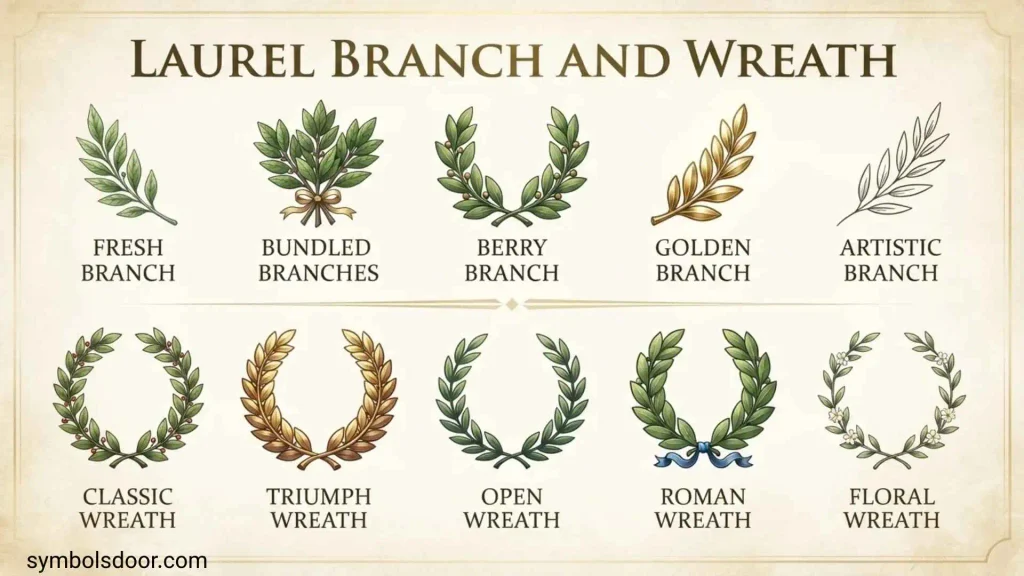
The laurel branch and laurel wreath are among the most recognizable symbols of Apollo.
The laurel is a sacred plant connected with the myth of Apollo and Daphne. Its leaves became associated with the god, and wreaths made from laurel later represented victory, honor, and achievement.
What Does the Laurel Branch Symbolize?
The laurel branch represents Apollo’s connection with Daphne and his sacred plant.
It also carries several broader meanings:
- Sacred dedication: The laurel was closely connected with Apollo’s worship.
- Victory: Laurel wreaths became awards for successful competitors.
- Honor: A wreath could recognize public achievement.
- Poetry: Laurel became associated with poets and artistic accomplishment.
- Transformation: Its mythological origin connects it with Daphne’s transformation.
The laurel is especially important because its meaning comes from both mythology and ancient religious practice.
Apollo and Daphne: The Story Behind the Laurel
The myth of Apollo and Daphne explains why the laurel became sacred to him.
According to a famous version told by the Roman poet Ovid in Metamorphoses, Apollo mocks Eros, the god of love. Eros responds by shooting Apollo with an arrow that causes intense desire.
He shoots Daphne with another arrow that makes her reject romantic love.
Apollo falls in love with Daphne and pursues her. Daphne, however, does not return his feelings and tries to escape.
As Apollo approaches, Daphne calls for help. Her father, the river god Peneus, transforms her into a laurel tree.
Apollo can no longer pursue her as a woman. Instead, he declares the laurel sacred to himself.
He promises to wear its leaves and use them to honor others.
The myth explains the connection between Apollo and the laurel. It also explores themes of love, rejection, transformation, and divine desire.
What Does Apollo’s Laurel Wreath Mean?
Apollo’s laurel wreath represents his relationship with Daphne and the honor associated with his sacred plant.
Ancient and later artists often show Apollo wearing a crown made from laurel leaves. This visual detail makes the god easy to identify.
The wreath also became a wider symbol of achievement. People associated it with:
- Athletic victory.
- Public honor.
- Poetry and literary excellence.
- Military success.
- Personal achievement.
- Recognition and distinction.
Its meaning gradually extended beyond Apollo’s own mythology.
Laurel Wreaths in Ancient Greek Competitions
Laurel wreaths were especially important at the Pythian Games, held at Delphi in honor of Apollo.
These games included athletic and artistic competitions. Winners received recognition connected with Apollo’s sanctuary and sacred traditions.
The Pythian Games were among the major Panhellenic festivals of ancient Greece.
One important distinction concerns the ancient Olympic Games. Olympic victors traditionally received olive wreaths, not laurel wreaths. Laurel was particularly associated with Apollo and the Pythian Games.
This difference matters when explaining the history of the laurel wreath as a symbol of victory.
Apollo’s Other Symbols, Sacred Objects, and Attributes
Apollo’s main symbols are easy to recognize, but several other objects and animals also connect with his mythology and religious worship.
These symbols often relate to his sanctuary at Delphi, his prophetic powers, or local traditions.
The Tripod: Apollo’s Symbol of Prophecy
The tripod is a three-legged stand associated with Apollo’s oracle at Delphi.
The priestess known as the Pythia delivered prophetic responses at the sanctuary. Ancient accounts connect her role with a tripod, making the object a symbol of prophecy and divine communication.
The tripod represents:
- Apollo’s prophetic authority.
- The Oracle of Delphi.
- Sacred knowledge.
- Communication between gods and humans.
- Religious authority and ritual practice.
Unlike the lyre or bow, the tripod is closely connected with Apollo’s religious sanctuary rather than his musical or athletic identity.
The Omphalos Stone: The Center of the World
The omphalos was a sacred stone associated with Delphi. The Greek word means “navel.”
Ancient tradition treated Delphi as the symbolic center of the world. The omphalos represented this central position.
Its connection with Apollo comes from the importance of Delphi as his prophetic sanctuary.
The stone is therefore a symbol of sacred geography, religious authority, and the central role of Apollo’s oracle in Greek life.
Apollo’s Sacred Animals
Several animals appear in Apollo’s myths and religious traditions. Their importance varies across different stories and local forms of worship.
| Animal | Association with Apollo |
| Raven | The story of Coronis and the delivery of a message |
| Swan | Music, song, and prophetic associations |
| Dolphin | Apollo’s connection with Delphi and the sea |
| Wolf | Appears in some local cults and religious traditions |
| Hawk | Associated with divine animals and messenger traditions |
The raven is especially recognizable because of the Coronis myth. The swan is another important association, particularly in stories connecting Apollo with song and music.
The dolphin also has a meaningful connection with Delphi. The Homeric Hymn to Apollo tells how Apollo took the form of a dolphin and guided Cretan sailors to his sanctuary.
These animals show how sacred animals helped communicate the different sides of a Greek god’s identity.
Apollo’s Sacred Plants
The laurel tree is Apollo’s best-known sacred plant.
Its connection comes from the Daphne myth and its use in religious traditions at Delphi. Laurel branches and wreaths became closely associated with Apollo’s worship.
The palm tree also appears in Apollo’s birth mythology because Leto is traditionally described as giving birth to him on Delos beside a palm tree.
However, the laurel remains the clearest and most widely recognized plant symbol of Apollo.
Apollo’s Symbols in Greek Mythology, Art, and Sculpture
Ancient Greek artists used objects, animals, clothing, and physical features to communicate the identities of gods and goddesses.
Apollo’s iconography is especially recognizable because his symbols appear in sculpture, pottery, paintings, and religious objects.
Apollo in Ancient Greek Sculpture
Greek sculptors often represented Apollo as an idealized young man. His body reflected Greek artistic ideas about beauty, proportion, athletic ability, and physical balance.
Some sculptures show him holding a bow. Others portray him with a lyre or laurel wreath.
One famous example is the Apollo Belvedere, a marble statue now held in the Vatican Museums. It is a Roman-era marble version of a Greek-style sculpture and became an influential example of classical male beauty during the Renaissance and later European art periods.
The statue is often used to illustrate Apollo’s youthful appearance and idealized physical form.
Apollo in Ancient Greek Paintings and Pottery
Apollo appears in many ancient Greek scenes painted on pottery and other objects.
Common subjects include:
- Apollo playing the lyre.
- Apollo holding his bow and arrows.
- Apollo with Artemis.
- Apollo and Daphne.
- Apollo defeating Python.
- Apollo among the Muses.
- Apollo at Delphi.
These images helped preserve Greek mythological stories and made religious figures recognizable to people who encountered their images in daily life.
A painted drinking vessel, for example, could show Apollo with a lyre and a raven. Such details helped viewers identify the god without needing a written explanation.
Apollo in Roman Art and Later European Art
Roman artists adopted many Greek gods and their visual traditions. Apollo remained important in Roman religious life and appeared in sculpture, coins, temples, and decorative artwork.
Roman rulers also used Apollo’s image to communicate ideas about order, protection, and divine favor.
Later European artists returned to classical mythology for inspiration. Apollo appeared in paintings, sculptures, palace decorations, and public monuments.
His familiar symbols remained easy to recognize:
- The lyre for music.
- The laurel wreath for honor.
- The bow for archery.
- Radiant light for his solar associations.
Apollo Symbols in Modern Culture
Apollo’s symbols continue to appear in museums, books, architecture, education, and visual design.
The laurel wreath remains a common image of achievement. The lyre represents music and poetry, while the bow and arrows identify Apollo’s mythological role as an archer.
Museums also use his image to explain ancient Greek religion and classical art.
These modern uses do not always preserve the full ancient meaning. For example, a laurel wreath may represent general success rather than a direct reference to Daphne or Apollo.
Understanding the original mythology helps you recognize the difference between a historical religious symbol and a later artistic reference.
Apollo’s Relationships and Their Connection to His Symbols
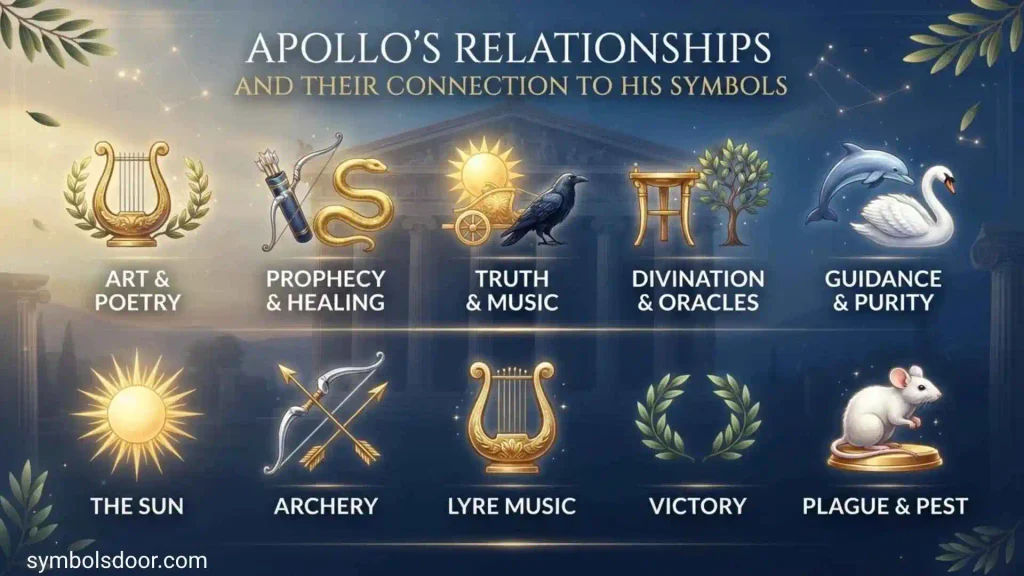
Apollo’s family and relationships explain several of his most recognizable attributes. His myths connect him with other gods, mortals, and mythological figures.
Apollo and Zeus
Zeus is Apollo’s father. As king of the Olympian gods, Zeus holds authority over the divine order.
Apollo’s prophetic role is closely connected with Zeus in some ancient traditions. Apollo can communicate divine knowledge and deliver oracles that express the will of his father.
This relationship helps explain why Apollo’s sanctuary at Delphi became such an important source of religious guidance.
Apollo and Artemis
Apollo and Artemis are twin children of Zeus and Leto.
Both are skilled archers, and both have important roles in ancient Greek religion.
Their domains differ in several ways:
| Apollo | Artemis |
| Music and poetry | Hunting and wilderness |
| Prophecy and oracles | Protection of young animals and children |
| Healing and plague | Childbirth and protection of girls |
| Archery | Archery |
| Later solar associations | Later lunar associations |
Their relationship represents a connection between two powerful divine figures who share family ties and some overlapping attributes.
Apollo and Hermes
The story of Apollo and Hermes explains the origin of Apollo’s connection with the lyre.
Hermes invents the instrument and later gives it to Apollo as part of their reconciliation after the cattle theft.
The exchange connects Hermes with invention and cleverness, while Apollo becomes the god most closely associated with the instrument.
Apollo and Asclepius
Asclepius is Apollo’s son and a major figure associated with medicine and healing.
His birth is connected with the story of Coronis. After her death, Apollo saves their unborn child in a common version of the myth.
Asclepius later becomes famous for his healing abilities. His story strengthens Apollo’s connection with medicine and shows how divine knowledge could pass through generations.
Apollo and Daphne
The story of Apollo and Daphne explains the origin of the sacred laurel.
Daphne’s transformation into a tree gives Apollo a permanent connection with the laurel branch and wreath.
The myth also shows that Apollo’s divine power did not always allow him to achieve what he wanted. Daphne escapes his pursuit through transformation, leaving the god with the laurel as a lasting symbol of their story.
Frequently Asked Questions About Apollo Symbols
What Are the Main Symbols of Apollo?
Apollo’s best-known symbols include the bow and arrows, lyre, raven, laurel branch, and laurel wreath. Other attributes include the tripod, omphalos stone, swan, and dolphin. Sun rays and a golden chariot appear in later solar representations.
What Does Apollo Symbolize?
Apollo symbolizes music, prophecy, healing, archery, poetry, and divine knowledge. His later solar associations also connect him with light and illumination.
His symbols reflect the different areas of his influence in ancient Greek religion.
What Is Apollo’s Most Recognizable Symbol?
The lyre and bow and arrows are among Apollo’s most recognizable symbols.
The lyre identifies him as a god of music and poetry, while the bow represents his skill as an archer and his power to send disease or punishment.
The laurel wreath is another widely recognized attribute.
What Does Apollo’s Lyre Represent?
Apollo’s lyre represents music, harmony, poetry, and artistic inspiration.
It also reflects the importance of music in ancient Greek education and cultural life. According to the Homeric Hymn to Hermes, Hermes invented the instrument and later gave it to Apollo.
Why Does Apollo Carry a Bow and Arrow?
Apollo carries a bow and arrow because he is a divine archer.
His weapons represent his ability to strike enemies from a distance, punish wrongdoing, and send plague. The story of the Trojan War in Homer’s Iliad is a well-known example of his arrows bringing disease.
Why Is the Raven Associated With Apollo?
The raven is associated with Apollo through the story of Coronis.
In a well-known version, the bird reports Coronis’ relationship with Ischys. Apollo becomes angry, and the story explains why the raven’s feathers changed from white to black.
Why Does Apollo Wear a Laurel Wreath?
Apollo wears a laurel wreath because the laurel became his sacred plant after the transformation of Daphne.
The wreath later became a symbol of victory, honor, poetry, and achievement. It was also associated with winners at the Pythian Games held in Apollo’s honor at Delphi.
Is Apollo the Greek God of the Sun?
Apollo became strongly associated with the sun, but Helios was traditionally the Greek personification of the sun.
Over time, Greek and Roman traditions increasingly identified Apollo with solar power. This is why many later paintings and sculptures portray him with sun rays or a solar chariot.
What Are Apollo’s Sacred Animals?
Animals associated with Apollo include the raven, swan, dolphin, wolf, and hawk.
The raven is connected with the Coronis myth, while the dolphin appears in the story of Apollo guiding Cretan sailors to Delphi. Animal associations can vary between ancient sources and local religious traditions.
What Plant Is Sacred to Apollo?
The laurel tree is Apollo’s best-known sacred plant.
Its connection comes from the myth of Daphne, who transforms into a laurel tree to escape Apollo. The god then declares the plant sacred to himself.
What Is Apollo’s Connection to the Ancient Olympics?
Apollo was honored at the Pythian Games, which took place at Delphi. These competitions included athletic and artistic events.
The Pythian Games awarded laurel wreaths to victors. The ancient Olympic Games traditionally used olive wreaths instead, so the two traditions should not be confused.
Conclusion: What Apollo’s Symbols Reveal About the Greek God
The symbols of Apollo reveal the many roles he played in Greek mythology and ancient Greek religion. His bow and arrows represent archery, divine authority, and punishment. His lyre connects him with music, harmony, and poetry. The raven recalls the tragic story of Coronis, while the laurel branch and wreath preserve the myth of Daphne and symbolize honor and victory.
Other attributes, including the tripod and omphalos stone, reveal Apollo’s importance at Delphi and his connection with prophecy. Sun rays and the golden chariot reflect his later association with solar power, although Helios was originally the traditional Greek sun god.
Together, these Apollo symbols and meanings provide a clearer picture of a god whose influence extended across music, healing, prophecy, art, and religious life. Understanding the myths behind each object makes his representations in ancient Greek art and modern culture much easier to recognize.

Hi, I’m Sienna Brooks, and I believe that the right words can inspire, comfort, and empower people at every stage of life. For as long as I can remember, I’ve been drawn to meaningful quotes and the stories behind them. I love curating collections of inspirational, motivational, and heartfelt quotes that resonate with readers around the world.
Through my writing, I strive to help others find encouragement, whether they’re celebrating life’s happiest moments or navigating its biggest challenges. I believe that wisdom is timeless, and I’m passionate about sharing words that leave a lasting impact.
I am the author of Reflections in Words and The Journey of Inspiration, two books dedicated to exploring the beauty and power of timeless quotes.
 Rowan Sinclair Rowan Sinclair
 Asher Monroe