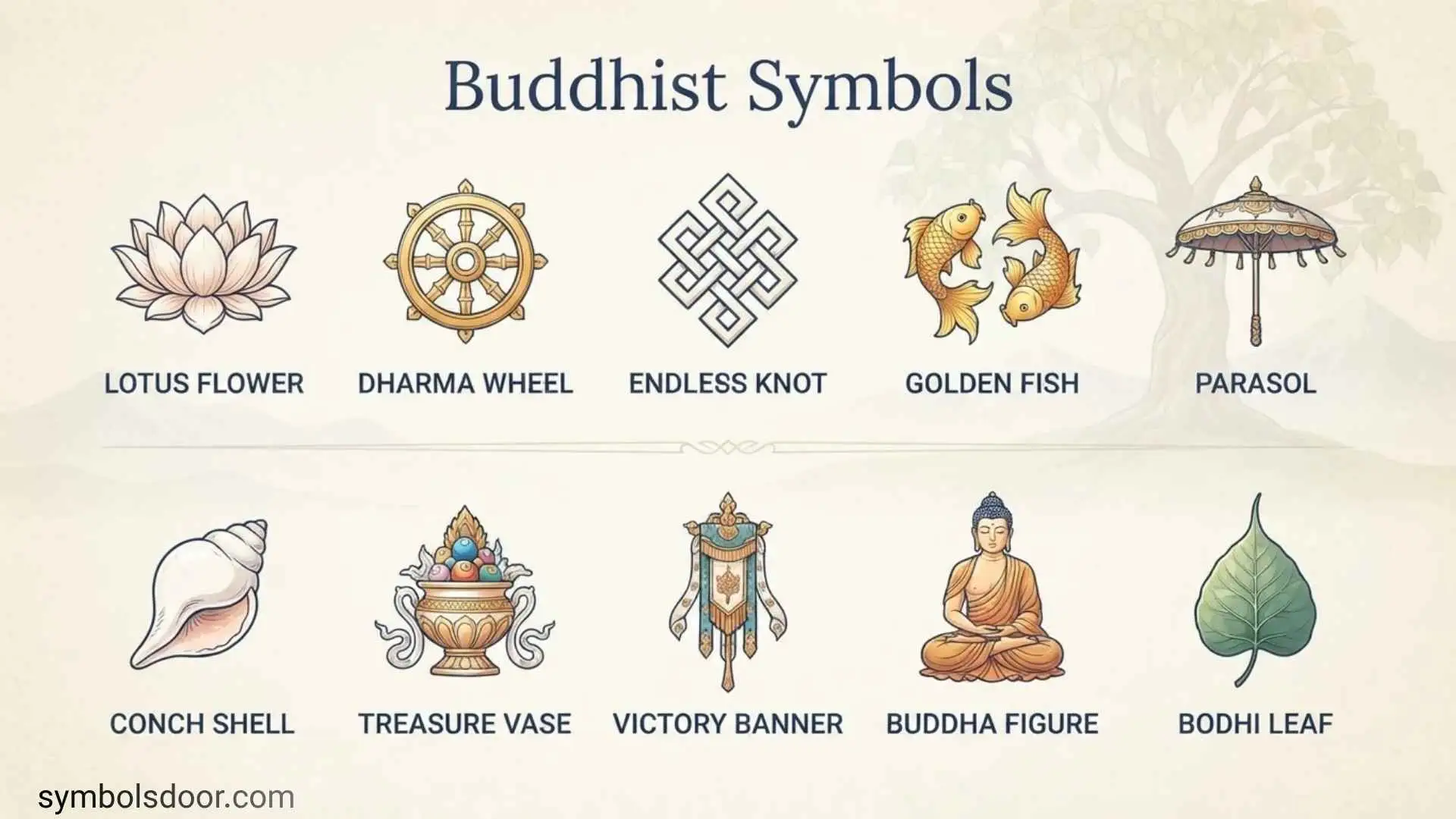
Buddhist symbols communicate some of the most important ideas in Buddhism, including enlightenment, wisdom, compassion, purity, and liberation. You can find these symbols in Buddhist temples, ancient sculptures, religious paintings, meditation spaces, prayer flags, and everyday devotional objects. Some represent the Buddha and his teachings, while others illustrate the path toward awakening or remind practitioners of important spiritual values.
The Dharma wheel, Bodhi tree, lotus flower, vajra, and Three Jewels are among the best-known examples. Another important group is the Eight Auspicious Symbols, traditionally called the Ashtamangala, which appears especially often in Tibetan and Himalayan Buddhist art.
However, Buddhist symbolism isn’t exactly the same everywhere. Theravada Buddhism, Mahayana Buddhism, Vajrayana Buddhism, and Zen Buddhism share many important symbols, but each tradition also has distinctive imagery and interpretations.
This guide explains the most recognizable Buddhist symbols, their meanings, historical backgrounds, and uses across different Buddhist cultures.
What Are Buddhist Symbols?
Buddhist symbols are visual signs, sacred objects, images, and artistic designs that represent Buddhist teachings, beliefs, and spiritual principles. They help communicate ideas that can be difficult to explain through words alone.
For example, the lotus flower represents purity and spiritual development. The Dharma wheel represents the Buddha’s teachings, while the Bodhi tree recalls the Buddha’s enlightenment.
These symbols appear in different forms, including:
- Religious emblems: Dharma wheels, the Three Jewels, and the swastika.
- Natural symbols: Lotus flowers, Bodhi trees, and animals.
- Sacred objects: Prayer beads, bells, vajras, and alms bowls.
- Architectural features: Stupas, pagodas, and temple decorations.
- Sacred diagrams: Mandalas and the Wheel of Life.
- Human representations: Buddha figures, Bodhisattvas, and Buddhist deities.
Why Are Symbols Important in Buddhism?
Buddhist symbols help practitioners remember the Buddha’s teachings and reflect on their spiritual goals. They also play an important role in Buddhist art, ceremonies, meditation, and devotional activities.
For instance, a Dharma wheel in a temple reminds visitors of the importance of following the Dharma. A prayer wheel containing sacred mantras supports devotional practice, while a mandala can serve as a focus for meditation and visualization.
Buddhist symbols commonly communicate ideas such as:
- Enlightenment and awakening: Freedom from ignorance and confusion.
- Wisdom (Prajna): Understanding reality and the nature of existence.
- Compassion: Concern for the suffering of other beings.
- Impermanence: The changing nature of all conditioned things.
- Emptiness (Sunyata): The absence of independent, permanent existence.
- Liberation: Freedom from the cycle of suffering known as samsara.
- Mindfulness: Awareness of thoughts, actions, and experiences.
A symbol doesn’t always have one fixed meaning. Its interpretation may depend on the Buddhist school, historical period, artistic setting, and religious practice.
Buddhist Iconography and Buddha Representation
Buddhist iconography refers to the visual features used to represent Buddhas, Bodhisattvas, deities, and sacred teachings. These features include body positions, hand gestures, clothing, colors, objects, and facial expressions.
For example, the Buddha’s earth-touching gesture is known as Bhumisparsha Mudra. It recalls the moment of enlightenment, when the Buddha called the earth to witness his awakening.
Other recognizable features include:
- Ushnisha: The raised feature on top of the Buddha’s head, associated with awakened wisdom.
- Urna: A mark between the eyebrows associated with the Buddha’s extraordinary qualities.
- Elongated earlobes: A reminder of his former royal life and renunciation.
- Monastic robes: A representation of simplicity and renunciation.
- Lotus throne: An image associated with purity and awakening.
Buddhist images are not merely decorative. In some traditions, consecrated statues and paintings serve as sacred supports for devotion, meditation, and religious practice. <Cite refs={[“turn948150search12″,”turn948150search1″,”turn948150search3”]}/>
Eight Auspicious Symbols of Buddhism (Ashtamangala)
The Eight Auspicious Symbols, known as the Ashtamangala in Sanskrit, form an important group of Buddhist religious emblems. They represent favorable qualities and spiritual principles associated with the Buddha’s teachings.
The complete group is particularly prominent in Tibetan Buddhism, Himalayan Buddhist traditions, and related forms of Buddhist art. Similar auspicious motifs also appear in other Asian cultures, although their arrangements and interpretations can differ.
<caption>Eight traditional Buddhist auspicious symbols</caption>
| Symbol | Sanskrit name | Common meaning |
| Lotus flower | Padma | Purity and enlightenment |
| Endless knot | Srivatsa | Interdependence |
| Pair of golden fish | Matsyayugma | Freedom and happiness |
| Victory banner | Dhvaja | Victory over ignorance |
| Dharma wheel | Dharmachakra | Buddha’s teachings |
| Treasure vase | Kumbha | Abundance and prosperity |
| Jeweled parasol | Chatra | Protection and dignity |
| White conch shell | Sankha | Proclamation of the Dharma |
Lotus Flower (Padma)
<caption>Purity, spiritual growth, and enlightenment</caption>
The lotus flower is one of the most recognizable Buddhist spiritual symbols. It grows in muddy water but rises above the surface with clean, beautiful petals. This natural process represents the possibility of developing wisdom and purity despite the difficulties of worldly life.
In Buddhist art, Buddhas and Bodhisattvas often sit or stand on lotus-shaped seats. The flower represents spiritual awakening and freedom from ignorance.
Different lotus colors can carry additional meanings in particular Buddhist traditions. However, their interpretations aren’t identical across every school.
Endless Knot (Srivatsa)
<caption>Interdependence and interconnectedness</caption>
The endless knot features a continuous pattern of interwoven lines without an obvious beginning or end. It represents interconnectedness and the relationship between different aspects of existence.
In Tibetan Buddhist symbolism, it is commonly associated with dependent origination, the principle that things arise through causes and conditions rather than existing independently.
The knot also represents the relationship between wisdom and compassion. It appears on religious paintings, temple decorations, textiles, and ceremonial objects.
Pair of Golden Fish (Matsyayugma)
<caption>Freedom, happiness, and auspiciousness</caption>
The pair of golden fish represents freedom and good fortune in the Eight Auspicious Symbols.
Fish move freely through water, making them a useful image for liberation from the difficulties of samsara. In some Buddhist interpretations, they also represent happiness and fearlessness.
You can often find this symbol in Tibetan Buddhist decorations, paintings, and traditional ritual designs.
Victory Banner (Dhvaja)
<caption>Victory over ignorance and spiritual obstacles</caption>
The victory banner represents the triumph of wisdom over ignorance. It reminds practitioners that spiritual development involves overcoming harmful mental states and obstacles.
These include attachment, hatred, confusion, and other defilements that contribute to suffering.
The banner also represents the victory of the Buddha’s teachings. It appears in Tibetan temples, religious paintings, and traditional Buddhist ceremonial decorations.
Dharma Wheel (Dharmachakra)
<caption>The Buddha’s teachings and the Noble Eightfold Path</caption>
The Dharma wheel represents the Buddha’s teachings, known as the Dharma. Its eight spokes are commonly associated with the Noble Eightfold Path, which provides guidance for ethical conduct, mental discipline, and wisdom.
The wheel also recalls the Buddha’s first sermon at Deer Park in Sarnath, traditionally described as the turning of the Wheel of Dharma.
Treasure Vase (Kumbha)
<caption>Abundance, prosperity, and spiritual richness</caption>
The treasure vase represents abundance, longevity, and good fortune. In Buddhist symbolism, its contents can suggest inexhaustible spiritual benefits and the richness of enlightened qualities.
Its meaning isn’t limited to material wealth. It can also represent the abundance of wisdom, compassion, and positive qualities developed through Buddhist practice.
Jeweled Parasol (Chatra)
<caption>Protection, dignity, and spiritual authority</caption>
The jeweled parasol, also called the royal umbrella, represents protection and honor. Historically, umbrellas were associated with royalty and high status in South Asian cultures.
In Buddhist symbolism, the parasol represents protection from spiritual obstacles and harmful influences. It can also symbolize the dignity and authority of the Buddha’s teachings.
White Conch Shell (Sankha)
<caption>The spreading of the Dharma</caption>
The white conch shell represents the powerful sound of Buddhist teachings spreading in every direction. Its sound can carry across a large area, making it an effective symbol of the Dharma reaching different communities.
In Tibetan Buddhist traditions, a white conch with a clockwise spiral is especially auspicious. Conch shells are also used as ceremonial instruments in some Buddhist settings.
Main Buddhist Symbols and Their Meanings
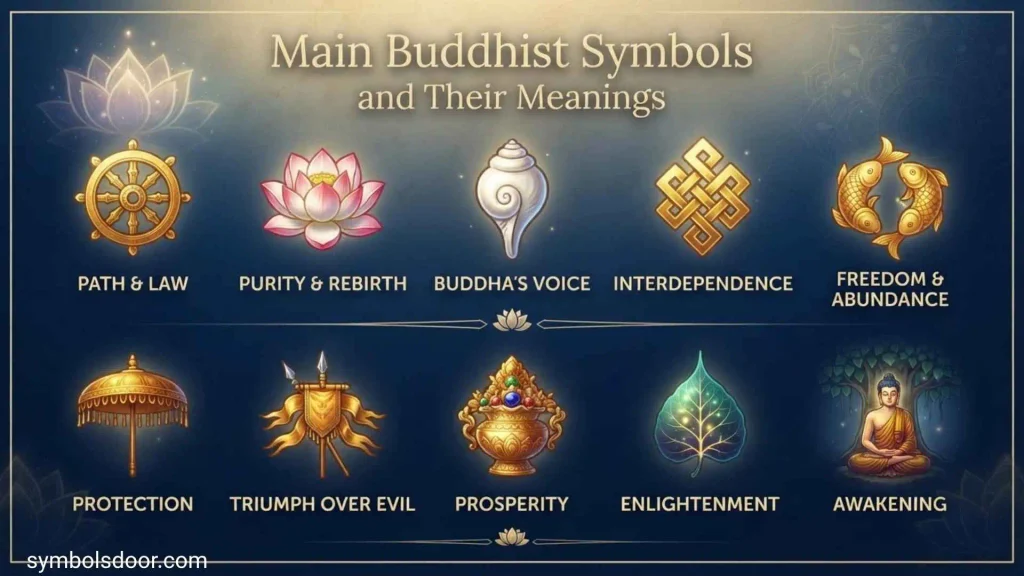
Beyond the Eight Auspicious Symbols, Buddhism uses many other important emblems, objects, and visual representations. Some have ancient roots in Indian Buddhist art, while others developed within specific regional traditions.
Dharma Wheel (Dharmachakra or Dhamma Wheel)
The Dharma wheel, also known as Dharmachakra in Sanskrit and Dhammacakka in Pali, is among the most important Buddhist religious symbols.
It represents the Buddha’s teachings and the path toward liberation. Its eight spokes are generally connected with the Noble Eightfold Path:
- Right view.
- Right intention.
- Right speech.
- Right action.
- Right livelihood.
- Right effort.
- Right mindfulness.
- Right concentration.
The wheel’s circular form can also suggest continuity and the ongoing transmission of the Dharma.
You can find the Dharma wheel on Buddhist monuments, temple entrances, religious paintings, and statues. In many Buddhist countries, it is also used as a recognizable emblem of Buddhist identity.
Bodhi Tree (Bodhirukka)
The Bodhi tree is the sacred fig tree associated with Gautama Buddha’s enlightenment. According to Buddhist tradition, Siddhartha Gautama attained awakening while meditating beneath a tree at Bodh Gaya in present-day Bihar, India.
The tree is therefore a powerful symbol of:
- Enlightenment and awakening.
- Wisdom and understanding.
- Meditation and mindfulness.
- Freedom from ignorance.
- Spiritual transformation.
The Bodhi tree is especially important in Theravada Buddhist countries, including Sri Lanka, Thailand, and Myanmar.
Bodhi tree shrines and sacred trees remain important places of Buddhist devotion. The tree represents the historical event of enlightenment rather than simply serving as a general nature symbol.
Stupa and Chörten
A stupa is a Buddhist monument traditionally associated with sacred relics, remembrance, and devotional practice. Early stupas often contained relics connected with the Buddha or other revered Buddhist figures.
Stupas developed into important architectural features across South and Southeast Asia. In Tibet, a stupa is commonly called a Chörten.
A traditional stupa may include:
- A square base.
- A rounded dome.
- A central pillar or spire.
- Decorative elements representing sacred principles.
- Relic chambers or other devotional features.
Stupas symbolize remembrance of the Buddha and his teachings. Their architecture also developed different regional forms, including the Tibetan chörten and East Asian pagoda.
Triratna (Three Jewels)
The Triratna, or Three Jewels, represents the three central refuges of Buddhism:
| Jewel | Meaning |
| Buddha | The awakened teacher |
| Dharma | The Buddha’s teachings |
| Sangha | The Buddhist community |
Taking refuge in the Three Jewels is a foundational expression of Buddhist commitment.
The Triratna symbol appears in early Buddhist art and can take different visual forms, including a distinctive three-part emblem. It reminds practitioners that the Buddha provides an example, the Dharma provides guidance, and the Sangha provides a community of support.
Vajra (Dorje)
The vajra, known as dorje in Tibetan, is a major symbol and ritual object in Vajrayana Buddhism.
The Sanskrit word vajra is associated with both a diamond’s indestructibility and the force of a thunderbolt. Its symbolism therefore includes strength, clarity, and awakened wisdom.
A vajra can represent:
- The indestructible nature of awakened awareness.
- Wisdom that cuts through ignorance.
- Spiritual power.
- The union of wisdom and method in Vajrayana practice.
A vajra is often used with a ritual bell. Together, these objects communicate important principles within tantric Buddhist practice.
Double Vajra (Vishvavajra)
The double vajra, also called the Vishvavajra or crossed vajra, features two vajra forms crossing one another.
It is associated with stability, protection, and the indestructible nature of awakened reality in relevant Vajrayana contexts.
The symbol appears in Tibetan Buddhist art, mandalas, ritual objects, and architectural decoration. Its exact interpretation depends on the particular ritual or visual system.
Buddha Footprints (Buddhapada)
Buddha footprints, known as Buddhapada, represent the Buddha’s presence and the path he left for others to follow.
In early Buddhist art, footprints were an important way to refer to the Buddha without depicting him in human form.
Traditional footprints may contain auspicious markings, including:
- Dharma wheels.
- Lotus designs.
- The Three Jewels.
- Other sacred emblems.
They remind practitioners of the Buddha’s teachings and the possibility of following the path toward awakening.
Empty Throne and Vajrasana
The empty throne is another important feature of early Buddhist art. It can represent the Buddha’s presence at a sacred location without showing his physical body.
The Vajrasana, or diamond throne, is especially associated with the place of enlightenment at Bodh Gaya.
An empty throne beneath a Bodhi tree or parasol can therefore refer to the Buddha’s awakening and the sacred site where it occurred.
Swastika in Buddhist Symbolism
The swastika is an ancient symbol used in several South Asian and East Asian religious traditions. In Buddhism, it traditionally represents auspiciousness, good fortune, and well-being.
It appears in Buddhist temples, sculptures, manuscripts, and decorative designs. In East Asian Buddhist settings, it can also be associated with eternity or the enduring nature of Buddhist teachings.
It’s important to distinguish this historical religious symbol from the Nazi appropriation of the swastika in the twentieth century. The Nazi emblem became associated with racial hatred, persecution, and genocide, while the traditional Buddhist symbol has a much older and different religious history.
The direction and appearance of the swastika can also vary across cultures.
Other Important Buddhist Symbols
| Symbol | Meaning or association |
| Cintamani | Wish-fulfilling jewel and spiritual abundance |
| Flaming sword of wisdom | Cutting through ignorance and confusion |
| Mandala | Sacred arrangement used in meditation and visualization |
| Bhavachakra | Samsara and the cycle of existence |
| Ensō | Circle used in Zen art and associated with awareness and expression |
| Gankyil | Threefold symbol found in Tibetan Buddhist contexts |
| Buddha eyes | Wisdom and awareness in Himalayan Buddhist art |
| Ever-burning lamp | Light, devotion, and the removal of darkness |
| Mala | Prayer beads used to count mantras |
| Yantra | Geometric diagram used in certain religious and contemplative contexts |
Buddhist Symbols in Early Buddhist Art and History
The history of Buddhist symbols is closely connected with the development of ancient Indian religious art. Early Buddhist artists used familiar visual motifs to communicate important teachings and commemorate events in the Buddha’s life.
Some of these symbols came from wider Indian artistic and religious traditions. Over time, Buddhist communities gave them meanings connected with the Dharma.
Aniconic Buddhist Art: How the Buddha Was Represented Before Statues
Aniconic Buddhist art refers to early visual traditions in which the Buddha was often represented through symbols rather than a human figure.
Artists used objects and sacred places to refer to important events in his life.
Common examples include:
- Bodhi tree: The Buddha’s enlightenment.
- Dharma wheel: The first sermon and teachings.
- Empty throne: The Buddha’s presence at a sacred location.
- Footprints: The Buddha’s presence and path.
- Stupa: Remembrance and association with the Buddha’s passing.
The interpretation of early Buddhist imagery remains a subject of scholarly discussion. Some scholars have questioned whether these symbols represent the absent Buddha, sacred places, important events, or broader Buddhist ideas.
Therefore, it’s better not to assume that every early symbol had only one meaning. <Cite refs={[“turn948150search12″,”turn948150search0″,”turn948150search15”]}/>
Buddhist Symbols During the Mauryan Era
The Mauryan era was an important period in the development of Buddhist history and art. Emperor Ashoka, who ruled much of the Indian subcontinent during the third century BCE, became a major supporter of Buddhism.
His inscriptions and monumental pillars helped communicate moral and religious messages across his empire.
The Pillars of Ashoka are particularly important examples of ancient Indian art. Their capitals and inscriptions include imagery associated with royal authority, animals, and Buddhist ideas.
The lion capital from Sarnath is especially well known. Its design includes four lions and a Dharma wheel motif. The wheel later became a prominent part of India’s national flag, although its modern national meaning is distinct from its historical Buddhist context.
Sanchi, Bharhut, and Amaravati
Several archaeological sites preserve important examples of early Buddhist visual culture.
- Sanchi: Famous for its stupas and carved gateways featuring Buddhist stories and symbolic imagery.
- Bharhut: Known for early stone railings and reliefs depicting Buddhist narratives and sacred motifs.
- Amaravati: Important for its detailed limestone sculptures and reliefs associated with Buddhist stories and teachings.
- Bodh Gaya: The sacred location associated with the Buddha’s enlightenment.
- Sarnath: The traditional location of the Buddha’s first sermon.
- Nagarjunakonda: An important archaeological site associated with ancient Buddhist monuments and art.
These sites show how the Dharma wheel, Bodhi tree, lotus, footprints, and stupa became important elements of Buddhist art.
The Development of Buddha Images
Human representations of the Buddha became prominent in Buddhist art around the early centuries of the Common Era.
Two especially important artistic centers were Gandhara and Mathura. Both developed influential forms of Buddha imagery during the Kushan period.
Gandharan art is known for its distinctive sculptural style, which includes artistic influences from the wider Hellenistic and Roman worlds. Mathura developed its own powerful tradition of Buddha and Bodhisattva sculpture.
Later, the Gupta period produced influential Buddha images known for their balanced proportions, calm expressions, and refined presentation.
These developments expanded Buddhist visual culture beyond its earlier symbolic forms.
Buddhist Symbols Across Different Traditions and Cultures
As Buddhism spread across Asia, its visual language developed through contact with different cultures. Some symbols remained widely recognizable, while others gained new meanings or artistic forms.
Symbols in Theravada Buddhism
Theravada Buddhism is especially prominent in Sri Lanka, Thailand, Myanmar, Laos, and Cambodia.
Important symbols include:
- Dharma wheel.
- Bodhi tree.
- Stupa.
- Buddha footprints.
- Lotus flower.
- Alms bowl.
Stupas and Bodhi tree shrines have a particularly important place in Theravada devotional life. Relics and sacred sites also play a significant role in religious practice.
Symbols in Mahayana Buddhism
Mahayana Buddhism places strong emphasis on the Bodhisattva ideal: the aspiration to attain awakening for the benefit of all sentient beings.
Its visual culture often features:
- Lotus flowers.
- Mandalas.
- Bodhisattva figures.
- The Three Jewels.
- Buddha images.
- Sacred scriptures.
Important figures include Avalokitesvara, associated with compassion; Manjushri, associated with wisdom; and Amitabha, associated with the Pure Land traditions.
Symbols in Vajrayana and Tibetan Buddhism
Vajrayana Buddhism uses an extensive system of ritual objects, sacred diagrams, colors, deities, and symbolic gestures.
Important examples include:
- Vajra and bell.
- Mandala.
- Kalachakra.
- Prayer wheels.
- Tibetan prayer flags.
- Eight Auspicious Symbols.
- Ritual drums and other ceremonial objects.
The symbolism of these objects can be highly specific. Their meanings often depend on particular tantric teachings, lineages, and ritual instructions.
Symbols in Zen Buddhism
Zen Buddhism is known for its distinctive visual culture, including the Ensō circle.
An Ensō is a circle drawn with a brush, often in a single expressive movement. It can suggest awareness, spontaneity, completeness, or the nature of mind, depending on the artist and context.
Zen art also uses calligraphy, simple natural imagery, and restrained compositions.
Japanese aesthetic concepts such as wabi-sabi and Mu can appear in discussions of Zen culture. However, they should not be treated as exact synonyms for Buddhist doctrines such as emptiness.
Symbols in Chinese, Japanese, and Korean Buddhism
East Asian Buddhist traditions developed distinctive forms of Buddhist art and architecture.
In Chinese Buddhism, the lotus, swastika, Dharma wheel, and images of Guanyin are especially recognizable.
In Japanese Buddhism, mandalas, Ensō circles, temple bells, and Zen calligraphy are important visual forms.
Korean Buddhist art includes distinctive Buddha sculptures, temple paintings, and architectural designs shaped by local artistic traditions.
Symbols in Southeast Asian Buddhism
Buddhist visual culture in Southeast Asia includes a wide range of regional styles.
Examples include:
- Thai Buddhist art: Known for distinctive Buddha images, temple decorations, and religious murals.
- Khmer Buddhist art: Includes Buddhist sculptures and architectural traditions influenced by the region’s religious history.
- Burmese Buddhist art: Features stupas, Buddha images, and devotional monuments.
- Lanna art: Associated with northern Thailand and its distinctive Buddhist artistic heritage.
- Sri Lankan Buddhist art: Includes important stupa traditions, Bodhi tree shrines, and Buddha images.
These regional traditions show how Buddhism developed a rich visual language without losing its central teachings.
Tibetan Buddhist Symbols and Their Meanings
Tibetan Buddhism has one of the most elaborate systems of Buddhist iconography. Its visual culture includes mandalas, ritual implements, sacred paintings, symbolic animals, and complex representations of Buddhas and deities.
Vajra and Bell (Vajra-Ghanta)
The vajra and bell are frequently used together in Vajrayana rituals.
The vajra represents indestructible wisdom and awakened awareness. The bell is associated with emptiness and wisdom.
Together, they express the relationship between wisdom and method, two essential principles in Vajrayana practice.
Some interpretations also discuss male and female principles, but the symbolism is more complex than a simple gender pairing.
Mandala and Kalachakra
A mandala is a structured sacred diagram used in Buddhist meditation, ritual, and visualization.
Its carefully arranged shapes and figures can represent a sacred palace, a Buddha’s enlightened environment, or a particular system of Buddhist teachings.
The Kalachakra mandala is a specialized form associated with the Kalachakra tradition. It contains complex imagery connected with cosmology, time, meditation, and spiritual transformation.
Mandalas are not merely geometric decorations. In their religious settings, they function as structured supports for practice.
Tibetan Prayer Flags and Mani Stones
Tibetan prayer flags are colorful cloth flags printed with prayers, mantras, and auspicious imagery. They are commonly displayed in mountain areas, monasteries, homes, and sacred locations.
The traditional five colors are:
- Blue.
- White.
- Red.
- Green.
- Yellow.
Their arrangement and associations can connect with elemental and cosmological systems.
Mani stones are stones carved or inscribed with sacred prayers, especially Om Mani Padme Hum, a mantra associated with Avalokitesvara.
Prayer flags and Mani stones are important parts of Tibetan Buddhist devotional culture.
Bhavachakra (Wheel of Life)
The Bhavachakra, or Wheel of Life, illustrates samsara: the cycle of birth, death, and rebirth.
It commonly includes six realms of existence and a central section representing three mental poisons:
- Ignorance.
- Attachment or desire.
- Aversion or hatred.
These mental states help sustain suffering and keep beings caught in samsara.
The Wheel of Life is a visual teaching tool. It helps practitioners reflect on the causes of suffering and the possibility of liberation.
Buddha Eyes and Wisdom Eyes
Buddha eyes, also called wisdom eyes, appear on stupas in Nepal and other Himalayan Buddhist settings.
They symbolize the Buddha’s wisdom and awareness. Their placement on the stupa suggests that awakened wisdom observes the world.
They are especially recognizable on the architecture of Boudhanath and other Nepalese Buddhist monuments.
Other Tibetan Ritual Symbols
| Symbol or object | Common meaning or use |
| Kila (Phurba) | Ritual implement associated with overcoming obstacles |
| Khatvanga | Tantric staff associated with specific deities and practices |
| Kapala | Ritual skull cup |
| Kartika | Ritual curved knife |
| Damaru | Small ritual drum |
| Kangling | Traditional thighbone trumpet used in certain rituals |
| Gankyil | Threefold symbol in Tibetan Buddhist contexts |
| White A | Symbol used in particular Dzogchen teachings |
| Wind Horse | Auspicious symbol associated with vitality and good fortune |
| Snow Lion | Emblem of strength and Tibetan cultural identity |
These objects and symbols should be understood within their specific ritual and cultural settings rather than treated as interchangeable decorations.
Five Buddha Families and Five Wisdom Buddhas
Some Vajrayana systems organize important Buddha figures into five families. These are associated with particular directions, colors, wisdoms, and symbolic qualities.
| Buddha | Common color association | Associated wisdom |
| Vairocana | White | Wisdom of the Dharmadhatu |
| Akshobhya | Blue | Mirror-like wisdom |
| Ratnasambhava | Yellow | Wisdom of equality |
| Amitabha | Red | Discriminating wisdom |
| Amoghasiddhi | Green | All-accomplishing wisdom |
The five families are also connected with teachings about transforming the five poisons into the five wisdoms.
These systems vary in their details, and their symbolism should be understood within the particular Vajrayana tradition being discussed.
Buddhist Colors and Their Meanings
Buddhist colors communicate spiritual qualities, religious teachings, and symbolic associations. Their meanings can differ depending on the culture, deity, ritual, and artistic tradition.
The five colors commonly associated with Tibetan prayer flags are blue, white, red, green, and yellow.
| Color | Common associations in Tibetan Buddhist contexts |
| Blue | Space and vastness |
| White | Purity and clarity |
| Red | Fire and transformation |
| Green | Activity and enlightened action |
| Yellow | Earth and stability |
These are useful general associations, not a universal code for every Buddhist tradition.
Meaning of White in Buddhism
White often represents purity, peace, and clarity.
It appears in the white conch shell and in images of White Tara. In relevant Buddhist contexts, it can suggest the removal of obstacles and the development of peaceful qualities.
Meaning of Green in Buddhism
Green is associated with enlightened activity and compassionate action in certain Tibetan Buddhist systems.
Green Tara is a prominent example. She is widely associated with compassionate activity and protection from obstacles.
Meaning of Yellow in Buddhism
Yellow can represent earth, stability, abundance, and prosperity in Tibetan Buddhist symbolism.
Yellow and saffron-colored robes also appear in several monastic traditions, although Buddhist monks do not all wear the same color.
Meaning of Blue in Buddhism
Blue is associated with space, vastness, and particular forms of awakened wisdom.
It is also connected with Akshobhya in the five Buddha-family system.
Meaning of Red in Buddhism
Red can represent fire, transformation, and particular forms of spiritual power.
Amitabha is commonly depicted in red in Vajrayana iconography.
Black, Orange, and Gold in Buddhist Art
Black can appear in protective or wrathful imagery, depending on the deity and artistic tradition.
Orange and saffron are associated with monastic robes in several Buddhist communities. Gold is widely used in sacred art to communicate preciousness, honor, and the elevated status of enlightened figures.
Color meanings should always be interpreted in context rather than applied as a single fixed system.
Buddhist Animal Symbols and Their Meanings
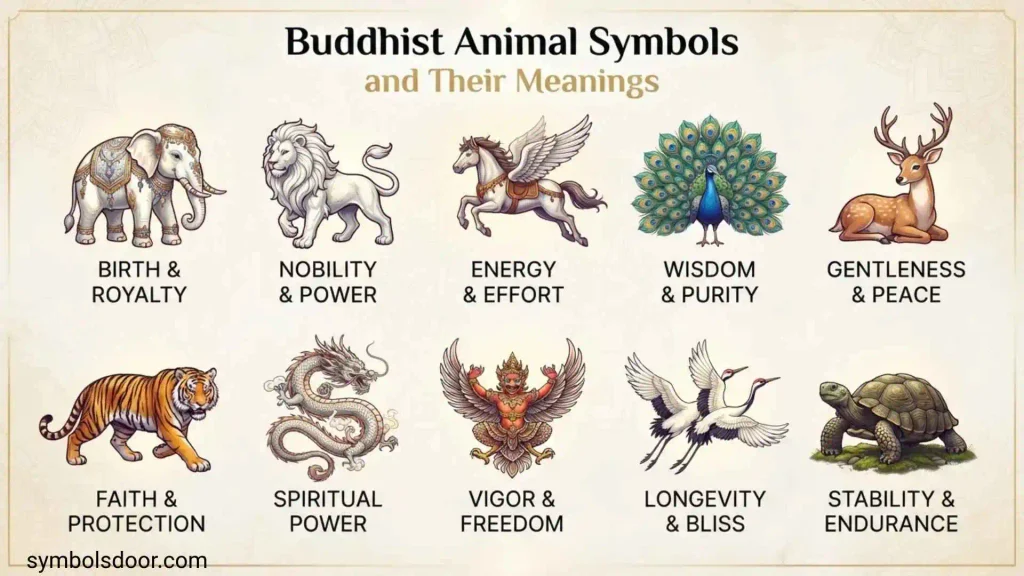
Animals appear throughout Buddhist stories, Jataka narratives, temple decoration, and religious paintings. They can represent spiritual qualities, moral lessons, protective powers, or important events in the Buddha’s life.
Lion and Snow Lion
The lion represents strength, courage, and the authority of the Dharma.
The expression Lion’s Roar (Sihanada) is associated with the power and confidence of the Buddha’s teachings.
The Snow Lion is especially important in Tibetan culture. It represents strength, fearlessness, and auspiciousness, and is widely used as a cultural emblem.
White Elephant
The white elephant is associated with the traditional account of Queen Maya’s dream before the birth of Siddhartha Gautama.
In Buddhist stories, the elephant can represent strength, dignity, and auspiciousness. It also appears in the wider artistic traditions of South and Southeast Asia.
Deer
The deer is strongly connected with the Buddha’s first sermon at Deer Park in Sarnath.
Deer are often depicted beside a Dharma wheel, creating a visual reference to the beginning of the Buddha’s teaching career.
They can also represent gentleness, peace, and a receptive attitude toward spiritual teachings.
Horse and Wind Horse
The horse is connected with the story of Kanthaka, the horse traditionally associated with Siddhartha Gautama’s renunciation.
In Tibetan cultural symbolism, the Wind Horse represents vitality, good fortune, and the successful movement of positive energy.
Nāga and Mucalinda
Nāgas are serpent-like beings that appear in Buddhist stories and South Asian religious traditions.
One famous Buddhist story describes the naga king Mucalinda protecting the meditating Buddha from heavy rain.
Naga figures also appear in Buddhist temple architecture, especially in Southeast Asian traditions.
Peacock
The peacock appears in Buddhist stories and Vajrayana imagery. In some traditions, it is associated with transformation and the ability to work with poison.
It is also connected with certain Buddhist deities and symbolic systems.
Garuda, Dragon, and Tiger
Garuda is a powerful mythical bird found in South Asian and Himalayan religious imagery. In some traditions, it represents protection and the overcoming of harmful forces.
The dragon appears widely in East Asian Buddhist art and is often associated with power, protection, and auspiciousness.
The tiger appears in Tibetan and Himalayan cultural imagery, where it can represent strength and confidence.
Buddhist Deities, Buddhas, and Bodhisattvas as Symbols
Buddhist figures communicate important religious qualities through their appearance, posture, gestures, colors, and objects.
It’s useful to distinguish between Buddhas, Bodhisattvas, and protective deities because they have different roles within Buddhist traditions.
Gautama Buddha (Shakyamuni Buddha)
Gautama Buddha, also called Shakyamuni Buddha, is the historical teacher at the center of Buddhism.
His images commonly include monastic robes, elongated earlobes, the ushnisha, and symbolic hand gestures known as mudras.
Some important gestures include:
- Bhumisparsha Mudra: Touching the earth, associated with enlightenment.
- Dhyana Mudra: Hands resting in meditation.
- Abhaya Mudra: A raised hand associated with fearlessness and reassurance.
- Dharmachakra Mudra: A gesture associated with teaching the Dharma.
Five Wisdom Buddhas
The Five Wisdom Buddhas are important in Vajrayana Buddhist iconography:
- Vairocana.
- Akshobhya.
- Ratnasambhava.
- Amitabha.
- Amoghasiddhi.
Their colors, directions, attributes, and wisdoms form part of a detailed symbolic system used in particular tantric traditions.
Avalokitesvara and Guanyin
Avalokitesvara is a Bodhisattva associated with compassion. In Tibetan Buddhism, the figure is especially important and is closely connected with the mantra Om Mani Padme Hum.
In Chinese Buddhism, Avalokitesvara developed into the widely revered figure known as Guanyin.
Representations vary across cultures. Some show a single compassionate figure, while others include multiple arms or heads to communicate the ability to respond to the suffering of many beings.
Manjushri
Manjushri represents wisdom and insight.
He is often shown holding a flaming sword that cuts through ignorance and confusion. In some images, he also holds a Buddhist scripture, representing knowledge and understanding.
Green Tara and White Tara
Green Tara is associated with compassionate activity and protection. She is often depicted in a seated posture with one leg extended, suggesting readiness to respond.
White Tara is associated with long life, healing, and peaceful qualities in Tibetan Buddhist traditions. She is commonly shown with multiple eyes, symbolizing awareness.
Other Important Buddhist Figures
Other figures include:
- Kshitigarbha: A Bodhisattva associated with helping beings in difficult circumstances and the realms of suffering.
- Prajnaparamita: A personification of the perfection of wisdom.
- Guru Rinpoche (Padmasambhava): A major figure in Tibetan Buddhist history and tradition.
- Vajrayogini: An important tantric deity.
- Jambhala: Associated with wealth and prosperity in certain Buddhist traditions.
- Vasudhara: A figure associated with abundance and generosity.
Their iconographic details should be understood within the traditions in which they are worshiped or visualized.
Buddhist Ritual Objects and Their Symbolic Meanings
Buddhist rituals use many objects that support chanting, meditation, offerings, and devotional practice. These objects have practical functions as well as symbolic meanings.
Buddhist Prayer Beads (Mala)
A mala is a string of prayer beads used to count mantras, prayers, or repeated devotional practices.
Many Buddhist malas contain 108 beads, although other arrangements also exist.
The number 108 has several traditional interpretations in Buddhist and broader South Asian religious contexts. It is commonly used in mantra recitation and devotional routines.
Mala beads can be made from wood, seeds, stone, or other materials. Their importance comes from their role in practice rather than their material value.
Prayer Wheel
A Buddhist prayer wheel is a cylindrical object containing written mantras, often associated with Tibetan Buddhist practice.
Practitioners turn the wheel as part of devotional activity. The practice is connected with the recitation and repetition of sacred mantras.
Prayer wheels may be handheld, mounted in rows, or installed in larger structures around monasteries and sacred places.
Buddhist Bell and Vajra
The ritual bell and vajra are important ceremonial objects in Vajrayana Buddhism.
The bell is associated with wisdom and emptiness, while the vajra represents indestructible awakened awareness and method.
Their paired use communicates the relationship between wisdom and method in tantric practice.
Alms Bowl and Begging Bowl
The alms bowl is a central object in traditional Buddhist monastic life.
Monks in several Buddhist traditions use it to receive food offered by lay supporters. This practice connects monastic life with generosity and the relationship between the Sangha and the wider community.
The bowl also represents simplicity, dependence on alms, and renunciation of excessive possessions.
Wooden Fish (Mokugyo)
The wooden fish, known as Mokugyo in Japanese, is a percussion instrument used in some East Asian Buddhist temples.
It helps maintain rhythm during chanting and recitation.
Its name and fish-shaped design are associated in some explanations with wakefulness and vigilance. Its practical role in group chanting is especially important.
Ring Staff (Khakkhara or Shakujō)
The ring staff is a traditional Buddhist monastic implement. It can function as a walking staff and produce a ringing sound.
In some traditions, it is associated with monastic travel, ritual use, and announcing a monk’s presence.
Other Buddhist Ritual Objects
| Object | Purpose or symbolic association |
| Ever-burning lamp | Light, devotion, and wisdom |
| Incense | Offering and devotional practice |
| Damaru | Small ritual drum used in certain Vajrayana practices |
| Kila | Ritual implement associated with overcoming obstacles |
| Kapala | Ritual skull cup used in particular tantric contexts |
| Kartika | Ritual curved knife |
| Kangling | Traditional ritual trumpet |
| Conch shell trumpet | Ceremonial sound and proclamation |
| Votive lamp | Offering of light |
| Monastic robe | Renunciation and commitment to monastic life |
These objects should be interpreted according to their particular religious and cultural contexts.
Buddhist Architecture and Sacred Places
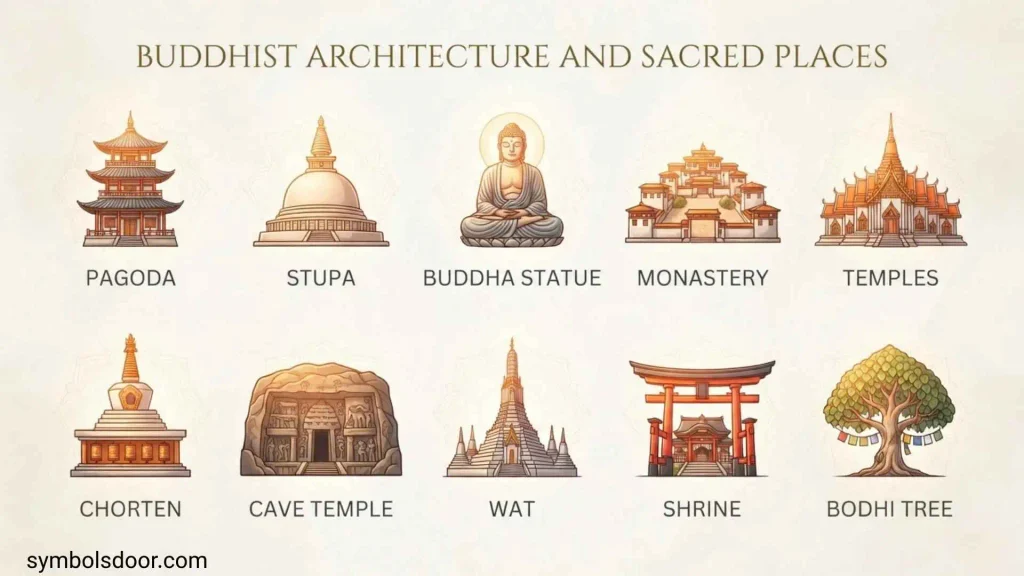
Buddhist architecture is filled with symbolic forms. Temples, stupas, pagodas, monasteries, and sacred shrines communicate Buddhist teachings through their structures and decorations.
Stupa Architecture and Symbolism
A traditional stupa often includes a base, dome, and upper structure. Its form varies across regions and historical periods.
Stupas are associated with relics, remembrance, and Buddhist devotion. Their construction and decoration may also communicate teachings about the Buddha and the path toward awakening.
Pagodas, Chörtens, and Buddhist Temples
A pagoda is a form of Buddhist sacred architecture especially associated with East Asian traditions. Its tiered structure developed through regional architectural styles.
A Chörten is the Tibetan form of a stupa. It may contain relics or serve as a sacred monument.
Although pagodas, stupas, and chörtens share historical and religious connections, they are not identical architectural forms.
Sacred Trees, Shrines, and Vajrasana
Bodhi tree shrines preserve the memory of the Buddha’s enlightenment.
The Vajrasana at Bodh Gaya is associated with the sacred place where the Buddha attained awakening. The term Bodhimanda refers to the sacred area or seat of enlightenment in relevant Buddhist contexts.
Buddhist Symbols in Temple Decoration
Common temple symbols include:
- Dharma wheels.
- Lotus flowers.
- Lions and guardian figures.
- Swastikas.
- Conch shells.
- Eight Auspicious Symbols.
- Buddha eyes.
- Bodhi tree motifs.
Their placement and meaning depend on the region and religious tradition.
Buddhist Symbols in Clothing and Physical Appearance
Buddhist clothing and physical appearance can communicate religious identity, discipline, and commitment to monastic life.
Buddhist Monk and Nun Robes
Buddhist monastic robes represent renunciation and dedication to the Buddhist path.
Robe colors and styles vary considerably. Theravada monks commonly wear shades of saffron, ocher, or brown, while other Buddhist communities use different colors and arrangements.
There is no single robe color shared by all Buddhist monks and nuns.
Shaved Heads and Monastic Identity
Head shaving is a common feature of Buddhist monastic life. It represents renunciation and a move away from worldly concerns about appearance and status.
It also forms part of the discipline and identity of many Buddhist monastic communities.
Zen Clothing and Traditional Monastic Accessories
In Japanese Zen traditions, the term koromo refers to monastic clothing.
Some Japanese Buddhist monks also practice takahatsu, a traditional form of alms begging. Straw hats may be worn during this practice.
These garments and accessories have practical uses as well as associations with monastic discipline and religious identity.
Buddhist Symbols in Modern Culture and Everyday Life
Buddhist symbols continue to appear in contemporary art, architecture, jewelry, and personal spiritual practices.
Buddhist Symbols in Jewelry and Personal Accessories
Common designs include:
- Lotus pendants.
- Dharma wheel necklaces.
- Endless knot bracelets.
- Mala beads.
- Vajra-inspired jewelry.
- Mandala designs.
Some people wear these objects as expressions of religious commitment, while others appreciate their artistic or cultural significance.
Understanding their original meanings helps prevent sacred symbols from becoming disconnected from their religious context.
Buddhist Symbols in Modern Art and Design
Artists continue to use Buddhist imagery in paintings, sculptures, architecture, textiles, and graphic design.
Contemporary works may reinterpret traditional motifs while retaining recognizable features such as the lotus, mandala, Dharma wheel, and Buddha images.
When using sacred Buddhist imagery, it’s worth understanding its cultural and religious significance rather than treating every object as a generic decoration.
Buddhist Symbols in Meditation and Personal Practice
Some symbols have practical roles in Buddhist meditation and devotional activities.
For example:
- Mandalas can support visualization.
- Mala beads help count mantras.
- Prayer wheels support devotional practice.
- Buddha images can serve as objects of reverence and reflection.
- Prayer flags display sacred texts and prayers.
- Dharma wheels remind practitioners of the Buddha’s teachings.
Their value lies in the practices and teachings they support.
Buddhist Symbols Compared With Hindu and Other Religious Symbols
Buddhism developed in ancient India, where several religious and philosophical traditions shared visual motifs and cultural practices.
As a result, some symbols appear in Buddhism, Hinduism, Jainism, and other South Asian traditions.
Shared Origins and Pan-Indian Symbolism
The lotus, swastika, conch shell, and vajra have histories that extend beyond a single religious tradition.
These are examples of Pan-Indian symbols: motifs that developed within a wider cultural environment and were adopted or reinterpreted by different communities.
The presence of a symbol in more than one religion doesn’t mean its meaning is identical everywhere.
Buddhist and Hindu Interpretations of Shared Symbols
| Symbol | Buddhist context | Hindu context |
| Lotus | Purity and spiritual awakening | Associated with deities, purity, and creation |
| Vajra | Indestructible wisdom and tantric ritual | Associated with Indra’s thunderbolt |
| Conch shell | Proclamation of the Dharma | Associated with Vishnu and ritual use |
| Swastika | Auspiciousness and good fortune | Auspiciousness and well-being |
The meaning depends on the specific religious story, artwork, or practice.
Symbols With Distinctly Buddhist Associations
Some symbols have especially strong connections with Buddhist teachings.
Examples include:
- Dharma wheel: The Buddha’s teachings.
- Triratna: Buddha, Dharma, and Sangha.
- Bodhi tree: The Buddha’s enlightenment.
- Bhavachakra: Samsara and the causes of suffering.
These symbols are closely tied to Buddhist philosophy and practice.
Common Misunderstandings About Buddhist Symbols
Even familiar Buddhist symbols can be misunderstood when people ignore their historical and cultural settings.
Here are some common mistakes to avoid:
- Assuming every Buddhist tradition uses identical symbols: Regional and school-specific differences are important.
- Treating the Eight Auspicious Symbols as universal: Their familiar arrangement is especially prominent in Tibetan and Himalayan traditions.
- Confusing the Buddhist swastika with the Nazi emblem: The traditional Asian religious symbol has a much older history and different meaning.
- Giving every lotus the same interpretation: Color and context can affect its symbolism.
- Assuming all Buddha statues represent the historical Buddha: Buddhist art includes many Buddhas and Bodhisattvas.
- Confusing stupas, pagodas, and chörtens: These architectural forms have related histories but distinct regional features.
- Treating every color association as universal: Color symbolism varies across traditions.
- Ignoring the ritual purpose of sacred objects: Vajras, bells, skull cups, and other implements may have specific ceremonial roles.
- Treating all animal symbols as fixed: Their meanings often depend on stories and regional traditions.
Frequently Asked Questions About Buddhist Symbols
What Are the Main Symbols of Buddhism?
Some of the main Buddhist symbols are the Dharma wheel, Bodhi tree, lotus flower, stupa, Triratna, vajra, Buddha footprints, and Eight Auspicious Symbols. These emblems represent important ideas such as enlightenment, wisdom, compassion, the Buddha’s teachings, and liberation. Their meanings can vary across Buddhist traditions and cultures.
What Are the Eight Auspicious Symbols of Buddhism?
The eight traditional symbols are the lotus, endless knot, pair of golden fish, victory banner, Dharma wheel, treasure vase, jeweled parasol, and white conch shell. Known as the Ashtamangala, they represent auspicious qualities and spiritual principles. They are especially prominent in Tibetan and Himalayan Buddhist art.
What Does the Dharma Wheel Symbolize?
The Dharma wheel represents the Buddha’s teachings and the path toward liberation. Its eight spokes are commonly associated with the Noble Eightfold Path: right view, intention, speech, action, livelihood, effort, mindfulness, and concentration. It also recalls the Buddha’s first sermon at Sarnath.
What Does the Lotus Flower Symbolize in Buddhism?
The lotus represents purity, spiritual development, and enlightenment. It grows in muddy water but rises above the surface with clean petals. This makes it a powerful image of developing wisdom and compassion despite the difficulties of worldly life. Buddhas and Bodhisattvas are often depicted on lotus seats.
What Does the Bodhi Tree Symbolize?
The Bodhi tree represents the enlightenment of Gautama Buddha. According to Buddhist tradition, Siddhartha Gautama attained awakening while meditating beneath a sacred fig tree at Bodh Gaya. The tree therefore symbolizes wisdom, awakening, meditation, and freedom from ignorance.
What Does the Vajra Symbolize?
The vajra represents indestructibility, awakened wisdom, and spiritual power in Vajrayana Buddhism. Its name is associated with both a diamond and a thunderbolt. As a ritual object, it is often used with a bell, expressing the relationship between wisdom and method.
What Does the Endless Knot Symbolize?
The endless knot represents interconnectedness and the relationship between causes and conditions. In Buddhist interpretation, it is commonly associated with dependent origination and the connection between wisdom and compassion. Its continuous design has no obvious beginning or end.
What Does the Buddhist Swastika Mean?
The Buddhist swastika is an ancient auspicious symbol associated with good fortune and well-being. It appears in several Asian religious traditions and has a history that predates its appropriation by Nazi Germany. Its traditional Buddhist meaning is different from the hateful ideology associated with the Nazi emblem.
What Does the Stupa Symbolize?
A stupa is a Buddhist monument associated with sacred relics, remembrance, and devotional practice. It can commemorate the Buddha or another revered Buddhist figure. Stupas also serve as important religious landmarks where practitioners offer respect and reflect on Buddhist teachings.
What Do Buddhist Colors Mean?
Buddhist colors can represent qualities such as purity, wisdom, compassion, stability, and transformation. Their meanings vary by tradition and context. In Tibetan Buddhism, blue, white, red, green, and yellow are especially recognizable in prayer flags and other sacred visual designs.
What Does the Number 108 Mean in Buddhism?
The number 108 is especially familiar through Buddhist prayer beads, or malas, which commonly contain 108 beads. Practitioners use them to count mantras and devotional recitations. The number also has broader symbolic interpretations in South Asian religious traditions, although explanations vary.
What Is the Meaning of Om Mani Padme Hum?
Om Mani Padme Hum is a well-known Buddhist mantra associated with Avalokitesvara, the Bodhisattva of compassion. It is especially important in Tibetan Buddhism and appears on prayer wheels, prayer flags, Mani stones, and other devotional objects. Its meaning is traditionally explained through the cultivation of compassion and wisdom.
What Is Aniconic Buddhist Art?
Aniconic Buddhist art refers to early Buddhist visual traditions in which the Buddha was often represented through symbols rather than a human figure. Common examples include the Bodhi tree, Dharma wheel, empty throne, footprints, and stupa. Scholars continue to discuss the precise meanings of these early images.
How Do Buddhist Symbols Differ Across Traditions?
Buddhist symbols differ through regional history, religious schools, and artistic traditions. Theravada art often emphasizes stupas, Bodhi trees, and Buddha images. Tibetan Vajrayana art includes vajras, mandalas, and ritual implements, while Zen art is known for forms such as the Ensō circle.
What Is the Difference Between a Buddhist Symbol and a Hindu Symbol?
Some symbols, including the lotus, vajra, conch, and swastika, appear in both Buddhist and Hindu traditions. However, their meanings depend on the religious context. The Dharma wheel and Three Jewels, for example, have especially important associations with Buddhist teachings.
Conclusion: Understanding Buddhist Symbols and Their Meanings
Buddhist symbols offer a visual way to understand the Buddha’s teachings, spiritual values, and religious traditions. The Dharma wheel represents the path of the Dharma, the Bodhi tree recalls enlightenment, and the lotus symbolizes purity and spiritual growth. The Eight Auspicious Symbols bring together important ideas such as protection, wisdom, abundance, and liberation.
These symbols also reveal how Buddhism developed across Asia. From early Indian relief sculptures to Tibetan mandalas, Japanese Zen paintings, and Southeast Asian temples, Buddhist visual culture reflects both shared teachings and regional creativity.
The most important point is that Buddhist symbols should be understood within their historical, cultural, and religious contexts. When you recognize those connections, the images become more than artistic designs. They become meaningful expressions of Buddhist philosophy and practice.

Hi, I’m Sienna Brooks, and I believe that the right words can inspire, comfort, and empower people at every stage of life. For as long as I can remember, I’ve been drawn to meaningful quotes and the stories behind them. I love curating collections of inspirational, motivational, and heartfelt quotes that resonate with readers around the world.
Through my writing, I strive to help others find encouragement, whether they’re celebrating life’s happiest moments or navigating its biggest challenges. I believe that wisdom is timeless, and I’m passionate about sharing words that leave a lasting impact.
I am the author of Reflections in Words and The Journey of Inspiration, two books dedicated to exploring the beauty and power of timeless quotes.
 Rowan Sinclair Rowan Sinclair
 Asher Monroe