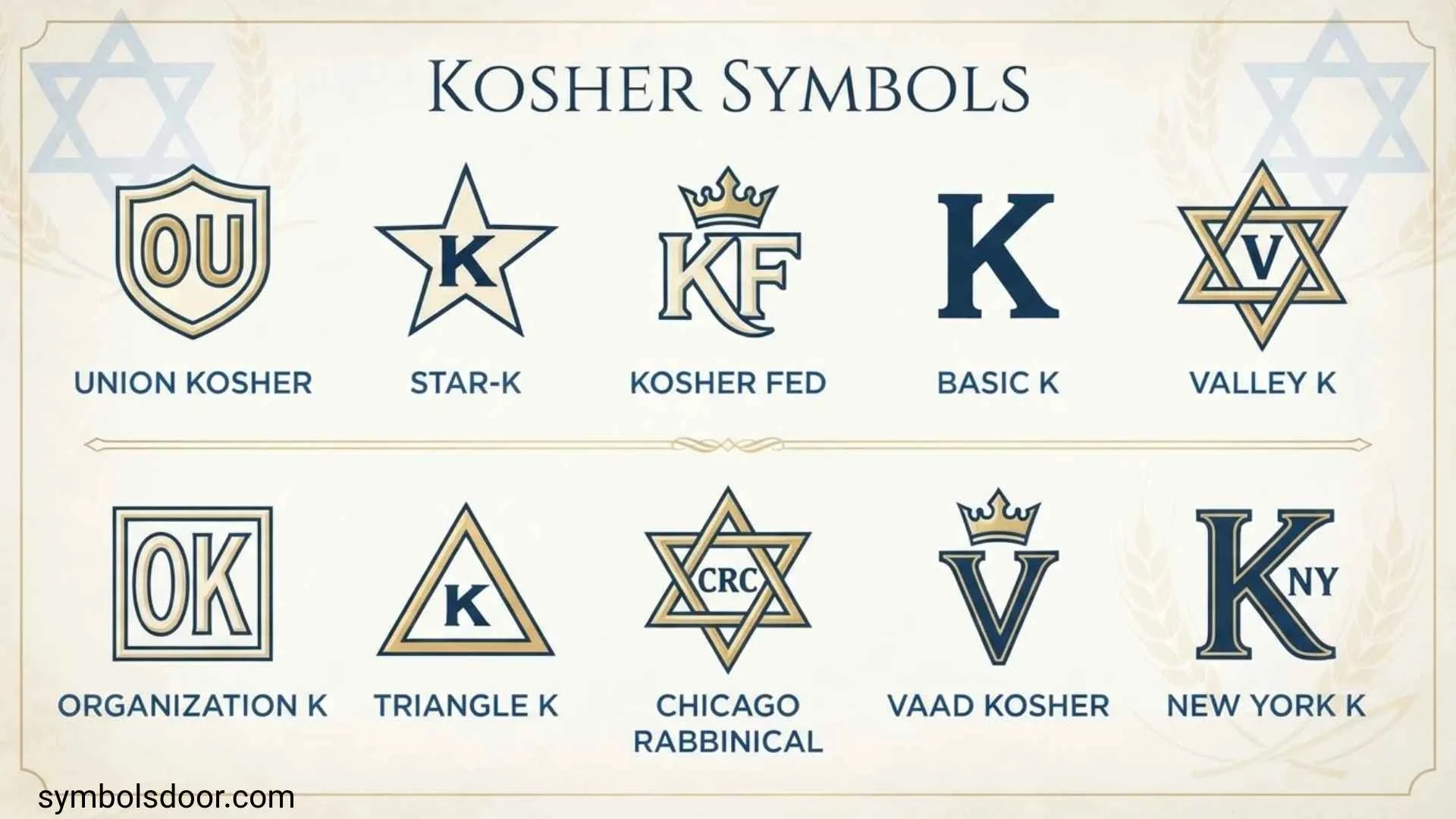
When you shop for packaged food, you may notice small symbols printed near the ingredients, nutrition facts, or product name. Some look like a letter inside a circle. Others use triangles, stars, Hebrew lettering, or abbreviations. These marks are kosher symbols, and they help consumers identify food products certified under Jewish dietary laws.
However, not every kosher symbol means the same thing. The OU symbol, Triangle K, cRc symbol, and KSA symbol, for example, identify different kosher certification organizations. Additional letters such as D, DE, M, and P can tell you whether a product is dairy, meat, made on dairy equipment, or certified for Passover.
Understanding these kosher certification symbols makes grocery shopping easier, especially if you follow Kashrut or buy food for someone who keeps kosher. It also helps you distinguish between a product’s certification organization and its actual food category.
This guide explains common kosher labels, what their symbols mean, how kosher certification works, and how to verify unfamiliar marks. You’ll also learn about meat, dairy, pareve, Passover certification, and why different Jewish communities may accept different kosher organizations.
What Are Kosher Symbols?
Kosher symbols are marks printed on food packaging to identify products certified by a kosher organization or rabbinical authority. These marks indicate that the product meets the kosher requirements followed by the organization supervising it.
You may also hear these marks called kosher seals, kosher certification logos, or a hechsher. A hechsher identifies the certification authority responsible for supervising or approving a product.
For example, the Orthodox Union uses the familiar OU mark, which looks like a U inside a circle. The Chicago Rabbinical Council uses the cRc name as its certification mark, while Kosher Supervision of America uses KSA.
These marks help consumers identify certified kosher products without investigating every ingredient and manufacturing step themselves.
What Is Kashrut?
Kashrut is the Hebrew term for the Jewish dietary laws that explain which foods are permitted and how food must be prepared, processed, and handled.
These Jewish dietary laws cover several areas, including:
- Which animals are permitted for consumption.
- How permitted animals must be slaughtered and prepared.
- Which fish and seafood qualify as kosher.
- The separation of meat and dairy foods.
- The ingredients used in processed products.
- The equipment and production methods used in food manufacturing.
- Additional restrictions observed during Passover.
The rules come from Jewish religious law, known as Halacha. Jewish communities may follow different customs and rabbinical guidance when applying certain details of these laws.
Kosher certification helps consumers identify products that have undergone supervision according to the standards of a particular certifying organization.
What Is a Hechsher?
A hechsher is a kosher certification mark or approval associated with a rabbi or kosher certification organization.
You can think of it as an identification mark that tells you who supervises a product. It may appear as a logo, letter, abbreviation, or Hebrew seal.
A hechsher generally provides two important pieces of information:
- The organization or rabbinical authority responsible for certification.
- The kosher status or category assigned to the product, when the label includes an additional designation.
For example, an OU-D mark identifies Orthodox Union certification with a dairy designation. The OU logo identifies the certifier, while the D tells consumers about the product’s dairy status.
What Is Hashgacha?
Hashgacha means kosher supervision. It refers to the oversight used to ensure that ingredients, equipment, preparation, and manufacturing processes follow the relevant kosher requirements.
A kosher supervisor may review ingredient suppliers, inspect production facilities, check equipment, and monitor manufacturing procedures.
The level and frequency of supervision depend on the product, production process, and certifying organization.
What Is a Mashgiach?
A Mashgiach is a person responsible for supervising kosher food preparation or production. The plural form is mashgichim.
A Mashgiach may work in a restaurant, commercial kitchen, food factory, catering facility, or another food production setting.
Typical responsibilities include:
- Checking ingredients and their certification documents.
- Monitoring food preparation.
- Inspecting equipment and utensils.
- Confirming that meat and dairy products remain properly separated.
- Checking cleaning and kosherization procedures when required.
- Supervising particular production stages.
- Reporting changes that could affect kosher compliance.
The Mashgiach plays an important role in kosher food supervision, especially when a product’s status depends on how manufacturers handle ingredients and equipment.
Common Kosher Certification Symbols and Their Meanings
Different kosher certification agencies use their own marks. Each organization has its own logo and certification procedures.
The following are some of the symbols consumers may encounter on food packaging in North America.
| Kosher symbol | Organization or meaning |
| OU | Orthodox Union |
| OU-D | Orthodox Union certification with dairy status |
| OU-P | Orthodox Union Passover certification |
| Triangle K | Triangle K certification mark |
| cRc | Chicago Rabbinical Council |
| KSA | Kosher Supervision of America |
| OK | OK Kosher certification |
| Star-K | Star-K Kosher Certification |
| Kof-K | Kof-K Kosher Supervision |
The appearance of a logo matters. A plain K, a circled K, and a K inside a triangle do not automatically identify the same organization.
OU Symbol: U Inside a Circle
<ins>OU</ins> is one of the most widely recognized kosher certification symbols in North America. It identifies certification by the Orthodox Union, a major Jewish organization that operates a kosher certification division.
The OU kosher symbol looks like a capital U inside a circle. Some people describe it as a U inside an O because the circular outline resembles the letter O.
The Orthodox Union reviews ingredients, manufacturing processes, and production facilities before authorizing its mark for approved products.
According to OU Kosher, the organization controls the use of its certification emblem. Products are endorsed under its program when they carry the authorized OU mark on their labels. <sup>Source: OU Kosher</sup>
An ordinary OU mark generally identifies a pareve product under OU labeling rules. However, additional letters can change the product’s classification.
Common OU designations include:
- OU: Generally pareve under OU labeling rules.
- OU-D: Dairy or produced on dairy equipment.
- OU-DE: Produced on dairy equipment, according to the OU’s specific designation.
- OU-Meat: Meat or meat-classified product.
- OU-F: Fish designation in relevant OU labeling contexts.
- OU-P: Certified kosher for Passover and pareve under the OU’s designation.
Always check the exact mark rather than assuming every OU-certified product has the same classification. OU Kosher explains its symbol categories here.
OU-D: Orthodox Union Dairy Symbol
The OU-D symbol indicates that a product is dairy or has been produced using dairy equipment under the Orthodox Union’s labeling standards.
It may appear on products such as:
- Cheese and yogurt.
- Milk-based desserts.
- Chocolate containing milk ingredients.
- Baked goods containing dairy ingredients.
- Processed foods made on dairy equipment.
The D designation matters because Jewish dietary law requires the separation of meat and dairy.
A product labeled OU-D should not be treated as pareve simply because it does not look like a traditional dairy food. Its ingredients and production equipment determine its classification.
OU-P: Orthodox Union Passover Symbol
The OU-P symbol identifies a product certified for Passover under Orthodox Union supervision.
Passover has additional dietary requirements. A product that qualifies as kosher throughout the year does not automatically qualify for the holiday.
The OU-P mark helps consumers identify products that have undergone the additional certification process.
One important detail: OU-P is not simply another way to write pareve. Under OU labeling, it identifies Passover certification and the product’s specific status must be understood from the full mark.
Triangle K Symbol
The Triangle K is a kosher certification mark associated with the Triangle K certification organization.
It uses a K inside a triangular outline. Consumers may encounter it on packaged food and other certified products.
However, a K inside a triangle should not be confused with every other kosher mark that uses a K. The exact logo identifies the issuing organization.
When checking a Triangle K product, consider:
- Whether the logo matches the organization’s official mark.
- Whether the product is listed in the certifier’s current information.
- Whether it carries a dairy, meat, pareve, or Passover designation.
- Whether the certification meets the standards followed by your household or community.
The Triangle K is an example of why recognizing the shape alone is not enough. You should identify the organization behind the mark.
cRc Symbol: Chicago Rabbinical Council
The cRc symbol identifies certification associated with the Chicago Rabbinical Council.
The organization provides kosher supervision and publishes consumer information to help people understand kosher products.
Consumers may see the cRc name or its certification mark on packaged foods. Some references describe the mark as cRc inside a triangle.
The cRc explains that kosher certification involves more than checking the ingredients printed on a package. Ingredients, processing aids that contact the food, and production equipment must also meet the relevant kosher requirements. <sup>Source: cRc Consumer Kosher</sup>
For example, a food manufacturer might use an ingredient that appears harmless but comes from a source that requires additional kosher verification. The certification organization reviews those details before approving the product.
KSA Symbol: Kosher Supervision of America
KSA stands for Kosher Supervision of America, a kosher certification organization based in the United States.
The KSA mark identifies products certified under its supervision. The organization also uses additional designations to explain product categories.
Its published symbol guide describes:
- KSA: Pareve products containing neither meat nor dairy ingredients.
- KSA-D: Dairy products or products processed on dairy equipment.
KSA also advises consumers to check ingredient panels because manufacturers may reformulate products, which can affect their kosher status. <sup>Source: KSA Kosher Certification Symbols</sup>
Other Kosher Certification Symbols
The OU, Triangle K, cRc, and KSA are not the only kosher organizations operating in North America and other regions.
Other recognizable marks include:
- OK: A certification mark associated with OK Kosher.
- Star-K: A kosher certification organization that uses a K inside a star.
- Kof-K: A certification organization with a distinctive K-shaped mark.
- Regional certification marks: Logos used by local rabbinical organizations and kosher authorities.
These organizations may certify products for different manufacturers, facilities, and markets.
A product’s certification should always be checked against the exact organization and its current information. Do not assume that two similar-looking symbols represent the same certifier.
What Do the Letters on Kosher Labels Mean?
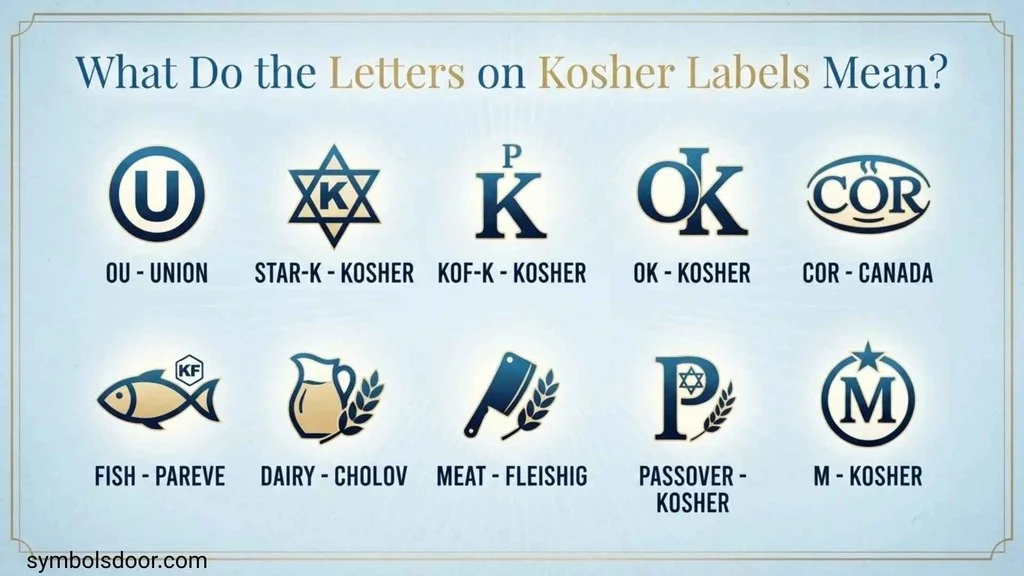
The letters printed beside a kosher logo often tell you more about a product than the main symbol alone.
For example, a certification mark may have a D, DE, M, F, or P beside it. These designations help consumers understand the product’s kosher classification.
However, labeling conventions can differ between kosher certification bodies. Always check the rules of the organization whose mark appears on the package.
| Designation | Common meaning |
| D | Dairy or dairy-classified product |
| DE | Dairy equipment |
| M or Meat | Meat or meat-classified product |
| Pareve or Parve | Neither meat nor dairy |
| P | Often indicates Passover certification |
| F | Fish designation used by some certifiers |
D or Dairy
The letter D commonly identifies a dairy product or a product classified as dairy by the certifying organization.
It may contain milk, cheese, butter, whey, casein, or another dairy ingredient.
Some products also receive a dairy designation because of the equipment used during production.
For example, a chocolate product may not contain an obvious milk ingredient, but if it is made on dairy equipment, the certifier may classify it as dairy equipment or dairy according to its labeling rules.
DE or Dairy Equipment
DE commonly means dairy equipment.
It indicates that a product was manufactured using equipment associated with dairy production, even if the product does not contain dairy ingredients.
This distinction matters to consumers who follow detailed meat-and-dairy separation practices.
Do not assume every certifier uses DE in exactly the same way. Check its official explanation before relying on the designation.
M or Meat
The letter M or the word Meat identifies a product containing meat or classified as meat under the certifier’s standards.
Examples may include:
- Kosher beef products.
- Kosher chicken products.
- Meat-based prepared meals.
- Processed foods containing meat ingredients.
Meat certification involves additional requirements concerning permitted animal species, slaughter, preparation, and production.
Pareve or Parve
Pareve, also spelled parve, means that a product is neither meat nor dairy under kosher classification.
It is an important category because pareve foods can generally be served with either meat or dairy meals, subject to the applicable kosher rules.
Examples of foods that may be pareve include:
- Fresh fruit.
- Vegetables.
- Plain grains.
- Certain oils.
- Some packaged snacks.
- Products made with approved non-meat and non-dairy ingredients.
However, a food is not automatically pareve just because its ingredient list contains no obvious meat or milk. Manufacturing equipment and processing methods can affect its status.
P or Passover
The letter P commonly identifies kosher for Passover certification.
It does not automatically mean pareve.
For example, an organization may use P to indicate that a product meets its Passover requirements. The product’s meat, dairy, or pareve classification must be understood from the full label.
This distinction is especially important during Passover shopping.
Three Main Kosher Food Categories: Meat, Dairy, and Pareve
Kosher food is commonly grouped into three categories: meat, dairy, and pareve. These classifications help consumers follow the dietary rules concerning ingredients, food preparation, and the separation of meat and milk.
Meat: Fleishig
Fleishig is a Yiddish term associated with meat.
Under kosher dietary law, only permitted animal species may be used for kosher meat. The animal must also be slaughtered and prepared according to the applicable Jewish legal requirements.
Common examples of kosher meat include properly certified beef, lamb, chicken, and turkey.
Kosher meat production involves more than checking the animal’s species. Slaughter, inspection, processing, and supervision all matter.
Consumers should look for a reliable kosher certification mark on packaged meat and poultry products.
Dairy: Milchig or Chalavi
Milchig is a Yiddish term for dairy, while Chalavi is a Hebrew-derived term used for dairy classification.
Dairy products include milk, cheese, yogurt, butter, cream, and foods containing dairy derivatives.
Some processed foods also receive a dairy designation because of their production equipment.
This explains why a packaged product that does not appear to be a milk-based food may still carry a D or dairy mark.
Pareve: Neutral Foods
Pareve foods contain neither meat nor dairy ingredients and meet the relevant kosher production requirements.
Many fruits, vegetables, grains, and other plant-based foods are naturally pareve. However, processing can change a product’s classification.
For example, a vegetable snack made on dairy equipment may not qualify for pareve status under the certifier’s rules.
Pareve does not mean vegan. Eggs and honey, for example, can be pareve even though they are not vegan.
Fish can also be pareve under kosher law, provided it comes from a permitted fish species and meets the applicable requirements.
Why Must Meat and Dairy Be Kept Separate?
One of the central principles of Jewish dietary laws is the separation of meat and milk.
This rule affects more than the ingredients in a recipe. It can also influence how people prepare, store, serve, and eat food.
Kosher households may use separate:
- Cooking pots and pans.
- Plates and serving dishes.
- Cutlery and utensils.
- Food preparation surfaces.
- Storage arrangements.
- Dishwashing equipment or procedures.
The exact household practices depend on the person’s religious guidance and community customs.
Kosher labels make this separation easier by identifying whether packaged products are meat, dairy, or pareve.
What Does Kosher for Passover Mean?
Kosher for Passover means that a product meets the additional kosher requirements observed during the Jewish holiday of Passover, also called Pesach.
A product can be kosher throughout the year but still be unsuitable for Passover.
This is why Passover products often carry a separate certification mark or designation.
What Is Kosher for Passover Certification?
Passover has special dietary restrictions involving chametz, which generally refers to leavened products made from certain grains.
The holiday’s rules affect ingredients, manufacturing, food preparation, and equipment.
For example, a product made from an ingredient that is acceptable throughout the year may require additional review before it can receive Passover certification.
Kosher certification organizations therefore supervise Passover production under additional requirements.
The Chicago Rabbinical Council explains that special Passover supervision is necessary because products and ingredients acceptable during the rest of the year may not meet Passover requirements. <sup>Source: cRc Consumer Kosher</sup>
What Does the P Symbol Mean on Kosher Labels?
The P designation commonly means that a product is certified kosher for Passover.
You may see it beside an organization’s certification mark, such as OU-P or another certifier’s Passover designation.
Do not confuse P with pareve. A product’s Passover status and its meat, dairy, or pareve category are different pieces of information.
Always read the full label and check the certification organization’s rules.
What Does Kasher l’Pesach Mean?
Kasher l’Pesach is a Hebrew phrase meaning kosher for Passover.
You may also see the wording Kosher for Pesach on food packaging, certificates, or product information.
Both phrases refer to Passover suitability, although the exact certification requirements depend on the supervising authority and the product.
Passover Food Restrictions
Passover food restrictions include avoiding chametz according to the applicable Jewish dietary rules.
Some Jewish communities also follow additional customs concerning foods known as kitniyot. These customs differ among Jewish traditions, particularly between many Ashkenazi and Sephardi communities.
This is one reason Passover certification and consumer guidance can vary.
When buying food for Passover, check:
- Whether the product has a specific Passover certification.
- Whether the mark belongs to a certifier you rely on.
- Whether the product is meat, dairy, or pareve.
- Whether the ingredients meet your community’s Passover requirements.
- Whether the certification applies to the exact product and package.
A regular kosher symbol alone does not automatically establish Passover certification.
How Does Kosher Food Certification Work?
Kosher certification is a structured process involving ingredient review, manufacturing inspections, supervision, and ongoing compliance checks.
The exact process differs between kosher certification agencies, but the central purpose is to ensure that a product meets the organization’s kosher requirements.
Ingredient Review
The certification organization reviews the ingredients used in a product.
This can include:
- Raw materials.
- Flavorings.
- Food colorings.
- Emulsifiers.
- Enzymes.
- Processing aids.
- Preservatives.
- Animal-derived ingredients.
- Ingredients supplied by outside manufacturers.
Some ingredients need extra attention because their source or manufacturing process may affect their kosher status.
For example, a flavoring ingredient may contain materials derived from animal sources. The certifier may need supplier documentation or further information before approving it.
The Orthodox Union describes an ingredient approval process in which ingredient sources are reviewed and authorized for certified products. <sup>Source: OU Kosher certification process</sup>
Food Production and Manufacturing Inspection
Kosher certification also considers how a product is manufactured.
A food factory may produce dairy, meat, pareve, and non-kosher products on shared machinery. The organization must determine whether the equipment and production procedures meet the relevant kosher requirements.
Inspectors may review:
- Production lines.
- Mixing tanks.
- Cooking equipment.
- Storage containers.
- Cleaning procedures.
- Ingredient handling.
- Packaging operations.
- Equipment used for meat and dairy production.
Manufacturing equipment matters because kosher status can depend on what the equipment previously processed and how it was cleaned or prepared.
Rabbinical Supervision
Rabbinical supervision helps ensure that food production follows the relevant kosher standards.
A rabbi or qualified kosher supervisor may review production records, approve ingredients, inspect facilities, and provide instructions for maintaining kosher compliance.
The organization may also assign a rabbinic coordinator to communicate with the manufacturer and handle certification questions.
The level of supervision depends on the product and production process.
Kosher Inspection and Ongoing Compliance
Kosher certification is not always a one-time inspection.
Organizations may conduct follow-up visits and review changes to ingredients, suppliers, equipment, or production methods.
For example, a manufacturer might replace a flavoring supplier to reduce costs. Even if the new ingredient has the same name, its source or processing method could affect kosher status.
The company must follow the certifier’s approval process before making changes that could affect its certification.
This ongoing process supports kosher compliance monitoring and helps ensure that certified products continue to meet the relevant standards.
What Does a Mashgiach Do During Food Production?
A Mashgiach may supervise particular production activities, especially when the process requires direct observation.
Responsibilities can include:
- Checking approved ingredients before production.
- Confirming that the correct materials enter the production line.
- Monitoring food preparation and processing.
- Checking equipment and cleaning procedures.
- Ensuring that meat and dairy production remain properly separated.
- Reporting production changes to the certifying organization.
Some facilities require continuous supervision for particular products or processes. Others operate under scheduled inspections and documented controls.
How Much Does Kosher Certification Cost?
There is no single price for kosher certification costs. Fees depend on the company, facility, products, and supervision requirements.
Factors that can affect certification expenses include:
- The number of products requiring approval.
- The number of manufacturing facilities.
- The complexity of the ingredients.
- The need for on-site supervision.
- The frequency of inspections.
- Equipment and production requirements.
- The certifying organization’s fee structure.
A small manufacturer producing a few simple products may have different costs from a large company operating several factories and manufacturing complex foods.
Companies should request a quote directly from the certification organization. Consumers generally do not need to know the manufacturer’s certification budget to understand a product’s kosher status.
Why Are There Different Kosher Certification Symbols?
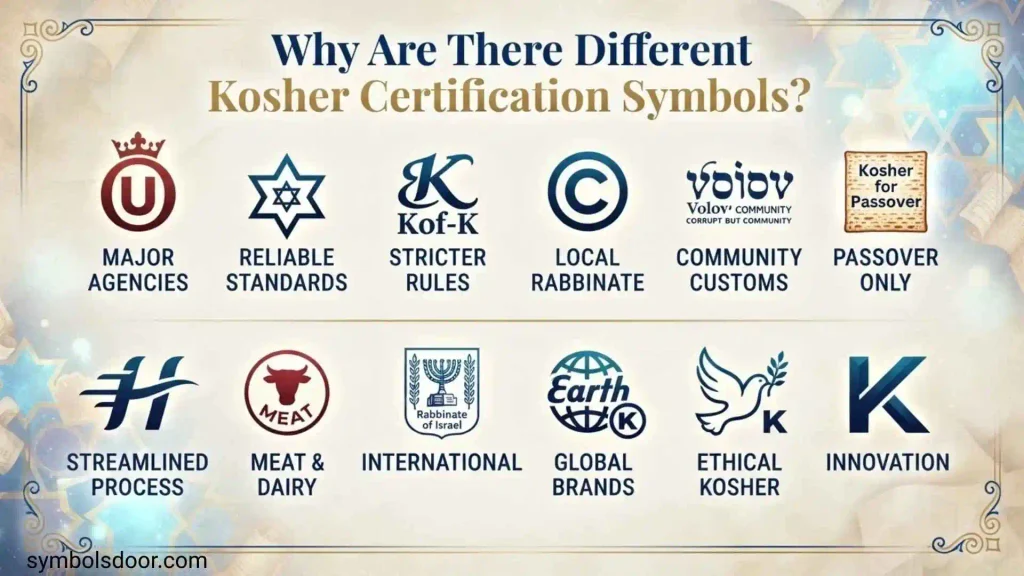
You may wonder why one product carries an OU symbol while another uses cRc, KSA, Triangle K, or a different logo.
The main reason is that multiple independent kosher certification organizations operate in different regions and markets.
Each organization has its own identity, certification procedures, supervision arrangements, and community relationships.
Different Kosher Certification Agencies
Some organizations operate nationally or internationally. Others focus on particular regions or communities.
Food manufacturers choose certification organizations based on factors such as:
- Their target customers.
- The organization’s reputation.
- Its geographic coverage.
- Its experience with particular food categories.
- Its supervision requirements.
- Its ability to inspect production facilities.
- The certification standards required by their customers.
This explains why supermarket shelves may contain products carrying many different kosher logos.
Differences in Rabbinical Opinions and Halachic Interpretations
Some kosher questions involve detailed interpretations of Halacha.
For example, certain ingredients, processing methods, and manufacturing situations may raise questions that require rabbinical review.
Different authorities may follow different opinions or apply particular standards to these cases.
This does not mean that every certification organization follows entirely different Jewish dietary laws. Many organizations share widely recognized kosher principles but may differ on specific applications or supervision policies.
Consumers should therefore check the exact certification rather than assuming that all symbols are interchangeable.
Community Acceptance and Orthodox Jewish Standards
Not every kosher-observant household follows the same certification list.
Some consumers rely on widely recognized national organizations. Others follow the guidance of a particular rabbi, synagogue, or community authority.
The acceptance of a kosher symbol can depend on:
- The certifying organization’s reputation.
- The standards it follows.
- The rabbinical authority behind its supervision.
- Its approach to particular ingredients.
- The community’s established practices.
- The type of product being certified.
This explains why one person may accept a certification mark while another prefers a different one.
Certification and community acceptance are related, but they are not identical. A product may carry a genuine kosher certification mark, yet a particular consumer may follow stricter requirements.
Are All Kosher Symbols Reliable?
No. You should not assume that every letter or symbol on a food package represents the same level of certification or the same organization.
A recognizable certification logo provides useful information, but consumers should still verify unfamiliar marks.
Why a Plain K Symbol May Not Be Enough
A plain letter K can appear on packaging as a manufacturer’s kosher claim. By itself, it does not necessarily identify an independent certification organization.
This is different from a distinctive, registered certification logo such as the Orthodox Union’s OU mark.
For example, a K inside a circle may belong to a specific certification organization, while a plain K printed without an identifying organization may not tell you who supervised the product.
The safest approach is to identify the certifier rather than relying on the letter alone.
How to Check Whether a Kosher Symbol Is Genuine
Follow these steps when you encounter an unfamiliar kosher food symbol:
- Identify the exact mark. Look at the letters, shape, and wording around the logo.
- Find the issuing organization. Check whether the mark belongs to a known kosher certification agency.
- Visit the organization’s official website. Look for a symbol directory or product search.
- Check the exact product. A certification may apply to some products from a brand but not its entire product range.
- Review additional designations. Check whether the product is dairy, meat, pareve, or Passover-certified.
- Confirm current status. Ingredient changes and certification updates can affect a product’s status.
- Ask a trusted rabbi if necessary. This is especially useful when your household follows specific community standards.
Which Kosher Symbols Are Accepted by Orthodox Jews?
There is no single list of symbols accepted by every Orthodox Jewish consumer.
Many Orthodox consumers rely on established certification organizations, but individual communities and rabbinical authorities may have different requirements.
Some may accept a broad range of certifications, while others may prefer organizations with particular supervision standards.
If you are buying food for someone else, ask which certification organizations they follow. This is more reliable than assuming that one familiar logo is accepted by everyone.
Is Gelatin Kosher?
Gelatin is an ingredient used in many processed foods. It helps create a thick, smooth, or gel-like texture.
You may find it in:
- Marshmallows.
- Gummy candies.
- Gelatin desserts.
- Some yogurt products.
- Certain confectionery products.
- Capsules and other manufactured products.
Its kosher status can be complicated because gelatin is commonly produced from animal-derived materials.
Where Does Gelatin Come From?
Commercial gelatin is generally made by processing collagen obtained from animal tissues, such as skin, bones, and connective tissue.
The animal source matters under Jewish dietary law.
For example, gelatin from a non-kosher animal raises different kosher questions from gelatin produced from a permitted animal under the required kosher conditions.
The manufacturing process and the rabbinical interpretation of that process can also matter.
Is Gelatin from Non-Kosher Animals Acceptable?
There are differing Halachic opinions on gelatin made from non-kosher animal sources.
Some rabbinical authorities have considered specific production methods and chemical transformations when assessing gelatin. Others follow stricter standards and do not accept certain animal-derived gelatin sources.
The answer should not be reduced to a universal yes or no.
For consumers, the practical approach is to look for a reliable kosher certification mark and check the product’s status with the issuing organization.
What Is Kosher Gelatin?
Kosher gelatin is gelatin produced and certified under kosher requirements accepted by the certifying authority.
Its status depends on the source material, manufacturing process, and rabbinical approval.
Some products use gelatin from permitted animal sources. Others may use fish-derived gelatin or alternative gelling ingredients, depending on the product and certification.
However, fish-derived gelatin also requires appropriate review and certification. The word fish alone does not guarantee that an ingredient is acceptable to every kosher consumer.
How to Identify Kosher Gelatin Products
When shopping for products containing gelatin:
- Check the complete ingredient list.
- Look for a recognized kosher certification mark.
- Review any meat, dairy, or pareve designation.
- Verify the exact product with the certifier if the source is unclear.
- Ask your rabbi if you follow specific standards concerning gelatin.
Do not assume that all gelatin is non-kosher or that every product labeled gelatin is acceptable. The source and certification matter.
How to Read Kosher Symbols on Food Packaging
Understanding kosher food labels becomes easier when you know what to check.
A small logo can tell you which organization supervises a product, while the letters beside it can provide information about its food category.
Use the following process when grocery shopping.
Find the Certification Logo
Start by looking for the kosher mark on the package.
It may appear near:
- The product name.
- The ingredients panel.
- The nutrition facts.
- The back or side of the packaging.
- The manufacturer’s product information.
Compare the mark with the organization’s official logo. Small differences in letters or shapes can identify different certifiers.
Check the Letters Beside the Logo
After identifying the organization, read any additional designation.
For example:
- D may indicate dairy.
- DE may indicate dairy equipment.
- M may indicate meat.
- Pareve may indicate neither meat nor dairy.
- P commonly indicates Passover certification.
These are common conventions, not universal rules for every organization.
Read the Ingredient List
A kosher symbol does not make ingredient information irrelevant.
Manufacturers can change recipes, suppliers, and production methods. These changes may affect a product’s kosher classification.
For example, a snack that previously carried a pareve designation might become dairy after a recipe change involving milk-derived ingredients.
The certifying organization should provide updated information when a product’s certification status changes.
Verify the Exact Product
A brand may sell dozens of products, but not every item necessarily carries the same certification.
One flavor may be dairy, another pareve, and a third may not be certified by the same organization.
Check the exact product name, flavor, packaging, and certification mark.
If the organization offers an online product directory, use it to confirm the product’s current status.
Kosher Certification Organizations in North America and Other Regions
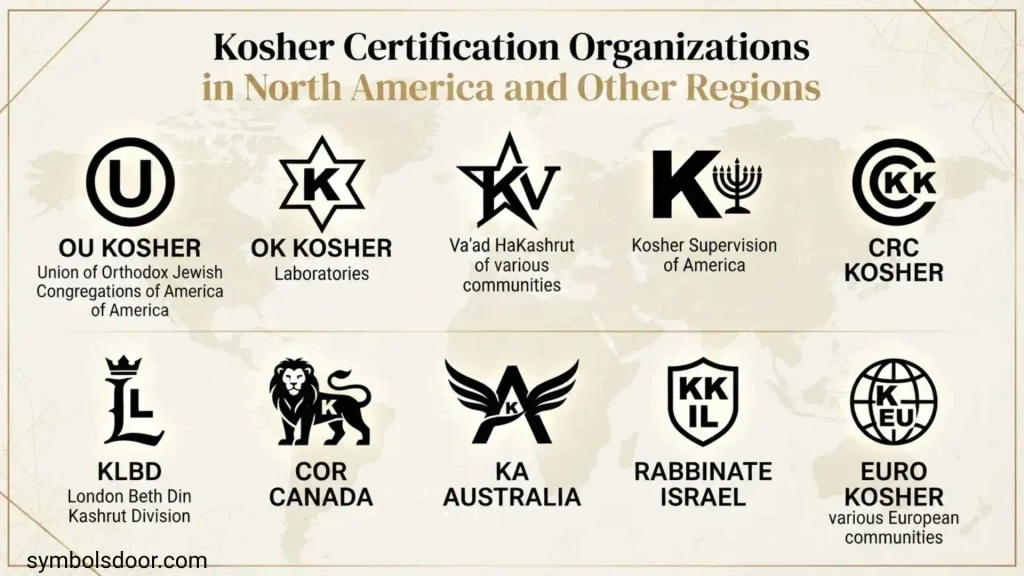
Kosher certification operates across national and international food markets.
Manufacturers may sell products in several countries, while consumers may follow certification organizations recognized by their local Jewish communities.
Kosher Certification in North America
North America has several established kosher certification agencies, including:
- Orthodox Union.
- Chicago Rabbinical Council.
- Kosher Supervision of America.
- OK Kosher.
- Star-K.
- Kof-K.
- Triangle K.
These organizations certify different food manufacturers, facilities, and products.
Their logos help consumers identify which authority supervises a particular product.
Regional Kosher Organizations
Some local kosher organizations serve specific cities or communities.
They may supervise restaurants, bakeries, food manufacturers, catering operations, and other businesses.
Regional organizations can provide local inspection and supervision that supports the needs of nearby Jewish communities.
However, recognition can vary outside the organization’s home region. Consumers should check whether a regional certification meets the standards they follow.
International Kosher Certification
Food companies that sell products internationally may work with certification organizations that operate across several countries.
A product manufactured in one country may carry a certification mark recognized by consumers in another.
International certification also requires attention to ingredients and manufacturing arrangements across supply chains.
For consumers, the basic rule remains the same: identify the exact certifier and verify the product rather than relying only on a familiar-looking logo.
Frequently Asked Questions About Kosher Symbols
What Is the Most Common Kosher Symbol?
The OU symbol is one of the most widely recognized kosher certification marks in North America. It identifies certification by the Orthodox Union.
Other recognized marks include cRc, KSA, OK, Star-K, and Kof-K.
What Does OU Mean on Food?
OU identifies kosher certification by the Orthodox Union. The mark usually appears as a U inside a circle.
Additional letters, such as D or P, provide further information about the product’s classification or Passover status.
What Does a U Inside a Circle Mean?
A U inside a circle is the familiar OU kosher symbol. It identifies products certified under the Orthodox Union’s kosher program.
What Does a Triangle K Mean?
Triangle K is a kosher certification mark associated with the Triangle K organization.
Check the exact logo and issuing organization because other kosher marks may also use the letter K.
What Does cRc Mean on Food?
cRc stands for the Chicago Rabbinical Council. Its certification mark identifies products supervised under its kosher certification program.
What Does KSA Mean in Kosher Certification?
KSA stands for Kosher Supervision of America. Its symbol identifies products certified under the organization’s supervision.
What Is the Difference Between Kosher and Kosher for Passover?
Regular kosher certification indicates that a product meets the applicable year-round kosher requirements.
Kosher for Passover certification means that the product also meets additional holiday-specific requirements.
A product that is kosher throughout the year is not automatically suitable for Passover.
Does Pareve Mean Vegan?
No. Pareve means that a food is neither meat nor dairy under kosher classification.
Pareve foods may contain eggs or honey, which are not vegan ingredients.
Does a Kosher Symbol Mean a Product Is Healthy?
No. Kosher certification concerns compliance with Jewish dietary laws. It does not automatically mean a product is nutritious, low in sugar, low in fat, organic, or healthier than other foods.
A kosher cookie, for example, can still contain sugar and saturated fat.
Can a Product Be Kosher Without a Symbol?
Yes. Some foods may be acceptable under particular kosher guidelines without carrying a printed certification mark.
However, processed foods often contain ingredients and undergo manufacturing steps that require additional verification. Consumers who follow kosher dietary laws should use the guidance of their rabbi or community when deciding which uncertified products are acceptable.
Can Two Products from the Same Brand Have Different Kosher Status?
Yes. Certification can differ between products, flavors, factories, and manufacturing processes.
One product may be pareve, another dairy, and another may not have kosher certification.
Always check the exact package rather than assuming that an entire brand has one kosher status.
Does a Rabbi Bless Food to Make It Kosher?
No. Kosher certification is not simply a blessing.
It involves reviewing ingredients, production methods, equipment, and other requirements under Jewish dietary law. Rabbinical supervision helps ensure that the relevant standards are followed.
Are All Kosher Certification Agencies the Same?
No. Organizations have different certification policies, supervision arrangements, and community recognition.
Many follow widely accepted kosher principles, but consumers may prefer particular certifiers based on their religious practice and rabbinical guidance.
Conclusion: How to Identify Kosher Symbols with Confidence
Kosher symbols help consumers identify food products certified under Jewish dietary laws. Marks such as OU, Triangle K, cRc, and KSA identify different certification organizations, while additional letters explain a product’s category or special status.
When reading kosher labels, remember these important points:
- OU identifies the Orthodox Union.
- cRc identifies the Chicago Rabbinical Council.
- KSA identifies Kosher Supervision of America.
- Triangle K identifies its own certification organization.
- D commonly indicates dairy.
- DE commonly indicates dairy equipment.
- M commonly indicates meat.
- Pareve means neither meat nor dairy.
- P commonly indicates Passover certification.
A familiar logo is useful, but you should always identify the certifier and check the exact product. Certification standards and community acceptance can differ, especially for ingredients such as gelatin and products intended for Passover.
When you are unsure about a mark, consult the organization’s official information or ask a trusted rabbi. That simple step can help you make informed choices while respecting the kosher requirements followed by your household or community.

Hello, I’m Rowan Sinclair, a passionate writer and lifelong admirer of the wisdom found in great quotes. I believe that words have the ability to inspire change, spark creativity, and connect people across cultures and generations.
I enjoy writing about motivational quotes, famous sayings, and lessons from history’s most influential thinkers. Every article I create is driven by my desire to help readers discover meaningful insights that they can apply to their own lives.
When I’m not writing, I spend my time reading biographies, exploring classic literature, and collecting memorable quotes that deserve to be shared with the world.
I am the author of Voices That Inspire and A Collection of Timeless Thoughts, two books that celebrate the enduring power of words and the stories behind them.
 Sienna Brooks
 Asher Monroe