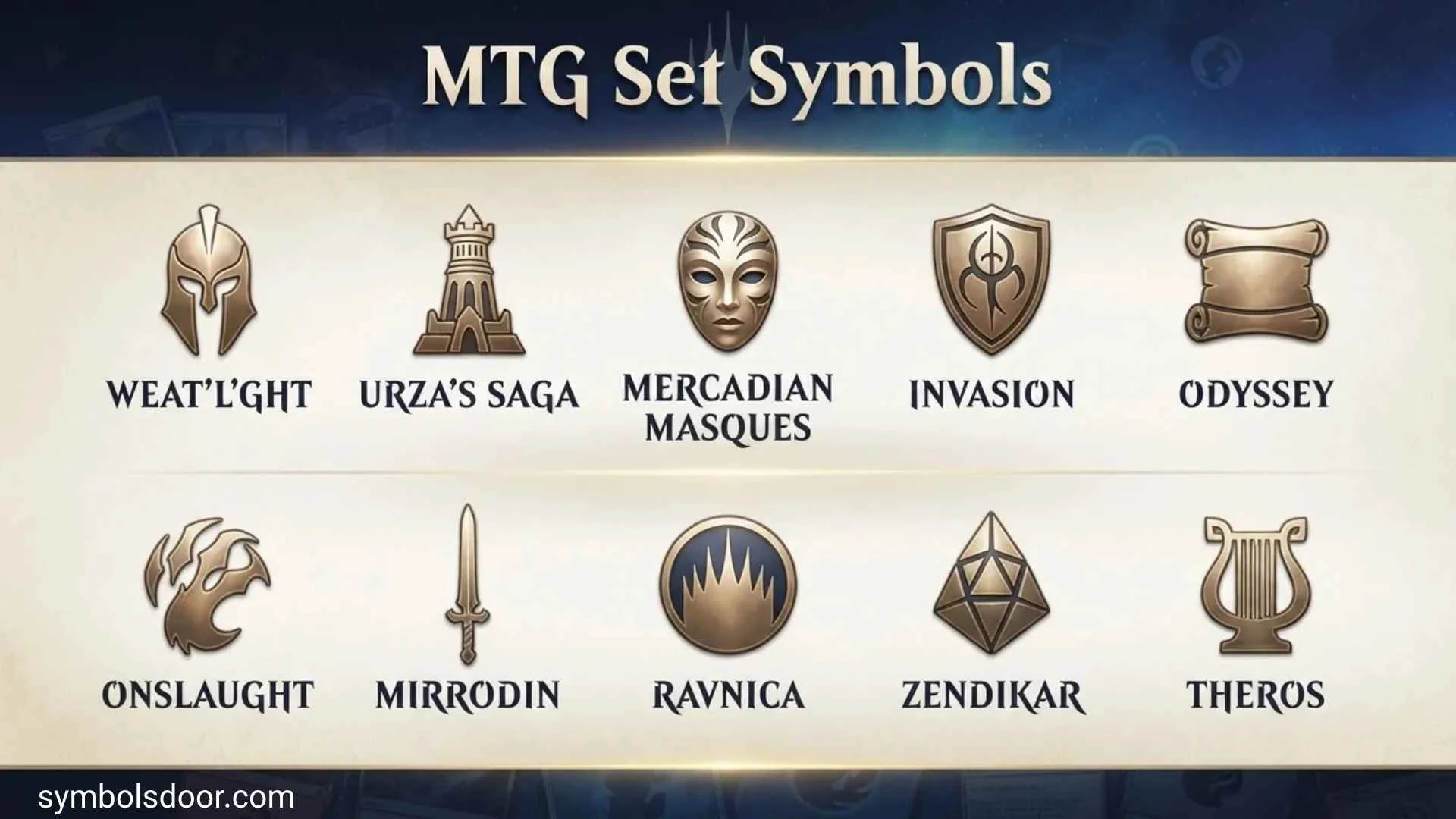
If you collect or play Magic: The Gathering (MTG), you’ve probably noticed the small symbols printed on your cards. Some look like shields, crowns, creatures, or other unique designs. Others have familiar colors, such as silver, gold, and orange-red.
These small icons are called MTG set symbols or expansion symbols. They help you identify the expansion or product in which a particular card printing appeared. Their colors also provide useful information about a card’s rarity.
However, there’s more to these symbols than appearance. They can help you identify different printings, organize a collection, research card prices, and distinguish cards with identical names. They’re especially useful when you own several versions of the same card.
This guide explains Magic: The Gathering set symbols, their meanings, their history, and how to use them for card identification. You’ll also learn how set symbols relate to rarity, card value, foil finishes, and format legality.
What Are MTG Set Symbols?
MTG set symbols are small graphic icons printed on Magic cards to identify the set associated with a particular printing. Wizards of the Coast calls them expansion symbols in the official game rules.
Each expansion or set generally has its own distinctive design. For example, a card from The Lord of the Rings: Tales of Middle-earth has a different expansion symbol from a card printed in Wilds of Eldraine.
The symbol gives collectors and players a quick visual way to recognize a card’s printing. You don’t have to rely entirely on its name or artwork.
According to the Magic: The Gathering Comprehensive Rules, the expansion symbol identifies the set from which a card comes. It has no effect on gameplay. <Cite refs={[“turn447706search36″,”turn447706search1”]}/>
In practical terms, a set symbol helps you answer questions such as:
- Which Magic expansion set does this card belong to?
- Is this an original printing or a later reprint?
- Are two cards with the same name from different sets?
- Which printing should you enter into your collection database?
- Where can you find accurate information about a card’s release and rarity?
What Information Does an MTG Set Symbol Provide?
A set symbol primarily identifies the card’s expansion. Its color also communicates rarity on printings that use the traditional rarity-color system.
However, the symbol doesn’t tell you everything about a card.
For complete Magic card identification, you should consider several details together:
- Card name: Identifies the card itself.
- Set symbol: Shows the associated expansion or product.
- Symbol color: Usually indicates the card’s rarity within that set.
- Collector number: Helps distinguish a specific card entry within the set.
- Set code: Provides a short text identifier used by databases and collection tools.
- Card frame and artwork: Help distinguish alternate designs and special printings.
Think of the set symbol as one part of a card’s identification system. It becomes much more useful when you read it alongside the other details.
Where Is the MTG Set Symbol Located on a Card?
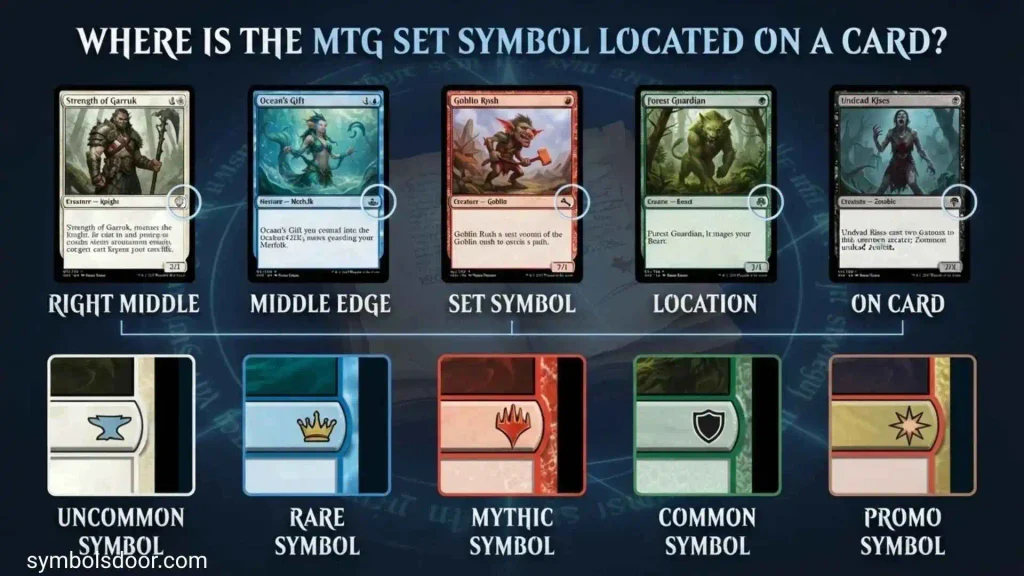
On most traditional Magic cards, the set symbol appears on the right side of the type line, directly below the illustration. It normally sits near the card’s type and subtype information.
You can usually find it without turning the card over.
<AsyncImage query=”Magic The Gathering trading card close up type line expansion set symbol collector number” aspectRatio=”16:9″ width=”100%” />
The exact position and surrounding layout can vary depending on the card frame. Older cards, alternate-frame cards, borderless cards, and promotional printings may display information differently.
For most modern cards, follow these steps:
- Look below the card’s illustration.
- Find the type line, where the card type appears.
- Look toward the right side of that line.
- Identify the small expansion icon.
- Check its color to get a general indication of rarity.
Where Is the Collector Number?
The collector number usually appears near the bottom of a modern Magic card, below the text box and close to the copyright information.
It often follows a format such as 125/281. The first number identifies the card’s position in the set’s collector-number sequence, while the second number represents the listed set total.
Not every printing follows this exact format. Some cards have numbers beyond the main set total, and special products may use different numbering systems.
The collector number is particularly useful when two cards share the same name and expansion symbol. It can help you distinguish their individual versions.
Why the Set Symbol May Look Different
You may notice that some symbols appear darker, brighter, or more reflective than others.
Several factors can explain these differences:
- Foil finish: Reflective card surfaces can make the symbol appear metallic.
- Card frame: Different frame treatments can change the symbol’s surrounding appearance.
- Printing variation: Older and newer card layouts don’t always display symbols in the same way.
- Special editions: Promotional and alternate-art cards may use unusual visual treatments.
- Lighting and card condition: Reflections, scratches, and wear can affect how the symbol looks.
A metallic appearance doesn’t automatically mean a card is rare. Always check the symbol’s actual rarity treatment and the card’s printed information.
MTG Set Symbol Colors and Rarity Meanings
One of the most common questions about Magic card symbols concerns their colors.
The traditional system uses different colors to indicate a card’s rarity within its set. This makes it easier to recognize common, uncommon, rare, and mythic rare cards.
However, this color system has historical exceptions. Older cards and certain special printings don’t always follow modern conventions.
Common Rarity Symbol: Black or White
<row align=start gap={3}> <AsyncImage query=”Magic The Gathering common rarity black expansion symbol card closeup” aspectRatio=”1:1″ maxWidth=”104px”/> <box flex=”1″ gap={1}> **Common rarity**
<badge color=”secondary”>Black or white</badge>
Common cards are generally the most frequently available rarity in a set. Their expansion symbols traditionally appear black or white, depending on the card and printing.
</box> </row>
Common cards form a large part of many Magic sets. They’re often important for limited formats, beginner decks, and everyday gameplay.
A common card isn’t necessarily weak or useless. Some commons become valuable because players need them for popular decks or collectors want particular versions.
Uncommon Rarity Symbol: Silver
<row align=start gap={3}> <AsyncImage query=”Magic The Gathering uncommon silver expansion symbol card closeup” aspectRatio=”1:1″ maxWidth=”104px”/> <box flex=”1″ gap={1}> **Uncommon rarity**
<badge color=”secondary”>Silver</badge>
Uncommon cards generally appear less frequently than common cards. Their expansion symbols traditionally use a silver or metallic-looking treatment.
</box> </row>
Uncommons often introduce stronger effects, more specialized abilities, or interesting combinations.
They’re useful to identify when sorting cards because their rarity differs from the more frequently distributed common cards.
Rare Rarity Symbol: Gold
<row align=start gap={3}> <AsyncImage query=”Magic The Gathering rare gold expansion symbol card closeup” aspectRatio=”1:1″ maxWidth=”104px”/> <box flex=”1″ gap={1}> **Rare rarity**
<badge color=”secondary”>Gold</badge>
Rare cards traditionally have gold expansion symbols. They are less frequent than common and uncommon cards in typical booster distributions.
</box> </row>
Many well-known Magic cards have rare versions. These can include powerful creatures, removal spells, lands, and cards that support popular strategies.
However, a gold symbol doesn’t guarantee a high market price. Demand, supply, condition, and competitive usefulness all matter.
Mythic Rare Symbol: Orange-Red
<row align=start gap={3}> <AsyncImage query=”Magic The Gathering mythic rare orange red expansion symbol card closeup” aspectRatio=”1:1″ maxWidth=”104px”/> <box flex=”1″ gap={1}> **Mythic rare**
<badge color=”warning”>Orange-red</badge>
Mythic rare symbols use a distinctive orange-red appearance. This rarity sits above rare in the traditional rarity structure.
</box> </row>
Mythic rares are generally less frequent than regular rares in sets that use this rarity level.
They often include major characters, powerful planeswalkers, iconic creatures, and cards with significant effects. Still, not every mythic rare becomes expensive or competitively important.
Special Rarity Symbols: Purple and Other Treatments
Some Magic products include special rarity treatments that don’t fit neatly into the familiar four-color system.
A notable example is the purple expansion symbol used for the original Time Spiral timeshifted cards. These cards had a special rarity category above the set’s ordinary rares.
The Comprehensive Rules specifically recognize purple as a special rarity color and describe its historical use for Time Spiral timeshifted cards. <Cite refs={[“turn447706search36″,”turn447706search1”]}/>
Other special products may use alternate frames, promotional markings, or unusual treatments. Don’t assume every unusual-looking symbol represents a new standard rarity level.
MTG Rarity Symbols: Quick Reference Table
| Symbol color | Traditional rarity | What it indicates |
| Black or white | Common | Common card or basic land |
| Silver | Uncommon | Uncommon card |
| Gold | Rare | Rare card |
| Orange-red | Mythic rare | Mythic rare card |
| Purple | Special rarity | Historically used for certain timeshifted cards |
Important: These colors describe the traditional rarity system, not every card ever printed. Before Exodus, expansion symbols were black regardless of rarity. Some special products also use different visual conventions.
Difference Between MTG Set Symbols and Rarity Symbols
A common mistake is treating the set symbol and rarity symbol as two completely separate icons.
On most traditional Magic cards, the expansion symbol itself carries both kinds of information:
- Its shape or design identifies the set.
- Its color indicates the card’s rarity within that set.
For example, a gold expansion symbol from one set and a gold expansion symbol from another set can have completely different designs. Both indicate rare cards, but they identify different expansions.
The distinction matters because you need both pieces of information to identify a particular printing correctly.
Set Symbol vs. Rarity Indicator vs. Collector Number
| Card detail | Main purpose | Example |
| Set symbol | Identifies the expansion or product | A unique expansion icon |
| Symbol color | Indicates traditional rarity | Gold for rare |
| Collector number | Identifies a card entry in the set | 125/281 |
| Set code | Identifies the set in databases | A short code such as a three-character abbreviation |
These details work together.
Imagine you own two cards with the same name and artwork. Their set symbols may differ because they come from different expansions. Their collector numbers and set codes can confirm the exact printing.
Does Every Magic Card Use the Same Rarity System?
No. The traditional color system is useful, but you shouldn’t apply it blindly.
Some older cards have black expansion symbols regardless of rarity. Special printings may also have unique treatments, while certain cards don’t display a conventional expansion symbol at all.
For accurate identification, compare the card with a trusted database entry rather than relying on color alone.
How to Identify Magic Card Sets Using Expansion Symbols
If you want to identify MTG card expansions, start with the expansion symbol. Then use the collector number and set code to confirm your result.
This method is especially useful when you have several cards with identical names.
Step-by-Step MTG Set Identification
Follow these steps to identify a card’s printing:
Step 1: Find the expansion symbol.
Look to the right side of the type line, usually below the illustration. Note the symbol’s overall design.
Step 2: Check the symbol color.
Use the traditional rarity colors as a starting point. Remember that older cards and special printings may have exceptions.
Step 3: Read the collector number.
Find the number printed near the bottom of the card. Record the complete number if it includes a set total or additional letters.
Step 4: Look for the set code.
Modern cards often include a short set code in their small-print information. This code can help you search a card database.
Step 5: Search a reliable database.
Enter the card name, set code, collector number, or a combination of these details. Compare the result with your physical card.
Step 6: Confirm the printing and finish.
Check whether your card is a regular, foil, promotional, borderless, or alternate-art version.
This process gives you a much more reliable result than identifying a card through artwork alone.
How to Identify Older Magic Card Editions
Older Magic cards can be more challenging to identify because their frames and printed information differ from modern cards.
For example, early Magic products didn’t all use expansion symbols. The original Alpha and Beta sets, as well as the original Unlimited edition, did not have the modern expansion-symbol system.
Arabian Nights, released in 1993, introduced expansion symbols. However, early symbols were black regardless of rarity.
This means you can’t use today’s color rules to identify every older card.
When researching an older printing, examine:
- The card frame and border.
- The expansion symbol, if present.
- The card’s collector information, if printed.
- The set’s release period.
- The artwork and artist credit.
- Other printing-specific details.
For valuable vintage cards, consider professional authentication. A symbol alone cannot establish whether a card is genuine.
How to Identify Reprints of the Same Magic Card
Magic frequently reprints popular cards in later expansions and special products.
A reprint may keep the same card name and rules text while changing its artwork, frame, or expansion symbol.
For example, a card originally printed in an older expansion may appear again in a modern set. The later version has a different set symbol because it belongs to a different printing.
When comparing two copies, check:
- Their expansion symbols.
- Their collector numbers.
- Their set codes.
- Their artwork and frame.
- Their foil or non-foil finish.
- Any promotional or special-printing information.
A card’s name tells you which game card it represents. Its printing details tell you which physical version you own.
Historical Development of MTG Set Symbols
Magic’s expansion symbols have changed over the years. Their history helps explain why some older cards don’t follow the modern rarity system.
Early Magic Sets Without Expansion Symbols
The original Magic: The Gathering release appeared in 1993. Early products such as Alpha, Beta, and Unlimited didn’t use the familiar expansion-symbol system.
Collectors had to rely on other printing details to identify these cards.
The same general issue applied to early core sets. Before Sixth Edition, core sets generally lacked expansion symbols, with the Simplified Chinese Fifth Edition being a historical exception.
Arabian Nights Introduced Expansion Symbols
<row align=start gap={3}> <AsyncImage query=”Magic The Gathering Arabian Nights expansion set symbol” aspectRatio=”1:1″ maxWidth=”112px”/> <box flex=”1″ gap={1}> **Arabian Nights (1993)**
The first Magic expansion to introduce expansion symbols. Its symbol helped distinguish cards from the new expansion.
</box> </row>
The introduction of expansion symbols gave collectors a simple way to recognize cards from different products.
Early expansion symbols were black. Their color didn’t communicate rarity.
Exodus Introduced Rarity-Based Symbol Colors
<row align=start gap={3}> <AsyncImage query=”Magic The Gathering Exodus expansion set symbol” aspectRatio=”1:1″ maxWidth=”112px”/> <box flex=”1″ gap={1}> **Exodus (1998)**
This set introduced the familiar color-based rarity identification system.
</box> </row>
With Exodus, the expansion symbol began communicating rarity through color.
This change made card identification easier because players could recognize both the expansion and the card’s rarity from the same icon.
Mythic Rare Arrived With Shards of Alara
<row align=start gap={3}> <AsyncImage query=”Magic The Gathering Shards of Alara expansion set symbol” aspectRatio=”1:1″ maxWidth=”112px”/> <box flex=”1″ gap={1}> **Shards of Alara (2008)**
The set introduced mythic rare as a new rarity level above rare.
</box> </row>
Mythic rare added another layer to Magic’s rarity classification. Its distinctive orange-red expansion symbol made it easier to recognize.
The four familiar rarity categories became:
- Common
- Uncommon
- Rare
- Mythic rare
Changes in Modern MTG Card Design
Modern Magic products include more card styles and treatments than early sets.
You may encounter:
- Traditional card frames.
- Retro frames.
- Borderless cards.
- Showcase frames.
- Extended-art cards.
- Full-art basic lands.
- Foil and special foil treatments.
- Promotional cards.
- Universes Beyond products.
These designs can make the set symbol appear in a different visual context. However, the underlying purpose remains the same: the expansion symbol identifies the set associated with the card printing.
MTG Expansion Symbols and Different Types of Sets
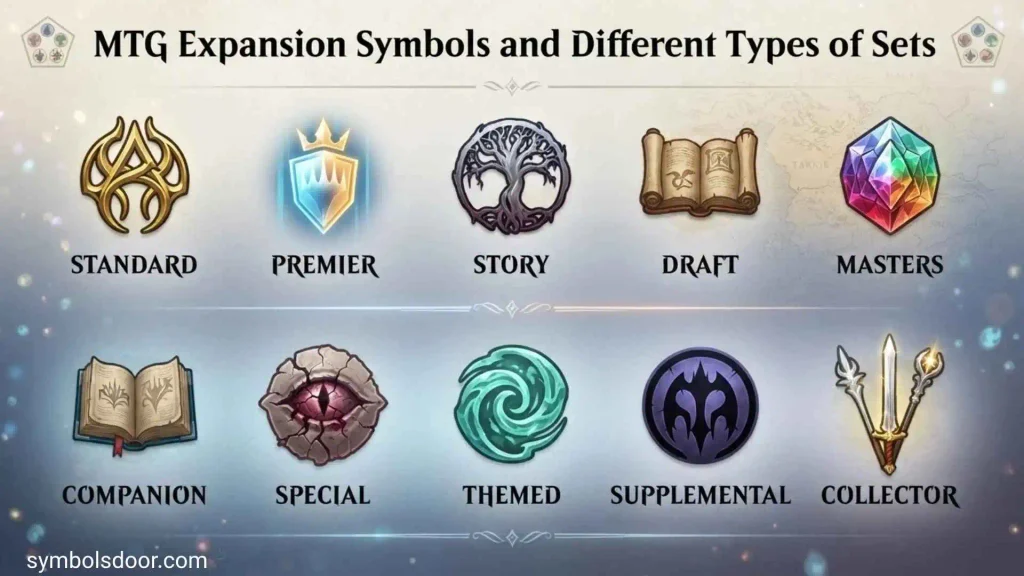
Not every Magic product serves the same purpose. The expansion symbol can help you recognize the product category, although you may need a database to confirm the exact release.
Standard Expansion Sets
Standard expansion sets are regular releases built around new Magic stories, characters, settings, and gameplay mechanics.
They typically introduce new cards and often contribute to the Standard format’s card pool.
Examples include:
- Wilds of Eldraine
- The Lost Caverns of Ixalan
- Bloomburrow
- Duskmourn: House of Horror
Each set has its own expansion symbol.
Core Sets
Core sets traditionally focused on accessible gameplay and familiar Magic themes. They often included reprints alongside new cards.
Older core sets didn’t always have expansion symbols. Starting with Sixth Edition, core sets generally used them.
Commander Sets and Products
Commander products support the multiplayer Commander format.
These products can include new cards, reprints, and special versions of existing cards. Their symbols and product identifiers help collectors distinguish them from regular expansion printings.
A card appearing in a Commander product isn’t automatically legal in every format. You must check the rules for the format you want to play.
Masters Sets
Masters sets focus heavily on reprints. They’re designed around bringing existing Magic cards together in a particular product.
Examples include Modern Masters, Ultimate Masters, and Double Masters.
Their expansion symbols help identify which Masters release contains a particular printing.
Supplemental and Special Sets
Magic also releases products outside the regular expansion schedule.
These can include:
- Draft-focused supplemental sets.
- Conspiracy products.
- Un-sets.
- Remastered sets.
- Special collector releases.
- Universes Beyond products.
- Limited-run releases.
Because these products have different purposes, don’t assume that every set symbol represents a Standard-legal expansion.
Promotional Sets and Limited Printings
Promotional cards can feature special artwork, frames, stamps, or other identifiers.
Some promotional cards are associated with a regular expansion. Others belong to a separate promotional product or release.
If you collect special versions, record the exact printing rather than simply writing down the card name.
Special MTG Card Printings and Their Set Symbols
Special printings can make Magic card identification more complicated. Two cards may have the same name and rules text but look very different.
The set symbol is useful, but you should also examine the card’s finish, artwork, frame, and collector information.
Foil Cards and Expansion Symbols
<AsyncImageGroup query={[“Magic The Gathering traditional foil card close up reflective surface”,”Magic The Gathering non foil card same card comparison”]} aspectRatio=”5:4″ layout=”carousel”/>
A foil Magic card has a reflective finish that creates a shiny appearance under light.
Foil is a card finish, not a rarity level. A common card can have a foil version, and a mythic rare card can also have one.
When identifying a foil card:
- Check the expansion symbol.
- Read the collector number.
- Compare the card’s set information.
- Look for the reflective finish across the card surface.
- Confirm whether the printing is a traditional foil or another special treatment.
A foil symbol may look more metallic because of the reflective surface. That doesn’t mean the card belongs to a different rarity category.
Alternate-Art and Borderless Cards
<AsyncImageGroup query={[“Magic The Gathering borderless alternate art trading card”,”Magic The Gathering showcase frame card alternate artwork”]} aspectRatio=”5:4″ layout=”carousel”/>
Alternate-art and borderless cards use different visual layouts from traditional Magic cards.
A borderless card may extend its artwork to the edges. A showcase card may use a frame inspired by the theme of its expansion.
These treatments can make the card’s expansion symbol less obvious. However, you can still use its printed information and database records to identify the correct version.
Showcase and Special Frame Cards
Showcase cards often use distinctive frames that reflect a set’s story or visual theme.
For example, a set may feature special treatments inspired by its characters, setting, or artistic style.
These cards may have:
- Alternate card borders.
- Unique artwork.
- Special text treatments.
- Different collector numbers.
- Foil or non-foil versions.
Don’t assume a showcase frame means the card belongs to a separate expansion. It may simply be an alternate treatment within the same set.
Secret Lair and Other Limited Releases
<AsyncImageGroup query={[“Magic The Gathering Secret Lair special card printing”,”Magic The Gathering Secret Lair alternate art card”]} aspectRatio=”5:4″ layout=”carousel”/>
Secret Lair releases feature special card designs, alternate artwork, and themed collections.
These products are particularly interesting to collectors because their cards may look very different from standard versions.
When identifying a Secret Lair card, check its product information and exact printing details. The card name alone may not reveal which release or treatment you own.
Digital MTG Cards
Digital Magic products can use card layouts and visual treatments that differ from physical cards.
For example, MTG Arena displays digital card versions through its own interface. Some digital-only cards and special treatments don’t have a direct physical equivalent.
When researching a digital card, use the game’s card information or a database that specifically supports digital printings.
Don’t assume that every physical-card identification method will work in exactly the same way for a digital version.
How to Find and Identify MTG Set Symbols Online
You don’t have to recognize every expansion symbol by memory. Several online resources make it easier to identify Magic cards and verify their printing information.
Using Gatherer
<row align=center gap={2}> <favicon url=”https://gatherer.wizards.com/” size=”24px”/> **<Link url=”https://gatherer.wizards.com/” title=”Wizards of the Coast Gatherer”/>** </row>
Gatherer is Wizards of the Coast’s official Magic card database.
You can use it to search for card names and review information about individual cards.
It’s useful for:
- Checking card names.
- Reviewing card text.
- Finding set information.
- Comparing card versions.
- Confirming official card details.
If you know the card name but not its expansion, search for it and review the available printing information.
Using Scryfall
<row align=center gap={2}> <favicon url=”https://scryfall.com/” size=”24px”/> **<Link url=”https://scryfall.com/” title=”Scryfall”/>** </row>
Scryfall is a widely used Magic card search database. It provides detailed information about cards, sets, artwork, and printings.
You can search by card name, set, collector number, rarity, and other details.
For example, if you want to find every printing of a particular card, search its name and examine the available versions.
Scryfall is especially useful for:
- Comparing different printings.
- Checking set codes.
- Viewing card images.
- Finding foil and non-foil versions.
- Reviewing rarity information.
- Searching by expansion or collector number.
Its advanced search tools can save time when you’re organizing a large collection.
Using MTGJSON
<row align=center gap={2}> <favicon url=”https://mtgjson.com/” size=”24px”/> **<Link url=”https://mtgjson.com/” title=”MTGJSON”/>** </row>
MTGJSON provides structured Magic card data for developers, researchers, and collection tools.
It can be useful if you want to build a spreadsheet, collection tracker, or custom card database.
Its structured information helps connect card names, set codes, collector numbers, and printing records.
How to Verify an Unknown MTG Set Symbol
If you find an expansion symbol you don’t recognize, use this process:
- Identify the card name.
- Record the collector number, if available.
- Look for the set code.
- Search the card on Gatherer or Scryfall.
- Compare the symbol and card image with the database entry.
- Check the release information.
- Confirm whether the card is a special or promotional printing.
If the card is old or has unusual printing details, compare more than one source before making a final identification.
How MTG Set Symbols Affect Card Value
A set symbol can help you identify the printing of a card, and that information may influence its market value.
However, the set symbol doesn’t determine a card’s price by itself.
Two versions of the same card can have very different prices because of their printing history, condition, availability, and collector demand.
Does a Set Symbol Affect Magic Card Value?
Yes, indirectly.
The symbol identifies the set associated with a particular printing. That printing may be more desirable because it is older, scarcer, visually distinctive, or connected to a popular release.
For example, collectors may prefer an original printing over a later reprint. However, that preference doesn’t apply equally to every card.
Several factors influence MTG card prices:
- Supply: How many copies are available?
- Demand: How many players and collectors want the card?
- Condition: Is the card near mint, lightly played, or heavily damaged?
- Rarity: Is it common, uncommon, rare, or mythic rare?
- Competitive play: Is it used in popular decks?
- Printing: Does it have a desirable set, frame, or release history?
- Finish: Is it a traditional foil or a special treatment?
- Collector interest: Does the artwork or product have a dedicated following?
Original Printings vs. Reprints
An original printing may be more desirable than a later version, especially when the card comes from an older or historically important set.
But a reprint can sometimes be more expensive if it has special artwork, a limited release, or strong collector demand.
You should compare the exact printing rather than assuming the oldest version always costs the most.
Rarity and Market Price
Rarity can influence supply, but it doesn’t guarantee market value.
A mythic rare card may be inexpensive if few people want it. Meanwhile, an uncommon card can become valuable if players need it for competitive decks or collectors seek a particular printing.
For a realistic price estimate, compare the same version of the card across marketplaces and price databases.
Foil, Promotional, and Special Versions
Special treatments can affect a card’s price.
A foil version may sell for more than its non-foil equivalent, but this isn’t guaranteed. Some foil cards are less desirable because of printing quality, condition, or market preferences.
Promotional and limited-release versions may also attract collectors.
Always compare:
- Exact set and collector number.
- Foil or non-foil finish.
- Artwork and frame.
- Card condition.
- Language.
- Current market listings and recent sales.
A broad search for the card name may mix several different printings. That can produce a misleading price estimate.
Do MTG Set Symbols Determine Card Legality?
No. MTG set symbols do not determine format legality by themselves.
A set symbol identifies a card’s printing. Format legality depends on the rules of the format, the card’s eligibility, and any applicable banned or restricted lists.
This distinction is important for players who own older cards or reprints.
What Is MTG Format Legality?
Magic supports several formats, and each has its own card-pool rules.
Some formats use a rotating group of eligible sets. Others allow a much larger range of cards.
Common formats include:
- Standard
- Pioneer
- Modern
- Legacy
- Vintage
- Commander
- Pauper
A card’s legality can differ from one format to another.
For example, a card may be legal in Commander but not in Standard. Another card may be legal in Modern but restricted or banned in a different format.
How Do MTG Set Symbols Relate to Standard Rotation?
Standard uses a changing group of eligible sets.
As older sets rotate out, their cards generally stop being legal in Standard unless another eligible printing or a specific format rule allows them.
The important point is that the physical set symbol on your card isn’t always the deciding factor.
A card printed in an older set may still be playable in Standard if that card has a qualifying printing in a currently eligible set, subject to the format’s rules.
The reverse is also true: owning a card from a once-legal Standard set doesn’t mean it remains Standard-legal forever.
How to Check Whether an MTG Card Is Legal
Use these steps before including a card in a deck:
- Identify the exact card name.
- Select the format you want to play.
- Check the card’s legality in a trusted database.
- Review the current banned and restricted list.
- Confirm any special rules that apply to the format.
You can use <Link url=”https://magic.wizards.com/en/formats” title=”Wizards of the Coast’s official format information”/> to review format details.
Scryfall also provides card legality information that can help you research individual cards.
Common Mistakes When Reading MTG Set Symbols
Even experienced collectors can misunderstand expansion symbols, especially when dealing with older cards or special printings.
Avoid these common mistakes when identifying your collection.
Assuming Every Set Symbol Has a Different Rarity Color
The symbol’s design identifies the expansion, while its color traditionally indicates rarity.
However, older cards don’t always follow the modern color system. Before Exodus, expansion symbols were black regardless of rarity.
Confusing the Set Symbol With the Collector Number
These details have different purposes.
The expansion symbol identifies the set visually. The collector number identifies a card’s position in the set’s numbering system.
You need both when researching certain printings.
Assuming a Rare or Mythic Card Must Be Valuable
Rarity and market price aren’t the same thing.
A card can be mythic rare but have little demand. An uncommon card can become valuable because of competitive play or collector interest.
Always research the exact printing before estimating its price.
Thinking the Set Symbol Determines Format Legality
A card’s expansion symbol doesn’t automatically make it legal or illegal in a format.
Check the format’s eligible card pool and current restrictions instead.
Using Artwork Alone to Identify a Printing
Magic sometimes uses the same artwork across multiple printings. It also reprints cards with different artwork.
Artwork can help, but it isn’t always enough to identify a specific edition.
Ignoring Promotional and Special Printings
Promotional cards, alternate-art versions, and limited releases may have unusual visual details.
Check their collector information and database records before assigning a set or price.
How to Organize an MTG Collection Using Set Symbols
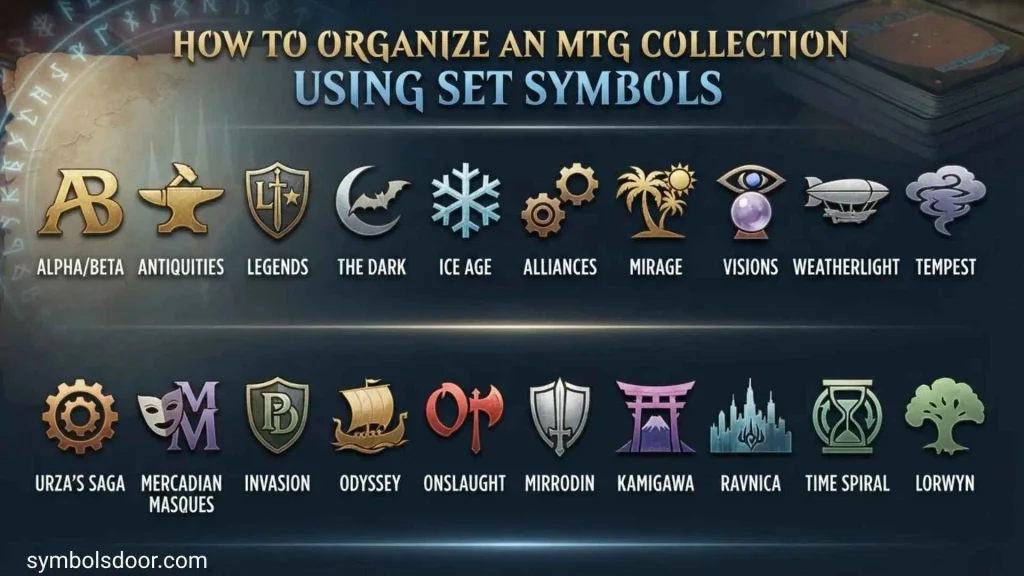
If you own a large Magic collection, set symbols can make sorting and cataloging much easier.
Instead of placing every card into one box, organize them using a consistent system.
Sort Cards by Set and Expansion
Start by grouping cards according to their expansion symbols.
This makes it easier to find cards from a particular release and see which sets you own.
You can organize them alphabetically by set name or chronologically by release date.
Organize Cards by Rarity
After sorting by expansion, separate cards by rarity.
A simple system includes:
- Common
- Uncommon
- Rare
- Mythic rare
- Special or promotional printings
This method works well for collectors who want to review their cards quickly.
Record Different Card Printings
Don’t record only the card name when building a collection inventory.
Include the printing details that help distinguish one version from another.
A useful collection record might include:
| Information | Example |
| Card name | A card’s printed name |
| Set name | The expansion or product |
| Set code | The database identifier |
| Collector number | The card’s printed number |
| Rarity | Common, uncommon, rare, or mythic rare |
| Finish | Foil or non-foil |
| Condition | Near mint, lightly played, or damaged |
| Quantity | Number of copies owned |
This information is especially helpful when you own multiple versions of the same card.
Build a Digital MTG Collection
A digital collection tracker can save time and reduce mistakes.
You can use a spreadsheet or a dedicated collection-management tool to record your cards.
For each entry, include the card name, set code, collector number, rarity, finish, condition, and quantity.
You can also add purchase prices and estimated market values if you want to track your collection’s financial side.
The more detailed your records, the easier it becomes to find a specific printing later.
Frequently Asked Questions About MTG Set Symbols
What Are MTG Set Symbols?
MTG set symbols are small icons printed on Magic cards to identify the expansion or product associated with a particular printing. Their colors traditionally indicate rarity.
Where Is the MTG Set Symbol Located?
On most traditional Magic cards, the set symbol appears on the right side of the type line, directly below the illustration. Its position can vary on older and special card layouts.
What Do Magic: The Gathering Set Symbols Mean?
The symbol’s design identifies the card’s set. Its color generally indicates rarity on cards that use the traditional rarity system.
What Do Different MTG Set Symbol Colors Mean?
The traditional colors are black or white for common cards or basic lands, silver for uncommon, gold for rare, and orange-red for mythic rare. Purple has been used for a special historical rarity.
How Can I Identify a Magic Card’s Set?
Find the expansion symbol, then check the collector number and set code. Search those details in Gatherer or Scryfall to confirm the exact printing.
What Is the Difference Between a Set Symbol and a Rarity Symbol?
The set symbol is the expansion icon printed on the card. Its color communicates rarity on applicable printings. In other words, the same icon provides both pieces of information.
Why Do Some Old MTG Cards Have No Set Symbol?
Early Magic sets didn’t use expansion symbols. The system began with Arabian Nights in 1993, while early core sets generally lacked symbols until Sixth Edition.
Why Are All Symbols on Some Older Magic Cards Black?
Before Exodus in 1998, expansion symbols were black regardless of rarity. The rarity-color system began with Exodus.
When Did MTG Start Using Colored Set Symbols?
Exodus, released in 1998, introduced rarity-based expansion-symbol colors.
When Was Mythic Rare Introduced in MTG?
Mythic rare was introduced with Shards of Alara in 2008. Its symbol uses a distinctive orange-red color.
Does a Set Symbol Affect Card Value?
The symbol itself doesn’t set the price. However, it helps identify the card’s printing, and that printing may affect market value through supply, demand, condition, and collector interest.
Can the Same MTG Card Have Different Set Symbols?
Yes. Magic frequently reprints cards in different expansions and products. Each printing can have its own set symbol, even when the card name and rules text remain the same.
Do Foil Cards Have Different Set Symbols?
Not necessarily. A foil version usually retains the set identity of its printing. The reflective finish can make the symbol look more metallic, but foil is a finish rather than a rarity.
Do MTG Set Symbols Determine Standard Legality?
No. Standard legality depends on the format’s eligible sets and current rules. A card’s physical printing may differ from the printing that makes it eligible for Standard.
How Can I Identify a Promotional MTG Card?
Check its set symbol, collector number, set code, promotional markings, artwork, and frame. Search the card in Gatherer or Scryfall and compare the exact printing.
Where Can I Find a Complete MTG Set Symbol List?
You can explore Magic’s card and set information through <Link url=”https://gatherer.wizards.com/” title=”Gatherer”/> and <Link url=”https://scryfall.com/” title=”Scryfall”/>. These resources help you look up expansions, card images, and individual printings.
Conclusion: Understanding Magic: The Gathering Set Symbols
MTG set symbols are small details that provide valuable information about your Magic cards. Their designs identify expansions, while their colors traditionally communicate rarity.
Once you understand how they work, identifying different card printings becomes much easier. You can also use them to organize your collection, compare reprints, research card prices, and verify card information.
Remember that the symbol is only one part of the identification process. For the most accurate result, check the card name, collector number, set code, artwork, and printing details together.
Whether you’re a new player or an experienced collector, learning to read Magic: The Gathering set symbols gives you a better understanding of the cards you own.

Hello, I’m Rowan Sinclair, a passionate writer and lifelong admirer of the wisdom found in great quotes. I believe that words have the ability to inspire change, spark creativity, and connect people across cultures and generations.
I enjoy writing about motivational quotes, famous sayings, and lessons from history’s most influential thinkers. Every article I create is driven by my desire to help readers discover meaningful insights that they can apply to their own lives.
When I’m not writing, I spend my time reading biographies, exploring classic literature, and collecting memorable quotes that deserve to be shared with the world.
I am the author of Voices That Inspire and A Collection of Timeless Thoughts, two books that celebrate the enduring power of words and the stories behind them.
 Sienna Brooks
 Asher Monroe