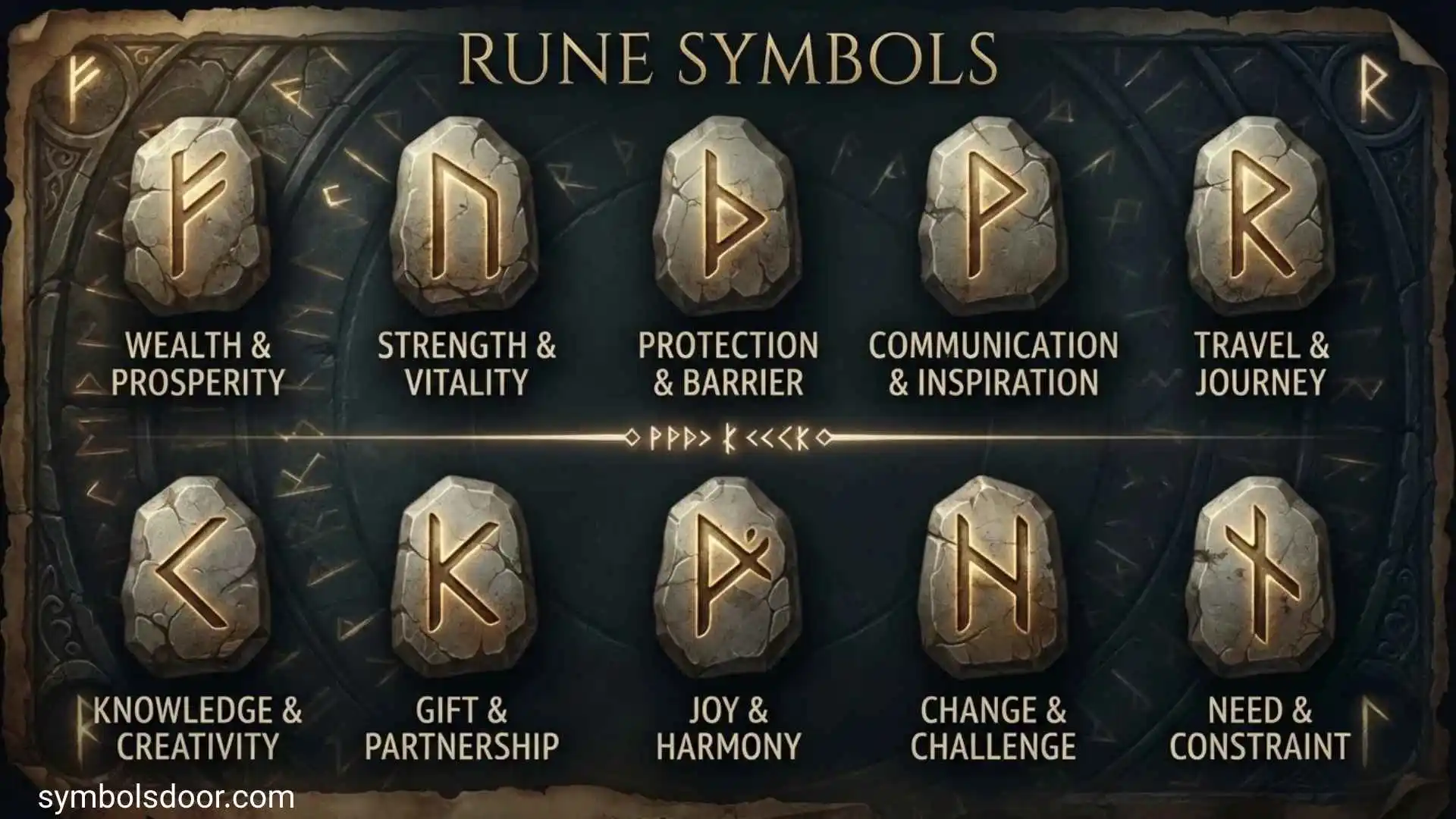
Rune symbols have fascinated people for centuries. You can find them carved into Viking stones, engraved on ancient weapons, displayed in museums, and used in modern tattoos and fantasy stories. Their sharp lines and unusual shapes make them instantly recognizable.
But what do these symbols actually mean?
Runes were more than mysterious signs. They formed writing systems used by Germanic-speaking peoples across northern and parts of central Europe. People carved them into wood, stone, metal, bone, and other materials to record names, messages, memorials, and important events.
Some runes also appeared in magical or religious contexts. Norse mythology connects them with Odin and secret knowledge. However, modern spiritual interpretations often differ from what historians can establish about ancient runic writing.
Understanding rune meanings requires looking at their original languages, historical periods, and cultural settings. The Elder Futhark, Younger Futhark, and Anglo-Saxon Futhorc each had different characters and uses.
This guide explores the major runic alphabets, the 24 Elder Futhark runes, Viking inscriptions, Norse mythology, historical artifacts, modern spiritual practices, and the use of runes in popular culture.
What Are Runes and What Do Rune Symbols Mean?
Runes are characters from historical writing systems used by Germanic-speaking communities. The word usually refers to letters in the ancient and medieval runic alphabets, including the Elder Futhark, Younger Futhark, and Anglo-Saxon Futhorc.
Unlike modern decorative symbols, historical runes primarily represented sounds. People used them to write personal names, words, sentences, ownership marks, memorial messages, and other information.
Each rune had a particular shape and sound value. Some also had a name associated with a familiar object, natural feature, or concept.
For example:
- Fehu (ᚠ): Associated with cattle and movable wealth.
- Uruz (ᚢ): Associated with the aurochs, a wild ancestor of modern cattle.
- Raidō (ᚱ): Associated with riding or a journey.
- Hagalaz (ᚺ): Associated with hail.
- Sōwilō (ᛊ): Associated with the sun.
These historical name associations provide the foundation for many modern interpretations.
However, a rune’s historical name, sound value, and spiritual meaning are three different things. You shouldn’t automatically treat them as interchangeable.
What Does the Word Rune Mean?
The word rune comes from old Germanic language forms associated with secrets, mysteries, or hidden knowledge.
Related forms include:
- Old Norse rún
- Old English rūn
- Old Saxon rūna
- Old High German rūna
- Gothic rūna
The word’s association with secrecy helps explain why later writers connected runes with magic and mysterious knowledge.
However, this doesn’t mean every ancient rune was a magical symbol. Most surviving runic inscriptions communicate ordinary information.
How Did the Runic Alphabet Work?
The runic alphabet was a phonetic writing system. Its characters represented sounds, much like letters in the modern Latin alphabet.
Runes had several practical features:
- Their shapes usually used straight lines.
- They could be carved into wood, stone, and metal.
- Their forms varied across different regions and periods.
- One rune could sometimes represent more than one sound.
- Different runic alphabets had different numbers of characters.
The word Futhark comes from the first six characters of the Elder Futhark sequence:
ᚠ ᚢ ᚦ ᚨ ᚱ ᚲ
These characters are traditionally named Fehu, Uruz, Thurisaz, Ansuz, Raidō, and Kaunaz.
What Is the Difference Between Runes and the Latin Alphabet?
The main difference is that runes belong to historical Germanic writing traditions, while the Latin alphabet developed from earlier Mediterranean writing systems.
| Feature | Runic alphabets | Latin alphabet |
| Historical use | Germanic-speaking regions | Rome and later European societies |
| Character shapes | Often angular | Angular and curved forms |
| Main purpose | Representing speech sounds | Representing speech sounds |
| Writing materials | Wood, stone, metal, bone, and parchment | Stone, tablets, parchment, paper, and other materials |
| Historical variations | Elder Futhark, Younger Futhark, Futhorc, medieval runes | Roman capitals, medieval scripts, modern forms |
| Modern use | Mainly historical, decorative, and cultural | Widely used for everyday writing |
Runes weren’t simply an alternative alphabet for all European languages. Their development and use were closely connected to the languages and communities that adopted them.
Types of Runic Alphabets and Their Differences
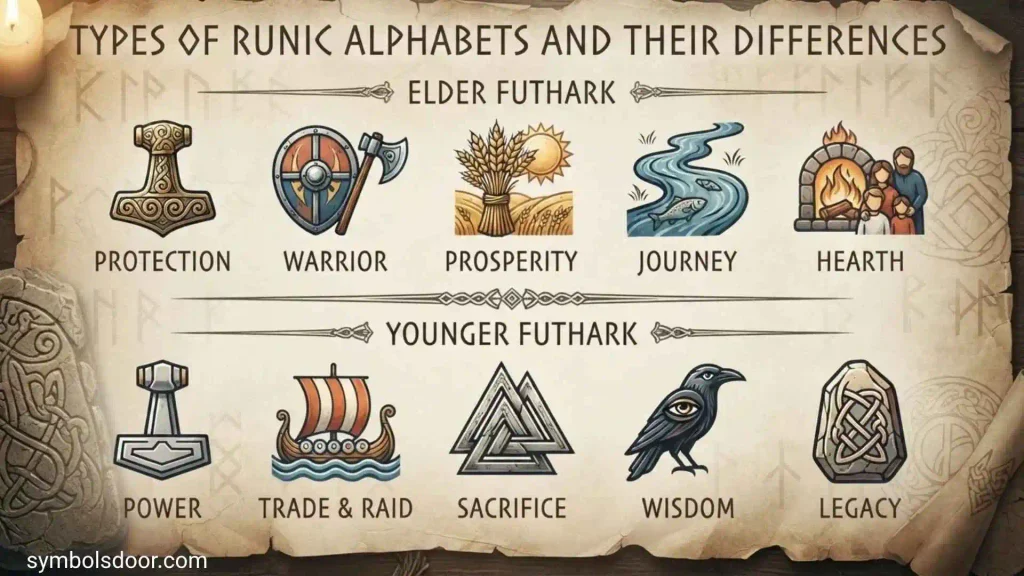
Runic writing changed over time. Different communities adapted its characters to represent the sounds of their languages.
The three most important historical traditions are the Elder Futhark, Younger Futhark, and Anglo-Saxon Futhorc.
Other forms developed later, including medieval Scandinavian runes and Dalecarlian runes.
Elder Futhark: The Oldest Major Runic Alphabet
<AsyncImage query=”Elder Futhark 24 runes ancient runic alphabet inscription chart” aspectRatio=”16:9″ width=”100%”/>
The Elder Futhark is the oldest major runic alphabet. It contains 24 characters and appears in inscriptions dating from approximately the second through eighth centuries CE.
It was used by early Germanic-speaking communities across parts of northern and central Europe.
The alphabet is traditionally divided into three groups of eight characters. These groups are commonly called ættir, a term associated with families or groups.
The Elder Futhark is especially important because it provides the foundation for studying early Germanic runes.
Its main characteristics include:
- 24 individual runic characters.
- A distinctive alphabetical order.
- Angular shapes suitable for carving.
- Sound values connected to early Germanic languages.
- Rune names reconstructed partly through later linguistic evidence.
Some famous inscriptions associated with this period include the Kylver Stone, Vimose Comb, and Noleby Stone.
Younger Futhark: The Viking Age Runic Alphabet
<AsyncImage query=”Younger Futhark 16 rune alphabet Viking runes chart” aspectRatio=”16:9″ width=”100%”/>
The Younger Futhark developed in Scandinavia around the beginning of the Viking Age. It contains 16 characters instead of the Elder Futhark’s 24.
This change may seem surprising. Why would a writing system use fewer characters as languages developed?
The answer involves changes in sound representation. Several sounds that had previously been represented by separate runes came to share characters.
As a result, one Younger Futhark rune could represent multiple sounds.
The Younger Futhark was widely used for:
- Viking Age runestones.
- Personal names.
- Memorial inscriptions.
- Ownership marks.
- Messages carved into everyday objects.
- Religious and commemorative texts.
Its two best-known forms are long-branch and short-twig runes.
Anglo-Saxon Futhorc: The Runic Alphabet of England
<AsyncImage query=”Anglo Saxon Futhorc runic alphabet manuscript characters” aspectRatio=”16:9″ width=”100%”/>
The Anglo-Saxon Futhorc developed from the older Germanic runic tradition and was adapted to represent sounds found in Old English.
Unlike the Elder Futhark, which contains 24 characters, the Anglo-Saxon system expanded to include additional runes.
The term Futhorc reflects a change in the names and sequence of its early characters.
The alphabet was used in England and parts of Frisia. It appears on objects, monuments, crosses, and manuscripts.
Important examples include:
- The Franks Casket.
- The Ruthwell Cross.
- Anglo-Saxon inscriptions on personal objects.
- Runic writing preserved in manuscripts.
The Anglo-Frisian tradition is important because it shows how runic alphabets adapted when communities used them to write different Germanic languages.
Medieval Runes
Medieval runes developed from earlier Scandinavian traditions, particularly the Younger Futhark.
During the medieval period, Scandinavian communities continued using runes even after Christianity spread and the Latin alphabet became increasingly common.
Medieval runic writing included modified characters and additional distinctions for sounds that the earlier system did not represent separately.
One important development was the use of dotted runes. These helped distinguish sounds that previously shared the same character.
Medieval runes appeared in:
- Wooden messages and everyday correspondence.
- Church bells and religious objects.
- Memorial inscriptions.
- Personal names.
- Commercial records.
- Runic manuscripts.
The Codex Runicus, a medieval manuscript written mainly in runes, demonstrates how the writing system continued beyond the Viking Age.
Other Historical and Specialized Runic Forms
Several additional forms deserve attention when studying the history of runic writing.
| Runic form | Main characteristics |
| Dalecarlian runes | Later regional runic tradition from Dalarna, Sweden |
| Hälsinge runes | Distinctive Scandinavian runic forms |
| Long-branch runes | More fully developed forms of Younger Futhark characters |
| Short-twig runes | Simplified forms of Younger Futhark characters |
| Staveless runes | Simplified runes that omit or reduce the main vertical stave |
| Rök runes | Unusual forms and cipher techniques associated with the Rök inscription |
| Cipher runes | Encoded or modified runic writing |
| Bindrunes | Two or more runic characters combined into one design |
Some names in popular rune lists need additional historical context.
Marcomannic runes refer to a runic-like system preserved in a medieval manuscript. They shouldn’t be treated as a widely documented ancient alphabet equivalent to the Elder Futhark.
Similarly, Armanen runes, Wiligut runes, and Uthark runes belong to later esoteric interpretations rather than established ancient Germanic writing systems.
The 24 Elder Futhark Runes and Their Meanings
The 24 Elder Futhark runes are among the most widely recognized ancient runic symbols.
Their names are connected with objects, animals, natural forces, and social ideas. Many familiar rune names come from comparative linguistic research and later rune poems.
The table below provides their traditional names and historical associations. Modern spiritual interpretations are discussed separately because they aren’t always supported by ancient evidence.
First Aett: Fehu to Wunjo
The first group contains eight runes. Their names are commonly associated with wealth, animals, supernatural beings, journeys, gifts, and joy.
<AsyncImage query=”Elder Futhark first eight runes Fehu Uruz Thurisaz Ansuz Raidho Kenaz Gebo Wunjo” aspectRatio=”16:9″ width=”100%”/>
| Rune | Name | Historical name association | Common modern interpretation |
| ᚠ | Fehu | Cattle, movable wealth | Prosperity, resources, success |
| ᚢ | Uruz | Aurochs | Strength, vitality, endurance |
| ᚦ | Thurisaz | Giant or supernatural being | Protection, challenge, defense |
| ᚨ | Ansuz | God or deity | Communication, wisdom, inspiration |
| ᚱ | Raidō | Riding or journey | Travel, movement, progress |
| ᚲ | Kenaz | Torch | Knowledge, creativity, illumination |
| ᚷ | Gebō | Gift | Generosity, exchange, partnership |
| ᚹ | Wunjō | Joy | Happiness, harmony, satisfaction |
Fehu (ᚠ) is associated with cattle and movable wealth. In early Germanic societies, livestock represented an important form of property. Modern rune readers often connect Fehu with money, prosperity, and material resources.
Uruz (ᚢ) takes its name from the aurochs, a large wild bovine that once lived across Europe and parts of Asia. Modern interpretations often associate it with physical strength, stamina, and natural power.
Thurisaz (ᚦ) is associated with a giant or supernatural being in later Germanic rune-name traditions. Its modern interpretations often involve protection, confrontation, and powerful forces.
Ansuz (ᚨ) is connected with a god or deity. The name is related to the Germanic divine beings known as the Æsir. Modern spiritual readings often associate it with communication, wisdom, and inspiration.
Raidō (ᚱ) is connected with riding or a journey. It is often interpreted today as movement, travel, progress, or the direction of one’s life.
Kenaz (ᚲ) is commonly associated with a torch in traditional reconstructions. Some modern interpretations connect it with knowledge, creativity, and the ability to see clearly. The related rune name Kauna or Kaunaz appears in other naming traditions, so spellings should not be treated as identical in every historical context.
Gebō (ᚷ) means gift. It is commonly associated with generosity, exchange, and relationships. The idea of a gift also reflects social obligations and bonds in early Germanic societies.
Wunjō (ᚹ) is associated with joy. Modern interpretations often connect it with happiness, harmony, and a sense of belonging.
Second Aett: Hagalaz to Sowilo
The second group contains eight runes associated with weather, need, time, natural objects, and the sun.
<AsyncImage query=”Elder Futhark second eight runes Hagalaz Naudiz Isaz Jera Eihwaz Perthro Algiz Sowilo” aspectRatio=”16:9″ width=”100%”/>
| Rune | Name | Historical name association | Common modern interpretation |
| ᚺ | Hagalaz | Hail | Disruption, change, hardship |
| ᚾ | Naudiz | Need or distress | Necessity, endurance, constraint |
| ᛁ | Īsaz | Ice | Stillness, delay, preservation |
| ᛃ | Jēra | Year or harvest | Cycles, reward, growth |
| ᛇ | Ī(h)waz | Yew tree | Endurance, continuity, transformation |
| ᛈ | Perþō | Uncertain | Mystery, chance, uncertainty |
| ᛉ | Algiz | Elk or related animal association | Protection, awareness, defense |
| ᛊ | Sōwilō | Sun | Energy, clarity, success |
Hagalaz (ᚺ) is associated with hail. Hail can damage crops and disrupt daily life, which helps explain modern interpretations involving sudden change or difficult events.
Naudiz (ᚾ) represents need or distress. Its modern meanings often include necessity, patience, and the ability to continue through hardship.
Īsaz (ᛁ) means ice. Ice can preserve, restrict movement, and create dangerous conditions. Modern rune readers often interpret it as stillness, delay, or a period of reflection.
Jēra (ᛃ) is associated with the year or harvest. It represents the passage of time and seasonal cycles. Modern interpretations commonly include patience, growth, and rewards earned through effort.
Ī(h)waz (ᛇ) is associated with the yew tree. The yew is long-lived and has a strong presence in European cultural traditions. Modern interpretations often connect it with endurance and transformation.
Perþō (ᛈ) is one of the most uncertain rune names. Its exact historical meaning remains disputed. Modern interpretations often associate it with mystery, chance, or hidden possibilities, but these meanings should not be presented as established ancient facts.
Algiz (ᛉ) is commonly associated with elk or an animal-related name in later rune traditions. Modern spiritual systems often interpret it as protection and awareness. Its historical name and original meaning require caution.
Sōwilō (ᛊ) means sun. Modern interpretations commonly connect it with energy, clarity, success, and vitality.
Third Aett: Tiwaz to Othala
The final group includes runes associated with deities, plants, animals, people, water, daylight, and inheritance.
<AsyncImage query=”Elder Futhark third eight runes Tiwaz Berkano Ehwaz Mannaz Laguz Ingwaz Dagaz Othala” aspectRatio=”16:9″ width=”100%”/>
| Rune | Name | Historical name association | Common modern interpretation |
| ᛏ | Tīwaz | The god Týr | Justice, duty, courage |
| ᛒ | Berkanan | Birch | Growth, renewal, fertility |
| ᛖ | Ehwaz | Horse | Movement, trust, partnership |
| ᛗ | Mannaz | Human or person | Humanity, community, identity |
| ᛚ | Laguz | Water or lake | Flow, intuition, adaptation |
| ᛜ | Ingwaz | Ing | Fertility, potential, development |
| ᛞ | Dagaz | Day | Light, change, awakening |
| ᛟ | Ōþala | Inherited property or estate | Heritage, family, belonging |
Tīwaz (ᛏ) is connected with Týr, a god in Germanic mythology. Modern interpretations often associate it with courage, justice, duty, and honorable action.
Berkanan (ᛒ) is associated with birch. The tree’s relationship with growth and renewal helps explain its modern connections with fertility, beginnings, and development.
Ehwaz (ᛖ) means horse. Horses were important in transportation, farming, and warfare. Modern readings often connect this rune with trust, cooperation, and movement.
Mannaz (ᛗ) means human or person. It is frequently interpreted as representing identity, society, relationships, and shared human experience.
Laguz (ᛚ) is associated with water or a body of water. Modern interpretations often involve intuition, emotional movement, and adaptability.
Ingwaz (ᛜ) is connected with Ing, a figure associated with early Germanic religious traditions. Modern readings often associate it with potential, fertility, and development.
Dagaz (ᛞ) means day. It is often interpreted as light, clarity, awakening, and a transition from one condition to another.
Ōþala (ᛟ) is associated with inherited property, ancestral land, or an estate. Modern interpretations often connect it with heritage, family history, and belonging.
Historical Rune Meanings vs. Modern Spiritual Meanings
The meanings in modern rune books are not always the same as the meanings supported by historical evidence.
There are three important distinctions:
| Type of meaning | What it describes |
| Historical name | A rune’s reconstructed or attested name |
| Linguistic meaning | The word or concept associated with that name in a historical language |
| Modern spiritual meaning | A later symbolic interpretation used in contemporary spiritual practices |
For example, Fehu has a strong historical association with cattle and movable wealth. Modern interpretations may extend this into financial success, abundance, or personal achievement.
That extension is a modern interpretation, not a direct translation of an ancient inscription.
The same caution applies to reversed runes. Some modern divination systems assign different meanings to upright and reversed characters, but this is not a universal ancient Germanic rule.
Viking Runes and Norse Rune Symbols
Viking runes are closely associated with the Younger Futhark, the main Scandinavian runic alphabet of the Viking Age.
The Vikings used runes to write names, memorials, messages, and other information. Their inscriptions provide valuable evidence about Scandinavian languages, society, trade, religion, and family relationships.
What Were Viking Runes?
Viking Age runic writing used a 16-character alphabet. It was more compact than the Elder Futhark, and individual runes could represent several sounds.
People carved Viking runes into:
- Memorial stones.
- Wooden objects.
- Weapons and tools.
- Jewelry and combs.
- Personal possessions.
- Everyday wooden messages.
Runestones were particularly important. They often commemorated deceased relatives and described the people who raised the stones.
The National Museum of Denmark explains that Viking Age runestones commonly honored the dead and their achievements. Many were placed in visible locations near roads and bridges rather than directly at burial sites. <Cite refs={[“turn264913search2”]}/>
Long-Branch and Short-Twig Runes
The Younger Futhark developed two important letter-form traditions: long-branch and short-twig runes.
<AsyncImage query=”Younger Futhark long branch short twig runes comparison chart” aspectRatio=”16:9″ width=”100%”/>
| Feature | Long-branch runes | Short-twig runes |
| Appearance | More fully developed strokes | Simplified strokes |
| Historical use | Common on monumental inscriptions | Common in everyday writing |
| Main association | Scandinavian Viking Age | Scandinavian Viking Age |
| Alphabet | Younger Futhark | Younger Futhark |
Long-branch runes are often associated with formal inscriptions, while short-twig forms were widely used in less monumental writing.
The difference is mainly visual. Both belong to the Younger Futhark tradition.
Norse Mythology and Runes
Runes appear in several important Old Norse literary sources.
The most famous connection is with Odin, who is associated with the acquisition of runic knowledge in the poem Hávamál.
Other relevant sources include:
- The Poetic Edda.
- Hávamál.
- Rígsþula.
- Ynglinga saga.
- Later Icelandic sagas.
These texts contain stories about gods, knowledge, social order, and magical practices.
However, they were written down in the medieval period. They should be studied as literary and cultural sources rather than treated as direct archaeological records of every Viking Age belief.
Odin and the Runes
In Hávamál, Odin describes hanging on a tree for nine nights, wounded by a spear and deprived of food and drink, before gaining knowledge of the runes.
This story is one reason runes became closely associated with hidden knowledge and spiritual power.
It is important to understand the difference between the mythological account and historical evidence. The poem tells a story about divine knowledge; it doesn’t prove that historical rune carvers followed the same ritual.
Famous Viking Rune Symbols and Inscriptions
Viking inscriptions provide evidence of ordinary life as well as religious beliefs.
Some inscriptions record:
- Who raised a memorial stone.
- Who died and who was remembered.
- Family relationships.
- Journeys and achievements.
- The names of rune carvers.
- Prayers and religious messages.
- Warnings or curses against damaging a monument.
The Glavendrup Stone in Denmark, for example, includes a warning against anyone who damages or moves the monument. It also invokes Thor in connection with the runes. <Cite refs={[“turn264913search1″,”turn264913search2”]}/>
History of Runes: Where Did Runic Writing Originate?
The history of runes begins in the early centuries CE. Their exact origin remains debated, but scholars generally connect their development with Germanic communities that had contact with the Roman world.
Origins of the Runic Alphabet
The earliest known runic inscriptions date to the first centuries CE.
The people who developed runic writing lived in regions where different writing systems were already known through trade, travel, and contact with the Roman Empire.
Researchers have compared runic characters with letters from:
- The Latin alphabet.
- The Etruscan alphabet.
- The Venetic alphabet.
- The Raetic alphabet.
- Other Old Italic scripts.
These comparisons help researchers study possible influences. However, the exact model or combination of models used to create runic writing remains uncertain.
The runic alphabet also has a distinctive arrangement. Its first six characters give the writing system its familiar name, Futhark.
Runic Writing During the Early Germanic Period
Early runes were used by Germanic-speaking communities across parts of northern and central Europe.
Their language background is connected with Proto-Germanic, the reconstructed ancestor of the Germanic language family.
Later regional languages included:
- Proto-Norse.
- Old Norse.
- Old English.
- Old Saxon.
- Old High German.
- Gothic.
- Middle Dutch.
These languages developed differently over time. As a result, runic alphabets also changed to represent their sounds.
Early inscriptions were often short. They could identify an object’s owner, name a person, or record a brief message.
Runic Writing During the Viking Age
During the Viking Age, runic writing became especially visible in Scandinavia.
The Younger Futhark was used across Denmark, Norway, and Sweden. Runestones became important public monuments, often erected by relatives in memory of deceased family members.
Sweden has a particularly large collection of Viking Age runic inscriptions. The National Museum of Denmark reports around 250 known Viking Age runestones in Denmark and more than 3,000 inscriptions in Sweden. <Cite refs={[“turn264913search2”]}/>
Runic writing also traveled with Scandinavian communities. Inscriptions have been found in places connected with Viking trade, travel, and settlement.
Runes During the Medieval Period
The spread of Christianity did not immediately end runic writing.
Runes continued to appear on church objects, bells, wooden staffs, and everyday items. Some inscriptions were religious, while others were practical or humorous.
The Latin alphabet became increasingly important as Christian institutions expanded. However, runes remained useful in some communities because people already knew how to read and write them.
The medieval period also saw changes in rune shapes and sound distinctions.
Decline and Survival of Runic Writing
Runic writing gradually lost ground as the Latin alphabet became more widely used in education, administration, religion, and literature.
The change happened at different times across different regions.
In Scandinavia, runes survived much longer than in many other Germanic-speaking areas.
One important later tradition was the Dalecarlian runes of Dalarna, Sweden. These forms continued to be used in some local settings into the modern period.
The survival of these traditions shows that runes didn’t disappear at one fixed moment.
How Were Runes Written and Carved?
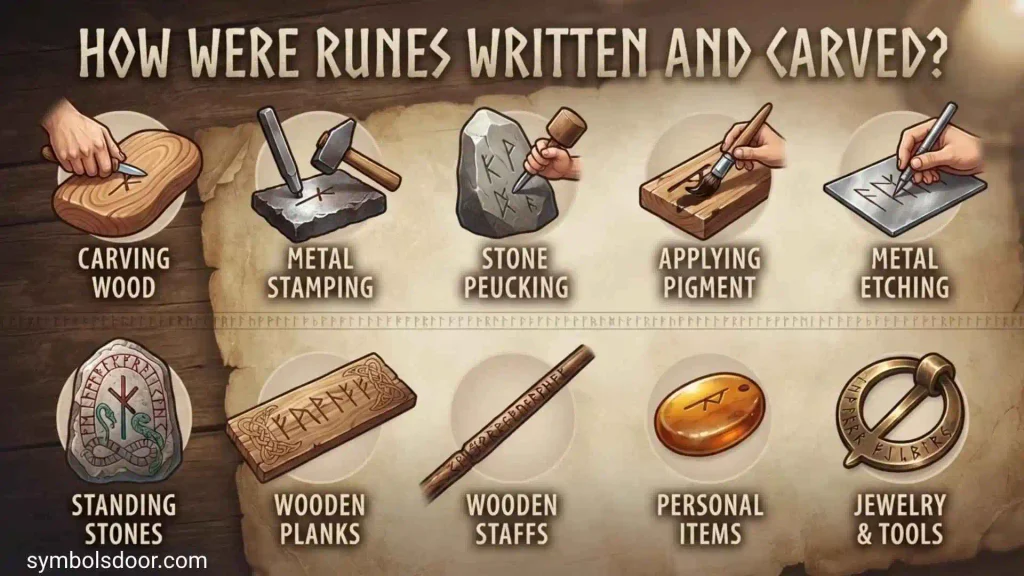
Runic writing was practical. Its angular shapes made many characters suitable for carving into hard or fibrous materials.
The material chosen depended on the purpose of the inscription and the resources available.
Materials Used for Runic Inscriptions
<AsyncImageGroup query={[“Viking runes carved wooden stick museum artifact”,”Viking runestone carved runic inscription close up”,”Viking Age runic inscription metal object museum”,”Viking bone comb runic inscription artifact”]} aspectRatio=”5:4″ layout=”carousel”/>
Common materials included:
- Wood: Used for messages, labels, and everyday writing.
- Stone: Used for memorials and public inscriptions.
- Metal: Found on weapons, jewelry, and other objects.
- Bone and antler: Used for personal objects and inscriptions.
- Parchment: Used in medieval manuscripts and written records.
Wood was widely available, but it decays more easily than stone or metal. This means the surviving archaeological record may not represent the full range of historical runic writing.
How Were Runes Carved?
Runes were commonly made with straight lines. This made them suitable for engraving into wood, where curved lines could be harder to cut cleanly.
A carver could use a sharp tool to create vertical strokes and diagonal branches.
On runestones, inscriptions were often arranged within decorative bands or alongside images.
The direction of writing could vary. Some inscriptions used word dividers or punctuation marks to make the text easier to read.
Common Types of Runic Inscriptions
Historical inscriptions served many purposes.
| Type | Purpose |
| Memorial inscription | Remembering a deceased person |
| Ownership mark | Identifying the owner of an object |
| Personal name | Recording an individual’s name |
| Message | Communicating information |
| Religious inscription | Expressing a prayer or religious statement |
| Protective inscription | Seeking protection or invoking supernatural help |
| Commercial inscription | Recording trade or practical information |
| Cipher inscription | Concealing or encoding a message |
Runes were not limited to monuments and religious objects. They were also part of everyday communication.
Bind Runes and Cipher Runes
Bindrunes combine two or more runic characters into a shared design. Characters may share a vertical stroke or connect through overlapping lines.
<AsyncImage query=”historical runic bindrune inscription carved stone artifact” aspectRatio=”16:9″ width=”100%”/>
Historical bindrunes exist, but their use and meaning depend on the specific inscription.
Modern decorative bindrunes are often created by combining characters associated with selected personal meanings. These designs may be meaningful to their creators, but that doesn’t make them ancient symbols.
Cipher runes are different. They use methods of encoding or rearranging runic characters to make an inscription harder to read.
Some historical inscriptions contain runic puzzles or coded sequences. The Rök Runestone is a famous example of a complex inscription that includes unusual forms and interpretive challenges.
Famous Runestones, Artifacts, and Runic Inscriptions
Archaeological objects provide some of the strongest evidence for how ancient communities used runes.
They allow researchers to study the actual characters, materials, languages, and messages rather than relying only on later stories.
Kylver Stone
The Kylver Stone is an important early runic artifact from Gotland, Sweden.
It is especially known for its Elder Futhark rune sequence. Its inscription provides valuable evidence about the early runic alphabet and its character order.
The stone is frequently discussed in studies of early runic writing because it preserves a complete rune row.
Rök Runestone
<AsyncImage query=”Rok runestone Sweden ancient Viking runic inscription photograph” aspectRatio=”16:9″ width=”100%”/>
The Rök Runestone in Sweden is famous for its unusually long and complex inscription.
It dates to the Viking Age and includes references that have attracted considerable scholarly attention.
Its text uses different runic forms and encoding techniques. Researchers continue to debate aspects of its meaning and literary references.
The stone is particularly important because it demonstrates that Viking Age runic writing could be much more complex than a simple name or memorial message.
Golden Horns of Gallehus
The Golden Horns of Gallehus were two decorated gold horns discovered in Denmark.
They carried important early runic inscriptions and are famous examples of Germanic craftsmanship.
The original horns were stolen and melted down in the nineteenth century. Their appearance and inscriptions are known through surviving drawings, descriptions, and later reconstructions.
They remain important in the study of early Germanic art and writing.
Vimose Comb
The Vimose Comb is an early runic object discovered in Denmark.
Its inscription is significant because it provides evidence of early runic writing on a practical personal item.
The comb helps demonstrate that runes were not limited to large stone monuments.
Other Important Runic Artifacts
| Artifact | Region | Historical importance |
| Einang Stone | Norway | Early Scandinavian runic inscription |
| Noleby Stone | Sweden | Important early runic evidence |
| Björketorp Runestone | Sweden | Known for a lengthy and unusual inscription |
| Stentoften Stone | Sweden | Early Scandinavian inscription with complex language |
| Gummarp Stone | Sweden | Important early runic monument |
| Sparlösa Runestone | Sweden | Rich inscription and imagery |
| Franks Casket | Anglo-Saxon England | Whalebone object with runic and other inscriptions |
| Ruthwell Cross | Scotland | Important Anglo-Saxon Christian monument |
| Thames scramasax | England | Weapon with an Anglo-Saxon runic inscription |
| Bryggen inscriptions | Norway | Medieval everyday runic messages |
| Codex Runicus | Denmark | Medieval manuscript written largely in runes |
These objects demonstrate how widely runes were used and how much their purpose changed across time.
Were Runes Used for Magic and Divination?
Runes have a long association with magic, especially in modern discussions of Norse spirituality.
Historical evidence does show that some inscriptions had magical or protective purposes. However, most surviving inscriptions record ordinary information.
The National Museum of Denmark notes that runic magic appears in medieval literary sources and later traditions, while many surviving inscriptions contain everyday messages. <Cite refs={[“turn264913search1”]}/>
Runes in Historical Germanic and Norse Beliefs
Some runic inscriptions include protective statements, curses, or religious invocations.
For example, the Glavendrup Stone includes a warning against damaging the monument and an invocation of Thor.
Such inscriptions suggest that people sometimes believed written words could have supernatural force.
However, the evidence doesn’t support the idea that every rune had one fixed magical power.
Runes were also practical writing tools.
Odin and the Magical Knowledge of Runes
Odin’s relationship with runes is described in Hávamál, a poem preserved in the Poetic Edda.
The poem describes Odin’s suffering and sacrifice as he gains knowledge of runes.
This story became a major influence on later ideas about runic wisdom, magical knowledge, and spiritual transformation.
It is a mythological account, not a documented description of how historical people learned to write.
Runic Divination and Rune Casting
Modern runic divination often involves selecting or casting rune pieces and interpreting the characters that appear.
A typical modern rune-reading set contains 24 Elder Futhark characters, sometimes with an additional blank piece.
However, the familiar modern system of casting 24 runes and interpreting their positions is not established as a standard Viking Age practice.
Historical sources mention casting lots and magical practices, but they don’t prove that ancient Scandinavians used the same system found in modern rune books.
Modern Rune Reading and Spiritual Interpretations
Today, some people use runes for personal reflection, meditation, or spiritual practice.
Common methods include:
- Drawing one rune for reflection.
- Selecting three runes to represent different stages of a situation.
- Casting several rune pieces onto a cloth.
- Interpreting upright and reversed positions.
- Combining runes into personal symbolic designs.
These are modern practices. Their meanings can vary between teachers, authors, and spiritual communities.
They should be understood as contemporary interpretations rather than a single ancient system.
Modern Uses and Cultural Significance of Rune Symbols
Runes remain recognizable because of their historical appearance and connection with Germanic and Scandinavian heritage.
Today, they appear in spirituality, art, tattoos, literature, games, jewelry, and popular culture.
Runes in Modern Paganism and Spirituality
Some modern pagan and Heathen communities use runes as part of their religious or cultural practices.
They may study historical rune names, use runes in personal rituals, or incorporate them into religious artwork.
However, beliefs differ between communities. There is no single modern interpretation that represents everyone who uses runes.
Germanic paganism and modern Heathen traditions also include beliefs and practices beyond runic symbolism.
Runes in Fantasy Literature
<AsyncImageGroup query={[“The Hobbit Tolkien runic map Lonely Mountain runes”,”Tolkien Cirth runic alphabet Lord of the Rings book illustration”]} aspectRatio=”5:4″ layout=”carousel”/>
Fantasy literature has played a major role in popularizing runic-looking writing.
J. R. R. Tolkien used several fictional writing systems in his legendarium.
In The Hobbit, the map and other material use runic-inspired characters. In The Lord of the Rings, Tolkien developed the Cirth writing system, also known as the runes of Daeron.
Tolkien’s fictional scripts were carefully constructed, but they aren’t historical Germanic alphabets.
The languages and writing systems of Middle-earth include:
- Cirth: A fictional runic writing system.
- Khuzdul: The language of the Dwarves.
- Tengwar: Another fictional writing system used by several peoples.
These creations show how historical runes can inspire entirely new writing systems.
Runes in Video Games and Popular Culture
<AsyncImageGroup query={[“God of War Norse runes game environment”,”Hellblade Senua Sacrifice runic symbols game”,”Northgard Viking runes game artwork”]} aspectRatio=”5:4″ layout=”carousel”/>
Video games often use runic symbols to create a connection with Norse mythology, ancient cultures, and fantasy worlds.
Examples include:
- God of War: Uses Norse mythology and runic-looking writing as part of its world and storytelling.
- Hellblade: Senua’s Sacrifice: Uses runic inscriptions and Norse-inspired visual elements.
- Northgard: Draws on Viking Age themes and Scandinavian imagery.
- Ultima: Includes fictional writing systems and fantasy symbols.
- The Fantasy Trip: Uses fantasy role-playing conventions that can include ancient-looking symbols.
Some games reproduce historical runes, while others create fictional designs inspired by them.
Always distinguish an authentic historical character from a fictional symbol designed for a game.
Runic Tattoos, Jewelry, and Decoration
<AsyncImageGroup query={[“Elder Futhark runic tattoo forearm design”,”Viking rune jewelry pendant Elder Futhark”,”runic symbols carved wooden decoration”]} aspectRatio=”5:4″ layout=”carousel”/>
Runic tattoos are popular among people interested in Scandinavian history, Norse mythology, and modern spiritual symbolism.
Some choose a single rune because of its historical name or modern interpretation. Others use a complete word, a name, or a bindrune.
Before choosing a rune tattoo, consider these points:
- Check the historical alphabet you want to use.
- Confirm the rune’s sound value.
- Make sure the spelling matches the intended language.
- Understand that Elder Futhark and Younger Futhark aren’t interchangeable.
- Research the cultural and political context of the design.
- Avoid relying on unverified online translations.
A rune that looks attractive may not spell the word you intend.
For example, writing a modern English name using Elder Futhark requires a transliteration system. The result is not automatically an ancient Germanic word.
Runes in Modern Political and Extremist Symbolism
Some historical runic characters have been appropriated by political movements, including Nazi organizations and later extremist groups.
This history deserves attention, but it is important not to treat every historical rune as an extremist symbol.
Armanen Runes and Guido von List
The Armanen runes are a modern esoteric system developed by Austrian occultist Guido von List in the early twentieth century.
List presented his rune system as a rediscovered ancient tradition. However, it is not recognized by mainstream scholarship as an authentic ancient Germanic alphabet.
His ideas formed part of a broader movement sometimes described as Armanism or Ariosophy.
Wiligut Runes and Nazi-Era Appropriation
Karl Maria Wiligut developed his own esoteric ideas about Germanic history, mythology, and symbolism.
He became associated with Nazi-era cultural and ideological circles.
Heinrich Himmler and the SS used certain stylized runic designs as organizational insignia. These uses were political inventions and appropriations, not proof that the same symbols had one fixed ancient meaning.
SS Runes and Nazi Symbolism
<AsyncImage query=”historical Schutzstaffel SS double sig rune insignia museum historical context” aspectRatio=”16:9″ width=”100%”/>
The SS insignia used two stylized Sig runes as a symbol of the Schutzstaffel.
This is a well-documented example of twentieth-century political appropriation of runic-looking characters.
When discussing Nazi symbolism or Neo-Nazi symbolism, context matters. Some historical characters have been adopted by extremist groups, while the same or similar characters also appear in legitimate historical, linguistic, and cultural research.
A responsible interpretation considers the design, its setting, and how it is being used.
The Bluetooth Logo and Its Connection to Viking Runes
<AsyncImage query=”Bluetooth logo Harald Bluetooth runic Hagall Bjarkan rune combination graphic” aspectRatio=”16:9″ width=”100%”/>
The Bluetooth logo is one of the best-known modern designs inspired by Viking runes.
The name Bluetooth comes from Harald Bluetooth, a tenth-century Danish king associated with the unification of parts of Denmark and Norway.
The logo combines two runic initials associated with his name:
- Hagall (ᚼ): A Younger Futhark form associated with the H sound.
- Bjarkan (ᛒ): A Younger Futhark form associated with the B sound.
These characters are combined into a single design.
The logo is therefore a modern bindrune based on the initials of Harald Bluetooth.
It demonstrates how historical runic characters can influence modern technology and branding without serving as ordinary writing.
Runes in Unicode and Digital Writing
Runes are not limited to stone inscriptions and historical objects. You can also type many runic characters on digital devices using Unicode.
Unicode is the international character-encoding standard used to represent text across computers, websites, and digital platforms.
The Unicode Runic Block
The Unicode Runic block occupies the range U+16A0–U+16FF.
It includes characters associated with different historical runic traditions, not only the 24 Elder Futhark runes.
The Unicode Standard’s Runic section explains that the script was historically used across German, Scandinavian, and Anglo-Saxon regions, with surviving inscriptions spanning many centuries. <Cite refs={[“turn264913search50″,”turn264913search48”]}/>
Some familiar Unicode runic characters include:
| Character | Unicode code point | Character name |
| ᚠ | U+16A0 | Fehu |
| ᚢ | U+16A2 | Uruz |
| ᚦ | U+16A6 | Thurisaz |
| ᚨ | U+16A8 | Ansuz |
| ᚱ | U+16B1 | Raidō |
| ᚲ | U+16B2 | Kauna |
| ᚷ | U+16B7 | Gebo |
| ᚹ | U+16B9 | Wunjo |
| ᚺ | U+16BA | Haglaz |
| ᛁ | U+16C1 | Isaz |
| ᛃ | U+16C3 | Jeran |
| ᛉ | U+16C9 | Algiz |
| ᛏ | U+16CF | Tiwaz |
| ᛒ | U+16D2 | Berkanan |
| ᛖ | U+16D6 | Ehwaz |
| ᛗ | U+16D7 | Mannaz |
| ᛚ | U+16DA | Laukaz |
| ᛜ | U+16DC | Ingwaz |
| ᛞ | U+16DE | Dagaz |
| ᛟ | U+16DF | Othalan |
The official Unicode chart also includes runic punctuation marks and characters associated with specialized historical uses. <Cite refs={[“turn264913search0″,”turn264913search48”]}/>
Runic Punctuation and Special Characters
Runic inscriptions did not always use punctuation in the same way as modern English.
Unicode includes several runic punctuation characters:
- ᛫ Runic Single Punctuation.
- ᛬ Runic Multiple Punctuation.
- ᛭ Runic Cross Punctuation.
The block also contains three Golden Number Runes:
- ᛮ Runic Arlaug Symbol.
- ᛯ Runic Tvimadur Symbol.
- ᛰ Runic Belgthor Symbol.
These characters are associated with historical Scandinavian calendar traditions.
How to Type or Copy Runic Symbols
You can copy runic characters from a Unicode chart or a supported digital font.
For example:
- Fehu: ᚠ
- Uruz: ᚢ
- Thurisaz: ᚦ
- Ansuz: ᚨ
- Raidō: ᚱ
- Gebō: ᚷ
- Wunjō: ᚹ
- Dagaz: ᛞ
Not every font supports every character. If a symbol appears as an empty box or an unusual shape, your device may lack the required font support.
Also remember that Unicode characters represent written characters. They do not automatically provide a correct translation or spiritual meaning.
Runology: The Academic Study of Runes
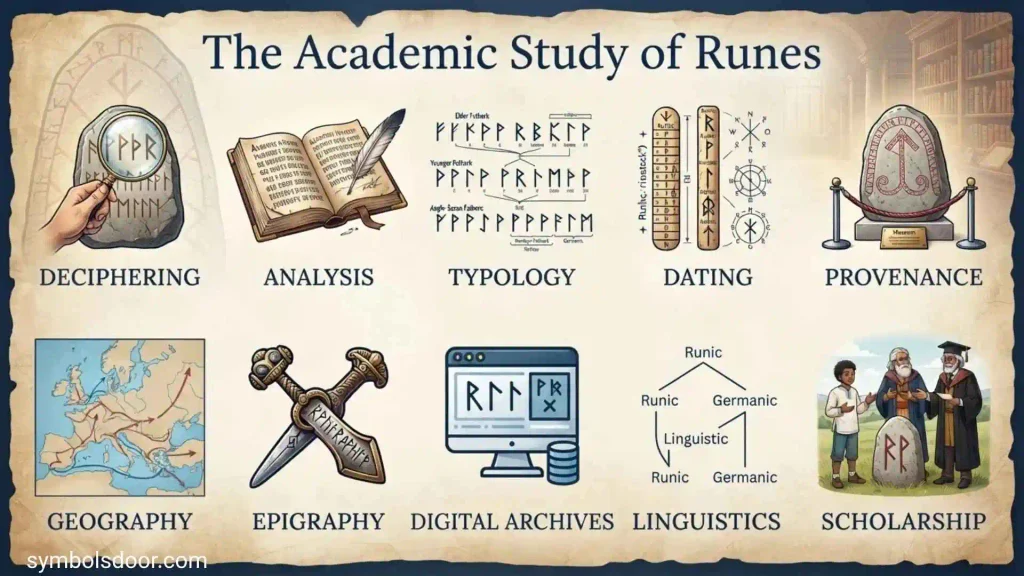
Runology is the academic study of runes, runic writing, and runic inscriptions.
It draws on several research fields, including archaeology, linguistics, history, epigraphy, and manuscript studies.
Runologists examine the physical objects and written evidence to understand how runes developed and how people used them.
What Does Runology Study?
Runology covers several important areas:
- Runic epigraphy: The study of inscriptions carved or written in runes.
- Germanic linguistics: The study of Germanic languages and their historical development.
- Runic transliteration: Converting runic characters into a Latin-script representation.
- Linguistic reconstruction: Reconstructing older language forms from surviving evidence.
- Archaeological dating: Establishing when an object or inscription was created.
- Runic symbolism: Studying how runes were used in religious, social, and cultural settings.
Researchers also compare runic inscriptions with related languages and writing systems.
How Researchers Interpret Runic Inscriptions
A damaged inscription may contain missing characters or unclear words. Researchers use several methods to interpret it.
They may examine:
- The shape of each surviving rune.
- The language and sound values used during the period.
- The inscription’s grammar.
- The object’s archaeological context.
- Similar inscriptions from the same region.
- Historical names and place references.
- Later linguistic evidence.
This process helps researchers distinguish a reliable interpretation from a speculative one.
Important Runic Research Resources
If you want to study authentic runic material, use established academic and museum resources.
- Rundata: A major database of Scandinavian runic inscriptions.
- Sveriges runinskrifter: A scholarly publication series documenting Swedish runic inscriptions.
- National Museum of Denmark: Provides historical information about Danish runestones and runic magic.
- Unicode Consortium: Provides official character names and digital encoding information.
- University research collections: Useful for linguistic studies, inscription interpretations, and runological publications.
These resources are more reliable than decorative rune charts that assign unsupported meanings to every character.
Common Misconceptions About Rune Symbols
Many online articles mix historical facts with modern spiritual beliefs. This can make rune meanings confusing.
Here are some common misunderstandings to avoid.
Runes Were Only Used for Magic
False. Runes were primarily a writing system. People used them for names, messages, ownership marks, memorials, and other practical purposes.
Some inscriptions had magical or religious associations, but that was only part of their use.
Every Rune Has One Fixed Spiritual Meaning
False. Historical rune names have linguistic associations, but modern spiritual interpretations vary.
A rune’s meaning can depend on the tradition, author, or modern system being used.
The Elder Futhark Was the Viking Age Alphabet
Not exactly. The Elder Futhark predates the Viking Age. The Younger Futhark was the main Scandinavian runic alphabet during the Viking Age.
All Runic Alphabets Had 24 Characters
False. The Elder Futhark has 24 characters, while the Younger Futhark has 16. The Anglo-Saxon Futhorc expanded beyond 24 characters.
The Blank Rune Was an Ancient Character
False. The modern blank or 25th rune is not part of the historical Elder Futhark.
Every Bindrune Has an Ancient Meaning
False. Historical bindrunes exist, but many modern designs are personal creations.
Their meanings should not be presented as historically established unless there is evidence for that specific design.
Odin’s Story Proves How Runes Were Invented
No. Odin’s sacrifice is a mythological story from Hávamál. It provides insight into Norse literary and religious traditions, not a verified historical account of the invention of runic writing.
Runes and Celtic Ogham Are the Same Writing System
No. Runes belong to Germanic writing traditions. Ogham is a separate historical writing system associated mainly with early medieval Ireland and Britain.
Both are ancient writing traditions, but they have different origins, characters, and historical uses.
Frequently Asked Questions About Rune Symbols
What Are Runes and What Do They Mean?
Runes are characters from historical writing systems used by Germanic-speaking peoples. They primarily represented speech sounds. Their names often refer to objects, animals, natural features, or concepts, while modern spiritual interpretations may assign additional symbolic meanings.
What Is the Runic Alphabet Called?
The best-known runic alphabets are called the Elder Futhark, Younger Futhark, and Anglo-Saxon Futhorc. The word Futhark comes from the first six characters of the older and Scandinavian runic sequences.
How Many Runes Are in the Elder Futhark?
The Elder Futhark contains 24 runes, traditionally divided into three groups of eight called ættir.
What Are the 24 Elder Futhark Runes and Their Meanings?
The 24 runes are Fehu, Uruz, Thurisaz, Ansuz, Raidō, Kaunaz, Gebō, Wunjō, Hagalaz, Naudiz, Īsaz, Jēra, Ī(h)waz, Perþō, Algiz, Sōwilō, Tīwaz, Berkanan, Ehwaz, Mannaz, Laguz, Ingwaz, Dagaz, and Ōþala. Their historical name associations include cattle, the aurochs, a giant, a god, a journey, a torch, a gift, joy, hail, need, ice, harvest, yew, an uncertain term, an elk-related association, the sun, Týr, birch, horse, human, water, Ing, day, and inheritance.
What Is the Difference Between Elder Futhark and Younger Futhark?
The Elder Futhark contains 24 characters and was used by early Germanic-speaking communities. The Younger Futhark contains 16 characters and became the main Scandinavian runic alphabet during the Viking Age.
What Is the Anglo-Saxon Futhorc?
The Anglo-Saxon Futhorc was a runic alphabet used in England and parts of Frisia. It developed from the older Germanic runic tradition and added characters to represent sounds in Old English.
What Do Viking Runes Mean?
Viking runes were primarily letters used for writing Old Norse and related languages. Their names and historical associations included concepts such as wealth, hail, need, the sun, and inheritance. Some inscriptions also had religious or protective purposes.
Where Did Runes Originate?
Runic writing developed among Germanic-speaking communities in the first centuries CE. Its exact origin is debated, but scholars generally believe that earlier Mediterranean or Old Italic writing systems influenced its development.
Were Runes Used for Magic and Divination?
Some historical inscriptions and medieval literary sources associate runes with magic, protection, and curses. However, the common modern practice of casting a set of 24 Elder Futhark runes is not established as a standard Viking Age tradition.
What Is the Connection Between Odin and Runes?
In Hávamál, Odin gains knowledge of runes after hanging on a tree for nine nights. This mythological story is a major source of the association between Odin, runes, and hidden knowledge.
What Are Bind Runes?
Bindrunes are designs that combine two or more runic characters, often by sharing strokes. Historical examples exist, but many decorative bindrunes used today are modern creations.
What Are Long-Branch and Short-Twig Runes?
They are two main forms of the Younger Futhark. Long-branch runes have more fully developed strokes, while short-twig runes use simplified shapes.
How Were Runes Carved Into Stones and Wood?
Runes were commonly carved with sharp tools. Their angular shapes made them suitable for engraving into wood, stone, metal, and other materials.
When Did the Latin Alphabet Replace Runes?
The transition happened gradually and at different times across Europe. The Latin alphabet became increasingly important through Christianity, education, and administration, while runes survived in parts of Scandinavia for centuries.
Are Runes Still Used Today?
Yes. People use runes in historical research, cultural displays, jewelry, tattoos, fantasy writing, and modern spiritual practices. They are also represented digitally through Unicode.
What Is Runology?
Runology is the academic study of runes and runic inscriptions. It combines archaeology, linguistics, epigraphy, history, and manuscript research.
What Is the Meaning of the Bluetooth Logo?
The Bluetooth logo combines two Younger Futhark characters associated with the initials of Harald Bluetooth: Hagall and Bjarkan. The resulting design is a modern bindrune.
What Is the Difference Between Runes and the Latin Alphabet?
Runes are characters from historical Germanic writing systems, while the Latin alphabet developed from earlier Mediterranean scripts. Both primarily represent speech sounds, but their shapes, histories, and regional uses differ.
What Is the 25th or Blank Rune?
The blank rune is a modern addition found in some contemporary rune-divination sets. It is not part of the historical 24-character Elder Futhark.
Are Modern Rune Meanings Historically Accurate?
Some modern interpretations build on genuine historical name associations. Others extend those associations into spiritual or personal meanings that aren’t documented in ancient sources. It’s important to distinguish historical evidence from modern belief.
Where Can You Find Authentic Runic Inscriptions?
You can explore runic objects through museums, archaeological collections, university research, and databases such as Rundata. The National Museum of Denmark and Swedish runic inscription publications are useful starting points.
Conclusion: Understanding Ancient and Modern Rune Symbols
Rune symbols are an important part of European writing history. They began as characters used by Germanic-speaking communities and developed into several distinct writing traditions.
The Elder Futhark, Younger Futhark, and Anglo-Saxon Futhorc show how runic writing changed across regions and centuries. Their characters recorded names, messages, memorials, and other information. Some inscriptions also carried religious or protective associations.
The 24 Elder Futhark runes remain especially popular because their names connect with familiar ideas such as wealth, strength, journeys, gifts, nature, and inheritance. However, their historical meanings should be separated from modern spiritual interpretations.
Runes also continue to influence contemporary culture. You can find them in modern paganism, tattoos, fantasy literature, video games, digital fonts, and even the Bluetooth logo.
The best way to understand ancient runes and their meanings is to consider their original languages, historical periods, and surviving inscriptions. When you separate archaeological evidence from later interpretations, these symbols become much more than mysterious designs. They reveal how people communicated, remembered their dead, expressed beliefs, and developed writing systems across centuries.
Hi, I’m Sienna Brooks, and I believe that the right words can inspire, comfort, and empower people at every stage of life. For as long as I can remember, I’ve been drawn to meaningful quotes and the stories behind them. I love curating collections of inspirational, motivational, and heartfelt quotes that resonate with readers around the world.
Through my writing, I strive to help others find encouragement, whether they’re celebrating life’s happiest moments or navigating its biggest challenges. I believe that wisdom is timeless, and I’m passionate about sharing words that leave a lasting impact.
I am the author of Reflections in Words and The Journey of Inspiration, two books dedicated to exploring the beauty and power of timeless quotes.
 Rowan Sinclair Rowan Sinclair
 Asher Monroe