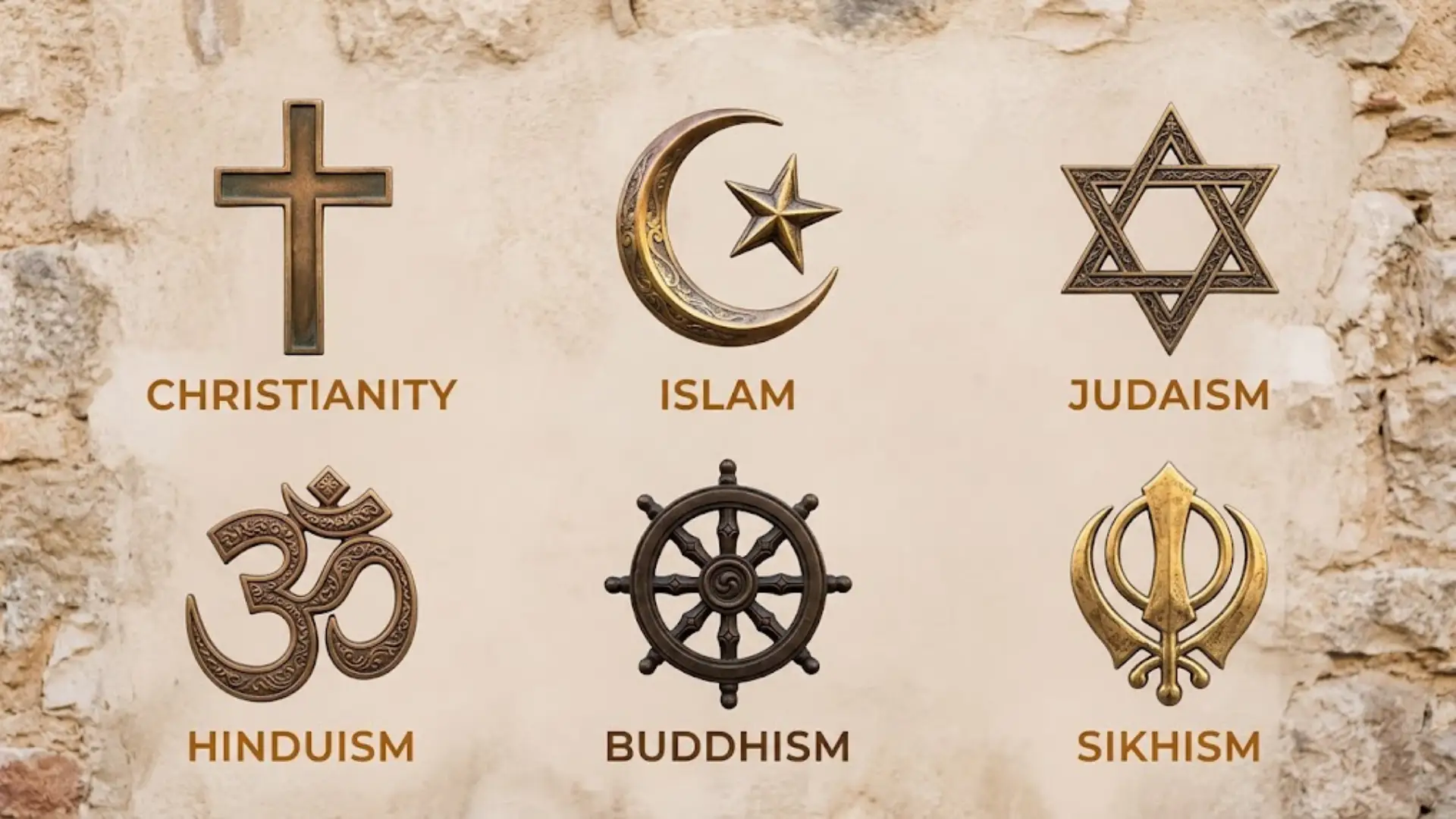
Religious symbols help people express faith, preserve traditions, and communicate spiritual ideas. From the Christian cross to the Hindu Om symbol, these signs connect religious communities with their beliefs, history, and practices. Some appear in sacred buildings, while others are worn as jewelry, used during prayer, or displayed during religious celebrations.
Understanding religious signs and symbols and their meanings also reveals how different cultures understand life, creation, morality, and the divine. However, a symbol does not always have the same meaning across every religion or community. Its interpretation often depends on history, religious teachings, and the way people use it.
This guide explores religious symbols and their meanings across Christianity, Islam, Hinduism, Buddhism, Judaism, Sikhism, and Pagan traditions. It also explains common symbolic themes, the role of sacred imagery, and how religious symbols express faith and identity.
What Are Religious Symbols?
A religious symbol is an image, object, shape, sign, or emblem associated with religious beliefs and practices. It can represent a deity, a spiritual teaching, a sacred event, a religious community, or an important part of worship.
For example, Christians use the cross to remember the crucifixion and resurrection of Jesus Christ. Buddhists use the Dharma Wheel to represent the Buddha’s teachings. The Star of David is widely recognized as a symbol of Jewish identity.
These examples show how symbolic representations can communicate complex beliefs through recognizable images.
Religious symbols may appear in:
- Sacred buildings, including churches, mosques, temples, synagogues, and gurdwaras.
- Religious paintings, sculptures, manuscripts, and stained-glass windows.
- Clothing, jewelry, pendants, and devotional objects.
- Prayer, meditation, ceremonies, and religious festivals.
- Flags, community emblems, and educational materials.
- Sacred texts and traditional artwork.
Some symbols have existed for centuries, while others developed more recently. Their meanings can also change as religious communities interpret and use them in new settings.
What Are Religious Symbols Called?
People use several terms to describe religious signs, images, and objects. Although these terms overlap, they do not always mean exactly the same thing.
- Religious symbols: Images, shapes, or objects that represent religious ideas or identity.
- Religious icons: Sacred images used in particular religious traditions. In Eastern Orthodox Christianity, for example, icons often depict Jesus, Mary, saints, and biblical events.
- Religious iconography: The study and use of religious images and their meanings.
- Sacred symbols: Signs or objects that a religious community considers spiritually significant.
- Religious emblems: Recognizable designs associated with a faith or religious organization.
- Religious drawings: Illustrations of sacred figures, stories, symbols, or concepts.
- Devotional images: Pictures or representations used to support prayer, remembrance, or worship.
The term icon has a more specific meaning in some traditions. Not every religious symbol is an icon, and not every sacred object functions as a symbol in the same way.
Why Are Symbols Important in Religion?
Religious symbols make spiritual teachings easier to recognize, remember, and communicate. They also help communities preserve traditions across generations.
Their importance includes several areas:
- Religious education: Symbols help explain sacred stories, teachings, and beliefs.
- Worship and devotion: Objects such as rosary beads and prayer candles support particular forms of religious practice.
- Faith and identity: A symbol can identify a person’s religious community or heritage.
- Spiritual reflection: Images and objects can remind believers of their values and responsibilities.
- Cultural preservation: Religious artwork and architecture preserve historical traditions.
- Community connection: Shared symbols can bring people together during ceremonies and celebrations.
A symbol’s importance comes from the meaning a religious community gives it, not simply from its appearance.
Religious Symbols and Their Meanings at a Glance
The following table introduces some of the world’s best-known sacred symbols and their common associations.
| Religious symbol | Associated tradition | Common meaning or significance |
| Christian cross | Christianity | Jesus Christ’s crucifixion, salvation, and resurrection |
| Crucifix | Catholicism and other Christian traditions | Jesus Christ’s sacrifice on the cross |
| Dove | Christianity | The Holy Spirit in biblical imagery |
| Sacred Heart | Catholic devotion | Christ’s love and compassion |
| Crescent moon and star | Some Muslim communities and countries | Cultural and historical associations; not a universal Islamic emblem |
| Om (Aum) | Hinduism and other Indian religious traditions | Sacred sound and spiritual reality |
| Dharma Wheel | Buddhism | The Buddha’s teachings and the path to liberation |
| Star of David | Judaism | Jewish identity and heritage |
| Menorah | Judaism | Jewish worship, sacred history, and religious continuity |
| Khanda | Sikhism | Sikh identity and principles of spiritual and worldly responsibility |
| Ichthys (fish) | Christianity | Christian faith and identity |
| Lotus flower | Hinduism and Buddhism | Spiritual development and purity in various contexts |
| Pentacle | Some Pagan and Wiccan traditions | Spiritual practice and, in some traditions, associations with the elements |
| Triple Moon | Some contemporary Pagan traditions | Lunar phases and particular Goddess-centered beliefs |
| Torii gate | Shinto | The entrance to or boundary of a shrine’s sacred space |
| Yin-yang | Chinese philosophical traditions, including Taoism | Complementary forces and their interdependence |
These are common associations rather than universal definitions. The same symbol can have different meanings depending on the religious community and historical context.
Symbols of the Six Major Religions
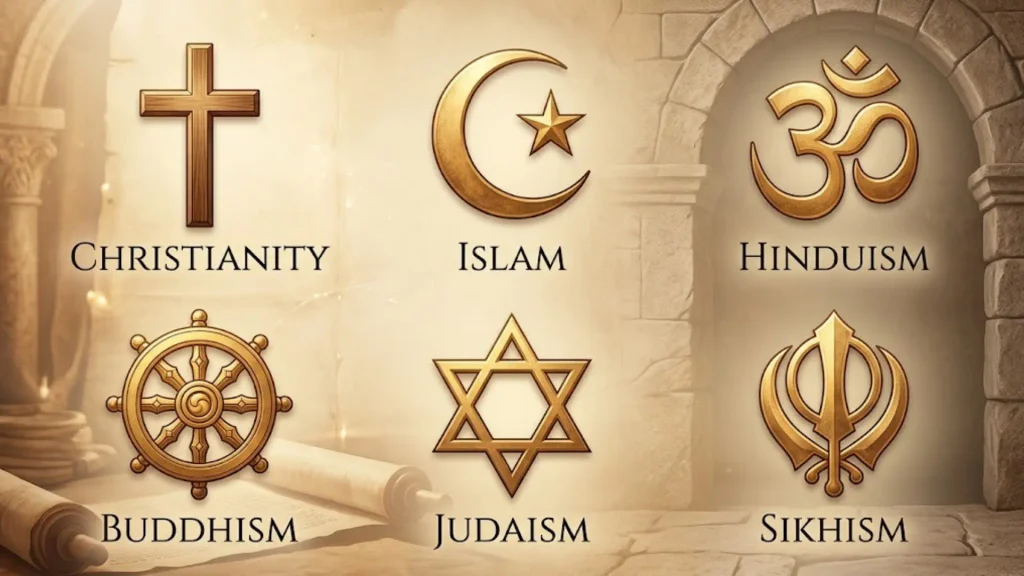
Christianity, Islam, Hinduism, Buddhism, Judaism, and Sikhism are often compared in introductory guides to world religions. Each has distinctive traditions, sacred teachings, and recognizable symbols.
However, no single emblem represents every member of every religion. Some traditions use several important symbols, while others emphasize sacred words, objects, rituals, or religious practices.
Christianity Religious Symbols and Meanings
Christian symbols communicate beliefs about Jesus Christ, salvation, resurrection, hope, and the relationship between humanity and God. They appear in churches, religious artwork, jewelry, and Christian ceremonies.
<underline>The Christian Cross</underline>
The cross religious symbol is one of the most widely recognized symbols of Christianity. It recalls the crucifixion of Jesus Christ and, within Christian faith, represents salvation, sacrifice, forgiveness, and the hope of resurrection.
Different Christian traditions use different cross designs. A plain cross does not depict Jesus’ body, while a crucifix includes a representation of Christ on the cross.
<underline>The Crucifix</underline>
A crucifix is especially prominent in Catholic worship and devotional imagery. It emphasizes Jesus’ suffering and sacrifice, reminding believers of the central Christian account of redemption.
The crucifix is not identical to every Christian cross. Many Protestant traditions commonly display a plain cross instead.
<underline>The Dove Symbol</underline>
The dove is a familiar Christian image of the Holy Spirit. In the Gospel accounts of Jesus’ baptism, the Spirit descends like a dove.
Christian artwork also uses the dove to communicate peace and divine presence in appropriate biblical contexts. The Vatican’s Catechism of the Catholic Church identifies the dove as one of the traditional symbols of the Holy Spirit.
<underline>The Ichthys or Christian Fish</underline>
The Ichthys is a fish-shaped sign associated with Christian identity. It became an important Christian identifier in early Christian history and remains recognizable today.
The fish is connected with biblical accounts involving Jesus and his disciples, including stories about fishing and feeding crowds.
<underline>The Holy Trinity Symbol</underline>
The Holy Trinity is the Christian belief in one God in three persons: the Father, the Son, and the Holy Spirit.
Christian artists have used several designs to express this teaching. Triangles and interlocking-circle diagrams appear in some Christian artwork, although no single geometric design represents the Trinity in every denomination.
Keywords: Christian symbols and meanings, Christian faith, Christian iconography, life of Jesus Christ, death and resurrection of Jesus Christ, religious teachings.
Catholic Religious Symbols
Catholic traditions include many symbols used in worship, prayer, and devotion. Some are shared with other Christian communities, while others have particular importance in Catholic devotional life.
<underline>The Sacred Heart</underline>
The Sacred Heart represents the love and compassion of Jesus Christ. It is often depicted as a heart surrounded by flames, sometimes with a crown of thorns and a cross.
The imagery encourages reflection on Christ’s love, suffering, and devotion to humanity.
<underline>The Rosary</underline>
The rosary is a set of prayer beads used in Catholic devotional practice. Its beads help users follow a sequence of prayers while meditating on events associated with Jesus Christ and Mary.
The rosary is more than a decorative necklace. It serves a practical role in prayer and spiritual reflection.
<underline>The Immaculate Heart of Mary</underline>
This devotional image represents Mary’s love, faithfulness, and relationship with Jesus. It is often shown as a heart surrounded by flowers or pierced by a sword.
<underline>Keys of Saint Peter</underline>
Two crossed keys are associated with Saint Peter and the authority of the papacy. They refer to biblical imagery involving the keys of the kingdom of heaven.
<underline>The Lamb of God</underline>
The lamb is an important Christian image associated with Jesus Christ, sacrifice, and redemption. Its meaning draws on biblical passages that describe Christ as the Lamb of God.
Other familiar Catholic religious symbols include prayer candles, religious statues, medals, and stained-glass images of Christian saints.
Keywords: Catholic religious symbols, Catholic religious symbolism, crucifix, sacred heart symbolism, rosary beads, Catholic worship, Catholic devotional imagery.
Islam Religious Symbols and Meanings
Islam emphasizes belief in one God, known in Arabic as Allah, and the teachings of the Quran and the Prophet Muhammad. Islamic religious expression often uses calligraphy, geometric patterns, sacred architecture, and objects associated with prayer.
It is important to understand that Islam does not have one universally prescribed visual emblem.
<underline>The Crescent Moon and Star</underline>
The crescent moon and star is widely associated with some Muslim communities, countries, and cultural settings. It appears on the flags of several countries with Muslim-majority populations and on some mosque decorations.
However, the symbol is not a universal religious emblem prescribed by Islam. Its historical association with Muslim identity developed over time, particularly through political and cultural history.
The moon also has a practical religious connection because the Islamic calendar is lunar. Lunar observations help determine the timing of religious months and celebrations.
<underline>Islamic Calligraphy</underline>
Islamic calligraphy is the artistic writing of Arabic letters, including Quranic passages and the name of Allah. It appears in manuscripts, religious buildings, ceramics, and other forms of Islamic artwork.
Calligraphy can communicate religious teachings while demonstrating the beauty and importance of the written word. Its use varies across cultures and artistic traditions.
<underline>The Kaaba</underline>
The Kaaba is a sacred structure in Mecca, Saudi Arabia. Muslims face toward it during their daily prayers, and it stands at the center of the Hajj pilgrimage.
The Kaaba is not simply a logo for Islam. Its significance comes from its central role in Muslim prayer, pilgrimage, and religious tradition.
<underline>Prayer Beads and Prayer Rugs</underline>
Some Muslims use prayer beads, known as misbaha or tasbih, when reciting phrases of remembrance of God. Prayer rugs provide a clean surface for prayer and may feature geometric or architectural designs.
Neither object is required in exactly the same way for every Muslim. Practices vary among individuals and communities.
Keywords: Islamic symbols and meanings, Islamic culture, crescent moon symbolism, Islamic calligraphy, lunar calendar, religious observances, spiritual direction.
Hindu Religious Symbols and Meanings
Hinduism includes many philosophical schools, devotional traditions, deities, and spiritual practices. Its symbols often express ideas about creation, consciousness, sacred sound, divine qualities, and spiritual development.
<underline>The Om Symbol</underline>
The Om symbol represents the sacred syllable Om, also written as Aum. It holds deep significance in Hindu traditions and appears in prayers, religious texts, meditation, and devotional artwork.
Om is associated with sacred sound and spiritual reality. Some Hindu philosophical interpretations connect its parts with different states of consciousness, while other interpretations emphasize its role as a sacred utterance.
The symbol is also used in some Buddhist and Jain contexts, although its meaning and use vary between traditions.
<underline>The Swastika in Hindu Traditions</underline>
The swastika is an ancient symbol used in Hindu religious and cultural settings. It is commonly associated with auspiciousness, well-being, and good fortune.
Its traditional use in Hinduism and some other Asian religions must be distinguished from the Nazi appropriation of a similar symbol, which became associated with antisemitism, racial hatred, and genocide.
Historical and cultural context matters when interpreting this symbol.
<underline>The Lotus Flower</underline>
The lotus is an important image in Hindu religious artwork. It appears in representations of several deities and can symbolize purity, spiritual development, and beauty.
Its growth from muddy water into a flower also provides a useful image for spiritual growth amid life’s difficulties.
<underline>The Trishula or Trident</underline>
The trishula is associated with Shiva, one of Hinduism’s major deities. It is a three-pronged weapon commonly depicted in images of Shiva.
Interpretations vary, and some traditions connect the three prongs with sets of three cosmic or spiritual principles.
<underline>The Tilak and Shri Yantra</underline>
A tilak is a mark worn on the forehead during religious or cultural practices. Its shape and meaning vary by community, deity, and religious tradition.
The Shri Yantra is a sacred geometric diagram used in certain Hindu devotional and contemplative practices. Its intersecting triangles form a complex pattern associated with particular theological and meditative interpretations.
Keywords: Hindu religious symbols, Om religious symbol, sacred vibration, sound of creation, Hindu deities, yoga, meditation, sacred chanting.
Buddhism Religious Symbols and Meanings
Buddhist symbols often communicate the Buddha’s teachings, the practice of ethical living, the development of wisdom, and the path toward liberation from suffering.
<underline>The Dharma Wheel</underline>
The Dharma Wheel, also called the Dharmachakra, is one of the best-known Buddhist symbols. It represents the Buddha’s teachings, known as the Dharma, and the path toward awakening.
Its eight-spoked form is commonly connected with the Noble Eightfold Path. The eight practices are:
- Right understanding
- Right intention
- Right speech
- Right action
- Right livelihood
- Right effort
- Right mindfulness
- Right concentration
These practices form a connected path of ethical conduct, mental discipline, and wisdom. The wheel’s meaning is therefore closely tied to Buddhist teaching and practice.
<underline>The Lotus Flower</underline>
In Buddhist art, the lotus often represents purity and spiritual development. Its growth from muddy water into a flower provides an image of awakening amid the difficulties of ordinary life.
The color and form of a lotus may carry additional meanings in particular Buddhist traditions, so not every lotus image has one fixed interpretation.
<underline>The Bodhi Tree</underline>
The Bodhi tree is associated with the place where Siddhartha Gautama attained awakening and became the Buddha. It has become an important symbol of enlightenment and the possibility of spiritual transformation.
<underline>The Endless Knot</underline>
The endless knot is especially familiar in Tibetan Buddhist traditions. It is often associated with interconnectedness and the relationship between causes and effects.
<underline>The Conch Shell and Stupa</underline>
The conch shell appears among traditional Buddhist auspicious symbols and can represent the proclamation of the Dharma.
A stupa is a sacred Buddhist structure associated with relics, remembrance, and religious practice. Stupas can serve as places of pilgrimage and contemplation.
Keywords: Buddhist symbols and meanings, Buddhist Dharma Wheel, Noble Eightfold Path, Buddhist wisdom, spiritual enlightenment, Buddhist temples, meditation spaces.
Judaism Religious Symbols and Meanings
Jewish symbols express religious tradition, communal identity, historical memory, and devotion. Their uses differ across Jewish communities and historical periods.
<underline>The Star of David</underline>
The Star of David, known in Hebrew as Magen David, is a six-pointed star formed from two overlapping triangles. It is widely recognized as a symbol of Jewish identity and heritage.
The symbol appears on synagogues, Jewish community materials, jewelry, and the flag of Israel. Its importance developed over centuries, and its meanings have varied across historical and cultural settings.
<underline>The Menorah</underline>
The menorah is a seven-branched lampstand associated with the ancient Temple in Jerusalem. It remains an important symbol of Jewish religious history and continuity.
It should be distinguished from the nine-branched Hanukkah lampstand, commonly called a hanukkiah, which is used during the festival of Hanukkah.
<underline>The Mezuzah</underline>
A mezuzah is a case attached to the doorpost of a Jewish home or building. It contains a parchment inscribed with passages from the Torah, including the Shema.
The mezuzah reminds observant Jews of religious teachings and their relationship with God.
<underline>The Chai Symbol</underline>
Chai is the Hebrew word for “life.” The word is commonly represented by two Hebrew letters and appears in Jewish jewelry, art, and cultural settings.
<underline>The Shofar</underline>
The shofar is a horn, traditionally made from a ram’s horn, used during important Jewish religious observances, especially Rosh Hashanah and Yom Kippur.
Its sound calls worshippers to reflection, repentance, and spiritual attention.
Keywords: Jewish symbols and meanings, Star of David meaning, six-pointed star, menorah symbolism, Jewish tradition, Jewish heritage, synagogues.
Sikhism Religious Symbols and Meanings
Sikhism teaches devotion to one God, equality, honest living, service, and responsibility toward others. Two important Sikh symbols are Ik Oankar and the Khanda.
<underline>The Khanda Symbol</underline>
The Khanda is a recognizable emblem of Sikh identity. Its design includes a central double-edged sword, a circular steel ring known as the chakkar, and two curved swords called kirpans.
These components are commonly interpreted through Sikh principles:
- Central double-edged sword: Associated with divine knowledge and the ability to distinguish truth from falsehood.
- Circular chakkar: Represents timelessness and the divine reality without beginning or end.
- Two curved swords: Associated with miri and piri, the relationship between worldly responsibility and spiritual authority.
Together, these elements communicate Sikh ideas about faith, justice, spiritual commitment, and social responsibility. The Khanda appears on Sikh flags and at gurdwaras, Sikh places of worship.
<underline>Ik Oankar</underline>
Ik Oankar is a sacred expression affirming the existence of one God, the Creator. It appears at the beginning of the Guru Granth Sahib, the central Sikh scripture.
The phrase expresses a central Sikh belief in one divine reality that encompasses all creation. It is an important religious expression as well as a recognizable symbol.
Keywords: Sikhism religious symbols, Khanda religious symbol, double-edged sword, divine justice, Sikh values, moral responsibility, Sikh religious identity.
Pagan Religious Symbols and Their Meanings
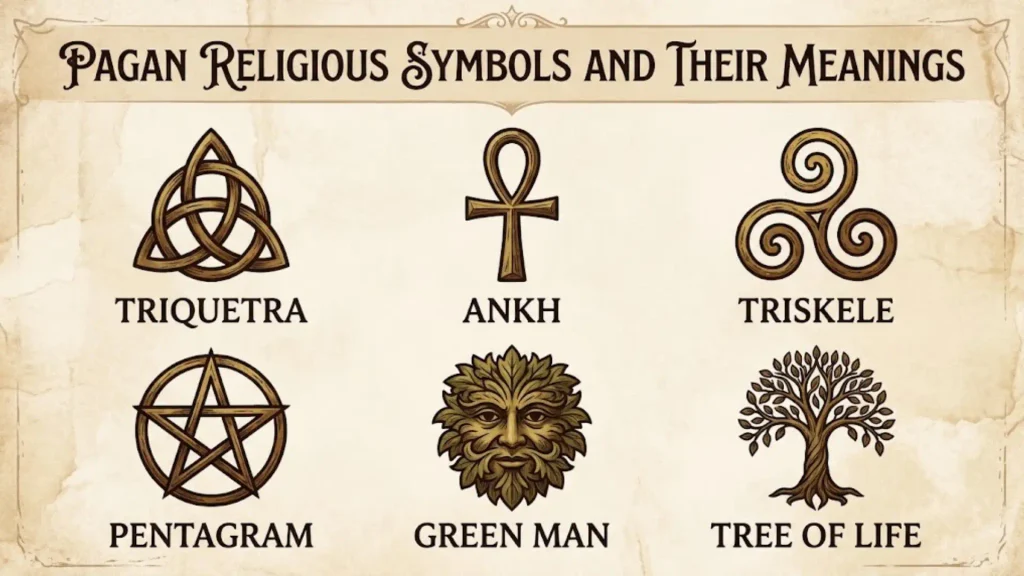
Paganism is a broad term covering different religious and spiritual traditions, including contemporary Wicca and other nature-based paths. These traditions do not all share the same beliefs or symbols.
Pentacle and Pentagram
A pentagram is a five-pointed star. A pentacle commonly refers to a pentagram enclosed in a circle, although usage can vary.
In some Pagan and Wiccan traditions, the pentacle is associated with the elements, spiritual practice, protection, or the relationship between nature and the sacred. The five points are sometimes linked with earth, air, fire, water, and spirit.
These interpretations are not universal to all Pagan traditions.
Triple Moon Symbol
The Triple Moon commonly shows a waxing crescent, full moon, and waning crescent. It is associated with lunar cycles and appears in some contemporary Goddess-centered traditions.
Some modern Pagan communities connect the three phases with the Maiden, Mother, and Crone. This interpretation belongs to particular traditions rather than every Pagan belief system.
Sun Wheel Symbol
The sun wheel is a term used for several circular solar designs found in historical and contemporary contexts. Depending on the tradition, solar imagery may relate to light, seasonal cycles, renewal, or the sun’s place in the natural world.
It is important to identify the specific design and tradition before assigning it a meaning.
Wheel of the Year
Many Wiccan and other contemporary Pagan traditions observe a seasonal calendar known as the Wheel of the Year. It commonly includes eight festivals marking seasonal transitions and points in the agricultural or solar year.
The dates and emphasis can vary between communities, especially between the Northern and Southern Hemispheres.
Keywords: Pagan religious symbols, Paganism symbols, pentacle meaning, triple moon symbolism, sun wheel symbolism, nature-based religious imagery, wheel of the year.
Other Religious Symbols From Around the World
Religious symbolism extends far beyond the six traditions commonly featured in introductory comparisons. Other religions and philosophical traditions have their own distinctive signs, sacred objects, and visual languages.
Taoist and Chinese Philosophical Symbols
The yin-yang symbol, also called the Taijitu, is associated with Chinese philosophy, including Taoist traditions. It represents complementary forces that depend on and interact with each other.
The symbol is not exclusive to one religion. Its wider philosophical and cultural history makes it important to distinguish its use in Taoism from its use in other settings.
The bagua, a set of eight trigrams, also appears in Chinese cosmology and related traditional practices.
Shinto Symbols
Shinto is a Japanese religious tradition with a strong focus on kami, sacred presences associated with natural features, places, and other aspects of the world.
- Torii gate: Marks an entrance to or boundary around a Shinto shrine’s sacred space.
- Shimenawa: A sacred rope used to mark certain sacred objects or spaces.
- Shide: Zigzag paper streamers used in Shinto ritual settings.
These objects help identify sacred places and practices within Shinto tradition.
Jain Symbols
Jainism places strong emphasis on nonviolence, self-discipline, and liberation from the cycle of rebirth.
The Jain emblem combines several elements associated with Jain teachings. The hand and wheel are commonly associated with nonviolence and the principle of avoiding harm.
Jain symbols are best understood in relation to the religion’s teachings on ethical conduct, spiritual purification, and respect for living beings.
Bahá’í Symbols
The nine-pointed star is commonly associated with the Bahá’í Faith. The number nine has symbolic importance in Bahá’í contexts and is often connected with ideas of unity.
The Ringstone Symbol is another design used in Bahá’í settings. Its lines and shapes are interpreted in relation to God, divine manifestations, and humanity.
Zoroastrian Symbols
The Faravahar is a widely recognized emblem associated with Zoroastrian heritage and identity. It appears in historical imagery and modern representations of Zoroastrian culture.
Its precise ancient meaning is debated, so modern interpretations should not be presented as universally accepted historical facts.
Common Themes in Religious Symbols
Different religions sometimes use similar shapes, animals, plants, and natural objects. These similarities can help explain recurring themes in human spirituality, but they do not mean that all traditions share identical beliefs.
Light as a Symbol of Truth and Divine Presence
Light appears in many religious settings. It can be associated with wisdom, guidance, sacred presence, or the victory of good over evil.
For example, lamps play an important role in Jewish and Hindu religious observances. Candles and other forms of light are also used in Christian worship.
The meaning depends on the particular ceremony and tradition.
Water as a Symbol of Purity and Renewal
Water has religious importance in many cultures because it is essential to life and can be used in purification rituals.
Examples include:
- Christianity: Water is central to baptism, which has meanings connected with new life and entry into the Christian community.
- Islam: Ritual washing prepares worshippers for prayer.
- Hindu traditions: Sacred rivers and ritual bathing have important religious meanings.
- Judaism: Ritual immersion in a mikveh serves specific purposes in Jewish religious life.
These practices share a connection with water but are not interchangeable. Each belongs to a distinct set of religious teachings and traditions.
Circles as Symbols of Unity and Continuity
Circles appear in many religious and philosophical symbols. Depending on context, they may represent wholeness, continuity, timelessness, or interdependence.
The circle in the Sikh Khanda is commonly interpreted through the timeless nature of the divine. Circular wheels in Buddhism communicate ideas connected with the Dharma and its teachings.
In some Pagan traditions, a circle surrounding a pentagram has additional spiritual meanings.
Stars and Celestial Objects
Stars, moons, and the sun appear in many religious and cultural traditions.
The Star of David is a widely recognized symbol of Jewish identity. Crescent imagery is associated with some Muslim communities and countries, although it is not a universal symbol of Islam. Solar and lunar symbols also appear in several nature-based spiritual traditions.
Their meanings come from particular histories and religious practices, not from one universal symbolic language.
Animals and Plants as Religious Symbols
Animals and plants often carry religious meaning because they appear in sacred stories, landscapes, or artistic traditions.
Examples include:
- Dove: Associated with the Holy Spirit in Christian imagery.
- Lamb: Associated with Jesus Christ and sacrifice in Christianity.
- Lotus: Important in Hindu and Buddhist religious art.
- Bodhi tree: Connected with the Buddha’s awakening.
- Bull: Nandi is associated with Shiva in Hinduism.
A plant or animal may carry several meanings within one religion. It may also have a different role in another tradition.
Sacred Colors and Geometric Shapes
Colors and geometric forms help artists organize religious imagery and communicate specific teachings. Their meanings depend on the tradition, region, and occasion.
Triangles appear in some Christian representations of the Trinity. Interlocking triangles form the Star of David. Geometric designs also play an important role in Islamic art, although not every geometric pattern has a specific religious meaning.
It is better to explain the context of a color or shape than to claim that it always represents one spiritual idea.
Religious Symbols Representing God and Spiritual Ideas
Many religious traditions use symbols to express beliefs about God, sacred reality, or humanity’s relationship with the divine. However, different religions understand and use these symbols in different ways.
What Symbol Represents God?
There is no single symbol accepted by every religion as a universal representation of God.
Christianity uses the cross to represent central beliefs about Jesus Christ and salvation. Sikhism uses Ik Oankar to affirm one God, the Creator. Islamic religious expression often features Arabic calligraphy, including the name of Allah, while Hindu traditions use symbols such as Om to express sacred ideas.
These examples do not all function in the same way. A symbol may identify a religious community, express a teaching, or support devotional practice without being a direct image of God.
Symbols of Love, Hope, Protection, and Wisdom
Some religious symbols are especially associated with particular virtues or spiritual ideas.
| Symbol | Tradition or context | Common association |
| Sacred Heart | Catholic devotion | Christ’s love and compassion |
| Anchor | Christian imagery | Hope and steadfastness |
| Lotus | Hindu and Buddhist traditions | Purity and spiritual development |
| Dove | Christian imagery | The Holy Spirit in biblical contexts |
| Pentacle | Some Pagan and Wiccan traditions | Spiritual practice and associations with the elements |
| Dharma Wheel | Buddhism | The Buddha’s teachings and path to liberation |
| Khanda | Sikhism | Sikh identity and spiritual and worldly responsibility |
These symbols may inspire hope, reflection, and purposeful living, but their established religious meanings should come first when explaining them.
Symbols of the Holy Spirit
Christian traditions use several images to explain the Holy Spirit’s presence and activity. The Catholic Catechism, for example, discusses water, anointing with oil, fire, cloud, light, the finger of God, and the dove.
There is no single universally standardized list called the “12 symbols of the Holy Spirit” that applies to all Christian traditions.
Some important biblical images include:
- Dove: Associated with the Holy Spirit descending at Jesus’ baptism.
- Fire: Associated with the coming of the Holy Spirit at Pentecost.
- Water: Associated with baptism and new spiritual life.
- Wind or breath: Connected with the biblical language of spirit and divine activity.
- Oil or anointing: Associated with consecration and the work of the Holy Spirit.
- Cloud and light: Images used in biblical accounts of divine presence.
- The finger of God: A biblical expression associated with divine action.
The meaning of each image depends on its scriptural passage and the Christian tradition interpreting it.
Religious Iconography in Art, Architecture, and Daily Life
Religious iconography is the study and use of images associated with religious beliefs, stories, and practices. It helps explain how people have expressed faith through art and architecture across different historical periods.
Religious Symbols in Architecture
Religious buildings often include symbols that communicate the purpose and identity of a sacred space.
Examples include:
- Crosses and crucifixes in Christian churches.
- Arabic calligraphy and geometric designs in Islamic architecture.
- Stupas and Buddha images at Buddhist sites.
- Menorahs and other Jewish religious objects in Jewish settings.
- Khanda emblems at Sikh gurdwaras.
- Torii gates at Shinto shrines.
Not every decorative element in a religious building has a specific sacred meaning. Some designs also reflect regional craftsmanship, artistic style, or historical influences.
Religious Symbols in Clothing and Jewelry
People may wear religious symbols to express devotion, identity, or connection with their heritage.
Examples include cross necklaces, Star of David jewelry, Om pendants, and Khanda emblems.
Some religious articles have a more specific role than ordinary jewelry. Sikh articles of faith, for example, are connected with religious commitments and should not be treated simply as decorative accessories.
Sacred Imagery and Devotional Objects
Religious objects may support prayer, meditation, remembrance, or ritual practice. Rosary beads, prayer candles, religious statues, and devotional images are examples of objects used in particular Christian traditions.
Their significance depends on how the religious community understands and uses them. Respectful interpretation requires attention to the beliefs and practices associated with each object.
How Religious Symbols Express Faith and Identity
Symbols often help people recognize shared beliefs and maintain connections with a religious community. They can represent family heritage, religious education, community history, or personal devotion.
Their role may include:
- Expressing faith: A symbol can communicate religious commitment without words.
- Preserving religious heritage: Sacred artwork and objects carry traditions across generations.
- Supporting worship: Certain symbols are used during prayer, festivals, and ceremonies.
- Building community: Shared emblems help identify religious institutions and gatherings.
- Teaching values: Images and symbols can remind people of religious teachings and moral responsibilities.
However, people within the same religion may use symbols differently. Some place great importance on visible emblems, while others emphasize prayer, ethical conduct, sacred texts, or ritual practice.
Understanding these differences helps explain why religious symbols can be meaningful without being universally used by every believer.
How Many Religious Symbols Are There?
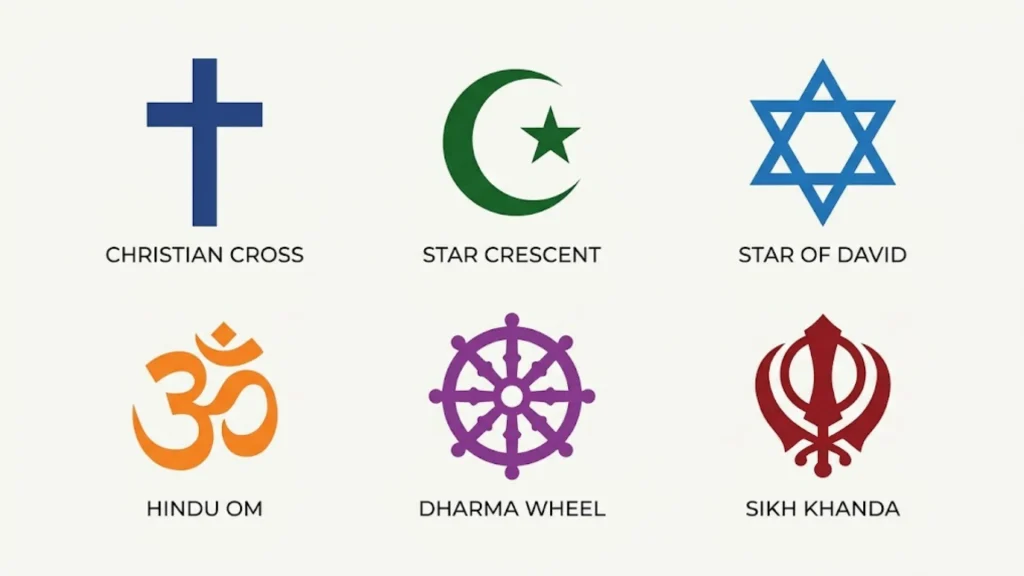
There is no official worldwide count of religious symbols.
Religions include numerous denominations, regional traditions, historical periods, sacred objects, visual designs, and ritual practices. Some symbols are recognized internationally, while others are important only within a particular community.
The answer also depends on what qualifies as a symbol. A researcher might count only widely recognized emblems, or they might include religious gestures, sacred objects, architectural features, and symbols found in manuscripts.
For that reason, it is more useful to study representative examples and their documented meanings than to rely on a fixed total.
Frequently Asked Questions About Religious Symbols and Their Meanings
What are religious symbols and their meanings?
Religious symbols are images, signs, objects, or shapes associated with religious beliefs and practices. Their meanings may relate to sacred teachings, worship, religious identity, historical events, or spiritual ideas.
What are the most famous religious symbols?
Some widely recognized examples include the Christian cross, Om, Dharma Wheel, Star of David, Menorah, Khanda, and crescent moon and star. Their significance varies by tradition, and not every symbol is an official emblem of a religion.
What are the symbols of the six major religions?
Commonly associated symbols include the cross in Christianity, calligraphy and crescent imagery in some Muslim contexts, Om in Hinduism, the Dharma Wheel in Buddhism, the Star of David and Menorah in Judaism, and the Khanda in Sikhism. These associations do not mean every religion has one official symbol.
What symbol represents God?
There is no universal symbol for God across all religions. Different traditions use sacred words, images, shapes, and objects to express beliefs about divine reality.
What does the Christian cross symbolize?
The Christian cross recalls the crucifixion of Jesus Christ. It is associated with sacrifice, salvation, forgiveness, and the hope of resurrection in Christian belief.
What does the crescent moon and star symbolize?
The crescent moon and star are associated with some Muslim communities and countries. However, Islam does not have one universally prescribed visual emblem, and the crescent and star are not universally accepted as official Islamic symbols.
What does the Om symbol mean?
Om is a sacred syllable in Hindu traditions, associated with sacred sound and spiritual reality. It is used in prayer, meditation, and religious texts, and it also appears in some other Indian religious traditions.
What does the Dharma Wheel represent?
The Dharma Wheel represents the Buddha’s teachings. Its eight-spoked form is commonly connected with the Noble Eightfold Path, which brings together ethical conduct, mental discipline, and wisdom.
What does the Star of David symbolize?
The Star of David is a widely recognized symbol of Jewish identity and heritage. It appears in Jewish community settings, religious artwork, jewelry, and the flag of Israel.
What does the Khanda symbol represent?
The Khanda is a Sikh emblem whose components are associated with divine knowledge, timelessness, and the relationship between spiritual authority and worldly responsibility. It is a recognizable expression of Sikh identity.
What are common Catholic religious symbols?
Common Catholic symbols include the crucifix, Sacred Heart, rosary, keys of Saint Peter, and devotional images of Mary and the saints. Each has a particular role in Catholic worship or devotional tradition.
What are the symbols of Paganism?
Symbols used in some Pagan and Wiccan traditions include the pentacle, Triple Moon, and certain solar or seasonal designs. Pagan traditions are diverse, so no single list represents every Pagan community.
What does the pentacle symbolize?
In some Pagan and Wiccan traditions, the pentacle is associated with spiritual practice, protection, and the elements. Its meaning depends on the tradition using it.
What does the Triple Moon symbol mean?
The Triple Moon typically depicts the waxing crescent, full moon, and waning crescent. Some contemporary Goddess-centered traditions connect it with the Maiden, Mother, and Crone.
What does the sun wheel represent?
The meaning of a sun wheel depends on the particular design and tradition. Solar imagery can be associated with light, seasonal cycles, renewal, or the sun’s place in nature, but interpretations vary.
What do religious symbols represent across cultures?
Religious symbols can represent sacred teachings, deities, spiritual values, religious identity, historical events, and forms of worship. Similar shapes may appear in different cultures, but their meanings should be understood within their specific traditions.
Conclusion: Understanding Religious Symbols Across the World
Religious symbols and their meanings offer a window into the beliefs, traditions, and identities of communities around the world. The Christian cross, Hindu Om, Buddhist Dharma Wheel, Jewish Star of David, Sikh Khanda, and other sacred signs each carry histories and meanings shaped by particular religious traditions.
Some symbols express faith and devotion, while others represent sacred teachings, spiritual practices, or cultural heritage. Their meanings may also change across regions, communities, and historical periods.
The best way to understand a religious symbol is to study its history, religious context, and actual use. By approaching religious signs and symbols with curiosity and respect, we can better understand the diverse ways people express faith and make meaning of the world.

Hello, I’m Rowan Sinclair, a passionate writer and lifelong admirer of the wisdom found in great quotes. I believe that words have the ability to inspire change, spark creativity, and connect people across cultures and generations.
I enjoy writing about motivational quotes, famous sayings, and lessons from history’s most influential thinkers. Every article I create is driven by my desire to help readers discover meaningful insights that they can apply to their own lives.
When I’m not writing, I spend my time reading biographies, exploring classic literature, and collecting memorable quotes that deserve to be shared with the world.
I am the author of Voices That Inspire and A Collection of Timeless Thoughts, two books that celebrate the enduring power of words and the stories behind them.
 Asher Monroe
 Sienna Brooks