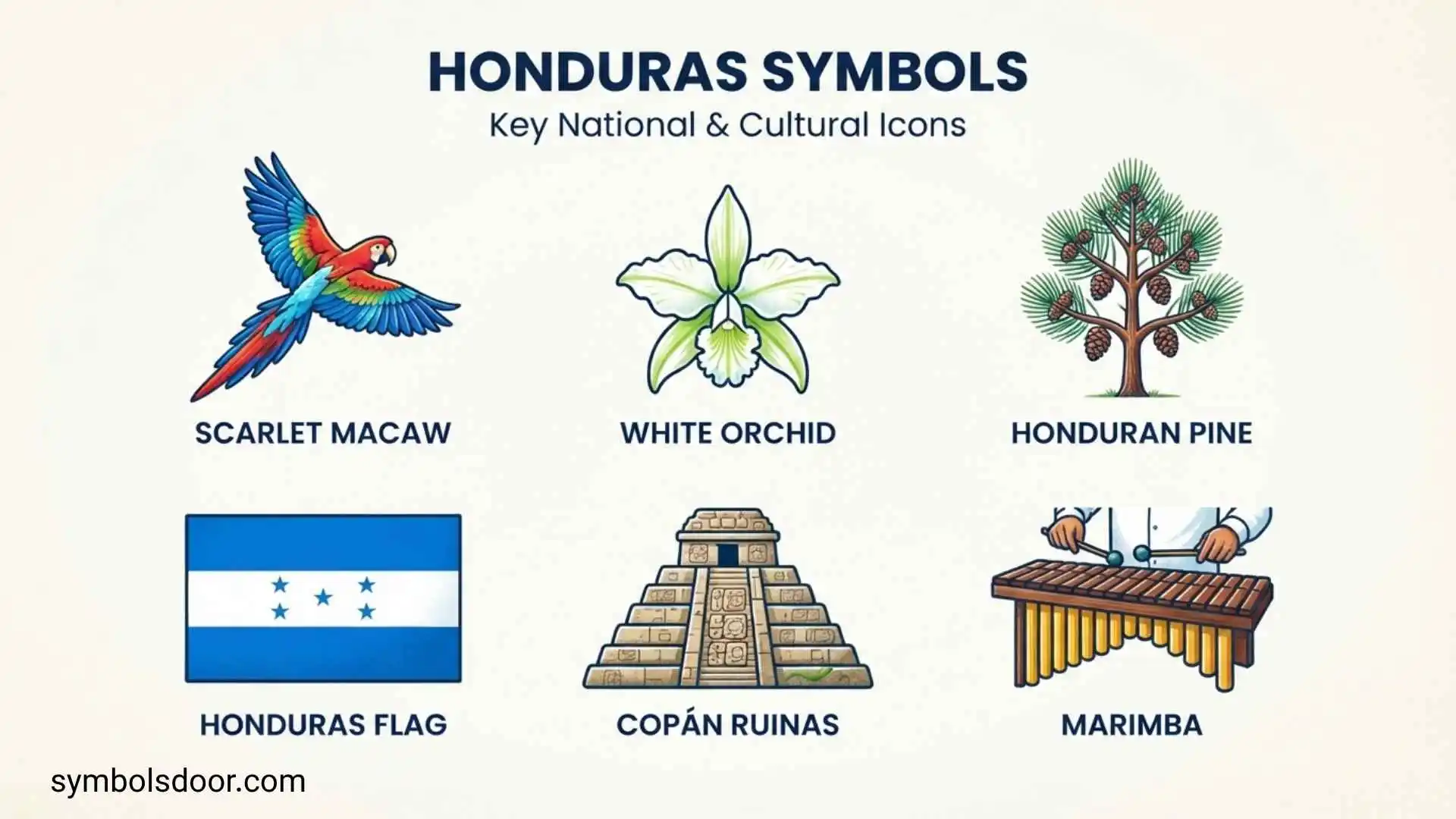
Honduras symbols represent the country’s national identity, history, independence, natural heritage, and cultural traditions. Some are officially recognized national symbols, such as the Honduran flag, coat of arms, national anthem, national flower, national bird, national tree, and national mammal. Others, including Copán and Maya heritage, are powerful cultural and historical symbols associated with Honduras.
The national symbols of Honduras help explain what makes the country distinctive. The flag reflects national identity and Central American history, the coat of arms contains imagery connected to Honduras’s landscape and resources, while the scarlet macaw, orchid, pine tree, and white-tailed deer represent the country’s rich natural heritage.
This guide explains the major symbols of Honduras and their meanings, including the five stars on the flag, the elements of the coat of arms, national plants and animals, and important cultural symbols.
What Are the Main Symbols of Honduras?
Honduras has several officially recognized national symbols rather than one single symbol representing the entire country.
| Honduras symbol | What it represents |
| National Flag | National identity and Central American heritage |
| Five Stars | The five historic Central American republics and the ideal of regional unity |
| Coat of Arms | History, sovereignty, geography, natural resources, and national heritage |
| National Anthem | Patriotism, independence, and Honduran history |
| National Flower | Natural beauty and botanical heritage |
| Scarlet Macaw | Wildlife and cultural heritage |
| Pine Tree | Forests and natural resources |
| White-tailed Deer | Native wildlife and biodiversity |
| Copán | Ancient Maya heritage and Honduran history |
It is important to distinguish between official national symbols and broader cultural or historical symbols. Copán, for example, is an extremely important symbol of Honduras’s ancient heritage, but it belongs to a different category from the national flag or national anthem.
The Honduras Flag and Its Meaning
The flag of Honduras is one of the country’s most recognizable national symbols.
It consists of three horizontal bands:
- Blue
- White
- Blue
Five blue stars appear in the center of the white band.
The flag combines Honduras’s national identity with its historical connection to the other nations of Central America.
What Do the Five Stars on the Honduras Flag Mean?
The five stars represent the five Central American countries that formed the former United Provinces of Central America:
- Honduras
- Guatemala
- El Salvador
- Nicaragua
- Costa Rica
The stars therefore have a strong connection with the history of Central American unity.
Their arrangement also has geographical significance. The central star represents Honduras, while the surrounding stars represent the other Central American republics.
The five-star design is one of the most recognizable features of the Honduran flag.
What Do the Blue and White Colors Mean?
The Honduran flag uses blue and white as its principal colors.
The colors have historical and regional associations with Central America. Blue is also commonly associated with Honduras’s surrounding seas and sky, while white is often interpreted in connection with peace, purity, and unity.
However, symbolic interpretations can vary depending on the source and context. The most important identifying features of the flag are its two blue bands, central white band, and five blue stars.
Why Are There Five Stars on the Honduras Flag?
The five stars reflect Honduras’s historical relationship with the other Central American nations.
They are a reminder of the idea of a united Central America and represent the five countries that were part of the former Central American federation.
This gives the flag both a national meaning and a regional historical meaning.
The Coat of Arms of Honduras
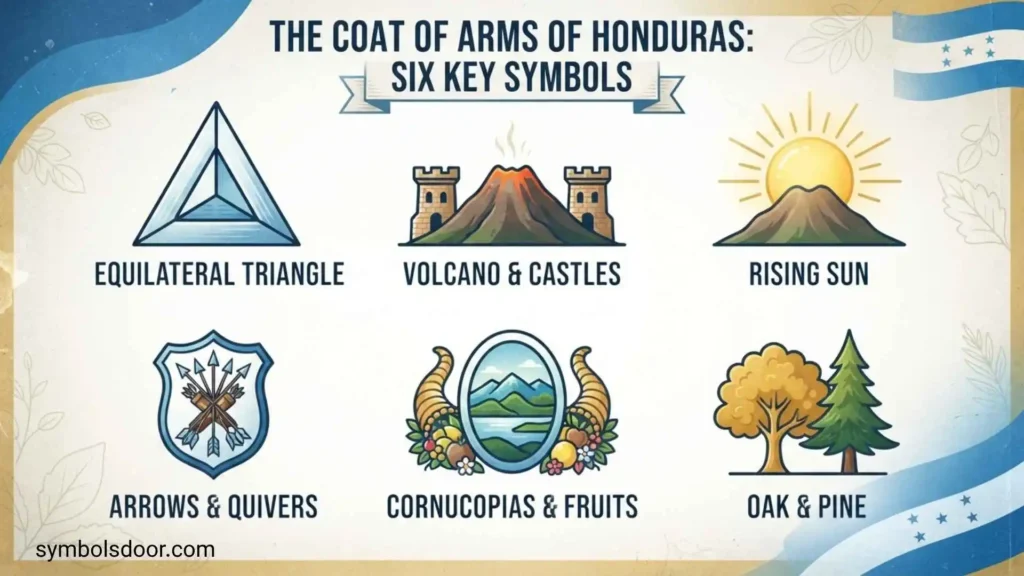
The coat of arms of Honduras is one of the country’s most detailed national symbols.
Unlike the simple design of the flag, the coat of arms contains numerous images representing different aspects of Honduran history, geography, independence, and natural resources.
The central design includes mountains, a volcano, a rising sun, a rainbow, castles, mining tools, and other elements.
What Does the Honduras Coat of Arms Represent?
The coat of arms brings together several themes:
- Honduran geography
- Historical heritage
- Natural resources
- Mining
- National sovereignty
- Independence
- Agriculture and forests
- Central American identity
Each element contributes to the overall story of the country.
What Do the Mountains and Volcano Represent?
The mountains and volcano in the emblem represent Honduras’s landscape and its rugged geography.
Honduras is characterized by extensive mountainous terrain, making the landscape an important part of its national identity.
The natural scenery shown in the coat of arms connects the national emblem to the physical territory of Honduras.
What Do the Castles Represent?
The castles are associated with the historical period of Spanish rule and the fortified structures built during that era.
They provide a visual connection to the country’s colonial history.
What Does the Pyramid Represent?
The pyramid is associated with the ancient civilizations and pre-Columbian heritage of the region.
It helps connect the modern Republic of Honduras with the country’s much older history.
This historical dimension is particularly significant because Honduras is home to major Maya archaeological heritage, including Copán.
What Do the Mining Tools Represent?
Mining tools in the coat of arms symbolize Honduras’s mineral wealth and the importance of mining in the country’s history.
The presence of these tools reflects the role that natural resources have played in the development of Honduras.
What Do the Pine Trees Represent?
Pine trees are another important element of the emblem.
They connect the coat of arms with Honduras’s forests and natural resources and reinforce the importance of the country’s woodland landscapes.
The National Anthem of Honduras
The National Anthem of Honduras, Himno Nacional de Honduras, is an important symbol of patriotism and national identity.
It is performed during official ceremonies, school events, national celebrations, and other important occasions.
What Does the Honduran National Anthem Represent?
The anthem tells a historical story about Honduras and its development as an independent nation.
Its lyrics refer to important periods in Honduran and Central American history, including the struggle against colonial rule and the country’s emergence as a sovereign republic.
Because the anthem combines music, history, and patriotism, it serves as both a ceremonial symbol and a reminder of the country’s past.
The National Flower of Honduras
The national flower of Honduras is the orchid Rhyncholaelia digbyana.
This orchid is native to Central America and is valued for its distinctive appearance and fragrant flowers.
What Does the National Flower Represent?
The orchid represents the natural beauty and botanical richness of Honduras.
Honduras contains diverse environments, including tropical forests, mountains, coastal areas, and other ecosystems that support a wide variety of plant species.
As a national symbol, the orchid highlights the country’s connection to its natural environment.
The National Bird of Honduras: Scarlet Macaw
The scarlet macaw (Ara macao), commonly known in Spanish as the guacamaya, is the national bird of Honduras.
Its striking red, yellow, and blue plumage makes it one of the most recognizable animals associated with the country.
Why Is the Scarlet Macaw Important to Honduras?
The scarlet macaw represents both natural and cultural heritage.
It has a particularly strong connection with ancient Maya culture. Images of macaws appear in Maya art and archaeological remains, including those associated with Copán.
This makes the bird more than simply a wildlife symbol. It also provides a connection between modern Honduras and the country’s ancient civilizations.
What Does the Guacamaya Symbolize?
The guacamaya can represent:
- Honduran biodiversity
- Tropical wildlife
- Natural beauty
- Ancient Maya heritage
- Cultural continuity
- Conservation of native species
Its vivid colors also make it a particularly recognizable visual representation of Honduras.
The National Tree of Honduras: Pine
The pine tree is the national tree of Honduras.
Pine forests are an important part of the country’s mountainous landscape and natural environment.
Why Is the Pine Tree a Symbol of Honduras?
The pine represents Honduras’s forests and natural resources.
Pine forests provide important ecological functions, including wildlife habitat and protection of watersheds. They also have economic importance for communities and industries associated with forest resources.
As a national symbol, the pine reflects the importance of protecting Honduras’s forests and natural landscapes.
The National Mammal: White-Tailed Deer
The white-tailed deer (Odocoileus virginianus) is recognized as Honduras’s national mammal and is commonly referred to as the country’s national animal.
The species is found across parts of the Americas and is associated with forest and woodland environments.
What Does the White-Tailed Deer Represent?
The white-tailed deer represents Honduras’s native wildlife and biodiversity.
Its status as a national symbol highlights the importance of the country’s ecosystems and the need to protect native animals and their habitats.
Copán: An Important Cultural Symbol of Honduras
Copán is one of the most important cultural and historical symbols associated with Honduras.
It was a major center of the ancient Maya civilization and is famous for its architecture, sculptures, monuments, and hieroglyphic inscriptions.
Copán should be distinguished from the country’s officially designated national symbols. It is better described as a cultural and historical symbol of Honduras.
Why Is Copán Important to Honduras?
Copán demonstrates the depth of Honduras’s pre-Columbian history.
Its archaeological remains show the sophistication of Maya architecture, art, writing, astronomy, and political organization.
The site’s connection with the scarlet macaw also demonstrates how natural and cultural symbols can overlap in Honduran heritage.
Maya Heritage as a Honduran Cultural Symbol
Honduras has an important connection to the ancient Maya civilization, particularly through Copán.
Maya heritage contributes to Honduras’s cultural identity through:
- Archaeological sites
- Sculpture
- Hieroglyphic writing
- Architecture
- Traditional artistic heritage
- Historical research
Although ancient Maya symbols should not automatically be classified as official Honduran national symbols, they are essential to understanding the country’s historical identity.
Honduras Symbols and Independence Day
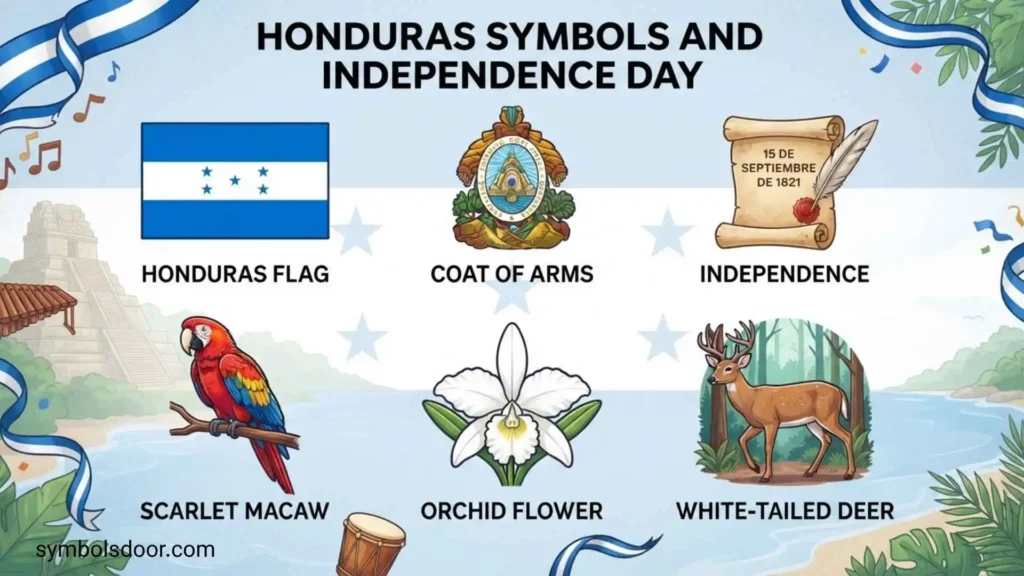
Honduran national symbols play an especially visible role on September 15, when Honduras celebrates its independence as part of Central America’s Independence Day.
The Honduran flag is displayed prominently, while schools and communities participate in patriotic activities and parades.
How Are National Symbols Used on Independence Day?
Common patriotic symbols include:
- The Honduran flag
- National colors
- The national anthem
- National emblems
- Patriotic decorations
- School performances
- Marching bands
- Parades
These traditions help connect national celebrations with Honduran history and identity.
Official National Symbols vs Cultural Symbols
Not every object associated with Honduras has the same official status.
This distinction is important when learning about Honduras symbols and meanings.
Official National Symbols
Official national symbols are formally recognized as symbols of the Honduran nation.
These include major emblems such as:
- The national flag
- The coat of arms
- The national anthem
- The national flower
- The national bird
- The national tree
- The national mammal
Cultural and Historical Symbols
Other symbols have strong cultural or historical importance without necessarily being official national emblems.
Examples include:
- Copán
- Maya archaeological heritage
- Traditional cultural imagery
- Historic sites
- Important regional traditions
These symbols help explain Honduran culture but should not automatically be presented as official national symbols.
Honduras Symbols and Their Meanings
The following table provides a quick reference to the country’s most important symbols:
| Symbol | Category | Meaning or significance |
| Honduras flag | National | Identity, sovereignty, and Central American heritage |
| Five stars | National | The five historic Central American republics and regional unity |
| Coat of arms | National | History, geography, sovereignty, and natural resources |
| National anthem | National | Patriotism, independence, and history |
| National orchid | Natural | Botanical beauty and natural heritage |
| Scarlet macaw | Natural and cultural | Biodiversity and Maya heritage |
| Pine tree | Natural | Forests and natural resources |
| White-tailed deer | Natural | Native wildlife and biodiversity |
| Copán | Cultural and historical | Ancient Maya civilization and archaeological heritage |
Why Are Honduras Symbols Important?
National symbols help create a shared sense of identity.
They provide simple visual, musical, and cultural ways for people to connect with their country’s past and present.
Honduras’s symbols represent several major themes.
National Identity
The flag, coat of arms, and anthem represent the Honduran nation and are used during official and patriotic events.
Natural Heritage
The orchid, scarlet macaw, pine, and white-tailed deer represent Honduras’s diverse natural environment.
Historical Heritage
The coat of arms and national anthem contain references to important periods in Honduran history.
Ancient Cultural Heritage
Copán, Maya archaeology, and the scarlet macaw connect present-day Honduras with the region’s pre-Columbian past.
Frequently Asked Questions
What are the national symbols of Honduras?
The main national symbols of Honduras include the national flag, coat of arms, national anthem, national flower, national bird, national tree, and national mammal.
What is the main symbol of Honduras?
Honduras does not have only one national symbol. The national flag is one of its most recognizable symbols, while the coat of arms and national anthem are also important official national emblems.
What does the Honduras flag symbolize?
The Honduran flag represents national identity and has a strong connection to the history and unity of Central America. Its five stars represent the five historic Central American republics.
What do the five stars on the Honduras flag mean?
The five stars represent Honduras, Guatemala, El Salvador, Nicaragua, and Costa Rica, reflecting the historical idea of Central American unity.
Why does Honduras have five stars on its flag?
The five stars recall the five Central American countries that were historically united in the former Central American federation.
What is the national bird of Honduras?
The scarlet macaw (Ara macao), or guacamaya, is the national bird of Honduras.
What does the scarlet macaw symbolize in Honduras?
The scarlet macaw represents Honduran wildlife and biodiversity and has important cultural connections with ancient Maya heritage, particularly through archaeological evidence from Copán.
What is the national flower of Honduras?
The national flower of Honduras is the orchid Rhyncholaelia digbyana.
What is the national tree of Honduras?
The pine tree is the national tree of Honduras and represents the country’s forests and natural resources.
What is the national animal of Honduras?
The white-tailed deer is recognized as Honduras’s national mammal and is commonly described as the country’s national animal.
What does the Honduran coat of arms mean?
The coat of arms combines imagery representing Honduras’s history, geography, natural resources, mining, forests, and national heritage.
What do the symbols on the Honduras coat of arms represent?
The coat of arms contains several elements, including mountains, a volcano, castles, a pyramid, a rising sun, a rainbow, mining tools, and pine trees. Together, they represent different aspects of Honduran history, geography, resources, and heritage.
Why is Copán a symbol of Honduras?
Copán is an important cultural and historical symbol because it was a major center of the ancient Maya civilization and contains significant archaeological remains, including monuments, sculptures, and inscriptions.
What symbols represent Honduras’s natural heritage?
The orchid, scarlet macaw, pine tree, and white-tailed deer are especially important natural symbols associated with Honduras.
What symbols are used during Honduras Independence Day?
The Honduran flag, national colors, anthem, patriotic emblems, parades, and school celebrations are commonly associated with Independence Day on September 15.
Are all Honduras symbols official national symbols?
No. Some symbols are officially recognized national emblems, while others are cultural or historical symbols. Copán, for example, is an important cultural and historical symbol rather than being equivalent in official status to the national flag.
Conclusion
The symbols of Honduras represent much more than national decoration. They tell a story about the country’s independence, geography, natural environment, history, and cultural heritage.
The Honduran flag represents national identity and Central American history, while its five stars recall the region’s historic unity. The coat of arms brings together imagery connected with geography, resources, history, and sovereignty, and the national anthem expresses patriotism and historical memory.
Honduras’s natural symbols are equally important. The national orchid, scarlet macaw, pine tree, and white-tailed deer reflect the country’s biodiversity and natural resources. Meanwhile, Copán and Maya heritage provide a connection to the ancient civilizations that flourished in the region.
Honduras Symbols: National Symbols, Meanings, and Cultural Significance
Honduras symbols represent the country’s national identity, history, independence, natural heritage, and cultural traditions. Some are officially recognized national symbols, such as the Honduran flag, coat of arms, national anthem, national flower, national bird, national tree, and national mammal. Others, including Copán and Maya heritage, are powerful cultural and historical symbols associated with Honduras.
The national symbols of Honduras help explain what makes the country distinctive. The flag reflects national identity and Central American history, the coat of arms contains imagery connected to Honduras’s landscape and resources, while the scarlet macaw, orchid, pine tree, and white-tailed deer represent the country’s rich natural heritage.
This guide explains the major symbols of Honduras and their meanings, including the five stars on the flag, the elements of the coat of arms, national plants and animals, and important cultural symbols.
What Are the Main Symbols of Honduras?
Honduras has several officially recognized national symbols rather than one single symbol representing the entire country.
| Honduras symbol | What it represents |
| National Flag | National identity and Central American heritage |
| Five Stars | The five historic Central American republics and the ideal of regional unity |
| Coat of Arms | History, sovereignty, geography, natural resources, and national heritage |
| National Anthem | Patriotism, independence, and Honduran history |
| National Flower | Natural beauty and botanical heritage |
| Scarlet Macaw | Wildlife and cultural heritage |
| Pine Tree | Forests and natural resources |
| White-tailed Deer | Native wildlife and biodiversity |
| Copán | Ancient Maya heritage and Honduran history |
It is important to distinguish between official national symbols and broader cultural or historical symbols. Copán, for example, is an extremely important symbol of Honduras’s ancient heritage, but it belongs to a different category from the national flag or national anthem.
The Honduras Flag and Its Meaning
The flag of Honduras is one of the country’s most recognizable national symbols.
It consists of three horizontal bands:
- Blue
- White
- Blue
Five blue stars appear in the center of the white band.
The flag combines Honduras’s national identity with its historical connection to the other nations of Central America.
What Do the Five Stars on the Honduras Flag Mean?
The five stars represent the five Central American countries that formed the former United Provinces of Central America:
- Honduras
- Guatemala
- El Salvador
- Nicaragua
- Costa Rica
The stars therefore have a strong connection with the history of Central American unity.
Their arrangement also has geographical significance. The central star represents Honduras, while the surrounding stars represent the other Central American republics.
The five-star design is one of the most recognizable features of the Honduran flag.
What Do the Blue and White Colors Mean?
The Honduran flag uses blue and white as its principal colors.
The colors have historical and regional associations with Central America. Blue is also commonly associated with Honduras’s surrounding seas and sky, while white is often interpreted in connection with peace, purity, and unity.
However, symbolic interpretations can vary depending on the source and context. The most important identifying features of the flag are its two blue bands, central white band, and five blue stars.
Why Are There Five Stars on the Honduras Flag?
The five stars reflect Honduras’s historical relationship with the other Central American nations.
They are a reminder of the idea of a united Central America and represent the five countries that were part of the former Central American federation.
This gives the flag both a national meaning and a regional historical meaning.
The Coat of Arms of Honduras
The coat of arms of Honduras is one of the country’s most detailed national symbols.
Unlike the simple design of the flag, the coat of arms contains numerous images representing different aspects of Honduran history, geography, independence, and natural resources.
The central design includes mountains, a volcano, a rising sun, a rainbow, castles, mining tools, and other elements.
What Does the Honduras Coat of Arms Represent?
The coat of arms brings together several themes:
- Honduran geography
- Historical heritage
- Natural resources
- Mining
- National sovereignty
- Independence
- Agriculture and forests
- Central American identity
Each element contributes to the overall story of the country.
What Do the Mountains and Volcano Represent?
The mountains and volcano in the emblem represent Honduras’s landscape and its rugged geography.
Honduras is characterized by extensive mountainous terrain, making the landscape an important part of its national identity.
The natural scenery shown in the coat of arms connects the national emblem to the physical territory of Honduras.
What Do the Castles Represent?
The castles are associated with the historical period of Spanish rule and the fortified structures built during that era.
They provide a visual connection to the country’s colonial history.
What Does the Pyramid Represent?
The pyramid is associated with the ancient civilizations and pre-Columbian heritage of the region.
It helps connect the modern Republic of Honduras with the country’s much older history.
This historical dimension is particularly significant because Honduras is home to major Maya archaeological heritage, including Copán.
What Do the Mining Tools Represent?
Mining tools in the coat of arms symbolize Honduras’s mineral wealth and the importance of mining in the country’s history.
The presence of these tools reflects the role that natural resources have played in the development of Honduras.
What Do the Pine Trees Represent?
Pine trees are another important element of the emblem.
They connect the coat of arms with Honduras’s forests and natural resources and reinforce the importance of the country’s woodland landscapes.
The National Anthem of Honduras
The National Anthem of Honduras, Himno Nacional de Honduras, is an important symbol of patriotism and national identity.
It is performed during official ceremonies, school events, national celebrations, and other important occasions.
What Does the Honduran National Anthem Represent?
The anthem tells a historical story about Honduras and its development as an independent nation.
Its lyrics refer to important periods in Honduran and Central American history, including the struggle against colonial rule and the country’s emergence as a sovereign republic.
Because the anthem combines music, history, and patriotism, it serves as both a ceremonial symbol and a reminder of the country’s past.
The National Flower of Honduras
The national flower of Honduras is the orchid Rhyncholaelia digbyana.
This orchid is native to Central America and is valued for its distinctive appearance and fragrant flowers.
What Does the National Flower Represent?
The orchid represents the natural beauty and botanical richness of Honduras.
Honduras contains diverse environments, including tropical forests, mountains, coastal areas, and other ecosystems that support a wide variety of plant species.
As a national symbol, the orchid highlights the country’s connection to its natural environment.
The National Bird of Honduras: Scarlet Macaw
The scarlet macaw (Ara macao), commonly known in Spanish as the guacamaya, is the national bird of Honduras.
Its striking red, yellow, and blue plumage makes it one of the most recognizable animals associated with the country.
Why Is the Scarlet Macaw Important to Honduras?
The scarlet macaw represents both natural and cultural heritage.
It has a particularly strong connection with ancient Maya culture. Images of macaws appear in Maya art and archaeological remains, including those associated with Copán.
This makes the bird more than simply a wildlife symbol. It also provides a connection between modern Honduras and the country’s ancient civilizations.
What Does the Guacamaya Symbolize?
The guacamaya can represent:
- Honduran biodiversity
- Tropical wildlife
- Natural beauty
- Ancient Maya heritage
- Cultural continuity
- Conservation of native species
Its vivid colors also make it a particularly recognizable visual representation of Honduras.
The National Tree of Honduras: Pine
The pine tree is the national tree of Honduras.
Pine forests are an important part of the country’s mountainous landscape and natural environment.
Why Is the Pine Tree a Symbol of Honduras?
The pine represents Honduras’s forests and natural resources.
Pine forests provide important ecological functions, including wildlife habitat and protection of watersheds. They also have economic importance for communities and industries associated with forest resources.
As a national symbol, the pine reflects the importance of protecting Honduras’s forests and natural landscapes.
The National Mammal: White-Tailed Deer
The white-tailed deer (Odocoileus virginianus) is recognized as Honduras’s national mammal and is commonly referred to as the country’s national animal.
The species is found across parts of the Americas and is associated with forest and woodland environments.
What Does the White-Tailed Deer Represent?
The white-tailed deer represents Honduras’s native wildlife and biodiversity.
Its status as a national symbol highlights the importance of the country’s ecosystems and the need to protect native animals and their habitats.
Copán: An Important Cultural Symbol of Honduras
Copán is one of the most important cultural and historical symbols associated with Honduras.
It was a major center of the ancient Maya civilization and is famous for its architecture, sculptures, monuments, and hieroglyphic inscriptions.
Copán should be distinguished from the country’s officially designated national symbols. It is better described as a cultural and historical symbol of Honduras.
Why Is Copán Important to Honduras?
Copán demonstrates the depth of Honduras’s pre-Columbian history.
Its archaeological remains show the sophistication of Maya architecture, art, writing, astronomy, and political organization.
The site’s connection with the scarlet macaw also demonstrates how natural and cultural symbols can overlap in Honduran heritage.
Maya Heritage as a Honduran Cultural Symbol
Honduras has an important connection to the ancient Maya civilization, particularly through Copán.
Maya heritage contributes to Honduras’s cultural identity through:
- Archaeological sites
- Sculpture
- Hieroglyphic writing
- Architecture
- Traditional artistic heritage
- Historical research
Although ancient Maya symbols should not automatically be classified as official Honduran national symbols, they are essential to understanding the country’s historical identity.
Honduras Symbols and Independence Day
Honduran national symbols play an especially visible role on September 15, when Honduras celebrates its independence as part of Central America’s Independence Day.
The Honduran flag is displayed prominently, while schools and communities participate in patriotic activities and parades.
How Are National Symbols Used on Independence Day?
Common patriotic symbols include:
- The Honduran flag
- National colors
- The national anthem
- National emblems
- Patriotic decorations
- School performances
- Marching bands
- Parades
These traditions help connect national celebrations with Honduran history and identity.
Official National Symbols vs Cultural Symbols
Not every object associated with Honduras has the same official status.
This distinction is important when learning about Honduras symbols and meanings.
Official National Symbols
Official national symbols are formally recognized as symbols of the Honduran nation.
These include major emblems such as:
- The national flag
- The coat of arms
- The national anthem
- The national flower
- The national bird
- The national tree
- The national mammal
Cultural and Historical Symbols
Other symbols have strong cultural or historical importance without necessarily being official national emblems.
Examples include:
- Copán
- Maya archaeological heritage
- Traditional cultural imagery
- Historic sites
- Important regional traditions
These symbols help explain Honduran culture but should not automatically be presented as official national symbols.
Honduras Symbols and Their Meanings
The following table provides a quick reference to the country’s most important symbols:
| Symbol | Category | Meaning or significance |
| Honduras flag | National | Identity, sovereignty, and Central American heritage |
| Five stars | National | The five historic Central American republics and regional unity |
| Coat of arms | National | History, geography, sovereignty, and natural resources |
| National anthem | National | Patriotism, independence, and history |
| National orchid | Natural | Botanical beauty and natural heritage |
| Scarlet macaw | Natural and cultural | Biodiversity and Maya heritage |
| Pine tree | Natural | Forests and natural resources |
| White-tailed deer | Natural | Native wildlife and biodiversity |
| Copán | Cultural and historical | Ancient Maya civilization and archaeological heritage |
Why Are Honduras Symbols Important?
National symbols help create a shared sense of identity.
They provide simple visual, musical, and cultural ways for people to connect with their country’s past and present.
Honduras’s symbols represent several major themes.
National Identity
The flag, coat of arms, and anthem represent the Honduran nation and are used during official and patriotic events.
Natural Heritage
The orchid, scarlet macaw, pine, and white-tailed deer represent Honduras’s diverse natural environment.
Historical Heritage
The coat of arms and national anthem contain references to important periods in Honduran history.
Ancient Cultural Heritage
Copán, Maya archaeology, and the scarlet macaw connect present-day Honduras with the region’s pre-Columbian past.
Frequently Asked Questions
What are the national symbols of Honduras?
The main national symbols of Honduras include the national flag, coat of arms, national anthem, national flower, national bird, national tree, and national mammal.
What is the main symbol of Honduras?
Honduras does not have only one national symbol. The national flag is one of its most recognizable symbols, while the coat of arms and national anthem are also important official national emblems.
What does the Honduras flag symbolize?
The Honduran flag represents national identity and has a strong connection to the history and unity of Central America. Its five stars represent the five historic Central American republics.
What do the five stars on the Honduras flag mean?
The five stars represent Honduras, Guatemala, El Salvador, Nicaragua, and Costa Rica, reflecting the historical idea of Central American unity.
Why does Honduras have five stars on its flag?
The five stars recall the five Central American countries that were historically united in the former Central American federation.
What is the national bird of Honduras?
The scarlet macaw (Ara macao), or guacamaya, is the national bird of Honduras.
What does the scarlet macaw symbolize in Honduras?
The scarlet macaw represents Honduran wildlife and biodiversity and has important cultural connections with ancient Maya heritage, particularly through archaeological evidence from Copán.
What is the national flower of Honduras?
The national flower of Honduras is the orchid Rhyncholaelia digbyana.
What is the national tree of Honduras?
The pine tree is the national tree of Honduras and represents the country’s forests and natural resources.
What is the national animal of Honduras?
The white-tailed deer is recognized as Honduras’s national mammal and is commonly described as the country’s national animal.
What does the Honduran coat of arms mean?
The coat of arms combines imagery representing Honduras’s history, geography, natural resources, mining, forests, and national heritage.
What do the symbols on the Honduras coat of arms represent?
The coat of arms contains several elements, including mountains, a volcano, castles, a pyramid, a rising sun, a rainbow, mining tools, and pine trees. Together, they represent different aspects of Honduran history, geography, resources, and heritage.
Why is Copán a symbol of Honduras?
Copán is an important cultural and historical symbol because it was a major center of the ancient Maya civilization and contains significant archaeological remains, including monuments, sculptures, and inscriptions.
What symbols represent Honduras’s natural heritage?
The orchid, scarlet macaw, pine tree, and white-tailed deer are especially important natural symbols associated with Honduras.
What symbols are used during Honduras Independence Day?
The Honduran flag, national colors, anthem, patriotic emblems, parades, and school celebrations are commonly associated with Independence Day on September 15.
Are all Honduras symbols official national symbols?
No. Some symbols are officially recognized national emblems, while others are cultural or historical symbols. Copán, for example, is an important cultural and historical symbol rather than being equivalent in official status to the national flag.
Conclusion
The symbols of Honduras represent much more than national decoration. They tell a story about the country’s independence, geography, natural environment, history, and cultural heritage.
The Honduran flag represents national identity and Central American history, while its five stars recall the region’s historic unity. The coat of arms brings together imagery connected with geography, resources, history, and sovereignty, and the national anthem expresses patriotism and historical memory.
Honduras’s natural symbols are equally important. The national orchid, scarlet macaw, pine tree, and white-tailed deer reflect the country’s biodiversity and natural resources. Meanwhile, Copán and Maya heritage provide a connection to the ancient civilizations that flourished in the region.
Together, these Honduras symbols and their meanings provide a clear picture of a country whose identity is shaped by national pride, Central American history, remarkable biodiversity, and deep cultural heritage.

Hi, I’m Asher Monroe, a writer who believes that meaningful words have the power to inspire change and bring people closer to their dreams. I have always been fascinated by the beauty of quotes and the way a simple message can provide motivation, hope, and comfort.
I enjoy creating content around inspirational quotes, life lessons, success stories, and positive thoughts that help readers find encouragement in their everyday lives. My goal is to share words that connect with people and remind them of their inner strength.
Through my writing, I explore the ideas of personal growth, confidence, and the importance of staying inspired through every chapter of life.
I am the author of Words That Move the Soul and The Path of Endless Inspiration, two books focused on the power of wisdom, positivity, and meaningful thoughts.