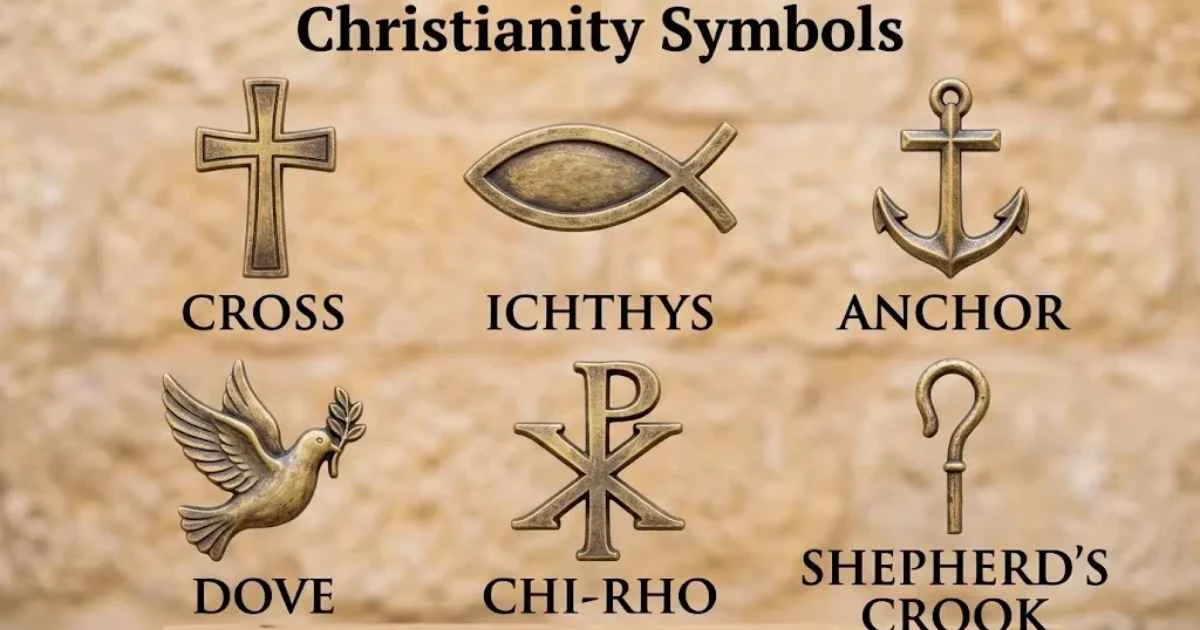
Christianity has a rich history of using symbols to express faith, remember important events, and communicate religious teachings. From the familiar Christian cross to the fish, dove, anchor, and Chi-Rho, these images represent important beliefs about Jesus Christ, salvation, hope, sacrifice, and eternal life.
Christian symbols appear in churches, religious artwork, stained-glass windows, jewelry, books, and everyday objects. Some come directly from biblical stories, while others developed through centuries of Christian tradition. Catholic, Orthodox, and Protestant communities share many symbols, although they may use certain images in different ways.
Understanding Christian symbols and meanings helps you explore the history of Christianity and recognize the messages behind religious artwork. This guide explains more than 25 important Christian religious symbols, their historical origins, and their significance. It also covers six common cross forms, Catholic symbols, symbols associated with the Twelve Apostles, and simple explanations of Christian symbols for kids.
What Are Christian Symbols?
Christian symbols are images, objects, shapes, signs, and visual representations that communicate beliefs and teachings connected with Christianity. They can represent Jesus Christ, the Holy Spirit, the Virgin Mary, the Bible, Christian virtues, biblical events, and important religious traditions.
For example, the cross represents the Crucifixion of Jesus and is closely connected with Christian beliefs about salvation. A dove can represent the Holy Spirit, while a fish is associated with Jesus Christ and the identity of early Christians.
These images help believers remember important teachings and communicate religious ideas without relying entirely on written or spoken words.
Why Are Christian Symbols Important?
Christian symbols have several important purposes in religious life.
- Expressing faith: Symbols communicate important Christian beliefs, including faith in Jesus Christ, salvation, and eternal life.
- Remembering biblical events: Images of the cross, crown of thorns, and bread and wine remind believers of events in the life of Jesus.
- Teaching religious lessons: Familiar images help children and adults understand Christian stories and teachings.
- Supporting worship: Churches use crosses, candles, icons, and other religious objects during worship and prayer.
- Preserving Christian history: Historical symbols provide evidence of how early Christians expressed their beliefs.
- Creating religious identity: Symbols such as the fish and cross help identify Christian communities and traditions.
A symbol may have more than one meaning. Its interpretation can depend on the biblical passage, historical period, denomination, and setting in which it appears.
Christian Symbols vs. Catholic Symbols
Christianity includes several major traditions, including Roman Catholicism, Eastern Orthodoxy, and Protestantism. These traditions share many central beliefs and symbols, but their religious practices and visual traditions are not identical.
For example, the cross is important across Christianity. The rosary, Sacred Heart of Jesus, and monstrance have more specific importance in Catholic devotion and worship.
Catholic symbols are therefore part of the wider collection of Christian religious symbols, rather than a completely separate category.
History and Origins of Christian Symbols
Christian symbolism developed over many centuries. Early Christians used familiar images to express their beliefs, remember Jesus, and represent their communities. Later, Christian artwork became more elaborate and included crosses, saints, biblical scenes, and religious objects.
Early Christian Symbols Before the Cross Became Prominent
During the first centuries of Christianity, believers used several recognizable images. These included the fish, anchor, dove, shepherd, and lamb.
The fish became one of the best-known early Christian symbols. The Greek word for fish, Ichthys, was connected with a phrase describing Jesus Christ as the Son of God and Savior.
Early Christian writers also discussed fish imagery in connection with baptism. Tertullian, an early Christian author writing around the late second and early third centuries, compared Christians to little fish born in water after the example of Christ. <Cite refs={[“turn179890search0″,”turn179890search6”]}/>
Other symbols carried important messages:
- Fish: Jesus Christ and Christian identity.
- Anchor: Hope and steadfast faith.
- Dove: Peace and spiritual life.
- Shepherd: Jesus’ care and guidance.
- Lamb: Christ and sacrificial imagery.
These images appeared in early Christian artwork, inscriptions, rings, seals, and burial places.
The Rise of the Christian Cross
The cross became the central symbol of Christianity because Jesus Christ was crucified. Christians came to understand this event as central to their faith and beliefs about salvation.
However, the history of the cross as a Christian image developed gradually. Early Christian communities used different forms of symbolic imagery, including the fish and Christograms. Cross imagery also appeared in early Christian contexts, although its public and widespread use developed over time.
The fourth century was especially important. Emperor Constantine became associated with the Chi-Rho emblem, a combination of the Greek letters Chi and Rho that represent the beginning of the name Christos, meaning Christ.
Following Constantine’s reign, the Chi-Rho became increasingly prominent in Christian art and imperial imagery. The cross also became more widely recognizable as a Christian emblem. <Cite refs={[“turn179890search5″,”turn179890search6″,”turn179890search12”]}/>
How Christian Symbolism Developed Over Time
As Christianity spread, its visual language grew more diverse.
Christian symbols began appearing in:
- Church mosaics and wall paintings.
- Religious manuscripts and illustrated Bibles.
- Stained-glass windows.
- Church altars and architectural decorations.
- Crosses, medals, and other religious objects.
- Paintings and sculptures of Jesus, Mary, and the saints.
Different Christian traditions developed distinctive artistic styles. Eastern Orthodox churches became known for their religious icons, while Catholic churches developed extensive traditions of devotional images, statues, and religious artwork. Protestant communities vary widely in their use of religious images.
These differences reflect the history and worship practices of Christian communities.
Common Christian Symbols and Their Meanings
The following table introduces some widely recognized Christian symbols examples and their common associations.
| Christian symbol | Common meaning |
| Cross | Crucifixion, sacrifice, salvation, and faith |
| Crucifix | Jesus Christ’s suffering and death |
| Christian fish (Ichthys) | Jesus Christ and Christian identity |
| Chi-Rho | Christ and His name |
| Dove | Holy Spirit and peace |
| Alpha and Omega | God as the beginning and the end |
| Anchor | Hope and steadfast faith |
| Lamb of God | Jesus Christ and sacrifice |
| Good Shepherd | Jesus’ care and guidance |
| Crown of thorns | Jesus’ suffering and kingship |
| Bible | Scripture and God’s Word |
| Bread and wine | Holy Communion and the Eucharist |
| Candle | Christ, light, and spiritual guidance |
| Olive branch | Peace and reconciliation |
| Sacred Heart | Christ’s love and compassion |
The Christian Cross
<text> </text>
The Christian cross is the most recognizable symbol of Christianity. It represents the Crucifixion of Jesus Christ, an event central to Christian belief.
According to the New Testament, Jesus was executed by crucifixion under Roman authority. Christians believe that His death and Resurrection are central to God’s plan of salvation.
The cross therefore carries several connected meanings:
- Sacrifice: Jesus gave His life for humanity.
- Salvation: His death is connected with the forgiveness of sins.
- Redemption: The cross represents deliverance from sin.
- Faith: It identifies the Christian faith and its central message.
- Hope: Christian belief connects the Crucifixion with the Resurrection and eternal life.
The cross also appears in churches, Christian jewelry, religious paintings, books, and worship spaces.
Crucifix
A crucifix is a cross that includes a representation of Jesus’ body, usually showing Him during the Crucifixion.
The distinction between a plain cross and a crucifix is visual and devotional:
- A plain cross has no figure of Jesus attached.
- A crucifix includes a figure of the crucified Christ.
Crucifixes are especially important in Roman Catholic worship and devotional practices. They also appear in some Anglican, Lutheran, and other Christian traditions.
A crucifix draws attention to Christ’s suffering and sacrifice. An empty cross is often used to emphasize the Crucifixion and the Resurrection together.
Christian Fish (Ichthys)
The Christian fish symbol, also called Ichthys or Ichthus, is one of the best-known images from early Christian history.
The Greek word Ichthys means fish. Early Christians used its letters as an acronym for the phrase:
Iesous Christos Theou Yios Soter
This translates as Jesus Christ, Son of God, Savior.
The fish became a concise expression of Christian belief. It also had connections with biblical stories involving fishing, the feeding of crowds, and Jesus’ followers.
Early Christian fish images appeared in catacombs and other religious objects. Historical evidence places the symbol in Christian use by the early centuries of the faith. <Cite refs={[“turn179890search0″,”turn179890search4”]}/>
Today, the fish is commonly used on car stickers, jewelry, signs, and other objects to express Christian identity.
Chi-Rho Symbol
The Chi-Rho is an ancient Christian symbol formed by combining two Greek letters:
- Chi (Χ)
- Rho (Ρ)
These are the first two letters of the Greek word Christos, meaning Christ.
The letters are often placed over one another to form a distinctive Christogram. A Christogram is a symbolic abbreviation of the name of Jesus Christ.
The Chi-Rho became especially prominent during the fourth century through its association with Emperor Constantine. It appears in Christian art, manuscripts, coins, and historical religious objects.
The symbol communicates the name and authority of Christ rather than representing a separate Christian teaching.
Dove
The dove is a familiar Christian symbol associated with the Holy Spirit.
In the Gospel accounts of Jesus’ baptism, the Holy Spirit descends like a dove. This image has made the bird an important part of Christian artwork representing the baptism of Jesus.
The dove can also communicate:
- Peace
- Purity
- Hope
- Spiritual presence
- New life
In paintings of Pentecost, a dove may represent the Holy Spirit’s presence among the followers of Jesus.
Alpha and Omega
Alpha and Omega are the first and last letters of the Greek alphabet.
In the Book of Revelation, these letters are used to describe God as the beginning and the end. The phrase communicates God’s eternal nature and authority.
The symbols often appear together as:
- Alpha (Α)
- Omega (Ω)
They may be displayed beside a cross or Chi-Rho in Christian artwork.
Their central meaning is that God exists beyond the limits of human time and history.
Anchor
The anchor is an early Christian symbol associated with hope and steadfast faith.
An anchor keeps a ship from drifting away, making it a natural image of stability and security. Christian writers and artists used it to communicate confidence in God’s promises.
The biblical Letter to the Hebrews describes hope as an anchor for the soul (Hebrews 6:19).
In early Christian artwork, anchors sometimes appeared alongside fish and other religious images. Their shape could also suggest a cross.
Common associations include:
- Hope
- Faith
- Stability
- Perseverance
- Eternal life
Lamb of God
The Lamb of God represents Jesus Christ and His sacrificial role in Christian belief.
The image is connected with the Gospel of John, where John the Baptist identifies Jesus as the Lamb of God.
The lamb also recalls the Passover lamb in the Old Testament. Christian theology connects this imagery with Jesus’ death and the redemption of humanity.
In Christian artwork, the lamb may appear carrying a cross or a banner.
It commonly represents:
- Jesus Christ
- Sacrifice
- Innocence
- Redemption
- Salvation
Good Shepherd
The Good Shepherd is an image of Jesus caring for and guiding His followers.
In John 10:11, Jesus describes Himself as the Good Shepherd who lays down His life for the sheep.
The shepherd represents Jesus, while the sheep represent the people He protects and guides.
This image appeared in early Christian art and became a familiar representation of Christ.
Its main associations include:
- Protection
- Guidance
- Care
- Compassion
- Faithfulness
Crown of Thorns
The crown of thorns represents the suffering Jesus experienced before His Crucifixion.
According to the Gospel accounts, Roman soldiers placed a crown made of thorns on Jesus’ head and mocked Him as a king.
The crown therefore has two connected meanings. It recalls Christ’s suffering and also refers to His kingship.
It commonly symbolizes:
- The Passion of Christ
- Sacrifice
- Humiliation
- Suffering
- Christ’s kingship
The image appears frequently in paintings, crucifixes, and religious artwork about the final events of Jesus’ life.
Bible or Open Book
The Bible is the central collection of sacred writings in Christianity.
An open Bible in religious artwork commonly represents God’s Word, Scripture, teaching, and spiritual knowledge.
It can also represent the work of Christian ministers, teachers, and missionaries.
A Bible may appear with a cross, candle, or other religious object to emphasize the relationship between Scripture and Christian faith.
Bread and Wine
Bread and wine are important Christian symbols connected with the Last Supper.
According to the New Testament, Jesus shared bread and wine with His disciples before His arrest and Crucifixion. He instructed them to remember Him through this meal.
Christians continue to use bread and wine, or bread and grape juice in some Protestant communities, during Holy Communion.
Their meaning differs somewhat across Christian traditions:
- Catholicism: The Eucharist is understood as the real presence of Christ.
- Eastern Orthodoxy: The Eucharist is a sacred mystery in which believers receive the Body and Blood of Christ.
- Many Protestant traditions: Communion is understood through different theological interpretations, including remembrance and spiritual participation.
Bread and wine therefore represent Christ, His sacrifice, and the shared life of the Christian community.
Candle and Light
Light is a recurring image throughout the Bible. Jesus describes Himself as the light of the world in John 8:12.
For this reason, candles often appear in Christian churches and worship settings.
They can represent:
- Jesus Christ as the light of the world.
- Truth and spiritual guidance.
- Hope during difficult times.
- Prayer and devotion.
- God’s presence.
Candles are used in different ways across Christian traditions, including worship services, vigils, and special ceremonies.
Olive Branch
The olive branch is associated with peace and reconciliation.
Its biblical connection comes partly from the story of Noah. In Genesis 8:11, a dove returns to Noah with a freshly plucked olive leaf, showing that the floodwaters have receded.
Christian artwork often uses the olive branch as an image of peace, hope, and renewal.
It may also appear with a dove to communicate reconciliation and the end of conflict.
Peacock
The peacock appears in some early Christian artwork as a symbol associated with immortality and resurrection.
This association developed partly from ancient beliefs about the bird and the preservation of its feathers. Early Christian artists used the peacock to communicate ideas about eternal life.
However, the peacock is not a central Christian doctrine or a symbol used equally across all denominations. It is better understood as a historical artistic symbol.
Six Common Types of Christian Crosses
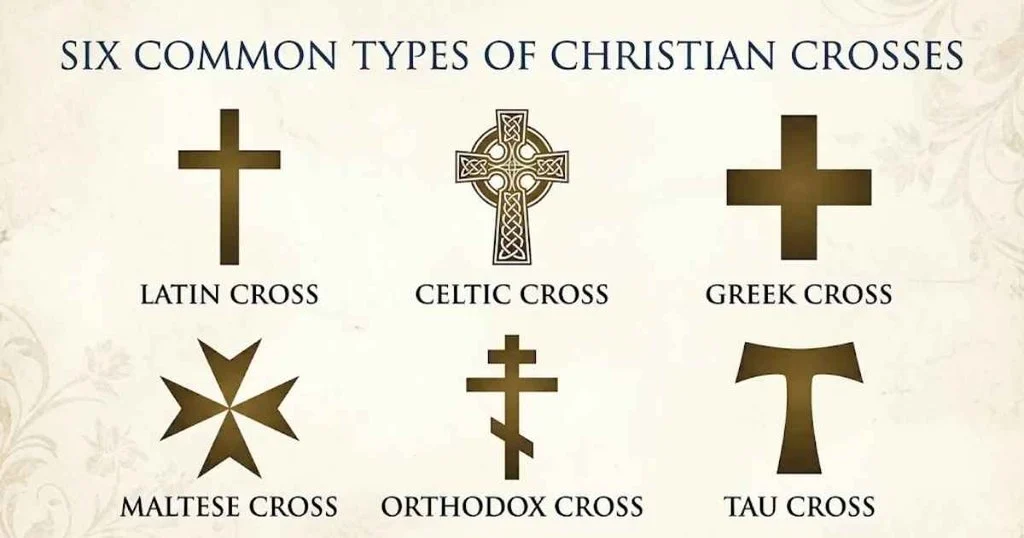
The cross has many shapes and designs. Some are associated with particular Christian traditions or saints, while others developed through church architecture and decorative art.
The following are six recognizable cross forms. One important detail: the Latin names Crux immissa, Crux decussata, Crux commissa, and Crux quadrata describe particular cross structures. They should not be treated as four additional designs separate from the corresponding Latin, X-shaped, T-shaped, and equal-armed crosses.
| Cross type | Shape | Common association |
| Latin cross | Longer vertical stem with a shorter horizontal beam | Crucifixion of Jesus |
| Greek cross | Four equal-length arms | Christian faith and church architecture |
| St. Andrew’s cross | X-shaped diagonal cross | St. Andrew’s martyrdom tradition |
| St. Anthony’s or Tau cross | T-shaped cross | St. Anthony and the Greek letter tau |
| Papal cross | Three horizontal bars | Papal authority |
| Jerusalem cross | Large central cross with four smaller crosses | Jerusalem and Christian tradition |
Latin Cross (Crux Immissa)
The Latin cross is the familiar Christian cross with a longer vertical stem and a shorter horizontal beam.
The horizontal beam crosses the vertical stem above its midpoint, leaving a longer section below.
This structure is commonly associated with the traditional representation of the cross on which Jesus was crucified.
Its Latin name is Crux immissa. It is also sometimes called crux capitata.
The Latin cross is used widely in Christian churches, cemeteries, religious jewelry, and artwork.
Common symbolic meanings:
- Jesus’ Crucifixion
- Sacrifice and redemption
- Salvation
- Christian faith
- Hope through the Resurrection
Greek Cross (Crux Quadrata)
The Greek cross has four arms of equal length.
Unlike the Latin cross, its vertical and horizontal sections are balanced around the center. Its shape resembles a plus sign (+).
The term Crux quadrata is used for this equal-armed cross form.
Greek crosses appear in Eastern Christian art, church architecture, religious decorations, and other Christian traditions.
Their balanced structure can communicate unity, symmetry, and the central importance of the Christian faith.
Greek and Latin cross differences:
| Feature | Greek cross | Latin cross |
| Vertical stem | Equal to horizontal arms | Longer than horizontal beam |
| Horizontal beam | Equal-length arms | Shorter than vertical stem |
| Overall shape | Plus sign | Traditional Christian cross |
| Common use | Architecture and decorative designs | Churches, crucifixes, and religious objects |
St. Andrew’s Cross (Crux Decussata)
St. Andrew’s cross has an X-shaped structure, with two diagonal sections crossing in the middle.
It is traditionally associated with St. Andrew, one of the Twelve Apostles.
Christian tradition holds that Andrew was martyred on a diagonal cross. According to this account, he considered himself unworthy of dying on a cross shaped like the one associated with Jesus.
The cross is therefore known as the Crux decussata, referring to its crossed diagonal structure.
St. Andrew’s cross is also known as a saltire. It appears in Christian artwork and in the national flag of Scotland, where St. Andrew is its patron saint.
Common associations:
- St. Andrew
- Christian martyrdom
- Faith and devotion
- Sacrifice
- Christian tradition
The account of Andrew’s X-shaped martyrdom belongs to Christian tradition. The exact circumstances of his death are not established by contemporary historical records.
St. Anthony’s Cross (Crux Commissa or Tau Cross)
St. Anthony’s cross is a T-shaped cross. Its horizontal beam rests at the top of the vertical stem.
The design resembles a capital letter T and the Greek letter tau (Τ).
Its Latin name is Crux commissa. It is also called the Tau cross.
The name connects the design with St. Anthony of Egypt, an important early Christian monk. The Tau cross became associated with the religious tradition of St. Anthony and later with the Order of St. Anthony.
The cross can also be understood through its resemblance to the Greek letter tau.
Common associations:
- St. Anthony
- Christian devotion
- Faith and spiritual commitment
- The Greek letter tau
- Christian religious history
A T-shaped cross is structurally different from the Latin cross because it does not have a vertical section extending above the horizontal beam.
Papal Cross
The Papal cross is a Christian cross with three horizontal bars placed across a vertical stem.
It is associated with the papacy and appears in some religious and ceremonial imagery connected with the pope.
The three bars are commonly interpreted as representing the pope’s spiritual authority and traditional roles. However, explanations of the bars can vary.
Do not confuse the Papal cross with the patriarchal cross, which usually has two horizontal bars.
Jerusalem Cross
The Jerusalem cross consists of one large central cross surrounded by four smaller crosses.
It is associated with Jerusalem and the historical Christian kingdom established there during the Crusader period.
Different interpretations explain the five crosses in different ways. Some connect them with Christ and the four evangelists, while others associate them with the spread of Christianity to the four corners of the world.
The design remains an important emblem in some Christian communities and organizations.
Other Christian Cross Designs and Variations
The six cross types above are not the only designs found in Christian history. Many additional forms developed through regional traditions, church architecture, religious orders, and artistic styles.
Crucifix vs. Plain Cross
A plain cross and a crucifix are closely related but visually different.
A plain cross shows the cross without a figure of Jesus. A crucifix includes the body of Christ.
| Feature | Plain cross | Crucifix |
| Appearance | Cross without a figure | Cross with Jesus’ body |
| Main emphasis | Christian faith, Crucifixion, and Resurrection | Jesus’ suffering and Crucifixion |
| Common use | Many Christian traditions | Especially Catholic worship and devotion |
Both represent the central Christian event of the Crucifixion.
Celtic Cross
The Celtic cross is a cross with a circular ring around the intersection of its arms.
It is strongly associated with historic Christian art in Ireland and other parts of the British Isles.
Stone high crosses from the early medieval period often contain intricate carvings, biblical scenes, and decorative patterns.
The circle is sometimes interpreted as a symbol of eternity or divine unity. However, not every historical Celtic cross has one agreed symbolic explanation.
Orthodox Cross
The Eastern Orthodox cross often has three horizontal bars.
The upper bar represents the inscription placed above Jesus during the Crucifixion. The middle bar represents the main crossbeam. The lower bar represents the footrest.
In many versions, the lower bar is slanted. Orthodox tradition commonly interprets this as part of the imagery of the Crucifixion, including the two criminals crucified beside Jesus.
This design appears in Orthodox churches, icons, religious jewelry, and other devotional objects.
Inverted Cross or Cross of St. Peter
The inverted cross is a cross turned upside down. In Christian tradition, it is associated with St. Peter.
According to a traditional account, Peter requested to be crucified upside down because he did not consider himself worthy of dying in the same manner as Jesus.
For this reason, the inverted cross can represent humility and Peter’s martyrdom.
It is important to understand its context. Although modern entertainment and some subcultures use the inverted cross in anti-Christian imagery, it is not automatically an anti-Christian symbol.
Catholic Symbols and Their Meanings
Catholicism shares the central Christian symbols found in other traditions. It also has a rich collection of devotional images and religious objects used in worship, prayer, and teaching.
The following Catholic symbols and meanings explain several important examples.
Sacred Heart of Jesus
The Sacred Heart of Jesus is a Catholic devotional symbol representing Christ’s love for humanity.
The image usually shows a heart surrounded by flames, a crown of thorns, and sometimes a cross.
Each detail has a particular association:
- Heart: Christ’s love and compassion.
- Flames: The intensity of divine love.
- Crown of thorns: Jesus’ suffering.
- Cross: His sacrifice and Crucifixion.
- Wound: The suffering Christ experienced.
The devotion emphasizes Jesus’ love, mercy, and willingness to sacrifice Himself for humanity.
Immaculate Heart of Mary
The Immaculate Heart of Mary represents Mary’s love, faith, purity, and devotion to God.
It is often shown with a heart surrounded by flowers or pierced by a sword. The sword refers to the sorrow Mary experienced during the life and death of Jesus.
This image is different from the Sacred Heart of Jesus, although both are important in Catholic devotional art.
Rosary
The rosary is a Catholic prayer tradition and a set of beads used to guide prayer and meditation.
It usually includes a crucifix, a central medal, and groups of beads arranged in a specific pattern.
The rosary helps believers reflect on important events in the lives of Jesus and Mary, known as the mysteries of the rosary.
It represents prayer, meditation, devotion, and reflection on the life of Christ.
Keys of St. Peter
The keys of St. Peter are an important symbol in Catholic imagery.
They refer to Matthew 16:19, where Jesus speaks to Peter about the keys of the kingdom of heaven.
The two keys are often shown crossed and are associated with Peter’s traditional role in Catholic teaching and the authority of the papacy.
They also appear in the coat of arms of the Vatican.
Eucharistic Host and Chalice
The Eucharistic host and chalice are central objects in Catholic Mass.
The host is the bread used in the celebration of the Eucharist. The chalice is the cup that holds the wine.
In Catholic teaching, the Eucharist is the sacrament in which Christ is truly present under the appearances of bread and wine.
These objects represent:
- The Last Supper
- Christ’s sacrifice
- Holy Communion
- The presence of Jesus Christ
- Unity among believers
Monstrance
A monstrance is a sacred vessel used in Catholic worship to display the consecrated Eucharistic host.
It often has a decorative sunburst design surrounding a central glass area.
The monstrance is used during Eucharistic adoration and certain religious ceremonies. Its purpose is to display the consecrated host for prayer and worship.
It is not simply a decorative religious object. It has a specific role in Catholic Eucharistic devotion.
Marian Symbols
Catholic artwork often uses symbols to represent the Virgin Mary.
Common examples include:
- Lily: Purity and innocence.
- Blue mantle: Mary’s traditional artistic association with heaven and devotion.
- Crown: Her queenship in Catholic tradition.
- Stars: Mary’s association with heavenly glory and traditional Marian imagery.
- Heart: Her love and devotion.
The meaning of these images can vary depending on the particular artwork and devotional tradition.
Symbols Associated With the Twelve Apostles
The Twelve Apostles were the followers Jesus chose to accompany Him during His ministry. Christian art often identifies them through objects associated with their biblical stories or traditional accounts of their lives and deaths.
These objects are called iconographic attributes. They help viewers recognize particular apostles in paintings, sculptures, stained glass, and church decorations.
Not all apostolic attributes come directly from the Bible. Some developed through later Christian traditions.
| Apostle | Common artistic symbol or attribute |
| Peter | Keys and sometimes an inverted cross |
| Andrew | X-shaped cross |
| James the Greater | Pilgrim’s staff and scallop shell |
| John | Eagle, book, or chalice |
| Philip | Cross |
| Bartholomew | Knife |
| Thomas | Spear or carpenter’s square |
| Matthew | Angel or winged man |
| James the Less | Club |
| Jude Thaddeus | Medallion or image of Christ |
| Simon the Zealot | Saw |
| Matthias | Axe or spear |
St. Peter and the Keys
St. Peter is often shown holding two keys.
The image comes from Matthew 16:19, where Jesus speaks about giving Peter the keys of the kingdom of heaven.
In Catholic tradition, this passage is important to the understanding of Peter’s role and the papacy.
St. Andrew and the X-Shaped Cross
St. Andrew is commonly identified by an X-shaped cross.
According to Christian tradition, Andrew was martyred on a diagonal cross rather than a Latin cross.
This association explains why the St. Andrew’s cross meaning and history are closely connected with sacrifice, devotion, and Christian martyrdom.
St. James and the Scallop Shell
St. James the Greater is associated with a scallop shell and pilgrim’s staff.
The shell is especially connected with the pilgrimage to Santiago de Compostela in Spain, where Christian tradition identifies the apostle’s shrine.
Today, the scallop shell remains a recognizable symbol of the Camino de Santiago pilgrimage.
St. John and the Eagle
St. John is traditionally represented by an eagle in Christian art.
The eagle is one of the four living creatures associated with the evangelists in Christian iconography.
It is commonly connected with the Gospel attributed to John and its theological emphasis on the divine nature of Christ.
Other Apostles and Their Attributes
The remaining apostles also have traditional artistic symbols.
For example, St. Bartholomew is often shown with a knife, while St. Thomas may appear with a spear or carpenter’s square.
These attributes developed through Christian art and tradition. Their exact use can differ between historical periods and artistic communities.
Christian Symbols for Kids
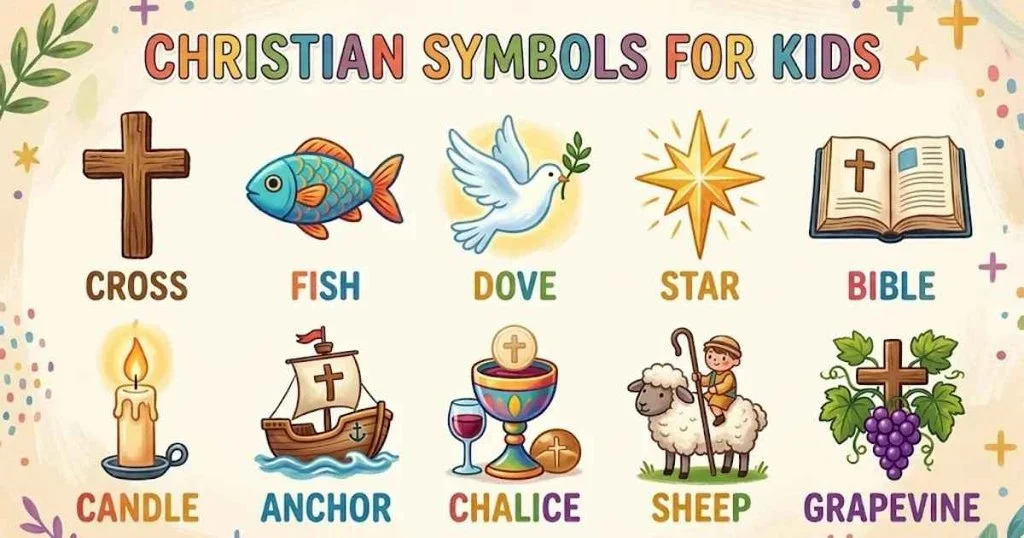
Children can learn about Christianity through simple images and explanations. Familiar symbols make religious lessons easier to understand and remember.
Here are some common Christian symbols for kids:
| Symbol | Simple meaning for children |
| Cross | Jesus and His love for people |
| Fish | Jesus Christ and His followers |
| Dove | The Holy Spirit and peace |
| Heart | Love and kindness |
| Bible | God’s Word and teachings |
| Candle | Jesus as the light of the world |
| Lamb | Jesus, the Lamb of God |
| Anchor | Hope and faith |
| Olive branch | Peace and forgiveness |
| Alpha and Omega | God is the beginning and the end |
Easy Lessons Children Can Learn From Christian Symbols
- The cross teaches sacrifice and love: It reminds Christians of what Jesus did for humanity.
- The dove teaches peace: It helps children understand the biblical image of the Holy Spirit.
- The heart teaches kindness: It represents love, compassion, and caring for others.
- The Bible teaches faith: It reminds children of the stories and teachings in Scripture.
- The anchor teaches hope: It represents trusting God during difficult times.
Parents and teachers can use these images in Sunday school lessons, classroom activities, coloring pages, and children’s Bible study.
Differences Between Christian, Catholic, and Orthodox Symbols
The terms Christian, Catholic, and Orthodox are related, but they are not interchangeable.
Christianity is the wider religion. Roman Catholicism and Eastern Orthodoxy are two major Christian traditions, alongside the many Protestant churches.
They share important beliefs about Jesus Christ, but their worship practices and use of religious imagery can differ.
| Tradition | Common symbolic features |
| Christianity broadly | Cross, fish, dove, Bible, and other biblical imagery |
| Roman Catholicism | Crucifix, rosary, Sacred Heart, Marian imagery, Eucharistic objects |
| Eastern Orthodoxy | Icons, Orthodox cross, Christ Pantocrator, images of saints |
| Protestant traditions | Cross, Bible, dove, and varying use of stained glass and religious artwork |
Symbols Shared Across Christianity
Many symbols are used by Catholic, Orthodox, and Protestant communities.
These include:
- The Christian cross.
- The fish symbol.
- The dove.
- The Bible.
- Bread and wine.
- Alpha and Omega.
Their exact use and interpretation may differ, but their connection with Christian faith is widely recognized.
Symbols Associated More Closely With Catholicism
Catholic devotional traditions include several images and objects that have a particular place in Catholic worship.
Examples include the rosary, Sacred Heart of Jesus, Immaculate Heart of Mary, monstrance, and keys of St. Peter.
Some other Christian traditions may also use certain images, but their religious practices and theological interpretations can differ.
Symbols in Eastern Orthodox Christianity
Eastern Orthodox churches place great importance on icons.
An icon is a religious image representing Jesus Christ, Mary, angels, or saints. Icons are used in worship and prayer, and they follow established artistic traditions.
The Orthodox cross, with its distinctive additional bars, is another recognizable part of Eastern Christian visual culture.
Symbols in Protestant Christianity
Protestant churches vary widely in their use of religious imagery.
Some use simple crosses and focus strongly on Scripture and preaching. Others include stained glass, paintings, candles, and detailed church decorations.
It would be inaccurate to say that all Protestant churches avoid religious symbols. Their practices depend on the denomination and local church tradition.
How Christian Symbols Are Used Today
Christian symbols remain important in modern religious and cultural life. They appear in places of worship, personal objects, educational materials, and artwork.
In Churches and Religious Buildings
Churches use symbols to communicate Christian teachings and create spaces for worship.
Common examples include:
- Crosses above altars.
- Crucifixes in Catholic churches.
- Stained-glass images of biblical events.
- Icons in Eastern Orthodox churches.
- Candles near altars and devotional areas.
- Religious artwork showing Jesus, Mary, and the saints.
These images help worshippers reflect on Scripture and Christian beliefs.
In Christian Worship and Religious Objects
Religious objects often contain symbolic details.
Examples include rosaries, chalices, candles, crosses, vestments, icons, and Eucharistic vessels.
Their purposes vary. Some are used during formal worship, while others support private prayer and devotion.
In Jewelry, Clothing, and Personal Items
Many people wear crosses, fish symbols, or religious medals as expressions of faith.
These objects may represent personal beliefs, family traditions, religious identity, or remembrance.
A cross necklace, for example, can be a personal reminder of Christian faith. A fish symbol on a car can identify the owner with Christianity.
In Christian Art and Modern Media
Christian symbols also appear in books, films, websites, illustrations, educational materials, and digital artwork.
Artists may use a dove to represent peace, a crown of thorns to recall the Passion of Christ, or a lamb to communicate sacrifice and innocence.
The meaning becomes clearer when the image is considered alongside the story or message it represents.
How to Understand Christian Symbols Correctly
Not every Christian image has one simple meaning. Some symbols come directly from Scripture, while others developed through church history, religious traditions, and artistic interpretation.
Use these steps when researching an unfamiliar symbol:
- Identify the image: Look carefully at its shape, objects, colors, and other visual details.
- Find its biblical connection: Check whether the symbol appears in a specific Bible passage or story.
- Research its historical origin: Learn when and where Christians began using it.
- Consider the denomination: Find out whether it has a particular meaning in Catholic, Orthodox, or Protestant traditions.
- Separate Scripture from tradition: Do not present a later legend or artistic interpretation as a direct biblical statement.
- Compare reliable sources: Use historical references, church resources, museum collections, and academic publications.
For example, the X-shaped cross is traditionally connected with St. Andrew. However, the account of his exact manner of martyrdom is a Christian tradition rather than a detail established by the New Testament.
This distinction helps you understand Christian symbols significance without confusing historical evidence, religious belief, and later interpretations.
Frequently Asked Questions About Christianity Symbols
What Are the Most Common Christian Symbols?
Some of the most common Christian symbols include the cross, crucifix, fish, Chi-Rho, dove, anchor, lamb, Good Shepherd, Bible, and Alpha and Omega. They represent central Christian beliefs such as Jesus Christ, salvation, faith, hope, and the Holy Spirit.
What Is the Main Symbol of Christianity?
The cross is the main and most widely recognized symbol of Christianity. It represents the Crucifixion of Jesus Christ and is closely connected with Christian beliefs about sacrifice, redemption, salvation, and the Resurrection.
What Does the Christian Cross Represent?
The Christian cross represents Jesus’ Crucifixion and the Christian belief that His sacrifice brought salvation to humanity. It also communicates faith, redemption, hope, and the Resurrection.
What Is the Difference Between a Cross and a Crucifix?
A cross is a Christian symbol with no figure attached. A crucifix includes a representation of Jesus’ body. Crucifixes are especially important in Catholic worship and devotion, while plain crosses are common across many Christian traditions.
What Are the Six Common Types of Christian Crosses?
Six recognizable forms are the Latin cross, Greek cross, St. Andrew’s cross, St. Anthony’s or Tau cross, Papal cross, and Jerusalem cross. Their shapes and historical associations differ.
What Is the Meaning of the Latin Cross?
The Latin cross has a longer vertical stem and a shorter horizontal beam. It is widely associated with Jesus’ Crucifixion and Christian beliefs about sacrifice and salvation. Its Latin name is Crux immissa.
What Is the Meaning of the Greek Cross?
The Greek cross has four equal-length arms and resembles a plus sign. It appears in Christian architecture, decorative designs, and Eastern Christian traditions. It is also called Crux quadrata.
What Is Crux Immissa?
Crux immissa is the Latin term for the Latin cross, which has a longer vertical stem and a shorter horizontal beam placed above its midpoint.
What Is Crux Decussata?
Crux decussata is the Latin term for an X-shaped cross. It is commonly associated with St. Andrew and his traditional martyrdom account.
What Is Crux Commissa?
Crux commissa refers to a T-shaped cross. It is also known as the Tau cross because it resembles the Greek letter tau.
What Is Crux Quadrata?
Crux quadrata refers to an equal-armed cross, commonly known as the Greek cross. Its four arms have the same length.
What Does St. Andrew’s Cross Represent?
St. Andrew’s cross is an X-shaped cross traditionally associated with the Apostle Andrew. Christian tradition connects it with his martyrdom and his devotion to Jesus.
Why Is St. Anthony’s Cross Shaped Like a T?
St. Anthony’s cross is T-shaped because its horizontal beam sits at the top of the vertical stem. The design resembles the Greek letter tau and is also called the Tau cross.
What Does the Christian Fish Symbol Mean?
The Christian fish, or Ichthys, represents Jesus Christ. Its Greek letters were traditionally understood as an abbreviation for “Jesus Christ, Son of God, Savior.” It was an important early Christian symbol.
What Does the Chi-Rho Symbol Stand For?
The Chi-Rho combines the Greek letters Chi (Χ) and Rho (Ρ), the first two letters of Christos, meaning Christ. It is an ancient Christian symbol representing Jesus Christ.
What Does the Dove Represent in Christianity?
The dove represents the Holy Spirit, especially in artwork showing the baptism of Jesus. It can also symbolize peace, purity, hope, and spiritual presence.
What Are the Main Catholic Symbols?
Important Catholic symbols include the crucifix, rosary, Sacred Heart of Jesus, Immaculate Heart of Mary, keys of St. Peter, Eucharistic host, chalice, and monstrance.
What Are the Symbols of the Twelve Apostles?
Traditional artistic attributes include Peter’s keys, Andrew’s X-shaped cross, James the Greater’s scallop shell, John’s eagle, and Bartholomew’s knife. Other apostles are associated with objects such as a spear, saw, club, or axe.
What Christian Symbols Are Suitable for Kids?
Children can learn about the cross, fish, dove, heart, Bible, candle, lamb, anchor, and olive branch. These symbols provide simple ways to explain Jesus, faith, peace, love, hope, and Christian teachings.
Are Christian and Catholic Symbols the Same?
Many Catholic symbols are also Christian symbols because Catholicism is part of Christianity. However, certain objects and devotional images, such as the rosary and Sacred Heart, have particular importance in Catholic traditions.
Why Do Some Christian Churches Use Icons and Religious Images?
Some Christian churches use icons and religious images to teach Scripture, remember Jesus and the saints, and support worship. Eastern Orthodox and Catholic traditions have especially developed forms of religious art, while Protestant practices vary.
Conclusion: Understanding Christian Symbols and Their Meanings
Christian symbols have played an important role in expressing faith, teaching religious lessons, and preserving Christian history. From the early fish and anchor to the familiar cross and Chi-Rho, these images communicate beliefs about Jesus Christ, salvation, hope, and eternal life.
The cross remains the central symbol of Christianity, while the dove, lamb, Good Shepherd, Alpha and Omega, and other images help explain different parts of Christian belief. Catholic traditions also use devotional symbols such as the Sacred Heart, rosary, and monstrance.
Understanding the history of Christian symbols means looking beyond their appearance. Some meanings come directly from the Bible, while others developed through centuries of worship, artwork, and religious tradition.
if you are studying Christianity, preparing religious lessons, or teaching Christian symbols for kids, learning the background of each image helps you understand its significance and respect the traditions connected with it.

Hello, I’m Rowan Sinclair, a passionate writer and lifelong admirer of the wisdom found in great quotes. I believe that words have the ability to inspire change, spark creativity, and connect people across cultures and generations.
I enjoy writing about motivational quotes, famous sayings, and lessons from history’s most influential thinkers. Every article I create is driven by my desire to help readers discover meaningful insights that they can apply to their own lives.
When I’m not writing, I spend my time reading biographies, exploring classic literature, and collecting memorable quotes that deserve to be shared with the world.
I am the author of Voices That Inspire and A Collection of Timeless Thoughts, two books that celebrate the enduring power of words and the stories behind them.
 Asher Monroe
 Sienna Brooks