Aztec symbols are visual designs connected with the beliefs, stories, gods, ceremonies, warfare, nature, and daily life of the Mexica and other peoples of central Mexico. Many designs that are called “Aztec symbols” today come from surviving manuscripts, sculpture, architecture, pottery, and other forms of Mesoamerican art.
Some symbols are especially popular in modern designs, including eagle and warrior imagery, sun motifs, serpent figures, skulls, shields, and geometric patterns. Their meanings can be complex, and a symbol may have a different significance depending on its historical and ceremonial context.
This guide explains important Aztec symbols and meanings in simple language. It also covers Aztec patterns, letters, symbols associated with love, protection, strength, warfare, family, and tattoos, while pointing out an important distinction between authentic historical symbols and modern decorative interpretations.
Aztec Symbols And Meanings
Aztec symbolism was closely connected to religion, mythology, political power, nature, agriculture, warfare, and the calendar. Rather than having one universal meaning, a design could communicate different ideas depending on where and how it was used.
Some commonly discussed examples include:
| Symbol or motif | Common historical association |
| Eagle | Sun, warriors, military identity, elite warrior orders |
| Jaguar | Power, night, warriors, elite military identity |
| Feathered serpent | Quetzalcoatl and religious mythology |
| Sun | Cosmic order, time, and solar religion |
| Skull | Death, sacrifice, and the cycle of life and death |
| Shield | Warfare, protection, and military identity |
| Fire | Ritual, transformation, and divine associations |
| Water | Life, fertility, agriculture, and water deities |
| Serpent | Different divine and natural associations depending on context |
| Maize | Agriculture, sustenance, and life |
Modern websites sometimes give one-word meanings to these designs. Those simplified explanations can be useful, but they should not be treated as complete translations of ancient Aztec thought.
Ancient Aztec Symbols
Ancient Aztec symbols appear in sculptures, codices, temples, ceramics, jewelry, stonework, and other surviving forms of material culture.
The Mexica, commonly called the Aztecs, used visual imagery to communicate religious and political ideas. Gods were often represented through recognizable attributes, while animals, plants, weapons, celestial bodies, and other objects could carry symbolic significance.
Important historical motifs include:
- Eagle imagery associated with solar and warrior traditions
- Jaguar imagery associated with power and elite warriors
- Serpents connected with several deities and mythological traditions
- Feathers associated with status, ritual, and divine imagery
- Skulls and skeletal imagery connected with death and sacrifice
- Maize imagery connected with agriculture and sustenance
- Water imagery connected with fertility and life
- Fire imagery connected with ritual and transformation
A major caution is that not every geometric design found online is an authentic ancient Aztec symbol. Many modern graphics are contemporary interpretations inspired by Mesoamerican art.
Mexican Aztec Symbols
The term “Mexican Aztec symbols” usually refers to visual motifs associated with the Mexica civilization and the wider cultural world of central Mexico.
The Aztec Empire was centered in the Valley of Mexico, with Tenochtitlan as its capital. The Mexica interacted with many neighboring peoples, so the artistic and religious world of the region was not limited to a single culture.
This is why it is useful to distinguish between:
- Mexica symbols — specifically associated with the Mexica people.
- Aztec symbols — a common modern term for Mexica-related culture and imagery.
- Mesoamerican symbols — a much broader category covering many cultures and periods.
For historically careful writing, “Mexica” is often preferable when discussing the people who built Tenochtitlan.
Important Aztec Symbols
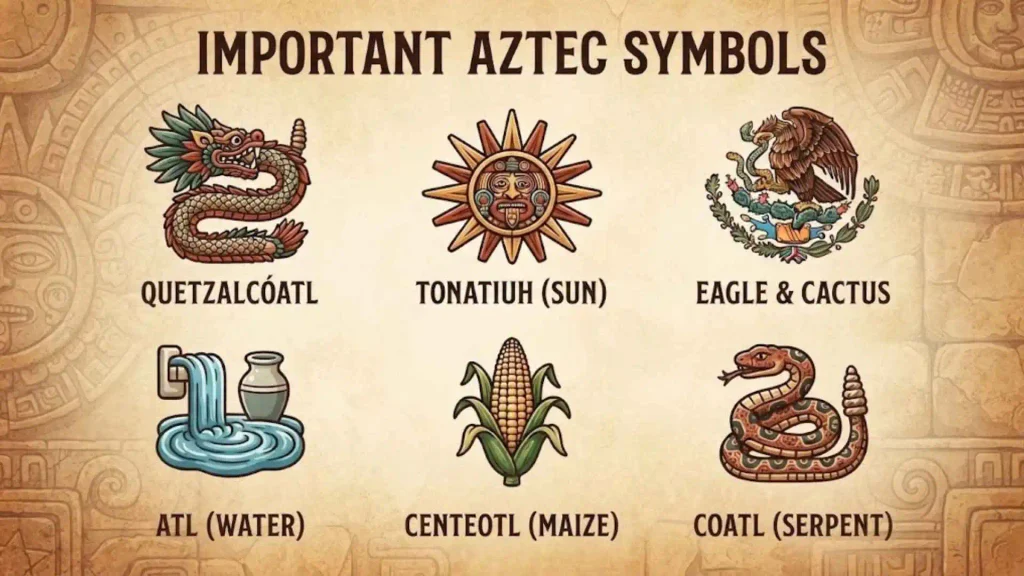
Some symbols and motifs are especially important when studying Aztec culture because they appear repeatedly in historical art and religious traditions.
Quetzalcoatl
Quetzalcoatl is commonly known as the Feathered Serpent. He was an important deity in central Mexican religious traditions and was associated with several concepts, including wind, knowledge, priesthood, and creation in different traditions.
Huitzilopochtli
Huitzilopochtli was a major Mexica deity associated with the sun and warfare. His imagery is connected with important aspects of Mexica religion and imperial identity.
Tlaloc
Tlaloc was a major rain and water deity. His imagery is recognizable through distinctive facial features and other attributes associated with rain and water.
Tonatiuh
Tonatiuh was a solar deity represented prominently in Mexica art. Solar imagery had major religious and cosmological importance.
These figures show why a symbol cannot always be separated from the larger mythology surrounding it.
Aztec Symbols And Patterns
Aztec-inspired patterns often use geometric forms, repeated shapes, stepped designs, lines, circles, and stylized natural imagery.
Historical Mexica art frequently combined geometry with representations of animals, gods, plants, weapons, and celestial objects. Modern designers often adapt these elements into borders, textiles, logos, jewelry, clothing, and decorative artwork.
Common visual features include:
- Repeating geometric borders
- Stepped shapes
- Spiral-like forms
- Stylized feathers
- Serpent patterns
- Sun motifs
- Eagle and jaguar imagery
- Skull designs
- Shield-like forms
A modern “Aztec pattern” should not automatically be assumed to be an exact reproduction of an ancient design. Many commercially available patterns are contemporary artwork inspired by Mesoamerican aesthetics.
Aztec Symbols Letters
Aztec writing did not use an alphabet in the same way as modern English. Mexica scribes used a combination of pictorial signs, logographic elements, and phonetic signs in manuscripts and inscriptions.
This means there is no authentic ancient Aztec alphabet in which each English letter has one matching Aztec symbol.
For example, online charts that present:
A = one symbol, B = another symbol, C = another symbol
may be modern creations rather than historical Aztec writing.
If you want to write a modern name using an Aztec-inspired design, it is better to describe it as Aztec-inspired lettering rather than claiming that it is an authentic translation into an Aztec alphabet.
There is also no standard Unicode block containing an “Aztec alphabet” for ordinary copy-and-paste use.
Easy Aztec Symbols
Simple Aztec-inspired designs can be useful for beginners, sketching, crafts, or decorative projects. Geometric motifs are usually easier to reproduce than detailed figures of deities.
Some beginner-friendly ideas include:
- Stepped pyramid shape — inspired by Mesoamerican architectural forms
- Simple sun motif — a circle surrounded by rays
- Geometric border — repeating squares or stepped lines
- Simple feather pattern — repeated feather shapes
- Basic serpent pattern — a stylized winding line
- Shield shape — a simple military-inspired outline
These are best described as Aztec-inspired designs unless their historical source is known.
Aztec Symbols For Love
There was no single universal Aztec symbol that simply meant “love” in the same way that a modern heart symbol is commonly understood today.
Aztec ideas about relationships, fertility, sexuality, family, marriage, and affection existed within a much larger religious and social system.
Modern artwork sometimes uses:
- Flowers
- Hearts
- Birds
- Serpents
- Fertility-related imagery
- Pairing motifs
as “Aztec love symbols.” However, these should not automatically be presented as historically documented symbols meaning romantic love.
For a historically inspired design about love, it is better to select imagery based on a documented deity, story, plant, or cultural concept and explain the context.
Aztec Symbols For Protection
Protection was an important theme in ancient Mesoamerican religious life, but there was not one universal “Aztec protection symbol” used like a modern protective emblem.
Protective meanings can be associated with deities, warriors, ritual objects, shields, weapons, and supernatural powers depending on the historical context.
Modern Aztec-inspired protection designs often use:
- Warrior imagery
- Eagle imagery
- Jaguar imagery
- Shields
- Serpents
- Deity representations
The meaning depends heavily on the specific image. A jaguar, for example, should not automatically be translated as “protection” because its historical associations are broader.
Family Aztec Symbols And Meanings
Family was an important part of Mexica social organization, but there was not one universally recognized Aztec symbol equivalent to a modern “family symbol.”
Modern designs may combine Aztec-inspired imagery with concepts such as:
- Ancestry
- Parents and children
- Community
- Heritage
- Continuity
- Strength
- Protection
Maize imagery can be especially relevant when discussing sustenance and life because agriculture was central to Mesoamerican society. However, calling a specific maize design an official “family symbol” would oversimplify its historical meaning.
For a family tattoo or emblem, combining a historically documented motif with a personal explanation is more accurate than assigning an invented traditional definition.
Aztec Symbols For Strength
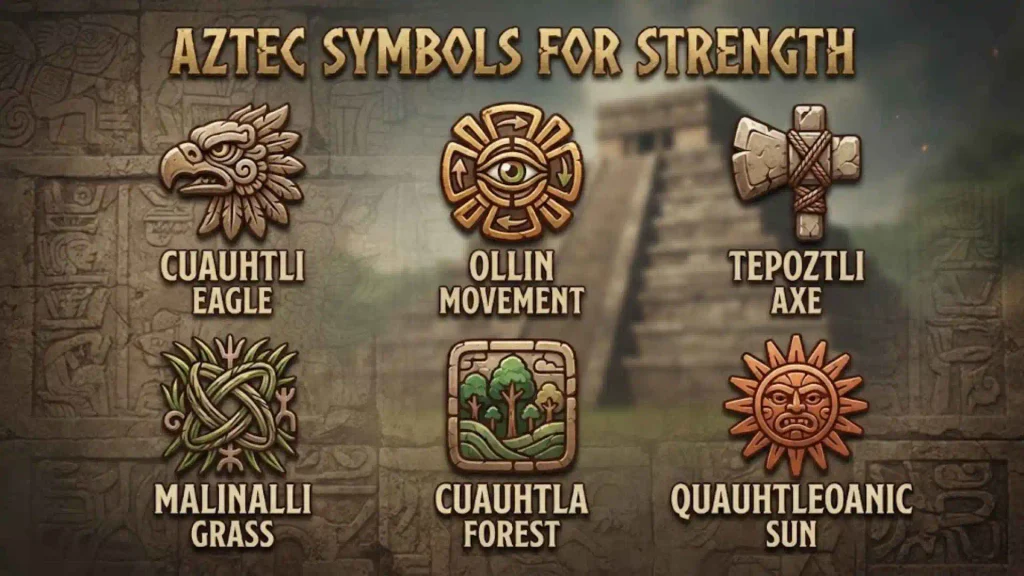
Strength is frequently associated with Aztec-inspired warrior imagery. The eagle and jaguar are particularly important because they were connected with elite warrior traditions.
The Eagle Warriors and Jaguar Warriors were important military groups in the Mexica world. Their imagery has therefore become strongly associated with courage, power, discipline, and martial identity.
Modern strength designs may feature:
- Eagle
- Jaguar
- Warrior
- Shield
- Weapon
- Sun
- Serpent
The exact historical meaning should still be checked rather than treating every warrior image as a direct symbol for physical strength.
Aztec Symbols Of Strength
Aztec symbols of strength are often represented through animals and warrior imagery rather than through one single abstract character.
Eagle
The eagle is strongly connected with Mexica warrior traditions and solar imagery. Its association with elite warriors makes it a popular modern representation of courage and strength.
Jaguar
The jaguar was associated with power and elite warriors. Jaguar imagery therefore has strong connections with martial identity.
Warrior
A warrior figure can represent courage, military service, discipline, and power. The meaning depends on the specific historical imagery being represented.
Shield
Shields were practical objects of warfare and also appear in military imagery. A shield can therefore work naturally as a modern symbol of defense and strength, although that modern interpretation should not be presented as a single ancient dictionary meaning.
Warrior Fighter Aztec Symbols
Warrior imagery is among the most recognizable aspects of modern Aztec-inspired symbolism.
The Mexica military system included elite warrior societies, including groups associated with eagles and jaguars. Military status was connected with social organization, warfare, and imperial expansion.
Common warrior-inspired imagery includes:
- Eagle warriors
- Jaguar warriors
- Shields
- Spears
- Clubs
- Feathers
- Warrior headdresses
- Military insignia
These images can be used in modern artwork to communicate courage or fighting spirit, but their historical context is broader than a simple “fighter symbol.”
Aztec Symbols For War
War had a major role in Mexica society and imperial expansion, and military imagery appears throughout surviving art.
Weapons and warrior equipment could have both practical and symbolic importance. Eagle and jaguar warrior traditions are particularly important when discussing Mexica warfare.
Other war-related imagery can include:
- Shields
- Spears
- Clubs
- Warrior costumes
- Eagle imagery
- Jaguar imagery
- Military banners
- Captive and battle scenes
It is useful to distinguish between an actual historical object and a later symbolic interpretation. A shield, for example, was a piece of military equipment first; its modern use as a symbol of protection or strength is an interpretation.
Strength Aztec Symbols And Meanings
When people search for Aztec symbols of strength, they often want a design that can represent courage, resilience, power, or determination.
The following associations are commonly useful:
| Motif | Modern interpretation | Historical context |
| Eagle | Courage and strength | Warrior and solar associations |
| Jaguar | Power and bravery | Elite warrior associations |
| Shield | Defense and resilience | Military equipment |
| Warrior | Courage and discipline | Mexica military culture |
| Sun | Vitality and power | Major religious and cosmological importance |
| Serpent | Power and transformation | Multiple religious associations |
These modern interpretations should be kept separate from historical definitions. Ancient symbolism was more complex than a list of modern motivational meanings.
Aztec Symbols And Meanings Tattoos
Aztec-inspired tattoos are popular because the visual style can combine bold geometric forms with animals, warriors, gods, and architectural imagery.
Common tattoo subjects include:
- Eagle imagery
- Jaguar imagery
- Quetzalcoatl
- Huitzilopochtli-inspired imagery
- Sun motifs
- Warrior designs
- Aztec calendar imagery
- Geometric borders
- Skull imagery
Before getting a tattoo, verify whether the design represents an actual historical motif or a modern interpretation. This is especially important when a tattoo artist or online seller assigns a very specific meaning to a design.
A good tattoo reference should preserve recognizable details rather than mixing unrelated Mesoamerican symbols into one design and calling the result historically authentic.
Aztec Symbols Tattoo
An Aztec tattoo can be based on a single motif or a larger composition. Popular choices include animals, warriors, deities, geometric patterns, and calendar-inspired artwork.
If accuracy matters, ask the artist where the reference image came from. A museum collection, historical manuscript, archaeological publication, or reputable cultural institution is generally more useful than an anonymous social media graphic.
The design can then be adapted for tattooing while keeping its historical inspiration clear.
Aztec Symbols Tattoos
Aztec-inspired tattoos range from small geometric designs to large full-sleeve compositions.
Small tattoos often work well with simple motifs such as:
- A stylized eagle
- A geometric sun
- A small serpent
- A simple shield
- A stepped geometric pattern
Larger tattoos can incorporate warriors, deities, architectural elements, and complex patterns.
Because some historical designs contain fine details, tattoo artists may simplify them for clarity and aging. Simplification is a practical tattoo decision, but it should not be mistaken for an authentic ancient version.
Meaning Aztec Symbols
The meaning of an Aztec symbol depends on its historical context. A single visual element may appear in religious, political, military, or decorative settings.
For example, an eagle can have associations with warriors and the sun, while a serpent can refer to different deities and concepts depending on the specific form.
This is why the safest approach is to identify the exact motif before assigning a meaning.
When researching an Aztec design, ask:
- What is the original source?
- Is the design historically documented?
- Which culture or period does it belong to?
- Is the stated meaning historical or modern?
- Is the image being reproduced accurately?
Aztec Symbols Meaning
There is no single meaning for “Aztec symbols.” The term covers a broad group of visual motifs connected with religion, warfare, nature, agriculture, social identity, mythology, and cosmology.
Some commonly encountered meanings include:
- Eagle: warrior and solar associations
- Jaguar: power and elite warrior associations
- Quetzalcoatl: Feathered Serpent deity and related religious traditions
- Tlaloc imagery: rain and water
- Maize: agriculture and sustenance
- Sun imagery: solar and cosmological significance
- Skull imagery: death and sacrifice
These descriptions provide context rather than fixed dictionary definitions.
Aztec Symbols And Meanings
Aztec symbolism becomes easier to understand when designs are grouped by subject.
Religious Symbols
Deities, sacred animals, celestial bodies, and ritual objects often appear in religious imagery.
Warrior Symbols
Eagles, jaguars, weapons, shields, and warrior costumes are associated with military traditions.
Nature Symbols
Rain, water, maize, animals, plants, and celestial bodies reflect the importance of the natural world.
Geometric Symbols
Repeated lines, steps, circles, and patterns appear throughout Mesoamerican art and architecture.
This approach helps prevent different kinds of imagery from being treated as if they all served the same purpose.
Aztec Symbols And Patterns
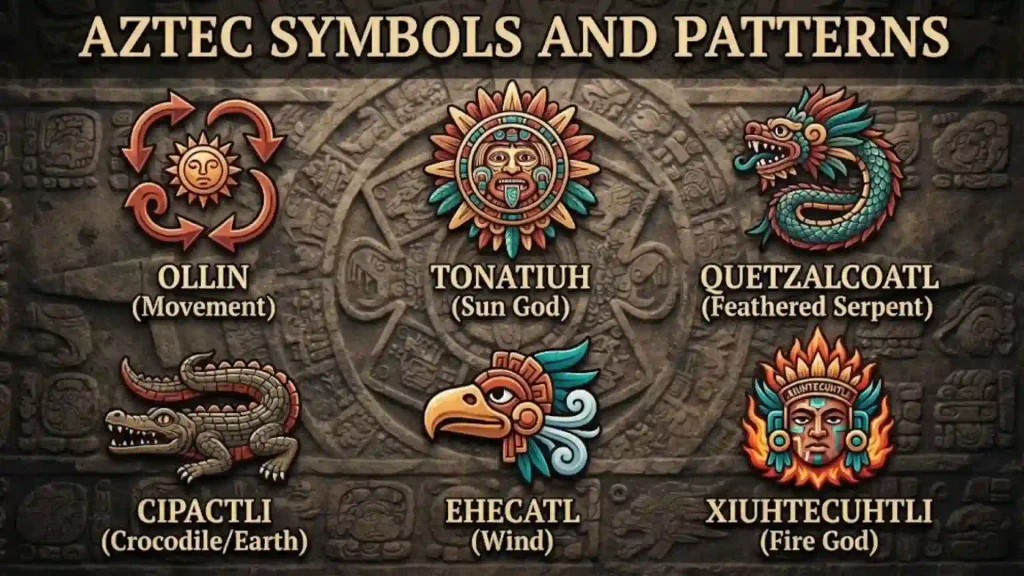
Aztec-inspired patterns are especially common in modern clothing, jewelry, home decoration, graphic design, and tattoos.
A repeated geometric border can create a distinctly Mesoamerican visual style without representing a particular ancient symbol. Other patterns may directly reproduce historical motifs from manuscripts, sculptures, or architectural decoration.
For design work, it helps to decide which of these goals you have:
- Historical reproduction
- Educational illustration
- Cultural-inspired decoration
- Modern tattoo design
- Contemporary graphic artwork
That distinction makes it easier to describe the finished design accurately.
Aztec Symbols And Meanings Tattoos
Tattoos based on Aztec imagery often combine symbolism with personal identity. A person may choose an eagle for warrior associations, a jaguar for power, or a deity image because of a connection with a particular story.
However, online tattoo lists frequently simplify complicated historical ideas into single words. Before permanently using a symbol, verify the original source and meaning.
For a culturally informed tattoo, include the historical name of the figure or motif and understand what it represented in its original setting.
Aztec Symbols And Meanings
Aztec symbols can communicate much more than simple ideas such as “love,” “strength,” or “protection.” Their historical meanings developed within a complex culture with its own religious traditions, political institutions, social structures, and understanding of the universe.
The most reliable way to interpret an image is to consider its complete context. A symbol’s surrounding figures, objects, colors, placement, and medium can all affect how it should be understood.
For modern use, a design can still have a personal meaning, but that personal meaning should be distinguished from the historical meaning.
Frequently Asked Questions
What Is The Most Famous Aztec Symbol?
One of the most recognizable Aztec-related designs is the Mexica Sun Stone, commonly called the Aztec Calendar Stone. Eagle, jaguar, serpent, and deity imagery are also widely recognized.
What Aztec Symbol Means Strength?
Eagle and jaguar imagery is commonly associated with strength in modern Aztec-inspired designs because both are connected with important warrior traditions. Their historical meanings are broader than simply “strength.”
Is There An Aztec Symbol For Love?
There was no single universal Aztec symbol equivalent to the modern heart as a symbol of romantic love. Modern designers may create Aztec-inspired love designs using flowers, paired figures, or other imagery.
Did The Aztecs Have A Written Alphabet?
The Mexica writing system was not an alphabet like modern English. It used pictorial, logographic, and phonetic elements. Modern charts assigning one Aztec symbol to each English letter should therefore be treated cautiously.
Can I Copy And Paste Aztec Symbols?
Traditional Aztec designs generally do not have dedicated Unicode characters that can be typed as ordinary text. For accurate digital use, an image or properly created graphic is usually more suitable than a random Unicode substitute.
Conclusion
Aztec symbols provide a fascinating look into Mexica and wider Mesoamerican art, religion, warfare, mythology, and social life. Eagles, jaguars, serpents, suns, maize, shields, and deity imagery can all carry important cultural associations.
Modern interest has expanded these designs into tattoos, clothing, jewelry, logos, patterns, and decorative artwork. That makes it especially important to separate historically documented meanings from modern interpretations created for contemporary design.
If you want to use an Aztec-inspired symbol, research the original motif first and then decide how you want to adapt it. Understanding the history behind the design gives the artwork more depth and helps avoid presenting modern inventions as ancient symbols.

Hi, I’m Sienna Brooks, and I believe that the right words can inspire, comfort, and empower people at every stage of life. For as long as I can remember, I’ve been drawn to meaningful quotes and the stories behind them. I love curating collections of inspirational, motivational, and heartfelt quotes that resonate with readers around the world.
Through my writing, I strive to help others find encouragement, whether they’re celebrating life’s happiest moments or navigating its biggest challenges. I believe that wisdom is timeless, and I’m passionate about sharing words that leave a lasting impact.
I am the author of Reflections in Words and The Journey of Inspiration, two books dedicated to exploring the beauty and power of timeless quotes.
 Rowan Sinclair Rowan Sinclair