Process map symbols are far more than mere corporate shapes on a screen; they represent the visual roadmap of human intention and collective effort. From the moment we first carved directional arrows on cave walls, our minds have craved a structured way to navigate complex journeys. By translating chaotic human actions into elegant, universal icons, these shapes act as mirrors to our psychology and progress. As we explore their hidden histories and archetypal depths, you will discover how these simple visual tools help us master the flow of our daily lives and work.
Process map symbols are standardized visual shapes, like rectangles, diamonds, and ovals, used in flowcharts to represent specific steps, decisions, inputs, and outputs within a workflow. They simplify complex systems, allowing teams to communicate clearly, analyze efficiency, and map out pathways to success across any industry or project.
Quick Facts About Process Map Symbols
| Aspect | Information |
| Origin | Introduced by Frank and Lillian Gilbreth in 1921 to the American Society of Mechanical Engineers. |
| Historical Significance | Revolutionized industrial engineering, building the foundation for modern assembly lines and quality control. |
| Main Meaning | A universal visual vocabulary that charts actions, decisions, documents, and data flows. |
| Spiritual Meaning | Archetypal geometry representing the soul’s journey, initiation portals, and crossroads of destiny. |
| Cultural Importance | Shifts human work from chaotic guesswork to collective, synchronized systems of shared understanding. |
| Modern Usage | Essential in software programming, UX/UI design, business management, and personal development mapping. |
What Are Process Map Symbols?
At their core, process map symbols are the alphabet of visual thinking. They are specialized geometric shapes that represent distinct actions, inputs, outputs, or decisions within a system. Instead of writing long paragraphs to explain how a task is completed, we use these standardized icons to tell a story at a glance.
The journey of these symbols began in the early 20th century. In 1921, industrial engineers Frank and Lillian Gilbreth presented a concept called the “Process Chart” to the American Society of Mechanical Engineers (ASME). The Gilbreths wanted a simple way to study human motion and eliminate waste in factories. Over the decades, their original set of shapes was refined, eventually becoming standardized by organizations like ASME and the International Organization for Standardization (ISO).
Today, these symbols are the global standard for business process mapping, software engineering, and systems design. They bridged the gap between human labor and automation, proving that visual maps are the fastest way to align human minds toward a common goal.
Deep Symbolic Meaning of Process Map Symbols
While we use these shapes to organize work, they carry profound psychological and historical meanings that resonate with the human subconscious.
Spiritual Level
On a spiritual and geometric level, process map symbols mirror ancient sacred geometry:
- The Oval (The Terminator): Represents the boundary of a sacred space. It is the cosmic egg, the portal of entry and exit where a journey begins and ends.
- The Rectangle (The Process Step): Symbolizes the earth, physical manifestation, and structure. It is the building block of creation where energy is transformed into practical action.
- The Diamond (The Decision): Represents the spiritual crossroads. It is the moment of free will, where one must choose between paths, testing the alignment of purpose and direction.
Psychological Level
Psychologically, these symbols speak directly to our cognitive wiring. Human beings are natural pattern-seekers. Carl Jung spoke extensively about archetypes, universal symbols resident in the collective unconscious.
When we look at a process map, the visual flow reduces cognitive load. It eases the deep psychological anxiety of the unknown. Seeing a clear path with visible choice points (diamonds) and structured steps (rectangles) gives us a sense of control, turning chaotic thoughts into structured, manageable actions.
Cultural Level
Culturally, process map symbols represent the evolution of collaboration. Before written text was widespread, human cultures relied on pictographs to coordinate hunts, rituals, and trade.
In the modern digital age, these symbols serve as a universal language. A software engineer in Tokyo, a designer in Berlin, and a project manager in New York can all look at the same process map and understand exactly how a system works without translating a single word of text.
Types and Variations of Process Map Symbols
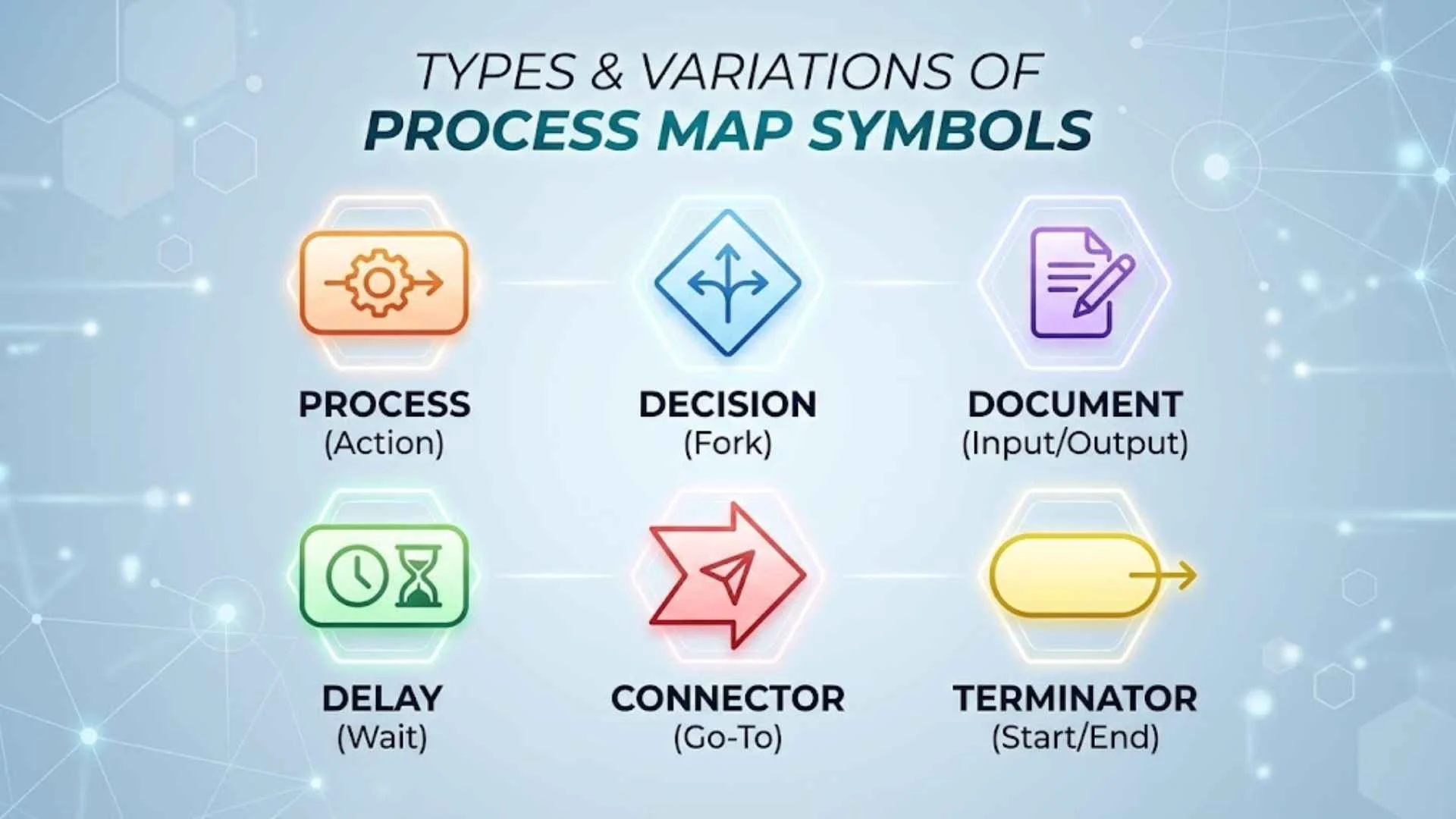
To read or build a process map, you must understand the core shapes that make up its vocabulary.
The Terminator (Oval)
- Visual Description: An elongated circle or rounded rectangle.
- Meaning: Represents the start or end point of a process.
- Symbolism: Birth, completion, boundaries, and transition points.
- Cultural Connection: The Egyptian cartouche, which enclosed sacred names, acting as a protective boundary.
- Where It Appears: At the absolute outer edges of flowcharts, systems diagrams, and journey maps.
The Process Step (Rectangle)
- Visual Description: A standard four-sided box with right angles.
- Meaning: Represents a single action, task, or operation.
- Symbolism: Foundation, physical labor, execution, and stability.
- Cultural Connection: The stone blocks used to build ancient monuments, symbolizing collective work.
- Where It Appears: Throughout the body of almost every process map, representing the actual work being done.
The Decision (Diamond)
- Visual Description: A four-sided rhombus resting on one of its points.
- Meaning: Indicates a choice point, typically requiring a “yes” or “no” answer that splits the path.
- Symbolism: Crossroads, destiny, discrimination, and free will.
- Cultural Connection: The classic folklore of meeting a traveler at the crossroads, demanding a crucial decision.
- Where It Appears: At pivot points where a process branches into multiple potential directions.
The Document (Rectangle with a Wavy Base)
- Visual Description: A standard rectangle, but the bottom line rises and falls like a wave.
- Meaning: Represents a physical document, report, or digital file.
- Symbolism: Records, legacy, communication, and tangible knowledge.
- Cultural Connection: The ancient papyrus scroll or stone tablet used to pass down laws and stories.
- Where It Appears: Wherever a process generates or requires written information, receipts, or contracts.
Data / Input-Output (Parallelogram)
- Visual Description: A slanted rectangle.
- Meaning: Represents resources entering the process (inputs) or leaving it (outputs).
- Symbolism: Reception, giving, exchange, and the flow of energy.
- Cultural Connection: Trading posts and marketplaces where goods are exchanged.
- Where It Appears: At the beginning of steps where external information or materials are introduced.
The Connector (Circle)
- Visual Description: A small, simple circle, often containing a letter or number.
- Meaning: Connects different parts of a complex map across multiple pages.
- Symbolism: Unity, continuous loops, portals, and safe passage.
- Cultural Connection: The Zen circle (Ensō), symbolizing flow, completeness, and smooth transitions.
- Where It Appears: At the bottom of a page or section to guide the reader to the next part of the map.
Process Map Symbols Across Different Cultures
While modern process engineering formalized these shapes, ancient civilizations used similar geometric visual tools to map out life, spirituality, and logistics.
Ancient Egypt
The Egyptians were masters of structured planning. They used geometric grids in architectural blueprints and tombs. They mapped the journey of the soul through the underworld using sequential scrolls like the Book of the Dead. These scrolls functioned as spiritual process maps, complete with visual steps, decisions (the weighing of the heart), and final outcomes.
Ancient Greece
In Greece, Euclid’s geometry established that shapes carry fundamental truths. The Greeks also used the concept of the labyrinth, a visual path representing a complex process with a single entrance and exit. Walking the labyrinth was a physical process map for inner transformation.
Roman Culture
The Roman Empire succeeded due to standardized processes. From road building to military formations, the Romans used strict structural symbols. Their milestones along roads served as physical process connectors, keeping vast supply chains synchronized across continents.
Eastern Traditions
In Eastern philosophy, the flow of energy is charted through diagrams like mandalas or the Chinese Bagua map. These sacred maps use geometry to show how different forces interact, balancing inputs and outputs to achieve harmony, much like a modern efficiency engineer balances a workflow.
Indigenous Traditions
Indigenous cultures used visual maps painted on animal hides or bark to track seasonal migrations, water sources, and historical stories. These maps used simple geometric symbols to show where to start a journey, where key decisions had to be made, and where resources could be gathered.
Modern Interpretations
Today, our global digital culture has distilled these historical shapes into the icons we see on our phones daily. The play button, the download arrow, and the settings gear are the modern descendants of early process mapping symbols, designed to help us navigate the digital landscape instantly.
Similar Symbols and Their Meanings
Process map symbols share common visual traits with other iconic system maps. Understanding how they compare helps us appreciate their unique design.
| Process Map Symbols | Architectural Blueprints | Traffic Signs | Musical Notation |
| Primary Focus | Actions, decisions, and logical workflows. | Physical spaces, dimensions, and materials. | Spatial safety, speed, and navigation rules. |
| Core Audience | Teams, programmers, and business analysts. | Builders, contractors, and city planners. | Drivers, pedestrians, and travelers. |
| Common Shapes | Diamonds, rectangles, ovals, and arrows. | Parallel lines, door swings, and crosshatches. | Circles, triangles, octagons, and shields. |
| Key Similarity | They all translate complex human activities into simple, repeatable visual codes. |
Process Map Symbols in Mythology and Folklore
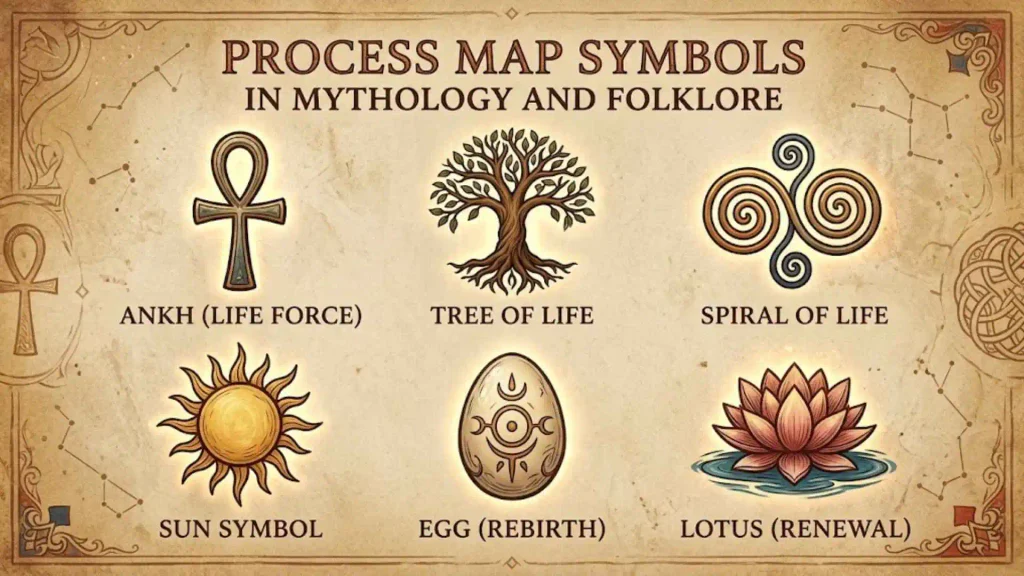
The concepts behind our standard shapes appear in myths around the world. The most famous example is the myth of Ariadne’s Thread. When Theseus entered the dark, confusing labyrinth to slay the Minotaur, Ariadne gave him a ball of thread. By unrolling the thread as he walked, Theseus mapped his process, creating a clear visual pathway that guided him safely back to the entrance.
Similarly, European folklore is filled with stories of the Crossroads. Characters in these tales often meet a figure of wisdom or temptation at a point where roads diverge. This is the physical manifestation of the decision diamond, reminding us that life is defined by the quality of our choices at critical junctions.
The ancient Greek Fates (the Moirai) also run a cosmic process map. Lachesis measures the thread of life (the process flow line), Clotho spins it (the input), and Atropos cuts it (the terminator shape), showing that even the ancients viewed existence as a structured sequence of events.
Process Map Symbols in Pop Culture, Art, and Literature
In modern storytelling, these symbols help us visualize complex ideas and branching realities.
Interactive Media and Movies
The hit interactive movie Black Mirror: Bandersnatch was built entirely on a giant decision-tree flowchart. Viewers made choices that sent the protagonist down different paths, making the flowchart diamond the driving force of the entire narrative.
Corporate Satire
In comics like Dilbert or television shows like The Office, flowcharts are often used to satirize corporate bureaucracy. Characters are shown trapped in infinite loops, demonstrating the humor and frustration of a poorly designed system.
[Wake Up] ──> [Drink Coffee] ──> [Is It Friday?]
│ │
No │ │ Yes
▼ ▼
[Work] [Celebrate]
Art and Tattoos
Minimalist artists use geometric shapes to represent the flow of life. Many people choose to get tattoos of process map symbols, particularly the decision diamond or the terminator oval, to symbolize a major turning point, a new beginning, or a conscious life choice they have made.
Spiritual and Dream Meaning of Process Map Symbols
Dreaming of diagrams and shapes can offer deep insights into your mental state.
Dreaming of a Flowchart Grid
If you find yourself dreaming of a structured flowchart or process map, it often indicates that your subconscious is trying to organize chaotic emotions or complex life events. It suggests a desire for control and clarity in your waking life.
Dreaming of the Decision Diamond
Standing inside a giant diamond shape in a dream indicates that you are facing a major life decision. Your mind is urging you to weigh your options carefully and recognize that your choice will lead you down a completely different developmental path.
Dreaming of an Endless Loop
Getting stuck in an endless loop in a dream, where arrows keep pointing you back to the same process box, is a warning sign. It suggests that you feel stuck in a repetitive cycle in your career, relationship, or personal habits, and it is time to break the pattern.
Positive and Negative Meanings of Process Map Symbols
Like any powerful tool, process map symbols carry both light and shadow, depending on how they are used.
| Positive Meanings (The Light) | Negative Meanings (The Shadow) |
| Clarity: It illuminates the path forward, removing doubt and confusion. | Rigidity: It can lock people into rigid systems, leaving no room for spontaneous creativity. |
| Efficiency: It reveals wasted time and energy, freeing up precious resources. | Bureaucracy: It can create unnecessary steps and red tape, slowing down progress. |
| Collaboration: It unites diverse teams under a single, shared visual language. | Dehumanization: It can treat human workers as mere boxes in a machine rather than individuals. |
Why Humans Are Attracted to Process Map Symbols
Our love for these symbols is deeply rooted in psychology and neuroscience. The human brain is a highly visual processing engine. We process images up to 60,000 times faster than text.
When we look at a wall of text, our brain must work hard to decode the letters, form words, and piece together the meaning. However, when we look at process map symbols, we immediately recognize the patterns. The Gestalt principles of visual perception explain that our minds naturally organize shapes into orderly groups.
This visual structure reduces mental fatigue. It turns a confusing, overwhelming project into a beautiful, step-by-step game board, satisfying our evolutionary desire to organize our environment and master our survival paths.
Modern Uses of Process Map Symbols
While these shapes started in factories, they have adapted perfectly to the digital age.
UX/UI Design
User experience designers use process maps (often called user flows) to plan out how a person navigates a website or app. They chart every click, swipe, and decision point to make sure the app feels intuitive and easy to use.
Personal Productivity and Therapy
Many people use process maps to design their daily habits, morning routines, or long-term goals. Therapists even use cognitive flowcharts to help patients map out their emotional triggers, choices, and reactions, allowing them to consciously rewrite negative behaviors.
Coding and Software Engineering
Before writing a single line of code, software engineers use these symbols to map out how a program will run. This ensures the logical structure of the software is flawless before development begins.
Excel, PowerPoint, and Visio
Process map symbols can be created in different software tools, depending on the complexity of the workflow and how you plan to share it. Microsoft Excel, PowerPoint, and Visio each offer useful options for building clear process diagrams.
Process Map Symbols in Excel
Excel is useful for creating simple process maps with shapes, arrows, and text labels. You can insert rectangles to represent tasks, diamonds for decisions, and ovals for the start and end of a workflow. Excel works well when you want to combine a process map with tables, calculations, or tracking data.
Process Map Symbols in PowerPoint
PowerPoint is a practical choice when you need to present a process map to a team or audience. You can use flowchart shapes and connector arrows to explain each step visually. Keeping labels short and arranging the shapes in a logical order makes your diagram easier to understand during a presentation.
Visio Process Map Symbols
Process Map Symbols in Six Sigma and Lean Six Sigma
Six Sigma and Lean Six Sigma use process mapping to help teams understand how work is performed and identify opportunities for improvement. Process map symbols make it easier to see each activity, decision, input, output, and handoff within a workflow.
Common symbols include rectangles for process steps, diamonds for decisions, ovals for start and end points, and arrows for the direction of work. Teams may also use specialized process mapping diagrams to examine suppliers, inputs, process activities, outputs, and customers.
In Lean Six Sigma, a process map can reveal unnecessary steps, delays, repeated work, and activities that do not add value. For example, a team might map an order approval process and discover that the same information is checked by several departments. The team can then investigate whether those checks are necessary.
The symbols used depend on the type of map and the project requirements. A simple flowchart may be enough for a small workflow, while a swimlane diagram or a more detailed process map may be better for a process involving multiple teams.
Regardless of the tool you choose, use symbols consistently and include a key when your diagram contains shapes that readers may not recognize.
Swimlane Process Map Symbols
Swimlane process map symbols help show both the sequence of activities and the person, team, or department responsible for each step. A swimlane diagram divides the process map into horizontal or vertical lanes, with each lane representing a specific role or area of responsibility.
The usual flowchart symbols remain important in a swimlane map. Rectangles represent tasks, diamonds show decisions, ovals mark the start or end, and arrows connect activities. The main difference is that each activity is placed in the lane belonging to the person or department responsible for it.
For example, a customer order workflow might include separate lanes for Sales, Finance, and Shipping. Sales receives the order, Finance verifies the payment, and Shipping prepares the package. Arrows show how the work moves from one department to another.
Swimlane process maps are useful for identifying unclear responsibilities, unnecessary handoffs, and delays between teams. They make complicated workflows easier to review because readers can see who performs each activity and when responsibility changes.
Process Map Symbols for Inspection
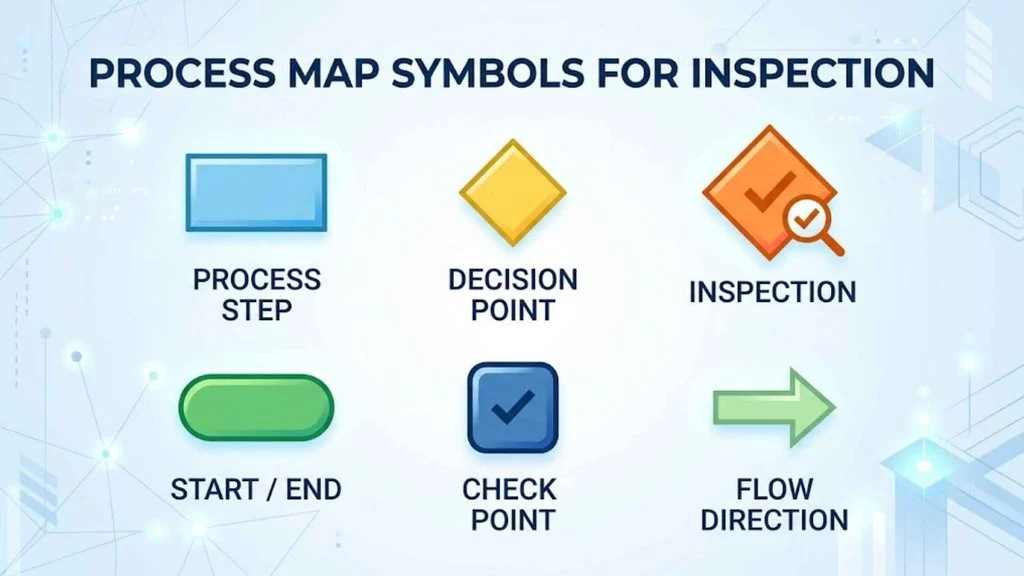
Inspection is an important part of many business, manufacturing, and quality control processes. An inspection step checks whether a product, document, service, or completed task meets the required standards.
The symbol used for inspection depends on the process mapping convention. Some traditional process charts use a circle to represent inspection, while ordinary flowcharts may show the inspection as a labeled rectangle. Therefore, it is important to identify the standard being followed instead of assuming that every process map uses the same inspection symbol.
For example, a manufacturing process may begin with assembling a product, followed by an inspection step. If the product passes the inspection, it moves to packaging. If it fails, it may return for correction or rework.
When creating a process map that includes inspection, label the activity clearly and use arrows to show what happens after the result. A decision diamond can be added when the process branches into different paths, such as “Pass” and “Fail.”
Process Map Symbols Example
A simple process map example can help explain how different symbols work together. Consider an online order process that begins when a customer submits an order.
- Start (Oval): The customer begins the order.
- Receive Order (Rectangle): The business records the order details.
- Enter Customer Information (Parallelogram): The required information enters the system.
- Payment Approved? (Diamond): The process checks whether the payment has been accepted.
- Prepare Order (Rectangle): If the payment is approved, the order is prepared.
- Resolve Payment Issue (Rectangle): If the payment is declined, the customer is asked to try another payment method.
- End (Oval): The workflow ends when the order process is completed or stopped.
Arrows connect the symbols and show the direction of the workflow. The decision diamond creates separate paths for approved and declined payments.
This example demonstrates how process map symbols turn a series of instructions into a visual guide. The same approach can be used for employee onboarding, customer support, manufacturing, document approval, and other business activities.
Business Process Map Symbols and Standard Guidelines
Business process map symbols help organizations explain how tasks move between employees, departments, customers, and computer systems. A well-designed process map makes responsibilities clearer and helps teams identify delays, repeated activities, and unnecessary steps.
Common symbols include the oval for a start or end point, the rectangle for an activity, the diamond for a decision, the parallelogram for input or output, and arrows for the direction of the workflow. Document symbols and connectors can be added when the process involves records or links between different parts of a diagram.
To create a clear and useful business process map, follow these guidelines:
- Use the same symbol consistently for the same type of activity.
- Label each task with a short, action-focused description.
- Mark decision branches clearly, such as “Yes” and “No.”
- Connect activities with arrows so the workflow is easy to follow.
- Avoid unnecessary crossing lines and confusing layouts.
- Use swimlanes when several people or departments share responsibility.
- Include a symbol key when specialized shapes or conventions are used.
There is no single diagram that fits every business process. Choose the mapping method that matches your purpose, and make sure everyone who reads the map understands the symbols and labels.
iple decision points, or connections between different stages
Interesting Facts About Process Map Symbols
- Lillian Gilbreth’s Legacy: Lillian Gilbreth, who co-created the first process symbols, was one of the first female industrial psychologists. She also invented the foot-pedal trash can and shelves on refrigerator doors!
- The ISO Standard: The official standard for flowchart symbols is ISO 5807. It defines the precise dimensions and functions for dozens of specialized shapes used globally.
- The Power of Yellow: In traditional office mapping sessions, decision diamonds are often written on yellow sticky notes to make them stand out, as yellow is the fastest color for the human eye to process.
- A Tool for Space Travel: NASA utilized highly detailed process maps to plan the exact, second-by-second procedures for the Apollo moon landings.
- The Origin of “Flowchart”: The term “flowchart” did not become popular until the 1940s, when computer pioneer John von Neumann used them to plan early computer programs.
Frequently Asked Questions
What is the most common process map symbol?
The rectangle, which represents a “Process Step” or action, is the most frequently used symbol. It represents any task, action, or activity that must be performed to move the process forward.
Why is a diamond used for decisions in a flowchart?
The diamond shape is used because it naturally has four points. This makes it visually easy to draw multiple exit arrows (such as “Yes” and “No”) departing in different directions without cluttering the map.
Can I create my own process map symbols?
While you can design custom shapes for personal use, it is best to stick to standardized ISO shapes for team projects. Using standard symbols ensures that anyone in your organization can easily understand your map without a learning curve.
What is the difference between a flowchart and a process map?
The two terms are often used interchangeably. However, a flowchart typically shows a simple, step-by-step sequence of a program or system, while a process map provides a broader business context, often showing who is responsible for each step, resources, and performance metrics.
Conclusion
Process map symbols are a beautiful testament to the human desire for order, clarity, and shared understanding. By transforming complex tasks into simple, universal shapes, they connect us to our ancient past while guiding us into a highly organized future. The next time you see a simple rectangle or decision diamond, remember that you are looking at a deeply human tool designed to conquer chaos, one step at a time.

Hi, I’m Asher Monroe, a writer who believes that meaningful words have the power to inspire change and bring people closer to their dreams. I have always been fascinated by the beauty of quotes and the way a simple message can provide motivation, hope, and comfort.
I enjoy creating content around inspirational quotes, life lessons, success stories, and positive thoughts that help readers find encouragement in their everyday lives. My goal is to share words that connect with people and remind them of their inner strength.
Through my writing, I explore the ideas of personal growth, confidence, and the importance of staying inspired through every chapter of life.
I am the author of Words That Move the Soul and The Path of Endless Inspiration, two books focused on the power of wisdom, positivity, and meaningful thoughts.
 Sienna Brooks
 Rowan Sinclair Rowan Sinclair