
Male and female symbols are among the most recognizable signs in science, medicine, public spaces, and everyday communication. You have probably seen the male symbol ♂ and female symbol ♀ on restroom doors, biology diagrams, medical documents, and educational materials. Although these signs look simple, their history reaches back through astronomy, Roman mythology, alchemy, and botanical science.
Today, gender symbols cover a much wider range of meanings. Some represent biological sex, while others communicate gender identity, sexual orientation, or gender diversity. You may also encounter symbols such as ⚥, ⚧, ⚢, ⚣, and ⚲ in scientific references and LGBTQ+ discussions.
Understanding these signs requires more than memorizing their shapes. Their meanings depend on their history, cultural setting, and intended use. A symbol used to classify a flower, for example, may have a different meaning when it appears in a discussion about human identity.
This guide explores the most familiar male and female symbols, their origins, and their modern applications. You’ll also learn about LGBTQ+ symbols, geometric signs, restroom pictograms, biological notation, genealogy, and Unicode characters.
What Are Gender Symbols?
A gender symbol is a visual sign used to represent sex, gender, or an identity associated with gender. These symbols help people communicate information quickly without relying on long descriptions.
The traditional examples are:
- ♂ Male symbol: Traditionally represents male sex or masculinity.
- ♀ Female symbol: Traditionally represents female sex or femininity.
- ⚥ Male and female symbol: Has historical associations with combined male and female characteristics, androgyny, and hermaphroditic flowers in botany.
- ⚧ Transgender symbol: Represents transgender identity in many contemporary contexts.
- ⚲ Neuter symbol: Represents neuter or neutral classification in certain systems.
You can find these signs in several fields:
- Biology: Classifying male and female organisms.
- Medicine: Identifying sex-related information in records and diagrams.
- Botany: Describing reproductive structures in plants.
- Genealogy: Showing individuals and relationships in family diagrams.
- Public signage: Identifying men’s, women’s, and gender-neutral facilities.
- LGBTQ+ communities: Representing different gender identities and sexual orientations.
- Digital communication: Using special characters in documents, websites, and messages.
Gender symbols, signs, pictograms, and glyphs
These terms often appear together, but they don’t mean exactly the same thing.
| Term | Meaning | Example |
| Symbol | A sign that represents an idea, category, or concept | ♂ and ♀ |
| Sign | A visual mark that communicates information | A restroom sign |
| Pictogram | A simplified picture used to communicate a message | A stick figure on a restroom door |
| Glyph | The visual form of a written character | The displayed shape of ♀ |
| Unicode character | A standardized digital character with a code point | U+2640 for ♀ |
The distinction matters because a gender glyph may have a standardized digital identity while its social meaning varies between communities.
For example, Unicode identifies ⚥ as the Male and Female Sign. Its annotations include intersex and androgynous associations, as well as hermaphroditic use in botany. That doesn’t mean every person or organization uses it in exactly the same way.
Male Symbol ♂: Meaning, Origin, and History
<figure> <pre>♂</pre> </figure>
The male symbol ♂ is traditionally used to represent males. Its design consists of a circle with a diagonal arrow extending toward the upper right.
You may recognize it from biology textbooks, scientific diagrams, medical illustrations, and public information signs. It is also commonly associated with Mars, the Roman god of war.
What does the male symbol mean?
The male sign traditionally identifies the male category in biological and scientific classification. It can also represent masculinity in cultural or symbolic contexts.
Common uses include:
- Identifying male organisms in biological diagrams.
- Showing male individuals in certain historical pedigree charts.
- Marking male flowers in botanical references.
- Representing men in educational graphics.
- Identifying men’s facilities in some public signage systems.
- Showing male-related categories in scientific data.
However, the symbol does not describe every aspect of a person’s identity. A sign used to indicate biological sex is not automatically a complete representation of someone’s gender identity.
Why does the male symbol have an arrow?
The male sign’s arrow is traditionally connected with the spear and shield associated with Mars.
In Roman mythology, Mars was the god of war. His name also became associated with the planet Mars and its astronomical symbol.
The male sign is visually identical to the traditional Mars symbol. Historical explanations connect this design with ancient planetary notation and later alchemical traditions.
The symbol also became associated with iron. Alchemists used planetary signs to represent metals, and Mars was linked with iron.
This explains the familiar combination of ideas:
- Mars: Roman god of war and the planet.
- Iron: Metal associated with Mars in alchemy.
- Masculinity: A traditional symbolic association with Mars.
- ♂: The familiar male sign.
Mars symbol and planetary symbolism
The relationship between Mars and the male symbol is older than modern gender classification.
Ancient astronomical traditions connected planets with gods, metals, and natural processes. Over time, these associations influenced the signs used in astrology, alchemy, chemistry, and medicine.
The British Medical Journal’s historical review of sex symbols explains how the symbols traveled through astronomy, astrology, alchemy, chemistry, pharmacy, and botany before becoming common in human biology and genetics.
Today, ♂ remains one of the most recognizable traditional gender symbols.
Female Symbol ♀: Meaning, Origin, and History

<figure> <pre>♀</pre> </figure>
The female symbol ♀ traditionally represents females. It consists of a circle with a small cross extending downward from its lower edge.
Like the male sign, the female symbol has a historical connection to planetary symbolism. It is associated with Venus, the Roman goddess of love and beauty.
What does the female symbol mean?
The female sign traditionally identifies the female category in biological and scientific classification.
You may encounter it in:
- Biology and reproductive science.
- Botanical descriptions of female flowers.
- Medical and educational diagrams.
- Historical family and pedigree charts.
- Gender-related illustrations.
- Women’s restroom pictograms and signage.
The symbol can also represent femininity in cultural contexts. However, femininity is not limited to people classified as female, and the symbol does not represent every woman’s personal experience.
Why does the female symbol have a cross?
The circle and cross are associated with the traditional sign of Venus.
In Roman mythology, Venus was the goddess of love and beauty. The planetary symbol for Venus later became associated with copper in alchemical traditions.
The small cross beneath the circle is part of the historical graphic design. It should not be interpreted as a religious cross in this context.
The familiar associations include:
- Venus: Roman goddess and planet.
- Copper: Metal traditionally associated with Venus in alchemy.
- Femininity: A historical symbolic association.
- ♀: The familiar female sign.
Venus symbol and planetary symbolism
Venus and Mars became important in the history of sex symbols because their planetary signs were already used in several areas of scholarship.
The signs eventually entered botanical classification and later appeared in zoology, human biology, and genetics.
The female sign is still used in modern scientific communication. It is also a familiar visual element in public information and digital content.
Male and Female Symbol ⚥: Meaning and Uses
<figure> <pre>⚥</pre> </figure>
The male and female symbol ⚥ is known in Unicode as the Male and Female Sign. Its design combines elements of the traditional male and female signs.
Its meaning depends on the context. Unicode annotations associate it with intersex and androgynous meanings, as well as hermaphroditic flowers in botanical classification.
What does the combined male and female symbol mean?
The symbol has several documented associations:
- Androgyny: A combination or presence of traditionally masculine and feminine characteristics.
- Intersex representation: A symbol associated with intersex in Unicode annotations and some other contexts.
- Botanical classification: A sign used for flowers with both male and female reproductive structures.
- Combined sex representation: A visual combination of traditional male and female signs.
These meanings are related historically, but they aren’t interchangeable.
For example, a flower with both reproductive structures is a botanical subject. An intersex person is a human being with sex characteristics that do not fit typical definitions of male or female bodies.
The word hermaphroditic is still used in some biological contexts, particularly when describing plants and certain animal species. It should not be casually applied to intersex people.
⚥ in biology and botany
In botanical classification, ⚥ can describe a perfect flower. A perfect flower contains both male and female reproductive structures.
These structures include:
- Stamens: The flower’s male reproductive organs, which produce pollen.
- Pistil: The female reproductive structure, which includes the stigma, style, and ovary.
A flower containing both structures can be described as bisexual or hermaphroditic in botanical terminology.
This is different from flowers that have only male or only female reproductive structures.
Is ⚥ the universal intersex symbol?
No. Although Unicode associates ⚥ with intersex, it isn’t the only symbol used by intersex people and organizations.
The intersex flag is a particularly important example. It features a purple circle on a golden yellow background. Its designer, Morgan Carpenter, created it in 2013 for Intersex Human Rights Australia.
The design intentionally avoids traditional male and female imagery. The unbroken circle represents wholeness and completeness.
You can learn more about its history through Intersex Human Rights Australia and the Museum of New Zealand Te Papa Tongarewa.
History and Origins of Male and Female Symbols
The male and female signs didn’t begin as modern gender labels. Their development involved astronomy, mythology, alchemy, botany, and medical science.
Understanding this history explains why the symbols look the way they do and how they entered scientific communication.
Ancient planetary symbols and Roman mythology
The traditional signs for male and female are connected with the planets Mars and Venus.
Roman mythology gave these planets familiar divine associations:
- Mars was the god of war.
- Venus was the goddess of love and beauty.
- Mercury was associated with communication, travel, and commerce.
Ancient astronomers and later scholars used planetary symbols to record celestial bodies. Alchemical traditions also connected these symbols with metals.
Mars became associated with iron, while Venus became associated with copper. These associations helped establish the signs that later appeared in scientific classification.
The male and female symbols therefore have a history that extends beyond their modern use.
How the symbols entered botanical science
The 18th-century botanist Carl Linnaeus played an important role in spreading the use of traditional planetary and alchemical signs in botany.
Linnaeus used symbols as a practical form of shorthand. They helped scientists record information about plant reproductive structures without repeatedly writing long descriptions.
His botanical works included Mantissa Plantarum and Mantissa Plantarum Altera.
The symbols helped distinguish:
- Male flowers.
- Female flowers.
- Flowers containing both reproductive structures.
Linnaeus did not invent the planetary symbols. Rather, he helped establish their use in botanical classification.
The BMJ historical article explains that Linnaeus adopted these signs from earlier scientific and pharmaceutical traditions.
From botany to human biology and genetics
After their use in botany, the male and female signs spread into other scientific fields.
They appeared in zoology, human biology, medicine, and genetic records. Researchers used them to identify individuals and biological categories in scientific diagrams.
The symbols also appeared in historical pedigree charts. These charts helped scientists trace inherited characteristics through families.
By the 20th century, the signs were familiar in medical and genetic literature. However, modern pedigree charts generally use squares and circles to represent individuals.
This change shows how scientific notation evolves as researchers develop clearer and more standardized ways to communicate information.
Different Types of Gender Symbols and Their Meanings
There are several different types of gender symbols. Some are traditional biological signs, while others represent gender identity or sexual orientation.
The following table summarizes common characters and their documented associations.
| Symbol | Unicode name | Common or documented association |
| ♂ | Male Sign | Male |
| ♀ | Female Sign | Female |
| ⚥ | Male and Female Sign | Intersex, androgynous, botanical hermaphroditism |
| ⚦ | Male with Stroke Sign | Transgender |
| ⚧ | Male with Stroke and Male and Female Sign | Transgender |
| ⚢ | Doubled Female Sign | Female homosexuality |
| ⚣ | Doubled Male Sign | Male homosexuality |
| ⚤ | Interlocked Female and Male Sign | Heterosexuality |
| ⚲ | Neuter | Neuter classification |
| ☿ | Mercury | Planetary and alchemical symbol; intersexuality annotation in Unicode |
These are Unicode annotations and historical associations, not rules that every community must follow. The official Unicode character chart provides the character names and annotations.
LGBTQ+ Symbols and Gender Identity Symbols
Modern LGBTQ+ symbols help represent identities, experiences, and communities that traditional male and female signs cannot fully describe.
Some symbols are individual Unicode characters. Others are flags, colors, or community-created designs.
It’s important to distinguish gender identity from sexual orientation. Gender identity describes a person’s sense of their own gender. Sexual orientation describes patterns of romantic, emotional, or sexual attraction.
Transgender symbol ⚧
<figure> <pre>⚧</pre> </figure>
The transgender symbol is widely used to represent transgender identity and gender diversity.
Unicode names ⚧ the Male with Stroke and Male and Female Sign. Its design combines traditional gender-symbol elements with an additional stroke.
The character ⚦, called the Male with Stroke Sign, is also annotated as transgender in Unicode.
The transgender symbol appears in:
- LGBTQ+ educational materials.
- Community organizations.
- Gender-inclusive information.
- Awareness campaigns.
- Some public signage and digital graphics.
The transgender flag is another widely recognized form of transgender representation. Designed by Monica Helms in 1999, it uses light blue, pink, and white stripes.
The flag and the Unicode character are different visual designs. Both can communicate transgender-related meanings, but they are not interchangeable in every situation.
Intersex symbol
Intersex refers to people born with sex characteristics that do not fit typical medical definitions of male or female bodies.
These characteristics may involve chromosomes, hormones, reproductive anatomy, or other physical traits.
The intersex flag is a widely recognized form of intersex identity representation.
<figure> <pre>🟡 🟣</pre> <figcaption>Conceptual color reference: golden yellow and purple. The official flag uses a purple circle on a golden yellow field.</figcaption> </figure>
The flag was designed by Morgan Carpenter in 2013. Its main features are:
- A golden yellow background.
- A purple circle in the center.
- An unbroken, unornamented circular design.
The circle represents wholeness and completeness. The design avoids relying on traditional male and female symbols.
This choice is meaningful because intersex people have often been represented through inaccurate or outdated imagery. The flag offers a distinct symbol created with intersex representation in mind.
Non-binary symbols
Nonbinary describes gender identities that do not fit exclusively within the categories of man or woman.
Some nonbinary people identify with elements of more than one gender. Others describe their gender as outside the traditional binary altogether.
There isn’t one universally accepted Unicode character for nonbinary identity.
The nonbinary flag, created by Kye Rowan in 2014, is a widely recognized form of representation. It contains four horizontal stripes:
- Yellow represents genders outside the traditional binary.
- White represents people with many or all genders.
- Purple represents a mixture of male and female genders.
- Black represents people who identify as having no gender.
Nonbinary symbols and flags can differ between individuals and communities. It’s better to use the design a person or organization identifies with rather than assume one symbol represents everyone.
Androgyne and androgynous symbols
Androgyny refers to a combination of traditionally masculine and feminine characteristics.
The term can describe appearance, expression, or identity, depending on how someone uses it.
Androgyny is not the same as being transgender or intersex. A person may have an androgynous appearance without identifying as nonbinary or transgender.
The combined symbol ⚥ has an androgynous association in Unicode, but it isn’t the only design used to communicate androgyny.
Agender and genderless symbols
Agender describes a person who identifies as having no gender or does not experience gender in the usual way.
Some people use neutral circles, colors, or specially designed symbols to express agender identity.
The agender flag is another common form of representation. It contains black, gray, white, and green stripes.
These colors are commonly explained as representing the absence of gender, partial genderlessness, and nonbinary identity.
A plain white circle, however, should not automatically be interpreted as an agender symbol. Its meaning depends on the context and the system using it.
Neutrois and neuter symbol ⚲
<figure> <pre>⚲</pre> </figure>
The character ⚲ is called the Neuter sign in Unicode.
In classification systems, neuter generally refers to something that is neither male nor female. The word appears in biology and grammar, although its meaning changes between fields.
Neutrois is a nonbinary gender identity that some people describe as neutral, genderless, or neither male nor female.
The neuter sign may appear in discussions of neutral gender, but it isn’t a universal symbol for every neutrois person.
Sexual Orientation Symbols
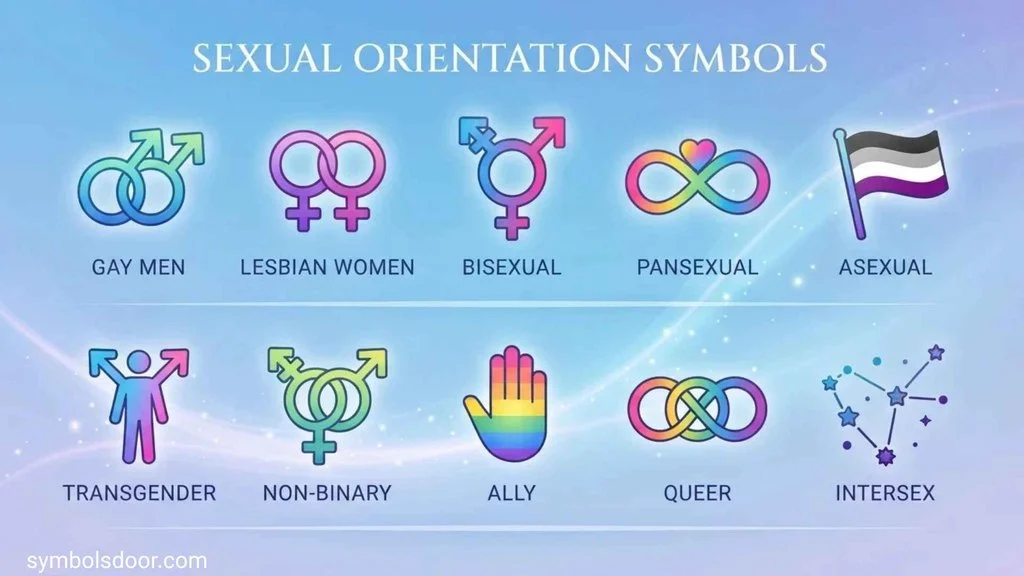
Sexual orientation symbols represent patterns of attraction. They should not be confused with signs that describe biological sex or gender identity.
Some Unicode characters have specific historical annotations related to sexual orientation.
Gay male symbol ⚣
<figure> <pre>⚣</pre> </figure>
The doubled male sign ⚣ is associated with male homosexuality in Unicode.
Its design combines two male-symbol elements. It has appeared in historical and specialized representations of gay male identity.
Today, many people and organizations use other forms of LGBTQ+ imagery, including rainbow flags and community-specific designs.
Lesbian symbol ⚢
<figure> <pre>⚢</pre> </figure>
The doubled female sign ⚢ is associated with female homosexuality in Unicode.
It combines two female-symbol elements and has been used to represent lesbian identity.
Lesbian communities also use flags and other visual designs. These include several versions of the lesbian pride flag, which have changed over time.
Heterosexuality symbol ⚤
<figure> <pre>⚤</pre> </figure>
The interlocked female and male sign ⚤ is annotated as heterosexuality in Unicode.
It combines traditional female and male symbols. Its meaning is connected with heterosexual attraction or relationships.
However, it isn’t a universal symbol used in every discussion of heterosexuality.
Bisexuality symbol
Bisexuality generally refers to attraction to more than one gender.
The most familiar bisexual symbol is often the overlapping pink, purple, and blue design. These colors also appear in the bisexual pride flag.
The colors are commonly interpreted as follows:
- Pink represents attraction to the same gender.
- Blue represents attraction to a different gender.
- Purple represents the overlap or combination of attractions.
The character ⚤ should not be presented as the standard bisexuality symbol. Unicode annotates it as heterosexuality.
Asexuality symbol
Asexuality describes a sexual orientation in which a person experiences little or no sexual attraction.
Asexual people can have different experiences of romantic attraction, relationships, and identity.
The asexual pride flag uses four horizontal stripes:
- Black represents asexuality.
- Gray represents the gray-asexual spectrum.
- White represents sexuality and allies in commonly used explanations.
- Purple represents community.
Asexuality is a sexual orientation, not a gender identity. An asexual person can be a man, woman, nonbinary, or another gender.
Geometric Gender Symbols: Circles, Triangles, and Squares
Geometric shapes sometimes appear in gender-related diagrams and symbolic systems. However, a shape doesn’t automatically have a universal gender meaning.
Its interpretation depends on the historical convention or visual system in which it appears.
White up-pointing triangle △
The white up-pointing triangle is a Unicode geometric character.
It appears in mathematics, diagrams, graphic design, and other visual systems. Some specialized systems may assign it a gender-related meaning.
However, △ is not a universally accepted male symbol.
White down-pointing triangle ▽
The white down-pointing triangle is another geometric character.
It can appear in diagrams and symbolic designs. Some historical or specialized systems may use inverted triangles to represent gender categories.
Its meaning must be established by the source using it. You shouldn’t automatically interpret ▽ as a universal female symbol.
White square □
The white square has a well-established role in conventional pedigree charts.
In these charts, a square generally represents a male individual. Geneticists use squares and circles to show family members and inherited traits.
White circle ○
The white circle generally represents a female individual in conventional pedigree charts.
Together, squares and circles help researchers display family relationships across multiple generations.
Why are triangles and circles used for gender?
Shapes make diagrams easier to read. A square and a circle are visually distinct, so readers can quickly identify different categories.
The use of these shapes depends on the diagram’s conventions. In a pedigree chart, a square and circle have specific meanings. In another graphic, they may simply be decorative shapes.
This is why geometric gender symbols should always be interpreted within their original context.
Male and Female Symbols in Biology and Medicine
The male and female signs remain useful in scientific communication because they provide compact visual labels.
However, modern biology and medicine require more detailed descriptions than two symbols can provide.
Biological sex symbols
Biological sex refers to a collection of physical and developmental characteristics involved in reproduction.
These characteristics can include:
- Chromosomes.
- Gonads.
- Hormones.
- Internal reproductive structures.
- External reproductive anatomy.
- Secondary sex characteristics.
The symbols ♂ and ♀ are commonly used to identify male and female categories in biological diagrams.
However, not every species has the same reproductive system. Some organisms have more complex sex-determination systems, and some species can change sex during their life cycle.
The signs are useful shorthand, but they don’t explain every biological detail.
Gender symbols in human biology and medicine
In medical and scientific materials, male and female symbols may appear in diagrams, records, or research documents.
They can help identify categories in a compact format.
However, medical records should use clear, relevant information rather than relying on a symbol alone. A patient’s anatomy, medical history, hormone levels, and other details may matter more than a general label.
Biological sex identification should also be distinguished from gender identity. A person’s sex-related characteristics do not automatically tell you how they identify.
Intersex and variations in sex characteristics
Intersex is an umbrella term for variations in sex characteristics that do not fit typical definitions of male or female bodies.
These variations can involve chromosomes, hormones, reproductive anatomy, or other physical traits.
Intersex is not the same as being transgender. Transgender describes a gender identity that differs from the sex assigned at birth. Intersex describes variations in sex characteristics.
Some people are both intersex and transgender, but the terms describe different things.
Gender symbols in botany
Botanical science uses male and female signs to describe reproductive structures in plants.
Flowers may be classified according to the reproductive organs they contain.
| Botanical type | Reproductive structures | Description |
| Male flower | Stamens | Produces pollen |
| Female flower | Pistil or carpels | Contains the ovary and receives pollen |
| Perfect flower | Stamens and pistil | Contains both male and female reproductive structures |
| Unisexual flower | One reproductive sex type | Has either male or female reproductive structures |
A perfect flower contains both stamens and pistils. This is why the combined sign ⚥ has a historical botanical association.
Some plants produce separate male and female flowers on the same plant. Others produce male and female flowers on different plants.
Conifers also have reproductive structures that differ from those of flowering plants. They produce pollen cones and seed cones rather than typical flowers.
These differences show why botanical symbols must be understood through plant anatomy, not simply human gender terminology.
Gender symbols in zoology
Biologists also use male and female signs when describing animals.
They may appear in:
- Animal breeding records.
- Reproductive biology.
- Species classification.
- Scientific illustrations.
- Research data.
- Animal husbandry documents.
Some animals have separate male and female individuals. Others are hermaphroditic or have more complex reproductive systems.
A single symbol cannot describe every reproductive pattern across the animal kingdom.
Gender Symbols in Genealogy and Anthropology
Gender-related notation also appears in family diagrams and anthropological research.
These systems help researchers record relationships, offspring, and family structures.
Gender symbols in pedigree charts
A pedigree chart is a diagram used to show relationships across generations. Geneticists often use it to trace inherited conditions and traits.
The most familiar conventions are:
- Square □ for a male individual.
- Circle ○ for a female individual.
- Horizontal line for a partnership or mating relationship.
- Vertical line for offspring.
- Shaded shapes for individuals with a particular trait or condition.
Pedigree charts may include additional marks for deceased individuals, carriers, twins, or other information.
The square-and-circle system became more common in modern genetics than the older use of Mars and Venus symbols.
Gender symbols in family trees
A family tree displays relationships between parents, children, siblings, and other relatives.
Traditional family trees often use male and female labels or symbols to identify individuals. These conventions can make large family diagrams easier to understand.
However, a family tree is not the same as a pedigree chart. A pedigree chart usually follows specific scientific conventions, while a family tree can be designed for general genealogical use.
Kinship symbols in anthropology
Anthropologists study kinship to understand family relationships, social organization, marriage, descent, and cultural practices.
Kinship charts can include terms and symbols for:
- Mother and father.
- Brother and sister.
- Son and daughter.
- Grandparents.
- Cousins.
- Marriage and partnership.
- Family lineage.
Researchers such as W. H. R. Rivers and Lewis Henry Morgan are associated with the development of kinship studies and anthropological methods.
Margaret Mead also contributed to anthropology through research on culture, social life, and gender roles.
These historical figures are relevant to the broader study of gender and family relationships. However, their work should not be confused with the invention of the modern male and female symbols.
Male and Female Restroom Symbols and Public Signs
Restroom signs are among the most familiar examples of gender pictograms.
You may see a standing figure, a figure wearing a skirt, or a simple written label. These designs help visitors identify facilities in public buildings.
Men’s restroom symbol 🚹
<figure> <pre>🚹</pre> </figure>
The men’s restroom symbol identifies a men’s public restroom.
Its Unicode character is called Men’s Room. The symbol commonly appears as a standing human figure.
You may find it in:
- Airports.
- Shopping centers.
- Schools.
- Restaurants.
- Offices.
- Public transportation facilities.
The restroom pictogram is different from the traditional male sign ♂. Both can identify a men’s category, but they belong to different visual systems.
Women’s restroom symbol 🚺
<figure> <pre>🚺</pre> </figure>
The women’s restroom symbol identifies a women’s restroom.
Its Unicode character is called Women’s Room. Many familiar designs use a human figure with a skirt or dress.
Clothing-based designs are easy to recognize in some settings, but they can also rely on traditional assumptions about how men and women dress.
Modern signage may use simplified figures, text, or other visual distinctions instead.
Unisex restroom symbol 🚻
<figure> <pre>🚻</pre> </figure>
The restroom symbol 🚻 is commonly used to identify a restroom facility.
It can appear on signs for general or shared restroom facilities. However, the exact meaning depends on the building and its signage system.
A gender-neutral restroom may also use text such as:
- All-gender restroom.
- Gender-inclusive restroom.
- Unisex restroom.
- Single-user restroom.
These labels can make the facility’s intended use clearer than a pictogram alone.
Accessible restroom symbols
An accessible restroom is designed to accommodate people with disabilities.
The familiar wheelchair symbol identifies accessibility, not gender. A facility can be accessible and gender-neutral, but these terms describe different features.
For example:
- An accessible men’s restroom is designed for men and includes accessibility features.
- An accessible women’s restroom is designed for women and includes accessibility features.
- An accessible all-gender restroom is intended for users of all genders and includes accessibility features.
Good signage should communicate both the facility’s accessibility and its intended use.
History of modern restroom pictograms
Modern public signage developed through transportation systems, public buildings, and graphic-design projects.
British Rail became known for its use of clear public information signs. Designers Margaret Calvert and Jock Kinneir helped shape the visual language of British road and transport signage.
Their work showed how simple pictograms, consistent typography, and clear layouts could help people navigate unfamiliar places.
In the United States, the American Institute of Graphic Arts (AIGA) worked with the Department of Transportation on a system of public information symbols.
These projects helped establish a wider approach to visual communication and universal design.
However, no single designer or organization invented every modern men’s and women’s restroom sign. Public signage evolved through many design systems and local standards.
Gender Symbols Around the World
Gender symbols around the world can look different because countries use different languages, clothing conventions, and design traditions.
Restroom signs are a useful example. Some rely on written words, while others use human figures, geometric shapes, or local characters.
Gender symbols in the United States
American public facilities commonly use standing human figures, clothing-based pictograms, and written labels.
You may see 🚹 and 🚺 style signs, accessible restroom symbols, and all-gender labels.
The exact design depends on local regulations, building policies, and the organization responsible for the facility.
Gender symbols in the United Kingdom
The United Kingdom has a long history of public information design.
British Rail and the work of Margaret Calvert and Jock Kinneir helped shape the country’s recognizable transport signage.
Public restrooms may use traditional male and female figures, text, or more inclusive designs.
Gender symbols in China and Japan
In China, the characters 男 and 女 are commonly used to identify men’s and women’s facilities.
- 男 means male or man.
- 女 means female or woman.
Japan also uses written characters and pictograms on public restroom signs. The exact wording and graphic design can vary by location.
These signs show how written language can work alongside visual symbols.
Gender symbols in Europe
European countries use a mixture of pictograms and written labels.
Common designs include:
- Standing human figures.
- Skirt and dress figures.
- Male and female signs.
- Written restroom labels.
- Accessible facility symbols.
- All-gender restroom signs.
There is no single visual design used by every European country. Local standards and building policies influence signage.
Gender symbols in India
India’s public signage often uses conventional men’s and women’s restroom signs.
The country also has a recognized cultural category known as hijra, which is associated with a long and diverse history of gender diversity in South Asia.
Hijra identity should not be reduced to a restroom pictogram. Cultural identity, legal recognition, and personal gender identity are broader subjects than a single public sign can communicate.
Some facilities use more inclusive restroom labels, but designs and policies vary.
Why do restroom symbols differ between countries?
Different designs develop for practical and cultural reasons.
These include:
- Language and literacy.
- Local clothing conventions.
- Cultural expectations.
- Graphic-design standards.
- Accessibility requirements.
- Building regulations.
- Public attitudes toward gender and inclusion.
A pictogram that seems obvious in one country may be unfamiliar in another. Clear text can help prevent confusion.
Unicode Gender Symbols and Their Character Codes
Unicode is the international standard that assigns code points to characters used in digital text.
It allows computers, phones, and other devices to exchange text using a shared character system.
The Unicode gender characters include traditional male and female signs, combined signs, transgender-related signs, and other symbols.
Male and female Unicode characters
| Symbol | Official Unicode name | Code point |
| ♂ | Male Sign | U+2642 |
| ♀ | Female Sign | U+2640 |
| ⚥ | Male and Female Sign | U+26A5 |
| ⚦ | Male with Stroke Sign | U+26A6 |
| ⚧ | Male with Stroke and Male and Female Sign | U+26A7 |
| ⚢ | Doubled Female Sign | U+26A2 |
| ⚣ | Doubled Male Sign | U+26A3 |
| ⚤ | Interlocked Female and Male Sign | U+26A4 |
| ⚲ | Neuter | U+26B2 |
| ☿ | Mercury | U+263F |
These code points identify the characters digitally. They don’t guarantee that every font or device will display them in exactly the same style.
Restroom Unicode symbols
| Symbol | Unicode name | Code point |
| 🚹 | Men’s Room | U+1F6B9 |
| 🚺 | Women’s Room | U+1F6BA |
| 🚻 | Restroom | U+1F6BB |
| 🚼 | Baby Symbol | U+1F6BC |
These characters are part of Unicode’s collection of symbols used in digital communication.
How to copy and paste male and female symbols
You can copy these characters directly:
<figure> <pre>Male: ♂ Female: ♀ Male and female: ⚥ Transgender: ⚧ Neuter: ⚲</pre> </figure>
To use them in a document or message:
- Select the symbol you need.
- Copy it using your device’s copy command.
- Open the document, message, or website editor.
- Paste the character where you want it to appear.
You can also use your operating system’s character or symbol viewer.
HTML codes for male and female symbols
If you’re adding these characters to a website, HTML character references can be useful.
| Symbol | HTML decimal reference | Unicode |
| ♂ | ♂ | U+2642 |
| ♀ | ♀ | U+2640 |
| ⚥ | ⚥ | U+26A5 |
| ⚧ | ⚧ | U+26A7 |
| ⚲ | ⚲ | U+26B2 |
You can use these references in HTML markup to display the corresponding characters.
Why do gender symbols look different on devices?
A Unicode code point identifies a character, but its appearance depends on the font and rendering system.
For example, the same character may look slightly different on:
- Windows computers.
- Apple devices.
- Android phones.
- Web browsers.
- Word-processing software.
- Graphic-design applications.
Some fonts may not support every character. In that case, your device may show an empty box or replacement symbol.
If a character doesn’t display correctly, try a font with broader Unicode support.
For accurate character names and code points, consult the Unicode Standard’s Miscellaneous Symbols chart.
Difference Between Sex Symbols and Gender Symbols
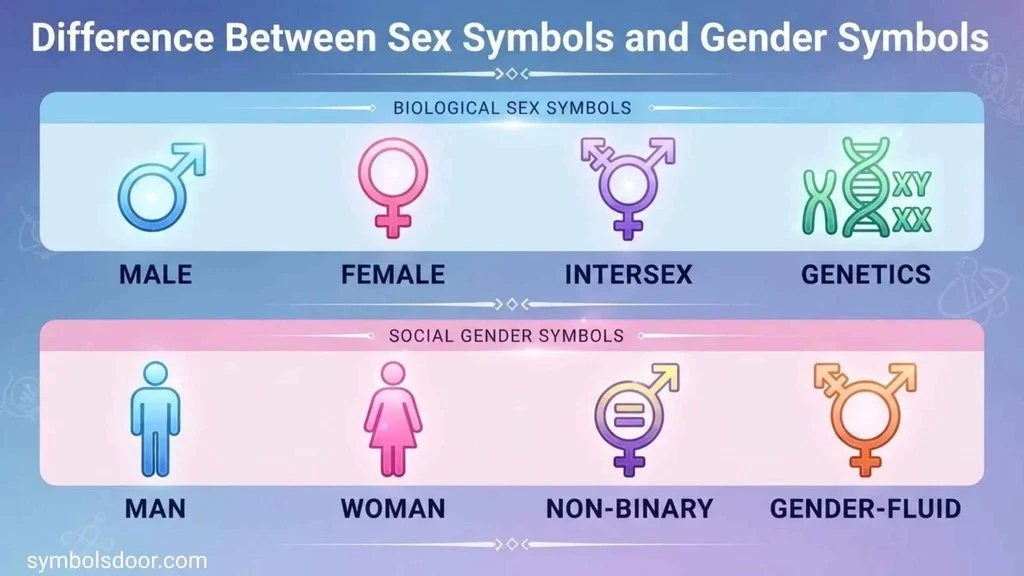
The terms sex symbols and gender symbols are sometimes used interchangeably, but they can describe different things.
Biological sex refers to physical characteristics associated with reproduction and development. Gender identity describes how a person understands and identifies their own gender.
Here’s a simple comparison:
| Concept | Meaning | Example |
| Biological sex | Physical sex characteristics | Reproductive anatomy and chromosomes |
| Gender identity | A person’s internal sense of gender | Man, woman, nonbinary, agender |
| Gender expression | How someone presents or expresses gender | Clothing, hairstyle, behavior |
| Sexual orientation | Patterns of romantic, emotional, or sexual attraction | Gay, lesbian, bisexual, heterosexual, asexual |
Traditional symbols such as ♂ and ♀ have historically been used to identify male and female biological categories.
Modern gender identity symbols can communicate a wider range of identities. Transgender, nonbinary, and agender representations are examples.
Sexual orientation symbols communicate something different again. For example, ⚣ and ⚢ are associated with same-sex attraction in Unicode annotations.
Understanding these differences helps prevent confusion when reading scientific, medical, cultural, or community materials.
Traditional Gender Symbols vs. Modern Gender Symbols
Traditional and modern symbols serve overlapping but different purposes.
Traditional signs developed through astronomy, alchemy, and scientific classification. Modern representations often reflect a broader understanding of gender identity and sexual orientation.
| Traditional symbols | Modern or identity-related representations |
| ♂ Male | ⚧ Transgender |
| ♀ Female | Nonbinary flag |
| ⚥ Male and Female | Intersex flag |
| ☿ Mercury | Agender flag |
| □ and ○ in pedigree charts | Gender-inclusive pictograms |
| 🚹 and 🚺 restroom signs | All-gender restroom signs |
Traditional symbols remain useful in biology, medicine, and public communication. Modern symbols add ways to represent identities that the traditional male-female system does not fully describe.
Neither group needs to replace every use of the other. The important point is to choose a symbol that accurately communicates the intended information.
Common Misunderstandings About Male and Female Symbols
Some gender-related symbols have several meanings or are used differently across fields. These common misunderstandings can lead to inaccurate descriptions.
Assuming ♂ and ♀ represent every gender
The male and female signs are traditional symbols. They don’t represent every gender identity.
Modern gender representation includes transgender, nonbinary, agender, and other identities.
Treating biological sex and gender identity as the same thing
Biological sex and gender identity are different concepts.
A medical diagram may use sex-related categories, while an LGBTQ+ resource may use symbols to represent personal identity.
The context determines what the symbol is communicating.
Assuming ⚥ always means intersex
Unicode associates ⚥ with intersex, androgynous, and botanical hermaphroditism.
However, it isn’t the universal symbol used by every intersex organization or individual. The yellow-and-purple intersex flag is a distinct and widely recognized design.
Calling Mercury the universal intersex symbol
The Mercury sign ☿ has historical planetary and alchemical meanings. Unicode also includes an intersexuality annotation.
However, the sign is not the standard universal intersex flag or the only way to represent intersex identity.
Assuming every triangle or circle has a gender meaning
Geometric shapes can have many meanings.
A square and circle have established uses in conventional pedigree charts, but an isolated triangle or circle does not automatically represent a particular gender.
Confusing sexual orientation with gender identity
A gay man, lesbian, bisexual person, or asexual person can have different gender identities.
Sexual orientation and gender identity describe separate aspects of a person.
Assuming every restroom sign is universal
Restroom pictograms vary by country, building, and design standard.
A standing figure, a skirt figure, or a written label may communicate the same basic purpose in different places.
Frequently Asked Questions About Male and Female Symbols
What is a gender symbol?
A gender symbol is a visual sign used to represent sex, gender identity, or a related concept. Examples include ♂, ♀, ⚥, and ⚧. Some symbols have historical scientific uses, while others represent modern gender diversity.
What do gender symbols mean?
Gender symbols communicate different categories and identities. The male symbol ♂ traditionally represents male sex, while the female symbol ♀ represents female sex. Other signs may represent transgender identity, intersex associations, sexual orientation, or neutral classification.
What is the male gender symbol?
The male gender symbol is ♂. It is called the Male Sign in Unicode and is associated with Mars in Roman mythology and traditional planetary symbolism.
What is the female gender symbol?
The female gender symbol is ♀. It is called the Female Sign in Unicode and is associated with Venus, the Roman goddess of love and beauty.
What is the symbol for male and female?
The combined male and female sign is ⚥. It has documented associations with intersex, androgyny, and hermaphroditic flowers in botany.
What is the origin of male and female symbols?
The male and female symbols developed from older planetary signs associated with Mars and Venus. They later entered alchemy, chemistry, pharmacy, and botanical science before becoming common in biology and genetics.
Why are Mars and Venus used as gender symbols?
Mars and Venus were associated with male and female categories through historical mythology and planetary symbolism. Mars was linked with iron and masculinity, while Venus was linked with copper and femininity in alchemical traditions.
What does the combined male and female symbol mean?
The symbol ⚥ combines elements of the traditional male and female signs. Unicode annotations associate it with intersex, androgyny, and hermaphroditic flowers in botanical contexts.
What is the transgender symbol?
The character ⚧ is called the Male with Stroke and Male and Female Sign in Unicode. It is associated with transgender representation. The character ⚦, or Male with Stroke Sign, also has a transgender annotation.
What is the symbol for nonbinary gender?
There is no single universally accepted Unicode symbol for nonbinary gender. The nonbinary pride flag is a widely recognized form of representation, and some people use community-specific symbols.
What is the symbol for intersex?
The character ⚥ has an intersex association in Unicode. However, the widely recognized intersex flag features a purple circle on a golden yellow background. Morgan Carpenter designed it in 2013.
What does the neuter gender symbol mean?
The neuter symbol is ⚲. It is used for neuter classification in certain systems and may appear in discussions of neutral gender. It is not a universal symbol for every nonbinary or neutrois identity.
What are the symbols for LGBTQ identities?
LGBTQ+ representation includes many symbols and flags. Examples include ⚧ for transgender representation, ⚢ for female homosexuality, ⚣ for male homosexuality, and the rainbow, bisexual, nonbinary, and intersex flags.
What do two interlocking male symbols represent?
The doubled male sign ⚣ is associated with male homosexuality in Unicode. It has been used as a symbol for gay male identity.
What do two interlocking female symbols represent?
The doubled female sign ⚢ is associated with female homosexuality in Unicode. It has been used to represent lesbian identity.
What is the symbol for bisexuality?
Bisexuality is commonly represented by the overlapping pink, purple, and blue design used in bisexual symbolism and the bisexual pride flag. The character ⚤ is annotated as heterosexuality in Unicode, not bisexuality.
What is the symbol for heterosexuality?
The interlocked female and male sign ⚤ is annotated as heterosexuality in Unicode. It combines the traditional male and female signs.
What is the difference between sex symbols and gender symbols?
Sex symbols traditionally identify biological sex categories, such as male and female. Gender symbols can represent gender identity and related concepts, including transgender, nonbinary, and gender-neutral identities.
What are gender-neutral symbols?
Gender-neutral symbols are signs designed to represent people or facilities without limiting them to male or female categories. Examples include some neutral restroom pictograms and community-specific gender identity symbols.
How are gender symbols used in biology?
Biologists use male and female symbols to classify organisms and describe reproductive structures. In botany, symbols can identify male flowers, female flowers, and flowers containing both reproductive structures.
What do gender symbols mean in genealogy?
In conventional pedigree charts, a square usually represents a male individual and a circle represents a female individual. Lines connect family members and show relationships across generations.
Why are triangles and circles used for gender?
Geometric shapes help make diagrams easy to understand. Squares and circles have established meanings in pedigree charts, but triangles and other shapes may have different meanings depending on the system using them.
What do male and female restroom symbols mean?
The men’s restroom symbol 🚹 identifies a men’s facility, while the women’s restroom symbol 🚺 identifies a women’s facility. The restroom symbol 🚻 is commonly used for a restroom facility, although its exact meaning depends on the signage context.
When were modern restroom symbols introduced?
Modern public pictograms developed through transportation, government, and graphic-design projects over time. British Rail and designers Margaret Calvert and Jock Kinneir helped shape modern British public signage. The AIGA and U.S. Department of Transportation also contributed to American public information symbol systems.
How are gender symbols used around the world?
Countries use a mixture of written labels, traditional symbols, and pictograms. For example, Chinese restroom signs commonly use 男 and 女, while other countries may use standing figures, clothing-based designs, or inclusive labels.
What are the Unicode codes for male and female symbols?
The male symbol ♂ uses U+2642. The female symbol ♀ uses U+2640. The combined male and female sign ⚥ uses U+26A5.
What is the history of gender pictograms?
Gender pictograms developed as part of broader public information and graphic-design systems. They became common on restroom doors, transportation facilities, and public buildings because simple images can communicate information quickly.
How have gender symbols changed over time?
Traditional male and female symbols developed from planetary and scientific notation. Over time, their uses expanded into medicine, biology, public signage, and digital communication. Modern identity symbols and flags now provide additional ways to represent gender diversity and sexual orientation.
Conclusion: Understanding Male and Female Symbols in Different Contexts
The male symbol ♂ and female symbol ♀ have a long history that connects astronomy, Roman mythology, alchemy, botany, and modern science. Their familiar shapes developed from planetary signs associated with Mars and Venus before becoming common in biological and medical classification.
Today, gender symbols cover a much wider range of meanings. The combined sign ⚥, transgender sign ⚧, doubled signs ⚢ and ⚣, and neutral sign ⚲ all have their own historical or specialized associations.
You may also encounter gender-related symbols in biology, genealogy, anthropology, public restrooms, and digital communication. Each setting has its own conventions.
The most important thing is to understand the context. A symbol used to classify a flower does not automatically describe a person’s identity. Likewise, a restroom pictogram does not communicate the same information as a scientific sex symbol.
When you understand the history and purpose behind each sign, male and female symbols become much easier to interpret accurately.

Hi, I’m Sienna Brooks, and I believe that the right words can inspire, comfort, and empower people at every stage of life. For as long as I can remember, I’ve been drawn to meaningful quotes and the stories behind them. I love curating collections of inspirational, motivational, and heartfelt quotes that resonate with readers around the world.
Through my writing, I strive to help others find encouragement, whether they’re celebrating life’s happiest moments or navigating its biggest challenges. I believe that wisdom is timeless, and I’m passionate about sharing words that leave a lasting impact.
I am the author of Reflections in Words and The Journey of Inspiration, two books dedicated to exploring the beauty and power of timeless quotes.
 Rowan Sinclair Rowan Sinclair
 Asher Monroe