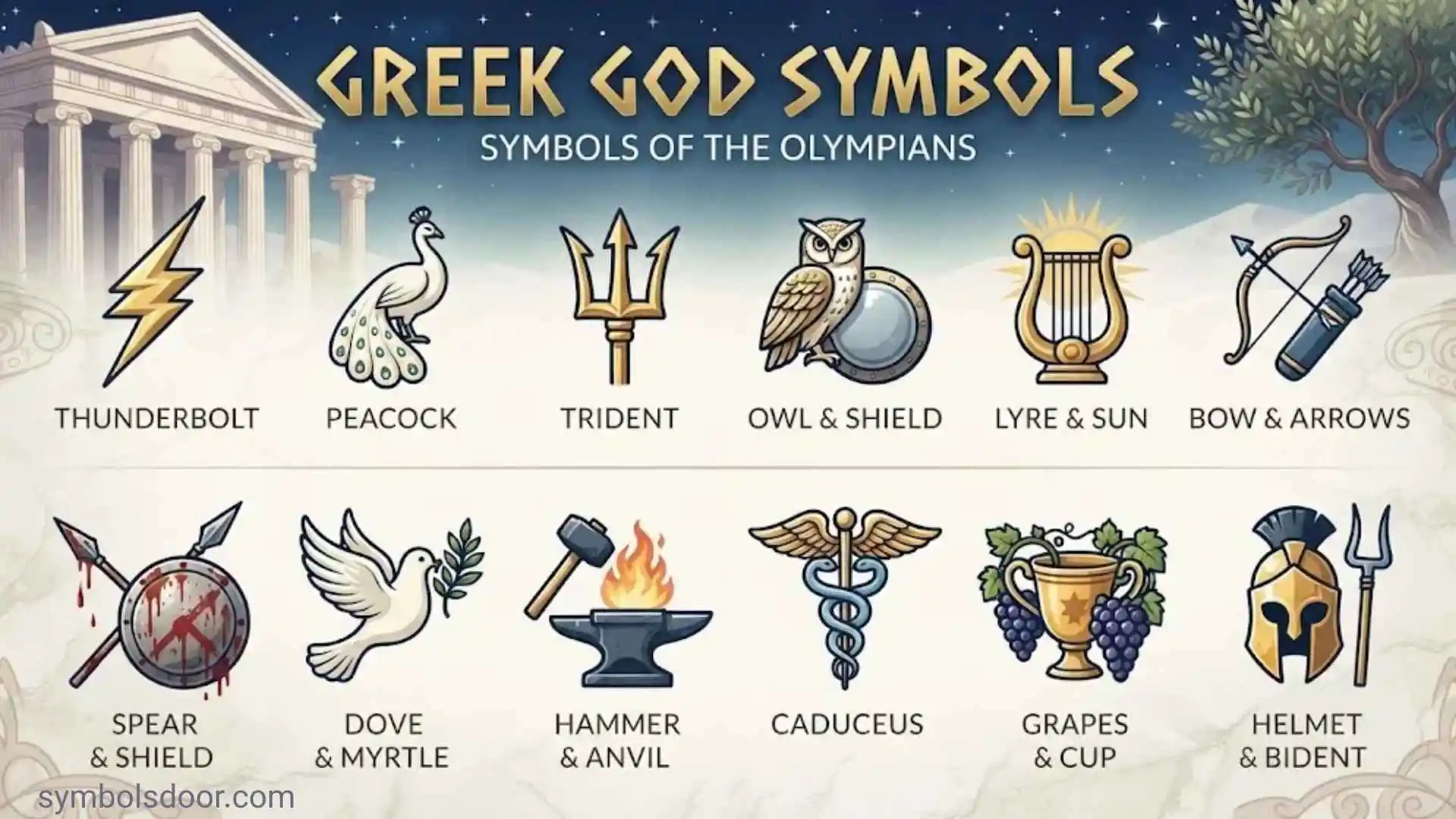
Greek mythology is filled with powerful symbols that tell stories about gods, goddesses, heroes, and ancient beliefs. A thunderbolt represents Zeus’s authority, an owl connects with Athena’s wisdom, and a trident identifies Poseidon as the ruler of the sea. These objects and animals helped ancient Greeks recognize their deities and understand their powers.
However, Greek god symbols were more than decorative images. They appeared on coins, pottery, sculptures, temple decorations, and religious objects. Some represented divine authority, while others symbolized protection, fertility, victory, healing, or renewal.
Whether you’re exploring Greek mythology symbols, researching ancient history, or looking for meaningful tattoo inspiration, understanding the stories behind these emblems makes them much more interesting.
This guide explores 17 important Greek mythology symbols, explains their meanings, and connects them with the gods and goddesses who used them. You’ll also discover their historical significance, sacred animals, cultural associations, and modern interpretations.
What Do Greek God Symbols Represent?
Greek god symbols are objects, animals, plants, and other visual attributes associated with particular deities in ancient Greek mythology and religion. They helped people identify gods in artwork and understand their powers, personalities, and responsibilities.
For example, artists often portrayed Zeus holding a thunderbolt. Athena appeared wearing a helmet and carrying a spear, while Hermes was recognizable by his winged sandals and herald’s staff.
These distinctive features formed an important part of Greek mythology iconography.
Ancient Greek religion was polytheistic, meaning people worshipped many gods and goddesses. Each deity had different responsibilities, although their powers sometimes overlapped. Their symbols reflected these roles and the stories connected with them.
Common Types of Greek Mythology Symbols
Greek mythology symbols generally fall into several categories:
- Animals: Owls, eagles, peacocks, dolphins, horses, and snakes.
- Weapons: Thunderbolts, tridents, bows, spears, and helmets.
- Plants and trees: Olive trees, laurel, wheat, grapevines, and myrtle.
- Objects: Caduceus, aegis, sceptres, torches, and musical instruments.
- Celestial imagery: The Sun, Moon, stars, and divine chariots.
- Mythological creatures: Medusa, the Gorgons, and the phoenix.
Some symbols belonged strongly to one deity. Others appeared in different religious and cultural settings.
For instance, the serpent could represent healing in the cult of Asclepius, but it could also suggest danger, protection, or renewal in other mythological contexts.
Most Meaningful Greek Mythology Symbols and Their Meanings
The following Greek mythology symbols and their meanings explain some of the most recognizable objects and images associated with ancient Greek gods and religious traditions.
| Greek symbol | Associated deity or figure | Common meaning |
| Thunderbolt | Zeus | Divine power and authority |
| Owl | Athena | Wisdom and intelligence |
| Trident | Poseidon | Power over the sea |
| Laurel wreath | Apollo | Honor and victory |
| Cornucopia | Demeter and other deities | Abundance and nourishment |
| Caduceus | Hermes | Communication and commerce |
| Aegis | Zeus and Athena | Divine protection |
| Labrys | Minoan religious traditions | Ritual and sacred power |
| Snake | Asclepius | Healing and renewal |
| Evil eye | Wider Greek and Mediterranean traditions | Protection against harmful envy |
| Olive tree | Athena | Peace and prosperity |
| Gorgoneion | Medusa and Athena | Protection and fearsome power |
| Phoenix | Broader ancient traditions | Rebirth and renewal |
| Lyre | Apollo and Hermes | Music and artistic harmony |
| Torch | Hecate and Demeter | Guidance and illumination |
| Chariot | Helios | Solar movement and divine power |
| Thyrsus | Dionysus | Ritual, fertility, and divine ecstasy |
Thunderbolt Zeus and Divine Power
<AsyncImage query=”ancient Greek Zeus holding thunderbolt classical sculpture museum” aspectRatio=”16:9″ width=”100%” />
Associated god: <Entity value=”Zeus” category=”other” disambig=”Greek king of the gods in mythology”/>
Meaning: Divine power, authority, strength, justice, and control over the sky.
The thunderbolt is one of the most recognizable Greek god symbols. It belongs to Zeus, the king of the Olympian gods and ruler of the heavens.
Ancient Greeks associated Zeus with thunderstorms, lightning, rain, and the authority to maintain order among gods and mortals. Artists often represented him as a powerful bearded figure holding a lightning bolt.
According to Greek mythology, the Cyclopes forged Zeus’s thunderbolt during the conflict between the Olympian gods and the Titans. Zeus used this powerful weapon in the struggle that helped establish his rule.
The thunderbolt represented more than physical strength. It also communicated Zeus’s ability to punish wrongdoing, enforce divine authority, and protect the established order.
What the thunderbolt symbolizes:
- Divine authority and leadership.
- Strength and fearsome power.
- Justice and punishment.
- Control over storms and lightning.
- Protection of cosmic order.
Zeus also had other important attributes, including the eagle, oak tree, and sceptre. These symbols reinforced his position as the supreme Olympian deity.
Owl Athena and Wisdom
<AsyncImage query=”ancient Greek Athena owl silver Athenian tetradrachm coin” aspectRatio=”16:9″ width=”100%” />
Associated goddess: <Entity value=”Athena” category=”other” disambig=”Greek goddess of wisdom and strategic warfare”/>
Meaning: Wisdom, intelligence, insight, and strategic thinking.
The owl is one of the most famous ancient Greek symbols of wisdom. It is closely associated with Athena, the goddess of wisdom, crafts, and strategic warfare.
Athena was especially important in ancient Athens, where people regarded her as the city’s divine protector. According to mythology, she won the city’s patronage by giving its people the olive tree.
The owl became a recognizable attribute of Athena in Greek art. It also appeared on Athenian silver coins, including the famous tetradrachms that circulated widely in the ancient Mediterranean world.
Why an owl? Its alert appearance and ability to see in low light made it a fitting image for knowledge, awareness, and insight.
What the owl symbolizes:
- Wisdom and intelligence.
- Clear thinking and judgment.
- Awareness and observation.
- Strategic planning.
- Knowledge and learning.
Athena also carried a helmet, spear, shield, and aegis. Together, these attributes presented her as a goddess who combined intelligence with military skill.
Trident Poseidon and the Power of the Sea
<AsyncImage query=”Poseidon ancient Greek sculpture holding three pronged trident” aspectRatio=”16:9″ width=”100%” />
Associated god: <Entity value=”Poseidon” category=”other” disambig=”Greek god of the sea and earthquakes”/>
Meaning: Authority over the sea, strength, earthquakes, and maritime power.
The trident is the defining weapon of Poseidon, one of the most important Greek gods. It has three pointed ends and resembles a large fishing spear.
Poseidon ruled over the seas and had the power to produce storms and earthquakes. Ancient Greeks who depended on sailing, fishing, and maritime trade had good reason to respect him.
In mythology, Poseidon could use his trident to disturb the sea, create powerful waves, and shake the earth. He was also associated with horses, which he was believed to have created or brought under human control in certain traditions.
What the trident symbolizes:
- Divine power over the sea.
- Strength and authority.
- Storms and earthquakes.
- Maritime protection.
- Control over natural forces.
Poseidon’s other associations include dolphins, horses, and marine creatures. The trident remains one of the easiest ways to identify him in ancient sculpture and modern representations of Greek mythology.
Laurel Wreath – Apollo and Victory
<AsyncImage query=”ancient Greek Apollo laurel wreath classical marble sculpture” aspectRatio=”16:9″ width=”100%” />
Associated god: <Entity value=”Apollo” category=”other” disambig=”Greek god of music prophecy and light”/>
Meaning: Honor, victory, achievement, and artistic excellence.
The laurel wreath is closely associated with Apollo, the Greek god of music, prophecy, poetry, and several other important aspects of life.
Its mythological origin is connected with Daphne, a nymph who was pursued by Apollo. In the familiar version of the story, Daphne called upon her father, a river god, for help. She transformed into a laurel tree to escape Apollo.
Apollo then adopted the laurel as a sacred plant.
The association became especially important in Greek culture, where wreaths made from leaves were used to honor successful athletes and other distinguished individuals. Laurel wreaths became a recognizable sign of achievement and public recognition.
What the laurel wreath symbolizes:
- Victory and success.
- Honor and glory.
- Achievement.
- Artistic excellence.
- Recognition and distinction.
The laurel is also connected with Apollo’s role as a patron of poetry and music. Its meaning therefore extends beyond athletic victory.
Cornucopia – Abundance and Nourishment
<AsyncImage query=”ancient Greek cornucopia horn of plenty classical sculpture fruit wheat” aspectRatio=”16:9″ width=”100%” />
Associated figures: Demeter and several other mythological deities.
Meaning: Fertility, abundance, nourishment, prosperity, and good fortune.
The cornucopia, also called the horn of plenty, is a horn-shaped container overflowing with fruit, grain, flowers, or other food.
It represents nature’s ability to provide nourishment and support life. In ancient mythology and later classical artwork, it became associated with agricultural abundance and prosperity.
Demeter, the goddess of agriculture and the harvest, is one deity connected with this imagery. Other mythological figures, including Ploutos, the personification of wealth, were also represented with a cornucopia.
Its exact mythological origin varies across traditions. One well-known story connects the horn of plenty with the infant Zeus and the goat Amalthea.
What the cornucopia symbolizes:
- Fertility and abundance.
- Food and nourishment.
- Prosperity and wealth.
- Generosity and good fortune.
- Agricultural success.
Today, the cornucopia remains a familiar image of harvest celebrations and plenty, especially in later European and American cultural traditions.
Caduceus – Hermes and Communication
<AsyncImage query=”Hermes caduceus ancient Greek herald staff two snakes wings sculpture” aspectRatio=”16:9″ width=”100%” />
Associated god: <Entity value=”Hermes” category=”other” disambig=”Greek messenger god of travelers and commerce”/>
Meaning: Communication, messages, travel, commerce, and exchange.
The caduceus is a staff associated with Hermes, the messenger of the Greek gods. It usually has two snakes winding around a central rod, often with a pair of wings near the top.
Hermes had many responsibilities. He carried messages between gods and mortals, protected travelers, and was associated with trade, merchants, and negotiation.
The caduceus therefore became an identifying attribute of his messenger role.
What the caduceus symbolizes:
- Communication and diplomacy.
- Commerce and trade.
- Travel and movement.
- Negotiation and exchange.
- Hermes’s role as divine messenger.
There is one important distinction worth remembering: the caduceus is not the same as the Rod of Asclepius.
The caduceus has two snakes and is associated with Hermes. The Rod of Asclepius usually has one snake and belongs to the god of healing.
Although the caduceus is sometimes used by modern medical organizations, its original Greek mythological association is with Hermes, not medicine. <Cite refs={[“turn950895search0″,”turn950895search9”]}/>
Aegis Zeus, Athena, and Divine Protection
<AsyncImage query=”Athena aegis Gorgon head ancient Greek statue breastplate” aspectRatio=”16:9″ width=”100%” />
Associated deities: Zeus and Athena.
Meaning: Protection, divine authority, and fearsome power.
The aegis is a protective object associated with Zeus and Athena. In ancient Greek artwork, it often appears as a protective garment or shield-like covering, sometimes decorated with the face of Medusa.
Athena is frequently shown wearing an aegis with a Gorgon’s head and snake-like details. This image combines protection with the frightening power of the Gorgon.
The aegis also appears in mythological accounts connected with Zeus. Its precise appearance varies between artistic and literary traditions.
What the aegis symbolizes:
- Divine protection.
- Authority and strength.
- Defense against enemies.
- Fearsome power.
- Protection in battle.
Athena’s aegis is especially recognizable because it appears alongside her helmet, spear, and other military attributes.
Labrys The Double-Headed Axe and Ancient Religious Symbolism
<AsyncImage query=”Minoan bronze double headed labrys axe archaeological artifact Crete” aspectRatio=”16:9″ width=”100%” />
Associated tradition: Minoan culture and religious practices.
Meaning: Ritual significance, sacred power, and possible religious authority.
The labrys is a double-headed axe with a blade extending from both sides of its central handle.
It is strongly associated with Minoan Crete, a Bronze Age civilization that flourished on the island of Crete before the rise of classical Greek civilization.
Archaeologists have discovered double-headed axe imagery in Minoan palaces, religious settings, and other archaeological contexts. Its exact significance remains a subject of scholarly discussion.
The labrys should not automatically be described as the personal symbol of a specific Olympian god or goddess. Its strongest historical associations are with Minoan religious and cultural imagery.
What the labrys may represent:
- Ritual and ceremonial activity.
- Sacred authority.
- Religious power.
- Ancient Minoan traditions.
The double-headed axe also appears in modern discussions of ancient feminine power, but these interpretations should be distinguished from what archaeological evidence can establish.
Snake Asclepius and Healing
<AsyncImage query=”ancient Greek Asclepius statue serpent single snake staff” aspectRatio=”16:9″ width=”100%” />
Associated god: <Entity value=”Asclepius” category=”other” disambig=”Greek god of medicine and healing”/>
Meaning: Healing, renewal, regeneration, and medical knowledge.
The serpent is an important symbol in Greek mythology. One of its best-known associations is with Asclepius, the god of medicine and healing.
Asclepius is commonly represented holding a staff with a single snake wrapped around it. This image is called the Rod of Asclepius and remains a widely recognized symbol of medicine.
Ancient Greeks worshipped Asclepius at healing sanctuaries called Asclepieia. People visited these sacred places seeking relief from illness and participating in religious healing practices.
Snakes had an important role in some Asclepian traditions. Their ability to shed their skin may have contributed to associations with renewal and regeneration.
What the snake symbolizes in this context:
- Healing and recovery.
- Renewal and regeneration.
- Life and transformation.
- Medical knowledge.
- Protection and sacred power.
However, snakes did not have one fixed meaning throughout Greek mythology. They could also represent danger, mystery, or other forms of power.
Evil Eye Protection Against Envy and Harm
<AsyncImage query=”traditional Greek blue evil eye mati protective amulet” aspectRatio=”16:9″ width=”100%” />
Cultural association: Ancient Greek and wider Mediterranean traditions.
Meaning: Protection against envy, harmful intentions, and misfortune.
The evil eye is a belief that a person’s envious or harmful gaze can bring misfortune to another person.
This belief has a long history across the Mediterranean and neighboring regions. Ancient Greek culture included beliefs and protective practices connected with harmful looks and envy.
Eye-shaped charms and protective imagery were used in different historical periods to guard against perceived supernatural harm.
In modern Greece, the evil eye is commonly known as mati. Blue eye-shaped charms appear in jewelry, homes, and decorative objects.
What the evil eye represents:
- Protection against envy.
- Safeguarding against misfortune.
- Defense against harmful intentions.
- Spiritual protection.
The evil eye is not the personal emblem of a particular Olympian god. It belongs to a broader history of Greek and Mediterranean folk belief.
Olive Tree and Olive Branch Athena and Peace
<AsyncImage query=”ancient Greek olive tree Athena olive branch classical art” aspectRatio=”16:9″ width=”100%” />
Associated goddess: Athena.
Meaning: Peace, prosperity, wisdom, nourishment, and longevity.
The olive tree is one of the most important plants in ancient Greek culture. It provided food, oil, and materials used in everyday life.
Its mythological association comes from the contest between Athena and Poseidon for the patronage of Athens.
According to the familiar story, Poseidon offered a powerful horse or a source of water, while Athena gave the city an olive tree. The people chose Athena’s gift because it offered long-term benefits, including food, oil, and wood.
Athena became the city’s patron goddess, and the olive tree became one of her most recognizable attributes.
What the olive tree symbolizes:
- Peace and reconciliation.
- Wisdom and prosperity.
- Nourishment and agricultural wealth.
- Longevity and endurance.
- Divine favor.
The olive branch later became a widely recognized symbol of peace and reconciliation. It also appeared in ancient Greek traditions of honor and victory.
Gorgoneion Medusa’s Head and Protection
<AsyncImage query=”ancient Greek Gorgoneion Medusa head shield sculpture museum” aspectRatio=”16:9″ width=”100%” />
Associated figure: <Entity value=”Medusa” category=”other” disambig=”Gorgon figure in Greek mythology”/> and Athena.
Meaning: Protection, defense, fear, and the power to repel danger.
A Gorgoneion is an image of a Gorgon’s face, most commonly Medusa’s. It was used in ancient Greek art and architecture as a powerful protective emblem.
Medusa was one of the three Gorgon sisters. In the best-known version of her story, her gaze could turn people to stone.
The hero Perseus eventually defeated her by using a reflective shield to avoid looking directly at her.
After Medusa’s death, her head became an important object in mythology. Athena is often depicted wearing it on her aegis.
Gorgoneion images also appeared on shields, armor, pottery, and buildings. Their frightening appearance was believed to help ward off danger.
What the Gorgoneion symbolizes:
- Protection against threats.
- Defense from harmful forces.
- Fearsome power.
- Divine safeguarding.
- The ability to confront danger.
The Gorgoneion is more than a representation of Medusa. It is a recognizable example of protective imagery in ancient Greek art.
Phoenix Rebirth and Renewal
<AsyncImage query=”ancient Greek phoenix mythological bird rising from flames classical illustration” aspectRatio=”16:9″ width=”100%” />
Mythological association: Broader ancient Mediterranean and Near Eastern traditions.
Meaning: Rebirth, immortality, renewal, endurance, and transformation.
The phoenix is a legendary bird associated with the cycle of death and rebirth. In later popular versions of the story, it burns or dies in flames and rises again from its ashes.
Ancient Greek writers discussed phoenix traditions, but the bird was not an exclusive symbol of one Olympian god. Its history involves a wider cultural background, including Egyptian and other ancient traditions.
Over time, the phoenix became a powerful image of renewal and the ability to begin again after destruction.
What the phoenix symbolizes:
- Rebirth and renewal.
- Immortality.
- Strength after hardship.
- Transformation.
- Hope and endurance.
Today, the phoenix is especially popular in artwork and tattoos because it represents personal change and recovery.
Lyre Apollo and Musical Harmony
<AsyncImage query=”ancient Greek Apollo holding lyre kithara marble sculpture” aspectRatio=”16:9″ width=”100%” />
Associated gods: Apollo and Hermes.
Meaning: Music, poetry, artistic inspiration, harmony, and creativity.
The lyre was an important stringed instrument in ancient Greek musical culture. It is strongly associated with Apollo, the god of music, poetry, prophecy, and artistic expression.
According to mythology, Hermes invented the lyre using a tortoise shell and gave it to Apollo. The instrument became one of Apollo’s defining attributes.
Ancient Greek musicians used lyres in musical performances, education, poetry, and social gatherings.
What the lyre symbolizes:
- Musical harmony.
- Creativity and artistic skill.
- Poetry and inspiration.
- Balance and beauty.
- Cultural achievement.
Apollo’s connection with the lyre made it an important emblem of artistic excellence in Greek mythology.
Torch Hecate and Demeter
<AsyncImage query=”ancient Greek Hecate goddess holding torches classical statue” aspectRatio=”16:9″ width=”100%” />
Associated goddesses: Hecate and Demeter.
Meaning: Guidance, illumination, searching, and movement through darkness.
The torch appears in several important Greek myths and religious traditions.
Hecate is frequently depicted carrying torches. Her associations with crossroads, night, and the boundaries between worlds made the torch a fitting attribute.
The torch also plays an important role in the story of Demeter and Persephone. When Persephone disappeared into the underworld, Demeter searched for her daughter while carrying torches.
The image therefore connects light with searching, guidance, and the struggle to find something lost.
What the torch symbolizes:
- Guidance through darkness.
- Illumination and knowledge.
- Searching and discovery.
- Spiritual safeguarding.
- Transition and movement.
The torch’s meaning depends on the deity and story in which it appears.
Chariot Helios and Celestial Movement
<AsyncImage query=”ancient Greek Helios sun god golden chariot horses classical relief” aspectRatio=”16:9″ width=”100%” />
Associated god: <Entity value=”Helios” category=”other” disambig=”Greek personification and god of the Sun”/>
Meaning: Solar movement, light, divine power, and cosmic order.
Helios was the Greek personification of the Sun. Ancient mythology described him traveling across the sky in a radiant chariot drawn by powerful horses.
His daily journey explained the movement of the Sun from sunrise to sunset.
Helios was distinct from Apollo in early Greek religious traditions. Apollo later developed strong solar associations, but Helios remained the traditional personification of the Sun.
The solar chariot became a powerful image of celestial movement and the regular order of the heavens.
What the chariot symbolizes:
- The movement of the Sun.
- Light and illumination.
- Divine power.
- Cosmic order.
- The passage of time.
Helios’s chariot is also an important feature of the myth of Phaethon, his son, who attempted to drive the solar chariot and lost control of it.
Thyrsus Dionysus and Ritual Power
<AsyncImage query=”ancient Greek Dionysus thyrsus pine cone staff ivy sculpture” aspectRatio=”16:9″ width=”100%” />
Associated god: <Entity value=”Dionysus” category=”other” disambig=”Greek god of wine and theatre”/>
Meaning: Fertility, wine, celebration, ritual, and divine ecstasy.
The thyrsus was a staff associated with Dionysus and his followers. It was often decorated with ivy or vine leaves and topped with a pine cone.
Dionysus was the god of wine, theater, celebration, and altered states of consciousness. His religious traditions included festivals and rituals that sometimes involved ecstatic dancing and music.
The thyrsus became one of the most recognizable objects in artistic representations of the god and his followers.
What the thyrsus symbolizes:
- Fertility and natural growth.
- Wine and celebration.
- Ritual activity.
- Divine power.
- Freedom and transformation.
Dionysus was also associated with grapevines, ivy, drinking cups, and big cats such as leopards and panthers.
Greek Gods and Goddesses and Their Symbols
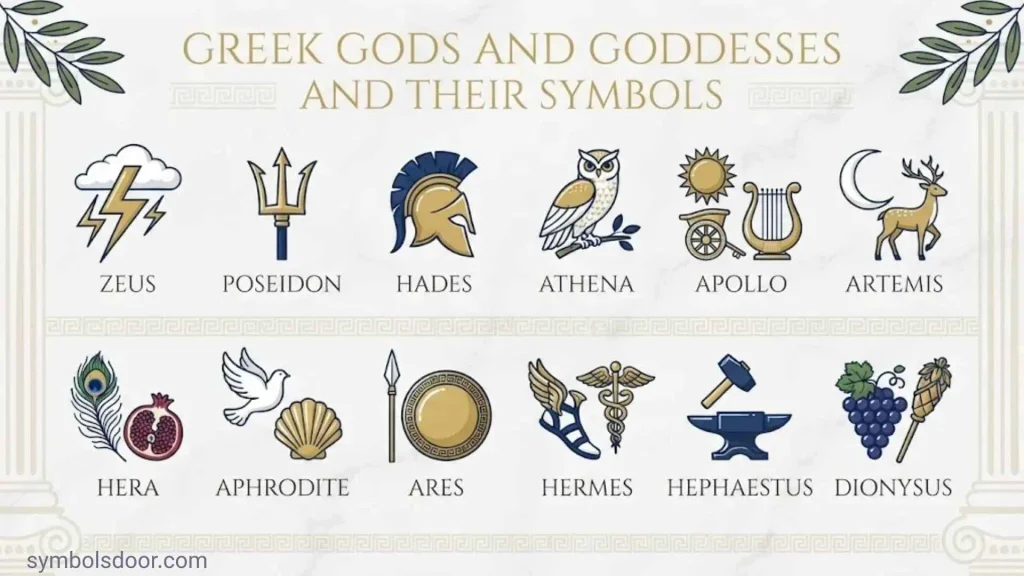
Greek gods and goddesses had distinctive attributes that helped ancient artists and worshippers identify them. Their symbols reflected their divine roles, sacred animals, and important mythological stories.
The following table provides a quick reference to major Greek deities and their best-known associations.
| Greek god or goddess | Main symbols | What they represent |
| Zeus | Thunderbolt, eagle, oak, sceptre | Authority and divine power |
| Hera | Peacock, crown, sceptre, pomegranate | Marriage and queenship |
| Poseidon | Trident, horse, dolphin | Sea and earthquakes |
| Demeter | Wheat, grain, torch, cornucopia | Agriculture and harvest |
| Athena | Owl, olive tree, helmet, aegis | Wisdom and strategic warfare |
| Apollo | Lyre, laurel, bow | Music, prophecy, and artistic skill |
| Artemis | Bow, deer, quiver | Hunting and wilderness |
| Ares | Spear, helmet, shield | Warfare and combat |
| Aphrodite | Dove, rose, shell, myrtle | Love and beauty |
| Hephaestus | Hammer, anvil, tongs, fire | Metalworking and craftsmanship |
| Hermes | Caduceus, winged sandals, hat | Messages, travel, and commerce |
| Dionysus | Thyrsus, grapevine, ivy, leopard | Wine and celebration |
| Hades | Cerberus, sceptre, Helm of Darkness | Underworld and the dead |
| Hecate | Torch, keys, dogs | Crossroads and night |
| Asclepius | Serpent and staff | Medicine and healing |
| Helios | Sun, golden chariot, horses | Solar movement and light |
Zeus Symbols and Meanings
<AsyncImage query=”Zeus ancient Greek sculpture eagle thunderbolt oak symbolism” aspectRatio=”16:9″ width=”100%” />
Zeus was the supreme ruler of the Olympian gods. His most recognizable attribute was the thunderbolt, but he was also associated with the eagle, oak tree, and sceptre.
- Thunderbolt: Divine power, punishment, and authority.
- Eagle: Kingship, strength, and divine status.
- Oak tree: Sacred authority and religious significance.
- Sceptre: Rule and leadership.
Zeus was also connected with justice, hospitality, and the protection of people who sought refuge.
Hera Symbols and Meanings
<AsyncImage query=”ancient Greek goddess Hera peacock classical statue” aspectRatio=”16:9″ width=”100%” />
Hera was the queen of the gods and the wife of Zeus. She was closely connected with marriage, family, and queenship.
Her most recognizable symbol is the peacock. She is also associated with a crown, sceptre, and pomegranate.
- Peacock: Majesty and divine status.
- Crown: Queenship and authority.
- Sceptre: Power and leadership.
- Pomegranate: Fertility and marriage-related symbolism.
The peacock became a particularly recognizable attribute in later classical art.
Poseidon Symbols and Meanings
<AsyncImage query=”Poseidon Greek god trident horse dolphin ancient art” aspectRatio=”16:9″ width=”100%” />
Poseidon ruled the sea and was also associated with earthquakes and horses.
His main symbols include:
- Trident: Control over the sea and natural forces.
- Horse: Strength and divine power.
- Dolphin: Marine life and the ocean.
- Bull: Another animal associated with his cult and mythology.
His importance extended beyond sailors. Communities also honored him in connection with earthquakes, horses, and coastal life.
Demeter Symbols and Meanings
<AsyncImage query=”ancient Greek Demeter goddess wheat sheaf torch sculpture” aspectRatio=”16:9″ width=”100%” />
Demeter was the goddess of agriculture, grain, and the harvest.
Her most important symbols reflect the natural cycle of growing food.
- Wheat: Agriculture and nourishment.
- Grain: Harvest and fertility.
- Torch: Her search for Persephone.
- Cornucopia: Abundance and prosperity.
The myth of Demeter and Persephone also helped ancient Greeks explain seasonal changes and the cycle of agricultural growth.
Athena Symbols and Meanings
<AsyncImage query=”Athena ancient Greek statue helmet owl olive tree aegis” aspectRatio=”16:9″ width=”100%” />
Athena was the goddess of wisdom, crafts, and strategic warfare. She was also the patron goddess of Athens.
Her symbols include:
- Owl: Wisdom and intelligence.
- Olive tree: Peace and prosperity.
- Helmet: Military protection.
- Spear: Strategic warfare.
- Aegis: Divine protection.
Unlike Ares, who represented the violent side of warfare, Athena was especially associated with strategy, discipline, and intelligent planning.
Apollo Symbols and Meanings
<AsyncImage query=”Apollo ancient Greek god lyre laurel wreath sculpture” aspectRatio=”16:9″ width=”100%” />
Apollo was associated with music, poetry, prophecy, healing, and light.
His symbols include:
- Lyre: Music and poetry.
- Laurel wreath: Honor and achievement.
- Bow and arrows: Divine skill and power.
- Tripod: His connection with the oracle at Delphi.
Apollo’s attributes made him one of the most recognizable figures in Greek art and religious traditions.
Artemis Symbols and Meanings
<AsyncImage query=”Artemis Greek goddess bow deer classical statue” aspectRatio=”16:9″ width=”100%” />
Artemis was the goddess of hunting, wild animals, and wilderness. She was also associated with childbirth and, in later traditions, the Moon.
Her symbols include:
- Bow and arrow: Hunting and protection.
- Deer: Wild nature and sacred animals.
- Quiver: Her role as a huntress.
- Moon: Later and broader lunar associations.
Artemis is often depicted with a bow, surrounded by animals or accompanied by hunting dogs.
Ares Symbols and Meanings
<AsyncImage query=”ancient Greek Ares god helmet spear shield statue” aspectRatio=”16:9″ width=”100%” />
Ares was the god of war, especially its violent and destructive aspects.
His main symbols include:
- Spear: Combat and warfare.
- Helmet: Military strength.
- Shield: Defense and battle.
- Sword: Fighting and conflict.
- Boar: An animal associated with some mythological traditions involving Ares.
Ares represents the dangerous and brutal side of war, while Athena represents strategic skill and disciplined military planning.
Aphrodite Symbols and Meanings
<AsyncImage query=”Aphrodite Greek goddess dove rose seashell ancient sculpture” aspectRatio=”16:9″ width=”100%” />
Aphrodite was the goddess of love, beauty, and desire.
Her symbols include:
- Dove: Love and affection.
- Rose: Beauty and romance.
- Seashell: Her association with the sea and her famous birth story.
- Myrtle: A sacred plant connected with the goddess.
- Swan: Beauty and grace in later artistic traditions.
These attributes made Aphrodite a popular subject in ancient sculpture, pottery, and later European art.
Hephaestus Symbols and Meanings
<AsyncImage query=”Hephaestus Greek god blacksmith hammer anvil classical artwork” aspectRatio=”16:9″ width=”100%” />
Hephaestus was the god of fire, metalworking, and craftsmanship.
His symbols reflect his work as the divine blacksmith.
- Hammer: Metalworking and skilled labor.
- Anvil: Forging and craftsmanship.
- Tongs: Handling heated metal.
- Fire: Transformation and creation.
Hephaestus was believed to create powerful weapons and objects for the gods, including armor and divine equipment.
Hermes Symbols and Meanings
<AsyncImage query=”Hermes ancient Greek statue winged sandals caduceus petasos” aspectRatio=”16:9″ width=”100%” />
Hermes was the messenger of the gods and the protector of travelers and merchants.
His symbols include:
- Caduceus: Communication and exchange.
- Winged sandals: Speed and travel.
- Winged hat: Movement and divine messages.
- Herald’s staff: His messenger role.
Hermes also had associations with boundaries, trade, and travelers.
Dionysus Symbols and Meanings
<AsyncImage query=”Dionysus Greek god grapevine thyrsus leopard ancient statue” aspectRatio=”16:9″ width=”100%” />
Dionysus was the god of wine, theater, celebration, and ecstatic religious experience.
His symbols include:
- Grapevine: Wine and cultivation.
- Thyrsus: Ritual power and fertility.
- Ivy: Natural growth and divine association.
- Leopard: Wildness and Dionysian imagery.
- Drinking cup: Wine and celebration.
His festivals played an important role in Greek religious and theatrical culture.
Hades Symbols and Meanings
<AsyncImage query=”Hades Greek underworld god Cerberus ancient classical sculpture” aspectRatio=”16:9″ width=”100%” />
Hades ruled the underworld, the realm of the dead. Although he was sometimes feared, he was not simply the Greek equivalent of an evil devil.
His symbols include:
- Cerberus: The three-headed dog guarding the underworld.
- Helm of Darkness: Invisibility.
- Sceptre: Authority over the dead.
- Cypress: Funerary and death-related associations.
- Pomegranate: A connection with Persephone’s underworld story.
Hades was also associated with the wealth hidden beneath the earth, including precious metals and minerals.
Hecate Symbols and Meanings
<AsyncImage query=”Hecate ancient Greek goddess three forms torches statue” aspectRatio=”16:9″ width=”100%” />
Hecate was associated with crossroads, night, magic, and transitions.
Her symbols include:
- Torch: Light and guidance.
- Keys: Access and boundaries.
- Crossroads: Choices and transitions.
- Dogs: Sacred animal associations.
Hecate was often represented carrying torches, making her one of the most recognizable torch-bearing figures in Greek mythology.
Asclepius Symbols and Meanings
<AsyncImage query=”Asclepius Greek god healing Rod of Asclepius marble sculpture” aspectRatio=”16:9″ width=”100%” />
Asclepius was the god of medicine and healing.
His best-known symbol is the Rod of Asclepius, a staff with one serpent wrapped around it.
It represents healing, medical practice, and recovery. His daughter Hygieia was associated with health and cleanliness.
Remember that the Rod of Asclepius has one snake, while Hermes’s caduceus usually has two.
Helios Symbols and Meanings
<AsyncImage query=”Helios Greek sun god radiant crown chariot ancient relief” aspectRatio=”16:9″ width=”100%” />
Helios personified the Sun and was traditionally described as driving a golden chariot across the sky.
His main symbols include:
- Solar disk: The Sun and light.
- Golden chariot: The Sun’s daily journey.
- Horses: The team pulling the chariot.
- Radiant crown: Solar brilliance.
Helios’s role is important when distinguishing early Greek solar traditions from the later association between Apollo and the Sun.
Greek Symbols and Their Meanings by Theme
People often search for ancient symbols based on the ideas they represent rather than the names of individual gods. The following categories make it easier to compare Greek symbols and their hidden meanings.
Greek Symbols for Strength, Power, and Authority
Several Greek mythology symbols communicate physical or divine power.
| Symbol | Associated figure | Meaning |
| Thunderbolt | Zeus | Supreme authority |
| Trident | Poseidon | Control over natural forces |
| Spear | Athena and Ares | Warfare and strength |
| Helmet | Athena and Ares | Protection and military power |
| Eagle | Zeus | Kingship and divine status |
The thunderbolt is particularly suitable when discussing divine authority. The trident is more closely connected with the sea, while the spear and helmet represent military power.
Greek Symbols for Wisdom and Intelligence
Athena is the strongest mythological association for wisdom.
- Owl: Knowledge, awareness, and insight.
- Olive tree: Wisdom and prosperity.
- Lyre: Artistic knowledge and harmony.
- Apollo’s tripod: Prophecy and divine guidance.
These symbols connect knowledge with both practical judgment and creative achievement.
Greek Symbols for Love, Beauty, and Peace
Aphrodite is closely connected with love and beauty, while Athena’s olive tree became an important symbol of peace.
Common examples include:
- Dove: Love and affection.
- Rose: Beauty and romance.
- Myrtle: Aphrodite’s sacred plant.
- Olive branch: Peace and reconciliation.
- Seashell: Aphrodite’s association with the sea.
These symbols have continued to appear in art, jewelry, literature, and decorative designs.
Greek Symbols for Healing and Protection
Greek mythology includes several symbols associated with protection and recovery.
| Symbol | Association | Meaning |
| Rod of Asclepius | Asclepius | Healing and medicine |
| Aegis | Zeus and Athena | Divine protection |
| Gorgoneion | Medusa and Athena | Protection against danger |
| Serpent | Asclepius and other traditions | Renewal and healing |
| Evil eye | Greek and Mediterranean folk traditions | Protection against envy |
These symbols have different histories. The Rod of Asclepius is specifically associated with healing, while the aegis and Gorgoneion are connected with divine protection.
Greek Symbols for Fertility and Abundance
Agriculture was essential to ancient Greek life. Symbols of grain, fruit, and plant growth therefore had important cultural and religious meanings.
- Wheat: Demeter and agricultural nourishment.
- Cornucopia: Abundance and prosperity.
- Pomegranate: Fertility and marriage-related symbolism.
- Grapevine: Dionysus, wine, and cultivation.
- Olive tree: Food, oil, and long-term prosperity.
Demeter’s association with agriculture made her one of the most important deities for farming communities.
Greek Symbols for Victory, Honor, and Achievement
The laurel wreath is one of the most recognizable ancient symbols of honor and achievement.
Other related imagery includes:
- Laurel wreath: Apollo and victory.
- Nike’s wings: Victory and triumph.
- Sceptre: Authority and leadership.
- Athena’s armor: Strategic strength and military success.
The goddess Nike personified victory and appeared in ancient Greek art celebrating athletic and military achievements.
Greek Symbols for Healing, Rebirth, and Transformation
Some mythological symbols are associated with the cycles of life and renewal.
- Phoenix: Rebirth and transformation.
- Serpent: Renewal and regeneration.
- Pomegranate: Life, fertility, and Persephone’s underworld story.
- Torch: Guidance through darkness and transition.
These associations are useful for understanding modern interpretations, but they should not all be treated as identical ancient religious meanings.
Greek Symbols for Guidance and Spiritual Protection
Several Greek symbols represent guidance, movement, and protection.
- Hecate’s torch: Guidance through darkness.
- Hermes’s winged sandals: Travel and movement.
- Aegis: Divine protection.
- Gorgoneion: Protection through fearsome imagery.
- Olive branch: Peace and reconciliation.
Their meanings come from different myths and cultural traditions.
Greek God Symbols in Ancient Greek Culture and Traditions
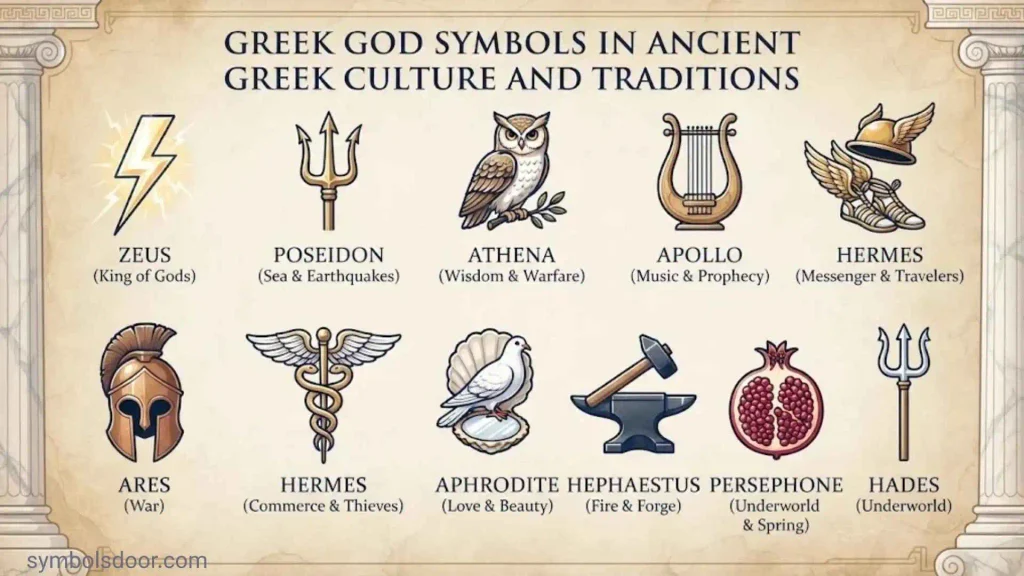
Greek mythology was closely connected with everyday religious life. Gods were not simply characters in stories. People honored them through sacrifices, festivals, temples, public ceremonies, and private offerings.
Their symbols helped worshippers recognize deities and understand the qualities associated with them.
Greek Symbols in Temples and Religious Worship
Ancient Greek temples and sanctuaries often included images of the gods they honored.
Sculptures, reliefs, and decorative objects showed deities with distinctive attributes. Athena might appear with a helmet, spear, and aegis, while Poseidon could be identified by his trident.
Religious objects also played a role in worship. People presented offerings, dedicated inscriptions, and left votive gifts at sacred sites.
The symbols used in these settings helped connect physical objects with divine identities and stories.
Greek Symbols in Pottery, Sculpture, and Artwork
<AsyncImageGroup query={[“ancient Greek black figure pottery Athena owl mythology”,”ancient Greek red figure vase Dionysus grapevine satyrs”,”ancient Greek sculpture Zeus thunderbolt museum”]} aspectRatio=”5:4″ layout=”carousel”/>
Artists used recognizable symbols to identify gods in paintings, pottery, and sculpture.
For example:
- Zeus often carried a thunderbolt or sceptre.
- Athena wore a helmet and carried a spear.
- Apollo held a lyre or bow.
- Hermes carried a herald’s staff and wore winged footwear.
- Dionysus appeared with grapevines, ivy, or a drinking cup.
These attributes allowed viewers to recognize mythological figures even when inscriptions were absent.
Ancient Greek pottery is particularly useful for studying this visual language because painted scenes often depict gods, heroes, sacrifices, and mythological events.
Greek Symbols on Ancient Coins
<AsyncImage query=”ancient Athens silver tetradrachm owl coin ancient Greek” aspectRatio=”16:9″ width=”100%” />
Coins provide valuable evidence of ancient Greek symbolism.
One famous example is the Athenian silver tetradrachm, which features Athena on one side and an owl on the other. The owl represented the city’s patron goddess and became a recognizable emblem of Athens.
Other Greek cities used local gods, animals, and religious objects on their coins.
These images communicated civic identity and religious associations. They also helped people recognize where coins originated.
Greek Symbols in Festivals and Religious Ceremonies
Festivals were an important part of ancient Greek religious life.
Some were dedicated to particular gods and included processions, sacrifices, athletic contests, theatrical performances, and public celebrations.
Examples include:
- Dionysian festivals: Associated with Dionysus, wine, and theater.
- Panathenaia: A major festival honoring Athena in Athens.
- Eleusinian Mysteries: Religious ceremonies connected with Demeter and Persephone.
- Heraia: Festivals honoring Hera, including athletic events for women and girls.
Symbols, sacred objects, and ritual imagery helped express the religious importance of these occasions.
Greek Symbols in Seafaring, Agriculture, and Warfare
The symbols of Greek gods also reflected the practical needs of ancient communities.
Poseidon’s trident was especially relevant to people whose lives depended on the sea. Demeter’s wheat represented agriculture and food production. Athena’s helmet and spear reflected military strategy, while Ares represented the violence of combat.
These connections show how ancient Greek symbolism grew from both religious beliefs and everyday experiences.
Greek Mythology Symbols in Modern Culture and Tattoo Ideas
Greek mythology continues to influence modern art, fashion, literature, jewelry, architecture, and tattoos.
Many people choose these symbols because they connect with a particular story or quality. However, modern interpretations are not always identical to ancient meanings.
Popular Greek Mythology Tattoo Symbols
<AsyncImageGroup query={[“Greek mythology Zeus thunderbolt black ink tattoo design”,”Athena owl Greek mythology tattoo line art”,”Poseidon trident Greek mythology tattoo design”,”Medusa Gorgon Greek mythology tattoo artwork”,”Apollo laurel wreath Greek tattoo design”]} aspectRatio=”3:4″ layout=”carousel”/>
Some popular Greek mythology tattoo symbols include:
| Tattoo symbol | Traditional association | Common modern interpretation |
| Zeus’s thunderbolt | Divine authority | Strength and leadership |
| Athena’s owl | Wisdom | Intelligence and knowledge |
| Poseidon’s trident | Sea and divine power | Strength and independence |
| Apollo’s laurel | Honor and victory | Achievement and success |
| Medusa’s head | Protective and fearsome imagery | Protection and personal resilience |
| Phoenix | Rebirth traditions | Recovery and transformation |
| Olive branch | Athena and peace | Harmony and reconciliation |
| Rod of Asclepius | Healing | Medicine and recovery |
If you choose a tattoo based on Greek mythology, research the original story before settling on a design. This helps you avoid confusing symbols that look similar but have different meanings.
Greek Symbols for Personal Growth and Transformation
Some Greek mythological symbols work especially well as modern reminders of personal growth.
- Phoenix: Starting again after a difficult period.
- Laurel wreath: Working toward a goal and earning recognition.
- Olive branch: Choosing peace and reconciliation.
- Serpent: Renewal and transformation.
- Athena’s owl: Seeking knowledge and making wise decisions.
These are modern personal interpretations inspired by mythology. They should not be confused with fixed meanings that all ancient Greeks shared.
How to Choose a Greek God Symbol for a Tattoo
Before choosing a design, consider the following:
- Identify the original deity: Find out whether the symbol belongs to Zeus, Athena, Apollo, or another figure.
- Research the myth: Learn the story behind the object or animal.
- Check the historical context: Some symbols come from Minoan, Roman, or broader Mediterranean traditions.
- Choose a meaningful design: Think about the quality or story you want the tattoo to represent.
- Avoid confusing similar symbols: The caduceus and Rod of Asclepius, for example, have different mythological associations.
A meaningful design begins with understanding the story behind it.
Greek Mythology Symbols vs. Ancient Greek Symbols: What’s the Difference?
The terms Greek mythology symbols and ancient Greek symbols are related, but they do not mean exactly the same thing.
Greek mythology symbols are specifically connected with gods, goddesses, heroes, and mythological stories. Ancient Greek symbols can include a wider range of cultural, religious, political, and decorative imagery.
| Greek mythology symbols | Broader ancient Greek symbols |
| Zeus’s thunderbolt | Geometric pottery patterns |
| Athena’s owl | Greek alphabet letters |
| Poseidon’s trident | Civic emblems |
| Apollo’s lyre | Coins and inscriptions |
| Hermes’s caduceus | Architectural ornaments |
| Medusa’s Gorgoneion | Everyday decorative motifs |
Some objects belong to more than one category. The olive branch, for example, has a mythological association with Athena and a broader cultural association with peace.
It is also important to recognize that ancient Greek civilization developed over many centuries. Minoan Crete, Mycenaean Greece, and classical Athens had different cultural and religious traditions.
Not every symbol found in the ancient Aegean world should automatically be described as an Olympian god’s emblem.
Frequently Asked Questions About Greek God Symbols
What Are the Most Recognizable Greek God Symbols?
Some of the most recognizable symbols include Zeus’s thunderbolt, Athena’s owl, Poseidon’s trident, Apollo’s laurel wreath, Hermes’s caduceus, and Athena’s aegis.
These symbols appear frequently in ancient Greek artwork and later representations of mythology.
What Is the Symbol of Zeus?
Zeus’s best-known symbol is the thunderbolt. He is also associated with the eagle, oak tree, and sceptre.
The thunderbolt represents his authority over the heavens and his power to punish wrongdoing.
What Is Athena’s Most Famous Symbol?
Athena’s most famous symbol is the owl, which represents wisdom and intelligence.
She is also associated with the olive tree, helmet, spear, and aegis.
What Does Poseidon’s Trident Represent?
Poseidon’s trident represents his authority over the sea and his ability to cause storms and earthquakes.
It is one of the clearest identifying attributes in ancient Greek representations of the god.
What Is the Greek Symbol for Wisdom?
The owl is the best-known Greek mythological symbol of wisdom because of its association with Athena.
It also became an important emblem of ancient Athens and appeared on Athenian coins.
What Is the Greek Symbol for Protection?
The aegis and Gorgoneion are important examples of protective imagery in Greek mythology.
The aegis was associated with Zeus and Athena, while Medusa’s image appeared on shields and other objects as a protective emblem.
What Does the Laurel Wreath Mean in Greek Mythology?
The laurel wreath is associated with Apollo and the story of Daphne.
It became a symbol of victory, honor, achievement, and recognition in ancient Greek culture.
Is the Caduceus a Greek Symbol for Medicine?
No. The caduceus belongs to Hermes and represents his role as messenger, traveler, and patron of commerce.
The Rod of Asclepius, which has one serpent wrapped around a staff, is the traditional Greek symbol associated with medicine and healing.
What Is the Difference Between the Caduceus and the Rod of Asclepius?
The caduceus usually has two snakes and wings and is associated with Hermes.
The Rod of Asclepius has one serpent wrapped around a staff and is associated with the god of medicine.
Their different origins are important in historical and medical iconography.
What Does the Double-Headed Axe Mean in Ancient Greek Symbolism?
The double-headed axe, known as the labrys, has strong archaeological associations with Minoan Crete.
It appears in Minoan religious and artistic contexts, although its exact meaning is still debated.
It should not automatically be assigned to a particular Olympian deity.
Are Greek Mythology Symbols Still Used Today?
Yes. Greek mythology symbols remain popular in modern art, literature, jewelry, tattoos, education, and design.
The owl, laurel wreath, trident, caduceus, and phoenix are especially recognizable examples.
What Are the Greek Gods and Their Sacred Animals?
Several Greek deities have well-known animal associations:
- Zeus – Eagle.
- Athena – Owl.
- Hera – Peacock.
- Poseidon – Horse and dolphin.
- Artemis – Deer.
- Aphrodite – Dove.
- Dionysus – Leopard or panther.
- Asclepius – Snake.
These associations helped ancient artists identify deities and communicate their attributes.
What Greek Symbols Represent Balance and Harmony?
Apollo’s lyre is associated with music and harmony. The olive branch represents peace, while Athena’s wisdom and strategic thinking can be connected with sound judgment and balance.
These are useful modern interpretations, although the meanings of ancient symbols varied by context.
Conclusion: Understanding the Meaning Behind Greek God Symbols
Greek mythology is full of symbols that reveal the powers, personalities, and stories of ancient gods and goddesses. Zeus’s thunderbolt represents divine authority, Athena’s owl communicates wisdom, Poseidon’s trident reflects control over the sea, and Apollo’s laurel wreath connects with victory and honor.
Other symbols have equally interesting histories. Hermes’s caduceus represents communication and commerce, Asclepius’s serpent staff is associated with healing, and the olive tree reflects Athena’s gift to Athens.
Understanding these Greek god symbols and their meanings requires more than memorizing a list. Their stories, historical uses, and cultural backgrounds explain why they became important.
if you’re studying ancient Greek symbolism, exploring Greek mythology artwork, or searching for meaningful tattoo inspiration, the original context makes each symbol more valuable. These ancient images continue to connect modern readers with the myths, beliefs, and artistic traditions of the Greek world.

Hello, I’m Rowan Sinclair, a passionate writer and lifelong admirer of the wisdom found in great quotes. I believe that words have the ability to inspire change, spark creativity, and connect people across cultures and generations.
I enjoy writing about motivational quotes, famous sayings, and lessons from history’s most influential thinkers. Every article I create is driven by my desire to help readers discover meaningful insights that they can apply to their own lives.
When I’m not writing, I spend my time reading biographies, exploring classic literature, and collecting memorable quotes that deserve to be shared with the world.
I am the author of Voices That Inspire and A Collection of Timeless Thoughts, two books that celebrate the enduring power of words and the stories behind them.
 Sienna Brooks
 Asher Monroe