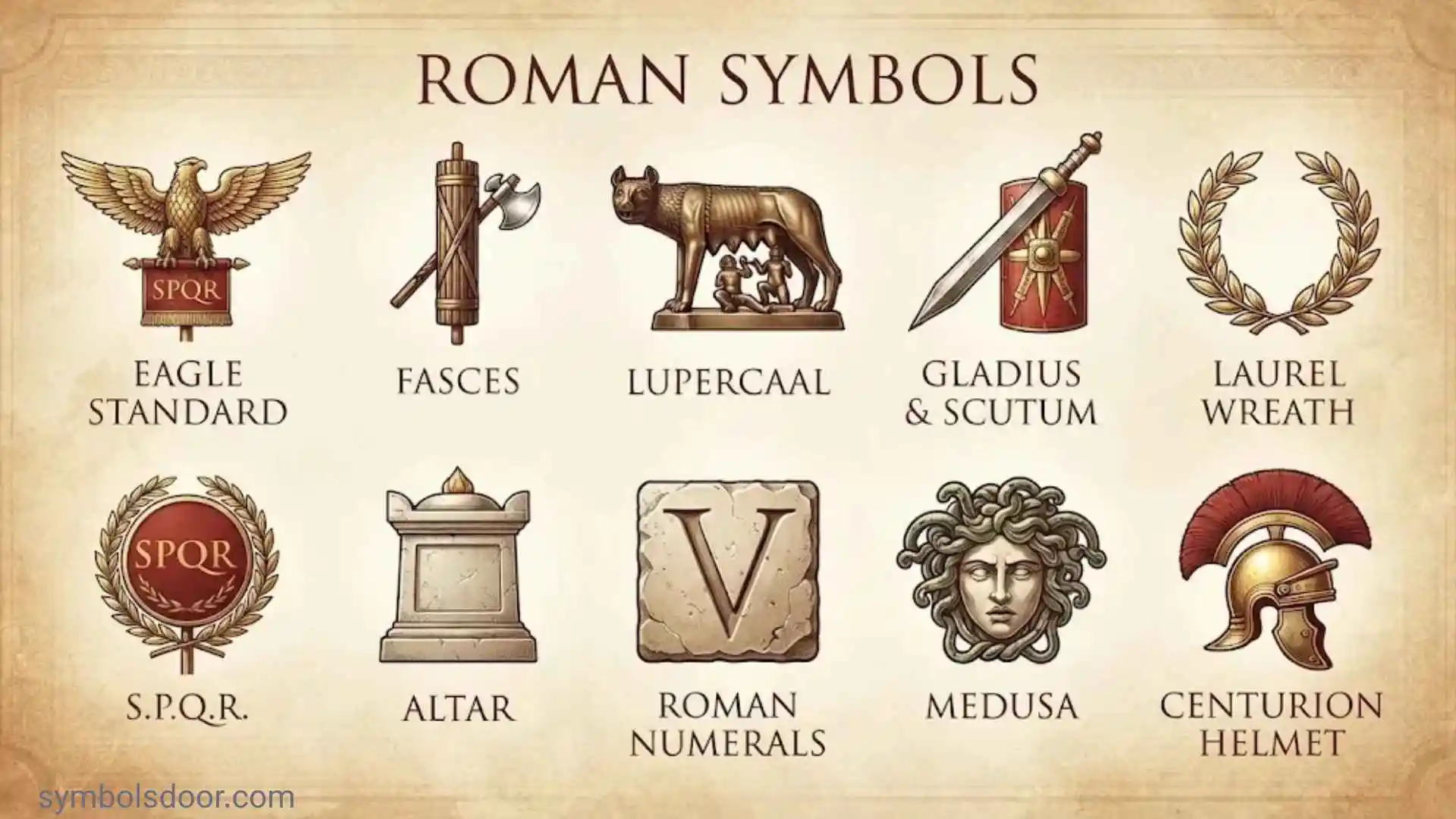
Rome’s identity is written into its monuments, buildings, sculptures, coins, and public spaces. From the letters SPQR carved into ancient stone to the eagle carried by Roman legions, its symbols tell stories about political power, military victories, religion, and the city’s legendary beginnings.
Some Roman symbols originated during the Roman Republic and Empire. Others appeared centuries later through Christianity, the papacy, Renaissance art, and the influence of noble families. Rome also preserves impressive Egyptian monuments, including ancient obelisks that Roman emperors transported from Egypt.
Understanding these different origins helps you read Rome’s visual history more accurately. A she-wolf may recall the legendary founding of the city, while crossed keys represent papal authority. An Egyptian obelisk may carry pharaonic inscriptions alongside Christian additions made much later.
This guide explores the most recognizable symbols of Rome, their historical meanings, and the places where you can still see them today.
What Do Roman Symbols Represent?
Roman symbolism refers to the use of images, objects, animals, inscriptions, and architectural details to communicate ideas about Roman society. These symbols helped people recognize political institutions, military units, religious beliefs, rulers, and important families.
Ancient Romans used visual symbols in almost every part of public life. They appeared on coins, statues, military equipment, temples, triumphal arches, and official monuments.
Their meanings depended on the period and setting. An eagle on a legionary standard had a military meaning, while an eagle connected with Jupiter carried religious associations.
The Main Types of Ancient Roman Symbols
The most important ancient Roman symbols can be grouped into several categories:
- Political symbols: SPQR, official inscriptions, imperial portraits, and civic emblems.
- Military symbols: The Roman eagle, legionary standards, shields, and victory imagery.
- Mythological symbols: The Capitoline Wolf, Romulus, and Remus.
- Religious symbols: Sacred animals, gods, ritual objects, and temple imagery.
- Imperial symbols: Laurel wreaths, triumphal monuments, and images of emperors.
- Papal symbols: Crossed keys, papal coats of arms, and Christian crosses.
- Family symbols: Noble coats of arms, family crests, and the Barberini bees.
- Egyptian symbols: Obelisks, hieroglyphs, and solar imagery preserved in Rome.
These categories overlap. For example, an obelisk began as an Egyptian religious and royal monument, but Roman emperors later used it to communicate conquest and imperial authority.
How Roman Symbols Changed Through History
Rome’s visual identity developed over many centuries. Its symbols changed as the city’s political and religious institutions changed.
| Historical period | Important symbols and visual features |
| Roman Kingdom and early Rome | Foundation legends, sacred animals, early religious imagery |
| Roman Republic | SPQR, civic inscriptions, magistrates, military standards |
| Roman Empire | Imperial portraits, eagles, laurel wreaths, triumphal monuments |
| Late Roman Empire | Christian imagery, imperial religious symbols, monumental crosses |
| Medieval Rome | Papal emblems, church symbols, family heraldry |
| Renaissance Rome | Reused ancient monuments, noble coats of arms, restored obelisks |
| Baroque Rome | Papal symbols, monumental fountains, elaborate family emblems |
This historical development matters because not every symbol found in Rome is an original emblem of the ancient Roman state.
Famous Roman Symbols and Their Meanings
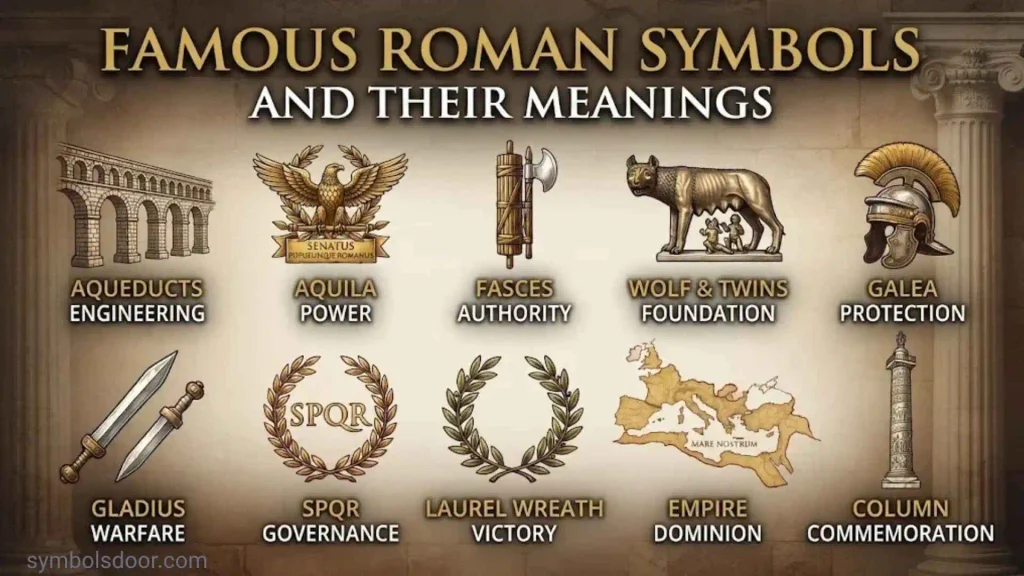
The following symbols represent different parts of Roman history. Some are closely connected with ancient political institutions, while others reflect mythology, Christianity, or later family traditions.
| Roman symbol | Main historical association | Common meaning |
| SPQR | Roman state | Civic and political identity |
| Roman eagle | Roman legions and Jupiter | Military power and authority |
| Capitoline Wolf | Romulus and Remus legend | Rome’s legendary origins |
| Laurel wreath | Roman triumphs and honor | Victory and achievement |
| Coats of arms | Medieval and Renaissance families | Heritage and prestige |
| Barberini bees | Barberini family | Family identity and influence |
| Crossed keys | Saint Peter and the papacy | Spiritual authority |
| Christian cross | Christianity | Faith and salvation |
| Egyptian obelisks | Ancient Egypt and Roman imperial reuse | Solar symbolism and imperial power |
| Egyptian hieroglyphs | Egyptian royal and religious traditions | Pharaohs and divine authority |
SPQR – The Senate and the Roman People
Meaning: Civic identity, political authority, and the Roman state.
SPQR is among the most recognizable Roman symbols. It stands for the Latin phrase Senatus Populusque Romanus, which translates as “The Senate and the Roman People.”
The phrase represented the Roman state and its political community. It connected two important parts of Roman government: the Senate and the citizens of Rome.
During the Roman Republic, the Senate played a major role in public affairs, while the Roman people participated in political life through assemblies and other institutions.
SPQR appeared in official inscriptions, public monuments, military contexts, and other expressions of state authority. It continued to be used during the Roman Empire, even as emperors gained increasing control over government.
What SPQR represents:
- The authority of the Roman state.
- The relationship between the Senate and citizens.
- Civic identity and public responsibility.
- Political continuity.
- The shared name of Rome’s governing community.
The phrase is still visible around modern Rome. You can find SPQR on municipal buildings, public infrastructure, and manhole covers.
Its modern use connects the present-day city with its ancient history. It is not simply a decorative abbreviation; it remains a recognizable expression of Roman civic identity.
Roman Eagle – Military Power and Imperial Authority
Meaning: Strength, military loyalty, victory, and authority.
The eagle was one of the most important animals in Roman public and religious life. It was associated with Jupiter, the chief Roman god, and became a central emblem of Roman military identity.
The most important military version was the aquila, the eagle standard carried by a Roman legion.
A legion’s eagle was more than a decorative object. It represented the honor, identity, and unity of the entire military unit. Losing the standard was considered a serious disgrace.
Roman soldiers guarded their standards, and the eagle accompanied the legion during campaigns. Its presence helped soldiers recognize their unit and gave them a shared symbol to follow in battle.
The eagle also appeared in imperial imagery. Roman emperors used it to communicate military success, divine associations, and the strength of the state.
What the Roman eagle symbolizes:
- Military strength and discipline.
- Loyalty to the legion.
- Victory and conquest.
- Imperial authority.
- Association with Jupiter and divine power.
The eagle continued to influence later European heraldry and political imagery. However, the Roman aquila should be understood first as a specific military standard, not simply as a general bird emblem.
She-Wolf of Rome – Romulus and Remus
Meaning: Rome’s legendary foundation, survival, protection, and civic identity.
The she-wolf is one of the most recognizable symbols that represent the city of Rome. Its meaning comes from the legendary story of Romulus and Remus, the twin brothers traditionally credited with founding the city.
According to Roman legend, the twins were the sons of Rhea Silvia and the god Mars. They were abandoned as infants near the River Tiber. A she-wolf discovered them and, in the familiar story, nursed and protected them.
A shepherd later found the children and raised them.
When the brothers grew older, they decided to establish a city. Their rivalry eventually led to conflict, and Romulus killed Remus in the traditional account. Romulus became the city’s legendary first king.
Roman tradition places the founding of Rome in 753 BCE. This date is important in Roman historical tradition, although the foundation story itself is a legend rather than a fully documented historical event.
What the she-wolf represents:
- The legendary origins of Rome.
- Protection and survival.
- The strength of the Roman people.
- Ambition and rivalry.
- The city’s cultural identity.
The famous bronze sculpture known as the Capitoline Wolf depicts the animal with Romulus and Remus beneath her.
The sculpture is preserved in the Capitoline Museums. The history of the bronze has been debated, particularly the dating of the wolf figure and the later-added twins. The museum’s historical collection also connects the sculpture with the development of Rome’s civic identity. <FileCite ref=”turn398411search2″ />
Laurel Wreath – Victory, Honor, and Achievement
Meaning: Military victory, honor, prestige, and public recognition.
The laurel wreath was an important symbol of achievement in Roman culture. It was made from the leaves of the laurel tree and appeared in representations of victorious generals, emperors, and honored individuals.
Roman triumphs were major public ceremonies celebrating military success. A victorious general could be honored with a triumphal procession through Rome, accompanied by soldiers, captured objects, and displays of victory.
Laurel imagery became closely connected with these celebrations. Roman emperors also appeared wearing laurel wreaths on coins and sculptures, presenting themselves as successful leaders.
The wreath had earlier associations with the Greek god Apollo, but Roman culture developed its own political and military uses for the image.
What the laurel wreath symbolizes:
- Military victory.
- Honor and glory.
- Achievement and success.
- Leadership and prestige.
- Public recognition.
The laurel wreath remains familiar today in academic awards, medals, and decorative designs. Its modern meaning of achievement reflects a long history of classical influence.
Roman Coats of Arms and Family Crests
Meaning: Family heritage, social status, identity, and political influence.
When people search for Roman coats of arms and family crests, they may be thinking of the shields and emblems displayed on palaces, churches, and fountains throughout Rome.
These symbols mostly belong to medieval and early modern heraldic traditions. They should not be confused with the political emblems of the ancient Roman Republic.
Noble families used coats of arms to identify their households and communicate their status. Their emblems could appear on buildings, official documents, tombs, and religious foundations.
Common heraldic features included:
- Animals such as bees, lions, eagles, and dragons.
- Crowns and other signs of rank.
- Crosses and religious imagery.
- Shields and decorative patterns.
- Stars, flowers, and other identifying motifs.
A family crest could also communicate a connection with a pope, cardinal, or influential political figure.
These family symbols are especially visible in Renaissance and Baroque Rome, where wealthy families funded churches, fountains, and public buildings.
Barberini Bees – Family Heritage and Papal Influence
Meaning: Family identity, prestige, patronage, and political influence.
The three bees of the Barberini family are among the most recognizable examples of family heraldry in Rome.
The Barberini were an influential Italian family that rose to great prominence during the seventeenth century. Their most famous member was Maffeo Barberini, who became Pope Urban VIII in 1623.
The family’s coat of arms featured three bees. The emblem appeared on buildings and monuments connected with Barberini patronage.
You can look for Barberini imagery in places associated with the family’s influence, including Palazzo Barberini and parts of Rome’s monumental and religious landscape.
The bees are not a universal symbol of ancient Roman power. They identify a particular family and its historical influence.
What the Barberini bees represent:
- Family heritage.
- Social prestige.
- Political and religious influence.
- Artistic patronage.
- The family’s lasting presence in Rome.
The Barberini example shows how a relatively small decorative motif can communicate a great deal about the people who funded and shaped a city’s architecture.
Crossed Keys of Saint Peter – Papal Authority
Meaning: Spiritual authority, Saint Peter, and the Catholic Church.
The crossed keys are among the most recognizable papal symbols. They represent the keys associated with Saint Peter and his authority in Christian tradition.
The image comes from the Gospel of Matthew, where Jesus speaks to Peter about the keys of the Kingdom of Heaven.
Over time, the keys became a central part of the visual identity of the papacy. They are commonly shown as two crossed keys, often one gold and one silver, sometimes accompanied by the papal tiara.
The traditional interpretation connects the keys with spiritual authority and the responsibilities of the Church.
What the crossed keys symbolize:
- Saint Peter’s authority.
- The Keys to the Kingdom of Heaven.
- The spiritual office of the pope.
- The Catholic Church.
- Papal authority and continuity.
The crossed keys appear in Vatican imagery, papal coats of arms, and religious decorations.
They belong to Christian and papal history, not to the original political symbolism of the Roman Republic.
Christian Cross – Faith and the Transformation of Rome
Meaning: Christianity, salvation, sacrifice, and religious identity.
The Christian cross became one of the most important religious symbols in Rome as Christianity grew within the Roman world.
Early Christianity developed while the Roman Empire still followed a range of traditional religious practices. Over time, Christian communities became increasingly influential, and emperors began supporting the faith.
The reign of Constantine in the fourth century marked a major turning point in the public history of Christianity. Later emperors gave Christianity an increasingly central position in imperial religious life.
The cross eventually became a familiar feature of Roman churches, basilicas, tombs, monuments, and public religious art.
Where Christian symbolism appears in Rome:
- Church façades and entrances.
- Basilicas and chapels.
- Papal monuments.
- Religious paintings and mosaics.
- Christian inscriptions.
- Obelisks topped with crosses.
The cross is not an original symbol of the pre-Christian Roman Republic. Its importance in Rome reflects the transformation of the city’s religious and political culture over time.
Dragons – Heraldic Imagery and Noble Family Emblems
Meaning: Protection, strength, power, and family identity in later European heraldry.
Dragons appear in some European coats of arms and decorative traditions associated with Rome. However, they are not one of the main defining symbols of the ancient Roman state.
Their presence on a building or family emblem needs to be understood in its historical context. A dragon might represent a particular noble family, a religious story, or an artistic tradition rather than a general Roman belief.
In heraldry, dragons could communicate ideas such as:
- Strength and courage.
- Protection and guardianship.
- Authority and prestige.
- Mythological power.
- Family identity.
When identifying a dragon on a Roman building, look for its accompanying coat of arms or inscription. That evidence can help connect the image with a specific family or historical period.
Egyptian Symbols and Obelisks in Rome
Rome is famous for its Egyptian obelisks. These tall stone monuments connect the history of ancient Egypt with Roman imperial expansion and later Christian Rome.
An obelisk is a tall, four-sided stone pillar with a pyramid-shaped top. Ancient Egyptian rulers placed them near temples, where they were associated with the Sun, royal authority, and religious devotion.
When Rome gained control of Egypt in 30 BCE, Egyptian monuments became important symbols of imperial prestige. Roman emperors transported several obelisks to their capital and displayed them in public spaces.
The city now contains more ancient obelisks than any other city. Some were made in Egypt for pharaohs, while others were created during the Roman period using Egyptian forms and hieroglyphic traditions. <Cite refs={[“turn398411search0″,”turn398411search7”]}/>
Egyptian Obelisks – Solar Symbolism and Royal Authority
Meaning: Solar power, divine authority, royal status, and imperial prestige.
In ancient Egypt, obelisks were connected with solar religion. Their pointed tops were associated with the Sun’s rays, and they often stood in front of important temples.
Pharaohs commissioned obelisks to honor Egyptian gods and record their own achievements. Their inscriptions could include royal names, titles, religious dedications, and statements of power.
When Roman emperors brought these monuments to Rome, their meaning expanded. The obelisks became displays of Roman control over Egypt and evidence of the empire’s ability to transport and possess monumental works from distant territories.
What Egyptian obelisks in Rome represent:
- Ancient Egyptian religious traditions.
- Solar symbolism and the Sun god Ra.
- Pharaohs and royal authority.
- Roman expansion and conquest.
- Imperial prestige.
- Cultural exchange across the Mediterranean.
The monuments also demonstrate how one object can acquire different meanings in different societies. An Egyptian obelisk could begin as a sacred monument and later become part of a Roman imperial display or a Christian public square.
Egyptian Hieroglyphs on Roman Monuments
Meaning: Egyptian royal history, religious dedication, and pharaonic authority.
Egyptian hieroglyphs are a writing system that used signs representing sounds, words, and ideas. They appear on many ancient Egyptian monuments, including obelisks.
The inscriptions on Rome’s Egyptian obelisks often preserve the names and achievements of pharaohs who commissioned them. For example, the Flaminian Obelisk carries inscriptions associated with Seti I and Ramesses II.
It is important to distinguish these original Egyptian inscriptions from later additions. Some monuments also have Latin inscriptions or Christian symbols added after their arrival in Rome.
The Vatican Obelisk is a special case: it has no original hieroglyphic inscriptions. Its importance comes from its Egyptian origin, Roman history, and later position in St. Peter’s Square. <Cite refs={[“turn398411search5″,”turn398411search7”]}/>
Vatican Obelisk – The Monument in St. Peter’s Square
<AsyncImage query=”Vatican obelisk St Peters Square Rome Egyptian granite monument” aspectRatio=”16:9″ width=”100%”/>
Location: <Entity value=”St. Peter’s Square” category=”point_of_interest” location=”Vatican City”/>.
Historical significance: Egyptian antiquity, Roman imperial history, and Christian symbolism.
The Vatican Obelisk stands at the center of St. Peter’s Square. It originally came from Egypt and was brought to Rome during the reign of Emperor Caligula in 37 CE.
Caligula placed it in the area of Nero’s Circus, where it became part of the monumental landscape associated with the ancient racing venue.
Unlike many Egyptian obelisks, this one has no hieroglyphic inscriptions. Its history is therefore especially connected with its movement, reuse, and changing surroundings.
In 1586, Pope Sixtus V ordered the obelisk to be moved to its present position. Architect and engineer Domenico Fontana directed the difficult operation.
A cross was placed at its summit, giving the ancient monument a new Christian setting.
Why the Vatican Obelisk matters:
- It preserves an ancient Egyptian monument in Rome.
- It was displayed in the Roman imperial landscape.
- Its relocation helped shape the monumental design of St. Peter’s Square.
- The cross at its summit reflects Christian reinterpretation.
- It represents the connection between Egyptian, Roman, and papal history.
The obelisk shows how Renaissance Rome reused ancient monuments to communicate a new religious and political identity.
Flaminian Obelisk – Piazza del Popolo
<AsyncImage query=”Flaminian Obelisk Piazza del Popolo Rome Egyptian hieroglyphs” aspectRatio=”16:9″ width=”100%”/>
Location: <Entity value=”Piazza del Popolo” category=”point_of_interest” location=”Rome, Italy”/>.
Historical significance: Egyptian pharaohs, Augustus, and Renaissance urban planning.
The Flaminian Obelisk is one of the most important Egyptian monuments in Rome. It was originally created for the Sun temple at Heliopolis during the reigns of Seti I and Ramesses II, around the thirteenth century BCE.
Emperor Augustus brought it to Rome in 10 BCE, after the Roman conquest of Egypt. It was placed in the Circus Maximus, where it became part of a major public and imperial setting.
The obelisk carries Egyptian hieroglyphs recording the names and achievements of the pharaohs who commissioned it.
Augustus also added a Latin dedication to its base. This created a monument that combined Egyptian royal inscriptions with a Roman statement of political control.
Pope Sixtus V later ordered the obelisk’s recovery and relocation. It was erected in Piazza del Popolo in 1589, where it became a central feature of the square.
What the Flaminian Obelisk represents:
- Egyptian royal and solar traditions.
- Roman control of Egypt.
- Augustan imperial authority.
- The reuse of ancient monuments.
- Renaissance urban planning.
Its present location makes it part of the monumental entrance to Rome from the north. <Cite refs={[“turn398411search5″,”turn398411search6”]}/>
Lateran Obelisk – Piazza San Giovanni in Laterano
<AsyncImage query=”Lateran Obelisk Piazza San Giovanni in Laterano Rome” aspectRatio=”16:9″ width=”100%”/>
Location: <Entity value=”Piazza San Giovanni in Laterano” category=”point_of_interest” location=”Rome, Italy”/>.
Historical significance: Egyptian pharaohs, Roman emperors, and Christian Rome.
The Lateran Obelisk is the tallest surviving ancient Egyptian obelisk in the world. It was commissioned under the Egyptian pharaoh Thutmose III and later completed under Thutmose IV during the fifteenth century BCE.
The monument was made from red granite and decorated with hieroglyphic inscriptions. These inscriptions include royal and religious imagery.
Emperor Constantius II brought the obelisk to Rome in 357 CE. It was placed in the Circus Maximus beside the Flaminian Obelisk.
After falling and becoming buried, the monument was recovered during the sixteenth century under Pope Sixtus V. It was restored and erected near the Lateran Basilica in 1588.
A cross and other Christian additions were placed on its summit.
What the Lateran Obelisk represents:
- Ancient Egyptian royal authority.
- Roman imperial ambition.
- Christian reinterpretation of ancient monuments.
- The preservation of historical heritage.
- The transformation of Rome’s public spaces.
The obelisk is especially important because its story connects pharaonic Egypt, the Roman Empire, and the Christian papacy. <Cite refs={[“turn398411search9″,”turn398411search0”]}/>
Montecitorio Obelisk – Solar Timekeeping and Augustan Rome
<AsyncImage query=”Obelisk of Montecitorio Piazza Montecitorio Rome” aspectRatio=”16:9″ width=”100%”/>
Location: <Entity value=”Piazza di Montecitorio” category=”point_of_interest” location=”Rome, Italy”/>.
Historical significance: Egyptian solar traditions and Augustan political symbolism.
The Montecitorio Obelisk originally came from Egypt. It was commissioned under Pharaoh Psamtik II during the sixth century BCE and later transported to Rome by Augustus.
Its most interesting Roman use was as part of the Horologium Augusti, a large solar timekeeping installation in the Campus Martius.
The obelisk served as the central pointer of a monumental sundial. Its shadow moved across a marked surface, allowing the Sun’s position to be observed.
This project connected Egyptian solar imagery with Roman engineering and Augustan political messaging.
The obelisk now stands in Piazza Montecitorio, close to the Italian Parliament.
What the Montecitorio Obelisk represents:
- Egyptian solar symbolism.
- Roman engineering and astronomy.
- Augustus’s political authority.
- The relationship between time, power, and the heavens.
- The reuse of Egyptian monuments in Rome.
Obelisks in the Circus Maximus
<AsyncImage query=”Circus Maximus Rome archaeological remains ancient chariot racing track” aspectRatio=”16:9″ width=”100%”/>
The Circus Maximus was one of ancient Rome’s most important public entertainment venues. It hosted large chariot races and could accommodate enormous crowds.
The central dividing structure of the track, called the spina, carried monuments and decorative objects. These included Egyptian obelisks.
Augustus placed the Flaminian Obelisk in the Circus Maximus in 10 BCE. The Lateran Obelisk arrived centuries later under Constantius II.
Their position made them part of the visual experience of public entertainment while also displaying imperial authority.
The obelisks connected the spectacle of Roman racing with the empire’s political and religious identity.
Later, both monuments were moved to other locations in Rome. Their present settings reflect the city’s changing urban design and its long history of reusing ancient monuments. <Cite refs={[“turn398411search5″,”turn398411search9”]}/>
Roman Symbols in Architecture, Monuments, and Public Spaces
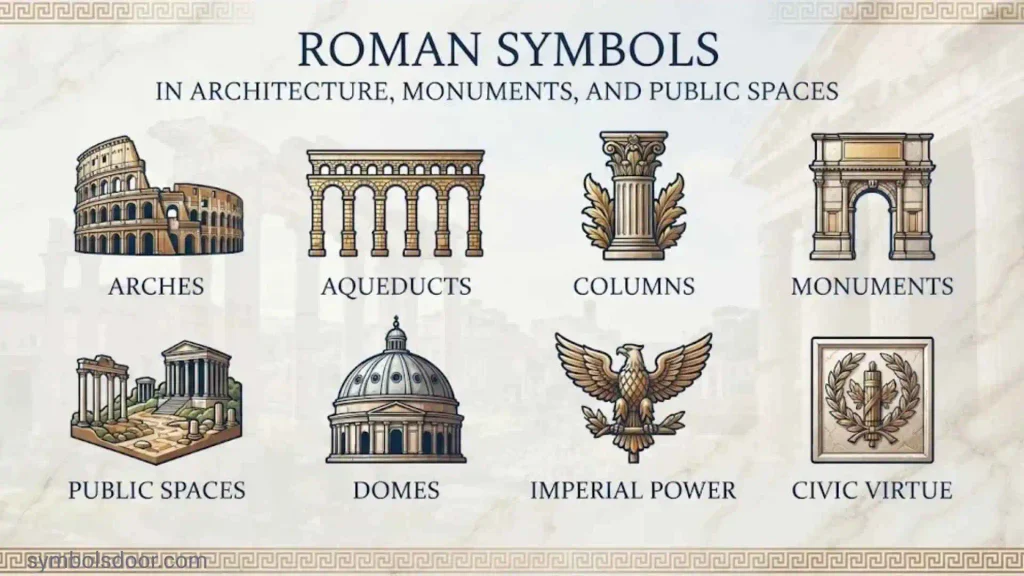
Rome’s symbols are not limited to museum objects. They are part of the city’s streets, fountains, churches, palaces, and public squares.
Roman architecture often uses inscriptions, sculptures, coats of arms, and decorative motifs to communicate historical or religious meaning.
Roman Symbols on Public Monuments and Municipal Buildings
Public monuments were important tools of visual communication in ancient Rome.
Emperors and political leaders commissioned buildings and inscriptions to record achievements, celebrate victories, and demonstrate authority.
Look for these features when examining historic Roman buildings:
- SPQR inscriptions identifying the Roman state.
- Latin inscriptions naming emperors and public officials.
- Sculpted eagles and victory imagery.
- Laurel wreaths representing honor.
- Imperial portraits and titles.
- Family coats of arms added in later periods.
These details can help identify the people or institutions responsible for a building’s construction, restoration, or decoration.
Roman Symbols on Fountains and Piazzas
<AsyncImageGroup query={[“Piazza Navona Four Rivers Fountain Rome”,”Piazza del Popolo Flaminian Obelisk Rome”,”St Peter Square Vatican obelisk aerial”,”Piazza Montecitorio obelisk Rome”]} aspectRatio=”5:4″ layout=”carousel”/>
Rome’s piazzas preserve several layers of its historical identity. Ancient monuments often stand alongside Renaissance and Baroque architecture.
Important examples include:
| Location | Important symbol or monument | Historical connection |
| Piazza del Popolo | Flaminian Obelisk | Egyptian pharaohs, Augustus, and Pope Sixtus V |
| Piazza Montecitorio | Montecitorio Obelisk | Ancient Egypt and Augustus |
| St. Peter’s Square | Vatican Obelisk | Egypt, Roman imperial history, and Christianity |
| Piazza San Giovanni in Laterano | Lateran Obelisk | Egyptian pharaohs and Christian Rome |
| Piazza Navona | Pamphili Obelisk and Four Rivers Fountain | Roman imperial reuse and Baroque papal patronage |
Piazza Navona is particularly interesting because its monumental design reflects several historical periods. The Four Rivers Fountain was commissioned under Pope Innocent X and designed by Gian Lorenzo Bernini. It is associated with the Pamphilj family, not the Barberini family.
Symbols on Church Façades and Palace Entrances
Churches and palaces often display coats of arms, religious imagery, and inscriptions.
On a church façade, you might see:
- Crossed keys representing the papacy.
- A papal tiara.
- A Christian cross.
- The coat of arms of a pope or cardinal.
- Decorative sculptures showing biblical figures.
Palace entrances may feature noble family crests, shields, animals, or other identifying motifs.
These details reveal who commissioned the building and which family or institution wanted its identity displayed publicly.
Roman Symbols in Modern Urban Life
Some symbols of Rome remain part of everyday city life.
The letters SPQR are particularly visible on municipal objects, including manhole covers and public infrastructure. The Capitoline Wolf appears in civic imagery, while Roman eagles and laurel wreaths remain familiar in historical and cultural designs.
Papal keys continue to identify the Vatican and the Catholic Church.
These examples show how ancient symbols reused in modern Rome help preserve the city’s historical identity.
How Roman Symbols Changed From Ancient Rome to the Vatican
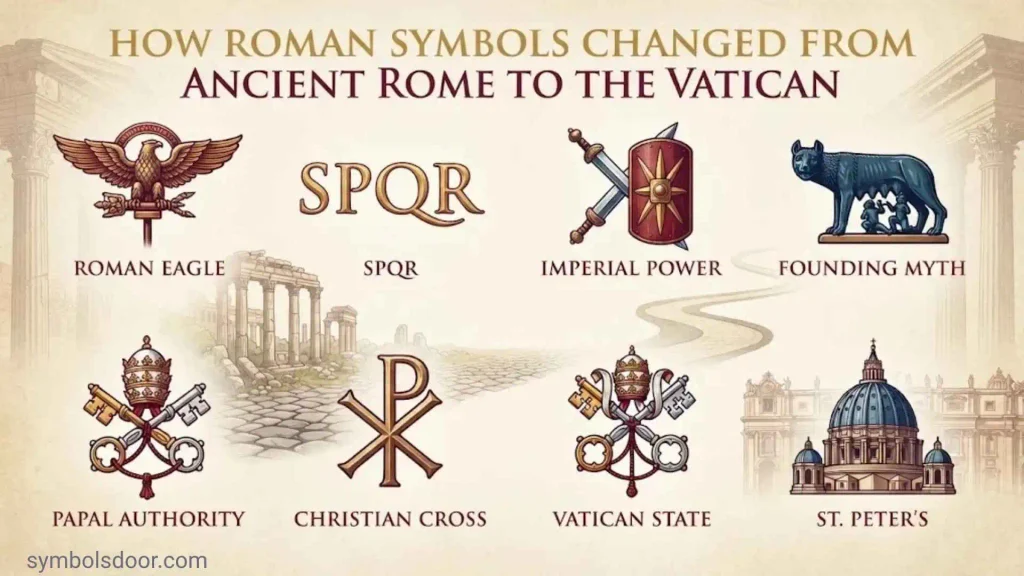
Rome’s visual identity developed through political changes, religious transformations, and artistic movements. Understanding these periods helps explain why the same city contains symbols with very different origins.
Symbols of the Roman Republic
The Roman Republic used symbols to communicate civic identity and public authority.
SPQR was particularly important because it connected the Senate and the Roman people with the Roman state.
Other features included:
- Official inscriptions.
- Republican coin designs.
- Military standards.
- Images of Roman magistrates.
- Religious objects and symbols connected with Roman gods.
These symbols emphasized the institutions and traditions of the Roman community.
Symbols of the Roman Empire
During the Roman Empire, symbols increasingly communicated the authority of individual emperors.
Imperial portraits appeared on coins and monuments. Laurel wreaths represented victory and honor, while eagle imagery reinforced military and religious power.
Augustus also used monumental architecture and public inscriptions to present his rule as a source of stability and success.
The Egyptian obelisks brought to Rome under his authority became powerful examples of imperial display. Their presence demonstrated Roman control over Egypt and connected the emperor with the symbolic power of the ancient monuments. <Cite refs={[“turn398411search6″,”turn398411search10”]}/>
Symbols of Medieval and Papal Rome
As Christianity became the dominant religion of Rome, Christian imagery transformed the city’s visual identity.
Churches, basilicas, religious monuments, and papal buildings displayed crosses and other Christian symbols.
The crossed keys became a recognizable emblem of the papacy. Papal coats of arms also appeared on buildings and monuments connected with the Catholic Church.
Ancient Roman objects were sometimes preserved and displayed in new Christian settings. This allowed later generations to connect the city’s Christian identity with its ancient past.
Symbols of Renaissance and Baroque Rome
During the Renaissance and Baroque periods, popes and wealthy families reshaped Rome’s urban landscape.
Pope Sixtus V played an important role in the relocation of ancient obelisks. Their placement in major squares helped create a new monumental layout for the city.
Noble families also used architecture to display their influence. Their coats of arms appeared on palaces, churches, and fountains.
The Barberini bees are a well-known example of this tradition.
This period created a distinctive mixture of ancient Roman monuments, Egyptian heritage, Christian symbolism, and Baroque architecture.
How to Recognize Roman Symbols When Visiting Rome
You do not need to be an archaeologist to recognize many of Rome’s historic symbols. A few simple clues can help you understand the meaning of monuments and decorative details.
Look for Latin Inscriptions
Latin inscriptions often identify rulers, public institutions, and the people responsible for a monument.
Start by looking for SPQR. Then check whether the inscription includes an emperor’s name, official title, or dedication.
Remember that Latin inscriptions and Egyptian hieroglyphs are different writing systems. Some monuments contain both because they were originally Egyptian and later reused by Roman rulers.
Identify Animals and Mythological Figures
Animals can provide useful clues about the meaning of a monument.
| Image | Possible association |
| Eagle | Jupiter, Roman military standards, imperial power |
| She-wolf | Romulus and Remus, Rome’s legendary foundation |
| Bees | Barberini family heraldry |
| Dragon | Later heraldic or mythological imagery |
| Laurel wreath | Victory, honor, and achievement |
Always examine the surrounding inscription or coat of arms before assigning a specific meaning.
Recognize Symbols on Historic Buildings
Look closely at church façades, palace entrances, fountains, and public monuments.
A shield may identify a noble family. Crossed keys may indicate a papal connection. An inscription may name the pope who commissioned a restoration.
Architectural details often reveal more than the building’s overall appearance.
Understand the Historical Period
The same monument can contain symbols from different centuries.
For example, an Egyptian obelisk may preserve pharaonic hieroglyphs, carry a Latin inscription added under a Roman emperor, and display a Christian cross installed by a pope.
This is not a contradiction. It is evidence of the monument’s changing role.
When studying Roman symbols in art and architecture, always ask three questions:
- Who originally created the object?
- Who moved, restored, or modified it?
- What did it mean in each historical period?
Frequently Asked Questions About Roman Symbols
What Are the Most Famous Roman Symbols?
Some of the most recognizable symbols are SPQR, the Roman eagle, the Capitoline Wolf, and the laurel wreath.
The crossed keys of Saint Peter and Egyptian obelisks are also prominent in Rome, although they belong to Christian and Egyptian traditions rather than the original Roman Republic.
What Does SPQR Mean in Rome?
SPQR stands for Senatus Populusque Romanus, meaning “The Senate and the Roman People.”
It expressed the identity and authority of the Roman state. Today, the abbreviation remains visible on municipal objects and public infrastructure throughout Rome.
Why Is the Eagle a Symbol of Rome?
The eagle was associated with Jupiter and became the emblem of the Roman legionary standard known as the aquila.
It represented military loyalty, strength, victory, and the authority of Rome’s armed forces.
What Does the She-Wolf of Rome Represent?
The she-wolf represents the legendary story of Romulus and Remus, the twin brothers associated with Rome’s foundation.
It has become a powerful symbol of Rome’s origins, survival, and civic identity.
What Is the Meaning of the Capitoline Wolf?
The Capitoline Wolf is a bronze representation of the she-wolf from the Romulus and Remus legend.
It is one of Rome’s best-known civic images and is preserved in the Capitoline Museums.
What Does the Laurel Wreath Mean in Ancient Rome?
The laurel wreath represented victory, honor, and public recognition.
It was associated with successful military leaders and Roman triumphal traditions. Emperors also wore laurel wreaths in coins and sculptures.
What Do the Barberini Family Bees Mean?
The three bees are the heraldic emblem of the Barberini family.
They became especially prominent during the papacy of Pope Urban VIII and appear on buildings and monuments associated with the family’s patronage.
What Do the Crossed Keys of Saint Peter Mean?
The crossed keys represent Saint Peter and the keys to the Kingdom of Heaven in Christian tradition.
They became a central symbol of papal authority and the Catholic Church.
Why Does Rome Have Egyptian Obelisks?
Roman emperors transported Egyptian obelisks to Rome after the conquest of Egypt.
They displayed these monuments as evidence of imperial power and control. Later popes restored and relocated many of them to major squares.
How Did Egyptian Obelisks Reach Rome?
Emperors arranged for the large stone monuments to be transported from Egypt across the Mediterranean and up the River Tiber.
Their movement required specialized ships, engineering, and enormous labor. Augustus brought several important obelisks to Rome, including the Flaminian Obelisk.
What Do Egyptian Hieroglyphs on Roman Monuments Mean?
The hieroglyphs usually preserve Egyptian royal names, titles, religious dedications, and statements honoring pharaohs.
They are original Egyptian inscriptions, not Latin Roman writing. Some monuments also have later Roman or Christian additions.
Who Moved the Vatican Obelisk?
Pope Sixtus V ordered the Vatican Obelisk to be moved to St. Peter’s Square in 1586.
Domenico Fontana directed the engineering operation.
What Is the Difference Between Roman and Papal Symbols?
Roman symbols originally represented ancient Roman political, military, religious, or civic traditions.
Papal symbols belong to the Catholic Church and the authority of the pope. SPQR and the Roman eagle are examples of Roman state symbolism, while the crossed keys represent the papacy.
Are Roman Symbols Still Used Today?
Yes. SPQR, the Capitoline Wolf, laurel wreaths, and Roman eagle imagery remain recognizable.
Papal keys, Christian crosses, and noble family coats of arms are also visible throughout Rome. They reflect the city’s later religious and cultural history.
Conclusion: The Lasting Meaning of Roman Symbols
The symbols of Rome tell a story that stretches across centuries. SPQR represents the Roman state and its civic identity. The eagle recalls the military power of the legions, while the Capitoline Wolf connects the modern city with its legendary foundation.
Other symbols reveal later chapters of Roman history. The Barberini bees preserve the identity of an influential noble family, and the crossed keys communicate the spiritual authority of Saint Peter and the papacy.
Egyptian obelisks add another layer to the city’s history. Originally created for Egyptian pharaohs, they became monuments of Roman imperial power and were later incorporated into Christian squares and public spaces.
Understanding these Roman symbols and their meanings helps you look beyond the surface of Rome’s famous buildings and monuments. Each inscription, sculpture, coat of arms, and decorative detail can reveal something about the people who created, used, or transformed it.
Rome’s visual identity is not the product of one age. It is a record of ancient civilization, imperial ambition, religious change, and artistic achievement.

Hi, I’m Sienna Brooks, and I believe that the right words can inspire, comfort, and empower people at every stage of life. For as long as I can remember, I’ve been drawn to meaningful quotes and the stories behind them. I love curating collections of inspirational, motivational, and heartfelt quotes that resonate with readers around the world.
Through my writing, I strive to help others find encouragement, whether they’re celebrating life’s happiest moments or navigating its biggest challenges. I believe that wisdom is timeless, and I’m passionate about sharing words that leave a lasting impact.
I am the author of Reflections in Words and The Journey of Inspiration, two books dedicated to exploring the beauty and power of timeless quotes.
 Rowan Sinclair Rowan Sinclair
 Asher Monroe