Ares is one of the most powerful and recognizable figures in Greek mythology. Known as the Greek god of war, he represents the violent, aggressive, and destructive side of battle. Ancient stories portray him as a fierce warrior who thrives on conflict, physical strength, and the chaos of warfare.
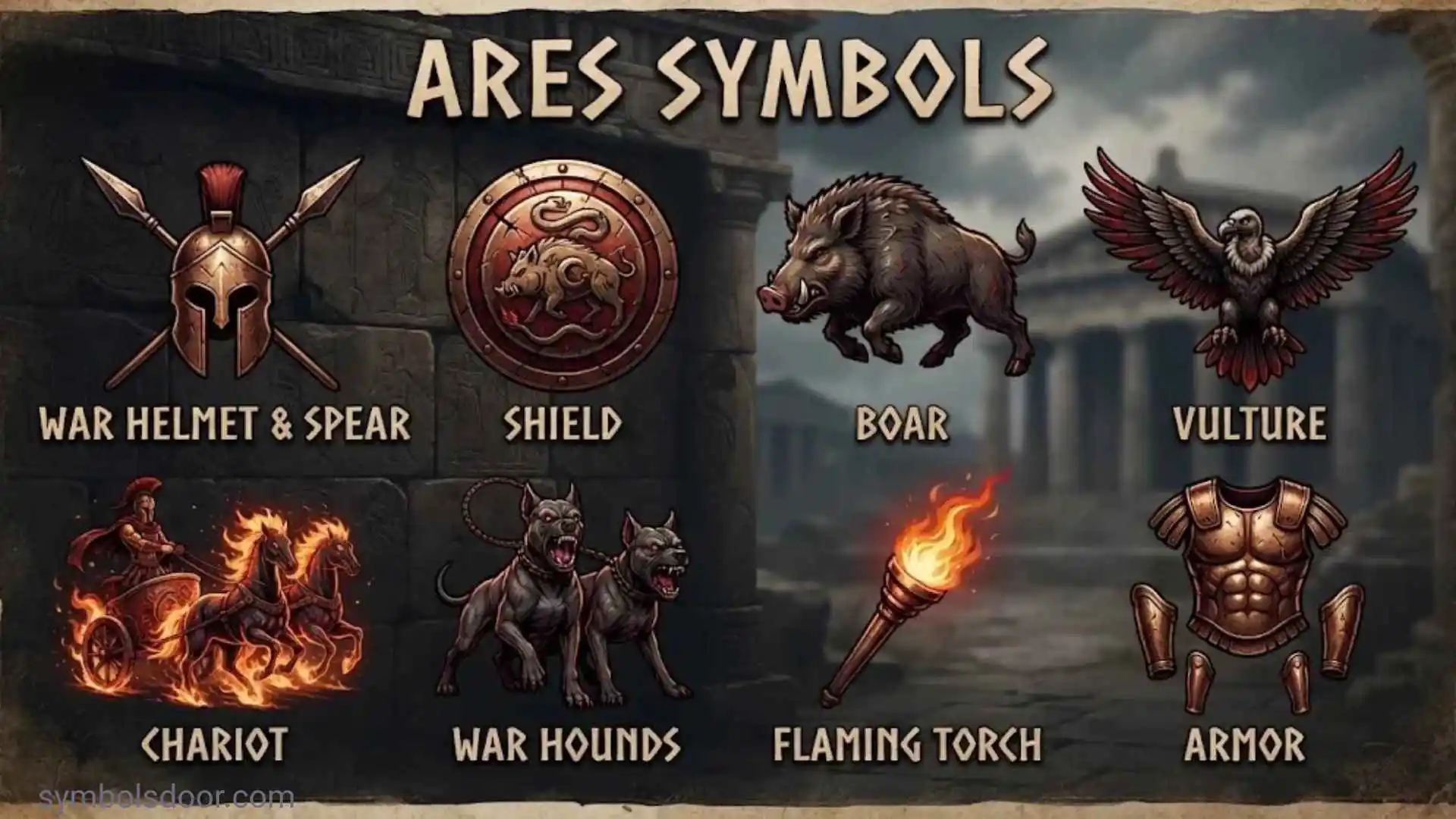
The symbols of Ares reflect this identity. His spear represents attack and aggression, while his helmet and shield connect him with protection and military readiness. His armor and war chariot also reinforce his image as a powerful battlefield figure. Traditional animal associations include the serpent, vulture, and certain owls.
However, Ares represents more than weapons and fighting. His mythology explores courage, anger, fear, competition, and the consequences of uncontrolled aggression. His complicated relationships with other gods, especially Athena and Aphrodite, reveal different sides of his character.
In this guide, you’ll discover the most important Ares symbols and their meanings, their connections to ancient Greek religion, and how people interpret them today. You’ll also learn about his sacred animals, colors, family, powers, famous myths, and modern tattoo symbolism.
Who Is Ares in Greek Mythology?
Ares was one of the Twelve Olympian gods in ancient Greek mythology. He was the son of Zeus, king of the gods, and Hera, queen of Olympus. His main domain was warfare, particularly the violent and destructive aspects of armed conflict.
Unlike Athena, who represented military strategy and wise leadership, Ares embodied the physical struggle of battle. He was associated with aggression, bloodshed, courage, and the excitement of combat.
Ancient Greek writers did not always portray him as a noble or admirable god. Many stories describe him as impulsive, difficult to control, and eager to fight. In Homer’s Iliad, even Zeus expresses strong dislike for his son’s destructive behavior.
Despite this reputation, Ares remained an important Olympian deity. His power represented a reality of ancient life: warfare could bring victory and protection, but it could also cause suffering, destruction, and death.
Ares’s Role as the Greek God of War
Ares represented the violent side of warfare. His influence extended across several aspects of conflict, from physical fighting to the emotions that drive people into battle.
His main areas of association included:
- Battle and combat: Physical fighting between warriors and armies.
- Aggression: Anger and hostility that can lead to armed conflict.
- Courage: The bravery needed to face dangerous opponents.
- Bloodshed: Injuries, deaths, and suffering caused by warfare.
- Military power: The strength and force of armed warriors.
- Fear and terror: The emotions that spread through soldiers during battle.
- Destruction: The damage caused by fighting and the fall of cities.
Ares was not simply a god who controlled weapons. He represented the emotional and destructive energy behind armed conflict.
His mythology also connects him with fear and panic through his sons, Phobos and Deimos. Their names are commonly translated as Fear and Terror. They accompany their father in several descriptions of battle, showing how closely Ares’s identity connects with the psychological effects of warfare.
Ares’s Parents and Family Tree
Ares belonged to the central family of Greek mythology. His parents were Zeus and Hera, two of the most powerful Olympian gods.
His relationship with Aphrodite is especially famous. Aphrodite was the goddess of love and beauty, and the two became lovers despite her marriage to Hephaestus in a well-known myth.
Their children and other family connections appear in different ancient traditions. Greek mythology does not always provide one consistent family tree, so some details vary between sources.
| Family member | Relationship to Ares | Mythological role |
| Zeus | Father | King of the Olympian gods |
| Hera | Mother | Queen of the gods |
| Aphrodite | Lover and consort | Goddess of love and beauty |
| Phobos | Son | Personification of fear |
| Deimos | Son | Personification of terror |
| Harmonia | Daughter | Goddess associated with harmony |
| Athena | Half-sister | Goddess of wisdom and strategic warfare |
Ares’s children Phobos and Deimos are particularly important to his symbolism. They represent the fear and terror that accompany battle.
Harmonia offers a different image. Her name connects with harmony and balance, creating an interesting contrast with the violence associated with her father.
Ares’s Personality and Characteristics
The personality of Ares is more complicated than the image of a fearless warrior.
Ancient Greek literature often describes him as aggressive, passionate, and quick to anger. He enjoys the noise and excitement of battle, but his enthusiasm for fighting does not always lead to wise decisions.
His main personality traits include:
- Aggression: A strong desire to fight and confront opponents.
- Courage: A willingness to enter dangerous battles.
- Impulsiveness: A tendency to act without carefully considering the consequences.
- Passion: Powerful emotions and intense reactions.
- Pride: Confidence in his strength and divine status.
- Competitiveness: A desire to prove his power against rivals.
- Violence: A close connection with destructive behavior and physical conflict.
Ares is sometimes interpreted as a symbol of strength without enough self-control. His stories show that bravery and physical power do not always guarantee victory.
Ares’s Powers and Abilities
As an immortal Olympian god, Ares possessed supernatural abilities far beyond those of ordinary human warriors.
His powers were closely connected to warfare and divine strength.
Immortality: Ares could not die from ordinary mortal injuries or aging. He was an Olympian deity, not a human warrior.
Superhuman strength: He possessed extraordinary physical power and could fight other gods and powerful mythological beings.
Combat ability: Ancient literature presents him as a formidable fighter who used weapons such as a spear and sword.
Battle influence: He could enter conflicts between gods and mortals, support one side, and attack another.
Fear and aggression: His presence was associated with terror, panic, and the violent emotions of battle.
Divine endurance: He could withstand injuries that would be fatal to ordinary warriors.
However, Ares was not invincible. In the Iliad, the mortal warrior Diomedes wounds him with Athena’s assistance. This episode shows that even an Olympian god could suffer defeat in mythological combat.
Ares Symbols and Their Meanings
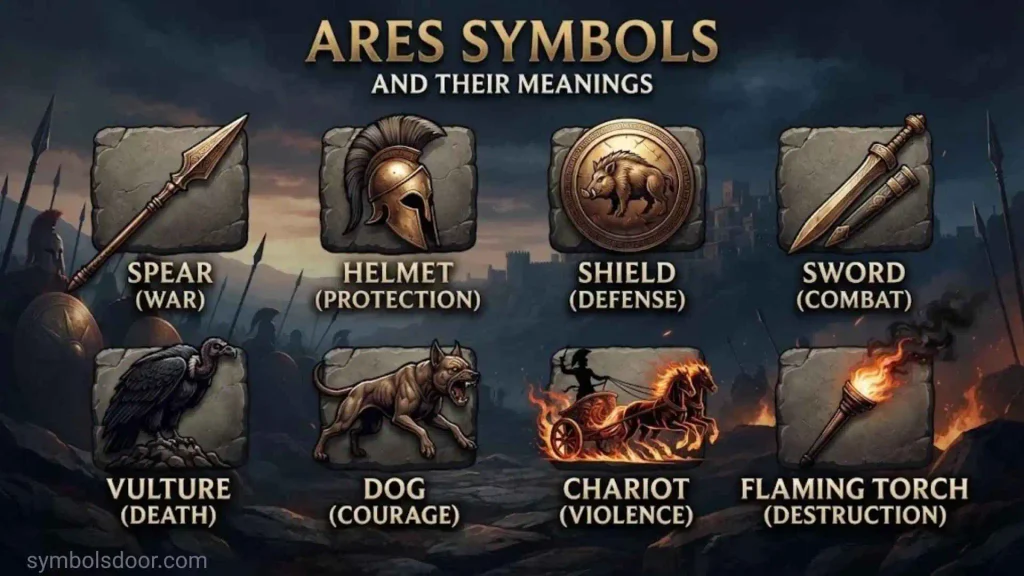
The Ares symbols are closely connected to his appearance as an armed warrior. Ancient Greek artists commonly represented him with a helmet, spear, shield, and armor.
These objects were also ordinary elements of Greek military equipment. They were not exclusive to Ares, but their repeated appearance in his representations helped audiences recognize his identity.
Theoi’s reference collection identifies the crested helmet and war spear as his standard attributes. The shield, armor, and sometimes a sword also appear in ancient descriptions and artwork.
Spear of Ares: Symbol of War and Aggression
The spear is one of Ares’s most recognizable attributes. Ancient Greek literature frequently describes him carrying a bronze-tipped spear into battle.
In Homer’s Iliad, Ares uses his spear during his involvement in the Trojan War. He charges into combat with the weapon, reflecting his aggressive and confrontational nature.
Ares spear symbolism centers on attack, military power, and direct confrontation.
The spear can represent:
- Aggression: The willingness to attack an opponent.
- Battle readiness: Preparation for armed conflict.
- Military power: The strength of an armed warrior.
- Courage: The willingness to face danger directly.
- Determination: The drive to continue fighting despite resistance.
In modern symbolic interpretations, a spear can also represent standing up for yourself and confronting difficult challenges.
However, its traditional connection with Ares is primarily warfare and direct combat. The spear was common equipment among ancient Greek warriors, so it was not a weapon used by Ares alone.
Ares Shield: Symbol of Defense and Protection
The shield is another important part of Ares’s warrior equipment.
Ancient Greek soldiers used shields to protect themselves from spears, arrows, and swords. A shield also helped warriors defend their positions and protect other members of their formation.
Ares is frequently depicted carrying a shield alongside his spear and helmet.
The Ares shield meaning is closely connected with:
- Protection during battle.
- Defense against enemies.
- Survival in dangerous situations.
- Military strength.
- Preparation for conflict.
A shield can also symbolize emotional protection in modern interpretations. Someone using it as a personal symbol may associate it with resilience, healthy boundaries, or defending people they care about.
One important detail: Ares did not have one universal shield design. Ancient artists sometimes decorated shields with different emblems, but these designs were not all exclusive to the god.
Ares Helmet: Symbol of Warrior Strength
The helmet is one of the most recognizable parts of Ares’s appearance.
Ancient Greek artwork often depicts him wearing a crested or peaked helmet. Some representations show a decorative plume, while others show him holding his helmet rather than wearing it.
A helmet helped protect a warrior’s head during combat. Its appearance also communicated military identity and readiness.
Ares helmet symbolism commonly includes:
- Courage under pressure.
- Protection from danger.
- Warrior identity.
- Discipline and preparation.
- Physical strength.
In modern artwork and tattoo designs, the helmet often represents the warrior spirit.
It can also symbolize mental toughness: the ability to remain focused when facing difficult situations.
Ares Armor: Symbol of Strength and Battle Readiness
Ares is frequently represented wearing shining armor.
Ancient descriptions associate him with a helmet, breastplate, war belt, shield, and protective leg armor called greaves. These elements create the image of a fully equipped divine warrior.
The Ares armor symbolism connects with physical protection, military power, and preparation for battle.
Armor can represent several ideas:
- Strength: The ability to withstand physical challenges.
- Protection: Defending the body against attacks.
- Discipline: Preparing carefully before entering a dangerous situation.
- Readiness: Being equipped to face conflict.
- Endurance: Continuing through difficult circumstances.
Bronze has a direct historical connection with ancient Greek weapons and protective equipment. It was widely used in ancient military gear, although the materials and designs changed over time.
In modern interpretations, bronze armor can symbolize durability, experience, and resilience.
Ares Sword: Symbol of Combat and Destruction
The sword is another weapon associated with Ares in ancient literary and artistic representations.
Although the spear is one of his most consistent attributes, stories also describe him using a sword during close combat.
A sword represents direct physical confrontation. Unlike a spear, which can be used to attack from a greater distance, a sword is commonly associated with fighting at close range.
The Ares sword meaning includes:
- Physical power.
- Aggression and conflict.
- Victory and defeat.
- Determination.
- The destructive consequences of warfare.
A sword can also represent justice and personal strength in modern symbolic artwork. However, its connection with Ares remains rooted in armed combat rather than a universal idea of justice.
Ares Chariot: Symbol of Battlefield Power
Ares is also associated with a magnificent war chariot drawn by four powerful horses.
Ancient mythological descriptions portray the chariot as a divine vehicle that carries him into battle. Some sources describe the horses as fiery or supernatural.
The horses are traditionally named:
| Horse | Name or symbolic association |
| Aithon | Burning or blazing |
| Phlogios | Flame |
| Konabos | Tumult or battle noise |
| Phobos | Fear |
The names and details vary across ancient accounts, so they should not be treated as a single universally fixed list.
The Ares chariot symbolism includes:
- Military strength.
- Rapid movement into battle.
- The power of an advancing army.
- Destruction and conflict.
- The momentum of warfare.
In ancient Greece, chariots also held important military, ceremonial, and cultural roles. Ares’s divine chariot combines familiar warrior imagery with the supernatural power of an Olympian god.
Ares Torch: A Secondary Symbol of Fire and Destruction
The torch sometimes appears in older lists of attributes associated with Ares, but it is not as firmly established as his spear, helmet, or shield.
Fire has a long symbolic connection with destruction. It can consume buildings, damage property, and turn peaceful places into dangerous environments.
In modern Ares-inspired imagery, a torch may therefore represent:
- Destruction caused by war.
- The outbreak of conflict.
- Aggression and intense energy.
- The dangerous consequences of violence.
It is best to treat the torch as a secondary or less consistent association rather than one of Ares’s main identifying attributes.
Main Ares Symbols at a Glance
| Ares symbol | Traditional connection | Common modern interpretation |
| Spear | Main weapon of the war god | Aggression, courage, direct action |
| Helmet | Standard warrior attribute | Protection and warrior identity |
| Shield | Defensive equipment | Safety and resilience |
| Armor | Divine battle clothing | Strength and endurance |
| Sword | Weapon used in combat | Confrontation and power |
| Chariot | Divine transportation into battle | Military force and momentum |
| Torch | Secondary association in some lists | Fire and destruction |
Ares Animal Symbols and Their Meanings
Animals appear throughout Greek mythology as symbols of divine power, personality, and religious identity.
Several animals are traditionally associated with Ares. Ancient sources do not always provide the same list, so it is important to distinguish well-attested sacred animals from later popular interpretations.
The serpent has a particularly clear connection in surviving mythological traditions. The vulture and certain owls also appear in descriptions of animals associated with the god.
Ares Serpent: Symbol of Danger and Power
The serpent is identified as a sacred animal of Ares in traditional accounts.
Several myths connect the god with powerful serpents and dragons. One example is the dragon that guards the Golden Fleece in Colchis. Another is the Ismenian dragon, which guards a sacred spring near Thebes.
Ares’s association with serpents also appears in artistic representations. Some images show him holding a snake or displaying a serpent on his shield.
The Ares serpent symbolism can include:
- Danger and destructive power.
- Protection of sacred places.
- Fear and intimidation.
- Strength and aggression.
- The threatening side of nature.
The serpent was not exclusive to Ares. It appeared in the mythology of many Greek deities and heroes, often with different meanings.
Ares Vulture: Symbol of Death and the Battlefield
The vulture has a strong connection with death and the aftermath of warfare.
Vultures feed on dead animals, including bodies left after battles. Their presence around ancient battlefields made them powerful images of mortality and destruction.
The vulture symbolism associated with Ares reflects:
- Death and bloodshed.
- The aftermath of battle.
- Destruction.
- The harsh reality of warfare.
- The relationship between violence and mortality.
The vulture is therefore a fitting animal association for a god connected with the destructive consequences of armed conflict.
Ares Owl: Symbol of War and Ill Fortune
Certain owls, including the eagle owl and barn owl, appear in traditional lists of animals associated with Ares.
In ancient Greek culture, birds could carry symbolic meanings and serve as omens. Some birds were interpreted as signs of danger, conflict, or misfortune.
The association between Ares and these owls connects them with the threatening side of warfare.
It is important not to confuse these associations with Athena’s owl. The owl is much more widely recognized as an attribute of Athena, where it represents wisdom and knowledge.
The same broad animal group can carry different meanings depending on the deity and mythological context.
Ares Woodpecker: A Less Familiar Animal Association
The woodpecker is a less familiar animal connected with Ares in traditional mythological material.
Some accounts describe it as a bird of good fortune associated with the god. This is a useful reminder that not every animal connected with Ares represents violence or death.
The woodpecker’s association is less prominent in modern popular descriptions than the serpent or vulture.
Ares Dog and Boar: Popular but More Complicated Associations
Dogs and boars sometimes appear in lists of animals associated with Ares. Their connections, however, require some explanation.
Dogs were important in ancient Greek life. They guarded homes, helped hunters, and appeared in various religious and cultural settings. Some traditional descriptions connect dogs with Ares, and later accounts associate them with the war god’s fierce character.
The boar has a more specific mythological connection through the story of Adonis. In one version, Ares transforms into a boar and kills the young hunter after becoming jealous of Aphrodite’s affection for him. Other versions of the story do not identify Ares as the animal.
The boar’s connection with Ares is therefore tied to a particular mythological tradition rather than a universal sacred-animal rule.
| Animal | Traditional connection | Symbolic interpretation |
| Serpent | Sacred animal of Ares; appears in myths about sacred dragons | Danger, power, and protection |
| Vulture | Associated with the battlefield and ill omens | Death and destruction |
| Eagle owl | Appears in traditional animal lists | War and misfortune |
| Barn owl | Appears in traditional animal lists | Omen and conflict |
| Woodpecker | Described as a bird of good fortune | Protection and good fortune |
| Dog | Appears in some traditional lists | Loyalty, alertness, and aggression |
| Boar | Connected with one version of the Adonis myth | Fierceness and destructive force |
Ares Colors and Their Symbolic Meanings
There is no universally established ancient Greek color palette assigned to Ares.
However, modern artists frequently use red, black, bronze, and dark metallic colors to communicate his association with warfare.
These choices are visual interpretations inspired by ancient weapons, battle scenes, and the destructive themes of his mythology.
Red: Symbol of Blood, War, and Passion
Red is one of the most recognizable colors in modern Ares-inspired artwork.
It can represent blood, danger, fire, anger, and intense emotion. The connection with Ares makes red a natural choice for artwork focused on battle and aggression.
Modern red symbolism associated with Ares includes:
- Bloodshed and warfare.
- Courage and passion.
- Aggression and anger.
- Energy and determination.
- The intensity of combat.
Red is especially common in mythology-inspired tattoos and digital illustrations.
Black: Symbol of Death and Destruction
Black often represents the darker side of warfare.
It can communicate death, danger, mystery, and destruction. Artists may combine black with red to create a dramatic image of Ares.
In modern symbolic interpretations, black can represent:
- The destructive consequences of conflict.
- Fear and intimidation.
- Death and mortality.
- Power and authority.
- Emotional darkness.
Black also creates a strong contrast with bronze or gold-colored armor.
Bronze: Symbol of Ancient Weapons and Armor
Bronze has a direct historical connection with ancient Greek military equipment.
Ancient Greek warriors used bronze for helmets, armor, shields, and weapons. The material is therefore closely connected with the visual identity of the ancient warrior.
Bronze armor symbolism includes:
- Strength and durability.
- Ancient military traditions.
- Protection.
- Warrior identity.
- Physical power.
Bronze is especially suitable for historically inspired representations of Ares.
Dark Gray and Deep Brown: Symbol of Endurance
Dark gray and deep brown are common modern choices for Ares-themed artwork.
Gray can suggest metal, weapons, and battle equipment. Brown can evoke earth, dust, and the physical environment of an ancient battlefield.
Together, these colors create a grounded warrior appearance.
Modern Ares Color Palette
| Color | Modern symbolic association |
| Red | Blood, passion, aggression, and battle |
| Black | Death, destruction, and power |
| Bronze | Ancient armor, strength, and military history |
| Dark gray | Weapons, metal, and endurance |
| Deep brown | Earth, battlefields, and physical strength |
Remember that these are modern visual interpretations, not a fixed color system from ancient Greek religion.
Ares Symbols in Ancient Greek Art and History
Ancient artwork provides some of the clearest evidence of how people imagined Ares.
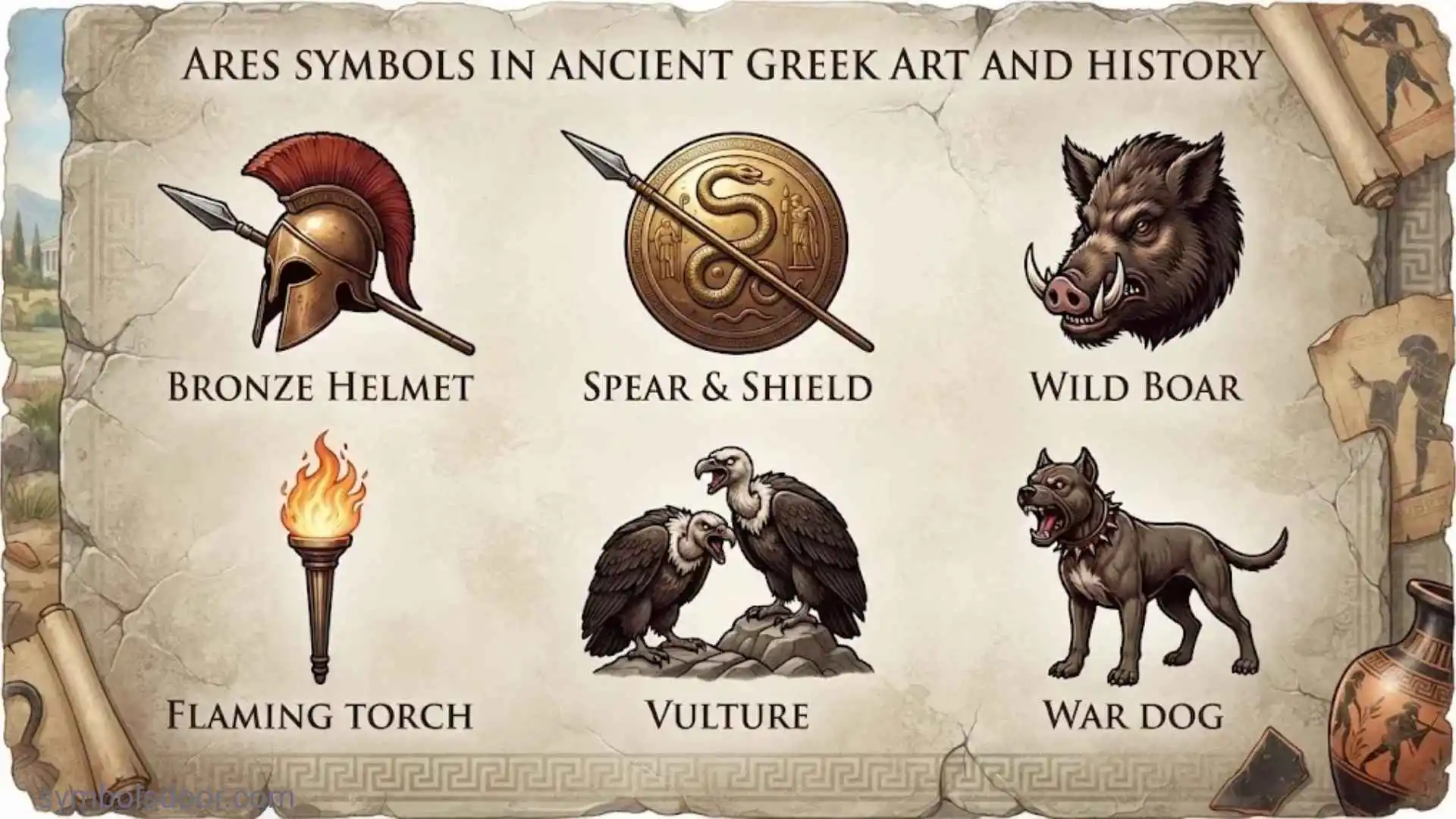
Artists represented him as an armed warrior, often carrying a spear and wearing a helmet. Some depictions show him with a shield and protective armor.
However, identifying Ares in ancient artwork can sometimes be difficult. Many Greek heroes and historical warriors wore similar equipment.
How Ancient Greeks Represented Ares
Ancient Greek artists represented Ares in different ways.
Some portray him as a mature, bearded warrior. Others show him as a younger, clean-shaven figure wearing a helmet and carrying a spear.
Common visual attributes include:
- A crested or peaked helmet.
- A bronze-tipped spear.
- A shield.
- A breastplate or cuirass.
- Greaves protecting the lower legs.
- A war chariot in some mythological scenes.
These features helped communicate his identity as the god of war.
Ares was not always represented as an extremely muscular or frightening figure. Some ancient artworks present him as a handsome, athletic young man.
Ares in Ancient Greek Pottery
Greek pottery provides important evidence of Ares’s appearance and mythology.
Black-figure and red-figure vase paintings show him in scenes involving other gods, warriors, and mythological events.
Artists often placed Ares among groups of Olympian deities. His helmet, spear, and military clothing helped distinguish him from other figures.
Some ancient images show him participating in battles or standing beside other gods during mythological events.
These artworks help researchers understand how ancient Greeks visually represented the god and connected him with warfare.
Ares in Ancient Greek Sculpture
Sculptures and reliefs also played an important role in representing Ares.
One famous example is the Ares Borghese, a Roman-period marble statue generally identified as Ares or Mars. It presents the god as a youthful, athletic warrior.
Ancient representations did not always include a unique symbol that made identification easy. A statue of an armed man might represent Ares, a mythological hero, or even a historical figure.
This is why inscriptions, surrounding figures, and the context of an artwork matter when identifying a deity.
Ares and Ancient Greek Religious Traditions
Ares belonged to the Olympian pantheon, but his worship was not equally widespread across ancient Greece.
His cult had important regional connections, particularly in areas such as Thrace and parts of northern Greece. Ancient sources also describe sanctuaries and religious practices connected with him in different Greek communities.
His reputation was complex. He was powerful and worthy of religious respect, but his association with violent conflict made him different from deities more closely connected with agriculture, wisdom, or household protection.
The ancient Greek relationship with Ares was not simply admiration for warfare. His mythology also reflected the fear, instability, and suffering that conflict could bring.
This distinction is important when discussing Ares symbolism in ancient Greece. His attributes were not merely decorative objects. They reflected religious ideas about war, courage, fear, and the danger of uncontrolled violence.
Ares vs. Athena: Two Different Greek War Deities
Ares and Athena both had strong connections with warfare, but they represented different aspects of military conflict.
Ares embodied the violence and physical aggression of battle. Athena represented strategy, intelligence, and disciplined military action.
Their contrast helps explain the wider Greek understanding of warfare.
Ares: The Violent Side of Warfare
Ares represents the physical and emotional intensity of combat.
His mythology focuses on:
- Direct fighting.
- Aggression and anger.
- Bloodshed and destruction.
- Physical courage.
- Fear and battlefield panic.
His approach to war is often impulsive and driven by the excitement of fighting.
Athena: Wisdom and Strategic Warfare
Athena represents the more disciplined side of military conflict.
She is associated with:
- Strategic planning.
- Tactical intelligence.
- Wise leadership.
- Protection of cities.
- Courage guided by reason.
Her role extends beyond warfare. Athena is also the goddess of wisdom, crafts, and practical skill.
Ares and Athena Comparison
| Feature | Ares | Athena |
| Main role | God of war and battle | Goddess of wisdom and strategic warfare |
| Main attributes | Spear, helmet, shield, armor | Owl, spear, helmet, shield, aegis |
| War association | Aggression and physical combat | Strategy and disciplined warfare |
| Personality | Often impulsive and aggressive | Intelligent and strategic |
| Symbolic themes | Violence, strength, and conflict | Wisdom, protection, and skill |
The contrast between these gods shows that the Greeks recognized two very different forces within warfare.
Ares represents the destructive energy of battle, while Athena represents the intelligence needed to control it.
Ares and Aphrodite: The Relationship Between War and Love
Ares and Aphrodite are among the most famous couples in Greek mythology.
Aphrodite was the goddess of love, beauty, and desire. Her relationship with Ares brought together two contrasting forces: passion and violence.
Although Aphrodite was married to Hephaestus in one major mythological tradition, she had a secret relationship with Ares.
Hephaestus eventually discovered the affair and created an invisible net that trapped the lovers together. He then invited the other gods to witness their humiliation.
The story appears in Book 8 of Homer’s Odyssey.
Their relationship is also connected with several children, particularly Phobos, Deimos, and Harmonia.
The symbolism of Ares and Aphrodite can be understood through the relationship between opposing human emotions:
- Love and aggression.
- Passion and anger.
- Desire and conflict.
- Attraction and rivalry.
Their story also reminds readers that Greek mythology often connects powerful emotions rather than treating them as completely separate forces.
Ares and Mars: Greek and Roman Gods of War
Ares is closely connected with Mars, the Roman god of war.
The Romans identified Mars with the Greek Ares, and the two deities share several attributes. However, they did not have identical religious roles.
What Is the Roman Name for Ares?
Mars is the Roman equivalent of Ares.
Both gods were associated with warfare and armed warriors. Their traditional representations also included military equipment such as spears, helmets, shields, and armor.
However, Mars held a particularly important position in Roman public religion.
He was associated not only with warfare but also with the protection of Rome, military strength, and agricultural traditions in early Roman society.
Ares, by contrast, was more strongly associated with the violent and destructive aspects of battle in much Greek literature.
Ares vs. Mars: Main Differences
| Feature | Ares | Mars |
| Mythological tradition | Greek | Roman |
| Main domain | War and battle | War, military protection, and Roman civic identity |
| Parents | Zeus and Hera | Juno in one Roman tradition |
| Literary personality | Often aggressive and impulsive | Frequently presented as a respected protector |
| Important associations | Aphrodite, Phobos, Deimos | Romulus, Remus, Roman military identity |
| Cultural importance | Olympian god of war | Major Roman state deity |
Mars, Romulus, and Remus
Roman mythology gives Mars an important role in the foundation story of Rome.
According to the traditional legend, Mars fathered the twins Romulus and Remus with Rhea Silvia.
The twins were abandoned as infants and later became central figures in Rome’s legendary founding story.
Romulus eventually became the city’s first king, while Remus died during a conflict with his brother in one version of the myth.
This story connects Mars with Roman ancestry, military strength, and the legendary beginnings of the city.
It is important not to confuse this Roman tradition with the family stories of the Greek Ares.
Ares in Greek Mythology: Famous Stories and Legends
The myths of Ares reveal his personality, relationships, and role among the Olympian gods.
Some stories show him as a powerful warrior. Others portray him as impulsive, defeated, or involved in conflicts caused by jealousy and anger.
Ares in the Trojan War and the Iliad
The Trojan War is one of the most important events in Greek mythology.
Ares appears in Homer’s Iliad, where he supports the Trojans during the conflict.
He enters the battlefield and fights alongside the Trojan side. His involvement brings him into conflict with Athena, who supports the Greeks.
One of the most famous episodes involves Diomedes, a Greek warrior.
With Athena’s assistance, Diomedes attacks Ares and wounds him. The god cries out in pain and returns to Olympus.
This episode is important because it shows that Ares’s physical strength does not guarantee victory.
His defeat also reinforces the contrast between his aggressive fighting style and Athena’s strategic intelligence.
Ares and the Giants
Ares also appears in myths involving powerful giants.
One famous story describes his capture by the Aloadae, two giant brothers named Otus and Ephialtes.
They imprison Ares inside a bronze vessel, where he remains trapped until Hermes eventually rescues him.
The story is unusual because it presents the god of war as helpless despite his supernatural strength.
It demonstrates that Greek mythology did not always portray the Olympian gods as completely invulnerable.
Ares and the Death of Adonis
The story of Adonis connects Ares with jealousy, desire, and destruction.
Aphrodite falls in love with Adonis, a handsome young hunter. In one version of the story, Ares becomes jealous and transforms into a boar.
He attacks Adonis while the young man is hunting, causing his death.
Other surviving versions describe a wild boar without directly identifying Ares as the animal.
This variation matters because ancient myths were not always preserved in one fixed form.
The story nevertheless explains why the boar appears in some discussions of Ares’s animal symbolism.
Ares Symbols in Modern Culture and Tattoos
Ares remains a popular figure in modern mythology-inspired artwork.
His image appears in tattoos, illustrations, games, films, and fictional stories. Artists often use his weapons, armor, and animals to communicate courage, strength, aggression, and determination.
However, modern interpretations do not always match the religious meanings of ancient Greece.
Ares Tattoo Meaning
An Ares tattoo can represent different ideas depending on the design and the person wearing it.
Some people choose Ares imagery because they connect with his warrior identity. Others use his symbols to represent personal struggles or the determination to overcome difficult situations.
Common modern interpretations include:
- Courage: Facing fear and difficult circumstances.
- Strength: Physical or emotional power.
- Determination: Continuing despite obstacles.
- Resilience: Recovering from setbacks.
- Protection: Defending yourself and people you care about.
- Aggression: Representing a fierce or competitive personality.
- Warrior spirit: Maintaining focus during personal challenges.
An Ares tattoo can also carry a warning about uncontrolled anger and destructive behavior.
Its meaning depends on the design and the personal interpretation behind it.
Popular Ares Tattoo Ideas
Ares offers several recognizable attributes that work well in mythology-inspired tattoo designs.
Ares helmet tattoo: Represents warrior identity, courage, and readiness.
Ares spear tattoo: Symbolizes direct action, aggression, and determination.
Ares shield tattoo: Represents protection, defense, and resilience.
Ares sword tattoo: Communicates strength, confrontation, and combat.
Ares warrior portrait: Combines several attributes to create a complete representation of the god.
Ares chariot tattoo: Can represent power, movement, and the force of battle.
Serpent tattoo: Connects with one of Ares’s better-attested sacred animals and can represent danger or protection.
Boar tattoo: Connects with the animal’s fierce qualities and its appearance in one Ares-related myth.
Ares Symbols and Their Meanings in Tattoo Art
| Tattoo design | Common modern meaning |
| Spear | Courage, aggression, and direct action |
| Shield | Protection and resilience |
| Helmet | Warrior identity and mental strength |
| Sword | Power and confrontation |
| Armor | Endurance and defense |
| Serpent | Danger and protection |
| Boar | Fierceness and determination |
| Vulture | Mortality and the aftermath of conflict |
| Red and black artwork | Passion, danger, and destruction |
Some artists combine these elements with Greek lettering, geometric patterns, and classical warrior imagery.
If historical accuracy matters to you, research the specific mythological attributes before choosing a design. A modern interpretation can be meaningful without being an exact reproduction of an ancient Greek religious symbol.
Ares in Video Games, Movies, and Modern Media
Ares appears in many modern stories inspired by Greek mythology.
One well-known example is the God of War video game franchise, which uses Greek mythological figures in a fictional narrative.
Other films, games, comics, and novels reinterpret Ares as a warrior, villain, rival, or powerful supernatural character.
These portrayals often exaggerate his abilities or change his personality to fit the story.
They can introduce new audiences to Greek mythology, but they should not be treated as historical evidence about ancient religious beliefs.
Psychological and Spiritual Symbolism of Ares
Modern readers sometimes interpret Ares as a symbol of the internal struggles people experience.
This is a personal and psychological interpretation rather than a fixed ancient Greek religious teaching.
His mythology provides useful imagery for discussing courage, anger, competition, and the importance of self-control.
Ares as a Symbol of Courage and Personal Strength
Ares represents the willingness to face dangerous situations.
In modern interpretations, this quality can symbolize the courage needed to confront personal challenges.
The warrior image may represent:
- Facing difficult decisions.
- Standing up for personal beliefs.
- Protecting important relationships.
- Continuing after failure.
- Building confidence during challenging periods.
This interpretation focuses on courage rather than violence.
Ares and Inner Battles
Not every battle involves weapons or physical opponents.
People also experience personal struggles involving fear, uncertainty, anger, and difficult emotions.
Ares can serve as a metaphor for confronting these challenges.
For example, someone dealing with a difficult life transition might choose an Ares-inspired symbol to represent determination and resilience.
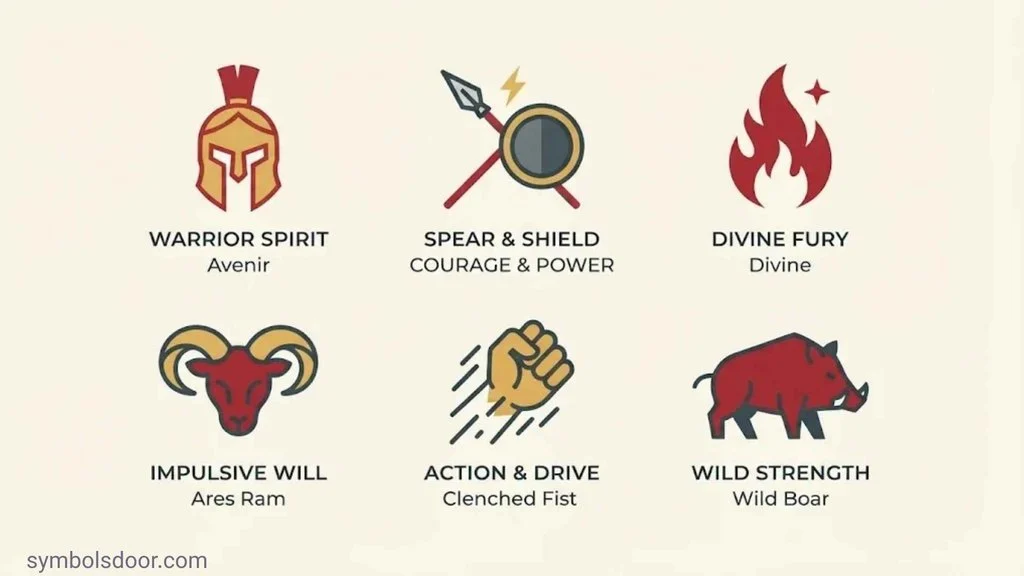
A spear might symbolize taking action. A shield could represent emotional boundaries. Armor might represent the strength needed to endure pressure.
These are modern personal interpretations, not meanings established by ancient Greek worshippers.
The Negative Side of Ares Symbolism
Ares also represents the destructive consequences of uncontrolled aggression.
His mythology repeatedly connects him with anger, violence, and the chaos of battle.
The negative side of his symbolism includes:
- Impulsive decisions.
- Uncontrolled anger.
- Aggression without purpose.
- Destruction caused by conflict.
- Confusing strength with domination.
- Acting without considering consequences.
These themes provide an important contrast with the positive interpretations of courage and determination.
Balancing Strength With Wisdom and Self-Control
The comparison between Ares and Athena offers a useful modern lesson.
Ares represents physical force and aggressive action. Athena represents strategic thinking and disciplined judgment.
Together, they can symbolize the balance between strength and wisdom.
True courage does not always mean fighting. Sometimes it means controlling anger, choosing a better response, or avoiding unnecessary conflict.
This interpretation makes Ares a more complex symbol than simply a representation of violence.
Frequently Asked Questions About Ares Symbols
What Are the Symbols of Ares?
The most recognizable symbols and attributes of Ares include the spear, helmet, shield, armor, and war chariot. Traditional animal associations include the serpent, vulture, and certain owls. Dogs and boars also appear in some Ares-related traditions.
What Does the Ares Symbol Mean?
Ares represents war, aggression, physical strength, courage, and the destructive side of conflict. His spear and helmet are among his best-known identifying attributes. He does not have one universally recognized standalone symbol.
What Animals Are Associated With Ares?
Traditional sources associate Ares with the serpent, vulture, barn owl, eagle owl, and woodpecker. Dogs also appear in some traditional lists. The boar is connected with the Adonis myth in one tradition involving Ares.
Why Is the Spear a Symbol of Ares?
The spear is one of Ares’s main weapons in Greek mythology. Ancient literary descriptions frequently portray him carrying a spear into battle. It represents aggression, direct combat, military power, and readiness for warfare.
What Does Ares’s Shield Represent?
Ares’s shield represents protection, defense, and preparation for battle. It was part of the standard equipment associated with ancient Greek warriors and appears alongside his spear and helmet in artistic representations.
What Weapons Does Ares Carry?
Ares is most commonly associated with a spear. Ancient descriptions and artistic representations also connect him with a sword, shield, helmet, and armor.
What Colors Represent Ares?
Red, black, bronze, dark gray, and deep brown are common modern color choices for Ares-inspired artwork. They represent themes such as bloodshed, aggression, ancient armor, and battlefield destruction. These colors are modern interpretations rather than an official ancient Greek palette.
What Is Ares the God of in Greek Mythology?
Ares is the Greek god of war, battle, aggression, and violent conflict. He represents the physical and destructive side of warfare, including courage, fear, bloodshed, and battlefield violence.
What Is the Difference Between Ares and Athena?
Ares represents the violent and aggressive side of warfare, while Athena represents wisdom, planning, and strategic military action. Both are associated with war, but they symbolize different approaches to conflict.
Who Are the Parents of Ares?
Ares is traditionally the son of Zeus and Hera. Both are major Olympian gods, with Zeus serving as king and Hera as queen of Olympus.
Who Are the Children of Ares?
Ares is associated with several children in Greek mythology. His most famous children with Aphrodite are Phobos, Deimos, and Harmonia. Other mythological traditions attribute additional children to him.
What Is the Roman Name for Ares?
The Roman equivalent of Ares is Mars. Both gods are associated with warfare, but Mars held a broader role in Roman religion, including connections with agriculture, military protection, and the identity of Rome.
What Does an Ares Tattoo Symbolize?
An Ares tattoo can represent courage, strength, resilience, determination, protection, or a warrior mindset. Some designs also communicate aggression and the destructive side of conflict. The meaning depends on the person’s interpretation and chosen imagery.
What Are the Powers and Abilities of Ares?
Ares is an immortal Olympian god with supernatural strength and endurance. His mythological abilities include combat, weapon use, and influence over warfare, fear, and aggression. However, ancient stories also show that he can be wounded and defeated.
How Is Ares Represented in Ancient Greek Art?
Ancient Greek artists commonly represented Ares as an armed warrior wearing a helmet and carrying a spear. Some images also show a shield, armor, or chariot. He appears in vase paintings, sculptures, reliefs, and other mythological artwork.
Conclusion: The Meaning and Legacy of Ares Symbols
The symbols of Ares reveal the many sides of the Greek god of war. His spear represents direct combat and aggression, while his helmet, shield, and armor communicate protection and military readiness. His chariot reflects the force of battle, and his traditional animal associations add further layers to his mythology.
Ares also represents powerful human emotions. His stories explore courage, anger, passion, competition, and the consequences of uncontrolled violence.
His contrast with Athena offers another important lesson. Strength and aggression can influence the outcome of conflict, but wisdom and discipline help determine how that strength is used.
Today, Ares continues to inspire tattoos, artwork, games, and modern interpretations of the warrior spirit. Whether you see him as a symbol of courage, physical power, personal struggle, or the destructive nature of war, his mythology remains a fascinating part of ancient Greek culture.

Hi, I’m Asher Monroe, a writer who believes that meaningful words have the power to inspire change and bring people closer to their dreams. I have always been fascinated by the beauty of quotes and the way a simple message can provide motivation, hope, and comfort.
I enjoy creating content around inspirational quotes, life lessons, success stories, and positive thoughts that help readers find encouragement in their everyday lives. My goal is to share words that connect with people and remind them of their inner strength.
Through my writing, I explore the ideas of personal growth, confidence, and the importance of staying inspired through every chapter of life.
I am the author of Words That Move the Soul and The Path of Endless Inspiration, two books focused on the power of wisdom, positivity, and meaningful thoughts.
 Sienna Brooks
 Rowan Sinclair Rowan Sinclair