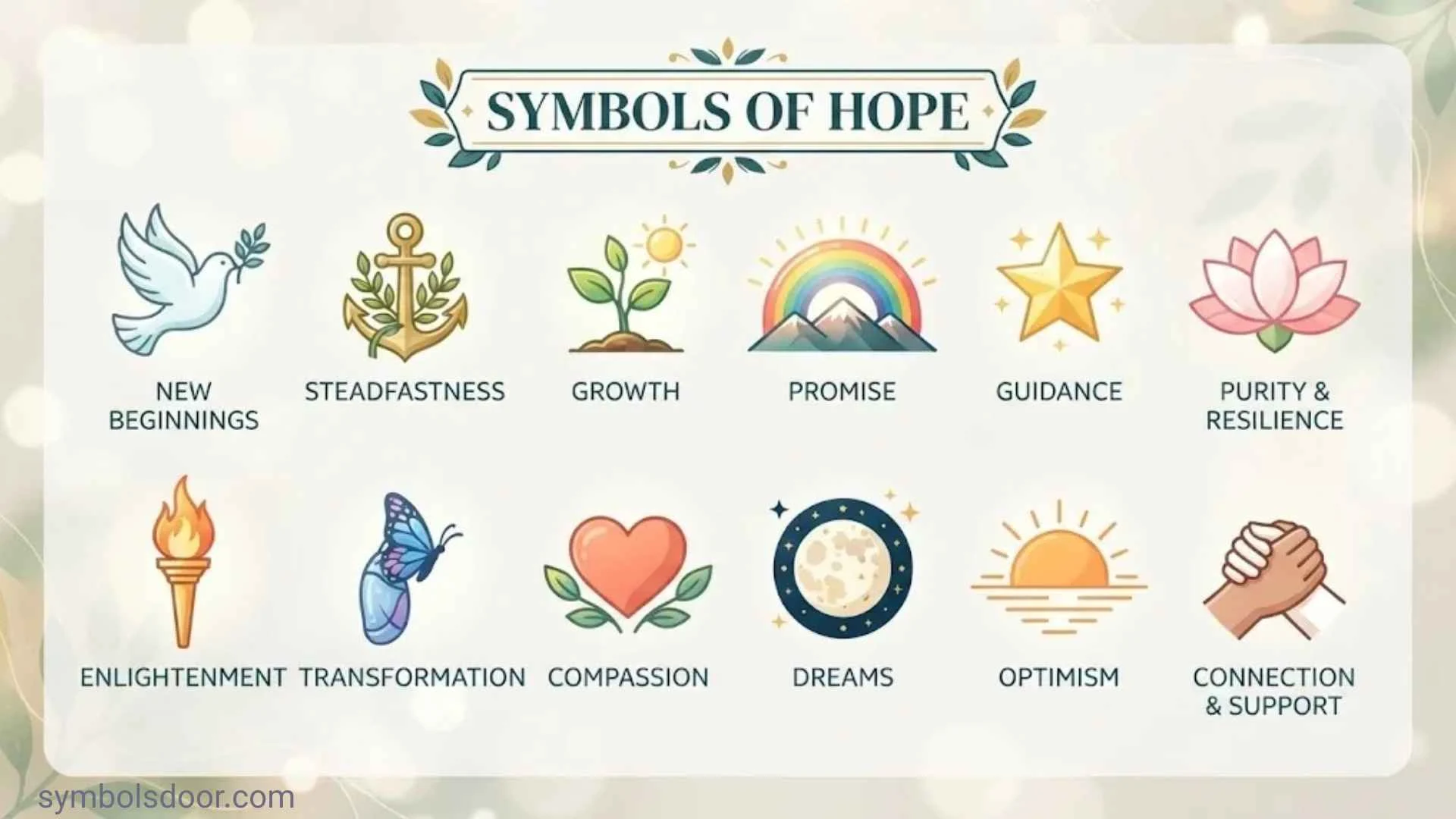
Hope is one of the strongest emotions people experience. It gives you the courage to keep moving when life becomes difficult and reminds you that better days are possible. Throughout history, people have expressed this feeling through symbols of hope found in nature, religion, mythology, art, and everyday objects.
A butterfly emerging from its cocoon can represent transformation. A dove carrying an olive branch suggests peace. A lighthouse shining through a storm offers a powerful image of guidance when everything feels uncertain. These symbols communicate feelings that words sometimes struggle to express.
The meanings of hope symbols also change across cultures. The lotus flower has deep spiritual importance in Buddhist and Hindu traditions, while the cross represents faith and salvation in Christianity. Chinese mythology includes creatures such as the Fenghuang and Qilin, which carry associations with harmony, virtue, and good fortune.
In this guide, you’ll discover 36 symbols of hope from around the world, including animals, birds, insects, flowers, plants, objects, and religious symbols. You’ll also learn their historical backgrounds, cultural meanings, and connections with optimism, resilience, renewal, faith, and new beginnings.
What Do Symbols of Hope Mean?
Symbols of hope are images, objects, animals, plants, or signs that represent the belief that something positive can happen. They can remind people of better days, encourage them during difficult experiences, or express faith in a brighter future.
Some symbols have well-documented historical and religious meanings. Others come from folklore, literature, or modern spiritual beliefs.
For example, the Christian anchor has a direct connection with hope in Hebrews 6:19. The butterfly, on the other hand, is widely used today to represent personal transformation because of its life cycle.
Common Meanings of Hope Symbols
Hope symbolism often connects with the following ideas:
- Optimism: Believing that a positive outcome is possible.
- Rebirth: Beginning again after a difficult experience.
- Renewal: Restoring strength, energy, or purpose.
- Resilience: Recovering and continuing despite hardship.
- Perseverance: Staying committed when progress feels slow.
- Faith: Trusting in a spiritual belief or a better future.
- Peace: Finding calm after conflict or uncertainty.
- Protection: Seeking safety from danger or misfortune.
- Growth: Recognizing new opportunities and potential.
- Healing: Moving toward emotional, physical, or spiritual recovery.
These meanings overlap, but they are not identical. A phoenix usually represents rebirth after destruction, while an anchor suggests stability during difficult conditions.
Why Do People Use Symbols of Hope?
People use symbols to express emotions, beliefs, and experiences. A small object can carry a powerful personal meaning, especially when it reminds someone of a loved one, a difficult period they survived, or a goal they still want to achieve.
You may see hope symbols in:
- Jewelry, necklaces, and bracelets
- Tattoos and personal artwork
- Religious buildings and ceremonies
- Memorials and remembrance objects
- Greeting cards and gifts
- Books, films, and poetry
- Cultural celebrations and festivals
In sociology, shared symbols help communities communicate values and create a sense of belonging. Religious and cultural symbols can also connect people with traditions passed down through generations.
However, not every interpretation is universal. A symbol may represent good fortune in one culture and carry a different meaning elsewhere.
Symbols of Hope and Their Meanings
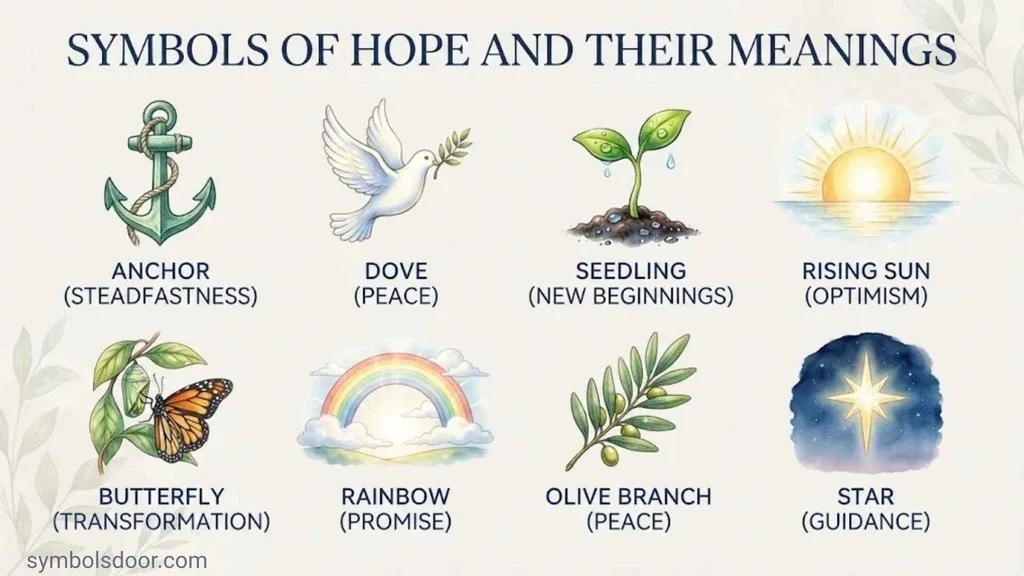
The following examples include animal symbols of hope, bird symbolism, insects, flowers, plants, objects, and religious or mythological signs. Their meanings reflect a mixture of historical traditions, documented religious teachings, folklore, and modern interpretations.
Animal Symbols of Hope
Animals often represent qualities that people admire, such as strength, loyalty, freedom, patience, and survival. Their behavior and life cycles also inspire symbolic meanings.
1. Butterfly: Transformation and New Beginnings
<escape> </escape>
The butterfly is one of the most recognizable symbols of hope and transformation. Its life cycle provides a natural image of change. A caterpillar develops inside a chrysalis before emerging as a butterfly with wings.
This transformation makes the butterfly a popular symbol of personal growth, renewal, and fresh starts. It can represent leaving an old chapter behind and moving toward a different future.
In modern art, spirituality, and memorial designs, butterflies may also represent the soul, remembrance, or the idea of life continuing after loss. These interpretations vary across cultures and are not one universal religious belief.
Symbolic meanings:
- Transformation and personal growth
- Rebirth and renewal
- Freedom and new opportunities
- Hope after difficult experiences
2. Baby Animals: Innocence and New Life
<escape> </escape>
Baby animals often represent innocence, vulnerability, affection, and new life. Their dependence on parents and potential for growth make them natural images of a fresh beginning.
Different young animals can carry slightly different modern associations:
- Baby elephants: Family bonds, protection, memory, and strength.
- Puppies: Loyalty, friendship, affection, and happiness.
- Bunnies: Fertility, springtime, and new life.
- Kittens: Curiosity, playfulness, comfort, and independence.
- Baby gorillas: Family care, social bonds, and protection.
These are mainly popular symbolic interpretations rather than fixed meanings from ancient religious traditions.
Baby animals can also remind people that growth takes time. A young animal does not need to be fully developed to have potential.
3. Starfish: Renewal and Resilience
<escape> </escape>
A starfish, more accurately called a sea star, is commonly used as a modern symbol of recovery and resilience. Some sea star species can regenerate lost arms, although their abilities vary by species and the extent of the injury.
This natural ability has inspired associations with healing, renewal, and the strength to recover after hardship.
A starfish may be used in artwork or jewelry to represent someone who has overcome a difficult period. Its five-arm shape also makes it a recognizable coastal and marine symbol.
Symbolic meanings: Recovery, resilience, renewal, and hope after loss.
4. Horse: Strength and Freedom
<escape> </escape>
The horse has played an important role in human history. People have relied on horses for transportation, agriculture, warfare, trade, and sport.
Because of their speed and strength, horses often symbolize freedom, endurance, courage, and progress. In some traditions, they are also associated with victory and good fortune.
Horses appear in many mythological traditions. In Greek mythology, the horse was closely connected with Poseidon, who was worshipped as Poseidon Hippios, or Poseidon of Horses.
As a symbol of hope, the horse suggests moving forward even when the journey is challenging.
5. Deer: Gentleness and Renewal
<escape> </escape>
The deer is often associated with gentleness, sensitivity, grace, and a close connection with nature. Its seasonal antler cycle can also inspire interpretations involving renewal and regrowth.
In some European and Celtic artistic traditions, deer appear in stories and imagery connected with forests, wilderness, and the spiritual world. Their meanings differ across specific traditions.
In modern symbolism, a deer may represent peaceful strength. It suggests that courage does not always need to look aggressive or forceful.
6. Snake: Renewal and Transformation
<escape> </escape>
The snake has complex symbolic meanings across the world. One reason it is connected with renewal is its ability to shed its skin as it grows.
This process has inspired associations with transformation, healing, and leaving the past behind. In some ancient traditions, snakes were also connected with fertility, wisdom, medicine, and divine power.
However, snake symbolism is not always positive. In Christianity, the serpent in the Garden of Eden is associated with temptation. In other traditions, snakes can represent protection or spiritual knowledge.
Its meaning depends heavily on the cultural and religious context.
7. Koi Fish: Perseverance and Good Fortune
<escape> </escape>
The koi fish is an important decorative and cultural symbol in Japan and other parts of East Asia. Its association with perseverance is often explained through a Chinese legend about carp swimming upstream and one transforming into a dragon after reaching the Dragon Gate.
This story is commonly used to represent determination, achievement, and overcoming obstacles.
Koi are also associated with good fortune, prosperity, and success in modern Japanese cultural imagery. Their colorful appearance makes them popular in gardens, paintings, tattoos, and decorative designs.
Symbolic meanings:
- Perseverance through difficulty
- Strength and determination
- Prosperity and good fortune
- Success and personal achievement
Bird Symbols of Hope
Birds often symbolize freedom, movement, guidance, and the ability to rise above difficult circumstances. Some have particularly strong associations with peace, renewal, and spiritual messages.
8. Dove: Peace and Hope
<escape> </escape>
The dove is one of the most widely recognized symbols of peace and hope. In the biblical story of Noah, a dove returns to the ark carrying a freshly plucked olive leaf. This signals that the floodwaters have receded and that the earth is becoming habitable again.
The image of a dove with an olive branch later became a powerful symbol of peace and reconciliation.
Doves also appear in Christian art, where they can represent the Holy Spirit. In modern culture, a white dove is often used in peace campaigns, memorials, and messages of unity.
Symbolic meanings: Peace, reconciliation, hope, purity, and spiritual guidance.
9. Hummingbird: Joy and Optimism
<escape> </escape>
The hummingbird is admired for its small size, quick movements, and ability to hover while feeding. Its energy and movement have inspired modern interpretations involving joy, adaptability, and optimism.
Some spiritual and popular traditions view the hummingbird as a reminder to appreciate small moments and continue finding happiness despite challenges.
Its symbolic meaning varies across communities. It should not be treated as a universal spiritual messenger with one fixed meaning.
As a modern symbol of hope, the hummingbird represents finding moments of beauty and joy even during difficult times.
10. Cardinal: Love and Remembrance
<escape> </escape>
The cardinal is a bright red songbird found across much of North America. Its striking color and familiar presence have made it a popular symbol in art, seasonal decorations, and personal memorials.
In modern popular beliefs, seeing a cardinal may remind someone of a departed loved one. Some people interpret the bird as a spiritual messenger or a sign that someone they miss remains close in memory.
This is a personal and folkloric belief, not an established Christian teaching or scientifically verified message.
Symbolic meanings: Love, loyalty, remembrance, comfort, and connection.
11. Albatross: Hope and Safe Voyages
<escape> </escape>
The albatross is a large seabird known for its ability to travel long distances over the ocean. Its connection with sailors and maritime journeys has given it a place in sea folklore and literature.
In some maritime traditions, an albatross was viewed as a favorable sign for sailors. However, its meaning became more complicated through literature.
In Samuel Taylor Coleridge’s poem The Rime of the Ancient Mariner, the albatross becomes a central symbol associated with guilt, suffering, and consequences. This shows why the bird cannot be described simply as a universal sign of good luck.
In modern interpretations, it can represent endurance, long journeys, and the hope of reaching safety.
12. Rooster: Dawn and Fresh Starts
<escape> </escape>
The rooster is closely associated with sunrise because its crowing often occurs around the beginning of the day. This connection has made it a symbol of awakening, vigilance, and fresh starts.
In some Christian traditions, the rooster also appears in connection with Peter’s denial of Jesus, as described in the Gospels. In other cultural settings, it can represent courage, alertness, and protection.
As a symbol of hope, the rooster reminds people that darkness does not last forever. Every sunrise offers another opportunity to begin.
13. Phoenix: Rebirth and Resilience
<escape> </escape>
The phoenix is a mythical bird associated with fire, death, and rebirth. In later classical traditions, it becomes a powerful image of a creature that dies and rises again from its ashes.
The phoenix is connected with ancient Egyptian and Greco-Roman traditions, although the histories of the Egyptian Bennu bird and the later phoenix are not identical.
Today, the phoenix is widely used to represent recovery after destruction. It may symbolize someone rebuilding a life after loss, failure, illness, or another major challenge.
Symbolic meanings:
- Rebirth and renewal
- Strength after hardship
- Transformation
- Immortality in mythological interpretations
- Hope after destruction
Insect Symbols of Hope
Insects may be small, but their life cycles and natural behavior have inspired powerful symbolic meanings. Several are associated with transformation, good fortune, and light in darkness.
14. Dragonfly: Transformation and Adaptability
<escape> </escape>
The dragonfly spends an important part of its life underwater as a nymph before emerging as a flying adult. This dramatic change makes it a natural image of transformation.
Dragonflies are commonly associated in modern symbolism with adaptability, freedom, and personal development. Their ability to move quickly in different directions also inspires ideas about flexibility and change.
In some cultural traditions, dragonflies have additional meanings connected with courage, summer, and spiritual awareness.
As a symbol of hope, the dragonfly suggests that a person’s present circumstances do not have to define their future.
15. Ladybug: Good Luck and Protection
<escape> </escape>
The ladybug is commonly associated with good luck in European folklore and modern popular culture. Its bright appearance and harmless reputation have helped make it a familiar lucky charm.
Ladybugs are also useful insects in agriculture because many species feed on aphids and other plant pests. This practical benefit may help explain their positive association with gardens and successful harvests.
Some traditional beliefs connect ladybugs with protection from misfortune. However, these are cultural beliefs rather than proven supernatural effects.
Symbolic meanings: Good luck, happiness, protection, and prosperity.
16. Firefly: Light in Darkness
<escape> </escape>
The firefly produces light through a natural chemical process called bioluminescence. Its glow is used for communication, especially during mating behavior.
Because fireflies shine in the dark, they have become popular symbols of hope, guidance, and small moments of brightness during difficult times.
Their light does not remove the darkness around them. Instead, it offers a visible point of brightness within it. That makes the firefly a meaningful modern image of hope.
Symbolic meanings: Light in darkness, inspiration, guidance, and optimism.
17. Caterpillar: Growth and Potential
<escape> </escape>
The caterpillar represents the beginning of the butterfly’s transformation. Before becoming a butterfly, it passes through several stages of growth and development.
This makes it a useful symbol of patience, potential, and personal progress. A caterpillar may not yet have wings, but its future development is already part of its life cycle.
In modern symbolism, it can represent a person who is still learning, growing, and preparing for a new chapter.
Flower Symbols of Hope
Flowers often symbolize hope because they bloom after periods of cold weather, produce new seeds, and return with changing seasons. Their colors and forms also give them strong meanings in religious art and cultural traditions.
18. Daffodil: Hope and New Beginnings
<escape> </escape>
The daffodil is one of the best-known flowers that symbolize hope and renewal. It blooms in spring, often appearing while winter is fading.
Its arrival represents the return of warmth, color, and new growth. This seasonal connection has made the daffodil a popular symbol of optimism and fresh starts.
Daffodils are also used in cancer-awareness fundraising campaigns in several countries. Their meaning in these campaigns connects with courage, support, and hope for people affected by cancer.
Symbolic meanings: Hope, renewal, optimism, and new beginnings.
19. Lotus Flower: Purity and Spiritual Awakening
<escape> </escape>
The lotus flower has deep religious and cultural importance in South Asia and East Asia. It grows in water and often rises above muddy surroundings to produce a clean, beautiful bloom.
This natural growth pattern has inspired its association with purity, spiritual development, and awakening.
In Buddhist symbolism, the lotus represents the possibility of developing wisdom and awakening despite the difficulties of ordinary life. In Hindu traditions, it is associated with creation, divinity, beauty, and prosperity.
Buddhist and Hindu deities are frequently shown seated or standing on a lotus throne. The flower’s position beneath a sacred figure can communicate spiritual purity and transcendence. <Cite refs={[“turn375761search1″,”turn375761search7″,”turn375761search65”]}/>
Symbolic meanings:
- Purity and beauty
- Spiritual awakening
- Growth and potential
- Renewal and new life
- Divine creation in some Hindu traditions
20. Lily: Purity and Faith
<escape> </escape>
The lily has a long history in religious art, particularly in Western Christianity. White lilies are often associated with purity, innocence, and devotion.
In Christian artwork, the white lily is especially connected with the Virgin Mary and the Annunciation. It may also appear in Easter decorations and religious ceremonies.
Lilies are also used in funeral arrangements and memorials. In those settings, they may express remembrance, peace, and hope.
Their meanings vary by color and cultural setting, so not every lily carries the same symbolic message.
21. Iris: Faith and Hope
<escape> </escape>
The iris is a flower with a long history in art and cultural symbolism. Its name comes from the Greek word associated with the rainbow and the Greek goddess Iris, who served as a divine messenger.
Because of this connection, the flower is sometimes associated with communication, messages, and guidance.
In different modern floral traditions, irises can represent faith, wisdom, hope, and admiration. Their symbolic meanings also vary by color and region.
The iris is a suitable symbol for people who connect hope with guidance, understanding, and the arrival of encouraging news.
22. Crocus: Spring and Renewal
<escape> </escape>
The crocus is among the flowers that appear early in the spring season. Some varieties bloom while the weather is still cool, making them familiar signs of seasonal change.
Their appearance after winter has inspired associations with renewal, youth, and fresh beginnings.
Crocuses also appear in gardens and seasonal decorations as reminders that growth can begin even when conditions are not yet perfect.
23. Sunflower: Optimism and Happiness
<escape> </escape>
The sunflower is commonly associated with sunlight, warmth, happiness, and optimism. Its large yellow flower head makes it one of the most recognizable natural symbols of positivity.
Sunflowers have also appeared in art as images of life, energy, and admiration. Their seeds provide food, while the plants themselves are grown for ornamental and agricultural purposes.
In modern symbolism, a sunflower can represent choosing hope and looking toward brighter possibilities.
Plant and Tree Symbols of Hope
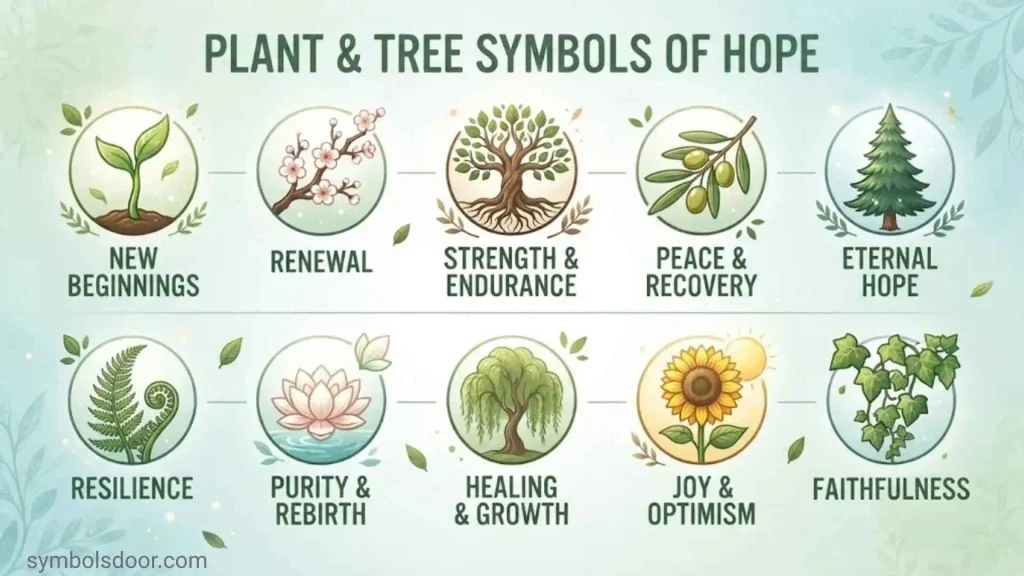
Plants and trees offer powerful examples of growth, survival, and renewal. A small seed can become a large tree, while some plants return after seasonal changes or environmental stress.
24. Sprouts: Growth and Potential
<escape> </escape>
A sprout is a young plant beginning to grow from a seed. It represents the earliest stage of development and the possibility of what may come next.
Sprouts are common images in environmental campaigns, education, wellness, and personal development. They can symbolize a new project, a fresh relationship, or the beginning of a personal journey.
Their message is simple: small beginnings can lead to meaningful growth.
25. Acorn: Potential and Future Strength
<escape> </escape>
The acorn is the seed of an oak tree. Although it is small, it has the potential to grow into a large and long-lived tree under suitable conditions.
This makes the acorn a popular symbol of potential, patience, strength, and future success.
It can represent a person who has not yet reached their full potential but has the ability to develop over time. The acorn also appears in decorative art and traditional designs connected with oak trees.
26. Oak Tree: Strength and Endurance
<escape> </escape>
The oak tree is widely associated with strength, endurance, and longevity. Its strong wood and ability to grow for many decades have made it an important symbol in European cultural traditions.
Oak trees held religious and symbolic importance in several ancient European societies. Some Celtic and other traditions connected oak groves with sacred places and spiritual practices.
In modern symbolism, an oak tree can represent stability, family roots, courage, and the ability to withstand difficult conditions.
27. Birch Tree: Renewal and New Beginnings
<escape> </escape>
The birch tree, especially the white birch, is associated in some northern European traditions with renewal and new beginnings.
Its pale bark makes it visually distinctive, while its ability to grow in certain challenging environments has inspired associations with adaptability and resilience.
Birch trees also appear in seasonal traditions and folklore. Their meanings differ across regions, but modern interpretations often connect them with purification, fresh starts, and protection.
28. Four-Leaf Clover: Hope, Faith, Love, and Luck
<escape> </escape>
The four-leaf clover is a familiar symbol of good fortune. It is a rare variation of the more common three-leaf clover.
A popular modern interpretation assigns a meaning to each leaf:
- First leaf: Faith
- Second leaf: Hope
- Third leaf: Love
- Fourth leaf: Luck
The four-leaf clover is also associated with Irish identity and wider European folklore. However, it should not be confused with the shamrock, which usually has three leaflets and is strongly connected with Ireland and St. Patrick.
The University of Florida Museum notes that four-leaf clovers are uncommon variations and that their association with luck has a long history in European folklore. <Cite refs={[“turn375761search8”]}/>
29. Olive Tree: Peace and Prosperity
<escape> </escape>
The olive tree has been important in Mediterranean life for thousands of years. Its fruit produces olive oil, which has been used for food, lighting, medicine, trade, and religious practices.
In ancient Greek mythology, the olive tree was associated with Athena, who offered it to the people of Athens during her contest with Poseidon.
The tree is also connected with peace through the olive branch. In the biblical story of Noah, a dove returns with an olive leaf, signaling that the floodwaters have receded.
Today, olive trees and branches can represent peace, prosperity, endurance, and reconciliation.
30. Ginkgo Tree: Survival and Hope
<escape> </escape>
The ginkgo tree is often associated with longevity and resilience. Its distinctive fan-shaped leaves and long evolutionary history make it a recognizable tree in botanical and cultural settings.
Its modern connection with hope became especially meaningful in Hiroshima, Japan. Several trees exposed to the atomic bombing on August 6, 1945, survived and later produced new growth.
The City of Hiroshima documents ginkgo trees that were replanted or preserved as symbols of peace. The regrowth of damaged trees became a powerful reminder of survival and the return of life after devastation. <Cite refs={[“turn254675search3″,”turn254675search4″,”turn254675search5″,”turn254675search10”]}/>
For this reason, the ginkgo is sometimes called a Bearer of Hope in modern discussions of Hiroshima’s recovery.
Symbolic meanings: Survival, peace, longevity, resilience, and renewal.
Object Symbols of Hope
Objects can become powerful symbols because they serve practical purposes in everyday life. Anchors keep ships stable, lighthouses guide sailors, and candles provide light in darkness.
31. Anchor: Hope and Stability
<escape> </escape>
The anchor is one of the oldest and most recognizable religious symbols of hope in Christianity. Its practical purpose is to keep a vessel from drifting, making it a natural image of stability and security.
The Bible directly connects hope with an anchor in Hebrews 6:19, describing hope as an anchor for the soul. Early Christians also used anchor imagery in burial inscriptions and catacomb art.
The symbol represented confidence in God’s promises and the hope of salvation. It was especially meaningful in a world where early Christian communities faced uncertainty and persecution. <Cite refs={[“turn254675search0″,”turn254675search9″,”turn254675search48”]}/>
Today, an anchor may represent:
- Stability during difficult times
- Faith and spiritual hope
- Loyalty and commitment
- Security and perseverance
32. Horseshoe: Good Luck and Protection
<escape> </escape>
The horseshoe is a traditional good-luck charm in European folklore. It is commonly displayed above doorways or carried as a small decorative object.
Some traditions connect the horseshoe with protection against evil spirits and misfortune. Others focus on its association with horses, which were valuable animals in earlier societies.
There are also different beliefs about how to hang a horseshoe. Some people place the ends upward to hold good luck, while others point them downward to let blessings spread.
These are cultural superstitions rather than proven protective powers.
33. Lighthouse: Guidance Through Darkness
<escape> </escape>
A lighthouse helps ships navigate dangerous coastal waters by providing a visible point of light. Its practical role has made it a powerful modern symbol of guidance and hope.
A lighthouse does not remove storms or change the ocean. It helps sailors understand where they are and how to avoid danger.
This makes it a useful metaphor for people facing difficult situations. A lighthouse can represent a trusted person, a source of wisdom, or a belief that helps someone find direction.
Symbolic meanings: Guidance, safety, protection, courage, and hope for the future.
34. Eight-Pointed Star and Star of Ishtar: Divine Power and Renewal
<escape> </escape>
The eight-pointed star appears in several ancient cultures and religious traditions. One important historical example is the Star of Ishtar, associated with the Mesopotamian goddess Ishtar and the planet Venus.
Ishtar was connected with love, fertility, war, and royal power. Her star symbol reflected her divine identity and celestial association.
The eight-pointed star should not be treated as a universal symbol of hope. Its meaning depends on the culture, historical period, and religious setting in which it appears.
In modern designs, people may use stars to represent guidance, aspiration, and a brighter future. Those interpretations are broader than the original religious meaning of the Star of Ishtar.
35. Fish Hook or Makau: Prosperity and Safe Journeys
<escape> </escape>
The makau is a traditional Polynesian fishhook, especially recognized in Hawaiian culture. Traditional fishhooks were made from materials such as bone, shell, and wood, with different shapes designed for different fishing methods.
The fishhook was important because fishing supported food supplies and community life. In modern Polynesian-inspired jewelry, the makau is often associated with strength, prosperity, connection with the ocean, and safe travel.
Its meaning varies among communities and individuals. It is important to respect its cultural background rather than treating every Polynesian design as interchangeable.
The National Park Service documents traditional Hawaiian makau materials and fishing uses, while the Bishop Museum preserves examples of historical fishhooks from Hawaii. <Cite refs={[“turn375761search5″,”turn375761search9”]}/>
36. Candle: Faith and Light in Darkness
<escape> </escape>
A candle is a familiar object used in religious ceremonies, personal prayer, memorials, and moments of remembrance.
Its flame can represent light, guidance, faith, and the presence of hope during difficult times. In Christianity, candles are used in worship and may symbolize Christ as the light of the world.
Candles also appear in other religious and cultural traditions. Their meanings vary, but they commonly create a visible expression of prayer, reflection, devotion, or remembrance.
Lighting a candle for a departed loved one can also serve as a personal act of memory and affection.
Religious and Mythological Symbols of Hope
Religious symbols often express hope through ideas such as salvation, redemption, spiritual healing, and life beyond death. Mythological symbols may communicate similar themes through stories of renewal, divine protection, and transformation.
The Cross: Christian Faith and Salvation
<escape> </escape>
The cross is the central symbol of Christianity. It represents the crucifixion of Jesus Christ and, through Christian belief in his resurrection, the promise of redemption and eternal salvation.
For Christians, the cross is not simply a sign of suffering. It also communicates God’s love, forgiveness, sacrifice, and the hope of life beyond death.
Crosses appear in churches, religious artwork, jewelry, cemeteries, and personal devotional objects. Their designs vary across Christian traditions, including Latin crosses, crucifixes, and other forms.
Ichthys: The Early Christian Fish Symbol
<escape> </escape>
The Ichthys is an ancient Christian fish symbol. The Greek word ichthys means fish, and its letters were used as an acronym for the phrase commonly translated as Jesus Christ, Son of God, Savior.
Early Christians used the fish in art and personal objects. It appeared in catacomb imagery, carved objects, and other forms of early Christian visual expression.
The fish also connected with stories in the Gospels, including the feeding of the multitude and Jesus’ calling of disciples to become fishers of people.
The Ichthys is therefore a symbol of Christian identity, faith, and devotion. It is related to hope through the Christian message of salvation, although it is more directly a symbol of Christ and belief. <Cite refs={[“turn254675search1″,”turn254675search13”]}/>
Rainbow: God’s Promise After the Flood
<escape> </escape>
The rainbow has an important place in the biblical story of Noah. In Genesis, God places a rainbow in the sky as a sign of the covenant made with Noah and every living creature after the flood.
This makes the rainbow a biblical symbol of promise and reassurance. It represents God’s commitment not to destroy all life on earth through another flood.
In modern culture, rainbows also represent hope, diversity, peace, and new beginnings. These broader meanings should be distinguished from the specific biblical meaning.
Star of Bethlehem: Guidance and Faith
<escape> </escape>
The Star of Bethlehem appears in the Gospel of Matthew in the account of the wise men who travel to find the newborn Jesus.
The star guides them toward the child and becomes an important image in Christian Christmas traditions.
In religious artwork, the star can represent divine guidance, revelation, faith, and the arrival of Jesus. Its exact astronomical identity remains a subject of historical and scientific discussion, so it is best understood as a religious symbol rather than a confirmed description of a specific celestial event.
Elpis: Hope in Ancient Greek Mythology
<escape> </escape>
In Greek mythology, Elpis is the personification of hope or expectation. Her story is connected with Pandora and the famous container that released troubles into the world.
In Hesiod’s Works and Days, Pandora opens a large jar, allowing many troubles to escape. Elpis remains inside when the lid closes.
The passage has attracted different interpretations. Some readers understand hope as a comfort left for humanity, while others question whether its confinement means people cannot easily reach it. The Greek word elpis can also mean expectation, not always a positive expectation.
This ambiguity makes Elpis especially interesting. Unlike symbols that have one widely accepted meaning, her story invites discussion about the complicated relationship between hope and suffering. <Cite refs={[“turn375761search4″,”turn375761search0″,”turn375761search61″,”turn375761search62”]}/>
Unicorn: Purity and Healing
<escape> </escape>
The unicorn is a mythical creature commonly portrayed as a horse-like animal with a single horn. It became especially popular in European medieval art, literature, and religious symbolism.
In medieval Christian interpretations, the unicorn could represent purity and, in some contexts, Christ. Its horn was also believed in folklore to have healing or protective properties.
Modern popular culture uses unicorns as symbols of innocence, imagination, uniqueness, and magic. These modern meanings are different from some of the creature’s older religious interpretations.
Fenghuang: Harmony and Good Fortune in Chinese Culture
<escape> </escape>
The Fenghuang is a mythical bird in Chinese culture. It is sometimes loosely compared with the phoenix, but the two creatures have different histories and symbolic roles.
The Fenghuang is associated with virtue, harmony, grace, and auspicious events. In traditional Chinese symbolism, it can appear alongside the dragon and may be connected with imperial imagery and the ideal of a harmonious order.
Its appearance in art and decorative objects can express good fortune and prosperity. However, it should not be described simply as the Chinese version of the Western phoenix.
Qilin: Peace, Wisdom, and Good Fortune
<escape> </escape>
The Qilin is a benevolent mythical creature in Chinese tradition. It is often described as having features drawn from several animals, such as a deer-like body, scales, and sometimes a single horn.
The Qilin is associated with peace, virtue, wisdom, and auspicious events. In some stories, its appearance signals the arrival or presence of a wise ruler or an exceptional person.
It is often represented in traditional Chinese art, sculpture, and decorative designs.
As a symbol of hope, the Qilin can suggest the possibility of a peaceful and prosperous future. Its established cultural associations, however, are broader than hope alone.
Symbols of Hope Across Different Cultures
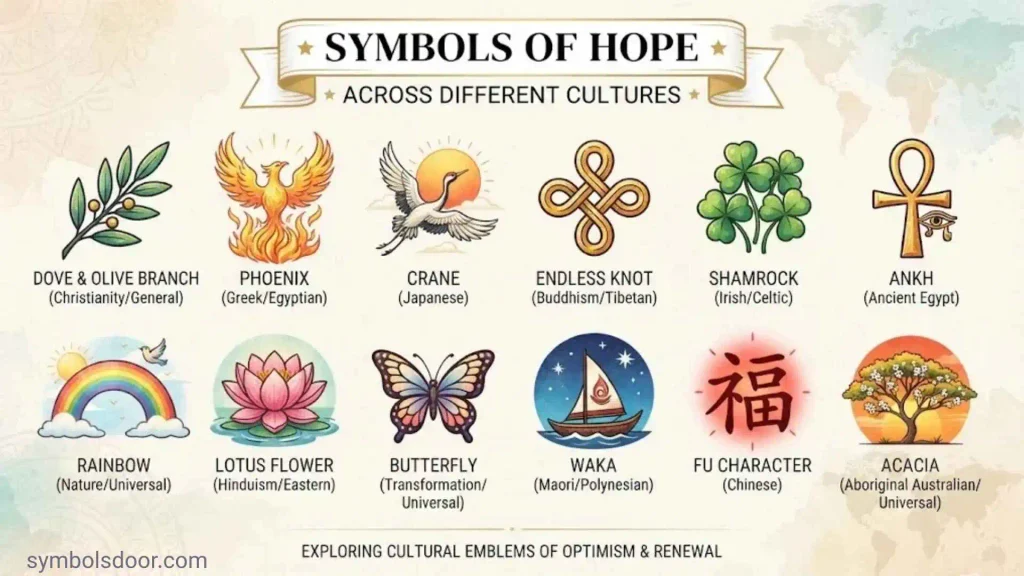
Hope appears in many cultural traditions, but communities express it in different ways. Some use plants and animals, while others use religious signs, mythological creatures, or objects connected with daily life.
Symbols of Hope in Chinese Culture
Chinese symbolism includes several creatures and objects associated with prosperity, harmony, and good fortune.
Important examples include:
- Fenghuang: Virtue, harmony, and auspicious events.
- Qilin: Peace, wisdom, and good fortune.
- Koi fish: Perseverance and success in popular East Asian symbolism.
- Paper lanterns: Celebration, light, reunion, and good wishes.
- Ginkgo leaves: Longevity and, in modern contexts, survival and peace.
Chinese paper lanterns are especially visible during festivals, including the Lantern Festival. Their colors, shapes, and decorations can carry different meanings, so there is no single interpretation for every lantern.
Symbols of Hope in Japanese Culture
Japanese traditions include several natural symbols associated with renewal, perseverance, and the passing of time.
Koi fish are commonly associated with determination and success. Cherry blossoms remind people of the beauty and shortness of life, while the ginkgo tree is connected with longevity and resilience.
Cranes also appear in Japanese cultural traditions and are associated with longevity and good fortune. These meanings have developed through folklore, art, and cultural practices.
Symbols of Hope in Celtic and Irish Culture
Celtic and Irish traditions include several symbols connected with nature, luck, and cultural identity.
- Four-leaf clover: Good fortune in European folklore.
- Shamrock: Strongly associated with Ireland and St. Patrick.
- Oak tree: Strength and sacred natural places in some ancient European traditions.
- Birch tree: Renewal and seasonal change in certain northern European traditions.
It is important not to assume that every modern meaning attached to a Celtic design comes from ancient Celtic religion. Some interpretations developed much later.
Symbols of Hope in Ancient Greek Mythology
Ancient Greek mythology includes several figures and objects that can communicate hope, guidance, or renewal.
Elpis represents hope or expectation. Iris serves as a divine messenger associated with the rainbow. The olive branch is connected with peace, while the horse can represent strength and movement.
The Greek stories also influenced later Roman and European interpretations of the phoenix and other mythological creatures.
Symbols of Hope in Ancient Egyptian Mythology
Ancient Egyptian religion included important symbols connected with life, rebirth, and the afterlife.
- Ankh: A sign associated with life.
- Scarab: Connected with regeneration and the rising sun.
- Bennu bird: Associated with creation, renewal, and solar symbolism.
- Lotus: Connected with creation and the renewal of life.
The Egyptian Bennu bird influenced later discussions of the phoenix, but the two should not be treated as exactly the same creature.
Symbols of Hope in Norse Culture
Norse mythology does not have one universally recognized object that simply means hope. Instead, ideas of survival and renewal appear in its stories.
One important example is the world tree Yggdrasil, which connects different parts of the cosmos. Another is the survival of Líf and Lífþrasir, the human pair who are said to live through Ragnarök and help repopulate the renewed world.
These stories offer themes of endurance, survival, and life continuing after destruction.
Symbols of Hope in Polynesian Culture
Polynesian cultures have rich maritime traditions. The makau, or fishhook, is an important example of an object connected with fishing and ocean life.
In Hawaiian culture, traditional fishhooks were made from materials such as bone, shell, and wood. Their practical role in securing food gave them cultural importance.
Modern makau jewelry may represent strength, connection with the ocean, prosperity, and safe journeys. Meanings differ across Polynesian communities, so the symbol should be understood within its particular cultural context.
Symbols of Hope in Buddhism and Hinduism
The lotus flower is one of the most important symbols shared across Buddhist and Hindu artistic traditions.
In Buddhism, the lotus can represent purity, spiritual development, and the potential for awakening. In Hindu traditions, it is associated with creation, divine beauty, prosperity, and several deities.
The lotus throne is also important in religious art. A deity or enlightened figure seated on a lotus communicates a connection with purity and spiritual transcendence.
Lamps and candles are also used in religious practices, where light can represent knowledge, devotion, and the movement away from ignorance.
What Symbols Represent Hope During Difficult Times?
Different symbols may feel meaningful depending on what someone is experiencing. A person facing uncertainty may prefer an image of stability, while someone rebuilding their life may connect with symbols of transformation.
| Personal meaning | Symbols to consider |
| New beginnings | Butterfly, daffodil, sprout, crocus |
| Strength and resilience | Oak tree, phoenix, horse, acorn |
| Peace and reconciliation | Dove, olive branch, rainbow |
| Faith and spiritual hope | Cross, anchor, candle |
| Good luck and protection | Four-leaf clover, ladybug, horseshoe |
| Guidance and direction | Lighthouse, star, firefly |
| Spiritual growth | Lotus flower, lotus throne |
| Love and remembrance | Cardinal, dove, baby animals |
| Perseverance | Koi fish, horse, starfish |
| Survival and renewal | Ginkgo tree, phoenix, butterfly |
These suggestions are starting points rather than fixed rules. A symbol becomes meaningful through its history, cultural context, and the personal connection someone has with it.
How to Choose a Symbol of Hope
Choosing a symbol is often a personal decision. You may want something connected with your faith, cultural background, family history, or a challenge you have overcome.
Consider these points before choosing one:
Think about its meaning. Decide whether you want a symbol of peace, courage, renewal, protection, or spiritual healing.
Understand its cultural background. Religious and traditional symbols can have meanings beyond their modern decorative use. Learn about those meanings before using them.
Choose something personally meaningful. A flower may remind you of a family member, while an anchor may represent stability during a difficult period.
Consider where you will use it. A symbol for a tattoo may have different practical requirements from one you want for a gift, necklace, or home decoration.
Avoid treating symbolism as a guarantee. A lucky charm may offer comfort, but it cannot guarantee protection, success, or a particular future outcome.
Some people also connect hope symbols with manifestation. In this context, a symbol can serve as a reminder of a goal or intention. It may help someone focus on positive actions, but it does not replace planning, effort, or practical support.
Frequently Asked Questions About Symbols of Hope
What Is the Most Universal Symbol of Hope?
There is no single symbol that means exactly the same thing in every culture. However, the dove, rainbow, butterfly, and anchor are widely recognized examples.
The dove often represents peace, the rainbow can represent promise and renewal, the butterfly suggests transformation, and the anchor communicates stability.
What Animal Represents Hope?
The butterfly is one of the most common modern animal symbols of hope because of its transformation from caterpillar to adult. Horses can represent strength and progress, while koi fish are associated with perseverance and success.
The phoenix is another popular example, although it is a mythical creature rather than a real animal.
What Bird Symbolizes Hope?
The dove is one of the best-known birds associated with hope and peace. Other examples include the hummingbird, cardinal, albatross, rooster, and phoenix.
Their meanings vary. A dove is strongly connected with biblical peace imagery, while the phoenix represents rebirth in mythological traditions.
What Flower Represents Hope and New Beginnings?
The daffodil is a well-known flower associated with hope and new beginnings because it blooms in spring. Crocuses also represent the return of growth after winter.
The lotus flower has a deeper religious connection with purity and spiritual awakening in Buddhist and Hindu traditions.
What Plant Symbolizes Growth and Hope?
Sprouts, acorns, oak trees, birch trees, and ginkgo trees can all represent growth and renewal.
A sprout suggests a new beginning, an acorn represents future potential, and an oak tree symbolizes strength and endurance.
What Is the Christian Symbol of Hope?
The anchor is a direct Christian symbol of hope because Hebrews 6:19 compares hope to an anchor for the soul.
The cross, dove, olive branch, rainbow, and Ichthys fish also have important Christian meanings connected with faith, peace, salvation, and God’s promises.
What Is the Chinese Symbol of Hope?
There is no single Chinese symbol that represents hope in every context. The Fenghuang and Qilin are associated with harmony, virtue, and auspicious events.
Koi fish are popular symbols of perseverance and success, while paper lanterns can represent celebration, reunion, and good wishes.
What Symbol Represents Hope During Difficult Times?
The lighthouse, anchor, phoenix, candle, and butterfly are common choices.
The lighthouse suggests guidance, the anchor represents stability, the phoenix symbolizes rebirth, and the candle represents light in darkness.
What Is the Symbol of Hope and Strength?
The oak tree, horse, phoenix, and acorn are popular symbols of hope and strength.
The oak tree represents endurance, the horse suggests power and progress, the phoenix symbolizes recovery, and the acorn represents the potential for future growth.
What Does a Four-Leaf Clover Represent?
A four-leaf clover is commonly associated with good luck. A popular modern interpretation assigns the four leaves the meanings of faith, hope, love, and luck.
It is different from the three-leaf shamrock, which is strongly associated with Ireland.
What Does the Lotus Flower Symbolize?
The lotus flower represents purity, spiritual growth, and awakening in Buddhist and Hindu traditions. It grows in muddy water but produces a clean bloom, making it a powerful image of spiritual development.
What Does the Phoenix Represent?
The phoenix represents rebirth, renewal, and resilience. In later classical mythology, it is a mythical bird that dies and rises again, making it a popular symbol of recovery after hardship.
What Does the Rainbow Symbolize in Christianity?
In the biblical story of Noah, the rainbow represents God’s covenant with Noah and all living creatures after the flood. It is a sign of God’s promise not to destroy all life through another flood.
Is a Cardinal a Sign From a Departed Loved One?
Some modern spiritual beliefs interpret a cardinal sighting as a message or reminder from a departed loved one. Others simply see the bird as a comforting symbol of remembrance.
This is a personal belief and should not be presented as a proven fact or universal religious teaching.
Conclusion: The Lasting Meaning of Symbols of Hope
Symbols of hope appear in almost every part of human culture. Animals, birds, insects, flowers, trees, religious objects, and mythical creatures all help people express the desire for a better future.
The butterfly represents transformation, the dove communicates peace, and the lotus suggests spiritual growth. The anchor reminds people to remain steady, while the phoenix offers a powerful image of rebirth after destruction. Other symbols, such as the ginkgo tree, carry modern meanings shaped by real historical experiences of survival.
Their meanings are not always universal. A symbol may have a specific religious purpose in one tradition and a personal or decorative meaning in another. Understanding that difference helps you appreciate the history behind each image.
Ultimately, a symbol of hope does not promise that life will always be easy. It reminds you that change is possible, growth can follow hardship, and even a small sign of encouragement can help you keep moving forward.

Hi, I’m Sienna Brooks, and I believe that the right words can inspire, comfort, and empower people at every stage of life. For as long as I can remember, I’ve been drawn to meaningful quotes and the stories behind them. I love curating collections of inspirational, motivational, and heartfelt quotes that resonate with readers around the world.
Through my writing, I strive to help others find encouragement, whether they’re celebrating life’s happiest moments or navigating its biggest challenges. I believe that wisdom is timeless, and I’m passionate about sharing words that leave a lasting impact.
I am the author of Reflections in Words and The Journey of Inspiration, two books dedicated to exploring the beauty and power of timeless quotes.
 Asher Monroe
 Rowan Sinclair Rowan Sinclair