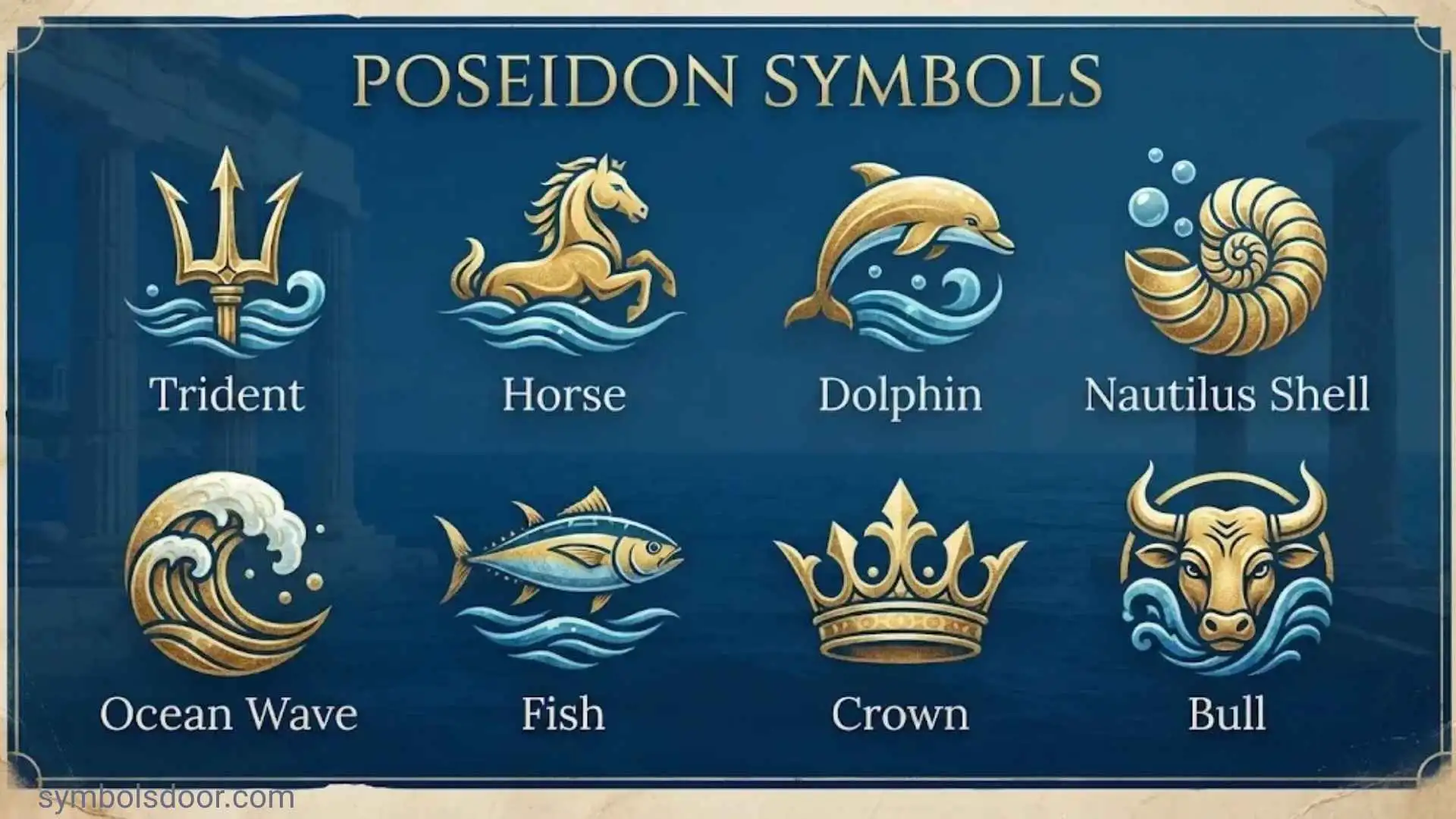
Poseidon symbols represent the power, authority, and unpredictable nature of the ancient Greek god of the sea. His most recognizable symbol is the trident, a three-pronged weapon associated with his control over oceans, storms, and earthquakes. Other important symbols include horses, dolphins, bulls, hippocampi, and the sea chariot.
In Greek mythology, Poseidon was one of the most powerful Greek gods and a member of the 12 Olympians. He ruled over the sea, influenced earthquakes, and protected horses and horsemanship. Ancient Greeks also worshipped him through prayers, sacrifices, festivals, and religious ceremonies.
Each symbol tells a different part of his story. The trident represents divine authority, the horse reflects strength and movement, and the dolphin connects him with marine life and the safety of sailors. Together, these images explain why Poseidon held such an important place in ancient Greek religion.
Who Was Poseidon in Greek Mythology?
Poseidon was one of the major Olympian deities in ancient Greek religion. He was the god of the sea, god of earthquakes, and god of horses. His influence extended beyond the ocean to rivers, springs, coastal communities, and the natural forces that could either support or threaten human life.
The ancient Greeks viewed the sea as a powerful and unpredictable force. It provided food, supported trade, and connected distant communities. However, storms, floods, and rough waters could destroy ships and take lives. Poseidon represented both sides of this natural world.
He was usually portrayed as a strong, mature man with a thick beard and flowing hair. Artists often showed him carrying a trident or riding a chariot across the waves.
Poseidon was the son of the Titans Cronus and Rhea. His siblings included Zeus, Hades, Hera, Demeter, and Hestia. He was married to Amphitrite, a sea goddess, and their son Triton was also connected with the marine world.
Poseidon’s Role Among the 12 Olympians
Poseidon belonged to the traditional group of twelve major Olympian gods. His responsibilities differed from those of his brothers:
- Zeus: Ruled the sky and governed divine authority, thunder, and lightning.
- Poseidon: Ruled the sea and was associated with earthquakes and horses.
- Hades: Governed the underworld and the realm of the dead.
These three brothers became especially important after the defeat of the Titans. According to the traditional myth, they divided the major realms among themselves. Zeus received the sky, Poseidon received the sea, and Hades received the underworld.
Poseidon’s authority over the sea made him important to sailors, fishermen, coastal settlements, and people who depended on maritime travel.
Poseidon and Neptune: Are They the Same God?
Poseidon is the Greek god of the sea, while Neptune is his Roman counterpart. Roman religion adopted many features of Greek mythology and connected Neptune with Poseidon’s maritime identity.
Modern paintings, statues, books, and films sometimes use their names interchangeably. However, they originated in different religious traditions.
What Are the Main Poseidon Symbols?
Poseidon’s symbols include weapons, animals, and mythical sea creatures. Some represent his divine power, while others connect him with horses, the ocean, and ancient religious practices.
| Poseidon symbol | Main meaning |
| Trident | Authority over the sea and divine power |
| Horse | Strength, speed, and horsemanship |
| Dolphin | Marine life and the sea |
| Bull | Strength, fertility, and sacrificial worship |
| Hippocampus | Mythical sea power and movement |
| Sea chariot | Dominion over the ocean |
| Fish and sea creatures | His connection with marine life |
| Pine tree | Association with the Isthmian Games |
The trident is his primary symbol. Horses, dolphins, and bulls are among the most important animals associated with him. Hippocampi and sea chariots appear frequently in artistic representations of his underwater kingdom. <Cite refs={[“turn670723search0″,”turn670723search1″,”turn670723search13”]}/>
The Trident: Poseidon’s Most Recognizable Symbol
<escape> </escape>
<escape> </escape>
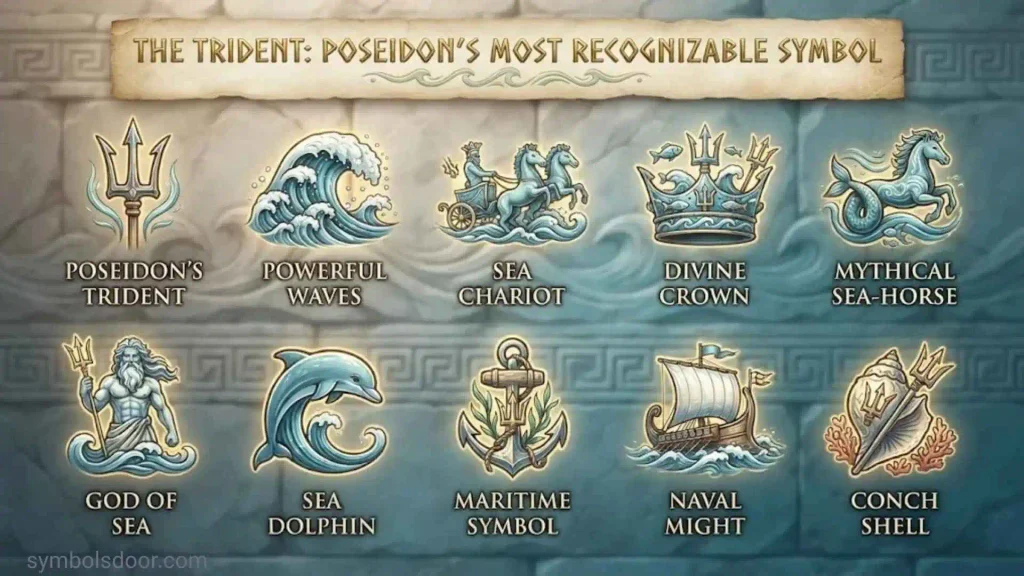
The trident is the most famous of all Poseidon symbols. It is a three-pronged spear that resembles a large fishing weapon. Ancient Greek artists regularly placed it in Poseidon’s hand to show his identity and authority.
The three points make the weapon easy to recognize. In ancient maritime life, similar spear-shaped tools could be used for fishing. However, Poseidon’s trident was much more than an ordinary fish spear. In mythology, it was a powerful divine weapon.
What Does Poseidon’s Trident Represent?
Poseidon’s trident has several important meanings:
- Control over the sea: It represents his authority over ocean waters, waves, and storms.
- Earthquakes: His weapon is connected with the ability to shake the ground.
- Divine power: The trident identifies him as a powerful Olympian god.
- Natural forces: It reflects the destructive and life-supporting power of water.
- Creation of springs: Some myths connect the weapon with the appearance of water sources.
The trident also represents the unpredictable character of the sea. Poseidon could calm the waters or make them dangerous, depending on the story.
How Did Poseidon Get His Trident?
The traditional story connects Poseidon’s trident with the Cyclopes, the one-eyed beings who helped Zeus and his brothers during the Titanomachy.
Cronus had swallowed his children because he feared that one of them would overthrow him. Zeus eventually escaped this fate and helped free his siblings. Together, the gods fought the Titans in a major conflict known as the Titanomachy.
During this war, the Cyclopes crafted powerful weapons for the three brothers:
- Zeus received the thunderbolt.
- Poseidon received the trident.
- Hades received a helmet of invisibility.
The weapons helped the Olympian gods defeat the Titans. Poseidon’s trident later became his most recognizable attribute.
Could Poseidon’s Trident Cause Earthquakes?
Yes. Ancient Greek mythology connected Poseidon with earthquakes and gave him titles meaning Earth-Shaker.
The Greeks believed that he could strike the ground with his trident and cause violent movements beneath the earth. This association explains why his power extended beyond the ocean.
The trident therefore represented both the sea above and the forces beneath the ground.
The Horse: Poseidon’s Sacred Animal and Symbol of Strength
<escape> </escape>
The horse is one of the most important animals associated with Poseidon. Although people often remember him only as the god of the sea, his connection with horses was equally significant in ancient Greek religion.
Poseidon was known by the title Poseidon Hippios, meaning Poseidon of Horses. He was associated with horse breeding, riding, chariot racing, and the protection of horses.
What Does the Horse Symbolize?
The horse represents several qualities connected with Poseidon’s divine identity:
- Strength: Horses were powerful animals used for transport, warfare, and agriculture.
- Speed: Their movement reflected energy and physical power.
- Vitality: Horses were connected with fertility and the continuation of life.
- Horsemanship: Poseidon was associated with the taming and management of horses.
- Divine power: His connection with horses extended his influence beyond the sea.
Horses also played an important role in ancient Greek ceremonies and athletic competitions.
Did Poseidon Create the First Horse?
Several ancient stories connect Poseidon with the creation of the horse, but the details vary.
One well-known tradition links the horse with Poseidon’s competition against Athena for the patronage of Athens. In this version, Poseidon produced a horse as his gift to the people. Athena offered the olive tree, which proved more useful to the city’s inhabitants.
Other traditions connect Poseidon’s creation of the horse with Thessaly rather than Athens.
These different versions show how Greek mythology developed through local stories and religious traditions. The horse remained strongly associated with Poseidon even when the details of its origin changed.
Why Were Horses Sacred to Poseidon?
Horses were valuable in ancient Greek society. They supported transportation, warfare, agriculture, and sporting events.
Because Poseidon was considered their divine protector, people offered prayers and sacrifices to him for healthy horses and successful races.
His association with horses also explains why ancient artwork sometimes shows him riding a horse rather than standing beside the sea.
The Dolphin: A Symbol of the Sea and Marine Life
<escape> </escape>
The dolphin is another important animal associated with Poseidon. Unlike the powerful horse and bull, the dolphin represents the marine world more directly.
Dolphins live in the sea, move quickly through the water, and often appear in ancient Greek artwork. Their presence helped artists communicate a scene’s connection with the ocean.
What Does the Dolphin Represent?
Dolphins associated with Poseidon can represent:
- Marine life and the ocean
- The beauty and movement of the sea
- Guidance and assistance during sea journeys
- The relationship between humans and the marine world
- The peaceful side of Poseidon’s watery domain
Dolphins also appeared in stories involving other Greek sea gods and heroes. Their symbolic meaning was not limited to Poseidon alone.
Dolphins in Poseidon’s Artistic Depictions
Ancient Greek artists used dolphins as recognizable marine symbols. They appeared on pottery, coins, mosaics, and sculptural decorations.
A dolphin beside a bearded man carrying a trident could help viewers identify the figure as Poseidon.
The dolphin also provided a contrast to the destructive imagery associated with storms and earthquakes. It represented the living sea, not simply its dangerous power.
The Bull: A Symbol of Strength and Sacrifice
<escape> </escape>
The bull was another important animal connected with Poseidon. It represented physical strength, fertility, and the powerful forces of nature.
Ancient Greek religious traditions included animal sacrifices to honor the gods. Bulls were among the animals offered to Poseidon in some communities.
Historical accounts describe sacrifices of black and white bulls, as well as other animals such as rams and wild boars. These practices varied by location and period. <Cite refs={[“turn670723search0″,”turn670723search2”]}/>
What Does the Bull Symbolize?
The bull’s association with Poseidon reflects several themes:
- Physical strength: Its powerful body represented force and endurance.
- Fertility: Bulls were connected with reproduction and agricultural life.
- Wild natural power: Its strength reflected the destructive side of the sea.
- Religious devotion: Animal offerings expressed respect and piety toward the god.
The bull also appears in important Greek myths. One famous example is the Cretan Bull, which is connected with Poseidon’s mythology and the story of the Minotaur.
The bull is therefore more than a decorative animal in Poseidon’s imagery. It connects his mythology with ancient Greek religious worship and ideas about natural power.
The Hippocampus: Poseidon’s Mythical Sea Horse
<escape> </escape>
The hippocampus is one of the most recognizable mythical sea creatures associated with Poseidon. It has the upper body of a horse and the lower body or tail of a fish.
In Greek mythology and ancient art, hippocampi often appear pulling Poseidon’s chariot across the ocean. Their unusual form combines the strength of a horse with the movement of a marine creature.
What Do Hippocampi Represent?
Hippocampi symbolize:
- The connection between land and sea
- Poseidon’s command over mythical marine creatures
- Movement through the ocean
- The supernatural nature of the sea
- The combination of horse symbolism and sea symbolism
These creatures helped ancient artists portray Poseidon’s underwater kingdom as a world filled with extraordinary beings.
Hippocampi in Greek Mythology and Art
Hippocampi appear in ancient Greek and later Greco-Roman artistic traditions. Artists used them in mosaics, sculptures, and decorative scenes involving sea gods.
They are especially associated with Poseidon’s sea chariot. Their horse-like bodies also reinforce his connection with real horses.
Are Hippocampi the Same as Real Seahorses?
No. A hippocampus in Greek mythology is a mythical creature with a horse-like front and a fish-like rear. A modern seahorse is a small marine fish with a distinctive head shape and curled tail.
The two share a name connection and an association with the sea, but they are not the same creature.
Poseidon’s Sea Chariot and Its Meaning
<escape> </escape>
Poseidon is frequently portrayed riding a sea chariot across the ocean. This image is one of the most dramatic representations of his power.
In artistic depictions, his chariot may be pulled by hippocampi or other extraordinary sea creatures. Dolphins, Tritons, and Nereids may also appear around him.
What Does the Sea Chariot Symbolize?
The chariot represents Poseidon’s authority over the ocean and the creatures that inhabit it.
Its main symbolic meanings include:
- Dominion over the sea: Poseidon travels across the waters as their divine ruler.
- Divine authority: The chariot presents him as a powerful god.
- Movement and energy: Its motion reflects the constant movement of waves.
- Mythical marine life: The creatures pulling the chariot show the supernatural character of his kingdom.
The sea chariot also connects Poseidon’s two major identities: god of the sea and god of horses.
Poseidon’s Animals and Their Meanings
The animals associated with Poseidon include both real creatures and mythical beings. Some were connected with his worship, while others appeared mainly in stories and artistic representations.
| Animal or creature | Type | Association with Poseidon |
| Horse | Real animal | Horsemanship, strength, and divine protection |
| Dolphin | Real animal | Marine life and the sea |
| Bull | Real animal | Strength and religious sacrifice |
| Hippocampus | Mythical creature | Sea chariot and marine power |
| Triton | Mythological sea being | Poseidon’s marine world |
| Fish | Real animal group | His connection with ocean life |
Which Animals Were Sacred to Poseidon?
The horse, bull, and dolphin are among the best-known sacred animals associated with Poseidon.
Their roles were different:
- Horses connected him with horsemanship and athletic competitions.
- Bulls appeared in religious sacrifices and represented strength.
- Dolphins connected him with the ocean and its living creatures.
Fish and other marine animals also appeared in Poseidon-related artistic scenes. However, not every sea creature was necessarily considered a sacred animal in the same way.
What About Seahorses and Other Mythical Sea Creatures?
Hippocampi are the best-known horse-like sea creatures in Poseidon’s artistic world. Tritons and Nereids also appear in scenes involving the sea god.
A Triton is a mythological marine being, often shown with a human upper body and a fish tail. Triton is also the name of Poseidon and Amphitrite’s son.
Nereids are sea nymphs associated with the sea and its divine inhabitants. They may appear in artistic scenes accompanying Poseidon.
These beings help explain the rich visual language of Greek mythology symbols connected with the ocean.
What Do Poseidon’s Symbols Mean Together?
Each symbol has its own meaning, but the full group tells a larger story about Poseidon’s character and divine responsibilities.
| Symbol | Symbolic meaning | Connection to Poseidon |
| Trident | Authority and power | His weapon and divine attribute |
| Horse | Strength and vitality | His role as protector of horses |
| Dolphin | Marine life | His rule over the sea |
| Bull | Force and fertility | His animal associations and sacrifices |
| Hippocampus | Supernatural sea power | His mythical sea chariot |
| Sea chariot | Dominion and movement | His journeys across the ocean |
| Fish | Ocean life | His connection with marine creatures |
Together, these symbols represent five major themes:
Authority: The trident and sea chariot show Poseidon’s position as ruler of the sea.
Strength: The horse and bull reflect physical power and the force of nature.
Destruction: His trident and earthquake associations represent the dangerous side of the natural world.
Protection: Ancient sailors and coastal communities prayed to him for favorable conditions and safe journeys.
Marine life: Dolphins, fish, hippocampi, and other sea creatures represent the living world under his influence.
Poseidon’s symbolism is not simply about water. It also reflects the ancient Greek understanding of nature as a force that could provide life while creating serious danger.
Poseidon and the Division of the World
Poseidon’s position as ruler of the sea comes from the mythology surrounding the defeat of the Titans.
Cronus and the Overthrow of the Titans
Poseidon was born to Cronus and Rhea. Cronus feared that one of his children would eventually overthrow him, so he swallowed his children after their birth.
Zeus escaped this fate and later helped free his siblings. The Olympian gods then fought against the Titans in the Titanomachy.
The Cyclopes and other allies supported the Olympians. Their weapons helped the gods defeat the older generation of divine rulers.
Zeus, Poseidon, and Hades Divide the Universe
After their victory, the three brothers divided the major realms of the universe.
- Zeus received the sky.
- Poseidon received the sea.
- Hades received the underworld.
The earth and Mount Olympus were not divided in the same way. The brothers held authority over different realms while remaining members of the same divine family.
This story explains how Poseidon became the ruler of the sea and why his symbols focus on water, marine creatures, and the forces of nature.
Why Was Poseidon the God of Earthquakes?
Poseidon’s connection with earthquakes was central to his identity in ancient Greek religion.
The Greeks called him by titles such as Earth-Shaker, reflecting their belief that he could cause the ground to tremble. His power was not restricted to the ocean’s surface.
Poseidon and the Earth-Shaker Tradition
Ancient Greeks lived in a region where earthquakes were a familiar natural danger. They used mythology to explain powerful events that could damage homes, temples, and entire settlements.
Poseidon became associated with these movements of the earth. His trident could symbolize his ability to strike the ground and release destructive forces.
This connection also explains why Poseidon had worshippers in inland communities, not only in coastal areas.
How Did the Sea and Earth Become Connected?
Ancient Greek ideas about the natural world did not always separate water and land into completely different systems.
Poseidon’s influence included the sea, springs, rivers, and earthquakes in various traditions. He was therefore understood as a god whose power could reach beneath the earth as well as across the ocean.
Poseidon and Athena’s Competition for Athens
One of the most famous stories involving Poseidon is his competition with Athena for the patronage of Athens.
The two gods wanted to become the city’s divine protector. According to the traditional myth, they each offered a gift to the people.
Poseidon’s Saltwater Spring
Poseidon struck the ground with his trident and produced a source of water. In the familiar version of the story, this was a saltwater spring.
The gift demonstrated his power over water and his connection with the sea. However, saltwater was less useful for everyday needs than fresh water.
Athena’s Olive Tree
Athena offered an olive tree. The tree represented practical benefits such as food, olive oil, and materials that supported daily life and trade.
The people favored Athena’s gift, and she became the patron goddess of Athens.
What Do the Saltwater Spring and Olive Tree Represent?
The two gifts represent different aspects of divine power:
| Poseidon’s gift | Athena’s gift |
| Saltwater spring | Olive tree |
| Connection with the sea | Connection with wisdom and practical prosperity |
| Power over water | Agricultural and economic value |
| Divine strength | Useful protection for the city |
The story explains why Athens became closely associated with Athena rather than Poseidon.
It also shows that Greek myths often used divine competitions to explain the identity and religious traditions of cities.
Poseidon’s Role in Ancient Greek Religion and Worship
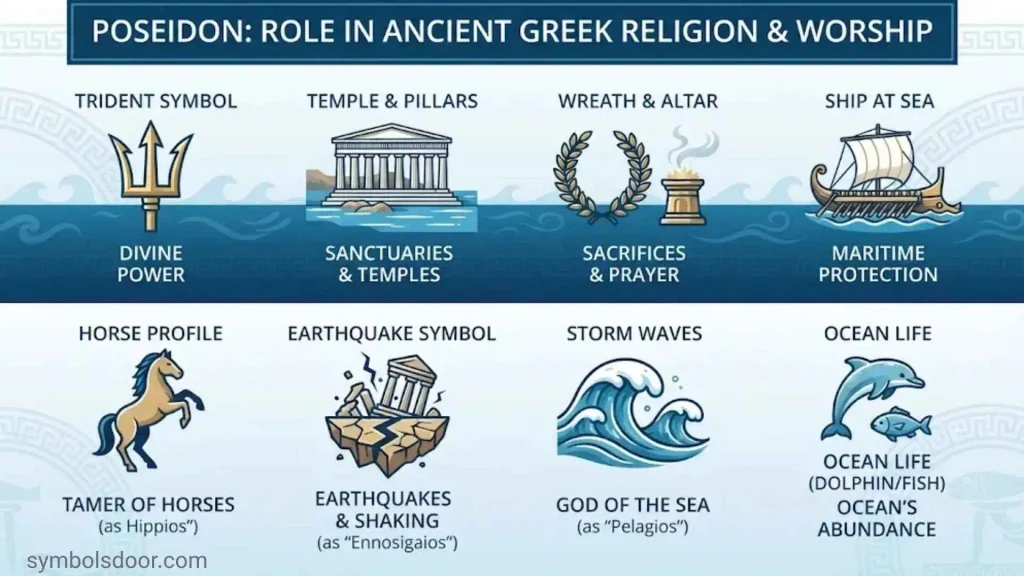
Poseidon was widely worshipped throughout the ancient Greek world. His importance was especially strong in coastal communities, maritime centers, and places where horses played a major role.
People prayed to him because their safety and livelihood could depend on the sea, weather, and animals under his protection.
Who Worshipped Poseidon?
Several groups had particular reasons to honor him:
- Sailors: They sought favorable winds and safe sea journeys.
- Fishermen: They depended on marine resources and ocean conditions.
- Horse breeders: They prayed for healthy and strong horses.
- Athletes and competitors: They honored him through games and athletic traditions.
- Coastal communities: They sought protection from storms, floods, and earthquakes.
Poseidon’s worship was not limited to one city or region. Temples, sanctuaries, and shrines dedicated to him existed across Greece.
Ancient Greek Prayers and Religious Rites
Ancient Greek worship involved more than simply asking a god for help. People used established religious practices to show respect and maintain a relationship with the divine.
Common forms of worship included:
- Prayers and spoken requests
- Animal sacrifices
- Offerings at temples and sanctuaries
- Religious festivals
- Processions and public ceremonies
- Dedications made in gratitude for divine assistance
These practices reflected piety and the importance of religious traditions in everyday Greek life.
Animal Sacrifices to Poseidon
Historical sources describe several animals offered to Poseidon, including horses, bulls, rams, and wild boars. Black and white bulls are mentioned in ancient accounts.
The type of offering depended on local customs, the occasion, and the community’s religious practices. Sacrifices were part of a wider system of ancient Greek worship rather than a single uniform ritual.
Festivals and Religious Sites Dedicated to Poseidon
Poseidon’s worship was connected with several important sanctuaries and public festivals. These places helped preserve his religious importance across different Greek communities.
The Isthmian Games and Poseidon
The Isthmian Games were among the major athletic festivals of ancient Greece. They were held near Corinth, at the Isthmus of Corinth, in honor of Poseidon.
The games included athletic competitions and were an important part of Greek religious and cultural life.
Horse and chariot racing also reflected Poseidon’s connection with horses. Victors traditionally received wreaths made from plants associated with the festival, including pine in the later tradition.
The sanctuary of Poseidon at Isthmia contained temples, statues, and dedications. The ancient writer Pausanias described the sanctuary and its offerings, including representations of Poseidon, Amphitrite, Tritons, and other sea-related figures. <Cite refs={[“turn670723search1″,”turn670723search2”]}/>
Were the Olympic Games Dedicated to Poseidon?
No. The ancient Olympic Games were held in honor of Zeus, not Poseidon.
The distinction is important because both gods had connections with major Greek athletic traditions.
- The Olympic Games honored Zeus at Olympia.
- The Isthmian Games honored Poseidon near Corinth.
Poseidon’s connection with horses and racing made the Isthmian Games especially appropriate for his worship.
The Temple of Poseidon at Cape Sounion
<escape> </escape>
The Temple of Poseidon at Cape Sounion is one of the best-known ancient sites associated with the god.
It stands on a coastal promontory at the southern tip of Attica, overlooking the Aegean Sea. Its location reflects Poseidon’s importance to maritime communities and people traveling by water.
The temple is a reminder that ancient Greek religious buildings were often placed in locations connected with the gods’ natural domains.
Other Important Places of Poseidon’s Worship
Poseidon had sanctuaries in several parts of Greece. Important locations included:
- Isthmia near Corinth: Home of the sanctuary connected with the Isthmian Games.
- Cape Sounion: A coastal sanctuary overlooking the Aegean Sea.
- Helike in Achaea: An important center of Poseidon’s worship.
- Onchestus in Boeotia: Another location associated with his religious cult.
- Mycale: A major sanctuary connected with the worship of Poseidon by Ionian communities.
These places show how widely ancient Greek communities recognized Poseidon’s power.
Poseidon in Ancient Greek Art and Sculpture
<escape> </escape>
Ancient artists used recognizable attributes to show that a statue or painting represented Poseidon.
His physical appearance was often similar to Zeus. Both gods were commonly shown as mature, powerful men with beards. The objects and creatures around them helped viewers distinguish their identities.
How Was Poseidon Depicted?
Common features in Poseidon statues and artistic depictions included:
- A muscular or powerful body
- A thick beard
- Flowing hair
- A trident held in one hand
- A dolphin or sea creature nearby
- A horse or hippocampus
- A chariot moving across the water
Artists sometimes showed Poseidon in a calm pose. In other scenes, they emphasized his anger and power through dramatic movement.
Poseidon in Pottery, Mosaics, and Sculpture
Poseidon appeared in several forms of ancient Greek and Roman art:
Pottery: Painted vessels showed stories involving Poseidon, other gods, and mythological heroes.
Sculpture: Statues used the trident and other attributes to identify the sea god.
Mosaics: Marine scenes often included Poseidon riding a chariot surrounded by sea creatures.
Coins: Some ancient communities used images of Poseidon to express their local religious identity.
The Artemision Bronze: Zeus or Poseidon?
The famous bronze statue known as the Artemision Bronze depicts a powerful male god with one arm extended as if preparing to throw something.
Its identity remains debated. Some scholars identify the figure as Zeus holding a thunderbolt, while others believe it represents Poseidon holding a trident.
The uncertainty exists partly because the original object held by the statue is missing. It is a useful example of why identifying ancient gods from sculpture sometimes requires careful interpretation.
Poseidon Symbols Compared With Other Greek Gods
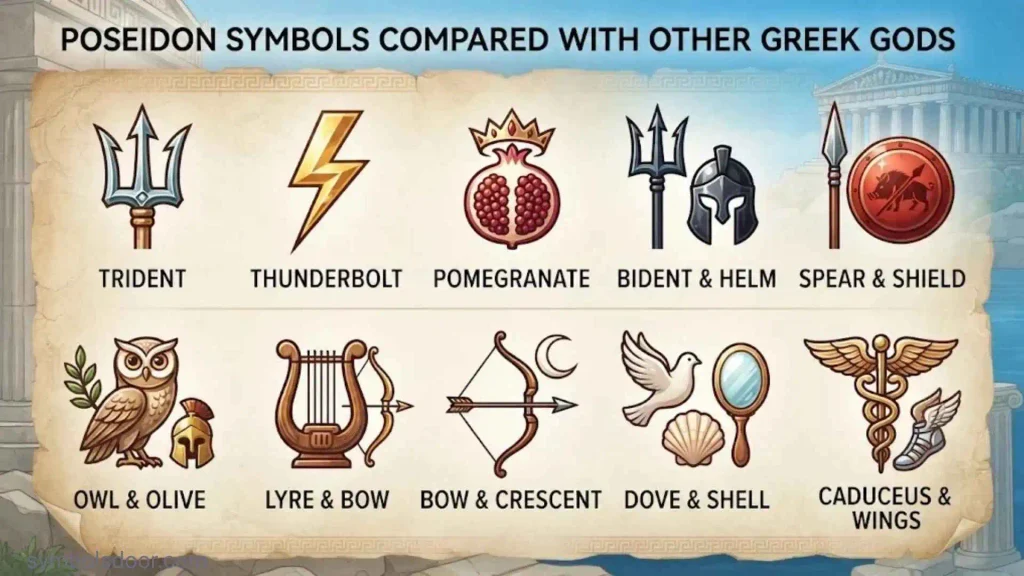
Greek gods often had distinct objects, animals, and natural elements associated with them. Comparing these symbols helps explain Poseidon’s identity.
Poseidon vs. Zeus Symbols
| Poseidon | Zeus |
| Trident | Thunderbolt |
| Horse | Eagle |
| Dolphin | Eagle and bull associations |
| Sea and earthquakes | Sky, thunder, and divine authority |
Poseidon ruled the sea, while Zeus governed the sky. Both were powerful Olympian gods, but their symbols reflected different areas of authority.
Poseidon vs. Hades Symbols
Poseidon’s trident and marine creatures connect him with the ocean. Hades is associated with the underworld, the dead, and wealth beneath the earth.
Their different symbols reflect the division of the universe after the defeat of the Titans.
Poseidon vs. Athena Symbols
Poseidon and Athena became rivals in the myth about the patronage of Athens.
| Poseidon | Athena |
| Trident | Helmet and spear |
| Horse | Owl |
| Saltwater spring | Olive tree |
| Sea and earthquakes | Wisdom and strategic warfare |
Their competition represents two different kinds of divine gifts: Poseidon’s power over natural forces and Athena’s practical contribution to the city.
Poseidon Symbols in Modern Culture
Poseidon’s image remains popular in modern art, literature, films, games, and decorative designs.
The trident is especially recognizable because it immediately suggests a powerful sea god. Artists often use it in illustrations, fantasy stories, tattoos, and jewelry.
Poseidon in Books and Movies
Modern books and films frequently draw on Greek mythology. Poseidon may appear as a powerful ruler of the ocean, a father of heroes, or a supernatural figure who controls storms and water.
His image is also familiar through stories involving the Roman god Neptune. Although their origins differ, the two figures share many visual features in modern popular culture.
Poseidon in Video Games and Fantasy Art
Video games and fantasy illustrations often portray Poseidon with:
- A glowing or oversized trident
- Waves and storm clouds
- A sea chariot
- Dolphins and mythical sea creatures
- A powerful underwater palace
These modern designs build on ancient artistic traditions while adding imaginative details.
Poseidon Tattoos and Jewelry
Poseidon-inspired designs often feature the trident, waves, horses, and dolphins.
People may choose these images because they like Greek mythology or want artwork associated with strength, authority, and the sea.
However, modern tattoo meanings are personal. They should not be treated as fixed religious meanings shared by all ancient Greeks.
Frequently Asked Questions About Poseidon Symbols
What Is Poseidon’s Main Symbol?
Poseidon’s main symbol is the trident, a three-pronged spear. It represents his authority over the sea and his ability to influence storms and earthquakes.
What Are the Five Main Symbols of Poseidon?
Five important symbols associated with Poseidon are:
- Trident
- Horse
- Dolphin
- Bull
- Hippocampus
The trident is his most recognizable attribute, while the other symbols reflect his connection with animals and the marine world.
What Animals Are Sacred to Poseidon?
The horse, dolphin, and bull are among Poseidon’s best-known sacred animals. Horses connect him with horsemanship, dolphins with the sea, and bulls with strength and religious sacrifices.
Why Is the Horse Associated With Poseidon?
Poseidon was worshipped as Poseidon Hippios, or Poseidon of Horses. Ancient Greek traditions connected him with the creation, protection, and taming of horses.
What Does Poseidon’s Trident Represent?
The trident represents divine authority, control over the sea, and the ability to cause earthquakes. It is also associated with the power to strike the ground and produce water in certain myths.
Why Did the Cyclopes Give Poseidon a Trident?
In the traditional story of the Titanomachy, the Cyclopes created powerful weapons for the Olympian gods. They gave Poseidon his trident, Zeus his thunderbolt, and Hades his helmet of invisibility.
What Is Poseidon’s Sea Horse Called?
Poseidon’s mythical sea horses are called hippocampi. They have the upper body of a horse and the lower body or tail of a fish.
Are Dolphins Symbols of Poseidon?
Yes. Dolphins are among the animals associated with Poseidon. They appear in ancient artwork and help represent his connection with marine life.
Is Poseidon the God of the Sea and Earthquakes?
Yes. Poseidon was worshipped as the god of the sea and earthquakes. He was also associated with horses, springs, and other sources of water.
What Is Poseidon’s Roman Name?
Poseidon’s Roman counterpart is Neptune. Roman mythology adopted many features of the Greek sea god and developed its own traditions around Neptune.
What Is Poseidon’s Connection With Athens?
Poseidon competed with Athena to become the patron deity of Athens. He offered a saltwater spring, while Athena gave the city an olive tree. Athena won the contest in the familiar version of the myth.
Were the Olympic Games Held in Honor of Poseidon?
No. The ancient Olympic Games honored Zeus. The Isthmian Games near Corinth were held in honor of Poseidon.
What Is the Difference Between a Hippocampus and a Seahorse?
A hippocampus is a mythical creature with the front of a horse and the tail of a fish. A real seahorse is a small marine fish. They are different despite the similarity in their names.
Conclusion: The Meaning Behind Poseidon’s Symbols
Poseidon symbols reveal why the ancient Greeks considered him one of their most powerful gods. His trident represented authority over the sea and the ability to cause earthquakes. Horses reflected strength and horsemanship, while dolphins and other marine creatures connected him with ocean life.
The bull represented physical power and appeared in religious sacrifices. Hippocampi and sea chariots brought his mythical underwater kingdom to life in ancient art.
These symbols also reflect the different ways people worshipped Poseidon. Sailors prayed for safe journeys, horse breeders sought his protection, and coastal communities honored him through festivals and religious ceremonies.
Whether you encounter his trident in a statue, his horse in an ancient myth, or his sea chariot in a mosaic, each image points back to the same powerful figure: Poseidon, the Greek god whose influence reached across the sea and beneath the earth.

Hi, I’m Asher Monroe, a writer who believes that meaningful words have the power to inspire change and bring people closer to their dreams. I have always been fascinated by the beauty of quotes and the way a simple message can provide motivation, hope, and comfort.
I enjoy creating content around inspirational quotes, life lessons, success stories, and positive thoughts that help readers find encouragement in their everyday lives. My goal is to share words that connect with people and remind them of their inner strength.
Through my writing, I explore the ideas of personal growth, confidence, and the importance of staying inspired through every chapter of life.
I am the author of Words That Move the Soul and The Path of Endless Inspiration, two books focused on the power of wisdom, positivity, and meaningful thoughts.
 Sienna Brooks
 Rowan Sinclair Rowan Sinclair