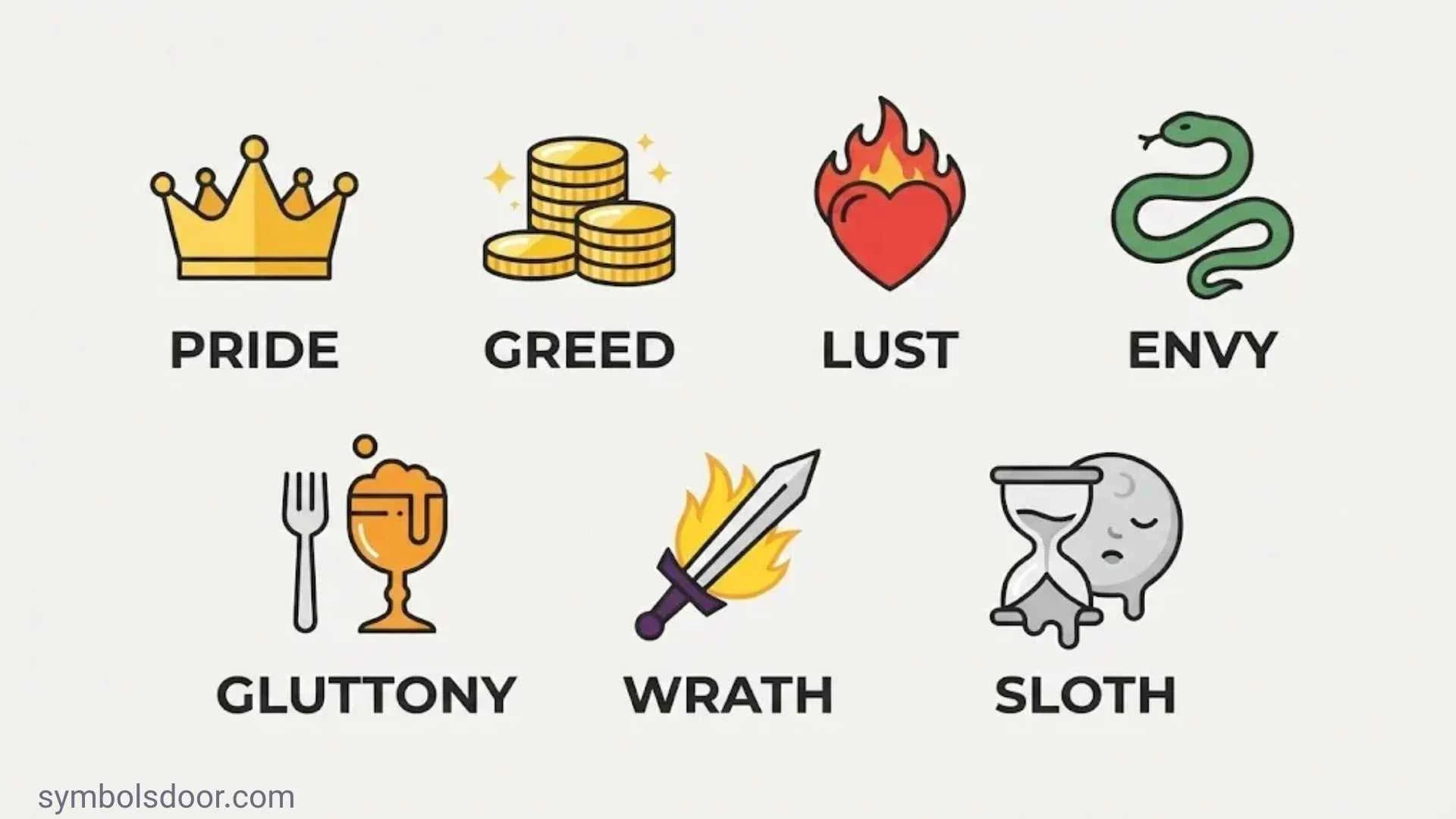
The seven deadly sins symbols represent seven major human weaknesses recognized in the Western Christian tradition: pride, greed, lust, envy, gluttony, wrath, and sloth. Religious artists have used animals, objects, colors, and human figures to represent these vices throughout history.
A peacock, for example, can symbolize pride and vanity. A pig may represent excessive appetite, while a snake can suggest temptation, deception, or envy. These symbolic images appear in medieval paintings, religious literature, sculpture, and modern popular culture.
However, there is no single official animal or object assigned to every sin across all Christian traditions. Symbolic meanings can change depending on the historical period, artwork, and cultural setting.
Understanding these differences helps you interpret the symbols of the seven deadly sins more accurately. This guide explores the meaning of each vice, its common symbolic associations, the history behind the classification, and its influence on Christian theology and art.
What Are the Seven Deadly Sins?
The seven deadly sins are a traditional Christian classification of major human vices. They describe destructive patterns of thought, desire, and behavior that can lead to other forms of wrongdoing.
The seven deadly sins are:
- Pride: Excessive self-importance, arrogance, and vanity.
- Greed: An uncontrolled desire for money, possessions, or material wealth.
- Lust: Disordered or excessive sexual desire.
- Envy: Resentment or sadness because another person has something good.
- Gluttony: Excessive consumption, especially of food and drink.
- Wrath: Uncontrolled anger, hatred, or the desire for revenge.
- Sloth: Spiritual laziness, neglect, or unwillingness to pursue what is good.
These vices are also known as capital vices or capital sins. The word capital comes from the Latin caput, meaning head. It describes their role as sources from which other sinful behaviors can develop.
For example, greed may encourage dishonesty, fraud, and exploitation. Envy can lead to resentment and hostility toward another person. Pride may encourage arrogance, boasting, and the refusal to accept correction.
The seven deadly sins are not simply a list of individual actions. They describe deeper tendencies that can influence human behavior, moral decisions, and spiritual life.
Are the Seven Deadly Sins Listed in the Bible?
The Bible discusses all seven types of wrongdoing, but it does not present the familiar seven deadly sins as one official list.
Instead, the classification developed through early Christian tradition. Christian writers studied biblical teachings about temptation, human behavior, spiritual discipline, and morality. Over time, they organized recurring patterns of wrongdoing into a group of major vices.
Several biblical passages are particularly relevant:
- Proverbs 6:16–19: Lists seven things that are detestable to God, including pride, lying, murder, and sowing discord. This is a separate biblical list, not the later seven-capital-vices classification.
- Galatians 5:19–21: Describes works of the flesh, including jealousy, anger, selfish ambition, and other destructive behaviors.
- Mark 7:20–23: Explains how evil thoughts and actions come from within a person.
- James 1:14–15: Describes how desire can lead to temptation and eventually to sin.
- 1 John 2:16: Discusses the desires of the flesh, the desires of the eyes, and the pride of life.
These passages provide important biblical antecedents for Christian discussions of sin. However, the familiar seven-part classification came later through theological reflection.
Capital Sins vs. Mortal Sins
The terms capital sin and mortal sin do not mean the same thing in Catholic theology.
A capital vice is a major source of other sinful behaviors. A mortal sin describes a serious personal sin that meets specific conditions.
According to the Catechism of the Catholic Church, three conditions must be present for a sin to be mortal:
- The act involves grave matter.
- The person has full knowledge of its sinful nature.
- The person gives deliberate consent.
Therefore, not every instance of pride, anger, or excessive eating automatically qualifies as a mortal sin. The seriousness of an act, a person’s knowledge, and the freedom of their choice all matter.
History and Origins of the Seven Deadly Sins
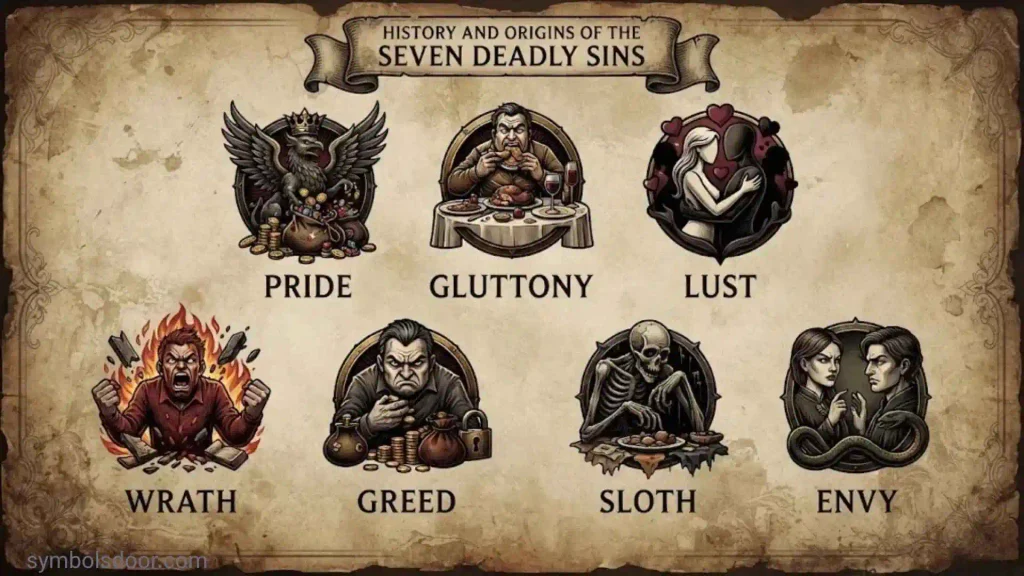
The familiar list did not appear all at once. It developed over several centuries through the writings of Christian monks, theologians, and religious leaders.
Evagrius Ponticus and the Eight Evil Thoughts
In the fourth century, the Christian monk Evagrius Ponticus described eight harmful thoughts that could interfere with a person’s spiritual life.
These thoughts were known in Greek as logismoi. They included:
- Gluttony
- Lust
- Avarice
- Anger
- Sadness
- Acedia
- Vainglory
- Pride
Evagrius developed this classification for the monastic environment. Monks practiced prayer, fasting, and spiritual discipline, so understanding recurring temptations helped them examine their thoughts and behavior.
His work focused on the internal roots of wrongdoing, not simply the outward actions people could see. A person might appear disciplined while struggling with pride, jealousy, or resentment internally.
This early classification is important because it shows that the seven deadly sins began as part of a broader discussion about evil thoughts, temptation, and spiritual progress. <Cite refs={[“turn494180search0″,”turn494180search4”]}/>
John Cassian and the Spread of the Classification
John Cassian, a Christian monk and writer, helped bring the earlier classification into Western Christianity.
He discussed eight principal faults and explained how they could influence one another. For example, excessive appetite could encourage lust, while frustration and anger could contribute to other destructive mental states.
His writings helped establish a tradition of examining the causes of sinful behavior rather than treating every wrongdoing as an isolated event.
Cassian played an important role in connecting Greek-speaking monastic traditions with the developing Latin Christian tradition in the West. <Cite refs={[“turn494180search4″,”turn494180search9”]}/>
Pope Gregory I and the Seven Capital Vices
In the sixth century, Pope Gregory I, also known as Gregory the Great, helped establish the familiar seven-vices classification in Western Christianity.
His treatment reorganized the earlier ideas. The resulting list became associated with:
- Pride (Superbia)
- Greed (Avaritia)
- Lust (Luxuria)
- Envy (Invidia)
- Gluttony (Gula)
- Wrath (Ira)
- Sloth (Acedia)
Gregory treated pride as a root vice and organized the other vices within his theological framework. His classification became influential in Western Christian teaching, particularly during the medieval period. <Cite refs={[“turn494180search0″,”turn494180search12”]}/>
Thomas Aquinas and the Meaning of Capital Vices
The medieval theologian Thomas Aquinas explored the seven capital vices in his major theological work, Summa Theologica.
Aquinas explained that these vices are called capital because they can give rise to other sins. His approach connected human desires, emotions, moral choices, and the pursuit of happiness.
He also examined how particular behaviors develop from each vice. For example, greed can encourage fraud, while pride can produce boasting and a refusal to accept another person’s guidance.
Aquinas’s work remains an important source for understanding the seven deadly sins in Catholic theology. <Cite refs={[“turn494180search7″,”turn494180search10”]}/>
Seven Deadly Sins Symbols and Their Meanings
The symbols associated with the seven deadly sins help communicate complicated moral ideas through recognizable images.
Artists have used animals, objects, clothing, gestures, and facial expressions to represent each vice. Some associations became popular, while others remained specific to particular artworks or regional traditions.
The following sections explain common symbolic interpretations without suggesting that every association is universal.
Pride Symbol: Peacock, Mirror, and Crown
Latin name: Superbia
Common symbols: Peacock, mirror, crown, throne, and elevated figures.
Pride represents excessive self-importance, arrogance, and the belief that you are better or more deserving than others.
In Christian moral teaching, pride becomes destructive when a person places personal status, power, or admiration above humility and concern for others.
Common symbolic associations include:
- Peacock: Its impressive feathers can represent vanity, beauty, and excessive admiration of appearance.
- Mirror: Represents self-obsession and constant concern with personal image.
- Crown: Suggests superiority, status, authority, and the desire to dominate.
- Raised head: Can represent arrogance and refusal to accept correction.
- Throne: May symbolize excessive ambition or an inflated sense of importance.
The peacock is especially recognizable in discussions of vanity. Its colorful display makes it a useful visual metaphor for someone who constantly seeks admiration.
However, peacocks do not always symbolize pride in Christian art. Their meaning depends on the surrounding imagery and the artist’s intention.
Pride, Vanity, and Vainglory: What’s the Difference?
These terms are related but not identical.
- Pride involves excessive self-importance.
- Vanity focuses heavily on appearance, reputation, or admiration.
- Vainglory refers to an excessive desire for recognition, praise, or public approval.
Early Christian writers treated vainglory and pride as separate categories in some classifications. Later Western traditions developed the familiar seven-vices list around pride.
Opposing virtue: Humility.
Greed Symbol: Toad, Money, and Treasure
Latin name: Avaritia
Common symbols: Toad, money bags, gold, treasure, and clenched hands.
Greed, also called avarice, represents an excessive desire to acquire or possess material wealth.
It involves more than wanting financial security. Greed becomes a moral problem when the desire for money or possessions controls a person’s choices and encourages dishonesty, exploitation, or a lack of compassion.
Common symbols include:
- Toad: Appears in some historical allegories as a representation of greed or attachment to material possessions.
- Money bags: Represent wealth accumulation and the desire to possess more.
- Gold coins: Symbolize material wealth and excessive attachment to possessions.
- Treasure chests: Suggest hoarding and the pursuit of riches.
- Clenched hands: Can represent unwillingness to share or give.
The toad is not a universal symbol of greed. Historical artists used different animals for the same vice, and the same animal could represent more than one sin.
Greed and Avarice in Christian Teaching
Avarice is closely connected with the desire to possess more than a person needs or can use responsibly.
It may encourage:
- Fraud and deception.
- Theft and dishonest business practices.
- Exploitation of vulnerable people.
- Treachery for financial gain.
- Refusal to help people in need.
- Excessive attachment to material wealth.
Christian moral teaching does not condemn every form of saving, earning, or owning property. The concern is the disordered desire that places possessions above spiritual good and moral responsibilities.
Opposing virtue: Charity and generosity.
Lust Symbol: Goat and Sensual Imagery
Latin name: Luxuria
Common symbols: Goat, sensual imagery, temptation, and broken restraints.
Lust represents excessive or disordered sexual desire.
Christian theology distinguishes ordinary sexual attraction from lust. Sexual desire itself is part of human experience. The moral concern arises when desire becomes detached from love, responsibility, respect, and appropriate moral boundaries.
Common symbolic associations include:
- Goat: Used in some medieval and later allegories to suggest sensuality or sexual misconduct.
- Sensual imagery: Represents temptation and uncontrolled desire.
- Broken restraints: Can symbolize the loss of self-control.
- Excessive luxury: In some allegorical contexts, represents indulgence and sensual pleasure.
- Erotic figures: May personify sexual temptation in religious paintings and literature.
The goat’s meaning depends on context. It can also have biblical associations unrelated to lust.
Lust and Sexual Misconduct
Historical Christian discussions of lust include concerns about sexual behavior such as adultery and fornication.
However, it is important to distinguish different actions rather than treating every sexual offense as identical. Rape, for example, is a violent crime involving the violation of another person’s consent. It should not be described simply as excessive desire.
The central moral concern in discussions of lust is disordered desire and the failure to respect the dignity of other people.
Opposing virtue: Chastity.
Envy Symbol: Snake, Dog, and Green Imagery
Latin name: Invidia
Common symbols: Snake, dog, watching eyes, and green imagery.
Envy is the painful feeling that arises when another person has something good that you wish you possessed or when you resent their success.
Unlike ordinary admiration, envy can make someone unhappy because another person is happy or successful.
Common symbolic associations include:
- Snake: Can represent malice, temptation, and destructive thoughts.
- Dog: Appears in some historical representations of envy.
- Watching eyes: Suggest jealousy and constant attention to another person’s possessions or achievements.
- Green imagery: A popular cultural association with envy, although it is not a universal historical rule.
- Gnawing figures: Sometimes represent the way resentment consumes a person’s peace of mind.
Envy vs. Jealousy
Envy and jealousy are related emotional states, but they are not always the same.
- Envy: You want something another person has.
- Jealousy: You fear losing something or someone you already value to another person.
For example, feeling envious of a friend’s success means resenting their achievement or wishing you had the same advantage.
Envy can develop into resentment, hatred, alienation, and harmful behavior. Christian teaching encourages people to respond with gratitude, compassion, and goodwill.
Opposing virtue: Kindness and gratitude.
Gluttony Symbol: Pig, Food, and Wine
Latin name: Gula
Common symbols: Pig, overflowing food, wine, and feasting.
Gluttony represents excessive consumption, especially eating and drinking beyond reasonable needs.
It is not simply enjoying a meal or eating a favorite food. The concern is overindulgence and the lack of moderation that can turn appetite into a controlling desire.
Common symbols include:
- Pig: Often represents excessive appetite and overconsumption in allegorical art.
- Overflowing table: Suggests excessive eating and waste.
- Wine cup: Can represent overindulgence in drinking.
- Food-filled plates: Show an uncontrolled appetite.
- Feasting figures: May symbolize a life dominated by physical pleasure.
Five Forms of Gluttony According to Thomas Aquinas
Thomas Aquinas discussed five forms of gluttonous behavior. These categories explain that excessive consumption is not limited to the quantity of food.
| Latin term | Meaning |
| Laute | Eating too expensively or seeking excessive refinement |
| Studiose | Being excessively particular or attentive about food |
| Nimis | Eating too much |
| Praepropere | Eating too soon or at an inappropriate time |
| Ardenter | Eating too eagerly or greedily |
These categories reflect medieval moral discussions about appetite, discipline, and moderation.
Gluttony can also be discussed more broadly in relation to overconsumption and excessive indulgence. However, the traditional capital vice focuses particularly on food and drink.
Opposing virtue: Temperance.
Wrath Symbol: Lion, Bear, Fire, and Weapons
Latin name: Ira
Common symbols: Lion, bear, fire, sword, and blood.
Wrath represents uncontrolled anger, hatred, hostility, and the desire for revenge.
Anger is a normal human emotion. It can arise when someone experiences injustice, danger, or mistreatment. In Christian moral teaching, anger becomes sinful when it leads to hatred, cruelty, unjust punishment, or a desire to cause suffering.
Common symbols include:
- Lion: Can represent rage, aggression, and destructive power.
- Bear: Appears in some allegorical representations of uncontrolled aggression.
- Fire: Represents burning anger and emotional intensity.
- Sword: Symbolizes violence, revenge, and hostility.
- Blood: Can suggest the destructive consequences of uncontrolled anger.
Wrath, Revenge, and Vengeance
Wrath can encourage several harmful behaviors:
- Revenge against someone who caused an offense.
- Hatred toward people who disagree.
- Violence driven by rage.
- Malice and deliberate cruelty.
- Excessive punishment.
- Long-lasting resentment.
The important distinction is between responding to wrongdoing and allowing anger to control your actions.
Christian teachings encourage justice, patience, forgiveness, and self-control rather than uncontrolled vengeance.
Opposing virtue: Patience and forgiveness.
Sloth Symbol: Snail, Donkey, and Sleeping Figure
Latin name: Acedia
Common symbols: Snail, donkey, sleeping figure, and abandoned tools.
Sloth represents spiritual laziness, neglect of responsibility, and unwillingness to pursue what is morally or spiritually good.
It is often misunderstood as simply being tired or physically inactive. In traditional Christian theology, sloth is more closely associated with acedia, a form of spiritual weariness or indifference toward spiritual duties.
Common symbolic associations include:
- Snail: Suggests slow movement and sluggishness.
- Donkey: Appears in historical allegories as a symbol associated with sloth.
- Sleeping figure: Represents idleness and neglected responsibilities.
- Abandoned tools: Suggest unfinished work and avoidance of duties.
- Unproductive surroundings: Can symbolize a lack of effort or purpose.
A historical example is the 1558 engraving Sloth (Desidia), based on a design by Pieter Bruegel the Elder and engraved by Pieter van der Heyden. The personification of sloth sleeps in the foreground while resting on a donkey. The scene reinforces the theme of wasted time and inactivity.
Sloth, Acedia, and Emotional States
The historical meaning of acedia is more complex than ordinary laziness.
It can involve:
- Apathy toward spiritual responsibilities.
- Indifference to moral duties.
- Avoidance of meaningful effort.
- Despair or discouragement in spiritual life.
- Neglect of responsibilities.
- Resistance to prayer or other spiritual practices.
However, ordinary tiredness, illness, disability, and depression should not automatically be labeled sloth. These conditions require understanding and compassion rather than moral judgment.
Opposing virtue: Diligence.
Seven Deadly Sins Symbols Chart
The following chart provides a quick reference to the seven vices and their common symbolic associations.
| Deadly sin | Latin name | Common symbols | Opposing virtue |
| Pride | Superbia | Peacock, mirror, crown | Humility |
| Greed | Avaritia | Toad, money, treasure | Charity |
| Lust | Luxuria | Goat, sensual imagery | Chastity |
| Envy | Invidia | Snake, dog, green imagery | Kindness |
| Gluttony | Gula | Pig, food, wine | Temperance |
| Wrath | Ira | Lion, bear, fire, weapons | Patience |
| Sloth | Acedia | Snail, donkey, sleeping figure | Diligence |
Important: These are representative associations, not a universal official symbol chart. Historical sources sometimes assign different animals to the same sins. The surrounding figures, objects, inscriptions, and setting help establish an artwork’s intended meaning.
Animals That Represent the Seven Deadly Sins
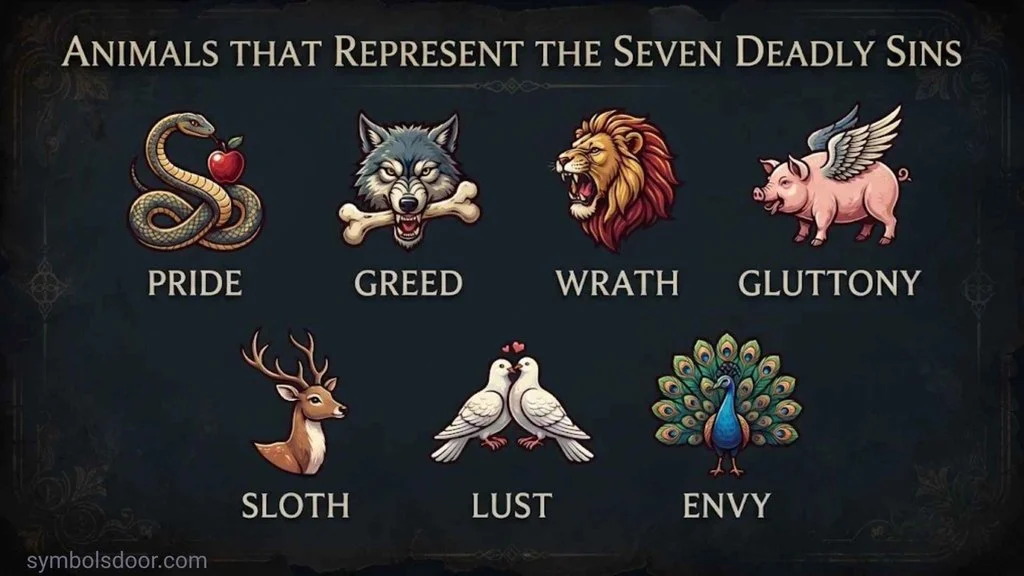
Animals played an important role in medieval religious art and literature. Artists used familiar creatures to communicate human weaknesses, moral lessons, and spiritual dangers.
Medieval bestiaries also contributed to this visual tradition. These illustrated books described real and imaginary animals, often combining observations about nature with religious or moral interpretations. The same animal could carry several meanings depending on the story or image.
Common Animal Associations
| Animal | Possible association | Symbolic idea |
| Peacock | Pride | Vanity and self-display |
| Toad | Greed | Attachment to possessions |
| Goat | Lust | Sensuality and sexual temptation |
| Snake | Envy or temptation | Malice and destructive thoughts |
| Dog | Envy | Resentment in some allegories |
| Pig | Gluttony | Excessive appetite |
| Lion | Wrath or pride | Power, aggression, or arrogance |
| Bear | Wrath or gluttony | Aggression or appetite |
| Donkey | Sloth | Idleness and unwillingness to act |
| Snail | Sloth | Sluggishness and delay |
Historical artwork demonstrates why animal symbolism needs context. Some compositions assign the snake to greed rather than envy, or use a frog for sloth instead of a snail. These variations show that allegorical representation of human vices developed through different artistic traditions.
The animal alone does not always reveal the meaning. You should also examine the human figure, objects, gestures, and other details in the artwork.
Latin and Greek Names of the Seven Deadly Sins
Latin terminology became important as the classification developed in Western Christianity. Greek terminology is especially useful when studying the earlier writings of Evagrius Ponticus and other early Christian thinkers.
| Sin | Common Latin name | Related Greek term |
| Pride | Superbia | Hyperēphania |
| Greed | Avaritia | Philargyria |
| Lust | Luxuria | Porneia |
| Envy | Invidia | No single direct equivalent in every early list |
| Gluttony | Gula | Gastrimargia |
| Wrath | Ira | Orgē |
| Sloth | Acedia | Akēdia |
The Greek terms should not be treated as exact translations of every later Latin category. They belong to a developing history of Christian moral vocabulary.
Other important terms include:
- Kenodoxia: Vainglory or an excessive desire for praise.
- Lypē: Sadness or distress.
- Acedia: Spiritual weariness, neglect, or indifference.
- Tristitia: Sadness or sorrow in Latin Christian discussions.
- Fornicatio: A Latin term associated with fornication and sexual wrongdoing.
- Vanagloria: Vainglory or excessive desire for recognition.
These distinctions matter because early Christian writers did not always organize human vices in exactly the same way as later theologians.
Seven Deadly Sins in Catholic Theology
The Catholic Church uses the language of capital vices to explain patterns of behavior that can lead people toward other sins.
The seven deadly sins are not simply a list of forbidden actions. They describe deeper tendencies that can influence thoughts, decisions, relationships, and spiritual life.
For example, a person who becomes consumed by greed may begin to value money above honesty or compassion. Someone controlled by pride may refuse to admit mistakes, even when those mistakes hurt others.
Why Are They Called Capital Vices?
The term capital means that these vices can act as starting points for other forms of wrongdoing.
Consider these examples:
- Pride may encourage arrogance, boasting, and contempt for others.
- Greed may encourage fraud, theft, and deceit.
- Envy may encourage resentment, hatred, and harmful competition.
- Wrath may lead to revenge, violence, and cruelty.
- Sloth may encourage negligence and the avoidance of moral responsibilities.
This does not mean every person who experiences one of these feelings automatically commits another sin. Christian moral teaching considers the person’s choices, intentions, circumstances, and actions.
Capital Sin and Mortal Sin Are Different
A capital sin describes a vice that can lead to other sins. A mortal sin describes a serious sin committed with full knowledge and deliberate consent, involving grave matter.
The Catechism of the Catholic Church explains that mortal sin destroys charity in the heart and turns a person away from God. It also distinguishes mortal sin from venial sin, which wounds but does not destroy charity.
The distinction is important when discussing spiritual consequences. It would be inaccurate to claim that every instance of pride, anger, or gluttony automatically results in eternal death or damnation.
Catholic and Protestant Perspectives on Sin
The seven capital vices have a long history in Western Christianity, but different Christian traditions may organize and emphasize moral teachings differently.
- Catholicism: Retains the traditional teaching on the seven capital vices and discusses them in relation to moral theology, virtues, and spiritual formation.
- Anglican tradition: Has inherited many historical Christian discussions of sin and virtue, although teaching and emphasis vary across Anglican communities.
- Lutheran tradition: Often emphasizes sin, grace, repentance, and justification through faith. Historical Lutheran theologians also discussed the traditional vices.
- Methodist tradition: Commonly emphasizes holiness, moral responsibility, grace, and growth in Christian character.
These traditions share many historical Christian ideas, but their theological frameworks are not identical.
Seven Deadly Sins and the Seven Opposing Virtues
Christian moral teaching does not focus only on identifying wrongdoing. It also encourages people to develop virtues that guide their choices toward goodness.
The traditional virtue pairings provide a simple way to understand this contrast.
| Deadly sin | Opposing virtue | Meaning |
| Pride | Humility | Recognizing your limitations and respecting others |
| Greed | Charity | Sharing resources and helping people in need |
| Lust | Chastity | Directing sexual desire responsibly |
| Envy | Kindness | Wishing others well rather than resenting their success |
| Gluttony | Temperance | Practicing moderation and self-control |
| Wrath | Patience | Responding to difficulties without uncontrolled anger |
| Sloth | Diligence | Taking responsibility and pursuing worthwhile duties |
These pairings are commonly used in Christian moral instruction. They help explain how people can replace destructive habits with more constructive behavior.
How the Opposing Virtues Encourage Spiritual Progress
Each virtue addresses a different weakness:
- Humility helps people recognize that they are not superior to everyone else.
- Charity encourages compassion and generosity.
- Chastity promotes respect, responsibility, and self-control.
- Kindness helps people respond to others without resentment.
- Temperance encourages balance in eating, drinking, and other pleasures.
- Patience reduces the desire to retaliate when frustrated.
- Diligence encourages people to fulfill their responsibilities.
The goal is not simply to avoid punishment. These virtues support moral growth, stronger relationships, and a more thoughtful spiritual life.
Seven Gifts of the Holy Spirit
The seven gifts of the Holy Spirit are another important concept in Catholic teaching. They are traditionally identified through Isaiah 11:2–3 and discussed as gifts that help believers live according to God’s guidance.
The seven gifts are:
| Gift | Meaning |
| Wisdom | Seeing life in the light of God’s purposes |
| Understanding | Grasping the meaning of spiritual truths |
| Counsel | Making sound moral decisions |
| Fortitude | Having courage to do what is right |
| Knowledge | Recognizing spiritual truth and God’s creation |
| Piety | Showing reverence and devotion toward God |
| Fear of the Lord | Respecting God’s holiness and authority |
These gifts are sometimes discussed alongside the seven deadly sins because both groups use the number seven and concern spiritual life.
However, they are not simply the seven opposing virtues under another name. The gifts of the Holy Spirit and the traditional virtues that oppose the capital vices are distinct theological concepts.
Seven Deadly Sins in Religious Art and Literature
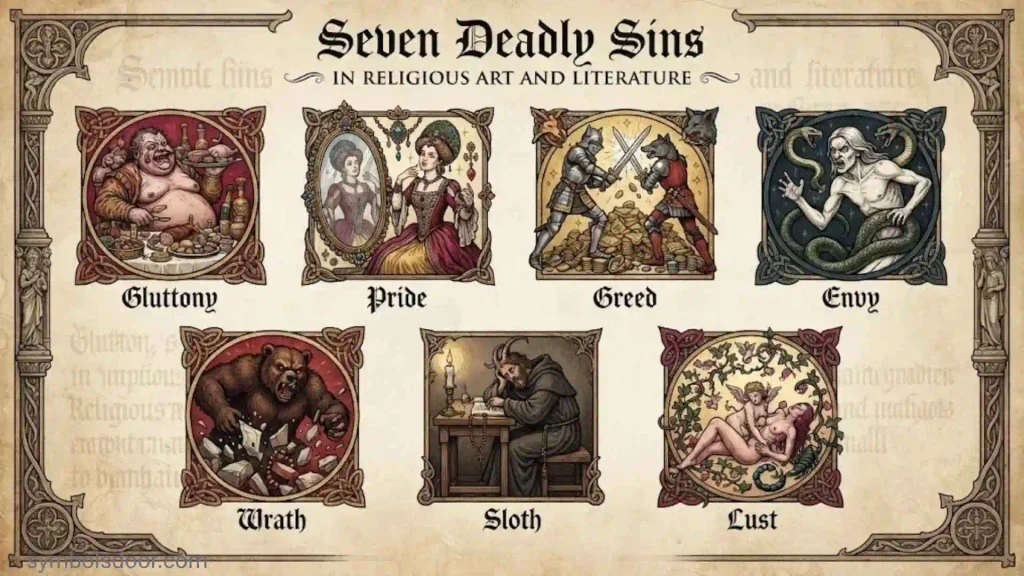
The seven deadly sins became popular subjects in medieval religious art and Christian literature. Artists and writers used them to explain moral choices, temptation, spiritual dangers, and the consequences of wrongdoing.
Their imagery was particularly useful when teaching people who might not have access to written religious texts.
Seven Deadly Sins in Medieval Paintings
Medieval paintings often presented the vices as human figures surrounded by symbolic objects and animals.
Artists used recognizable details to communicate each sin. A proud figure might admire a mirror, while a greedy figure might hold a money bag. A person representing gluttony might sit among overflowing plates and drinking vessels.
These images helped turn abstract moral concepts into scenes that viewers could understand.
One important example is Pieter Bruegel the Elder’s series of drawings for the seven deadly sins, which inspired engravings by Pieter van der Heyden in 1558. The series helped popularize the vices through detailed allegorical scenes.
Seven Deadly Sins in Sculpture and Decorative Art
Sculptors and craftspeople also represented the vices through human figures, animals, and symbolic attributes.
The subject appeared in:
- Church decorations.
- Carved architectural details.
- Religious objects.
- Illustrated manuscripts.
- Tapestries.
- Engraved prints.
- Decorative household objects.
The British Museum’s Waddesdon Bequest includes a seventeenth-century tankard decorated with representations of the seven deadly sins. Its imagery combines human personifications with accompanying animals and reflects the influence of medieval allegorical traditions.
This type of object shows that the seven deadly sins were not limited to church paintings. Their symbolism also appeared in decorative art and objects used in everyday life.
Seven Deadly Sins in Christian Literature
Christian writers used the seven vices to explore human weaknesses and the moral consequences of personal choices.
Geoffrey Chaucer is an important medieval literary figure to consider. His Canterbury Tales includes discussions of sin, repentance, and moral behavior, especially in the Parson’s treatment of penitence.
Other medieval works used allegorical characters and symbolic journeys to explain the struggle between virtue and vice.
These literary traditions helped make the seven deadly sins familiar beyond theological texts.
Important Artists and Historical Examples
When researching specific artworks, distinguish between a work that directly depicts the seven sins and one that explores only a related theme.
Examples worth examining include:
- Pieter Bruegel the Elder and Pieter van der Heyden: The sixteenth-century series of engravings representing the seven deadly sins.
- Evelyn De Morgan: The Worship of Mammon, an artwork associated with the worship of wealth and material possessions.
- Jacques de l’Ange: Religious and allegorical paintings that can be examined for their treatment of human passions and destructive behavior.
- Albert Anker: His still-life work should be discussed in relation to consumption only when the specific artwork and interpretation support that connection.
- Walters Art Museum: Its collections offer opportunities to explore historical religious art, manuscripts, and visual symbolism.
Do not automatically label every painting about wealth, violence, temptation, or food as an official representation of one of the seven deadly sins. The artist’s subject and historical context matter.
Seven Deadly Sins in Modern Popular Culture
The seven deadly sins continue to appear in film and television, novels, games, and other forms of popular media.
Modern storytellers often use them as character traits or themes. A character may represent greed through an obsession with wealth, while another may embody pride through an exaggerated belief in personal superiority.
Some examples of their modern use include:
- Se7en (1995): A crime thriller built around murders connected to the seven deadly sins.
- Shazam! (2019): Uses the seven deadly sins as supernatural figures within a superhero story.
- Books and fantasy fiction: Often use the seven vices to create symbolic characters or moral conflicts.
- Television: May assign a particular vice to a character or use the seven sins as a theme for an episode.
- Video games: Sometimes turn the vices into enemies, bosses, or stages in a symbolic journey.
These interpretations can make the historical ideas more familiar to modern audiences. However, entertainment often changes the original religious meanings to serve a story.
Difference Between the Seven Deadly Sins and Other Religious Classifications
Several religious and philosophical systems discuss wrongdoing, temptation, and moral responsibility. However, their classifications should not be treated as interchangeable.
Seven Deadly Sins vs. Ten Commandments
The Ten Commandments are biblical moral instructions concerning a person’s relationship with God and other people.
The seven deadly sins are a later Christian classification of major vices.
For example, the commandment against stealing addresses a specific type of wrongdoing. Greed describes a deeper desire that may encourage stealing but can also appear in other behaviors.
Seven Deadly Sins vs. Eight Evil Thoughts
The eight evil thoughts belong to the earlier monastic classification associated with Evagrius Ponticus.
The familiar seven deadly sins developed later in Western Christianity. The lists differ in their number and arrangement, particularly in how they treat sadness, vainglory, pride, and envy.
Seven Deadly Sins vs. Jewish Moral Teachings
The seven deadly sins belong to the history of Christian moral theology. Jewish ethical teachings have their own texts, concepts, and approaches to human behavior.
For example, Pirkei Avot is a Jewish collection of ethical teachings and sayings associated with the Mishnah. It discusses character, responsibility, wisdom, and relationships, but it is not the source of the Christian seven-capital-vices classification.
Recognizing these differences helps avoid confusing separate religious traditions.
Frequently Asked Questions About Seven Deadly Sins Symbols
What Are the Seven Deadly Sins and Their Symbols?
The seven deadly sins are pride, greed, lust, envy, gluttony, wrath, and sloth. Common symbolic associations include the peacock for pride, money and treasure for greed, the goat for lust, the snake or dog for envy, the pig for gluttony, the lion or bear for wrath, and the snail or donkey for sloth. These associations vary across historical sources.
What Animal Represents Each of the Seven Deadly Sins?
There is no single universal animal list. A commonly encountered set includes the peacock, toad, goat, snake, pig, lion, and snail. However, historical artworks sometimes use a dog, bear, frog, or donkey instead. The meaning depends on the specific artistic tradition.
What Is the Original Symbol of Pride?
The peacock is a familiar symbol of pride and vanity because of its elaborate feathers and display. Mirrors and crowns can also represent excessive self-admiration, status, and arrogance.
Why Is a Toad Associated With Greed?
Some historical allegories use a toad to represent greed or attachment to material possessions. However, other works use different animals, so the toad should not be treated as the only traditional symbol of avarice.
What Does the Snake Represent in the Seven Deadly Sins?
A snake can represent temptation, malice, deception, or envy, depending on the artwork. It has several meanings in Christian symbolism and is not limited to one deadly sin.
What Is the Difference Between the Seven Deadly Sins and the Seven Capital Sins?
The terms generally refer to the same traditional group of seven major vices. Capital emphasizes that these vices can lead to other sinful behaviors.
Are the Seven Deadly Sins Listed in the Bible?
No single biblical passage presents the familiar seven deadly sins as one complete list. The classification developed through early Christian tradition, although the Bible contains passages addressing all seven types of wrongdoing.
Who Created the Seven Deadly Sins?
No single person created the complete tradition. Evagrius Ponticus described eight evil thoughts in the fourth century. John Cassian helped transmit the classification to Western Christianity, and Pope Gregory I helped establish the familiar seven-vices grouping.
What Are the Latin Names of the Seven Deadly Sins?
The traditional Latin names are:
- Pride: Superbia
- Greed: Avaritia
- Lust: Luxuria
- Envy: Invidia
- Gluttony: Gula
- Wrath: Ira
- Sloth: Acedia
What Virtues Oppose the Seven Deadly Sins?
The traditional opposing virtues are humility, charity, chastity, kindness, temperance, patience, and diligence. These virtues encourage people to replace destructive habits with moral and spiritual strengths.
Are the Seven Deadly Sins the Same in Catholic and Protestant Christianity?
The seven-vices tradition has influenced both Catholic and Protestant discussions of morality. However, different Christian denominations may place different emphasis on sin, grace, repentance, spiritual discipline, and moral responsibility.
What Is the Difference Between a Capital Sin and a Mortal Sin?
A capital sin is a vice that can lead to other sins. A mortal sin is a serious sin that involves grave matter, full knowledge, and deliberate consent according to Catholic teaching. The terms describe different aspects of sin and should not be used interchangeably.
Conclusion: Understanding the Symbols of the Seven Deadly Sins
The seven deadly sins symbols turn complex moral ideas into recognizable images. A peacock can suggest vanity, a money bag can represent greed, and a sleeping figure can communicate spiritual neglect. These associations helped religious artists and writers explain human weaknesses through paintings, sculpture, literature, and allegorical storytelling.
The history of the seven vices also shows how Christian thought developed over time. Evagrius Ponticus described eight evil thoughts, John Cassian helped transmit the tradition to the West, Pope Gregory I contributed to the familiar seven-part classification, and Thomas Aquinas explored the capital vices in detail.
Remember that animal symbols are not universal rules. Their meanings change according to the historical source and artistic context. Understanding that variety makes it easier to interpret religious imagery without confusing popular associations with official doctrine.
Ultimately, the seven deadly sins remain a useful framework for discussing pride, greed, desire, resentment, excess, anger, and spiritual neglect. Their opposing virtues remind readers that Christian moral teaching is not only about recognizing wrongdoing. It is also about developing humility, charity, self-control, patience, and compassion.

Hello, I’m Rowan Sinclair, a passionate writer and lifelong admirer of the wisdom found in great quotes. I believe that words have the ability to inspire change, spark creativity, and connect people across cultures and generations.
I enjoy writing about motivational quotes, famous sayings, and lessons from history’s most influential thinkers. Every article I create is driven by my desire to help readers discover meaningful insights that they can apply to their own lives.
When I’m not writing, I spend my time reading biographies, exploring classic literature, and collecting memorable quotes that deserve to be shared with the world.
I am the author of Voices That Inspire and A Collection of Timeless Thoughts, two books that celebrate the enduring power of words and the stories behind them.
 Sienna Brooks
 Asher Monroe