Venn diagram symbols are far more than mere classroom tools designed for solving dry math problems. They are the universal language of connection, bridging the silent spaces between separate worlds to show us where we meet. Throughout human history, these beautiful overlapping circles have whispered secrets about unity, relationships, and the shared experiences that define our existence. By looking closer at these elegant shapes, you will unlock a profound understanding of how different parts of your life, mind, and spirit beautifully weave together.
(Quick Answer) Venn Diagram Symbols
Venn diagram symbols represent the logical and mathematical relationships between different groups or concepts. Through overlapping circles, these symbols visually map out shared traits (intersections), unique differences, and complete unions, turning complex data or profound relationships into an easily understood picture of connection and boundaries.
Quick Facts About Venn Diagram Symbols
| Aspect | Information |
| Origin | Created by philosopher John Venn in 1880, though rooted in ancient geometric art. |
| Historical Significance | Revolutionized symbolic logic, computer science, and set theory in the late 19th century. |
| Main Meaning | Illustrates relationships, shared traits, and logical connections between sets. |
| Spiritual Meaning | Represents the sacred union of opposites, like the physical and spiritual realms. |
| Cultural Importance | Serves as a universal design icon representing collaboration, unity, and shared humanity. |
| Modern Usage | Used in computer science, business branding, internet memes, and deeply symbolic tattoo art. |
What Are Venn Diagram Symbols?
At its simplest, a Venn diagram is a visual way to show how different things relate to each other. By using overlapping closed curves, which are almost always circles, these diagrams map out the logical relationships between two or more sets of items.
The origin of these symbols traces back to 1880, when an English philosopher and logician named John Venn published a groundbreaking paper. He wanted a clear, visual method to show how different propositions connect. However, the idea of using circles to show logic was not entirely new. Brilliant thinkers like Leonhard Euler had used similar circular drawings in the 18th century. John Venn took these concepts and made them much more consistent, allowing people to represent empty sets and complex logical arguments.
Over time, these diagrams evolved from dusty academic textbooks into essential tools for everyday life. They became crucial because they do something the human brain craves: they turn abstract, complicated ideas into clear, digestible pictures. Today, they are used by data analysts, designers, and spiritual seekers alike to find order in chaos.
Deep Symbolic Meaning of Venn Diagram Symbols
Beyond math and logic, Venn diagram symbols hold deep, comforting meanings that speak directly to our human experience on several levels.
Spiritual Level
On a spiritual level, the overlap of two circles creates a sacred shape known as the Vesica Piscis. This almond-shaped center represents the womb of creation, the delicate space where the spiritual world meets the physical world. It symbolizes inner transformation, showing how the soul and human consciousness merge to create a higher state of awareness.
Psychological Level
Psychologically, these overlapping circles represent the journey of integration. In Jungian psychology, we often speak of the conscious self and the shadow self. The Venn diagram represents the integration of these two halves. The overlapping center is the healthy, balanced self, where we accept our light and shadow. It also represents our emotional attraction to others, showing how two separate individuals can share a deep, emotional bond without losing their unique identities.
Cultural Level
Culturally, these symbols represent community, shared beliefs, and peace. Think of a community as a cluster of individual circles. When they overlap, they create a shared cultural space. This is where traditions, language, and mutual trust are born. It is a visual reminder that despite our individual differences, our shared humanity is where our true strength lies.
Types and Variations of Venn Diagram Symbols
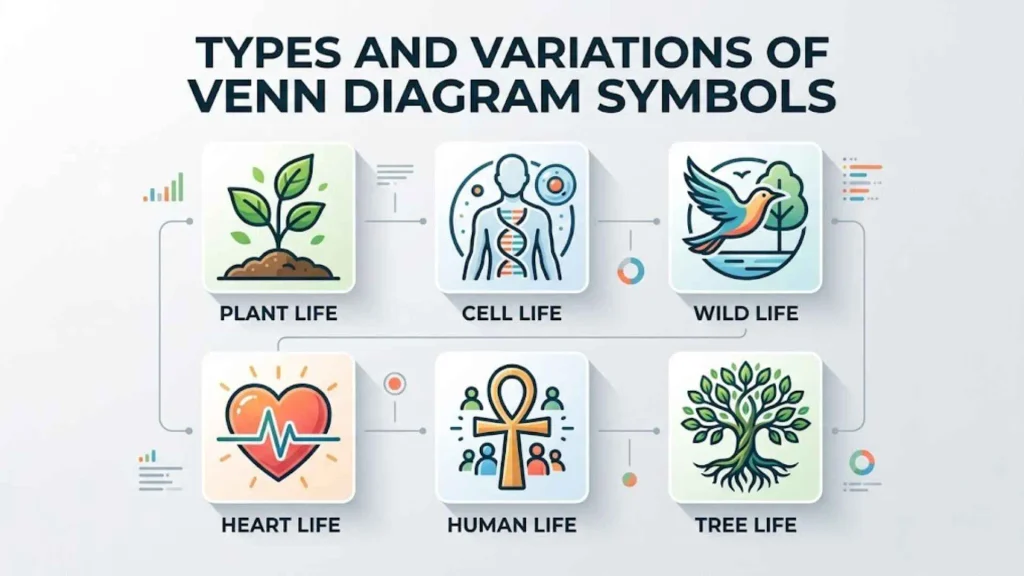
In mathematics and logic, different parts of the Venn diagram are represented by specific symbols. Each one has its own visual description, deep meaning, and cultural connection.
1. The Intersection Symbol ($\cap$)
- Visual Description: An upside-down letter “U” that represents the overlapping middle section of the circles.
- Meaning: It represents the shared elements that belong to both groups.
- Symbolism: True partnership, compromise, and mutual understanding.
- Cultural Connection: Often associated with marriage vows, where two distinct families come together to form a shared life.
- Where It Appears: Math textbooks, logic puzzles, and modern relationship tattoos.
2. The Union Symbol ($\cup$)
- Visual Description: A cup-like shape resembling the letter “U” that encompasses both circles entirely.
- Meaning: It represents everything contained within both circles, combined.
- Symbolism: Inclusivity, total togetherness, and collective strength.
- Cultural Connection: Found in community organizing, cooperative movements, and universalist philosophies.
- Where It Appears: Set theory, civic unity campaigns, and collaborative art installations.
3. The Complement Symbol ($A’$ or $A^c$)
- Visual Description: An apostrophe or a small “c” placed next to a set’s letter, representing the space outside that circle.
- Meaning: It represents everything that does not belong to a specific group.
- Symbolism: Individual boundaries, defining what you are not, and honoring personal space.
- Cultural Connection: Associated with individualistic philosophies and rites of passage where a person must step away from the crowd.
- Where It Appears: Logic equations, boundary-setting therapy books, and minimalist graphic design.
4. The Subset Symbol ($\subset$)
- Visual Description: A sideways letter “U” pointing to the right, showing one small circle completely inside a larger circle.
- Meaning: It means that every single item in the smaller group is also part of the larger group.
- Symbolism: Protection, belonging, and being held by something greater than yourself.
- Cultural Connection: Represents family lineages, mentorship, and how a person fits into their wider ancestry.
- Where It Appears: Family trees, organizational charts, and classical literature exploring a character’s place in society.
Venn Diagram Symbols Across Different Cultures
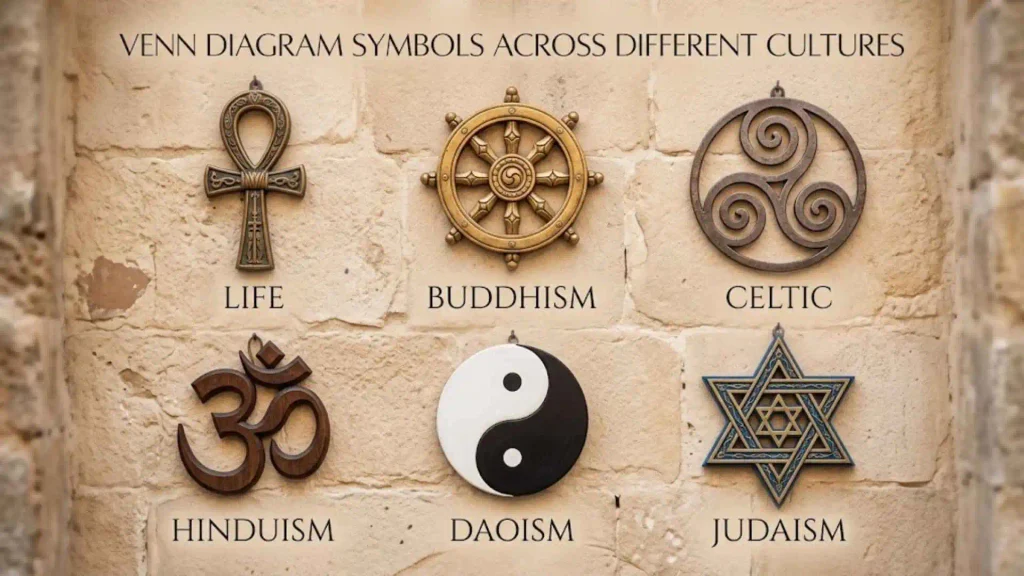
The concept of overlapping circles has captivated human imagination for thousands of years, long before John Venn gave them a mathematical name.
+—————————————————————–+
| HISTORICAL EVOLUTION |
| |
| Ancient Egypt ==> Ancient Greece ==> Modern Logic |
| (Flower of Life) (Pythagorean Dyad) (John Venn 1880) |
+—————————————————————–+
Ancient Egypt
In ancient Egypt, overlapping circles were the foundation of sacred geometry. The most famous example is the “Flower of Life” pattern found carved into the ancient stone of the Temple of Abydos. To the Egyptians, these overlaps represented the blueprint of the universe and the flow of divine energy.
Ancient Greece
The Pythagorean philosophers of ancient Greece studied the “Dyad,” which was formed by two overlapping circles. They believed the intersection was a holy doorway. It represented the transition between the infinite spirit world and the finite physical world.
Roman Culture
Roman architects used overlapping circular arcs in their mosaic floors and massive stone arches. For the Romans, this design symbolized strength through structural unity. The overlapping parts distributed weight evenly, mirroring how they believed their massive empire should function.
Eastern Traditions
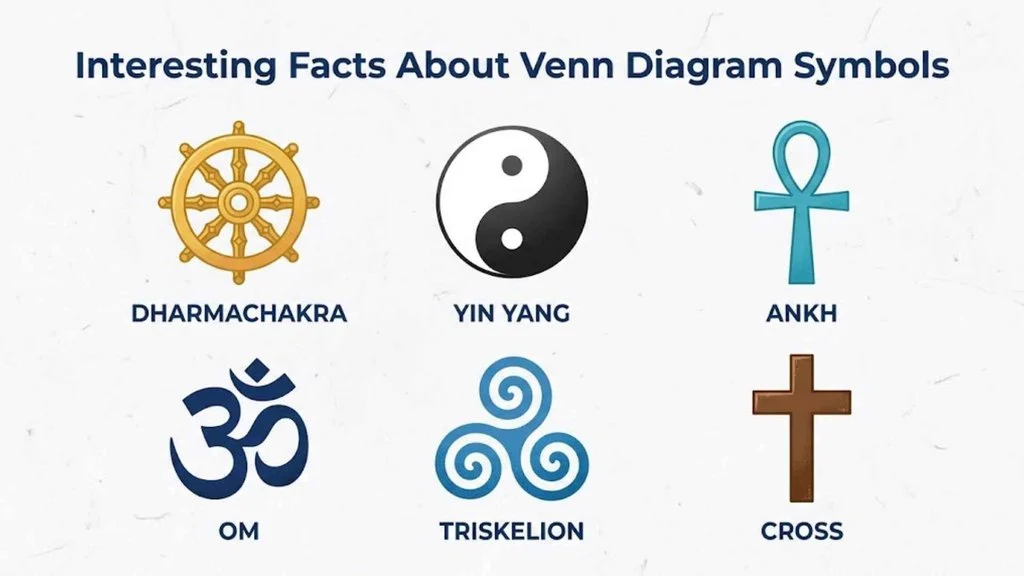
In Eastern philosophies, the overlapping concept is beautifully mirrored in the Yin and Yang symbol, where opposing forces contain a seed of one another. Similarly, in Buddhist mandalas, overlapping circles represent the beautiful, intricate net of Indra, showing that every living thing is connected to everything else.
Indigenous Traditions
Many Indigenous cultures around the world use overlapping circular designs, such as the medicine wheel. These circles map out the seasons, the directions, and the stages of life, showing how each phase of existence overlaps with and relies on the next.
Modern Interpretations
Today, these symbols are seen as ultimate icons of global communication, empathy, and corporate connection. They remind us that in a highly connected world, our success depends on finding where our interests overlap.
Similar Symbols and Their Meanings
It is easy to confuse Venn diagram symbols with other famous geometric and spiritual icons. This comparison table helps clarify their differences and relationships.
| Symbol | Similarity to Venn | Key Difference | Common Misconception |
| Euler Diagram | Uses circles to show relationships. | Only shows actual, existing relationships. It leaves out empty overlaps. | People often call Euler diagrams Venn diagrams by mistake. |
| Vesica Piscis | Features two overlapping circles. | Focuses strictly on the sacred geometry of the central almond shape. | Believed to be purely spiritual, though it has deep mathematical properties. |
| Borromean Rings | Shows three interconnected rings. | If you remove just one ring, the other two completely fall apart. | Thought to be a standard three-circle Venn, but Venn circles can exist independently. |
| Triquetra | Features three overlapping loops. | Created from one continuous, unbroken line representing eternity. | Often thought to be purely Christian, though it has ancient Pagan roots. |
Venn Diagram Symbols in Mythology and Folklore
In folklore and mythology, overlapping circles represent destiny and the weaving of lives. Celtic myths often feature intricate, overlapping knotwork. These knots showed that the past, present, and future are not separate lines, but rather overlapping circles that influence one another.
In Norse mythology, the Valknut, three interlocking triangles, uses overlapping geometry to symbolize the transition between life, death, and rebirth. These ancient stories shaped our modern understanding of overlapping shapes as symbols of destiny, proving that our lives are constantly intersecting with the lives of others in ways we cannot always see.
Venn Diagram Symbols in Art, Literature, and Pop Culture
Overlapping circles continue to make powerful statements in our modern creative world.
- Paintings and Sacred Art: During the Middle Ages, artists frequently painted religious figures inside the Vesica Piscis, the central overlap of two circles, to show their divine nature.
- Literature and Movies: In modern science fiction movies like Arrival, alien languages are written in circular symbols that overlap to convey complex, shared emotions.
- Tattoos: Minimalist Venn diagram tattoos are incredibly popular. Couples, best friends, and family members get them to symbolize their unique bond, with their initials placed inside the overlapping center.
- Branding: One of the most famous logos in the world, MasterCard, uses a red and yellow Venn diagram. It beautifully represents the intersection of trust, access, and finance.
Spiritual and Dream Meaning of Venn Diagram Symbols
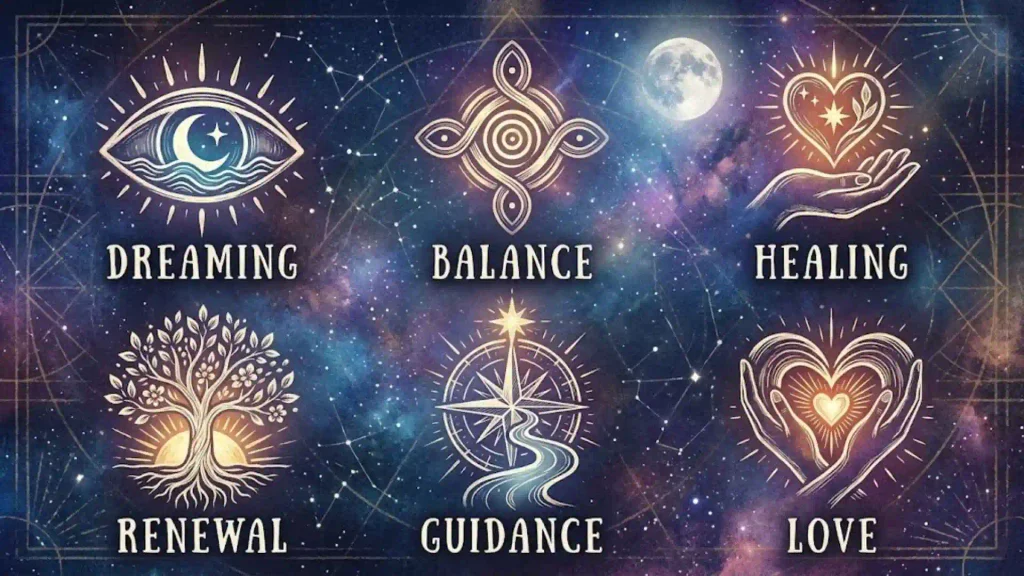
Have you ever dreamed of overlapping circles? In the realm of dreams, these symbols are highly positive.
[ Circle A: Conscious ] <— Both exist independently
\ /
\ /
[Mine] <— The Overlap: Spiritual Alignment
/ \
/ \
[ Circle B: Unconscious ]
Dreaming of a Venn diagram suggests that you are currently finding balance in your life. Perhaps you have been struggling to balance your logical mind with your intuitive heart, or your career with your personal life. The dream is a gentle sign that these separate areas are finally coming into harmony.
During meditation, focusing your mind on the central overlapping shape of a Venn diagram can help you find your “center.” It serves as a visual anchor, helping you quiet the noise of the outside world and connect with your inner peace.
However, these symbols also carry a healthy warning. If the circles in your dream overlap too much, almost merging into one, it might be a sign that you are losing your individuality. It warns you to maintain healthy personal boundaries in your relationships.
Positive and Negative Meanings of Venn Diagram Symbols
Like any powerful symbol, Venn diagrams carry both light and shadow meanings depending on how they are used.
| Context / Aspect | Positive Meaning (The Light) | Negative Meaning (The Shadow) |
| Relationships | Shared values, deep connection, and compromise. | Codependency, lost individuality, and blurred boundaries. |
| Logic & Mind | Exceptional clarity, organization, and finding common ground. | Over-simplifying complex human emotions into cold categories. |
| Community | Inclusivity, teamwork, and welcoming diversity. | Groupthink, peer pressure, and excluding those outside the circles. |
Why Humans Are Attracted to Venn Diagram Symbols
Psychologists have long studied why we are so deeply drawn to circular, overlapping shapes. Part of this attraction comes from our brain’s love for pattern recognition. Circles feel safe, complete, and gentle to our eyes compared to sharp angles and harsh squares.
Furthermore, we possess a collective cultural memory that associates circles with protection and unity. When we see circles overlap, we intuitively feel a sense of relief. It simplifies a complex world, reassuring us that even when things seem completely different, there is always a quiet, beautiful space where they can connect.
Modern Uses of Venn Diagram Symbols
In our daily lives, we encounter these symbols in delightfully creative ways:
- Jewelry: Interlocking rings are a classic fashion statement, representing eternal love and friendship.
- Social Media Memes: People love using humorous Venn diagrams to show unexpected connections between completely unrelated topics.
- Home Decor: Overlapping circular patterns in rugs, wallpaper, and light fixtures bring a sense of balance and calm energy into living spaces.
- Contemporary Spirituality: Used in mindfulness journals to help people track how their daily habits overlap with their personal happiness.
Interesting Facts About Venn Diagram Symbols
- John Venn never actually called them “Venn diagrams.” He referred to them as “Eulerian Circles.” The term “Venn diagram” was popularized much later, in 1918, by a philosopher named Clarence Irving Lewis.
- While we usually see them with two or three circles, you can make Venn diagrams with many more sets. However, they become so complex that you have to use ellipses or horseshoe shapes to make all the areas overlap correctly.
- To honor his incredible contribution to logic, the dining hall window at Gonville and Caius College in Cambridge, England, features a beautiful stained glass Venn diagram.
- The central overlapping shape has its own official geometric names, it is called a “lens” or a “lune.”
- If you work in tech, you use these symbols every day. They are the visual foundation behind SQL database “JOIN” statements, which programmers use to find matching data.
Frequently Asked Questions
What is the mathematical symbol for intersection in a Venn diagram?
The symbol for intersection is $\cap$, which looks like an upside-down letter “U”. It represents the elements that are shared between two or more sets.
What is the difference between a Venn diagram and an Euler diagram?
A Venn diagram must show every possible logical relationship between sets, even if some of those overlapping areas contain absolutely no items. An Euler diagram only shows relationships that actually exist in real life, completely leaving out empty overlaps.
What does the overlapping area of a Venn diagram represent?
The overlapping area represents the common traits, shared characteristics, or mutual connections between different groups. It is the visual representation of “common ground.”
Can a Venn diagram have four or more circles?
Yes, but using simple circles for four or more sets makes it impossible to show all the necessary intersections. To solve this, mathematicians use complex, symmetrical shapes like ellipses or gears.
Why is the Venn diagram used in spiritual sacred geometry?
Spiritual practices value the Venn diagram because the overlap of two equal circles creates the Vesica Piscis. This shape has been revered for thousands of years as a symbol of creation, balance, and the meeting of heaven and earth.
Conclusion
At their core, Venn diagram symbols remind us that we are never truly isolated islands. They show us that while we all possess our own unique spaces, traits, and boundaries, our most beautiful moments happen in the overlap. Whether through science, art, or love, finding common ground is how we make sense of our complex universe. Let these elegant circles inspire you to cherish your own individuality while actively seeking those magical spaces where your world meets another.

Hi, I’m Asher Monroe, a writer who believes that meaningful words have the power to inspire change and bring people closer to their dreams. I have always been fascinated by the beauty of quotes and the way a simple message can provide motivation, hope, and comfort.
I enjoy creating content around inspirational quotes, life lessons, success stories, and positive thoughts that help readers find encouragement in their everyday lives. My goal is to share words that connect with people and remind them of their inner strength.
Through my writing, I explore the ideas of personal growth, confidence, and the importance of staying inspired through every chapter of life.
I am the author of Words That Move the Soul and The Path of Endless Inspiration, two books focused on the power of wisdom, positivity, and meaningful thoughts.
 Sienna Brooks
 Rowan Sinclair Rowan Sinclair