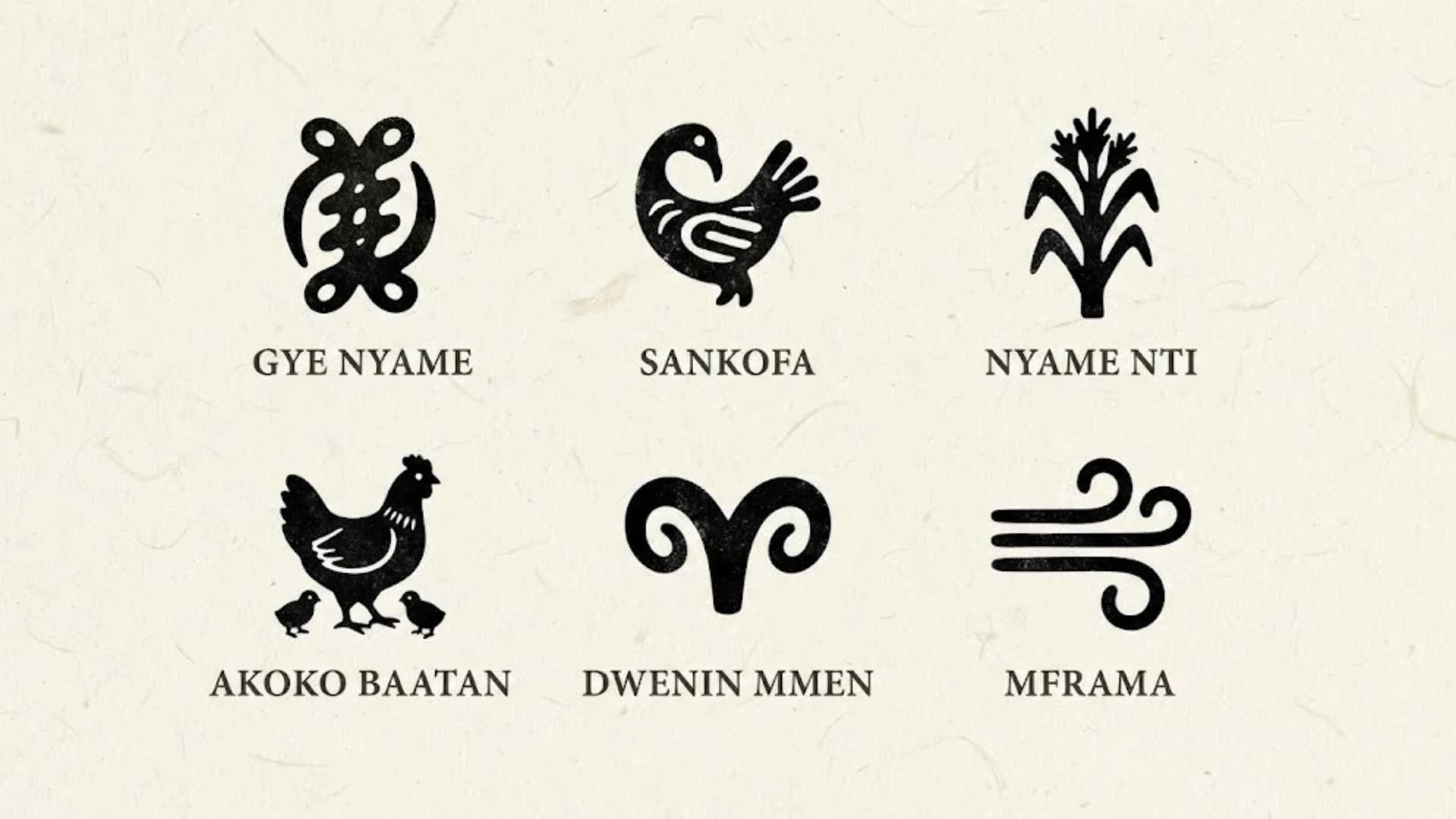
Adinkra symbols are visual symbols associated especially with the Akan peoples of Ghana and Côte d’Ivoire. Each design can communicate an idea, value, proverb, or life lesson, making Adinkra a rich form of visual language.
From Sankofa and Gye Nyame to symbols representing strength, unity, wisdom, peace, and leadership, Adinkra designs appear in textiles, architecture, jewelry, artwork, ceremonies, and modern tattoos. Their meanings are often connected to Akan philosophy and traditional knowledge.
This guide explains what Adinkra symbols are, where they come from, how they developed, and what some of the best-known designs mean. It also covers their use in Ghanaian architecture and tattoos and provides a practical list of important symbols and meanings.
Adinkra Symbols Origin
Adinkra symbols originated among Akan-speaking peoples of West Africa, particularly in present-day Ghana and Côte d’Ivoire. The symbols became strongly associated with the Asante tradition in Ghana, where they were used to communicate ideas through visual designs.
The history of Adinkra is commonly connected with the Asante kingdom and the cultural exchange between Akan states and neighboring regions. Traditional Adinkra cloth became especially associated with funerals and other important occasions.
The exact origin story is difficult to reduce to a single event because Adinkra developed through cultural traditions over time. Different historical accounts also describe its transmission and development in different ways.
Today, Adinkra is widely recognized as an important part of Ghanaian cultural heritage.
Adinkra Symbols History
Adinkra has a long history connected with Akan art, philosophy, communication, and textile traditions. Traditionally, symbols were stamped onto cloth using carved stamps and a dark dye made from plant materials.
Historically, Adinkra cloth had particular ceremonial importance. It was often worn during funerals and other significant events, with selected symbols expressing ideas appropriate to the occasion.
Over time, Adinkra designs moved beyond traditional cloth. They became visible in:
- Buildings and architectural decoration
- Jewelry and accessories
- Wood carving
- Pottery
- Paintings and graphic design
- Educational materials
- Fashion
- Contemporary tattoos
The continued use of Adinkra shows how an older symbolic tradition can remain meaningful while also appearing in modern creative forms.
What Are Adinkra Symbols
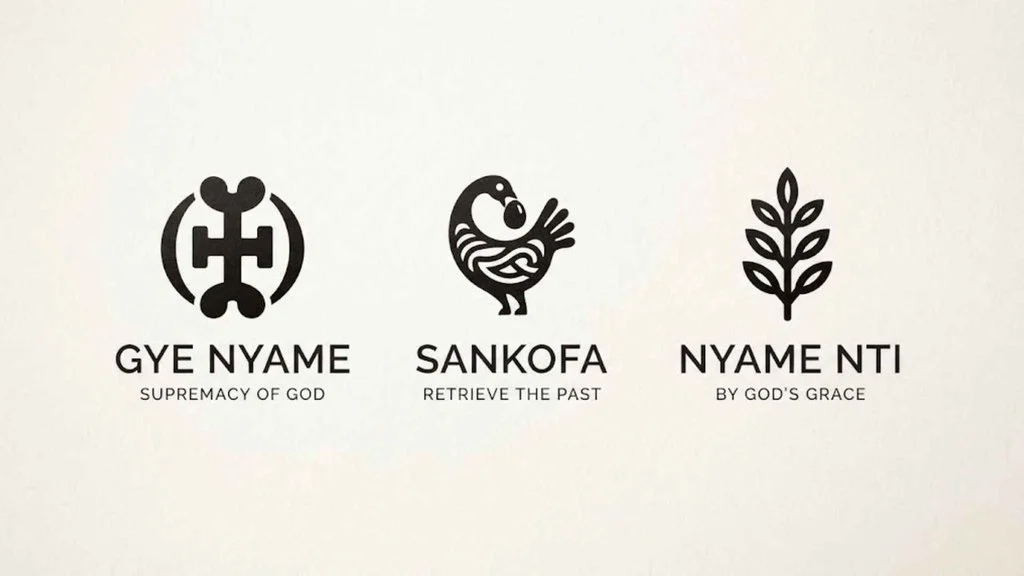
Adinkra symbols are graphic designs that represent concepts, values, proverbs, beliefs, and observations about life. They are closely associated with Akan culture, particularly the Asante tradition of Ghana.
An Adinkra symbol is more than a decorative picture. Its significance comes from the cultural idea attached to the design.
For example:
- Sankofa — learning from the past and retrieving valuable knowledge
- Gye Nyame — a statement concerning the supremacy or omnipotence of God
- Dwennimmen — humility combined with strength
- Duat? — meanings should be checked carefully because names and spellings can vary across sources
Adinkra symbols are therefore best understood within their cultural context rather than treated as a universal pictographic alphabet.
Adinkra Symbols Meaning
The meaning of an Adinkra symbol depends on the particular design and the cultural tradition in which it is used. Many symbols communicate moral principles, wisdom, social values, spirituality, or lessons about human behavior.
Some widely recognized examples include:
| Symbol | Commonly associated meaning |
| Sankofa | Learn from the past and bring forward what is valuable |
| Gye Nyame | The supremacy or omnipotence of God |
| Adinkrahene | Leadership, authority, greatness |
| Dwennimmen | Humility with strength |
| Fawohodie | Independence and freedom |
| Akoben | Vigilance and readiness |
| Nyame Dua | Divine protection and the presence of God |
| Nkyinkyim | Initiative, adaptability, and the twists and turns of life |
| Mpatapo | Reconciliation and peacemaking |
| Wawa Aba | Hardiness, toughness, and perseverance |
Meanings can vary somewhat between sources because many interpretations are explanatory rather than literal translations.
Adinkra Symbols List
Here is a useful starter list of commonly discussed Adinkra symbols:
- Sankofa — learning from the past
- Gye Nyame — divine supremacy
- Adinkrahene — leadership and authority
- Dwennimmen — humility and strength
- Fawohodie — freedom and independence
- Akoben — vigilance and preparedness
- Mpatapo — reconciliation
- Nkyinkyim — adaptability and initiative
- Wawa Aba — resilience and toughness
- Nyame Dua — divine presence and protection
- Nyame Nti — faith and trust in God
- Aya — endurance and resourcefulness
- Eban — safety and security
- Mate Masie — wisdom, understanding, and awareness
- Nea Onnim No Sua A, Ohu — learning through teaching and experience
Some Adinkra names are written with different spellings or transliterations. When researching a specific symbol, checking the cultural source behind the interpretation is useful.
Adinkra Symbols Origin
The origin of Adinkra is closely connected with Akan cultural history in West Africa. Ghana is particularly important in the modern history and preservation of Adinkra traditions.
The symbols developed as part of a culture in which proverbs, oral traditions, artistic designs, and philosophical ideas were closely connected. Visual symbols offered another way to express concepts that could also be communicated through speech.
Traditional production also involved skilled craftsmanship. Adinkra cloth was decorated using stamps made from carved materials, creating repeated symbolic patterns.
Because the tradition developed over generations, it is more accurate to discuss Adinkra as a cultural system that evolved over time rather than assigning every symbol to one specific historical moment.
Ghana Adinkra Symbols
Ghana is one of the main places associated with Adinkra symbols and their continued cultural use. The tradition is particularly connected with the Akan and Asante cultural heritage of southern Ghana.
Adinkra designs can be found in Ghanaian crafts, textiles, public art, educational materials, cultural institutions, and contemporary design.
The symbols commonly express themes such as:
- Wisdom
- Leadership
- Faith
- Courage
- Peace
- Unity
- Freedom
- Patience
- Resilience
- Community
Their presence in modern Ghana demonstrates that Adinkra is not simply an ancient decorative system. It remains part of living cultural expression.
Ghanaian Adinkra Symbols
Ghanaian Adinkra symbols represent ideas that have been passed through Akan cultural traditions. Their use can communicate a message without requiring a long written explanation.
A person may select a symbol because its associated concept reflects a personal value. A textile designer may use several symbols to create a visual message, while an architect may incorporate them into a building as cultural decoration.
The same design can therefore function as art and communication at the same time.
African Adinkra Symbols
Adinkra symbols are African symbols with a specific cultural history rooted primarily in Akan traditions of West Africa. They should not be treated as symbols representing every African culture.
Africa contains thousands of cultural traditions, languages, artistic systems, and symbolic practices. Adinkra belongs specifically to the cultural history of Akan communities.
This distinction matters when using Adinkra designs. Calling them simply generic African symbols can remove the cultural context that gives them their meaning.
For educational, artistic, or commercial use, it is better to identify Adinkra symbols by their Akan and Ghanaian cultural connections.
Akan Adinkra Symbols
Akan Adinkra symbols are connected with Akan-speaking peoples and their cultural traditions. Akan communities have historically lived across parts of present-day Ghana and Côte d’Ivoire.
The symbols often reflect ideas found in Akan proverbs and social philosophy. Instead of functioning like ordinary letters, they visually represent concepts.
For example, Mate Masie is commonly associated with knowledge and understanding, while Sankofa expresses the importance of looking back to gain something valuable for the future.
This relationship between symbol and proverb is one reason Adinkra remains culturally significant.
Adinkra Symbols And Meaning
Understanding Adinkra symbols requires looking at both the visual design and the concept associated with it.
For instance, the image of Sankofa is commonly explained through the idea of reaching back to retrieve something valuable. The lesson is that knowledge from the past can help guide the present and future.
Similarly, symbols connected with freedom, reconciliation, vigilance, or leadership can communicate a broader principle rather than a single dictionary definition.
When using an Adinkra symbol, consider:
- The traditional name of the symbol.
- Its commonly documented meaning.
- Its cultural background.
- The situation in which it is being used.
- Whether the design is being used respectfully.
Adinkra Symbols Tattoo
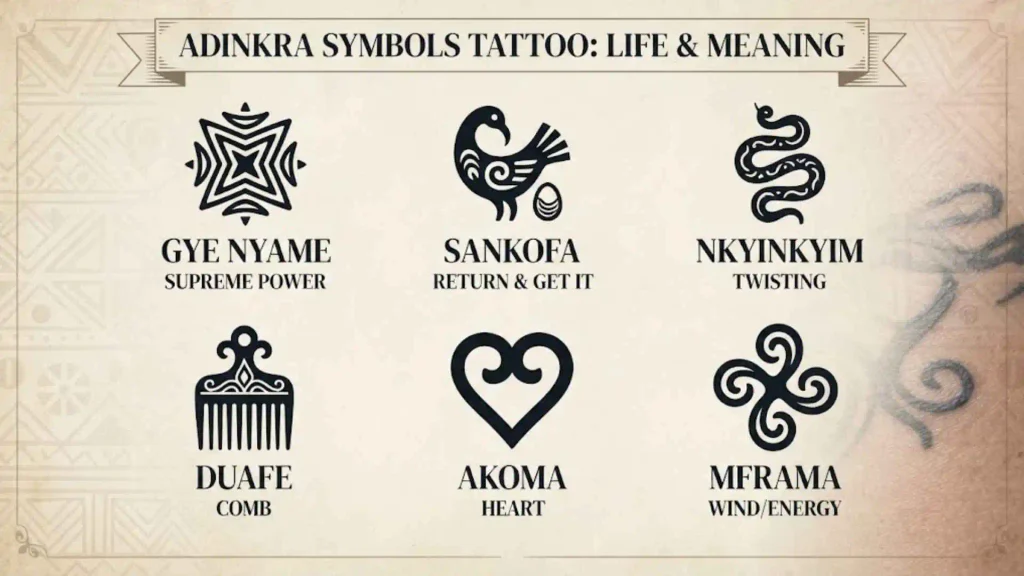
Adinkra symbols are sometimes chosen for tattoos because their compact designs can represent meaningful personal ideas.
A person might select Sankofa to represent learning from the past, Fawohodie for freedom, or Gye Nyame because of its association with faith and divine supremacy.
Before getting an Adinkra tattoo, it is worth checking the exact symbol and its documented meaning. Similar-looking designs can have very different cultural associations.
A few practical considerations include:
- Verify the symbol name before giving it to a tattoo artist.
- Use a clear reference image.
- Check the spelling of the Akan name.
- Understand the cultural meaning rather than choosing a design only because it looks attractive.
- Ask the artist to preserve the important features of the original design.
- Avoid combining symbols in a way that changes their intended visual form without understanding the result.
Adinkra tattoos can be personal expressions, but their cultural background should remain part of the research behind the design.
Adinkra Symbols Tattoos
The plural form refers to the many Adinkra designs that people use as tattoo inspiration. Popular choices often include Sankofa, Gye Nyame, Adinkrahene, Aya, and other symbols associated with personal values.
For a tattoo, a symbol can be used by itself or incorporated into a larger composition. However, adding decorative elements does not automatically preserve the original meaning.
If the goal is cultural accuracy, start with the traditional symbol first and then decide how much modern styling is appropriate.
Adinkra Symbols In Architecture
Adinkra symbols can be incorporated into architecture as decorative and cultural elements. In Ghana, symbolic patterns have appeared in buildings, walls, gates, public spaces, monuments, and interior decoration.
Architectural use can be especially effective because repeated symbols can create a visual pattern while also communicating cultural ideas.
For example, a building might incorporate symbols associated with:
- Leadership
- Unity
- Protection
- Wisdom
- Peace
- Strength
- Community
Modern architects and designers may reinterpret traditional designs through concrete, metal, wood, glass, tile, or digital fabrication. The material can change, but the symbolic reference remains connected to the original design.
Adinkra Symbols Sankofa
Sankofa is one of the best-known Adinkra symbols. Its central message is commonly expressed through the idea of going back to retrieve what has been left behind.
The concept is often connected to learning from history and using that knowledge to improve the present and future.
Sankofa is frequently represented by a bird turning its head backward toward an egg held near its body. Another related representation is a stylized heart-like form.
The symbol is especially useful when discussing:
- Heritage
- Ancestry
- Education
- Historical memory
- Personal growth
- Cultural identity
- Learning from past mistakes
Sankofa is not simply a symbol meaning history. Its deeper idea concerns returning to the past to recover something valuable.
Sankofa Adinkra Symbols
Sankofa belongs to the wider Adinkra symbolic tradition and is commonly discussed as one of its most recognizable designs.
Its message can be summarized as learning from the past without becoming trapped by it. The past becomes a source of knowledge that can inform future decisions.
The word is often connected with an Akan proverb expressing the idea that it is not wrong to return for something that was forgotten or left behind.
Because Sankofa has become widely used outside Ghana, its meaning is sometimes simplified. The fuller cultural idea is more useful than simply translating it as remember the past.
Adinkra Symbol Sankofa Adinkra Symbols
The phrase Adinkra symbol Sankofa refers specifically to the Sankofa design within the Adinkra tradition.
For copy-and-paste users, there is an important technical distinction: Sankofa does not have a dedicated official Unicode character equivalent to standard Unicode symbols such as ★ or ♥.
That means you generally cannot copy a traditional Sankofa design as a single universally supported text character.
Instead, Sankofa is normally represented through an image, illustration, decorative graphic, tattoo design, or typographic artwork.
For digital use, an image is usually more accurate than trying to substitute an unrelated Unicode character.
Adinkra Symbols Gye Nyame
Gye Nyame is another highly recognizable Adinkra symbol. Its name is commonly translated in relation to the supremacy or omnipotence of God.
The symbol is strongly associated with faith and the power of God within Akan cultural expression.
Its distinctive curved design has appeared widely in Ghanaian art, clothing, jewelry, architecture, and contemporary graphic design.
Because Gye Nyame carries religious significance, it is better understood as a culturally specific expression of faith rather than simply labeling it as a generic religious icon.
Like Sankofa, Gye Nyame does not have a dedicated standard Unicode character for direct text copying.
All Adinkra Symbols And Meanings
There is no single universally standardized short list that captures every Adinkra symbol and every interpretation. Different educational and cultural sources may document different selections, spellings, and explanations.
A useful selection includes:
| Adinkra symbol | Common meaning |
| Sankofa | Learning from the past |
| Gye Nyame | Supremacy or omnipotence of God |
| Adinkrahene | Leadership and authority |
| Dwennimmen | Humility and strength |
| Fawohodie | Freedom and independence |
| Akoben | Vigilance and preparedness |
| Mpatapo | Reconciliation |
| Nkyinkyim | Initiative and adaptability |
| Wawa Aba | Toughness and perseverance |
| Aya | Endurance and resourcefulness |
| Eban | Safety and security |
| Mate Masie | Knowledge and understanding |
| Nyame Dua | Divine presence and protection |
| Nyame Nti | Faith and trust in God |
These meanings are useful starting points, but they should not be treated as exact one-word translations for every cultural context.
Adinkra Symbols And Their Meanings
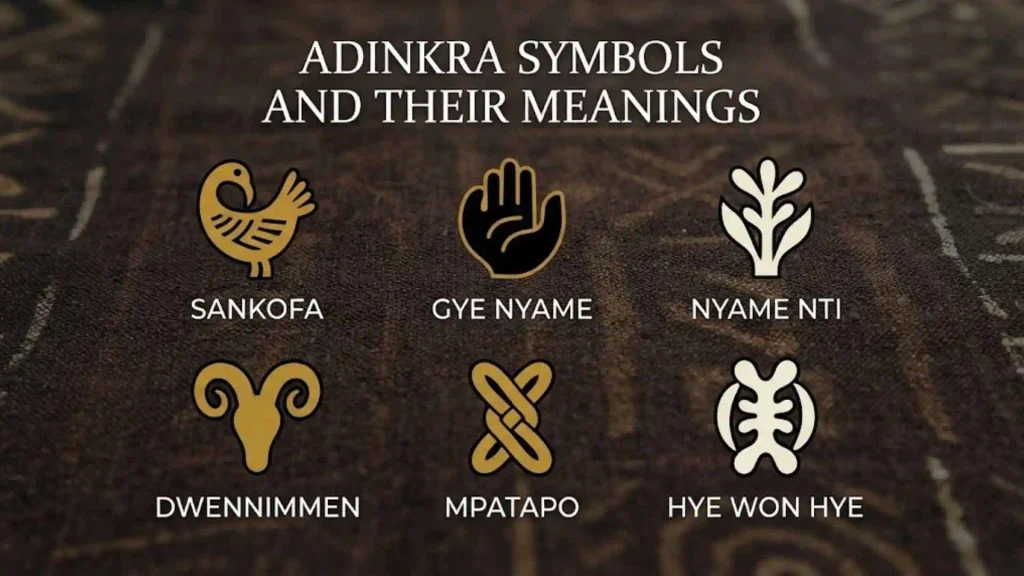
Adinkra symbols combine visual design with ideas about life, society, morality, spirituality, and human relationships. Their value comes from this combination rather than from their appearance alone.
When choosing an Adinkra symbol, focus first on the meaning you want to communicate. Then verify the traditional name and design.
For digital projects, remember that most Adinkra designs are not ordinary Unicode text symbols. If you need a visually accurate version for a website, presentation, social post, or printed design, a properly sourced image or vector graphic is usually more appropriate than a keyboard character.
Frequently Asked Questions
What Do Adinkra Symbols Represent?
Adinkra symbols represent ideas, values, proverbs, beliefs, and observations connected with Akan cultural traditions. Individual symbols can represent concepts such as wisdom, freedom, leadership, faith, reconciliation, or learning from the past.
Where Did Adinkra Symbols Originate?
Adinkra symbols originated among Akan-speaking peoples of West Africa and became particularly associated with the Asante tradition in Ghana. They are now widely recognized as part of Ghanaian cultural heritage.
What Does The Sankofa Adinkra Symbol Mean?
Sankofa is commonly associated with learning from the past and retrieving valuable knowledge for the present and future. It emphasizes the usefulness of remembering and understanding history.
What Does Gye Nyame Mean?
Gye Nyame is commonly associated with the supremacy or omnipotence of God. It is one of the most recognizable Adinkra symbols and is strongly connected with Akan expressions of faith.
Are Adinkra Symbols Unicode Characters?
Traditional Adinkra designs generally do not have individual dedicated Unicode characters for direct copy-and-paste use. They are usually represented as images, illustrations, artwork, or decorative designs rather than standard text characters.
Conclusion
Adinkra symbols provide a visual way to explore Akan cultural ideas, Ghanaian heritage, proverbs, values, spirituality, and lessons about life. Symbols such as Sankofa and Gye Nyame have become especially recognizable, but the wider Adinkra tradition contains many other meaningful designs.
Their uses have also expanded beyond traditional textiles. Adinkra-inspired designs can be found in architecture, fashion, jewelry, artwork, education, graphic design, and tattoos. Understanding the original cultural context makes these uses more meaningful and helps prevent inaccurate interpretations.
When selecting an Adinkra symbol, focus on its documented meaning, traditional name, and cultural background. For digital copy-and-paste purposes, remember that Adinkra designs are generally images rather than Unicode characters, so a clear and accurately sourced graphic is often the best choice.

Hi, I’m Asher Monroe, a writer who believes that meaningful words have the power to inspire change and bring people closer to their dreams. I have always been fascinated by the beauty of quotes and the way a simple message can provide motivation, hope, and comfort.
I enjoy creating content around inspirational quotes, life lessons, success stories, and positive thoughts that help readers find encouragement in their everyday lives. My goal is to share words that connect with people and remind them of their inner strength.
Through my writing, I explore the ideas of personal growth, confidence, and the importance of staying inspired through every chapter of life.
I am the author of Words That Move the Soul and The Path of Endless Inspiration, two books focused on the power of wisdom, positivity, and meaningful thoughts.
 Sienna Brooks
 Rowan Sinclair Rowan Sinclair