Sumerian symbols are the very first keys humanity used to unlock the mysteries of the cosmos and write down the whispers of the soul. When you gaze upon these ancient clay carvings, you are not just looking at old letters: you are staring into the birth of human consciousness itself. Written over five thousand years ago in the fertile lands of Mesopotamia, these powerful shapes bridged the gap between the mortal world and the divine realm of the gods. Understanding them allows us to reconnect with our oldest collective memories, reminding us that our modern hopes, fears, and dreams are deeply tied to the ancient past.
(Quick Answer) Sumerian Symbols
Sumerian symbols are the ancient visual marks and cuneiform characters developed in Mesopotamia around 3200 BCE. Originally used for record-keeping, they evolved into complex spiritual and cultural icons representing powerful deities, cosmic forces, and eternal truths that shaped the foundation of human civilization, writing, and spiritual belief.
Quick Facts About Sumerian Symbols
| Aspect | Information |
| Origin | Southern Mesopotamia (modern-day Iraq), around 3200 BCE |
| Historical Significance | The oldest written language system in human history (Cuneiform) |
| Main Meaning | Cosmic order, divine law, and the connection between heaven and earth |
| Spiritual Meaning | The presence of the gods (Anu, Enki, Inanna) in everyday life |
| Cultural Importance | Shaped early law, religion, literature, and agricultural organization |
| Modern Usage | Spiritual talismans, sacred geometry art, tattoos, and literature |
What Are Sumerian Symbols?
To truly understand Sumerian symbols, we have to travel back in time to the shores of the Tigris and Euphrates rivers. Here, the Sumerians built the world’s first cities, like Uruk and Ur. To manage their growing society, they needed a way to keep track of grain, sheep, and trade.
They began pressing pointed reeds into wet clay tablets, creating simple pictographs. Over centuries, these pictures evolved into wedge-shaped marks known as cuneiform, which is Latin for “wedge-shaped.”
But these symbols quickly became far more than a simple bookkeeping tool. The Sumerians believed that writing was a direct gift from Nisaba, the goddess of scribes and wisdom. As their civilization grew, their scribes began using these marks to capture the epic stories of their gods, write down sacred prayers, and record laws that protected the weak.
The symbols became a bridge. A single carved star did not just mean “sky” anymore: it became a physical vessel for the divine presence of the creator gods.
Sumerian Cuneiform Symbols
Cuneiform was one of the most important writing systems of the ancient Near East. Early forms developed in southern Mesopotamia around the late fourth millennium BCE, initially for administrative purposes such as recording goods, animals, and transactions.
Over time, cuneiform signs became more complex and could represent words, sounds, or grammatical information depending on context. Sumerian was one of the languages written in cuneiform, but the writing system was later adapted for other languages, including Akkadian.
This distinction is important: cuneiform is the writing system, while Sumerian is a language. Therefore, not every cuneiform symbol found in Mesopotamia is specifically a Sumerian symbol.
Deep Symbolic Meaning of Sumerian Symbols
Ancient symbols speak to us on multiple levels at once. The Sumerians did not separate science, religion, and psychology. To them, everything was beautifully woven together.
Spiritual Level
On a spiritual level, Sumerian symbols represent the belief that the physical world is a mirror of the divine world. The concept of As above, so below was alive and well in Mesopotamia. Symbols like the eight-pointed star of Inanna represented the planet Venus, showing how cosmic movements directly influenced human emotions and spiritual transformations.
Psychological Level
Psychologically, these symbols tap directly into what Carl Jung called the collective unconscious. The figures of Sumerian mythology are archetypes: deep, universal patterns of the human mind.
- Enki, the god of water and wisdom, represents the creative subconscious and the deep well of human intuition.
- Inanna represents the passionate ego, our inner wildness, and the painful but necessary journey of self-discovery and rebirth.
Cultural Level
Culturally, these symbols held community life together. In a world where only a small percentage of people could read, visual symbols were vital. They were carved on cylinder seals, which citizens rolled across wet clay to “sign” contracts. These symbols gave people a shared identity, a common moral code, and a comforting sense of order in a wild, unpredictable world.
Sumerian Symbols List
Some of the best-known symbols and motifs associated with Sumerian and wider Mesopotamian traditions include:
| Symbol or Motif | Main Association |
| Dingir sign | Divinity or a deity |
| Eight-pointed star | Inanna and Venus |
| Rod and ring | Divine authority and kingship |
| Lion imagery | Power and association with certain deities |
| Bull imagery | Strength, fertility, and divine power |
| Serpent imagery | Particular deities, transformation, and the underworld in specific contexts |
| Cuneiform signs | Writing, language, administration, and religious texts |
| Cylinder seals | Identity, administration, mythology, and religious imagery |
| Protective figures | Protection against supernatural dangers |
Types and Variations of Sumerian Symbols
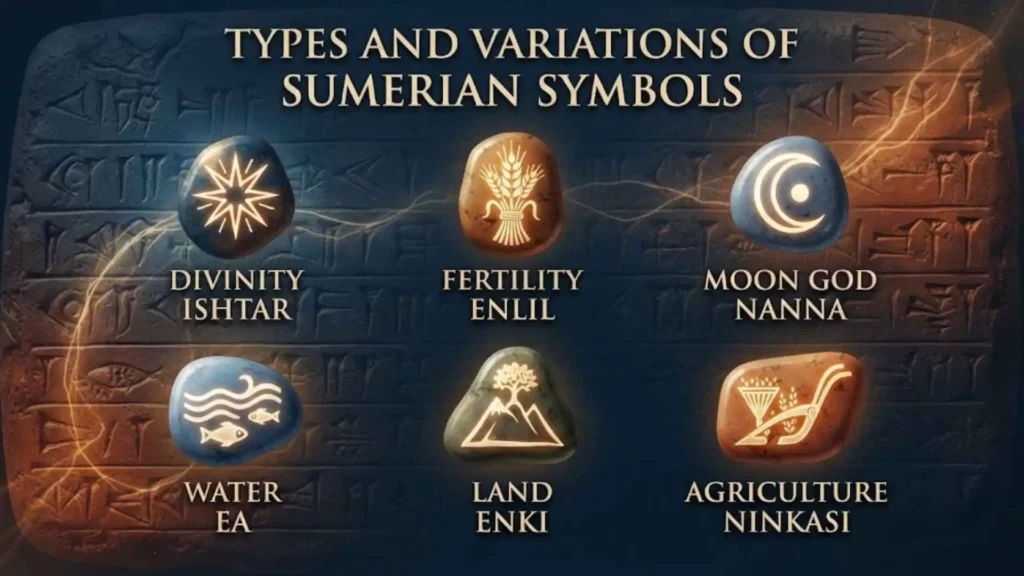
Sumerian iconography is rich and varied. Here are some of the most powerful and common symbols that have survived the sands of time.
1. The Dingir (The Star of Anu)
- Visual Description: A simple, eight-pointed star or a cross with intersecting diagonal lines.
- Meaning: Divinity, heaven, and high spiritual authority.
- Symbolism: It represents the sky god Anu and acts as a prefix in cuneiform writing to show that a name belongs to a god.
- Cultural Connection: It shows the Sumerian obsession with the stars and their belief that the gods lived in the heavens.
- Where It Appears: Clay tablets, temple walls, and cylinder seals.
2. The Star of Inanna (The Rosette)
- Visual Description: An eight-pointed star or a beautiful, circular flower-like rosette.
- Meaning: Love, war, fertility, and the planet Venus.
- Symbolism: It captures the dual nature of humanity: the softness of love and the fierce intensity of war.
- Cultural Connection: Dedicated to Inanna, the most popular goddess in Sumerian myth.
- Where It Appears: The famous Ishtar Gate, jewelry, and ancient royal garments.
3. The Rod and Ring
- Visual Description: A divine figure holding a straight rod and a circular ring.
- Meaning: Divine law, justice, and the right to rule.
- Symbolism: The rod represents a measuring tool (standard of truth) and the ring represents the endless cycle of cosmic order.
- Cultural Connection: Given by the gods to human kings to prove they had the divine right to govern fairly.
- Where It Appears: Stele of Ur-Nammu and the Code of Hammurabi.
4. The Lamassu
- Visual Description: A massive, winged creature with the body of a bull or lion and the head of a human.
- Meaning: Protection, strength, and cosmic guardianship.
- Symbolism: The human head represents intellect, the bull body represents physical power, and the wings represent spiritual ascension.
- Cultural Connection: Placed at city gates and palace entrances to ward off evil spirits and enemy forces.
- Where It Appears: Palace ruins of ancient Mesopotamian kings.
5. The Double Snake Entwined (Ningishzida)
- Visual Description: Two serpents wrapping around a central rod.
- Meaning: Healing, underworld mystery, and cosmic balance.
- Symbolism: The shedding of snake skin represents rebirth and eternal life.
- Cultural Connection: Associated with the deity Ningishzida, a messenger of the underworld. This is a direct ancestor to the modern medical Caduceus symbol.
- Where It Appears: Green steatite vases and libation cups.
Magic Sumerian Symbols
Ancient Mesopotamian societies used written incantations, ritual objects, amulets, protective figures, and religious images in practices intended to protect people, heal illness, or deal with supernatural dangers. Some of these practices are described today as Sumerian magic, although the surviving evidence comes from different periods and cultures of Mesopotamia.
Cuneiform writing could be used to record incantations and ritual instructions, while protective objects could contain inscriptions or images of supernatural beings. Rather than assuming that every cuneiform sign had magical powers, it is more accurate to look at the specific inscription, object, and ritual context.
Sumerian Talisman
Ancient Mesopotamians used various objects for religious and protective purposes, including amulets, seals, figurines, inscribed objects, and ritual items. Some carried images or inscriptions associated with gods and protective supernatural beings.
A modern Sumerian talisman may feature cuneiform writing, stars, divine imagery, or other Mesopotamian designs. These modern objects can be inspired by ancient traditions, but they should not automatically be described as authentic ancient talismans. Historical artifacts and modern Sumerian-inspired jewelry or artwork are two different categories.
Nibiru Sumerian Symbols
Nibiru is a term found in Mesopotamian astronomical and religious texts. Its meaning and astronomical identification depend on the particular text and historical period. For this reason, there is no universally accepted ancient symbol that can simply be called the “Sumerian symbol of Nibiru.”
Modern websites sometimes connect Nibiru with stars, planets, winged discs, or Anunnaki imagery. These designs are often modern interpretations and should not automatically be presented as authentic ancient Sumerian symbols. Historical Mesopotamian astronomy provides a more reliable way to understand how the term was actually used.
Sumerian Symbols Across Different Cultures
Sumer was the cradle of civilization, and its symbols sent ripples outward, deeply influencing the cultures that followed.
[ Sumerian Symbols ]
|
+——————-+——————-+
| | |
[Ancient Egypt] [Ancient Greece] [Eastern Traditions]
– Rod and Ring – Caduceus – Rosette / Lotus
– Winged Disc – Winged Staff – Intertwined Serpents
- Ancient Egypt: The Sumerian Rod and Ring symbol likely inspired the Egyptian Shen ring (a loop of rope representing eternal protection) and the Cartouche. Similarly, the Sumerian winged solar disc was adapted by Egyptians to represent Horus.
- Ancient Greece: The entwined serpents of the Sumerian god Ningishzida directly evolved into the Greek Caduceus (the staff of Hermes) and the Rod of Asclepius, which we still use today as symbols of medicine and healing.
- Roman Culture: Roman emperors used eagle motifs and winged victory symbols that trace their roots back to the majestic protective power of the Mesopotamian Lamassu and winged discs.
- Eastern Traditions: The Sumerian rosette, representing life and divine fertility, shares deep visual and spiritual similarities with the sacred Lotus flower of Buddhist and Hindu traditions, symbolizing purity rising out of the mud.
- Indigenous Traditions: Many indigenous cultures worldwide share the Sumerian view of the cosmos, using circular patterns and star symbols to track seasonal changes and mark the spiritual connection between earth and sky.
- Modern Interpretations: Today, these ancient designs are celebrated in sacred geometry, Western astrology (which is based on Sumerian/Babylonian star charts), and modern esoteric philosophy.
Symbol of Mesopotamia
There is no single official symbol of Mesopotamia because Mesopotamia was a large historical region that included different peoples, cities, languages, religions, and civilizations over thousands of years.
Common modern representations include cuneiform tablets, ziggurats, eight-pointed stars, cylinder seals, winged figures, and protective creatures such as the lamassu. Each represents a different part of Mesopotamian history. Cuneiform is particularly useful for representing the region because it was used by several Mesopotamian cultures over a very long period.
Similar Symbols and Their Meanings
It can be easy to mix up ancient symbols. This table helps clarify the differences between Sumerian symbols and similar icons from other cultures.
| Sumerian Symbol | Egyptian Counterpart | Greek Counterpart | Core Difference | Common Misconception |
| Star of Inanna | Eye of Horus | Star of Venus | Inanna’s star focus is on the planet’s cyclic path; Horus focus is on protection and healing. | Many people mistake Inanna’s star for a simple decorative flower. |
| Rod and Ring | Shen Ring / Ankh | Staff of Hermes | The Sumerian version represents the power of law; the Ankh represents eternal life. | Often confused with a simple key or a royal sceptre. |
| Ningishzida Serpents | Uraeus (Cobra) | Caduceus | The Sumerian serpents represent underworld wisdom; the Greek Caduceus represents commerce. | Often incorrectly called a symbol of evil due to later biblical snake associations. |
Sumerian Symbols in Mythology and Folklore
In ancient stories, these symbols were not passive. They were alive, active forces in epic tales.
In the famous Epic of Gilgamesh, symbols of horns and wild bulls represent the untamed power of nature and the king’s own ego. When Gilgamesh fights the Bull of Heaven, he is fighting his own fear of death and insignificance.
Another profound story is Inanna’s Descent to the Underworld. To enter the land of the dead, she must pass through seven gates. At each gate, she is forced to strip away one of her royal symbols: her crown, her lapis lazuli necklace, and her rod. This ancient myth shows that to undergo a true spiritual rebirth, we must let go of our earthly titles, egos, and symbols of power, standing completely open and vulnerable before the universe.
Sumerian Symbols in Art, Literature, and Pop Culture
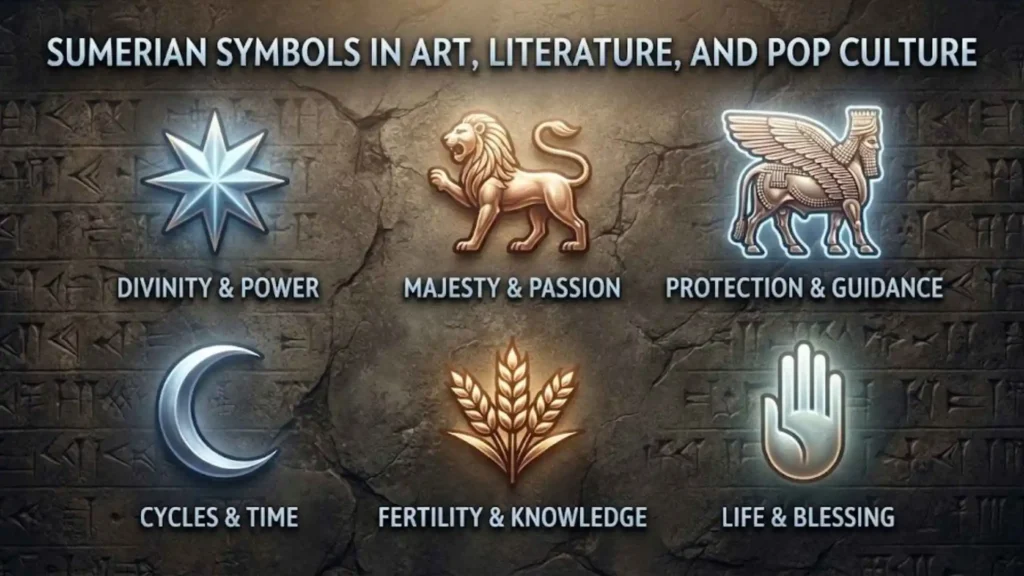
The mystery of Sumer continues to capture the modern imagination.
- Paintings & Visual Art: Surrealist artists like Max Ernst and Leonora Carrington drew inspiration from the dreamlike, heavy stone carvings of Mesopotamia.
- Literature & Fiction: From H.P. Lovecraft’s eerie stories to fantasy novels, ancient cuneiform often represents forbidden, ancient knowledge hidden from humanity.
- Movies & TV: Sci-fi shows and movies like Stargate or Prometheus frequently use Sumerian-style symbols to hint at ancient alien builders or lost cosmic wisdom.
- Tattoos & Fashion: The clean, geometric lines of the eight-pointed star and the striking look of the Lamassu have made Sumerian symbols incredibly popular in modern tattoo culture, representing strength, guidance, and deep historical roots.
Spiritual and Dream Meaning of Sumerian Symbols
Have you ever seen ancient writing or star symbols in your dreams? Psychologists and spiritual guides believe these symbols carry heavy subconscious meaning.
- Dreaming of Cuneiform: This suggests you are searching for answers in your life. Your subconscious is trying to translate a hidden message or tap into “forgotten” inner wisdom.
- Dreaming of the Star of Inanna: This points to a time of transition. You may be entering a passionate creative phase, or perhaps you are experiencing a conflict between love and assertiveness.
- Dreaming of the Lamassu: This is a comforting sign of protection. It shows that you have the inner strength and mental clarity to guard your energy against toxic influences.
A Note of Caution: When working with ancient symbols in meditation, remember that they carry powerful psychological energy. Approach them with respect and curiosity, viewing them as tools for self-discovery rather than magical quick fixes.
Positive and Negative Meanings of Sumerian Symbols
Most ancient symbols contain a duality. They represent both light and shadow, reminding us that nature is balanced.
| Symbol | Positive (Light) Meaning | Negative (Shadow) Meaning |
| The Star of Inanna | Love, creative passion, birth, beautiful beginnings | Destruction, chaos, the storm of war, unpredictable rage |
| The Serpent / Snake | Healing, spiritual wisdom, rejuvenation, rebirth | The cold underworld, hidden dangers, the sting of betrayal |
| The Bull / Horns | Strength, fertility, abundance, protective power | Destructive anger, stubborn ego, overwhelming force |
Why Humans Are Attracted to Sumerian Symbols
Why do we still look at five-thousand-year-old clay markings with a sense of wonder?
Our brains are hardwired for pattern recognition. Long before we had written words, we communicated through shapes. When we look at a Sumerian symbol, our minds instantly recognize the sacred geometry behind it.
Furthermore, these symbols tap into our shared human history. They remind us that the people who lived in Mesopotamia were not so different from us. They sat under the same stars, felt the same burning passion of love, and worried about the legacy they would leave behind. In a fast-moving, digital world, these ancient stone codes anchor us to our roots.
Modern Uses of Sumerian Symbols
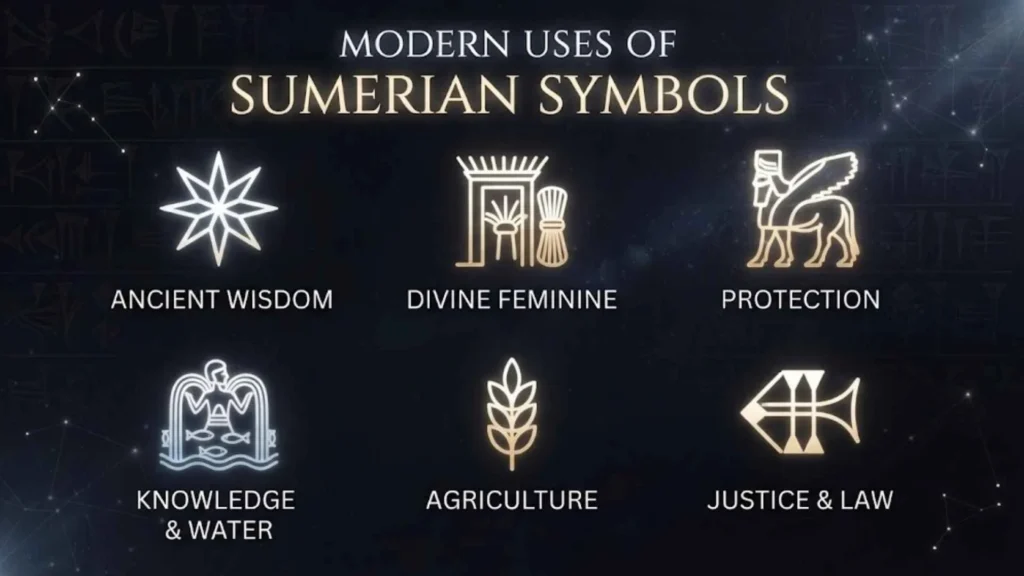
Today, these symbols have stepped out of museum cases and into daily life:
- Tattoos: People wear the Lamassu or the Cuneiform sign for “freedom” (Ama-gi) as permanent reminders of their personal journeys.
- Jewelry: Minimalist pendants featuring the eight-pointed star are popular fashion choices for those who love history and cosmic style.
- Branding & Design: Many tech and creative companies use stylized cuneiform or ancient star shapes in their logos to project stability, ancient wisdom, and innovation.
- Spiritual Spaces: You will find Sumerian-inspired art in yoga studios and meditation rooms, encouraging deep reflection on the origins of human thought.
Sumerian Symbols Copy and Paste
Sumerian symbols are most accurately represented by cuneiform signs, which were created by pressing a reed stylus into wet clay. There is no single official collection of decorative “Sumerian symbols” that can be copied and pasted like modern emojis. Many symbols shared online are modern recreations or stylized versions of ancient signs.
Some commonly recognized Sumerian and Mesopotamian motifs include the dingir sign for divinity, the eight-pointed star associated with Inanna, and individual cuneiform signs representing words or concepts. If you use a Sumerian symbol for a tattoo, design, or social media post, it is important to check the original sign and its historical meaning rather than relying only on a modern symbol chart.
Sumerian Runes
The phrase Sumerian runes is common in modern searches, but it is not historically accurate terminology. The Sumerians used cuneiform, a writing system made from wedge-shaped impressions pressed into clay with a reed stylus.
Runes belong to much later Germanic writing traditions and developed in a different cultural and geographical setting. Therefore, authentic
Sumerian Cross
There is no single universally recognized Sumerian cross with one fixed meaning. Cross-like forms can appear in ancient Mesopotamian art and writing, but their interpretation depends on the exact shape, period, and archaeological context.
Some modern sources describe particular cross-shaped designs as symbols of protection, balance, or eternity. These interpretations should be separated from meanings that can actually be supported by ancient inscriptions or archaeological evidence. A cuneiform sign should always be identified according to its historical form rather than simply being labeled a “Sumerian cross.”
Sumerian Colors
Color appears in Mesopotamian art, architecture, sculpture, jewelry, seals, and ceremonial objects. However, there was no simple universal color chart in which every color had one fixed Sumerian spiritual meaning.
Materials were often important as well as their colors. Lapis lazuli, for example, was a highly valued blue stone that appears frequently in Mesopotamian art and luxury objects. Other natural pigments and colored materials were also used. The meaning of a particular color depended on the object, period, and cultural context, so modern claims that assign one permanent meaning to every Sumerian color should be treated cautiously.
Interesting Facts About Sumerian Symbols
- The World’s Oldest “Signature”: The earliest recorded name in history belongs to a Sumerian accountant named Kushim, found on a clay tablet marked with economic symbols.
- Written in Reverse: Originally, Sumerian was written in columns from top to bottom, but scribes eventually turned the tablets sideways, writing from left to right to avoid smudging the wet clay.
- The First Environmental Symbol: The Sumerian cuneiform for “mountain” combined with “woman” was used to symbolise foreign slave girls, showing how they categorized their changing world.
- Astronomical Accuracy: The Sumerians used their symbols to map the movements of Jupiter, Venus, and Mars with mathematical precision that matches modern calculations.
- The Original Noah’s Ark: Long before the Bible was written, Sumerian symbols on the Epic of Atrahasis clay tablets detailed a massive flood and a hero building a giant boat.
Frequently Asked Questions
What is the oldest Sumerian symbol?
The oldest Sumerian symbols are simple pictographs dating back to around 3200 BCE, which represented physical items like sheep, barley, and water for agricultural record-keeping.
What does the Sumerian eight-pointed star mean?
The eight-pointed star (the Dingir) represents high divinity, the heavens, and the sky god Anu. It is also the symbol of Inanna, representing love, war, and the planet Venus.
Are Sumerian symbols still used today?
Yes. While no longer used as a writing system, they are highly popular in modern jewelry, tattoos, fantasy literature, sacred geometry art, and spiritual practices.
What is the Sumerian symbol for protection?
The most famous symbol of protection is the Lamassu, a massive creature with the body of a bull or lion, the wings of an eagle, and a human head.
How did Sumerian symbols influence the Bible?
Many symbols, stories, and laws found in the Bible, such as the Great Flood, the Garden of Eden, and the concept of “an eye for an eye,” closely mirror earlier Sumerian myths recorded in cuneiform.
Conclusion
Sumerian symbols are much more than dusty relics of a bygone age: they are the foundational language of human imagination and spiritual discovery. By exploring these ancient codes, we get to look through a window into the souls of our ancestors, finding a reflection of our own eternal search for meaning. As you carry these stories and symbols in your mind, remember that the quest to understand the universe and ourselves is a journey we have been sharing together since the very dawn of time.

Hi, I’m Sienna Brooks, and I believe that the right words can inspire, comfort, and empower people at every stage of life. For as long as I can remember, I’ve been drawn to meaningful quotes and the stories behind them. I love curating collections of inspirational, motivational, and heartfelt quotes that resonate with readers around the world.
Through my writing, I strive to help others find encouragement, whether they’re celebrating life’s happiest moments or navigating its biggest challenges. I believe that wisdom is timeless, and I’m passionate about sharing words that leave a lasting impact.
I am the author of Reflections in Words and The Journey of Inspiration, two books dedicated to exploring the beauty and power of timeless quotes.
 Rowan Sinclair Rowan Sinclair