Hera is one of the most powerful and recognizable goddesses in Greek mythology. Known as the Queen of the Gods, she ruled beside Zeus on Mount Olympus and held an important place in ancient Greek religion. She was especially connected with marriage, women, family life, and royal authority.
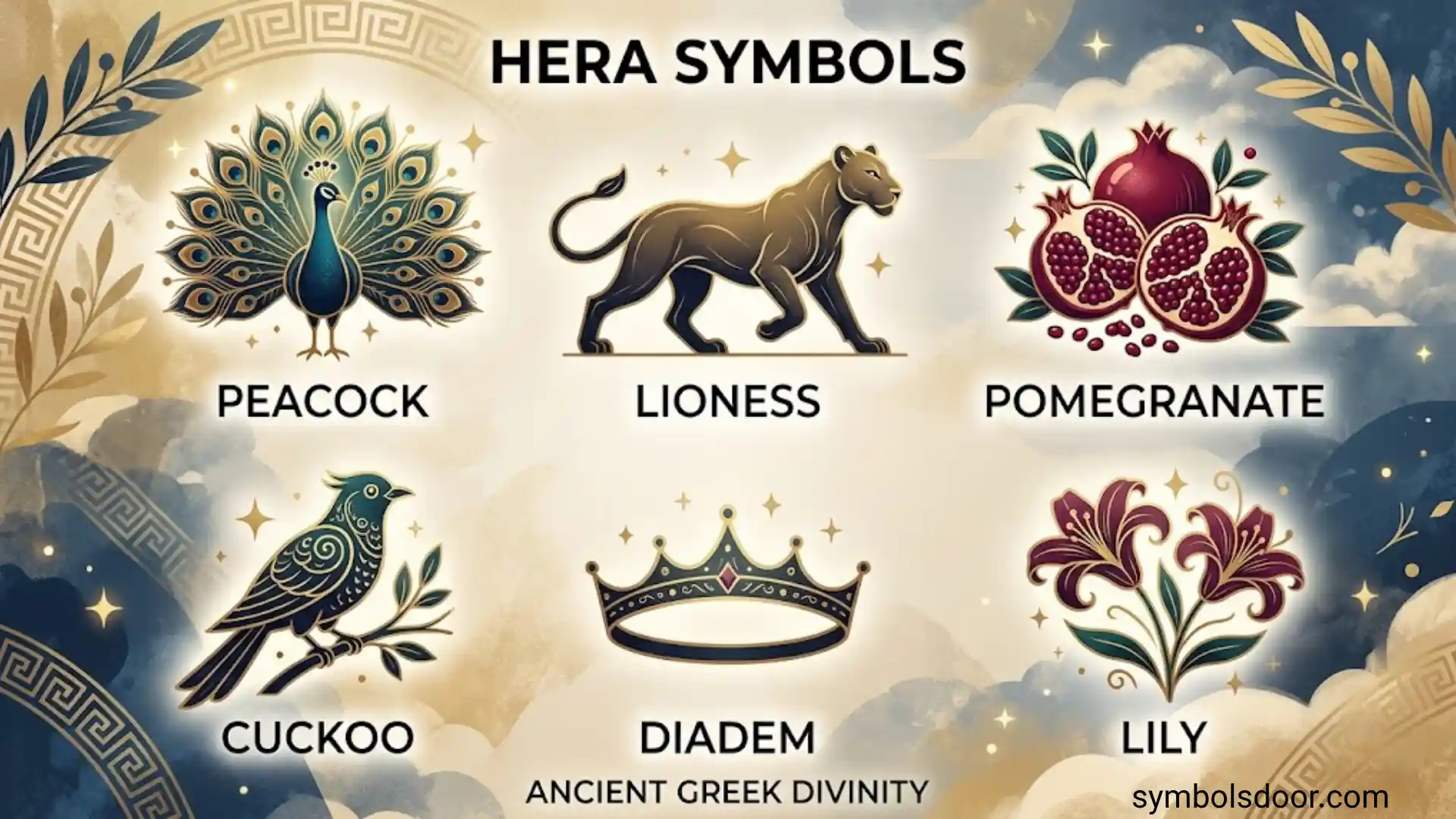
The symbols of Hera reveal much about her identity and influence. The peacock represents her majestic appearance, while the cow reflects an older connection with fertility and protection. Her scepter and diadem express her royal status, and the pomegranate connects her with marriage, abundance, and fertility.
However, not every object or animal associated with Hera has the same historical importance. Some symbols appear regularly in ancient Greek art, while others come from individual myths or modern spiritual interpretations.
In this guide, you’ll discover the most important Hera goddess symbols, their meanings, her sacred animals, colors, and stones, and the myths behind her reputation. You’ll also learn about her family, personality, powers, ancient temples, and Roman counterpart, Juno.
What Are the Symbols of Hera?
Hera’s most recognizable symbols include the peacock, cow, pomegranate, scepter, and diadem. Ancient Greek artists used these objects and animals to identify her and communicate her position as queen of the Olympian gods.
The Acropolis Museum identifies the scepter, diadem, and pomegranate as Hera’s symbols. It also names the peacock and ox as her sacred animals.
| Hera symbol | Main meaning | Historical connection |
| Peacock | Royal beauty, majesty, and divine status | Sacred animal associated with Hera |
| Cow or ox | Fertility, protection, and nurturing power | Ancient animal association and the epithet Boōpis |
| Pomegranate | Fertility, abundance, and marriage | Appears among Hera’s recognized attributes |
| Scepter | Authority, sovereignty, and leadership | Common object in artistic representations |
| Diadem | Royal status and divine dignity | Frequently worn in images of Hera |
| Cuckoo | Spring, renewal, and marriage traditions | Connected with a myth involving Zeus |
| Lily | Purity and beauty | Connected with later mythological traditions |
These symbols don’t all have identical meanings. Some are supported by ancient religious and artistic evidence, while others developed through later storytelling.
Hera Symbols and Their Meanings
Peacock: The Most Famous Symbol of Hera
<em> </em>
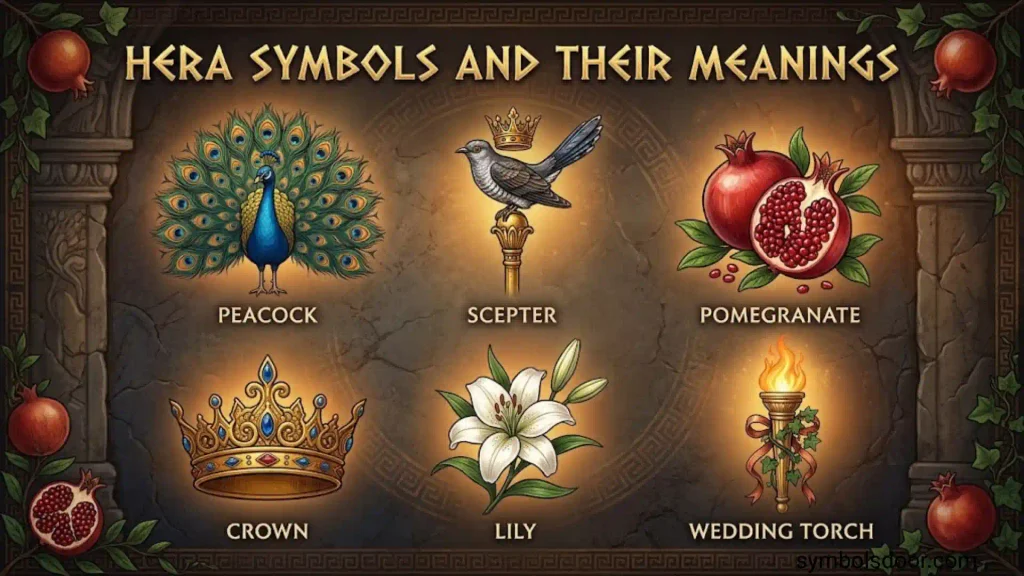
The peacock is probably the most recognizable animal associated with Hera. Its colorful feathers, impressive appearance, and elaborate display make it a fitting symbol for the queen of Olympus.
In Greek mythology, the peacock became connected with Hera through the story of Argus Panoptes, a giant famous for having many eyes.
According to the familiar version of the myth, Hera assigned Argus to watch Io. Io was a woman whom Zeus had transformed into a cow to hide her from his wife. Hera wanted to keep watch over her, so she placed Argus in charge.
Zeus eventually sent Hermes to rescue Io. Hermes lulled Argus to sleep and killed him. Hera then honored Argus by placing his eyes on the feathers of her sacred bird, the peacock.
This story explains the traditional connection between the peacock’s feather patterns and Argus’s many eyes.
Peacock symbolism associated with Hera includes:
- Royal beauty and elegance
- Divine authority and dignity
- Watchfulness and protection
- Immortality in later symbolic interpretations
- Pride and impressive appearance
- The power of a queen
The peacock feather meaning is often connected with all-seeing wisdom because of its eye-like markings. However, this interpretation comes from the Argus story and later symbolism rather than a single universal ancient doctrine.
Cow and Ox: Fertility and Protection
The cow and ox are among Hera’s oldest and most important animal associations. Ancient sources and museum materials identify the ox as one of her sacred animals.
Hera also has the Greek epithet Boōpis, commonly translated as “cow-eyed” or “ox-eyed.” Homer uses this description when referring to the goddess in the Iliad.
The expression was not necessarily an insult. It described her large, beautiful eyes and connected her with an animal that held importance in ancient agricultural life.
Cattle represented wealth, nourishment, and prosperity in the ancient Greek world. They were valuable for farming, food, and religious offerings.
The cow’s association with Hera can therefore suggest:
- Fertility and abundance
- Motherhood and nurturing
- Protection of women
- Prosperity and agricultural wealth
- Divine beauty and dignity
- Family and household stability
The cow also appears in the story of Io. Zeus transforms Io into a cow, and Hera eventually takes responsibility for watching her.
This myth gives the animal another connection with Hera’s complicated relationship with Zeus and his lovers.
Pomegranate: Marriage, Fertility, and Abundance
The pomegranate is another recognized symbol of Hera. Ancient Greek religious traditions associated this fruit with several female deities, including Hera, Demeter, Kore, and Aphrodite.
Its many seeds made it a natural symbol of fertility, abundance, and prosperity. The fruit could also represent marriage and the continuation of family life.
The pomegranate had more than one meaning in ancient Greek culture. It could appear in religious offerings and funerary contexts, so its symbolism was not limited to marriage or fertility.
For Hera, the fruit is particularly meaningful because of her role as the Goddess of Marriage.
Its possible symbolic associations include:
- Fertility and family growth
- Marital union
- Abundance and prosperity
- Family lineage
- Renewal and continuity
- Women’s reproductive power
The pomegranate also appears in the famous myth of Persephone. However, that story belongs primarily to Persephone, Demeter, and Hades. It should not be confused with Hera’s own symbolism.
Scepter: Royal Authority and Sovereignty
Hera is frequently shown holding a scepter, a long ceremonial staff associated with kingship and divine authority.
In ancient Greek art, the scepter helped identify powerful rulers and gods. Hera’s possession of one reflects her position beside Zeus as queen of Olympus.
The object represents more than personal power. It also suggests her role in maintaining divine order and protecting the communities that worshipped her.
The scepter’s symbolic meanings include:
- Royal authority
- Sovereignty and leadership
- Power and influence
- Divine dignity
- Protection of communities
- Social order and stability
Hera’s scepter sometimes appears with a cuckoo in descriptions of her famous statue by the sculptor Polykleitos. This detail connects her royal image with the cuckoo’s mythological and seasonal associations.
Crown and Diadem: Royal Status and Divine Dignity
The crown and diadem are important parts of Hera’s appearance in ancient Greek art.
A diadem was a band or headpiece associated with royalty. Artists often depicted Hera wearing one to show her position as the queen of the gods.
Some representations also show her wearing a veil and elaborate clothing. These details emphasize her connection with marriage and royal womanhood.
The crown symbolism associated with Hera includes:
- Royal status
- Divine authority
- Leadership
- Nobility and dignity
- Marriage and womanhood
- Power and influence
A diadem is not exactly the same as every type of crown. The term usually refers to a royal headband or similar ornament, while a crown can describe different forms of headwear.
Both communicate Hera’s elevated position in Greek mythology.
Cuckoo: Spring and the Marriage of Hera and Zeus
The cuckoo is a less familiar but meaningful animal in Hera’s mythology.
One popular myth explains that Zeus approached Hera in the form of a cuckoo. The bird appeared cold and distressed, so Hera took pity on it. Zeus then revealed himself, and their relationship developed into marriage.
The story connects the cuckoo with the divine marriage of Zeus and Hera.
The bird also had seasonal associations. In ancient Greek interpretations, its call could signal the arrival of spring, a season linked with growth, fertility, and new beginnings.
The cuckoo can therefore represent:
- Spring and renewal
- Marriage traditions
- Seasonal change
- Fertility
- The relationship between Hera and Zeus
Unlike the peacock, the cuckoo is not usually the first symbol people recognize when they think of Hera. Its importance comes mainly from specific myths and ancient cult traditions.
Lily Flower: Purity and Beauty
The lily flower sometimes appears in modern discussions of Hera’s sacred flowers.
Its connection comes from later mythological storytelling about Hera’s milk and the creation of the Milky Way. In versions of this story, drops of divine milk fall into the sky or onto the earth.
The lily is sometimes connected with this tradition through the symbolism of milk, whiteness, and purity.
However, the lily is not as firmly established as Hera’s principal symbol as the peacock, cow, pomegranate, scepter, or diadem.
Its modern symbolic associations include:
- Purity and innocence
- Beauty and elegance
- Motherhood
- Femininity
- Renewal and new beginnings
It is best to describe the lily as a flower associated with later Hera traditions rather than claim it was her universally recognized sacred flower.
Lotus Flower: A Less Certain Association
The lotus flower appears in some modern lists of Hera symbols. It is often connected with purity, rebirth, beauty, and spiritual awakening.
However, there is limited evidence that the lotus was one of Hera’s principal sacred plants in ancient Greek worship.
The lotus has important associations in other ancient cultures, especially in Egyptian religious art. Its appearance in modern Hera symbolism may reflect broader spiritual interpretations rather than a well-established Greek tradition.
If you include the lotus in a modern spiritual interpretation of Hera, distinguish that interpretation from documented ancient religious practice.
Mirror and Golden Chair: Are They Really Hera Symbols?
The mirror and golden chair sometimes appear in online lists of Hera symbols. Their historical status needs clarification.
A mirror is not one of Hera’s standard identifying attributes in ancient Greek art. Mirrors were important objects in ancient Greek life and art, especially in representations of women and beauty, but that does not make the mirror a principal symbol of Hera.
The golden chair has a more direct connection with a myth.
According to one version of the story, Hephaestus made a magical throne that trapped Hera when she sat on it. He had been rejected by his mother, and the throne became part of his revenge.
The chair is therefore an object in a myth about Hera and Hephaestus. It is not a standard symbol used to identify Hera.
Hera’s Sacred Animals and Their Meanings
Hera’s sacred animals reflect her position as a powerful goddess, her connection with marriage, and her importance in ancient Greek religious life.
The peacock and cow have the strongest general associations. The cuckoo also has an important mythological connection.
| Animal | Connection with Hera | Symbolic meaning |
| Peacock | Her most recognizable sacred bird | Majesty, beauty, and divine status |
| Cow | Ancient sacred animal and mythological association | Fertility, nourishment, and protection |
| Ox | Identified in museum descriptions of Hera’s sacred animals | Strength and agricultural prosperity |
| Cuckoo | Connected with Zeus’s approach to Hera | Spring, marriage, and renewal |
| Lion | Appears in some ancient and later associations | Strength and royal power |
| Black panther | Not a well-established principal Hera animal | Modern or unsupported association |
| Turtle | Not a standard sacred animal of Hera | Avoid presenting it as historically established |
Peacock Chariot and Peacock Feathers
Modern illustrations sometimes show Hera riding in a chariot pulled by peacocks. The peacock is strongly associated with her artistic identity, although specific depictions vary across periods and traditions.
Peacock feathers also appear in modern spiritual interpretations of her symbolism. Their eye-like patterns connect them with Argus Panoptes and the idea of watchfulness.
Hera’s Sacred Flowers and Plants
Hera’s plant associations are less straightforward than her animal and royal symbols.
Ancient Greek religious traditions connected different plants with different gods and local cults. Some associations also developed through myths rather than formal worship.
| Flower or plant | Association | Important note |
| Pomegranate | Fertility, abundance, and marriage | Strongly supported as a Hera symbol |
| Lily | Purity and beauty | Connected with later mythological storytelling |
| Osier or chaste tree | Ancient plant association | Mentioned in Greek religious reference materials |
| Lotus | Purity and rebirth | Not a firmly established principal Hera symbol |
The osier or chaste tree deserves attention because it appears in descriptions of Hera’s sacred plant associations. The chaste tree also had wider uses and symbolic meanings in ancient Mediterranean traditions.
When writing about Hera’s sacred flower, the pomegranate is the safer historical choice. The lily and lotus should be discussed with appropriate qualifications.
Hera’s Sacred Colors and Their Symbolism
Ancient Greek art does not provide one fixed color chart for Hera. Modern spiritual traditions often associate her with royal blue, jade green, gold, and silver.
These colors can help communicate her personality and royal identity. However, they should be described as modern interpretations rather than an official ancient Greek color system.
| Color | Modern symbolic meaning | Why it suits Hera |
| Royal blue | Nobility, authority, and loyalty | Reflects her royal position |
| Jade green | Growth, prosperity, and renewal | Connects with fertility and abundance |
| Gold | Wealth, power, and divine status | Reflects her position as queen |
| Silver | Elegance, dignity, and femininity | Complements her majestic image |
| White | Purity and marriage | Connects with later interpretations of her divine femininity |
Royal Blue
Royal blue is a popular modern color association for Hera. It suggests leadership, dignity, and nobility.
As Queen of the Gods, Hera represents a form of divine royalty. Blue can therefore work as a symbolic color in modern artwork, altars, and devotional designs.
Jade Green
Jade green is often connected with prosperity, fertility, growth, and renewal.
These meanings complement Hera’s role in marriage and family life. Still, there is no strong evidence that ancient Greek worshippers followed a specific jade-green color tradition for her.
Gold and Silver
Gold represents wealth, authority, and divine splendor. Silver suggests elegance, dignity, and refined beauty.
Both colors suit artistic representations of a goddess who wears royal clothing and holds a scepter.
Hera’s Sacred Stones and Crystals
Modern spiritual practices sometimes connect Hera with gemstones and crystals. These associations can be useful in contemporary devotional or symbolic contexts, but they should not be mistaken for a documented ancient Greek list.
There is no reliable historical evidence that Hera had one official collection of sacred crystals.
| Stone or crystal | Modern symbolic meaning | Possible connection with Hera |
| Lapis lazuli | Wisdom, truth, and royalty | Her queenly image |
| Pearl | Purity, femininity, and elegance | Marriage and womanhood |
| Garnet | Commitment, passion, and devotion | Marital fidelity |
| Amber | Warmth, protection, and vitality | Family protection |
| Citrine | Confidence, prosperity, and happiness | Royal authority |
| Emerald | Growth, renewal, and harmony | Family unity |
| Diamond | Strength, loyalty, and lasting commitment | Marriage and fidelity |
| Star sapphire | Wisdom, guidance, and protection | Divine authority |
Lapis Lazuli
Lapis lazuli is a deep blue stone traditionally associated with royalty, wisdom, and spiritual significance in several ancient cultures.
Modern interpretations connect it with Hera because of her royal status. However, that connection should not be presented as a confirmed ancient Hera-specific practice.
Pearls
Pearls are often associated with elegance, purity, and femininity. These qualities complement Hera’s image as a queen and goddess of marriage.
Modern spiritual interpretations may also connect pearls with emotional balance and lasting relationships.
Garnet
Garnet is commonly linked with commitment, devotion, and passion. Those associations make it a popular modern stone for marriage-related symbolism.
Amber and Citrine
Amber is associated in modern crystal traditions with warmth, protection, and vitality. Citrine is often linked with confidence, prosperity, and optimism.
Both can be used as contemporary symbolic choices for Hera, although neither is established as one of her ancient sacred stones.
Emerald, Diamond, and Star Sapphire
Emerald is commonly connected with growth and harmony. Diamond represents strength and lasting commitment, while star sapphire is associated with guidance and wisdom.
These meanings fit modern interpretations of Hera’s role in family unity and marriage. They remain modern associations rather than verified ancient religious attributes.
Who Is Hera in Greek Mythology?
<em> </em>
Hera is one of the twelve major Olympian gods and goddesses in ancient Greek mythology. She is the daughter of the Titans Cronus and Rhea and the sister and wife of Zeus.
She lives on Mount Olympus and holds the position of queen among the gods.
Hera is best known as the Goddess of Marriage and protector of married women. She also has important connections with family life, women, fertility, and royal authority.
Her mythology presents her as a powerful and complex goddess. She can protect marriage and punish those who threaten her position or offend her.
What Is Hera the Goddess Of?
Hera has several divine roles, although ancient traditions did not always define them in exactly the same way.
| Role | Explanation |
| Goddess of marriage | Protects marriage and legitimate unions |
| Goddess of women | Represents important aspects of women’s lives |
| Goddess of family | Connects with household and family stability |
| Queen of the Gods | Shares royal authority on Mount Olympus |
| Protector of marriage | Represents the sacred and social importance of marriage |
| Goddess associated with fertility | Connects with family growth and abundance in some traditions |
| Protector of cities | Held important local cult roles in places such as Argos and Samos |
Hera is sometimes described as the Goddess of Childbirth. However, Eileithyia, her daughter, was the specific Greek goddess associated with childbirth and labor.
Hera’s connection with motherhood and childbirth is therefore important, but it should not erase Eileithyia’s distinct role.
Why Is Hera Called the Queen of the Gods?
Hera is called the Queen of the Gods because she is Zeus’s wife and shares his royal household on Mount Olympus.
Her position appears in ancient literature and artistic representations. She is often shown wearing a diadem, sitting on a throne, or holding a scepter.
Her authority also extended beyond Olympus through important local religious centers. Argos and Samos, for example, had major sanctuaries dedicated to her.
Hera’s Powers and Abilities
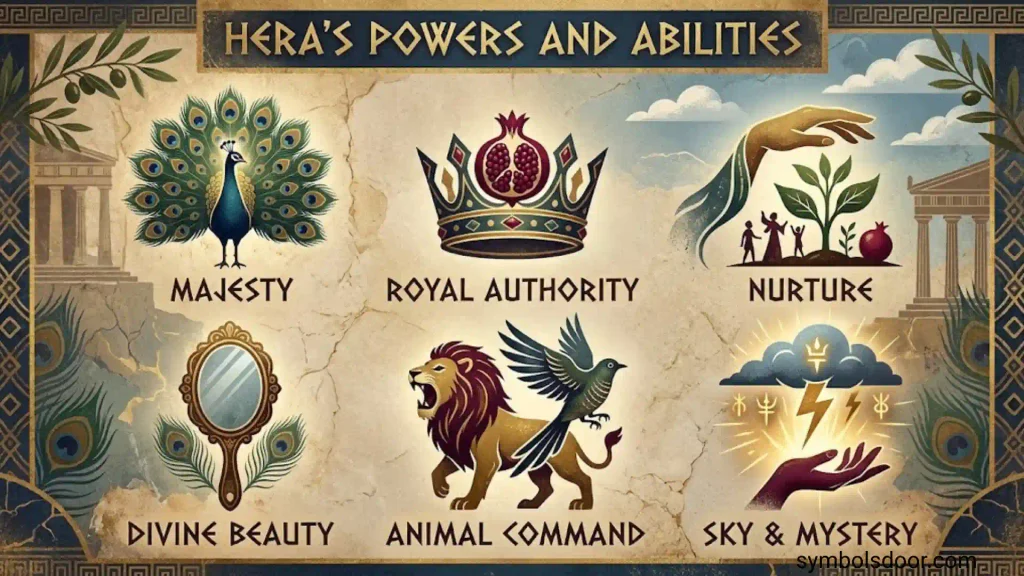
As an Olympian goddess, Hera possesses immortality, divine strength, and supernatural abilities.
Her powers are connected with her position among the gods and her influence over marriage, women, and divine relationships.
Important abilities and characteristics include:
- Immortality: Hera does not die from ordinary aging or natural causes.
- Divine authority: She holds a powerful position among the Olympian gods.
- Supernatural strength: Like other major gods, she possesses abilities beyond those of mortals.
- Divine punishment: Myths describe her punishing people who offend her or become involved with Zeus.
- Protection: She protects marriage and receives worship as a guardian deity in several cities.
- Transformation in myth: Stories involving Io and other figures include supernatural transformations connected with Hera’s actions or decisions.
- Influence over divine affairs: Her position allows her to intervene in conflicts involving gods and mortals.
Does Hera Control the Weather?
Some descriptions connect Hera with the sky and atmosphere. Ancient writers and later interpreters sometimes associated her with heavenly or atmospheric phenomena.
However, claims that she specifically controls air pressure, wind currents, or destructive thunderstorms are not standard descriptions of her powers.
In Greek mythology, Zeus is more directly associated with thunder, lightning, and the authority of the sky.
Is Hera the Goddess of Fertility and Childbirth?
Hera has connections with fertility, marriage, and family growth. The pomegranate and cow also support these associations.
However, childbirth had its own divine specialist: Eileithyia. She was closely connected with labor and delivery.
Hera’s role is broader. She protects marriage and women’s lives, while Eileithyia has a more specific childbirth function.
Hera’s Myths and Legends
Hera appears in many famous Greek myths. These stories show her royal position, her complicated relationship with Zeus, and her conflicts with several heroes.
Hera and Zeus: A Complicated Divine Marriage
Hera and Zeus were both children of Cronus and Rhea. They became husband and wife and ruled together on Mount Olympus.
Their marriage was powerful but often troubled. Zeus had relationships with several goddesses and mortal women, and Hera frequently responded with anger or revenge.
Many myths describe her targeting Zeus’s lovers or their children. These stories reflect the ancient mythological tradition of a goddess defending her marriage and royal position.
Hera’s relationship with Zeus is one reason she is associated with marital fidelity, jealousy, and the protection of marriage.
The Judgment of Paris and the Golden Apple
The Judgment of Paris is one of the major events leading to the Trojan War.
At the wedding of Peleus and Thetis, the goddess Eris introduced a golden apple marked for the fairest goddess. Hera, Athena, and Aphrodite all claimed it.
Zeus avoided choosing between them and assigned the decision to Paris, a Trojan prince.
Each goddess offered Paris a reward:
- Hera promised political power and royal authority.
- Athena offered wisdom and success in war.
- Aphrodite promised the love of the most beautiful woman, Helen.
Paris chose Aphrodite. Hera and Athena became hostile toward the Trojans, contributing to the events of the Trojan War.
The story reveals Hera’s pride, ambition, and desire for recognition.
Heracles and Hera: Why Did Hera Hate Hercules?
Heracles, known as Hercules in Roman mythology, was the son of Zeus and the mortal woman Alcmene.
Hera resented him because he was the result of Zeus’s relationship with another woman. She became one of his greatest divine enemies.
In one famous story, Hera sent madness upon Heracles, causing him to kill his own family. He later had to complete the Twelve Labors of Heracles as part of his punishment and path toward redemption.
Hera also sent dangers against him during his life. These included the serpents sent to attack him when he was an infant in some versions of the story.
His famous labors included:
- Killing the Nemean Lion
- Defeating the Lernaean Hydra
- Capturing the Ceryneian Hind
- Capturing the Erymanthian Boar
- Cleaning the Augean stables
- Capturing the Cretan Bull
- Taking the horses of Diomedes
- Obtaining the girdle of Hippolyta
- Capturing the cattle of Geryon
- Taking the apples of the Hesperides
- Capturing Cerberus
The exact order and details vary between ancient accounts. Heracles eventually achieved immortality and joined the gods.
Hephaestus’ Birth: Why Did Hera Throw Him Off Mount Olympus?
Hephaestus was the god of fire, metalworking, and craftsmanship. He was also associated with the forge and the creation of extraordinary objects.
Ancient myths offer different accounts of his birth. In one well-known tradition, Hera gave birth to him without Zeus. She rejected him because of his physical appearance and threw him from Olympus.
Other versions describe Zeus throwing Hephaestus from heaven after a family conflict.
These different accounts show why it is important not to present one version as the only ancient tradition.
Hephaestus later became famous for his remarkable creations. One story describes him making a magical throne that trapped Hera when she sat on it.
Semele and Dionysus
Semele was a mortal woman who became involved with Zeus. Hera learned about their relationship and wanted to expose the danger of Semele seeing Zeus in his full divine form.
In a familiar version of the story, Hera approached Semele in disguise and encouraged her to ask Zeus to reveal himself as he had promised.
Zeus had sworn to grant her request. When he appeared in his divine glory, Semele could not survive the experience.
Zeus rescued their unborn child, Dionysus, and later brought him to birth.
The myth demonstrates Hera’s jealousy and her ability to influence events involving Zeus’s mortal relationships.
Io’s Transformation and Argus Panoptes
Io was a priestess associated with Hera. Zeus became interested in her, and in some versions he transformed her into a white cow to conceal their relationship.
Hera became suspicious and demanded the cow. She then placed Io under the watch of Argus Panoptes, the hundred-eyed giant.
Zeus sent Hermes to rescue Io. Hermes managed to put Argus to sleep and killed him.
Hera honored Argus by placing his eyes on the peacock’s feathers in the familiar version of the story.
Io’s transformation is one of the most important myths explaining Hera’s connection with the cow and peacock.
Hera, Jason, and the Golden Fleece
Hera also plays a role in the story of Jason and the Golden Fleece.
In one tradition, Hera disguised herself as an old woman and tested Jason by appearing in a river crossing. Jason helped her cross and lost a sandal in the process.
This became important because an oracle had warned Pelias about a man wearing one sandal. Jason later arrived at Pelias’s court and demanded the throne.
Hera supported Jason during his quest for the Golden Fleece. Her involvement also connects her with the larger story of Medea, the Argonauts, and the dangerous journey to Colchis.
The details of the quest involve many other characters and divine influences. Hera should not be credited with every event in Jason’s journey.
Hera’s Family Tree and Genealogy
Hera belongs to the generation of Olympian gods born from the Titans Cronus and Rhea.
Her family relationships are important because many Greek myths revolve around the conflicts between parents, siblings, spouses, and children.
Hera’s Parents
Hera’s parents are:
- Cronus: A Titan who ruled before Zeus and the Olympian gods.
- Rhea: A Titan goddess and mother of several major Olympian deities.
Cronus swallowed his children because he feared one of them would overthrow him. Rhea eventually saved Zeus, who later freed his siblings and defeated Cronus.
This conflict became part of the Titanomachy, the war between the Titans and Olympians.
Hera’s Siblings
Hera’s siblings include:
- Zeus
- Poseidon
- Hades
- Demeter
- Hestia
Zeus later became her husband, making their relationship both marital and familial.
Hera’s Children
Hera’s children are traditionally associated with Zeus, although some ancient sources offer different parentage traditions.
| Child | Divine role |
| Ares | God of war |
| Hebe | Goddess of youth |
| Eileithyia | Goddess of childbirth |
| Hephaestus | God of fire and metalworking |
Some traditions also connect Hera with Eris and Enyo. Their parentage varies across ancient accounts, so they should not be treated as universally accepted children of Hera.
Hera’s Family Tree
| Family relationship | Names |
| Parents | Cronus and Rhea |
| Siblings | Zeus, Poseidon, Hades, Demeter, Hestia |
| Husband | Zeus |
| Children commonly associated with her | Ares, Hebe, Eileithyia, Hephaestus |
| Other children in some traditions | Eris and Enyo |
This genealogy connects Hera with nearly every major Olympian family story.
Hera’s Epithets and Different Forms
Ancient Greek worshippers used different titles for Hera. These titles often reflected her roles, local traditions, and stages of women’s lives.
Three particularly interesting epithets are Pais, Teleia, and Chēra.
| Epithet | Common translation | Meaning |
| Hera Pais | Hera the Girl or Child | Her identity as a young female figure |
| Hera Teleia | Hera the Wife or Complete One | Her connection with marriage |
| Hera Chēra | Hera the Widow or Separated Woman | A title associated with separation |
These titles are especially connected with local traditions at Stymphalus. They should not be treated as a universal biography or a simple sequence followed in every Greek community.
Hera Pais
Pais means child or girl. The title connects Hera with youth and her identity before marriage.
Hera Teleia
Teleia is strongly associated with Hera’s role as a wife and goddess of marriage.
It reflects the importance of marital union in her worship and mythology.
Hera Chēra
Chēra is often translated as widow or separated woman. It reflects a different aspect of Hera’s identity in local religious traditions.
These epithets show that ancient worshippers understood Hera through several roles rather than only as Zeus’s wife.
Hera’s Personality and Character Traits
Hera has one of the most complex personalities in Greek mythology. She is powerful, proud, protective, and deeply concerned with her position.
Many stories describe her anger toward Zeus’s lovers and their children. However, her mythology also includes her dignity as queen and her role as a protector of marriage.
| Personality trait | How it appears in mythology |
| Loyalty | Her identity is closely tied to her marriage with Zeus |
| Pride | She expects recognition as queen of the gods |
| Jealousy | She reacts strongly to Zeus’s relationships |
| Vengeance | Several myths describe her punishing Zeus’s lovers or their children |
| Royal authority | She holds an important position among the Olympians |
| Protectiveness | Her worship includes the protection of marriage and women |
| Intelligence | She uses planning and persuasion in several myths |
| Anger | Her conflicts often lead to divine punishment |
Hera’s Loyalty and Fidelity
Hera represents the ideal of marriage in many ancient Greek traditions. Her position as Zeus’s wife makes her a central figure in stories about marital commitment.
However, her own marriage is far from peaceful. Zeus repeatedly has relationships outside their union.
This contrast makes Hera a complicated symbol of fidelity and marriage.
Hera’s Jealousy and Vengeance
Hera’s jealousy is one of her most famous personality traits. Many myths describe her punishing Zeus’s lovers or their children.
Her treatment of Heracles and Io provides two well-known examples.
These stories often present Hera as harsh and unforgiving. They also reflect ancient mythological ideas about divine authority, marriage, and revenge.
Hera’s Royal Authority
Hera is not simply a jealous wife. She is also a major Olympian deity with her own power and influence.
Her scepter, diadem, and throne communicate her royal position. Her major sanctuaries show that communities across Greece honored her as a powerful goddess.
Ancient Greek Temples Dedicated to Hera
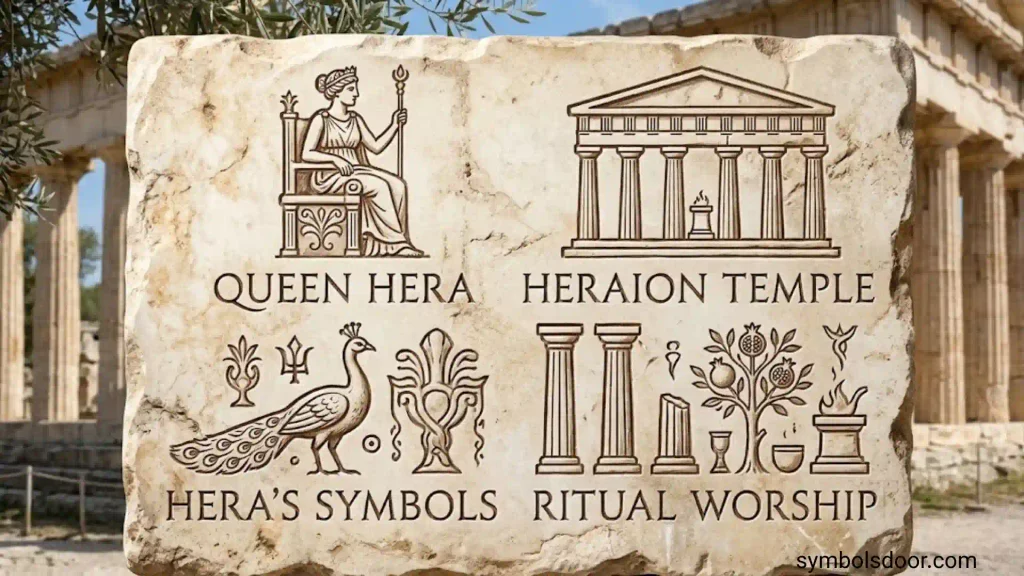
Hera had some of the most important sanctuaries in ancient Greece. Her worship was especially strong in the Peloponnese and on the island of Samos.
These temples were more than places to honor a goddess. They were centers for festivals, offerings, community identity, and religious activity.
Heraion of Argos
The Heraion of Argos was one of the most important sanctuaries dedicated to Hera.
It stood on the Argive plain, between Argos and Mycenae. The sanctuary held major religious importance and was connected with the identity of the Argive community.
Ancient traditions described Hera as a particularly important goddess in Argos. The sanctuary was also associated with festivals and processions.
Heraion of Samos
The Heraion of Samos was another major center of Hera worship.
It became famous for its monumental architecture and religious offerings. The sanctuary was rebuilt and expanded over several periods.
Its location and size show how important Hera was to the people of Samos.
Hera’s Sanctuary at Olympia
Hera also had an important sanctuary at Olympia.
The Temple of Hera at Olympia is among the earliest monumental temples at the site. It stood within the wider sanctuary associated with Zeus and the Olympic Games.
The temple reflects the importance of Hera in one of ancient Greece’s most famous religious centers.
Heraion of Perachora
The Heraion of Perachora stood on a promontory near Corinth. It was dedicated to Hera Akraia, a title associated with the sanctuary’s elevated coastal location.
The sanctuary attracted offerings from a wide area and was especially important during the Archaic period.
Other Important Hera Sanctuaries
Hera’s worship extended across mainland Greece and the Greek world.
| Location | Importance |
| Argos | One of Hera’s most important cult centers |
| Samos | Famous island sanctuary and monumental temple |
| Olympia | Important temple within the sanctuary of Zeus |
| Perachora | Sanctuary of Hera Akraia near Corinth |
| Mycenae | Part of the region where Hera’s cult was especially strong |
| Sparta | Important local worship of Hera |
| Delos | Island sanctuary with an early temple |
| Paestum | Famous Greek temples in southern Italy |
| Capo Colonna | Site of the sanctuary of Hera Lacinia |
| Metapontum | Associated with the important Hera sanctuary known as the Tavole Palatine |
Hera Temples in Southern Italy and Sicily
Greek settlers established important sanctuaries in southern Italy and Sicily.
The sanctuary of Hera Lacinia near modern Capo Colonna in Calabria was particularly important. Its location on a coastal promontory made it a major religious landmark.
At Paestum, the temples traditionally called Temple of Hera I and Temple of Hera II are among the best-known examples of ancient Greek architecture in Italy.
The identification and naming of individual temples can vary in archaeological discussions, so historical descriptions should distinguish traditional labels from confirmed dedications.
Hera’s Worship and Ancient Greek Religious Practices
Hera’s worship involved sacrifices, offerings, festivals, and visits to sanctuaries.
Different communities honored her in different ways. Her cult was not identical across the Greek world.
Some communities emphasized her role as a marriage goddess. Others connected her with royal authority, local protection, fertility, and the prosperity of their land.
Common religious practices included:
- Offering animals and other gifts at sanctuaries
- Participating in festivals dedicated to Hera
- Making votive offerings
- Visiting temples and sacred spaces
- Taking part in processions
- Honoring her through local cult titles
Her worship demonstrates how important marriage, family, and community life were in ancient Greek religion.
Hera and Juno: Greek and Roman Goddess Comparison
Hera’s Roman equivalent is Juno. The Romans identified Juno with Hera, although their religious traditions developed in different ways.
Both goddesses held important positions in their respective pantheons. They were associated with marriage, women, and royal or divine authority.
However, Juno also had distinct Roman roles and religious traditions.
| Feature | Hera | Juno |
| Mythological tradition | Greek | Roman |
| Husband | Zeus | Jupiter |
| Position | Queen of the Gods | Queen of the Roman gods |
| Main associations | Marriage, women, family, royal authority | Marriage, women, childbirth, and protection of the Roman state |
| Sacred animal associations | Peacock and cow | Goose and other animals in Roman traditions |
| Famous symbols | Scepter, diadem, pomegranate | Diadem, scepter, and other Roman attributes |
| Major religious context | Ancient Greek sanctuaries | Roman temples and state festivals |
Juno was especially important in Roman public religion. She was part of the Capitoline Triad with Jupiter and Minerva.
The two goddesses share many similarities, but they should not be treated as completely identical in every religious detail.
Frequently Asked Questions About Hera Symbols
What Are the Symbols of Hera?
Hera’s best-known symbols are the peacock, cow, pomegranate, scepter, and diadem. These represent her royal status, connection with marriage, fertility, and divine authority.
What Is Hera’s Most Famous Symbol?
The peacock is probably Hera’s most recognizable symbol. Its colorful feathers are traditionally connected with Argus Panoptes and his many eyes.
Why Is the Peacock Associated With Hera?
The peacock is associated with Hera through the story of Argus Panoptes. After Hermes killed Argus, Hera honored him by placing his eyes on the feathers of her sacred bird.
What Does the Peacock Feather Symbolize for Hera?
The peacock feather is commonly associated with beauty, royal dignity, watchfulness, and divine majesty. Its eye-like patterns connect it with the myth of Argus.
What Does the Pomegranate Symbolize for Hera?
The pomegranate represents fertility, abundance, marriage, and family growth. Its many seeds make it a natural symbol of prosperity and continuity.
What Does the Lotus Flower Represent in Greek Mythology?
The lotus can symbolize purity, beauty, and rebirth in modern interpretations. However, it is not firmly established as one of Hera’s principal sacred flowers in ancient Greek religion.
Why Does Hera Hold a Scepter?
Hera holds a scepter because it represents her royal authority and sovereignty. It identifies her as the queen of the gods and a powerful Olympian goddess.
What Does Hera’s Crown Symbolize?
Hera’s crown or diadem represents royal status, dignity, authority, and divine power. Artists use it to communicate her position as Zeus’s queen.
What Is Hera’s Sacred Flower?
The pomegranate is a well-supported plant-related symbol of Hera. The lily appears in later mythological associations, while the lotus is a less certain modern connection.
What Are Hera’s Sacred Animals?
Hera’s principal sacred animals are the peacock and cow or ox. The cuckoo also has a connection with her mythology and ancient religious traditions.
What Colors Are Associated With Hera?
Modern interpretations commonly associate Hera with royal blue, jade green, gold, silver, and white. These colors reflect her royal status, dignity, and connection with marriage.
What Crystals and Stones Represent Hera?
Modern spiritual interpretations connect Hera with lapis lazuli, pearls, garnet, amber, citrine, emerald, diamond, and star sapphire. These are contemporary associations rather than a verified ancient Greek list.
What Is Hera the Goddess Of?
Hera is primarily the goddess of marriage and women. She is also associated with family, royal authority, and the protection of married life.
Is Hera the Goddess of Fertility and Childbirth?
Hera has connections with fertility and family growth. Her daughter Eileithyia, however, is the specific Greek goddess of childbirth and labor.
Who Are Hera’s Parents?
Hera’s parents are Cronus and Rhea, two Titans in Greek mythology.
Who Are Hera’s Children?
Hera’s children commonly include Ares, Hebe, Eileithyia, and Hephaestus. Some traditions also associate her with Eris and Enyo.
Who Are Hera’s Siblings?
Hera’s siblings are Zeus, Poseidon, Hades, Demeter, and Hestia. They are all children of Cronus and Rhea.
Who Is Hera’s Husband?
Hera’s husband is Zeus, the king of the Olympian gods. They are both siblings and spouses in Greek mythology.
What Is Hera’s Roman Name?
Hera’s Roman counterpart is Juno. Both goddesses are associated with marriage, women, and divine authority.
What Are Hera’s Personality Traits?
Hera is often described as proud, loyal, jealous, protective, powerful, and determined. Her myths show both her royal authority and her tendency toward vengeance.
Why Did Hera Hate Hercules?
Hera resented Heracles because he was the son of Zeus and the mortal woman Alcmene. She repeatedly tried to make his life difficult, and some traditions connect her with the madness that led to his greatest tragedy.
Why Did Hera Throw Hephaestus Off Mount Olympus?
One tradition says Hera rejected Hephaestus because of his physical appearance and threw him from Olympus. Other versions say Zeus was responsible, so the story has more than one form.
What Happened to Io in Greek Mythology?
Zeus transformed Io into a cow in a familiar version of the myth. Hera placed her under the watch of Argus Panoptes, but Hermes eventually rescued her.
What Is Hera’s Role in the Golden Fleece Myth?
Hera supports Jason during his quest for the Golden Fleece. In one tradition, she tests him while disguised as an old woman and later helps him during his journey.
Where Were the Temples of Hera Located?
Important Hera sanctuaries existed at Argos, Samos, Olympia, Perachora, Sparta, Mycenae, and Delos. Greek colonies also established major sanctuaries in southern Italy, including Paestum and Capo Colonna.
What Is the Heraion of Argos?
The Heraion of Argos was one of ancient Greece’s most important sanctuaries dedicated to Hera. It stood on the Argive plain and played a major role in the religious identity of the region.
What Is the Difference Between Hera and Juno?
Hera belongs to Greek mythology, while Juno belongs to Roman mythology. The Romans identified Juno with Hera, but Juno developed her own religious roles and traditions.
Final Thoughts on Hera Symbols and Their Meanings
The symbols of Hera reveal why she held such an important position in Greek mythology. The peacock represents her majestic image, the cow connects her with fertility and protection, and the pomegranate reflects abundance and marriage.
Her scepter and diadem communicate her authority as the Queen of the Gods. Meanwhile, her myths reveal a complicated personality shaped by loyalty, pride, jealousy, and power.
Hera’s importance also extends beyond mythology. Her temples at Argos, Samos, Olympia, and other ancient sites show how widely people honored her.
When exploring Hera symbolism, it helps to separate ancient evidence from modern spiritual interpretations. The peacock, cow, pomegranate, scepter, and diadem have strong historical connections. Many crystal and color associations are newer ways of interpreting her character.
Together, these symbols offer a deeper understanding of Hera as a goddess of marriage, women, family, and divine royalty.

Hello, I’m Rowan Sinclair, a passionate writer and lifelong admirer of the wisdom found in great quotes. I believe that words have the ability to inspire change, spark creativity, and connect people across cultures and generations.
I enjoy writing about motivational quotes, famous sayings, and lessons from history’s most influential thinkers. Every article I create is driven by my desire to help readers discover meaningful insights that they can apply to their own lives.
When I’m not writing, I spend my time reading biographies, exploring classic literature, and collecting memorable quotes that deserve to be shared with the world.
I am the author of Voices That Inspire and A Collection of Timeless Thoughts, two books that celebrate the enduring power of words and the stories behind them.
 Asher Monroe