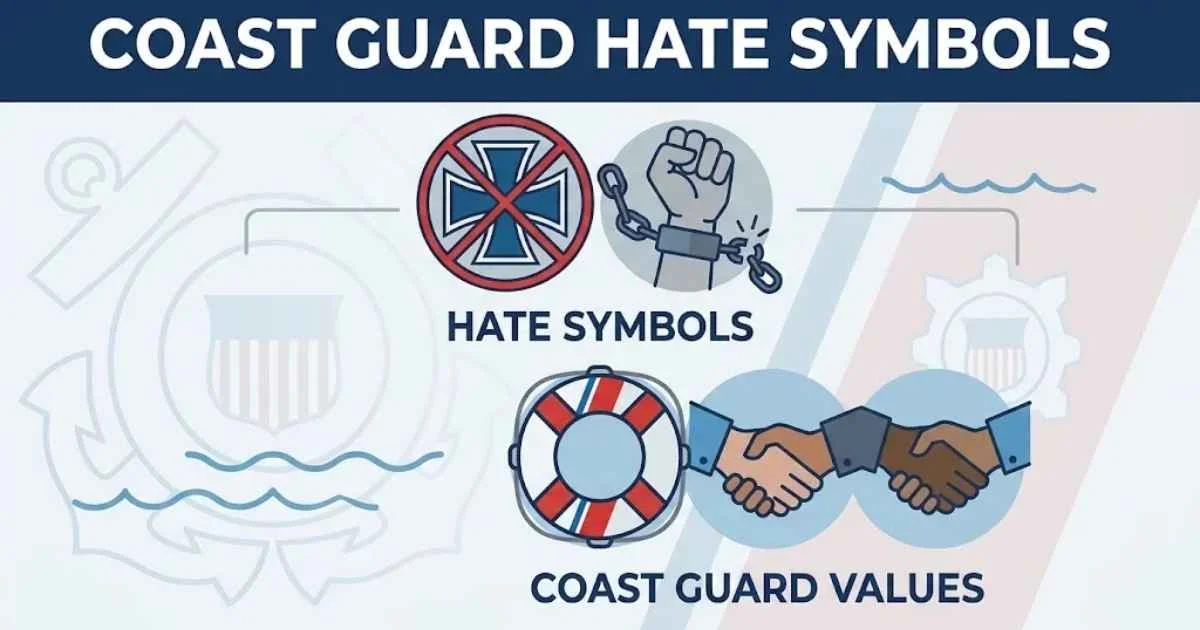
Coast Guard hate symbols can include offensive signs, emblems, gestures, slogans, and imagery associated with hate groups, extremist movements, or discriminatory beliefs.
Understanding these symbols can help you recognize potentially harmful messages, identify inappropriate displays, and learn why certain images or phrases may raise concerns. However, not every controversial symbol automatically represents hate.
Context, intent, history, and how a symbol is used all matter. In this guide, you’ll learn about hate-related symbols that may appear in Coast Guard settings, their meanings, and the importance of following official policies on discrimination, harassment, and extremist activity.
What Is the Coast Guard Hate Symbols Policy?
The Coast Guard hate symbols policy prohibits personnel from displaying divisive or hate-related symbols and flags in Coast Guard workplaces, facilities, and assets. It specifically identifies a swastika, a noose, and symbols or flags adopted or co-opted by hate-based groups to represent supremacy, racial or religious intolerance, antisemitism, or other improper bias.
The policy applies to all Coast Guard personnel. It is not limited to commissioned officers or people serving at large military bases. Its requirements cover the service’s workplaces, facilities, and other assets.
The December 12, 2025, policy statement explains that a symbol or flag can be prohibited when its display adversely affects:
- Good order and discipline
- Unit cohesion
- Command climate
- Personnel morale
- Mission effectiveness
The policy also makes an important distinction between widely recognized hate symbols and other symbols that may require additional review. Commanders, commanding officers, officers-in-charge, and supervisors must direct the removal of prohibited displays. They must also consult their servicing legal office when assessing other potentially divisive symbols.
The order is more than general workplace guidance. For personnel subject to the Uniform Code of Military Justice (UCMJ), it also operates as a punitive general order. A violation can be addressed under Article 92(1), which covers failure to obey a lawful general order or regulation.
The Coast Guard published the December policy statement on December 12, 2025. It reaffirmed the November 20 lawful order and explained that existing Civil Rights Manual provisions on hate incidents remained effective.
You can read the official December 2025 policy statement and lawful order.
What Symbols Are Prohibited by the Coast Guard?
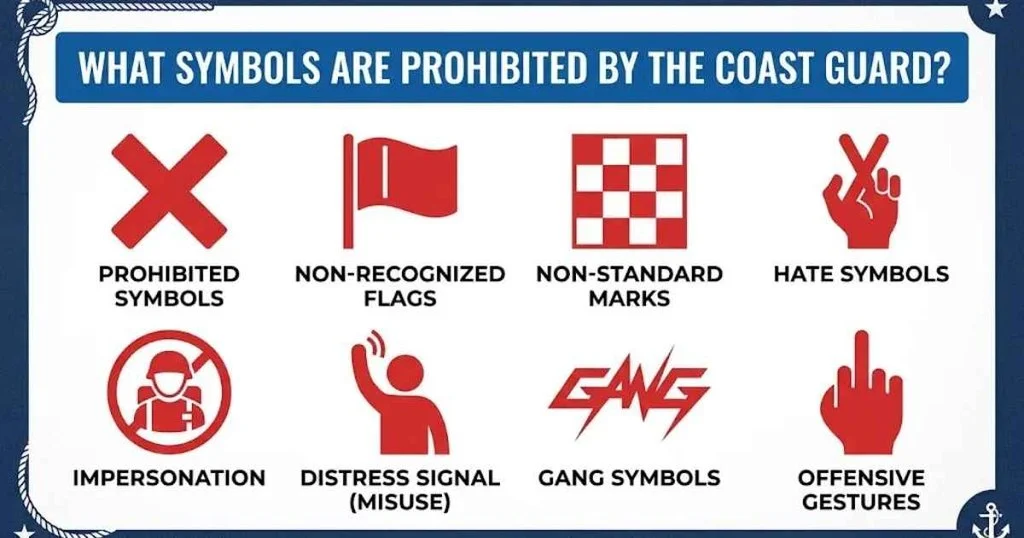
The Coast Guard’s policy identifies several categories of prohibited imagery. It names specific examples and also covers symbols or flags adopted by hate-based groups.
The list is not limited to a fixed collection of images. A symbol’s meaning, context, and effect on the workplace can matter, especially when commanders assess symbols beyond the examples expressly named in the order.
Swastika and Nazi Symbolism
<bold>Note:</bold> The swastika has a long history in several religions and cultures. However, the Nazi regime adopted a particular version of the symbol and made it a central emblem of its ideology.
The Nazi swastika is widely recognized as a symbol of Adolf Hitler’s National Socialist movement, Nazi racial ideology, antisemitism, and the Holocaust. Nazi Germany used it on flags, military insignia, official buildings, uniforms, and propaganda.
The symbol became closely associated with persecution, state-sponsored racism, and mass murder. For Jewish communities and many other people affected by Nazi crimes, its display can carry a direct message of intimidation and hatred.
The Coast Guard policy specifically names a swastika among the prohibited divisive or hate symbols. Its November 20, 2025, order makes clear that displaying such imagery in Coast Guard workplaces, facilities, and assets is prohibited.
It is important to distinguish the Nazi symbol from older religious and cultural uses of the swastika. The policy’s wording concerns divisive or hate-related displays and the context in which a symbol is used. It should not be read as a statement that every historical or religious use of the symbol has the same meaning.
Noose Symbol
A noose symbol can represent racial intimidation, threats, and violence, particularly in the history of the United States.
During the era of racial terror and segregation, lynching was used to terrorize Black Americans and enforce white supremacy. A noose displayed as a threat or racist message can therefore communicate a history of violence and intimidation.
The Coast Guard specifically names a noose in its policy. It does not need to be part of a larger display to raise serious concerns. Its display as a hate-related symbol is prohibited under the service’s order.
A noose can also appear in unrelated settings, such as maritime instruction, historical exhibits, or rope-handling demonstrations. Context matters when determining whether an item is being used as a legitimate object or as a symbol of hatred. The policy’s purpose is not to prevent ordinary maritime training or appropriate historical education.
Confederate Battle Flag
The Confederate battle flag is another major subject in the Coast Guard policy.
The flag is associated with the Confederacy, which fought to preserve slavery during the American Civil War. It later became closely connected with segregationist movements and white supremacist activity. Some people describe it as a symbol of Southern heritage, but its history also includes its use by groups and movements that promoted racial oppression.
The Coast Guard’s order specifically prohibits the display or depiction of the Confederate battle flag in its workplaces, facilities, and assets.
The restriction covers more than flags hanging on walls. It also includes:
- Barracks and other quarters where the flag is readily visible
- The exterior of Coast Guard housing
- Automotive bumper stickers
- Other vehicle decorations and adornments
- Clothing and other apparel
- Displays inside vehicles when the flag is in plain view and readily visible to the public
The order includes limited exceptions for state flags, state-issued license plates, and displays in which the Confederate battle flag is only an incidental or minor component, such as certain works of art or educational and historical displays.
That distinction matters. The policy does not say that every appearance of the flag in a history book, museum exhibit, or legitimate educational setting is automatically prohibited.
Ku Klux Klan Symbols
The Ku Klux Klan (KKK) is a white supremacist organization with a long history of racial terrorism, intimidation, and violence in the United States.
Its imagery has included white robes, pointed hoods, burning crosses, and other symbols associated with organized racial hatred. The group has used these images to intimidate Black communities, religious minorities, and people who opposed its ideology.
The Coast Guard’s policy does not provide a separate illustrated list of every KKK symbol. Instead, it covers symbols adopted or co-opted by hate-based groups to represent supremacy, racial or religious intolerance, antisemitism, or other improper bias.
As a result, a display of KKK-related imagery used to promote white supremacy or intimidate personnel may fall within the policy’s prohibition. Commanders must assess other potentially divisive displays with advice from their servicing legal office.
Other Hate-Based Flags and Symbols
The policy also covers symbols that are not individually named in the order.
These may include flags, insignia, or images adopted by groups promoting:
- Racial supremacy
- Religious intolerance
- Antisemitism
- White supremacy
- Other forms of improper bias or hatred
This broader wording allows the Coast Guard to address symbols that may change over time. Hate-based groups can adopt new imagery, reuse older symbols, or give familiar images new meanings.
The central question is not simply whether a symbol looks offensive. The policy considers whether it represents prohibited hatred or adversely affects good order, discipline, unit cohesion, command climate, morale, or mission effectiveness.
Coast Guard Hate Symbols Policy: What Changed in November and December 2025?
The controversy developed through several policy documents. Treating them as one announcement can lead to confusion because they addressed related but different issues.
The most important distinction is between the revised harassment instruction and the separate lawful order prohibiting divisive or hate symbols.
Coast Guard Policy Timeline
| Date | Policy development | Why it matters |
| March 5, 2025 | Coast Guard Civil Rights Manual updated | Chapters 3F and 3G addressed hate incidents and related responsibilities |
| November 13–14, 2025 | Revised Harassing Behavior Prevention, Response, and Accountability instruction issued | Introduced revised language and reporting procedures |
| November 20, 2025 | Admiral Kevin Lunday issued a separate lawful order | Explicitly prohibited divisive or hate symbols and flags |
| December 12, 2025 | Further policy statement and lawful order issued | Reaffirmed the prohibition and clarified enforcement |
| December 15, 2025 | Revised harassment instruction became effective | New harassment-reporting procedures took effect |
The dates show why the controversy needs careful explanation. The harassment instruction and the separate hate-symbol order were not identical documents, and they did not serve exactly the same purpose.
The Previous Coast Guard Policy
Before the November 2025 controversy, the Coast Guard already had policies addressing hate incidents, discrimination, and extremist symbols.
The Civil Rights Manual, including Chapters 3F and 3G, addressed hate incidents, command responsibilities, notifications, and the processing of reports. The service also maintained anti-discrimination and equal-opportunity policies.
The November 2025 changes therefore did not introduce the idea that hate-related conduct was unacceptable for the first time. The Coast Guard already had rules covering such behavior.
The issue was how the revised harassment instruction described certain symbols and how it organized the reporting and investigation process.
The November 2025 Harassment Policy Revision
In November 2025, the Coast Guard issued a revised instruction titled Harassing Behavior Prevention, Response, and Accountability, identified as COMDTINST 5350.6A.
Its Chapter 11 addressed the public display of divisive symbols and flags. It described symbols such as a noose and swastika as potentially divisive and stated that public displays could undermine unit cohesion and marginalize parts of the workforce.
The instruction also described when a display counts as public. It included workplaces, common access areas, operating facilities, visible barracks displays, the exterior of Coast Guard housing, clothing, vehicle decorations, and symbols displayed inside vehicles where they could be seen by the public.
It excluded private spaces outside public view, such as family housing.
The instruction also prohibited the public display of the Confederate battle flag and allowed commanders to review other potentially divisive symbols with their legal offices.
The wording caused concern because widely recognized hate symbols appeared under the broader phrase potentially divisive symbols. Critics questioned whether this language weakened the service’s earlier approach to hate incidents.
Another important change involved harassment reporting. The revised instruction generally required reports, except sexual harassment reports, to be submitted within 45 calendar days of an incident or the latest incident in a series. It also allowed discretion to accept reports after that period.
The revised instruction became effective on December 15, 2025. Until then, the previous reporting and processing requirements remained in place.
You can review the official Harassing Behavior Prevention, Response, and Accountability instruction.
Admiral Kevin Lunday’s November 20 Lawful Order
<bold>November 20, 2025, was a key turning point.</bold>
Following public criticism and questions about the revised language, Acting Commandant Admiral Kevin E. Lunday issued a separate policy and lawful order to all Coast Guard personnel.
The order stated that divisive or hate symbols and flags were prohibited. It specifically named nooses, swastikas, and symbols or flags adopted by hate-based groups to represent supremacy, racial or religious intolerance, antisemitism, or other improper bias.
It also required the removal of prohibited displays from Coast Guard workplaces, facilities, and assets.
The order addressed the Confederate battle flag separately and explained where the prohibition applied. It included limited exceptions for state flags, state-issued license plates, and incidental appearances in legitimate artwork or educational and historical displays.
The Coast Guard described the order as a clarification and reaffirmation of its prohibition. Its November 20 press release said the service was doubling down on its existing rules against hate symbols.
Read the November 20, 2025, lawful order and the official Coast Guard press release.
The December 2025 Policy Statement
On December 12, 2025, the Coast Guard issued another policy statement and lawful order signed by Admiral Kevin Lunday.
It reaffirmed the prohibition on divisive or hate symbols and flags. It also stated that the Coast Guard Civil Rights Manual’s Chapters 3F and 3G remained effective and controlled where they conflicted with another policy.
This is especially important because the December document connected the symbol prohibition with the existing procedures for reporting and processing actual or potential hate incidents.
The document did not erase the earlier controversy. Instead, it clarified the service’s stated position and reinforced the rules that commanders and personnel were expected to follow.
What Does “Potentially Divisive Symbols” Mean?
The phrase potentially divisive symbols became one of the most discussed parts of the Coast Guard policy controversy.
In the November harassment instruction, the term described symbols and flags whose public display could harm the workplace environment. The document identified nooses, swastikas, and symbols adopted by hate-based groups as examples.
It also connected a symbol’s divisive effect to specific military concerns:
- Good order and discipline
- Unit cohesion
- Command climate
- Morale
- Mission effectiveness
The wording did not mean that every symbol was automatically permitted unless someone complained. The instruction required commanders to assess displays and consult legal offices when deciding how to handle other potentially divisive imagery.
However, critics argued that describing a swastika or noose as only potentially divisive could create confusion. These symbols have well-established associations with racial violence, Nazi ideology, and antisemitism.
The November 20 lawful order addressed that concern by explicitly stating that divisive or hate symbols, including swastikas and nooses, were prohibited.
The December policy statement reinforced that position.
The key distinction: The phrase “potentially divisive” appeared in the revised harassment instruction, while the separate lawful order explicitly prohibited hate symbols and identified specific examples. The documents should be read together rather than treating the wording in one section as the complete policy.
Where Does the Coast Guard Hate Symbols Ban Apply?
The policy covers Coast Guard workplaces, facilities, and assets. The harassment instruction also explains how the service understands a public display.
The restrictions are not limited to an office wall or a flagpole. They cover several locations and forms of display.
| Location or item | Policy treatment |
| Coast Guard workplaces | Prohibited divisive or hate displays must be removed |
| Common access areas | Public displays fall within the harassment instruction’s scope |
| Operational facilities | Prohibited displays are not allowed |
| Barracks and visible quarters | Restrictions apply when displays are readily visible |
| Exterior of Coast Guard housing | Confederate battle flag display is prohibited |
| Clothing and apparel | Covered by the order’s display restrictions |
| Vehicle bumper stickers and decorations | Covered by the order |
| Inside a vehicle | Confederate battle flag display is covered when plainly visible to the public |
| Private spaces outside public view | The harassment instruction excludes private spaces such as family housing |
| Educational and historical displays | Limited exceptions may apply |
Public Spaces and Coast Guard Facilities
A display is considered public when other people cannot reasonably avoid seeing it in a Coast Guard workplace, common access area, public area, or operating facility.
This approach recognizes that a symbol displayed in a shared work environment can affect people who did not choose to encounter it.
For example, a hate symbol displayed in a common work area may create an intimidating environment for colleagues. A symbol placed on a vehicle in a public parking area may also be visible to other personnel and visitors.
The policy gives commanders authority and responsibility to address prohibited displays.
Private Housing and Personal Spaces
The harassment instruction distinguishes public displays from private spaces outside public view, such as family housing.
That distinction is important. A rule about displays visible to other people in a workplace does not automatically mean every item kept inside a private home is treated as a public display.
However, the Confederate battle flag order also addresses the exterior of Coast Guard housing. It specifically covers displays that are visible to the public, including certain vehicle displays and exterior decorations.
Personnel should therefore avoid assuming that something is exempt simply because it is located near a residence. The location and visibility of the display matter.
Are Confederate Flags Allowed in the Coast Guard?
The Coast Guard prohibits the display or depiction of the Confederate battle flag in its workplaces, facilities, and assets.
The restriction applies to several situations, including:
- Displaying the flag in a Coast Guard office
- Hanging it in a shared or publicly visible barracks area
- Displaying it on the exterior of Coast Guard housing
- Wearing it on clothing or apparel
- Placing it on a vehicle bumper sticker
- Displaying it inside a vehicle when it is plainly visible to the public
The policy also identifies specific exceptions.
Exceptions for State Flags and License Plates
The order states that the Confederate battle flag prohibition does not apply to state flags or state-issued license plates.
This matters because a state flag or government-issued plate is not automatically treated as a prohibited Confederate battle flag display simply because it may contain historical imagery.
Educational and Historical Exceptions
The policy also allows the Confederate battle flag to appear when it is only an incidental or minor component of a legitimate display.
Examples include:
- Works of art
- Educational exhibits
- Historical displays
- Relevant historical materials
For example, a museum exhibit explaining the American Civil War may include a historical image of the flag to provide context. That is different from displaying the flag as a personal statement or symbol of support for racial oppression.
The exception is limited. It does not create a general right to display the flag anywhere on Coast Guard property by calling the display educational or historical.
What Happens If Coast Guard Personnel Display Hate Symbols?
The Coast Guard’s order is both a policy requirement and a punitive general order for personnel covered by the UCMJ.
That means a violation can lead to disciplinary consequences, depending on the circumstances and applicable procedures.
UCMJ Article 92(1)
The November 20 and December 12 orders identify Article 92(1) of the Uniform Code of Military Justice as the provision relevant to violations of the lawful general order.
Article 92 addresses failure to obey a lawful order or regulation. In this case, the order expressly states that violations are punishable under that provision for personnel subject to the UCMJ.
The potential consequences depend on the facts, the person’s status, the evidence, and the applicable military justice process. The policy does not mean that every incident automatically produces the same punishment.
Removal of Prohibited Displays
Commanders, commanding officers, officers-in-charge, and supervisors must order or direct the removal of prohibited symbols and flags.
For other potentially divisive displays, they must conduct an inquiry and consult their servicing legal office before directing removal under the relevant criteria.
Investigation and Disciplinary Action
If a display suggests possible extremist activity, leaders must consider appropriate action under the applicable discipline and conduct rules.
The response may involve:
- Directing the removal of the display
- Reporting the incident through the chain of command
- Consulting military legal advisers
- Investigating possible misconduct
- Taking administrative or disciplinary action when justified
A hate-related display can also be part of a wider pattern of harassment, intimidation, or extremist activity. Commanders should consider the surrounding conduct rather than treating every case as an isolated decoration issue.
What Is the Difference Between a Hate Incident and Harassment?
A hate incident and harassment are related concepts, but they are not interchangeable.
A hate incident may involve conduct or a display motivated by hatred, prejudice, or bias. Harassment is a separate category governed by the Coast Guard’s harassment instruction and its requirements.
The November 2025 revision made this distinction particularly important.
| Term | General meaning | Policy significance |
| Hate incident | Conduct or an event involving hate-related bias or symbols | Addressed through the Coast Guard Civil Rights Manual |
| Potential hate incident | A reported situation that may involve hate-related conduct | Requires appropriate command attention and processing |
| Harassment | Conduct that meets the instruction’s definition and is based on a protected characteristic | Processed under the harassment instruction |
| Divisive or hate symbol | A symbol or flag prohibited under the relevant lawful order | Must be removed from covered Coast Guard locations and assets |
The revised harassment instruction stated that conduct must be based on a protected characteristic to qualify as harassment under that instruction.
It identified protected characteristics including race, color, religion, sex, national origin, age of 40 or older, disability, parental status, marital status, and genetic information.
However, this does not mean conduct that falls outside the harassment definition is automatically acceptable. Other Coast Guard policies may apply, including the rules on hate incidents, discipline, bullying, hazing, or extremist activity.
The December 2025 policy statement specifically confirmed that Chapters 3F and 3G of the Civil Rights Manual remained effective.
This distinction helps explain why the service’s policy documents should not be treated as one interchangeable set of rules.
How Do Coast Guard Personnel Report Hate Incidents?
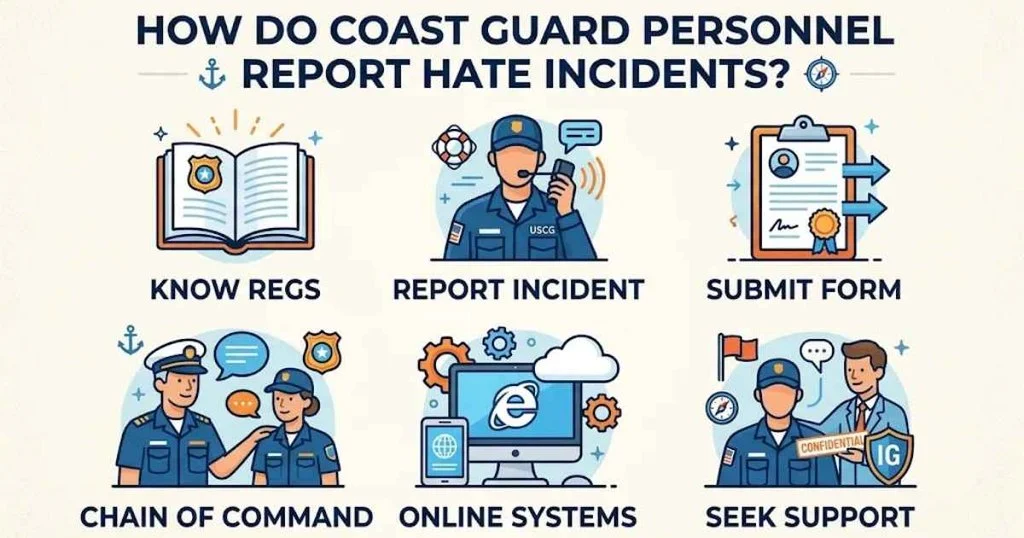
The Coast Guard has procedures for receiving and processing reports of actual or potential hate incidents.
The Civil Rights Manual’s Chapters 3F and 3G address command responsibilities and the processing of those reports. The December 2025 policy statement reaffirmed that these chapters remained effective.
A person who encounters a suspected hate incident should use the appropriate Coast Guard reporting channels. The exact route can depend on the person’s role, the nature of the conduct, and the relevant command procedures.
A useful report should describe the incident clearly and provide details such as:
- What happened
- When and where it happened
- What symbol, message, or conduct was involved
- Whether anyone was directly targeted
- Whether witnesses were present
- Whether the conduct appears connected to a wider pattern
- Whether supporting photographs, messages, or other evidence are available
Personnel should preserve relevant evidence when it is safe and appropriate to do so. They should avoid altering or distributing potentially sensitive material unnecessarily.
The 45-Day Harassment Reporting Rule
One of the most debated parts of the November 2025 harassment instruction was its reporting deadline.
Under COMDTINST 5350.6A, reports of harassing behavior generally had to be submitted within 45 calendar days of the incident. For a series of incidents, the period generally ran from the most recent incident.
The instruction included an important qualification: reports could be accepted after 45 days at the discretion of the appropriate authority.
The rule did not apply in the same way to allegations of sexual harassment, which were excluded from that general deadline provision.
Admiral Lunday addressed the issue in written responses submitted during his Senate nomination process. He said the deadline was intended to align with federal equal-employment complaint timeframes and facilitate timely investigations. He also stated that deployment or other reasonable circumstances could support accepting a late report.
Most importantly, the 45-day harassment reporting rule did not remove commanders’ responsibility to maintain good order and discipline or respond to hate incidents under other applicable policies.
Why Did the Coast Guard Hate Symbols Policy Become Controversial?
The controversy developed because the revised harassment instruction used language that critics believed could weaken the treatment of well-known hate symbols.
The concern focused on two related issues:
- The use of the phrase potentially divisive when discussing symbols such as swastikas and nooses.
- Changes to the process for reporting and handling harassment complaints, including the general 45-day reporting period.
Critics argued that a swastika or noose should be identified clearly as a hate symbol rather than placed under wording that might sound uncertain.
They also questioned whether the revised reporting process could make it harder for personnel to report incidents, particularly if they were deployed or unable to report promptly.
The November 20 lawful order was issued after the wording attracted public criticism. It explicitly prohibited hate symbols and flags and reaffirmed the Coast Guard’s position on swastikas, nooses, and other symbols adopted by hate-based groups.
Public and Congressional Reaction
The controversy attracted attention from lawmakers and civil rights advocates.
Senator Jacky Rosen was among the lawmakers who raised concerns about the revised language. Her questions focused on the treatment of Nazi symbols and nooses, the reporting deadline, and whether the policy would protect personnel from hate-related conduct.
The issue also appeared in the Senate’s consideration of Admiral Kevin Lunday’s nomination to become Coast Guard Commandant.
In written responses to senators, Lunday said there had been no intention to change the prohibition on swastikas, nooses, or other widely recognized hate symbols. He also said the November 20 order clarified the service’s position and that existing Civil Rights Manual provisions remained in effect.
The Senate hearing record and Lunday’s written responses provide useful primary-source context for understanding the questions raised by lawmakers and the Coast Guard’s answers.
The public debate was not simply about whether a particular symbol should be permitted. It also concerned how clearly the military communicates its rules, how it handles reports, and how it protects personnel from discrimination and intimidation.
Who Is Admiral Kevin Lunday?
<bold>Admiral Kevin E. Lunday</bold> was the Coast Guard leader who signed the November 20, 2025, lawful order prohibiting divisive or hate symbols and flags.
He also signed the December 12, 2025, policy statement reaffirming the restrictions.
His written responses during the Senate nomination process are important because they explain the Coast Guard leadership’s position on the controversy.
Lunday said the service did not intend to weaken the prohibition on recognized hate symbols. He also stated that the Civil Rights Manual’s provisions on hate incidents remained effective.
His November 20 order made the prohibition explicit in a separate lawful order. This gave commanders and personnel a clear statement of the service’s expectations.
What Role Did Admiral Linda Fagan Play?
<bold>Admiral Linda Fagan</bold> was the former Commandant of the Coast Guard before the 2025 leadership transition.
Her name may appear in broader discussions of Coast Guard leadership, diversity policies, and the service’s earlier approach to workplace conduct. However, the November 20 and December 12, 2025, orders discussed in this article were signed by Admiral Kevin Lunday.
It is important not to attribute those specific 2025 orders to Fagan. The relevant policy documents identify Lunday as the signing authority.
How Does the Department of Homeland Security Relate to Coast Guard Policy?
The U.S. Coast Guard is an armed service and a federal maritime law enforcement organization. In peacetime, it operates under the Department of Homeland Security (DHS).
That relationship is different from the structure of the military services that normally operate under the Department of Defense.
The Coast Guard carries out several national missions, including:
- Maritime safety
- Search and rescue
- Port and waterway security
- Maritime law enforcement
- Drug interdiction
- Protection of the marine transportation system
- National defense operations
The service’s position within DHS does not mean that every Coast Guard policy is a Pentagon directive. Its command structure and legal authorities are distinct.
The Coast Guard can operate as part of the Navy in certain circumstances under federal law, but that does not make the Department of Defense the routine peacetime authority for every Coast Guard workplace policy.
Did the Pentagon Direct the Coast Guard Policy Change?
The Coast Guard’s November 20 press release said the new lawful order aligned with military policy and clarified the service’s prohibition on hate symbols.
During the Senate nomination process, Lunday was also asked about outside involvement in the policy. In written responses, he said the Department of Homeland Security had not directed the November 20 memorandum.
It is therefore important to distinguish general references to military policy alignment from a claim that the Pentagon ordered the Coast Guard to issue the memorandum.
The available official statements support the former. They do not establish that the Pentagon directly ordered the November 20 Coast Guard policy.
Why Do Hate Symbol Restrictions Matter for Military Readiness?
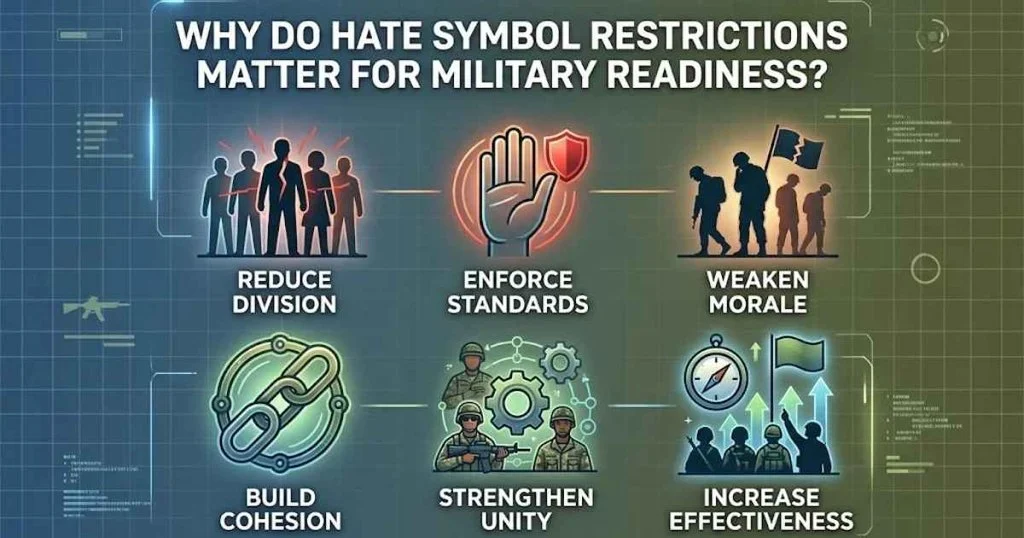
Military service depends on trust, discipline, and cooperation. Coast Guard personnel often work in demanding conditions where they must rely on colleagues during emergencies, law enforcement operations, and maritime missions.
A workplace that tolerates racial intimidation or religious hatred can damage that trust.
The Coast Guard’s policy connects prohibited symbols with several organizational concerns.
Unit Cohesion
Unit cohesion means personnel can work together effectively and trust one another. Hate-related displays can undermine that relationship by making some members feel targeted or unwelcome.
Morale and Personnel Safety
Personnel should be able to perform their duties without facing intimidation based on race, religion, or another protected characteristic.
A visible hate symbol can create fear or distress, especially when it refers to a history of violence against a particular community.
Good Order and Discipline
Military organizations rely on clear conduct standards. When personnel ignore lawful orders or use symbols to intimidate others, commanders must respond.
The policy therefore treats hate-related displays as more than a matter of personal taste. It connects them to the standards needed to maintain an effective military workplace.
Mission Effectiveness
Coast Guard missions can require people to make quick decisions and work under pressure. Discrimination, bullying, and intimidation can damage communication and cooperation.
A respectful working environment supports personnel safety, operational effectiveness, and mission accomplishment.
How Does the Coast Guard Policy Compare With Other Military Rules?
The Coast Guard is part of the United States Armed Forces, but it has its own command structure and service-specific instructions.
Other military services also maintain rules governing extremist activity, discrimination, harassment, and professional conduct. The exact wording and procedures can differ.
The Coast Guard’s December 2025 order is notable because it explicitly names nooses and swastikas, identifies symbols adopted by hate-based groups, and connects violations to the UCMJ.
It also addresses the Confederate battle flag in specific locations and includes limited historical and educational exceptions.
However, it would be inaccurate to assume that every service uses identical definitions, reporting deadlines, or disciplinary procedures. Each service’s official instructions should be checked before making a direct comparison.
The broader principle is that military personnel must follow lawful conduct standards, and commanders have responsibilities to address behavior that threatens discipline, safety, or unit cohesion.
Frequently Asked Questions About the Coast Guard Hate Symbols Policy
What is the new Coast Guard hate symbols policy?
The policy prohibits divisive or hate symbols and flags in Coast Guard workplaces, facilities, and assets. It specifically identifies nooses, swastikas, and symbols or flags adopted by hate-based groups to represent supremacy, racial or religious intolerance, antisemitism, or other improper bias.
Did the Coast Guard ban swastikas and nooses?
Yes. The November 20, 2025, lawful order explicitly prohibited divisive or hate symbols, including swastikas and nooses. The December 12 policy statement reaffirmed that prohibition.
Why did the Coast Guard describe hate symbols as potentially divisive?
The November 2025 harassment instruction used the term potentially divisive symbols to describe displays that could harm unit cohesion, morale, command climate, good order and discipline, or mission effectiveness.
The wording drew criticism because it included widely recognized hate symbols such as swastikas and nooses. The separate November 20 lawful order explicitly stated that these symbols were prohibited.
Are Confederate flags prohibited in the Coast Guard?
The Confederate battle flag is prohibited in Coast Guard workplaces, facilities, and assets. The order covers visible displays in barracks, the exterior of Coast Guard housing, clothing, vehicle decorations, and certain displays inside vehicles.
Limited exceptions apply to state flags, state-issued license plates, and incidental or minor appearances in legitimate artwork or educational and historical displays.
When did the Coast Guard policy change take effect?
Several dates matter. Admiral Lunday issued the separate lawful order on November 20, 2025. He signed the further policy statement on December 12, 2025. The revised harassment instruction, COMDTINST 5350.6A, became effective on December 15, 2025.
What changed in the Coast Guard harassment policy?
The revised instruction changed how harassment reports were processed and introduced a general 45-calendar-day reporting period for most harassment reports, with discretion to accept late reports. It also specified that conduct must be based on a protected characteristic to qualify as harassment under that instruction.
The separate Civil Rights Manual provisions on hate incidents remained effective.
Can Coast Guard commanders remove offensive symbols?
Yes. Commanders, commanding officers, officers-in-charge, and supervisors must direct the removal of prohibited divisive or hate symbols and flags.
For other potentially divisive displays, they must make the appropriate inquiry and consult their servicing legal office.
Can Coast Guard personnel display hate symbols in private housing?
The harassment instruction excludes private spaces outside public view, such as family housing, from its definition of public display. However, the Confederate battle flag order specifically covers the exterior of Coast Guard housing and other displays visible to the public.
The exact location and visibility of a display therefore matter.
What happens if someone violates the Coast Guard hate symbols policy?
The order operates as a punitive general order for personnel subject to the UCMJ. A violation can be punishable under Article 92(1), which addresses failure to obey a lawful general order or regulation. Other administrative or disciplinary procedures may also apply, depending on the circumstances.
What is the difference between a hate incident and harassment?
A hate incident is addressed through the Coast Guard Civil Rights Manual’s procedures for actual or potential hate incidents. Harassment is a separate category under the harassment instruction and must meet its definition, including the requirement that conduct be based on a protected characteristic.
The two categories can overlap, but they are not identical.
Who issued the November 2025 Coast Guard hate symbol order?
Admiral Kevin E. Lunday signed the November 20, 2025, lawful order. He also signed the December 12, 2025, policy statement reaffirming the restrictions.
Does the Pentagon control the Coast Guard hate symbols policy?
The Coast Guard operates under the Department of Homeland Security in peacetime. It is a military service, but it has a distinct organizational structure. The Coast Guard described its policy as aligned with military policy, while Lunday stated in Senate responses that DHS did not direct the November 20 memorandum.
Are historical displays of hate symbols always prohibited?
No. The policy includes limited exceptions for legitimate historical or educational displays. The Confederate battle flag may appear as an incidental or minor component of artwork or educational and historical displays. The context and purpose of the display matter.
Conclusion
The Coast Guard hate symbols policy became controversial in 2025 because revised harassment language raised questions about how the service classified well-known hate symbols and handled reports of discriminatory conduct.
The November 20 lawful order and December 12 policy statement made the service’s position explicit. They prohibited divisive or hate symbols, including swastikas, nooses, and symbols adopted by hate-based groups. They also reaffirmed restrictions on the Confederate battle flag and connected violations to military discipline.
At the same time, the revised harassment instruction introduced separate reporting and processing procedures. Its general 45-day reporting period, protected-characteristic requirement, and distinction between harassment and hate incidents should not be confused with the separate lawful order.
The most important point is that the Coast Guard’s rules address both the display of hate symbols and the conduct that can harm personnel. They aim to protect unit cohesion, maintain discipline, support personnel safety, and preserve the trust needed to accomplish demanding maritime missions.

Hi, I’m Asher Monroe, a writer who believes that meaningful words have the power to inspire change and bring people closer to their dreams. I have always been fascinated by the beauty of quotes and the way a simple message can provide motivation, hope, and comfort.
I enjoy creating content around inspirational quotes, life lessons, success stories, and positive thoughts that help readers find encouragement in their everyday lives. My goal is to share words that connect with people and remind them of their inner strength.
Through my writing, I explore the ideas of personal growth, confidence, and the importance of staying inspired through every chapter of life.
I am the author of Words That Move the Soul and The Path of Endless Inspiration, two books focused on the power of wisdom, positivity, and meaningful thoughts.
 Rowan Sinclair Rowan Sinclair