
Planet symbols have fascinated astronomers, astrologers, and mythology enthusiasts for centuries. These small but recognizable signs represent celestial bodies, ancient gods, natural forces, and traditional beliefs. From the familiar Sun symbol (☉) to the mysterious Pluto symbol (♇), every planetary glyph has a unique history and meaning.
You can find planetary symbols in astrology charts, astronomy books, historical manuscripts, alchemical texts, and digital documents. Some represent the physical characteristics of celestial bodies, while others connect with ancient mythology and traditional interpretations.
Understanding these symbols helps you recognize the planets and explore their cultural significance. You’ll also discover how planetary glyphs developed, why Venus has a female symbol, why Mars has a male symbol, and how different planets became associated with metals and weekdays.
This guide covers the planet symbols and meanings, including the Sun, Moon, eight planets, dwarf planets, and notable asteroids. You’ll also find Unicode codes, historical background, astrological interpretations, and easy-to-copy planetary characters.
What Are Planet Symbols?
Planet symbols, also called planetary glyphs, are graphic signs used to represent planets and other celestial bodies. They provide a simple visual way to identify objects in astronomy, astrology, and historical scientific traditions.
Most familiar planetary symbols combine basic shapes such as circles, crosses, crescents, and arrows. For example, the Venus symbol (♀) features a circle above a small cross. The Mars symbol (♂) combines a circle with an upward-pointing arrow.
These symbols have roots in ancient astronomical observations, Greek and Roman mythology, medieval manuscripts, and alchemical traditions. Over time, their designs became recognizable across different cultures and written traditions.
Today, planetary symbols appear in several places:
- Astrology: Astrologers use planetary glyphs in natal charts, horoscopes, and planetary transit diagrams.
- Astronomy: Historical astronomical texts use symbols to identify celestial bodies.
- Alchemy: Traditional alchemical systems associate seven classical celestial bodies with seven metals.
- Mythology: Several planetary names and symbols connect with ancient Greek and Roman deities.
- Digital communication: Unicode makes many planetary characters available for websites, documents, and messages.
One important distinction matters here. Astronomy studies celestial objects through scientific observation, while astrology interprets their positions symbolically. Both traditions use planetary symbols, but they don’t assign them the same purpose.
All Planet Symbols and Their Meanings at a Glance
The following table shows the commonly used symbols of the planets, along with the Sun and Moon. These celestial bodies appear together in many traditional astrological systems.
| Celestial body | Symbol | Common association |
| Sun | ☉ | Vitality, identity, and life |
| Moon | ☾ | Emotions, intuition, and cycles |
| Mercury | ☿ | Communication and intelligence |
| Venus | ♀ | Love, beauty, and relationships |
| Earth | ♁ | Life and the physical world |
| Mars | ♂ | Action, courage, and energy |
| Jupiter | ♃ | Growth, wisdom, and expansion |
| Saturn | ♄ | Discipline, structure, and responsibility |
| Uranus | ♅ / ⛢ | Innovation and independence |
| Neptune | ♆ | Dreams, imagination, and intuition |
| Pluto | ♇ / ⯓ | Transformation and power |
Note: The Sun is a star, the Moon is Earth’s natural satellite, and Pluto is a dwarf planet. They aren’t all planets under modern astronomical classification. However, astrology commonly groups the Sun and Moon with planetary bodies.
The familiar planetary glyphs also have historical associations with metals. For example, the Sun connects with gold, Venus with copper, and Saturn with lead.
Individual Planet Symbols and Their Meanings

Each planetary glyph has a distinctive appearance and cultural background. Some designs resemble mythological objects, while others developed through historical astronomical and alchemical traditions.
Let’s explore the individual symbols and what they represent.
Sun Symbol (☉): Meaning and Symbolism
The Sun symbol (☉) consists of a circle with a small dot in its center. It is one of the oldest and most recognizable celestial symbols.
The circle represents wholeness in several symbolic traditions, while the central dot can suggest a focal point or source. Together, they create a simple representation of the Sun.
In ancient Roman mythology, the Sun was associated with Sol. Greek traditions connected it with Helios and Apollo.
The Sun also holds a special place in traditional alchemy. Its symbol represents gold, known by the Latin name aurum. Alchemists used planetary associations to connect celestial bodies with earthly materials.
Sun symbol meanings include:
- Life and vitality.
- Light and illumination.
- Identity and individuality.
- Energy and personal expression.
- Leadership and authority.
- Gold and traditional alchemy.
In astrology, the Sun represents your core identity, sense of purpose, and conscious self-expression. Its position in a natal chart determines your commonly known Sun sign.
Astronomically, the Sun is the star at the center of our solar system. Its gravity holds the planets and other orbiting objects within the solar system.
Mercury Symbol (☿): Meaning and Symbolism
The Mercury symbol (☿) combines a circle, a cross, and a crescent-like shape. Its design resembles a figure with a curved upper element.
The symbol connects with Mercury, the Roman messenger god. His Greek counterpart is Hermes, a deity associated with communication, travel, trade, and messages.
Mercury traditionally carries a winged staff called the caduceus. Mythological depictions also show him wearing a winged helmet and sandals.
In alchemy, Mercury represents quicksilver, the historical name for the liquid metal. The association between Mercury and quicksilver became an important part of traditional planetary symbolism.
Mercury symbol meanings include:
- Communication and conversation.
- Intelligence and reasoning.
- Learning and information.
- Travel and movement.
- Trade and negotiation.
- Adaptability and curiosity.
In astrology, Mercury governs communication, thinking, writing, and learning. Astrologers examine its position to interpret how someone processes information and expresses ideas.
The astronomical planet Mercury is the smallest planet in our solar system and the closest to the Sun. Its name reflects the ancient association with the swift messenger god.
Venus Symbol (♀): Meaning and Symbolism
The Venus symbol (♀) consists of a circle positioned above a small cross. It is widely recognized as the traditional female symbol.
Its historical association comes from Venus, the Roman goddess of love and beauty. Her Greek counterpart is Aphrodite.
The symbol is often interpreted as a hand mirror associated with the goddess. However, this explanation is a traditional interpretation rather than a proven account of the glyph’s original design.
Venus also has a connection with copper in traditional alchemy. Its planetary symbol represents this metal in historical alchemical systems.
Venus symbol meanings include:
- Love and affection.
- Beauty and attraction.
- Relationships and partnership.
- Fertility and femininity.
- Harmony and pleasure.
- Copper and alchemical symbolism.
In astrology, Venus represents love, relationships, beauty, attraction, and personal values. Its placement in a birth chart is traditionally used to interpret romantic preferences and aesthetic interests.
The astronomical planet Venus is the second planet from the Sun. It is the hottest planet in the solar system because of its dense atmosphere and powerful greenhouse effect.
Earth Symbol (♁): Meaning and Symbolism
The Earth symbol (♁) represents our home planet. Its design features a circle with a cross-like arrangement of lines.
The symbol has several traditional interpretations. The intersecting lines can represent the four cardinal directions or the four regions of the world.
Earth is sometimes associated with balance, nature, stability, and physical existence.
Earth symbol meanings include:
- Life and nature.
- The physical world.
- Stability and grounding.
- Four cardinal directions.
- The natural environment.
- Human existence.
Unlike the symbols of Mercury, Venus, and Mars, Earth’s glyph doesn’t have one universally accepted mythological origin.
In astrology, Earth is often treated as a symbolic reference point rather than one of the ten traditional planetary bodies. Some modern astrological systems also use an Earth glyph in charts.
Astronomically, Earth is the third planet from the Sun. It is currently the only known world that supports life.
Moon Symbol (☾ / ☽): Meaning and Symbolism
The Moon symbol (☾ or ☽) represents Earth’s natural satellite. Its crescent shape reflects the changing appearance of the Moon during its monthly cycle.
The Moon has strong connections with ancient mythology. Roman mythology associates it with Luna, while Greek traditions connect it with Selene and Artemis.
Different lunar phases have their own appearances. A waxing crescent grows brighter each night, while a waning crescent becomes thinner as the lunar cycle approaches a new moon.
Moon symbol meanings include:
- Emotions and intuition.
- Femininity and nurturing.
- Cycles and change.
- Mystery and reflection.
- Dreams and the subconscious.
- Silver and traditional alchemy.
In astrology, the Moon represents emotions, instincts, habits, and inner needs. Its position in a natal chart determines your Moon sign.
The Moon is also associated with silver in traditional alchemy. This connection appears in historical planetary-metal systems.
Mars Symbol (♂): Meaning and Symbolism
The Mars symbol (♂) consists of a circle with an arrow pointing diagonally upward and to the right. It is also widely recognized as the traditional male symbol.
The glyph connects with Mars, the Roman god of war. His Greek counterpart is Ares.
The arrow and circle are traditionally interpreted as a shield and spear. This interpretation reflects Mars’s association with warfare, courage, and military strength.
Mars also connects with iron in alchemical traditions. Iron was especially useful for producing weapons and tools throughout ancient history.
Mars symbol meanings include:
- Courage and bravery.
- Action and determination.
- Strength and physical energy.
- Conflict and competition.
- Masculinity.
- Iron and warfare.
In astrology, Mars represents motivation, ambition, aggression, desire, and action. Astrologers use its position to interpret how someone approaches challenges and pursues goals.
Astronomically, Mars is the fourth planet from the Sun. Its reddish appearance comes mainly from iron minerals that have oxidized across its surface.
Jupiter Symbol (♃): Meaning and Symbolism
The Jupiter symbol (♃) has a distinctive curved shape that developed through historical astronomical and astrological notation.
Jupiter connects with the Roman king of the gods. Its Greek equivalent is Zeus, the ruler of Mount Olympus.
Ancient mythology associates Jupiter with thunder, lightning, authority, and the eagle. These associations helped establish its reputation as a powerful celestial body.
In traditional alchemy, Jupiter represents tin.
Jupiter symbol meanings include:
- Wisdom and knowledge.
- Growth and expansion.
- Prosperity and opportunity.
- Leadership and authority.
- Good fortune.
- Tin and traditional alchemy.
In astrology, Jupiter is associated with optimism, abundance, generosity, education, and personal growth. It is traditionally considered a planet of expansion.
Astronomically, Jupiter is the largest planet in our solar system. It is a gas giant with a powerful magnetic field and dozens of known moons.
Saturn Symbol (♄): Meaning and Symbolism
The Saturn symbol (♄) features a curved shape that resembles a sickle or scythe. These objects connect with Saturn’s traditional agricultural symbolism.
Saturn was an ancient Roman agricultural deity. His Greek counterpart was Cronus, often spelled Kronos.
Mythological stories connect Cronus with the passage of time and the overthrow of his father, Uranus. Over centuries, these stories contributed to Saturn’s symbolic association with age, limitations, and time.
In alchemy, Saturn represents lead.
Saturn symbol meanings include:
- Discipline and responsibility.
- Patience and endurance.
- Time and aging.
- Structure and boundaries.
- Agriculture and harvest.
- Lead and traditional alchemy.
In astrology, Saturn represents structure, responsibility, restrictions, and long-term lessons. Astrologers often interpret its placement as an indication of areas requiring patience and consistent effort.
Astronomically, Saturn is famous for its extensive ring system. It is the sixth planet from the Sun and the second-largest planet in our solar system.
Uranus Symbol (♅ / ⛢): Meaning and Symbolism
Uranus is unusual because it has two commonly used astronomical and astrological symbols.
The first is ♅, which combines elements of earlier planetary symbolism. The second is ⛢, a design associated with Uranus’s astronomical representation.
The discovery of Uranus changed humanity’s understanding of the solar system. William Herschel discovered the planet in 1781 using a telescope.
Uranus takes its name from Ouranos, the Greek personification of the sky. Unlike many other planetary names, Uranus comes directly from Greek mythology rather than a Roman deity.
Uranus symbol meanings include:
- Innovation and originality.
- Independence and freedom.
- Sudden change.
- Technology and discovery.
- Rebellion and unconventional thinking.
- The sky and celestial space.
In astrology, Uranus represents innovation, independence, disruption, and unexpected developments. Astrologers associate it with originality and breaking away from established patterns.
The astronomical planet Uranus is the seventh planet from the Sun. It has an unusual sideways rotation, making its seasons especially extreme.
Neptune Symbol (♆): Meaning and Symbolism
The Neptune symbol (♆) resembles a trident with three upward-pointing tips. It connects directly with Neptune, the Roman god of the sea.
His Greek counterpart is Poseidon, who traditionally carries a three-pronged spear. Mythological stories often associate the trident with control over oceans, storms, and sea creatures.
Neptune was discovered in 1846 after astronomers investigated irregularities in Uranus’s orbit. Its discovery marked an important achievement in mathematical astronomy.
Neptune symbol meanings include:
- Dreams and imagination.
- Intuition and spirituality.
- Mystery and illusion.
- Creativity and inspiration.
- The ocean and water.
- Emotional sensitivity.
In astrology, Neptune represents imagination, idealism, dreams, spirituality, and blurred boundaries. Astrologers often connect it with artistic expression and unrealistic expectations.
Astronomically, Neptune is the eighth and most distant recognized planet from the Sun. It is an ice giant with a deep blue appearance and extremely powerful winds.
Pluto Symbol (♇ / ⯓): Meaning and Symbolism
The Pluto symbol (♇) is commonly associated with the initials P and L. These letters are traditionally connected with Pluto and astronomer Percival Lowell.
Another Pluto character is ⯓, an alternative planetary glyph included in Unicode.
Pluto takes its name from the Roman god of the underworld. His Greek counterpart is Hades, the ruler of the realm of the dead.
Astronomers discovered Pluto in 1930 at Lowell Observatory. Clyde Tombaugh made the discovery while searching photographic plates for a moving object beyond Neptune.
Pluto symbol meanings include:
- Transformation and renewal.
- Hidden matters and secrets.
- Power and control.
- Death and rebirth.
- Destruction and regeneration.
- The underworld and mystery.
In astrology, Pluto represents deep transformation, psychological intensity, power, and major life changes. These interpretations belong to astrological tradition rather than established scientific findings.
In 2006, the International Astronomical Union reclassified Pluto as a dwarf planet. It remains one of the most recognizable objects in the Kuiper Belt.
Dwarf Planet Symbols and Their Meanings

Dwarf planets resemble regular planets in several ways. They orbit the Sun and have enough gravity to become nearly round. However, they haven’t cleared their orbital neighborhoods of other objects.
The International Astronomical Union officially recognizes five dwarf planets in our solar system:
- Ceres
- Pluto
- Haumea
- Makemake
- Eris
These objects have different physical characteristics, mythological names, and historical discoveries. Their symbols are less standardized than the traditional glyphs of the major planets.
Ceres Symbol (⚳)
Ceres is the largest object in the asteroid belt between Mars and Jupiter. It was discovered by Giuseppe Piazzi on January 1, 1801.
The Ceres symbol (⚳) traditionally resembles a sickle. It connects with Ceres, the Roman goddess of agriculture, crops, and fertility.
Her Greek counterpart is Demeter.
In astrology, Ceres represents nurturing, caregiving, nourishment, and relationships with family. Astrologers also connect it with growth and the natural cycles of life.
Pluto Symbol (♇)
Pluto is one of the best-known dwarf planets. Its familiar glyph (♇) incorporates the letters P and L.
Pluto was once considered the ninth planet in our solar system. Its classification changed in 2006 after astronomers adopted a formal definition of a planet.
In mythology, Pluto rules the underworld. His name and traditional associations connect with death, hidden wealth, and the mysteries of existence.
Haumea Symbol and Meaning
Haumea is a dwarf planet located in the Kuiper Belt beyond Neptune.
Its name comes from Haumea, a Hawaiian goddess associated with fertility and childbirth. The name reflects the dwarf planet’s connection with Hawaiian mythology.
Haumea has an unusually elongated shape because of its rapid rotation. It also has two known moons and a ring system.
Unlike the traditional symbols for Venus and Mars, Haumea doesn’t have one universally established planetary glyph used across all astronomical publications.
Makemake Symbol and Meaning
Makemake is another dwarf planet in the Kuiper Belt. Astronomers discovered it in 2005.
Its name comes from Makemake, a creator deity in the mythology of the Rapa Nui people of Easter Island.
Makemake has one known moon, officially designated S/2015 (136472) 1 and nicknamed MK 2.
Its mythology connects with creation and fertility. However, its astronomical classification is based on its physical properties and orbit rather than its mythological background.
Eris Symbol and Meaning
Eris is a distant dwarf planet named after the Greek goddess of discord and strife.
Astronomers discovered it in 2005. Its discovery played an important role in the debate surrounding Pluto’s classification.
Eris has one known moon called Dysnomia. The moon’s name comes from the Greek personification of lawlessness.
In astrology, Eris is sometimes associated with conflict, competition, independence, and challenging established systems.
However, Eris’s astrological meanings aren’t part of the scientific definition of the dwarf planet.
What About Sedna?
Sedna is another important distant object in the outer solar system. It was discovered in 2003 and named after a sea goddess in Inuit mythology.
Although some discussions include Sedna among possible dwarf planets, it isn’t one of the five officially recognized dwarf planets.
Sedna is a trans-Neptunian object with an extremely elongated orbit. Its distant journey around the Sun makes it an important subject in research on the outer solar system.
Asteroid Symbols and Their Meanings
Asteroids are small rocky or metallic bodies that orbit the Sun. Most known asteroids occupy the main asteroid belt between Mars and Jupiter.
Some asteroids also have historical symbols used in astronomy and astrology. These characters often connect with the mythological figures after whom the asteroids were named.
The four major asteroids traditionally studied in astrology are Ceres, Pallas, Juno, and Vesta.
| Asteroid | Symbol | Traditional association |
| Ceres | ⚳ | Nurturing and agriculture |
| Pallas | ⚴ | Wisdom and strategy |
| Juno | ⚵ | Marriage and commitment |
| Vesta | ⚶ | Devotion and sacred fire |
The Four Major Asteroids
Ceres: Ceres represents agriculture, nourishment, motherhood, and caregiving. Its name comes from the Roman goddess of agriculture.
Pallas: Pallas, also known as Pallas Athena in astrological discussions, represents wisdom, intelligence, strategy, and creative problem-solving.
Juno: Juno represents marriage, partnership, commitment, and relationship expectations. Her Greek counterpart is Hera.
Vesta: Vesta represents devotion, dedication, and sacred responsibilities. Her Greek counterpart is Hestia, the goddess of the hearth.
Other Notable Asteroids and Their Meanings
Several other asteroids have names connected with Greek and Roman mythology. Astrologers sometimes use these objects to explore additional symbolic themes.
| Asteroid | Mythological or symbolic association |
| Astraea | Justice and innocence |
| Hebe | Youth and renewal |
| Iris | Messages and communication |
| Flora | Flowers and growth |
| Metis | Wisdom and cleverness |
| Hygiea | Health and cleanliness |
| Parthenope | Greek mythology and the sirens |
| Victoria | Victory and achievement |
| Egeria | Wisdom and inspiration |
| Irene | Peace and harmony |
| Eunomia | Order and good governance |
| Psyche | The soul and inner life |
| Thetis | Protection and motherhood |
| Melpomene | Tragedy and dramatic arts |
| Fortuna | Luck and fortune |
| Proserpina | Seasonal change and the underworld |
| Bellona | War and courage |
| Amphitrite | The sea |
| Leukothea | Protection and rescue |
| Fides | Trust and loyalty |
These mythological associations provide cultural context. They aren’t scientific descriptions of asteroid properties.
Planet Symbols in Astrology
Planet symbols play an important role in astrology. They help astrologers identify celestial bodies in birth charts, horoscopes, and planetary transit diagrams.
An astrological birth chart shows the positions of the Sun, Moon, planets, and zodiac signs at a particular time and location.
Each planet represents a different symbolic area of life. Astrologers interpret these placements alongside zodiac signs, houses, and planetary aspects.
What Each Planet Represents in Astrology
| Planet | Astrological meaning |
| Sun | Identity, purpose, and vitality |
| Moon | Emotions and instincts |
| Mercury | Communication and thinking |
| Venus | Love and relationships |
| Mars | Action and ambition |
| Jupiter | Growth and opportunity |
| Saturn | Discipline and responsibility |
| Uranus | Innovation and independence |
| Neptune | Dreams and imagination |
| Pluto | Transformation and power |
Personal Planets
Personal planets are associated with individual behavior and everyday experiences.
They include:
- Sun
- Moon
- Mercury
- Venus
- Mars
Astrologers interpret these bodies to understand identity, emotional responses, communication, relationships, and motivation.
Social Planets
Jupiter and Saturn are traditionally called social planets.
Jupiter represents expansion, education, opportunity, and growth. Saturn represents discipline, boundaries, structure, and responsibility.
Together, astrologers use them to interpret how individuals relate to society and long-term responsibilities.
Outer Planets
Uranus, Neptune, and Pluto are commonly called outer or generational planets.
They move more slowly through the zodiac than personal planets. As a result, astrologers often associate them with broader generational themes.
- Uranus represents change and innovation.
- Neptune represents dreams and imagination.
- Pluto represents transformation and power.
Planet Symbols in a Birth Chart
A natal chart uses planetary glyphs to show where celestial bodies appeared at the time of someone’s birth.
For example:
- The Sun glyph identifies the Sun’s zodiac placement.
- The Moon glyph identifies the Moon’s position.
- Mercury shows its zodiac sign and degree.
- Venus indicates its placement in the zodiac.
- Mars identifies its position and relationship with other chart elements.
Astrologers also examine planetary aspects, which describe angular relationships between celestial bodies.
Common aspects include conjunctions, oppositions, squares, trines, and sextiles.
These interpretations belong to astrology. Scientific astronomy does not establish that planetary positions determine personality or predict individual events.
Planet Symbols in Astronomy
Astronomers use symbols, abbreviations, and standardized designations to identify celestial objects. Historical astronomical texts frequently used planetary glyphs because they provided a convenient shorthand.
Modern scientific publications usually prefer full names, abbreviations, and catalog numbers. This approach reduces confusion when researchers discuss planets, moons, asteroids, and distant objects.
For example, astronomers commonly write Mercury, Venus, and Earth instead of relying entirely on their traditional glyphs.
The International Astronomical Union (IAU) helps establish naming conventions and classifications for celestial objects.
Astrology Symbols vs. Astronomy Symbols
| Feature | Astrology | Astronomy |
| Main purpose | Symbolic interpretation | Scientific study |
| Planet glyphs | Commonly used | Mainly historical or specialized |
| Birth charts | Central to practice | Not a scientific research tool |
| Planetary positions | Interpreted symbolically | Measured scientifically |
| Mythological meanings | Often important | Historical background |
| Planetary influence | Traditional astrological belief | Physical gravitational and other measurable effects |
Astronomy studies measurable properties such as mass, distance, temperature, orbital periods, and atmospheric composition.
Astrology interprets planetary positions through traditional symbolic systems.
Understanding this distinction helps you use planetary terminology accurately.
Planet Symbols and Their Unicode Codes
Unicode gives computers a standard way to represent written characters and symbols. Many familiar planetary glyphs have their own Unicode code points.
You can use these characters in websites, documents, messages, and other digital content.
Here are the most useful planet symbols Unicode characters.
| Planet or body | Symbol | Unicode code |
| Sun | ☉ | U+2609 |
| Mercury | ☿ | U+263F |
| Venus | ♀ | U+2640 |
| Earth | ♁ | U+2641 |
| Moon | ☽ | U+263D |
| Moon | ☾ | U+263E |
| Mars | ♂ | U+2642 |
| Jupiter | ♃ | U+2643 |
| Saturn | ♄ | U+2644 |
| Uranus | ♅ | U+2645 |
| Uranus | ⛢ | U+26E2 |
| Neptune | ♆ | U+2646 |
| Pluto | ♇ | U+2647 |
| Pluto | ⯓ | U+2BD3 |
These code points identify the characters in the Unicode Standard. Their visual appearance can vary depending on the font, operating system, and application.
How to Copy and Paste Planet Symbols
Copying planetary symbols is simple. You don’t need special software to use most Unicode characters.
Follow these steps:
- Find the planetary symbol you want.
- Highlight the character with your mouse.
- Press Ctrl + C on Windows or Command + C on Mac.
- Open the document, message, or website where you want to use it.
- Press Ctrl + V or Command + V to paste it.
You can also use Unicode input methods in applications that support them.
If a symbol appears as an empty square, your device or selected font may not support that character.
What Do the Shapes in Planet Symbols Represent?
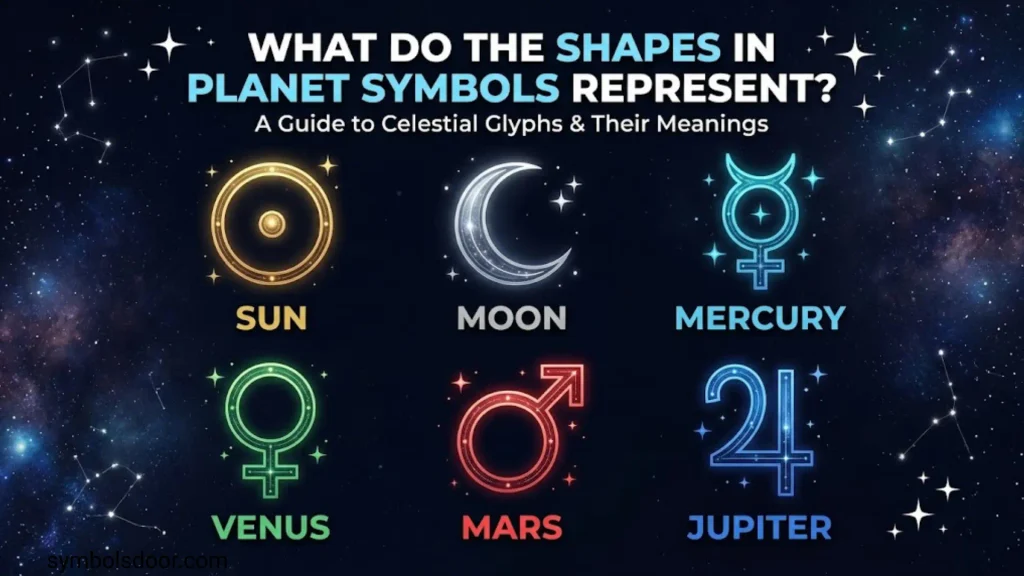
Many planetary glyphs contain basic geometric shapes. Circles, dots, crosses, crescents, and arrows appear throughout traditional planetary notation.
These elements have different interpretations in historical, alchemical, and esoteric traditions.
However, not every planetary symbol has a single confirmed explanation. Some interpretations developed long after the original glyphs appeared.
Circle Symbol Meaning
The circle appears in several planetary glyphs, including the Sun, Venus, and Mars.
In traditional symbolic systems, it can represent wholeness, unity, eternity, and completeness.
The Sun symbol (☉) provides the clearest example because it combines a circle with a central dot.
Dot Symbol Meaning
The central dot in the Sun symbol creates a focal point within the circle.
Some symbolic interpretations connect it with the center, individual identity, or a source of energy.
These meanings are traditional interpretations rather than proven explanations of the symbol’s original design.
Crescent Symbol Meaning
The crescent appears in the Moon symbol and the upper part of Mercury’s glyph.
It commonly represents lunar cycles, receptivity, change, and intuition in symbolic traditions.
Its shape also reflects the visible appearance of the Moon during certain phases.
Cross Symbol Meaning
The cross appears in Venus’s symbol and several historical planetary glyphs.
In esoteric traditions, it is sometimes interpreted as a representation of matter, physical existence, or earthly experience.
Its meaning depends on the particular symbol and historical tradition.
Arrow Symbol Meaning
Mars’s glyph contains an arrow extending from a circle.
The arrow is traditionally interpreted as a spear or weapon. This connects with Mars’s association with warfare, action, and physical strength.
Trident Symbol Meaning
Neptune’s glyph resembles a three-pronged trident.
Its design connects with the mythological weapon carried by Neptune and Poseidon, both associated with the sea.
The trident therefore provides a direct visual connection between the planet’s name and its mythological background.
History and Origins of Planet Symbols
The history of planetary symbols stretches across ancient astronomy, mythology, medieval scholarship, and alchemical traditions.
Ancient civilizations observed the sky long before telescopes existed. They noticed that certain bright objects moved against the background of fixed stars.
The Greeks called these wandering objects planētai, meaning wanderers. The word eventually developed into the English term planet.
Ancient observers recognized five planets visible to the naked eye:
- Mercury
- Venus
- Mars
- Jupiter
- Saturn
They also observed the Sun and Moon, creating the traditional group of seven classical celestial bodies.
The Seven Classical Planetary Symbols
The classical system included:
| Celestial body | Traditional metal |
| Sun | Gold |
| Moon | Silver |
| Mercury | Quicksilver |
| Venus | Copper |
| Mars | Iron |
| Jupiter | Tin |
| Saturn | Lead |
These associations became important in ancient and medieval alchemy.
Planetary symbols helped scholars connect celestial objects with metals, deities, and traditional ideas about the natural world.
Planet Symbols in Ancient Astronomy
Ancient Greek astronomers developed mathematical models to explain planetary movements.
They studied how planets appeared to move across the sky and attempted to predict their positions.
Roman scholars later preserved and expanded many Greek astronomical traditions.
The seven classical celestial bodies also became connected with the days of the week. These associations influenced weekday names in several European languages.
Development During the Medieval Period
During the Middle Ages, astronomical and astrological knowledge continued through manuscripts, translations, and scholarly traditions.
Planetary glyphs appeared in manuscripts alongside zodiac signs, astronomical diagrams, and alchemical illustrations.
Arabic-language scholarship played an important role in preserving and developing earlier Greek astronomical knowledge.
European scholars later translated many of these works into Latin.
Planet Symbols During the Renaissance
The Renaissance brought renewed interest in classical astronomy, astrology, and alchemy.
Planetary symbols became common in manuscripts and printed works. Alchemists used them to represent metals and materials in experimental instructions.
The seven traditional planetary-metal associations remained influential:
- Sun and gold.
- Moon and silver.
- Mercury and quicksilver.
- Venus and copper.
- Mars and iron.
- Jupiter and tin.
- Saturn and lead.
These associations belong to historical alchemical practice rather than modern chemical science.
Discovery of Uranus, Neptune, and Pluto
The invention and improvement of telescopes expanded the known solar system.
| Planet or body | Discovery year | Discoverer |
| Uranus | 1781 | William Herschel |
| Neptune | 1846 | Johann Galle and Heinrich d’Arrest, following mathematical predictions by Urbain Le Verrier |
| Pluto | 1930 | Clyde Tombaugh |
The discovery of these distant objects required new names and symbols.
Uranus and Neptune expanded the traditional seven-body planetary system. Pluto later became the ninth recognized planet before its reclassification as a dwarf planet in 2006.
Planet Symbols in Alchemy and Their Associated Metals
Alchemy was a historical practice that combined early chemical experimentation with philosophical and spiritual ideas.
Medieval and Renaissance alchemists associated seven celestial bodies with seven metals. These relationships reflected traditional beliefs about connections between the heavens and the material world.
The associations became a common feature of historical alchemical writing.
Planets, Days of the Week, and Associated Metals
| Celestial body | Day | Traditional metal |
| Sun | Sunday | Gold |
| Moon | Monday | Silver |
| Mars | Tuesday | Iron |
| Mercury | Wednesday | Quicksilver |
| Jupiter | Thursday | Tin |
| Venus | Friday | Copper |
| Saturn | Saturday | Lead |
The planetary weekday associations also appear in the historical naming traditions of several languages.
For example, Tuesday connects with Mars in Romance-language traditions. French mardi and Spanish martes preserve this connection.
Similarly, Friday connects with Venus. French vendredi and Spanish viernes reflect the same historical association.
English weekday names preserve related Germanic deity traditions rather than directly using all the Roman planetary names.
Planet Names and Their Mythological Origins
Many planetary names come from Greek and Roman mythology. Ancient observers often connected celestial bodies with powerful gods and goddesses.
These names became part of the traditional language of astronomy and continue to influence planetary symbolism.
| Planet | Roman deity | Greek equivalent | Traditional domain |
| Mercury | Mercury | Hermes | Messages and travel |
| Venus | Venus | Aphrodite | Love and beauty |
| Mars | Mars | Ares | War |
| Jupiter | Jupiter | Zeus | Sky and thunder |
| Saturn | Saturn | Cronus | Agriculture and time |
| Uranus | Uranus | Ouranos | Sky |
| Neptune | Neptune | Poseidon | Sea |
| Pluto | Pluto | Hades | Underworld |
| Ceres | Ceres | Demeter | Agriculture |
The Sun and Moon also have important mythological connections.
The Roman Sun deity was Sol, while the Greek tradition associated the Sun with Helios and Apollo. The Moon was associated with Luna in Roman mythology and Selene in Greek mythology.
These mythological relationships explain why planetary symbols often carry meanings beyond their astronomical identities.
Frequently Asked Questions About Planet Symbols
What Are the Symbols of All the Planets?
The eight recognized planets have these commonly used symbols: Mercury (☿), Venus (♀), Earth (♁), Mars (♂), Jupiter (♃), Saturn (♄), Uranus (♅), and Neptune (♆). Pluto (♇) is a dwarf planet. The Sun (☉) and Moon (☾) are also commonly included in astrological planetary lists.
What Do Planet Symbols Mean?
Planet symbols represent celestial bodies and their traditional associations. In astrology, they connect with ideas such as communication, love, ambition, discipline, and transformation. In astronomy, they serve mainly as historical or specialized identifiers.
What Is the Symbol for Each Planet?
The traditional planetary symbols are:
- Mercury: ☿
- Venus: ♀
- Earth: ♁
- Mars: ♂
- Jupiter: ♃
- Saturn: ♄
- Uranus: ♅
- Neptune: ♆
Pluto’s commonly used symbol is ♇.
What Are the Five Classical Planets?
The five classical planets are Mercury, Venus, Mars, Jupiter, and Saturn. Ancient observers could see them without telescopes. Together with the Sun and Moon, they formed the seven classical celestial bodies.
Where Did Planet Symbols Originate?
Planet symbols developed through ancient astronomical, mythological, and alchemical traditions. Their familiar forms became more established through medieval and Renaissance manuscripts.
Who Created the Planetary Symbols?
No single person created all planetary symbols. Their designs developed gradually through centuries of astronomical observation, manuscript writing, astrology, and alchemical practice.
Why Are Planets Named After Roman Gods?
Roman mythology strongly influenced the traditional naming of the visible planets. Ancient observers associated their appearance and movement with deities. For example, Mars received the name of the Roman god of war because of its reddish appearance.
Why Is Venus the Female Symbol?
The Venus glyph (♀) became associated with the female symbol through its traditional connection with Venus, the Roman goddess of love and beauty. The glyph is also commonly interpreted as a hand mirror.
Why Is Mars the Male Symbol?
The Mars glyph (♂) became associated with the male symbol through its connection with Mars, the Roman god of war. Its arrow and circle are traditionally interpreted as a shield and spear.
What Does the Mercury Planetary Symbol Represent?
The Mercury symbol (☿) represents the planet Mercury and its traditional mythological and alchemical associations. It connects with Hermes, the messenger god, and quicksilver, the metal historically associated with Mercury.
What Are the Two Symbols for Uranus?
The two commonly used Uranus symbols are ♅ and ⛢. The first is a traditional planetary glyph, while the second is the Unicode astronomical symbol for Uranus.
What Are the Two Symbols for Pluto?
Pluto has two commonly recognized Unicode glyphs: ♇ (U+2647) and ⯓ (U+2BD3). The first is associated with Pluto’s initials and the second is an alternative form.
What Are the Symbols of Dwarf Planets?
The five officially recognized dwarf planets are Ceres, Pluto, Haumea, Makemake, and Eris. Ceres has a traditional glyph (⚳), while Pluto has the commonly used symbol (♇). The other dwarf planets don’t have equally standardized planetary glyphs.
Do Asteroids Have Their Own Symbols?
Some asteroids have historical and astrological symbols. Ceres, Pallas, Juno, and Vesta are notable examples. However, not every asteroid has a widely recognized Unicode glyph.
Which Metals Are Associated With the Planets?
Traditional alchemy associates the Sun with gold, the Moon with silver, Mercury with quicksilver, Venus with copper, Mars with iron, Jupiter with tin, and Saturn with lead.
Which Planet Represents Each Day of the Week?
Traditional planetary weekday associations are Sunday with the Sun, Monday with the Moon, Tuesday with Mars, Wednesday with Mercury, Thursday with Jupiter, Friday with Venus, and Saturday with Saturn.
What Is the Unicode for Planet Symbols?
Planet symbols have individual Unicode codes. For example, the Sun uses U+2609, Mercury uses U+263F, Venus uses U+2640, Mars uses U+2642, and Pluto uses U+2647.
How Are Planet Symbols Used in Astrology?
Astrologers use planetary glyphs in natal charts, horoscopes, and transit diagrams. Each glyph identifies a celestial body whose position is interpreted alongside zodiac signs, houses, and planetary aspects.
How Are Planet Symbols Used in Astronomy?
Historically, astronomers used planetary glyphs as shorthand in manuscripts and diagrams. Modern scientific publications generally favor planetary names, abbreviations, and standardized astronomical designations.
Final Thoughts on Planet Symbols and Their Meanings
Planet symbols provide a fascinating connection between astronomy, astrology, mythology, and the history of science. Their simple designs carry centuries of cultural and historical meaning.
From the Sun’s central dot to Neptune’s trident, each glyph offers a recognizable way to identify a celestial body. Some connect with ancient gods, while others reflect traditional associations with metals, weekdays, and symbolic shapes.
Learning these planetary symbols and meanings also helps you understand their different uses. Astronomy uses them mainly as historical or specialized notation, while astrology interprets them through traditional symbolic systems.
Whether you’re exploring a birth chart, studying ancient mythology, or looking for planetary symbols to copy and paste, these glyphs offer a useful starting point for understanding humanity’s long relationship with the sky.

Hi, I’m Asher Monroe, a writer who believes that meaningful words have the power to inspire change and bring people closer to their dreams. I have always been fascinated by the beauty of quotes and the way a simple message can provide motivation, hope, and comfort.
I enjoy creating content around inspirational quotes, life lessons, success stories, and positive thoughts that help readers find encouragement in their everyday lives. My goal is to share words that connect with people and remind them of their inner strength.
Through my writing, I explore the ideas of personal growth, confidence, and the importance of staying inspired through every chapter of life.
I am the author of Words That Move the Soul and The Path of Endless Inspiration, two books focused on the power of wisdom, positivity, and meaningful thoughts.
 Rowan Sinclair Rowan Sinclair